

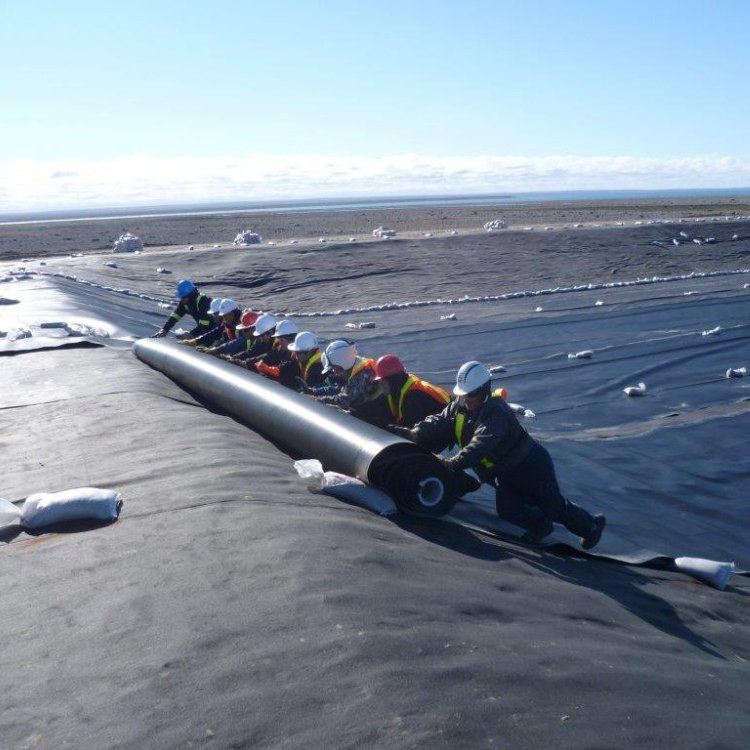
For driveways and roads, a recommended tensile strength is typically ≥50–100 kN/m. For patios or walkways, 20–40 kN/m is usually sufficient. For better durability, basis weight is commonly in the range of 200–400 g/m². The roll width should cover the full work area and allow an additional 30–50 cm for overlaps. Common widths are 3–6 m.
Tensile Strength
Understanding the Ratings
Pick up the spec sheet for a 200-pound geotextile and your eyes will land on the code ASTM D4632. The testing machine uses a clamp only 1 inch wide to grip a fabric sample measuring 4 inches wide by 8 inches long.
The machine pulls at a constant rate of 12 inches per minute. The number everyone advertises is simply the peak load recorded at the instant the polymer fibers rupture. That 200 pounds is not the carrying capacity of the whole roll. It is only the tearing limit at that 1-inch clamping area.
Some imported materials or commercial drawings use kN as the unit. 1 kN is roughly equal to 224.8 pounds. If an inspection sheet requires a minimum of 1.4 kN, then the purchasing list needs to specify a product with a 315-pound grab tensile strength, or the building inspector will not sign off on it.
Take a closer look at the fine print on the label and you will usually find two different values: MD and CD.
Woven geotextile is produced on a large loom with interlaced warp and weft tapes. MD refers to the tensile strength in the machine direction, running along the full 300-foot length of the roll. CD measures the cross-direction strength across the 12.5-foot roll width.
Cheap rolls often play games with this. The front of the packaging may boldly say “200 lb tensile strength,” but the fine print reveals that MD is 200 pounds while CD drops to only 120 pounds.
- Look for the abbreviation MARV on the packaging (Minimum Average Roll Value)
- Confirm that the difference between MD and CD is less than 20%
- Be cautious of labels that show only a single peak value
- Make sure the test standard clearly states ASTM D4632
If a testing agency randomly checks 10 rolls and 9 of them reach 210 pounds while only 1 barely reaches 200 pounds, the manufacturer can only print 200 as the MARV.
If there is no MARV listed, be careful with off-brand material. Some labels brag about a “Typical Value” of 300 pounds. But once you cut a piece from the roll and test it, the actual strength may not even reach 180 pounds. Under the weight of many tons of stone, it can tear open in several places almost instantly.
ASTM D4595 wide-width tensile testing is another industrial metric that often gets mixed into the civilian market. In that test, the machine grips a full 8-inch wide sample and pulls across the entire width. A fabric that achieves only 150 pounds in the D4632 grab test can easily produce an exaggerated number of more than 1,200 pounds per foot in a D4595 wide-width test.
- Products that use wide-width tensile data to disguise weak grab strength
- Materials that do not state the retained strength after 500 hours of UV exposure
- Products with no test report showing elongation below 15%
- Packaging that uses basis weight as the main selling point instead of lbs
Elongation is just as critical as tensile strength. When a 1-inch strip of woven fabric reaches 200 pounds just before failure, the amount it has stretched determines how many centimeters your newly built driveway may eventually sink.
High-quality polypropylene woven products keep elongation at peak load tightly limited to 15% or less. When a 10-ton box truck drives over the surface, the fabric below stays taut like a trampoline, and the surface experiences less than half an inch of elastic deflection.
Cheap material labeled 200 pounds but with elongation above 50% is already badly deformed long before the fibers actually break. By then, the gravel above has usually settled into wheel ruts several inches deep.
Using basis weight to judge tensile performance is another easy mistake. Some older round-yarn woven fabrics weighing 4 oz/yd² will fail at only 130 pounds in a grab test.
Switch to a modern slit-film woven product at the same 4 oz weight, and the tightly interwoven flat polypropylene tapes can easily push tensile strength up to 200 pounds. The weight is identical, but the real structural strength is almost doubled.
When a building supplier hands you a spec sheet, take a moment to visualize what the number really means. That 1-inch wide test clamp is trying to tear apart a narrow plastic woven strip using a force close to the suspended body weight of a grown adult.
Choosing the Right Strength
Last year in Ohio, a private driveway was rebuilt over highly saturated silty clay using woven fabric rated at only 150 pounds. After it was covered with 6 inches of #57 stone, a fully loaded concrete mixer truck weighing nearly 80,000 pounds drove onto it and the subgrade failed immediately.
On extremely soft ground with a CBR below 3, standard-grade fabric can easily be cut by the sharp edges of the aggregate. The soft mud below then rises upward by several millimeters per day. Within 3 months, the clean stone layer can be completely swallowed.
For a residential gravel driveway that only needs to support an ordinary Ford F-150, material tested at 200 pounds under ASTM D4632 is usually sufficient. With 4 to 6 inches of base aggregate underneath, the surface can remain free of noticeable rutting for 5 to 8 years.
A farm tractor yard is a completely different situation. Once axle loads exceed 18,000 pounds, the dynamic shear force at the surface is intense, and only heavy-duty polypropylene material rated at 315 pounds or more can handle it.
Different ground conditions require different tensile-performance thresholds:
- Dry sand or well-compacted hard ground: 120–150 pounds is enough for pedestrians or a light mower
- Mixed clay with seasonal standing water: the baseline should be raised to 200 pounds
- Marsh edges or peat soils: start at 250 pounds and use a double-layer installation
- Heavy loader access in gravel pits: use 315 pounds or higher without compromise
Choosing the right strength is only the first step. Overlap width at the seams has a major effect on how well the tensile force transfers across the system. On firm, level ground, overlapping adjacent sheets by 12 to 18 inches is usually enough to keep stresses moving smoothly across the seam.
On poor mud with low CBR, the overlap should be increased to 30 to 36 inches. If the two sheets are sewn together using a double-line lock stitch, the seam can retain roughly 60% to 80% of the parent fabric strength.
The size of the stone placed above the fabric also puts the material under serious tear stress. Crusher Run with a particle size of only about 0.75 inch and fines mixed in applies a relatively even load and produces very little localized puncture force.
But when you switch to #3 stone with pieces about 2 to 3 inches across, the sharp corners create severe point loads under pressure. Even for a simple backyard path, it is smart to step up to a stronger product rated at 250 pounds.
Repairing a failure caused by under-rated material is exhausting and expensive. Just excavating 50 tons of stone that has sunk into the mud, then hauling it away again with trucks and machinery, multiplies labor and equipment time almost immediately.
UV exposure also quietly damages polymer strength. If the job is delayed and the fabric sits exposed in direct sun for more than 500 hours, tensile strength typically drops by about 30%.
Warning signs that you need to upgrade the specified strength immediately:
- Even after removing 10 inches of topsoil, a shovel still pushes into the mud easily
- After just 0.5 inch of rainfall, standing water remains after 48 hours
- You expect frequent access by box trucks weighing more than 10 tons
In northern regions with more than 20 freeze-thaw cycles per year, freezing groundwater produces irregular upward heave. The fabric still needs to remain flexible and hold 200 pounds of tensile strength at temperatures as low as -20°F.
The grab-tensile test does not just look at the maximum load at failure. It also pays close attention to elongation. For woven geotextile, elongation at maximum load is generally limited to 15% or less so the surface does not distort badly.
Non-woven material of the same weight can easily stretch more than 50%. Even slight tension in the base can then crack a 4-inch asphalt layer above it. That is why a structural base must rely on the low-elongation nature of woven construction.
Width
Overlap Loss
Last month in Ohio, a crew installed 200-pound woven geotextile over a red clay subgrade with a CBR below 1.5, but they left only 30 cm of overlap. After one rain, a pickup weighing 2.5 tons drove over the freshly placed aggregate for half an hour, and the seams tore open completely.
Lateral movement in soft ground is far more aggressive than most people realize. AASHTO M288 makes it clear that when subgrade CBR is between 1 and 3, the overlap should never be less than 60 to 90 cm.
Settlement in muddy ground does not happen purely vertically. It comes with strong lateral tearing forces.
If you buy two rolls that are each 1.8 m wide to cover a standard single-lane driveway 3.5 m wide, and the center seam needs a mandatory 90 cm overlap, your final effective width is only 2.7 m. Once the exposed soil at the edges mixes with the 15 cm layer of 3/4-inch gravel above it, rutting begins very quickly.
Many clients assume it is fine to buy a slightly wider roll and trim the excess, but the real waste rate can be surprisingly high. On a roll 100 m long, if your cuts drift off by just 5 degrees, the error at the end of the roll can reach almost 8 m, creating dozens of square meters of unnecessary waste.
On large parking-lot projects, we rarely rely on simple overlapping alone because the overlap loss can reach 30%. Two workers with a handheld portable bag-closing machine and high-strength polyester thread can stitch the adjacent sheets together, reducing the overlap requirement from 90 cm to only 15 cm.
- The stitching thread must be UV-resistant; Kevlar or Teflon thread with at least 30 lb of tension capacity is usually recommended
- The seam should use a Type 401 double-thread chain stitch, so even if one thread breaks, the entire seam does not instantly fail
- A stitched seam can typically retain 70% to 90% of the parent fabric tensile strength, while ordinary overlap alone provides almost no real force transfer
Wind speed on installation day can also destroy your theoretical overlap area. Once wind speed exceeds 25 km/h, a sheet of fabric 15 m long behaves like a sail. Unless you drive a 15 cm U-pin into the overlap edge at about 1.5 m spacing, the overlap zones will shift out of alignment.
Never try to save money on pins. One hundred No. 11 steel U-pins cost less than USD 20, but they can protect hundreds of dollars’ worth of fabric from blowing loose.
Curved garden paths and circular driveways are a completely different calculation. To fit a curve with an inside radius of 3 m, a sheet 1.8 m wide needs a V-cut on the inside edge every 2 m, followed by a new overlap of about 30 cm.
French-drain wrapping is another place where people often underestimate fabric loss. A trench 40 cm wide and 60 cm deep has a bottom and side length totaling about 160 cm. Then the top still has to wrap over a perforated PVC pipe with a diameter of 10 cm, with at least 30 cm of overlap above it.
- The total fabric width for trench work usually needs to be at least 1.5 times the trench perimeter
- In soils with large amounts of silt finer than 0.05 mm, top overlap should be increased to 45 cm
- Never stretch the fabric too tightly; leave about 5% slack to accommodate stone settlement, or sharp aggregate edges may puncture it
When a fully loaded dump truck backs in and unloads 10 cubic yards of #57 stone, the steering force from the tires can be extremely destructive. If the tires happen to run directly over an overlap that is only 45 cm wide, the underlying mud can drag the fabric out of place almost instantly.
The safest approach is to make sure the tires always travel along the center of a single unseamed sheet.
Installation direction matters too. The fabric should be laid in the same direction as vehicle travel. The sheet installed later should overlap on top of the earlier sheet like roof shingles, with at least 50 cm of shingle-style coverage, so the dozer blade pushing the aggregate will not lift and roll the fabric edge upward.
On slopes, gravity also changes the overlap calculation. On a 3:1 slope, the fabric naturally slides downslope after installation. Each new sheet added upslope should therefore increase overlap to at least 1.2 m.
The anchorage at the top of the slope also carries major tension. Normally, a V-shaped anchor trench about 30 cm deep is cut at least 1 m back from the crest. The fabric edge is tucked in, backfilled with soil, and compacted. Otherwise, a rainstorm can drag the entire sheet downslope together with hundreds of pounds of stone.
Common Widths
Many people choose roll width by looking only at how wide the site is, but they forget how the roll will actually be handled and installed. A standard roll is usually 50 to 100 m long, and widths commonly range from 1 m to 5 m. The way it will be moved and unrolled should absolutely influence the choice.
A single roll 4 m wide and 100 m long usually weighs between 80 and 120 kg, which is difficult for two people to lift intact.
If the site is long and narrow—say a garden path 30 m long and 1 m wide—a roll 1 m or 1.5 m wide is actually easier to manage. One person can drag it into place, and cutting error is usually easy to keep within 10 cm.
But once roll width exceeds 3 m, even at the same length, unrolling usually requires two people working together. Otherwise, one edge starts drifting, and the installation becomes skewed. By the time you reach the end, the offset can exceed 0.5 m.
Once the fabric goes down crooked, the only fix is repeated trimming, and every trim increases waste.
The following sizes are commonly seen in real projects:
| Fabric Width (m) | Roll Length (m) | Typical Weight (kg) | Typical Use |
|---|---|---|---|
| 1.0 – 1.5 | 50 – 100 | 20 – 40 | Drainage trenches, pipe wrapping |
| 1.8 – 2.5 | 50 – 100 | 40 – 70 | Paths, patio paving |
| 3.0 – 4.5 | 50 – 100 | 70 – 130 | Driveways, parking areas |
| 5.0+ | 50 – 100 | 130+ | Large-scale engineering works |
As the table shows, every additional 1 m of width usually adds roughly 20 to 30 kg of weight, and field handling difficulty rises accordingly.
For a driveway, one practical rule is to keep the wheel path centered on a single sheet. A standard residential driveway is about 3 to 3.5 m wide. If you use fabric 3.6 m wide, the tires generally avoid running over a seam.
If you instead join two 2 m sheets, even with a 60 cm overlap, tires are much more likely to run repeatedly over the seam.
After several months of repeated wheel traffic, the difference at the seam becomes obvious.
Take another example: a parking pad 4 m wide and 20 m long. If you use a 4 m wide sheet, you cover the full width with no transverse seam, and only need 1 to 2 longitudinal connections. If you switch to 2 m wide fabric, you need two full strips, each overlapping the other by at least 60 cm. The effective width drops to about 3.4 m, and the edges usually need extra patching.
On a larger site—say 10 m wide by 50 m long—using 5 m wide rolls means only 2 strips. Using 2.5 m wide rolls means 4 strips.
As the number of strips increases, the number of seams doubles and alignment becomes much harder. Every additional strip introduces another opportunity for error, and the accumulated offset can eventually exceed 1 m.
The more strips you use, the harder it becomes to keep everything aligned by the end of the installation.
Some people assume wider fabric is always easier, but they overlook transport issues. Once roll width exceeds 4.5 m, it approaches transport limits in many places, and truck turning radius or site access width can become a real problem.
Once the roll arrives on site, moving a single roll that weighs more than 100 kg even just 10 m often requires 3 people. Obstacles such as trees, manholes, or posts also make wide fabric less efficient.
A sheet 4 m wide meeting a tree with a trunk diameter of 30 cm has to be cut open and wrapped around it, which effectively creates an extra seam. A roll only 1.8 m wide can often be installed on both sides of the obstacle instead, with much less trimming.
The more obstacles there are, the less advantage extra-wide fabric offers.
Curves create another issue. On a curved path with a radius of 5 m, the outside edge is about 1.5 m longer than the inside edge. If the fabric is 3 m wide, every 2 m of installation creates wrinkles.
The usual solution is to cut and re-overlap. That means each 2 m section creates an extra overlap of more than 30 cm. If you instead use fabric only 1.5 m wide, you can reduce the number of cuts by roughly half and keep seam control much easier.
On long installations, roll length also matters. A 100 m roll reduces the number of joints, but it is more likely to drift off line during installation.
Many crews actually prefer 50 m rolls because they can re-check the alignment after each section, keeping the final error within about 20 cm.
Long rolls reduce seams but are easier to misalign. Shorter rolls are easier to control, but they create more joints.
There is another small field detail worth noting: the edges of a roll usually include a compressed selvedge zone about 5 to 10 cm wide. This edge area is slightly stronger, but it should not be treated as the main load-bearing zone.
If the chosen width is too tight, this edge strip may end up carrying the main load at the side of the driveway, and over time it wears faster. That is why it is common to allow an extra 10% to 15% of width so the middle of the sheet carries the main load instead.
Project Type
Driveways & Roads
The dozer tracks strip away the vegetation and roots along the outside of the yard, excavating to a depth of roughly 8 to 12 inches. What comes out is usually a saturated clay layer. One shovel scoop can pull up more than a dozen thick earthworms. Experienced crews insist that the bottom of the excavation be graded flat, with a cross slope of about 2%, so future runoff drains toward both sides.
During the May rainy season, an untreated muddy excavation can hold more than 3 inches of standing water within just 2 days. The soft slurry can consume gravel at a rate of about 1.5 tons per year, slowly turning one truckload after another of expensive aggregate into buried fill. To stop the unstable subgrade below, the crew rolls out polypropylene woven geotextile with a tensile strength of 200 pounds in the direction of the driveway.
The black surface reflects light slightly under strong sun, and the interwoven grid pattern is easy to see. A standard roll width is about 12.5 feet, which is just enough to cover a standard one-lane driveway with a little extra on both sides. Where a curve must be cut, or where two rolls need to be joined end to end, overlap must never be less than 18 inches.
One installer likes to drive a 6-inch long No. 11 steel U-pin every 3 feet, so even a strong wind does not shift the edge. When a heavily loaded pickup rolls over the surface, the woven sheet immediately tensions up and spreads the tire pressure—up to 60 PSI—across about 4 square feet of subgrade.
Several details during installation must be watched closely:
- Remove any sharp roots longer than 2 inches from the trench bottom
- Pull the fabric tight enough to maintain roughly 20 pounds of tension
- At seams, overlap in the downslope direction like shingles
- At corners, cut and fold rather than forcing the fabric to twist
The first layer placed is large #3 stone roughly the size of golf balls. A fully loaded dump truck weighing about 15 tons must never drive onto exposed fabric. It must reverse and unload onto a previously covered area. Then a small skid steer pushes the large aggregate forward, leveling it to a thickness of about 4 to 6 inches. The machine’s metal tracks produce a deep rattling noise as they pass over the stone.
Water falling on the woven fabric takes about 3 to 5 seconds to seep through. The flow rate is deliberately limited to around 4 to 6 gallons per minute per square foot. It is not there to handle drainage. Its only job is to keep clay particles smaller than 0.075 mm from rising into the aggregate. Once those fines contaminate the voids in the stone layer, the entire road will turn into thick soup after the first major snowmelt.
The second layer is standard #57 stone, with particles ranging from roughly 1 to 1.5 inches. It is also placed at a thickness of about 4 inches. Those smaller stones fill the large voids left by the coarse base. A double-drum vibratory roller then makes 4 steady passes, locking the upper and lower aggregate layers together like a zipper.
Compaction control is strict:
- The vibratory roller should weigh at least 3 tons
- Rolling speed should stay below 2 mph
- A water truck should spray about 20 gallons of water in advance to dampen the stone
- Dead zones near the edges must be compacted by hand with a tamping machine
The final layer is usually a 2-inch layer of Crusher Run. The fine stone dust locks together after exposure to dew and rain, almost like cement. Surface hardness testing can reach more than CBR 80%, and even a heavy garbage truck with a wheel load of 4,000 pounds leaves virtually no rutting—certainly less than half an inch.
Over the next 15 years, a surface that might otherwise settle by about 2 inches per year often ends up dropping by less than 0.2 inch. A neighbor’s driveway built without fabric may need two full truckloads of new stone every 2 years, costing about USD 800 each time. That single roll of polypropylene fabric costing about USD 150 quietly saves at least USD 4,000 in maintenance over the next decade. :contentReference[oaicite:0]{index=0}
Heavy-Duty Parking & Pads
Parking a 35-foot Class A motorhome or a tracked tractor weighing 14,000 pounds is a disaster for ordinary backyard soil. Once the excavator digs out a pit about 14 inches deep, the black topsoil mixed with coarse roots is removed, revealing a soft yellow clay layer with moisture content above 20%.
A motorhome tire often contacts less than half a square foot of ground, yet applies nearly 80 PSI of pressure. If no separation layer is installed, just two storms with 3 inches of rain can let the 6-ton rear axle create ruts about 8 inches deep.
The crew pulls a heavy woven roll from the back of a pickup. The material weighs about 85 pounds and has a rated tensile strength above 315 pounds. The black woven surface, roughly 12.5 feet wide when unrolled, feels even tougher than heavy backpack canvas, and its flow rate is limited to about 4 gallons per minute.
Four workers stretch the sheet across the excavated rectangle and fold the edges up about 18 inches along the sides. At seams between two rolls, the overlap is never less than 24 inches to prevent the sheets from being pulled apart under high load.
Several steps during installation cannot be done carelessly:
- Drive a hardened No. 11 steel pin every 1.5 feet
- Any depression deeper than 3 inches must first be filled and leveled with sand
- At corners, use a Z-fold method to tighten excess fabric
- Temporarily weigh down the folded edge with bricks to resist wind
The first truck delivers coarse stone with a size of roughly 2 to 3 inches. A fully loaded 22-ton truck is never allowed to enter the excavation. Instead, a skid steer places the stone over the fabric lift by lift, until the first coarse layer reaches a compacted thickness of at least 8 inches.
The sharp stone edges bite into the high-strength polypropylene network. Even when the skid steer backs up with a full bucket and generates several thousand pounds of lateral force, the woven fabric holds steady. The intense point loads from the tires are immediately transferred across nearly 10 square feet of surrounding area.
| Load Condition | Point Pressure (PSI) | Base Settlement (inches) | Annual Aggregate Loss |
|---|---|---|---|
| Bare subgrade without fabric | 85 | 6.5 | 15% |
| With 315-lb heavy-duty fabric | 12 | 0.4 | < 1% |
After the coarse base is compacted, another 4 to 6 inches of #57 stone or mixed aggregate with fines is placed above it. A 5-ton double-drum roller then runs in high-vibration mode for 6 passes across the full 40-foot parking pad, driving the air out of the voids.
The full installation takes about 3 days and uses nearly 24 tons of aggregate. The black woven fabric at the bottom permanently separates the damp clay below from the expensive stone above. Even when the groundwater rises by 2 feet in spring, the slurry below cannot break into the dense stone layer above.
Retaining Walls & Riprap
An excavator cuts a trench about 24 inches deep into the riverbank slope. The slope is trimmed to a 3:1 angle, dropping 1 foot vertically for every 3 feet horizontally. The exposed yellow-brown clay smells damp, and broken willow roots about 2 inches thick still hang from the soil face.
If as little as 0.5 inch of rain falls the next day, muddy runoff immediately begins streaming down the slope. Under a flow velocity of about 5 ft/s, the soil can erode at a rate of roughly 20 pounds per day. Once the foundation is lost, the riprap stones weighing hundreds of pounds eventually roll into the water.
The crew unrolls a heavy-duty woven geotextile 15 feet wide from the top of the slope, following the direction of the flow. The black material is rated at about 300 pounds of puncture resistance, with a rough textured surface that feels almost like sandpaper. At the top, at least 3 feet of extra fabric is buried back into the flat ground above the slope.
The fabric should never be stretched tight like a drum over a slope. It needs about 5% slack so it can conform to the irregular surface. Fixing it on a slope is far more demanding than on level ground:
- Use heavy-duty U-pins at least 10 inches long
- Install one every 2 feet
- At the toe, where water is most aggressive, tighten spacing to 1 foot
- At overlaps, never go below 24 inches
In a riprap job, the stone size is enormous. An 18-wheel truck may bring in 20 tons of rock, with individual stones about 8 to 15 inches across and weighing 40 to 80 pounds. The excavator must never drop them from any height onto the fabric. A single heavy impact can tear a slit roughly 1 foot long.
Instead, the operator uses a grapple to place each stone gently from a height of less than 0.5 foot. The first course is a base layer of large stones about 12 inches thick. Each base stone weighs more than 100 pounds, anchoring the lower edge of the fabric. The rock edges are sharp like blades, but the high-strength woven surface resists several tons of abrasion.
Cloudy runoff may still seep down through the rock voids by the gallon, but the black woven openings are only about 0.4 mm wide, so the soil stays behind the fabric. Flow rate remains only about 3 gallons per minute, and not even a trace of sediment escapes into the river.
Now shift to a 40-foot long retaining wall trench in the backyard. The trench bottom has already been compacted with a heavy plate compactor for 6 passes, and the soil is now so firm that a shovel cannot penetrate more than 0.5 inch. A strip of geotextile about 4 feet wide is laid along the base, with the edges folded upward about 15 inches on both sides.
Next, about 6 inches of #57 stone is placed on top as the drainage base. Concrete wall blocks weighing around 80 pounds each are stacked course by course. At least two-thirds of the first course must remain buried below grade. As the wall rises, more crushed stone is placed behind it.
The wrapping behind the wall must be handled carefully:
- The bottom fabric must wrap fully around the drainage stone with no open gaps
- For every 12 inches of wall height, backfill one new lift of coarse stone
- The fabric should remain tight against the soil side to prevent particle mixing
- Leave about 6 inches of topsoil space at the top for finish grade
- The final closure must be overlapped and sealed tightly, almost like wrapping a dumpling
The soil behind the wall can develop enormous hydrostatic pressure. After a heavy rain, the lateral force can exceed 200 pounds per square foot. Without this separation layer, the soft fines behind the wall can clog every void in the stone within just 2 weeks. Once the drainage path is lost, the wall can lean outward by more than 3 degrees.


Leave a reply