

When choosing materials for drainage engineering, Non-Woven Geotextile is an excellent choice, while Woven Geotextile is generally not recommended for drainage.
Non-Woven Geotextile (Preferred for Drainage): Manufactured using a needle-punching process, its structure is similar to a sponge, possessing a very high Apparent Opening Size (usually $0.07-0.2$ mm) and Permittivity.
While allowing water to pass through rapidly, it effectively intercepts tiny soil particles, preventing drainage systems (such as French drains or the back of retaining walls) from clogging.
Woven Geotextile (Preferred for Reinforcement): As dense as a woven bag, although its tensile strength is extremely high (reaching over $50$ kN/m), its water permeability is poor and it is easily blocked by fine silt and sand.
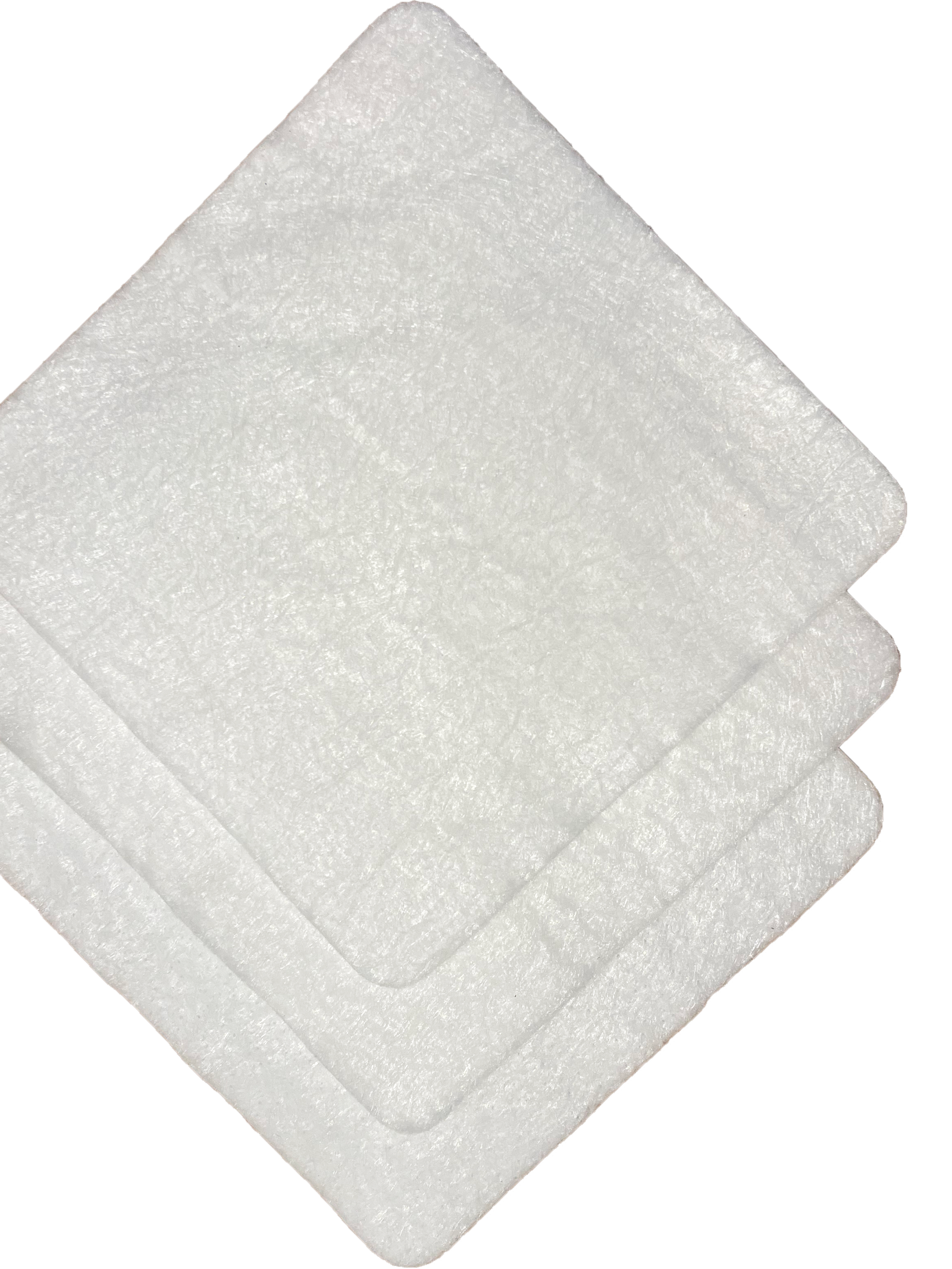
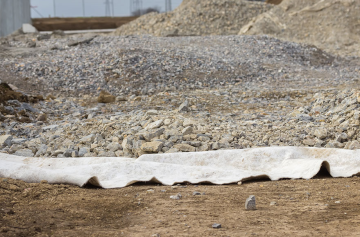
Non Woven Geotextile Fabric
Non-Woven Geotextile is usually made of polypropylene (PP) fibers through a needle-punching process, with a three-dimensional pore structure similar to wool felt. Its parameters lie in the Apparent Opening Size (O95) typically being between 0.075mm and 0.212mm, which allows its Permittivity to reach up to 3.5s⁻¹.
In contrast, its Grab Tensile Strength is generally in the range of 0.5kN to 3kN, primarily responsible for filtration, drainage, and separation, rather than bearing high-intensity tension.
Filtration and Drainage
Under the fluid dynamics standard ASTM D4491, Filtration refers to the process of water flow passing vertically through the plane of the non-woven geotextile. The three-dimensional fiber structure of needle-punched non-woven fabric forms a complex tortuous path, and its Apparent Opening Size (AOS) is typically stable between 0.150mm and 0.212mm. This structure can intercept more than 95% of soil particles of a specific grain size while maintaining minimal head loss.
When the water flow direction is parallel to the fabric surface, its function shifts to Drainage, also known as in-plane transmissivity. High-weight non-woven fabrics with a thickness of 2.0mm to 3.5mm (such as 8 oz/yd²) possess significant lateral Transmissivity. Under pressure, its internal voids can still maintain a water conduction capacity of 0.0001 m²/s, guiding accumulated water to the collection pipe network.
The performance of this material under compressed conditions varies significantly; here are the physical property parameters for the two functions:
- Permittivity: Common specifications are usually between 1.5s⁻¹ and 2.2s⁻¹, ensuring that the surface water infiltration rate during heavy rain is not less than 50 gallows/min/ft².
- Retention: The fiber layer is capable of capturing fine sand above 0.075mm (No. 200 sieve), preventing it from entering the gravel drainage layer and causing structural siltation.
- Gradient Ratio: In laboratory tests, the gradient ratio of qualified non-woven fabrics should be less than 3.0, indicating that soil particles will not form a dense mud cake layer at the fabric interface.
- Drainage Thickness: As the load increases to 200 kPa, the drainage space of the non-woven fabric compresses by about 40%, so heavy-duty specifications above 10 oz/yd² must be selected for the back of high retaining walls.
Filtration function relies on the geometric constraints of the pores, while drainage function relies on the redundant space between fibers. In French drain projects for North American residences, a 4 oz/yd² lightweight non-woven fabric is sufficient for filtration needs.
However, in edge drains for highway subgrades, thicker and more porous materials must be used to handle lateral inflow rates as high as 3000 liters/minute/square meter.
Physical experiments show that when the fine powder content in the soil exceeds 15%, the thickness of the filtration layer determines the anti-clogging capacity. The fiber layer generated by the needle-punching process provides an initial porosity of over 85%.
Even if some pores on the surface layer are filled with tiny clay particles, the internal deep-level three-dimensional channels can still maintain water flow. This characteristic is particularly intuitive in the protection of weep holes in gravity Retaining Walls.
The following are engineering standard data that must be referenced when evaluating filtration and drainage selection:
- Pore Size Consistency: The needle-punching process ensures thousands of tiny channels per square inch, with the Coefficient of Variation (CV) typically controlled within 10%.
- Biological Clogging Resistance: Polypropylene material does not absorb water, and its low surface energy characteristics inhibit the attachment of underground microflora and algae, maintaining long-term water permeability.
- Dynamic Head Loading: Under a dynamic water flow impact with a frequency of 1Hz, the pore size drift rate of high-strength non-woven fabric is less than 5%, ensuring drainage stability under extreme weather.
- Shear Strength Impact: Even when laid on a 30-degree slope, the interface friction angle between non-woven fabric and soil can usually reach 25 to 28 degrees, preventing soil slippage due to drainage and venting.
Compared to the single-plane holes of woven fabric, the non-linear channels of non-woven fabric can effectively dissipate the kinetic energy of water flow. This reduces the erosive force of water flow on the soil surface, making it more likely for small particles to remain suspended in the water rather than being forced into the interior of the fabric. In high groundwater table areas, this microscopic buffering mechanism can extend the life of the entire underground pipe network by more than 20 years.
For areas with high rainfall, the failure of drainage systems is often not due to pipe breakage but because the filtration layer is completely sealed by sub-micron clay powder. Non-woven fabric, through its unique deep-layer filtration mechanism, expands the interception point from a single two-dimensional plane to the entire thickness of the fabric. This depth effect allows the material to retain more than 30% of its initial flow cross-section even when encountering high-turbidity groundwater.
Performance Index Comparison
When evaluating water permeability under the ASTM D4491 standard, Non-Woven Geotextile materials typically specified at 4 oz/yd² can reach a water flow rate of 140 gpm/ft² (approx. 5700 L/min/m²). This high flow rate ensures that under heavy rain wash, water can quickly pass through the fabric into the drainage aggregate layer, effectively preventing surface water accumulation.
The water permeability of Woven Geotextile is usually lower than 30 gpm/ft², discharging water mainly through regular weaving pores. When soil particle size is smaller than 0.075mm, woven materials are extremely prone to pore clogging. Experimental data shows that the non-woven three-dimensional fiber structure can maintain more than 85% of its initial pore permeability during the filtration process.
Grab Tensile Strength measures the maximum load the material can carry before breaking. The strength of 8 oz/yd² heavy-duty non-woven fabric is usually around 205 lbs (912 N). However, woven fabric of the same weight often reaches strengths exceeding 315 lbs (1400 N) due to the directional arrangement of its filaments or film tapes.
This difference in strength determines the role of materials in different projects. Specific parameter comparisons can be found in the table below:
| Performance Parameter | 4 oz/yd² Non-Woven | 8 oz/yd² Non-Woven | 200 lb Woven | Engineering Reference Standard |
|---|---|---|---|---|
| Grab Elongation | 50% – 60% | 50% – 70% | 15% – 20% | ASTM D4632 |
| CBR Puncture Strength | 310 lbs | 535 lbs | 900 lbs | ASTM D6241 |
| Apparent Opening Size (AOS) | 70 US Sieve | 80 US Sieve | 40 US Sieve | ASTM D4751 |
| UV Resistance (500h) | 70% Strength Retention | 70% Strength Retention | 70% Strength Retention | ASTM D4355 |
In the event of irregular backfill stones or localized ground settlement, an elongation of >50% allows the fabric to conform to terrain changes. Under the North American ASTM D4751 standard, Apparent Opening Size (AOS) is the primary parameter for measuring the screening capability of non-woven geotextiles.
For common specifications such as 4 oz/yd² non-woven fabric, the AOS is typically 0.212mm (No. 70 sieve), which can effectively block fine sand from entering. For soils with high clay content, heavy-duty materials with an AOS of 0.150mm (No. 100 sieve) should be selected to prevent the loss of tiny particles.
Permittivity determines the amount of water passing through the fabric per unit time. Needle-punched non-woven fabric under 50mm head pressure typically has a water permeability between 1.5s⁻¹ and 3.5s⁻¹. It can release 95 to 145 gallons of water per minute per square foot. In comparison, the water permeability of ordinary woven fabric is often lower than 0.05s⁻¹.
The following table lists the physical parameter comparison of three main types of non-woven geotextiles in compressed and non-compressed states:
| Metric Item | Lightweight (3-4 oz) | Medium Weight (6-8 oz) | Heavy-Duty Industrial (10-16 oz) | Industry Test Standard |
|---|---|---|---|---|
| Grab Tensile Strength | 400 – 550 N | 700 – 1000 N | 1100 – 1700 N | ASTM D4632 |
| Trapezoidal Tear Strength | 180 – 220 N | 280 – 400 N | 450 – 650 N | ASTM D4533 |
| CBR Puncture Strength | 1.2 – 1.5 kN | 2.1 – 2.8 kN | 3.3 – 5.0 kN | ASTM D6241 |
| Flow Rate (@ 50mm) | 5500 – 6500 L/min/m² | 3500 – 4500 L/min/m² | 2500 – 3200 L/min/m² | ASTM D4491 |
CBR Puncture Strength determines the damage resistance of non-woven fabric when in contact with coarse gravel (such as #57 Stone). For road bases, a puncture force of over 250 lbs (approx. 1.1 kN) is usually required. Medium-weight fabrics with a thickness of 2.5mm can produce a deformation of 50% to 80% without puncturing when squeezed by stone corners due to the high elongation of their fibers.
Weather resistance is mainly measured by the UV degradation rate. Under the North American ASTM D4355 standard, qualified polypropylene non-woven fabrics must have a strength retention rate higher than 70% after 500 hours of exposure.
On construction sites, the exposure time after unpacking should generally not exceed 14 days. This chemical stability can be maintained for more than 50 years in soils with pH values between 2 and 13.
In addition to vertical penetration, Transmissivity is also important. When the weight of the non-woven fabric increases to over 300g/㎡, the lateral voids between its internal fibers can form miniature drainage channels. At a gradient pressure of 1.0, the lateral drainage capacity is usually around 0.0001 m²/s. This plays a major role in diversion in retaining wall drainage layers or roof greening drainage systems.
The following are three quantitative data points regarding performance changes under installation loads:
- Compression Deformation Rate: Under a normal working pressure of 20 kPa, the thickness of needle-punched non-woven fabric typically compresses by 30%, leading to a decrease in its water permeability of about 15%.
- Biological Resistance: Since polypropylene is a non-biodegradable material, in farmland drainage rich in nutrient salts, the growth rate of biofilm on its fiber surface is much lower than 0.05 mm/year.
- Pore Size Consistency (AOS Variation): The AOS Coefficient of Variation (CV) of high-quality needle-punched fabric should be controlled within 5.5%, ensuring uniform filtration effects throughout the entire section.
Tensile modulus is not a primary performance indicator for non-woven fabrics; its break elongation is typically set at over 50%. This characteristic allows non-woven fabrics to stretch like rubber when dealing with uneven settlement (such as soft soil embankments), without undergoing brittle fracture like low-elongation woven fabrics.
In the balance of fluid dynamics parameters, although 8 oz/yd² heavy-duty fabric has a smaller pore size (0.180mm) to intercept finer impurities, its flow rate will also drop from 145 gpm/ft² for lightweight fabric to around 90 gpm/ft². Designers must calculate the best matching weight specification based on Darcy’s Law and the total site precipitation.
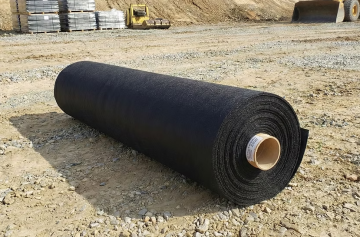
Woven Geotextile Fabric
Woven Geotextile is an industrial fabric made of polypropylene (PP) strips interlaced on a loom. Its performance lies in high strength and low elongation: grab tensile strength is usually between 200 lbs and 1000 lbs, while the break elongation remains below 15%. Due to its tight structure, the Apparent Opening Size (AOS) is mostly distributed between 40-70 US Mesh, and the water Permittivity is usually lower than 0.05 sec⁻¹.
This makes it perform excellently in subgrade reinforcement and heavy-duty support, but limited in filtration systems requiring high-speed drainage.
Three Functions
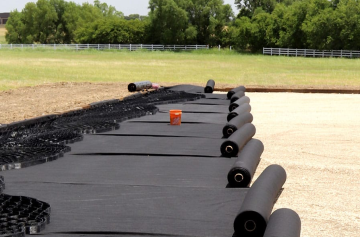
Due to the use of high-modulus polypropylene (PP) monofilament or slit-film tape weaving, this material exhibits extremely high rigidity when loaded. In subgrade engineering, it can effectively prevent gravel layer particles from being squeezed down into weak soil layers, maintaining the design thickness of the base layer at 15cm-30cm without dilution.
This physical separation significantly enhances the Load Capacity Ratio (LCR) of the road, preventing premature failure of the pavement structure even on extremely soft soil bases with California Bearing Ratio CBR < 3%.
- Separation Efficiency: Capable of blocking over 95% of silt and sand particles with a diameter greater than 0.15mm from migrating upward.
- Structural Retention: Maintains aggregate modulus, reducing gravel layer thickness loss due to soil mixing by up to 50%.
- Application Standard: Complies with AASHTO M288 Level 1, 2, or 3 separation technical specifications.
- Acid and Alkali Resistance: Within the range of pH 2 to pH 13, physical strength retention exceeds 90%.
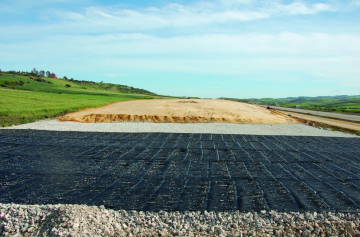
This interlaced structure has significant advantages in tensile modulus, usually triggering extremely high tensile resistance at 2% to 5% elongation. In steep slope reinforcement or retaining wall backfill, woven fabric can withstand long-term design tensile strengths of 2000 lbs/ft to 5000 lbs/ft. By offsetting the lateral pressure generated by the soil’s self-weight through lateral anchoring force, the material transforms an originally unstable soil pile into a self-stabilizing reinforced soil structure.
- Tensile Performance: Grab Tensile strength ranges typically from 200 lbs to 400 lbs (ASTM D4632).
- Extremely Low Extension: Break elongation is controlled within 12% – 15%, much lower than the 50% of non-woven fabric.
- Puncture Protection: CBR Puncture strength can reach 1000 lbs, sufficient to resist penetration by sharp stones.
UV Protection
In 500-hour Xenon Arc under North American AASHTO M288 engineering standards, when the subgrade California Bearing Ratio CBR value is lower than 3, the gravel base layer will quickly sink into the soft soil due to uneven earth pressure. Laying a layer of woven fabric with a 200 lbs grab tensile strength can establish a physical barrier, preventing the loss of aggregates over 2.5 inches and keeping the base layer thickness constant.
- Effectively stops tiny soil particles below 75μm (No. 200 sieve) from entering the upper graded gravel layer.
- Converts the vertical load of the pavement into horizontal tension along the fabric plane, reducing ground stress by 40%.
- In saturated soil environments, maintains base layer compaction at over 95%, preventing the occurrence of pumping phenomena.
This physical separation is not just static; Woven Geotextile‘s low elongation (typically 12% – 15%) can quickly lock soil particle displacement when heavy vehicles pass by. This “membrane effect” can offset uneven settlement of the foundation.
According to ASTM D4632 laboratory data, high-specification woven fabrics can have a Trapezoidal Tear strength of over 120 lbs, far exceeding ordinary non-woven fabrics. In temporary construction road (Haul Roads) applications, adding a layer of woven fabric can reduce gravel fill volume by 30% – 50%. This reinforcement capability is equally effective in slope stability protection, providing a long-term ultimate tensile force of over 4000 lb/ft.
| Reinforcement Parameter Index | Standard Test Method | Typical Value (Class 1 Woven) |
|---|---|---|
| Initial Modulus (2% Secant Modulus) | ASTM D4595 | 35,000 lbs/ft |
| Ultimate Tensile Strength | ASTM D4595 | 4,800 lbs/ft |
| CBR Puncture Strength | ASTM D6241 | 900 lbs (4000 N) |
Although its permeability is low, it serves to limit soil loss in coastal engineering and under Rip Rap breakwaters. By precisely controlling the Apparent Opening Size (AOS) near 0.425 mm (No. 40 sieve), water can slowly pass through, but most load-bearing soil particles will be intercepted behind the fabric.
- Utilizes the high porosity design of Monofilament woven fabric to reduce erosion caused by wave wash.
- In dam bases, interrupts piping phenomena caused by head differences, protecting fine sand grains.
- For chemical environments from pH 2 to 13, its polymer molecular chains exhibit extreme biological inertness.
When the project involves retaining walls (MSE Walls), woven geotextile acts both as a tie-bar to provide structural stability and to prevent backfill material from leaking through gaps. Typically, large-width rolls of 12.5 feet or 17.5 feet are selected to reduce material waste in overlapping parts and ensure stable performance at environmental temperatures from -30°C to 70°C.
Not Suitable for Drainage Filtration
The geometric structure of woven geotextile determines its inherent limitations in hydraulic performance. Its woven layer is interlaced from flat polypropylene strips (Slit Film), presenting a closed two-dimensional plane under a microscope. This structure leads to a Percent Open Area (POA) typically only 1% to 4%, and while monofilament woven fabric is slightly higher, it is still difficult to achieve the over 30% porosity formed by the three-dimensional random fibers of non-woven fabric.
- Low Permittivity: According to ASTM D4491 testing, the flow rate of woven fabric is often lower than 5 gpm/ft².
- Two-Dimensional Blocking Effect: Once fine particles (such as silt below 75μm) cover the surface, they will quickly seal the very few water channels.
- Lack of Lateral Drainage Capacity: The material lacks thickness (typically < 0.5 mm) and cannot conduct flow within the fabric plane like non-woven fabric.
When water flow tries to pass through the tight warp and weft weave lines, pressure quickly builds up on one side of the fabric, leading to a rise in local water pressure. In French Drains or underground retaining wall drainage systems, this pressure accumulation can destroy the effective stress of the soil and even cause foundation liquefaction. According to North American pavement engineering specifications, the permeability coefficient of the drainage layer must be at least 10 times that of the surrounding soil, a ratio that woven fabric often fails to meet.
Experimental data shows that under a normal pressure of 20 psi, the Apparent Opening Size (AOS) of woven geotextile will further shrink due to fiber extrusion, sharply reducing the original 0.425 mm pores to below 0.3 mm, which easily triggers severe clogging risks.
When silt and clay particles in the soil are moved to the fabric surface by water flow, because woven fabric lacks deep filtration space, these particles will become embedded in the weaving gaps. Once mechanical clogging occurs, the Transmissivity of the system will drop exponentially, eventually causing the entire drain to fail, leading to moisture retention within structural layers causing frost damage or pavement pumping.
- Permeability Coefficient Comparison: Non-woven fabric is typically 0.2 cm/sec, while slit-film woven is often lower than 0.01 cm/sec.
- Biological Clogging Risk: Flat strip surfaces easily attach biofilms, and in environments with pH values higher than 9, chemical precipitates will quickly close pores.
- Pore Size Non-Uniformity: The weaving process may lead to excessively large local pore sizes, causing Piping and the loss of over 15% of fine materials.
Due to the lack of a three-dimensional pore matrix, woven geotextile cannot provide an effective Soil Arching effect. In an ideal filtration layer, larger soil particles should be intercepted to form a natural filter layer that allows extremely fine particles to pass through while retaining the skeleton. The two-dimensional planar structure of woven fabric intercepts particles of all sizes, leading to the formation of a high-density “mud cake” about 1-2 mm thick on the back of the fabric, turning the originally designed drainage interface into a completely impermeable membrane.
In engineering designs involving the AASHTO M288 standard, if the goal is to control groundwater levels or wrap porous drainage pipes, the code clearly recommends using filament needle-punched non-woven geotextile with a more matching Apparent Opening Size (EOS) to ensure the drainage system does not clog within its 50-year design life.
When runoff from rainfall reaches a peak of 50 gpm/ft², the flow-limiting effect of woven fabric will cause water flow to seek the path of least resistance, often bypassing the drainage layer and instead scouring the road base or building foundations. This scouring can carry away 10% to 20% of the foundation’s load-bearing soil, triggering severe settlement deformation or ground collapse, completely contradicting the original intention of installing the geotextile.
| Drainage Performance Comparison | Slit Film Woven | Non-Woven |
|---|---|---|
| Porosity | < 5% | 55% – 80% |
| Flow Rate | 4 – 10 gpm/ft² | 90 – 150 gpm/ft² |
| Clogging potential | High | Low |
| Filter Depth | 2D Plane (0.3mm) | 3D Structure (1.5mm – 3mm) |
In actual North American construction sites, if an engineer finds a contractor incorrectly wrapping black woven fabric around drainage pipes, they will usually demand a work stoppage and rework. This is because woven fabric’s break elongation is extremely low; when subjected to soil compaction loads, sharp stones (such as 3/4″ gravel) will produce point-to-point pressure. Since the material cannot disperse pressure through deformation, the pores on its surface will be locally squeezed shut, further worsening the Permeability.
Selection Recommendation
Choosing geotextiles requires quantifying Apparent Opening Size (O95) and Permeability. For drainage projects, the Permittivity of Non-Woven Geotextile usually needs to reach $10^{-1}$ to $10^{-2}$ cm/s, and its O95 pore size should be controlled between 0.075 – 0.2 mm to match the ASTM D4751 standard. If used for foundation reinforcement, Tensile Strength must be prioritized, as the modulus performance of woven fabric at 2% – 5% elongation is far superior to that of non-woven fabric.
Flow Rate and Particles
When evaluating drainage systems, the matching of Apparent Opening Size (O95) with Soil Particle Size Distribution (PSD) determines long-term permeability stability. The O95 defined by the ASTM D4751 standard represents the maximum pore size through which 95% of particles cannot pass. For soils containing more than 50% fine silt, the pore size of non-woven geotextile needs to be controlled between 0.15mm – 0.212mm to establish a natural filter layer.
High flow rate conditions such as French Drains rely on the material’s Permittivity. The porosity of needle-punched non-woven fabric is typically between 85% and 91%, allowing it to maintain a flow of 100 – 150 gpm/ft² under 50mm head pressure. If the flow rate exceeds 0.02 cm/s, slit-film woven fabric will cause fluid obstruction and generate hydrostatic pressure due to its effective open area of only 1% – 4%.
- Sand: Select non-woven fabric with O95 < 0.297mm (50 mesh) to ensure particles form a skeleton at the interface.
- Clay: Use high-specification materials with permeability > 1.5 sec⁻¹ to prevent clay particles from settling and blocking pores.
- Silt: Prioritize needle-punched fabric with a thickness over 2mm to increase internal particle storage space.
- Graded Stone: Use a fabric layer with a flow rate over 140 gpm/ft² at the stone and soil interface to isolate different particle sizes.
- Heavy-Duty Construction Subgrade: Lay woven fabric with 315lb tensile strength on cohesive soil to reinforce via modulus at 3% elongation.
- Roof Greening: Adopt 140g/m² specification non-woven fabric, with permeability greater than extreme precipitation of 300mm per hour.
In drainage trenches, if soil $d_{85} \ge 0.15mm$, then $O_{95}$ should be less than $2 \times d_{85}$ to prevent particle loss. For extremely fine powder soils, this ratio is usually tightened to $O_{95} \le d_{85}$.
When the flow field is in a turbulent state, such as under Rip-Rap, the geotextile must possess a break elongation of over 50%. High ductility allows the material to fit closely to the soil contours under the heavy pressure of 24″ blocks. Woven fabric often tears at sharp edges under equivalent stress due to a lack of flexibility.
In the drainage layer behind retaining walls, the Hydraulic Gradient is usually set around 1.0. The three-dimensional pore structure of Needle-Punched non-woven fabric can still maintain a water conductivity of 0.3 cm/s under a vertical pressure of 20 psi. Slit-film woven fabric will have its flow channels narrowed under this pressure as woven pores deform and close.
- Vertical Interceptor Drainage: In Interceptor Drains, select 6 oz/yd² non-woven fabric to ensure water enters the pipe laterally.
- Sports Field Subgrade: Lay geotextile with permeability up to 1.8 sec⁻¹, combined with a 0.5% to 1% slope, to keep the field dry within one hour after heavy rain.
- Bridge Abutment Backfill: Must use high UV-resistant 8 oz non-woven fabric to resist UV exposure intensity for over 500 hours during the construction period.
- Airport Runway Edge Drainage: Selection must meet AASHTO M288 Class 2 strength to handle puncture loads over 160 lbs.
In soil environments containing high concentrations of chemicals or salts, PP material remains stable in the range of pH 2 to pH 13, suitable for leachate collection systems in landfills.
When the content of fine particles (less than 0.075mm) in the soil exceeds 15%, the Gradient Ratio of the filtration layer should be less than 3. Choosing inferior fabric with non-uniform openings will lead to physical clogging of the channels in the first rainy season. Data shows that the AOS index deviation of high-quality needle-punched non-woven fabric is usually less than 5%.
- Basement Wall Waterproofing: Wrap 100g/m² non-woven fabric on the outside of the drainage board to prevent fine mud from filling the spaces between the board’s protrusions.
- Paving Stone Subgrade: Lay low-elongation woven fabric under a 1/4″ gravel layer to maintain a pavement subgrade modulus of 15,000 psi.
- Soakaways: Use non-woven fabric with vertical permeability up to 0.2 cm/s to handle instantaneous peaks of 50 liters/minute per square meter.
Since the Thickness of non-woven fabric is usually between 1.5mm – 4.5mm, it has unique advantages in lateral conduction (Transmissivity). Compared to woven fabric with a thickness of only about 0.5mm, non-woven fabric can act as an independent in-plane micro-drainage channel in a non-compressed state.
Common Application Scenarios
In the typical configuration of French Drains, 4 oz/yd² needle-punched non-woven geotextile is the standard selection. This material wraps around 1.5-inch clean stone, with its Permittivity typically reaching 2.0 sec⁻¹. Due to its three-dimensional pore structure, it can maintain a flow rate of 120 gpm/ft² even under 2,000 psf of soil pressure, preventing fine silt from clogging pipe wall holes.
For Retaining Walls, for walls exceeding 4 feet in height, it is recommended to use 6 oz/yd² or 8 oz/yd² heavy-duty non-woven fabric. This specification’s CBR Puncture strength reaches 450 lbs – 600 lbs, resisting the sharp mechanical stress generated by angular gravel during compaction.
- Paver Patios: Lay woven fabric with 200 lbs tensile strength under a 4-inch gravel layer. This can enhance the CBR (California Bearing Ratio) of the base, preventing 2-inch thick paving stones from shifting due to soil softening.
- Driveways: Woven fabric with 315 lbs tensile strength must be selected as a separation layer. Its modulus at 5% elongation effectively disperses vehicle loads, reducing settlement risk by 70%.
- Rain Gardens: Choose lightweight non-woven fabric with an O95 pore size of 0.18mm. This material allows water to infiltrate vertically at a rate of 140 gallons per minute while intercepting organic impurities larger than 75 microns in diameter.
- Foundation Damp-proof Course: Cover the outside of basement wall drainage boards with 120 g/m² non-woven fabric. Its flow rate index should be greater than 3 times the local maximum hourly rainfall to ensure hydrostatic pressure does not act on the waterproof coating.
In Shoreline Rip-Rap projects, 10 oz/yd² thick non-woven fabric has over 50% break elongation, allowing for elastic deformation during stone impact. The material’s Trapezoidal Tear strength typically exceeds 100 lbs, ensuring soil particles are not lost under water flow wash.
For Horse Arenas ground construction, a dual-layer filtration scheme is usually adopted. A high-modulus woven fabric is laid at the bottom for physical support, while 150 g/m² needle-punched non-woven fabric is used between the upper layer and the footing. This combination ensures that the arena surface remains dry and free of mud under a rain intensity of 2 inches per hour.
- Roof Greening Drainage: Use non-woven fabric with a thickness of 1.8mm, whose Transmissivity needs to reach $3 \times 10^{-4} m^2/s$. This can establish secondary drainage channels under thin-layer planting media.
- Golf Course Bunkers: Lay 110 g/m² non-woven fabric between the sand layer and the original soil. Its AOS index needs to match the $d_{15}$ size of the sand grains to prevent expensive white quartz sand from mixing with the underlying mud.
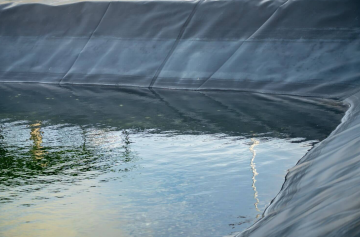
- Protection of Artificial Lake Anti-seepage Liners: Lay 8 oz non-woven fabric as a buffer layer under 40 mil HDPE membranes. It can absorb concentrated stress from bottom rocks, reducing the risk of liner rupture to below 0.1%.
- Temporary Construction Roads: Use woven fabric with a weight of 200 g/m²; even under the repeated traffic of 30-ton trucks, its Grab Tensile Strength can still remain above 250 lbs.
In the design of Infiltration Trenches, geotextiles must handle runoff containing 15% to 20% fine suspended particles. Data shows that the chemical stability of Polypropylene Needle-Punched non-woven fabric fluctuates minimally within the range of pH 4.0 to 11.0. The pore geometry of this material allows it to maintain 85% of its initial permeability after the first year of operation.
For gravity-type support structures of Bridge Abutments, geotextiles must maintain performance under a vertical load of 3,000 psf. Choose 10 oz/yd² or thicker non-woven fabric, with a permeability coefficient reaching 0.25 cm/s. High-weight materials can absorb some fine silt particles through the three-dimensional fiber network, thereby extending the effective life of drainage channels.
- Tennis Court and Sports Field Subgrade: Recommend selecting 140 g/m² non-woven fabric. Its flow rate index should be greater than 110 gpm/ft², ensuring no standing water on the field surface within 30 minutes after rain.
- Underground Tanks Backfill: Lay 4 oz non-woven fabric between the sand and the surrounding soil. This can maintain the 95% Proctor density of the fill, preventing tanks from tilting due to the loss of surrounding soil.
- Airport Taxiway Edges: Must use 8 oz non-woven fabric complying with AASHTO M288 Class 1 strength. Its CBR Puncture strength needs to reach over 2,200 N.
Technical Reminder: Do not use Slit-Film Woven geotextile on vertical filtration surfaces involving water flow. Due to its very low water permeability, it easily forms a “plastic film” barrier under water pressure, leading to upstream water level rise or soil instability.

Leave a reply