

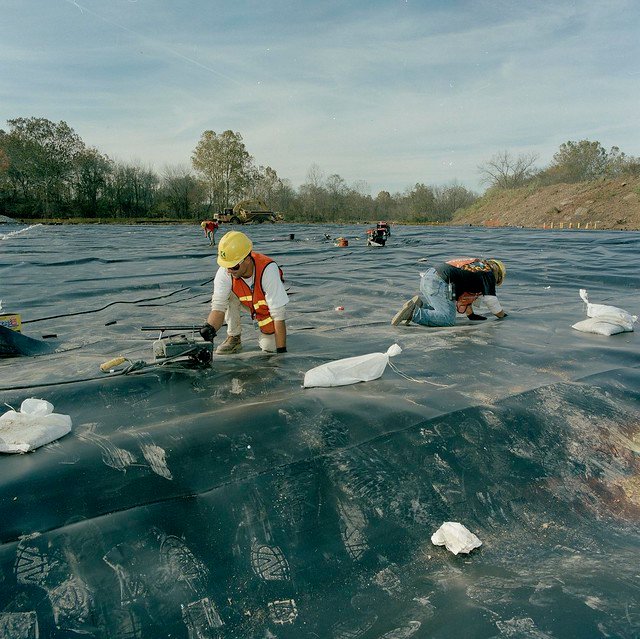
When choosing woven geotextile for a gravel driveway, the width should cover the full driveway and allow at least 30–50 cm of overlap to prevent shifting and edge curl. For a typical residential driveway, a product with strength of at least 50 kN/m and a roll width of 3–6 m is generally recommended. It can effectively separate the soil layers, reduce settlement, and extend service life to 10 years or more.
Confirm Requirements
Assess the Ground Conditions
Take an ordinary shovel to the area where you plan to install the gravel. Step down on it firmly. If the blade sinks more than 15 cm into the soil without much effort, or if the ground is still muddy 48 hours after rainfall, you are likely dealing with weak subgrade with a CBR below 3%. Ground like this behaves like a sponge. Even if you place 20 cm of gravel on top, vehicle loads can drive the stone down into the soil within a matter of months.
If you are unsure about the soil, take a 12 mm steel rebar rod and try pushing it into the ground by hand. The resistance you feel once it reaches beyond 30 cm can help you judge the bearing capacity of the soil. For “tofu-soft” ground that cannot resist even 50 kg of pushing force, ordinary geotextile with a grab tensile strength of 150 lbs is nowhere near enough. In that case, you need to upgrade to a woven geotextile with a grab tensile strength of at least 315 lbs (about 1.4 kN) to provide the rigidity the base actually needs.
The particle composition of the subgrade also affects material selection. Pick up a handful of soil and rub it in your palm. If it feels clearly sandy and drains moisture quickly, the soil is relatively stable. But if it feels powdery and develops cracks wider than 5 mm when dry, that is typical high-plasticity clay. Once wet, clay can swell by roughly 10% to 15%. That repeated physical movement constantly pushes upward from below and tries to break through the gravel layer.
- For extremely soft ground with a CBR between 1% and 2%, you must use high-modulus woven geotextile.
- If the topsoil cannot carry 2 kg of static pressure per square centimeter, the reinforced layer thickness should be increased by 30%.
- If the groundwater table remains within 60 cm of the surface year-round, capillary action will keep softening the subgrade.
When a 2.5-ton SUV drives onto a gravel driveway, the tire contact pressure is roughly 35–50 psi. Without a properly rated separation layer underneath, that pressure creates a pumping effect that draws fine particles from below—dust smaller than 0.075 mm—up into the clean voids between the gravel. Once more than 5% of this fine soil mixes into the aggregate, the interlocking friction between the stones can drop by about 60%, and the driveway begins to fail.
You also need to pay attention to the “hidden water paths.” A simple infiltration test works well: dig a hole 30 cm deep, fill it with water, and record how fast the water level drops. If it falls by less than 1 cm per hour, your subgrade has very poor drainage. In that kind of environment, the AOS (Apparent Opening Size) of woven geotextile becomes especially important. In most cases, a fabric that corresponds to a No. 40 sieve (0.425 mm) is recommended. It is fine enough to block slurry, but not so tight that the driveway turns into a pond.
- Make sure the woven fabric maintains a flow rate of about 5 to 15 gallons per minute per square foot.
- If your driveway slope exceeds 5 degrees, lateral pressure from soil erosion will increase by about 20%.
- Winter frost heave can cause upward movement of about 3 cm, and low-elongation woven fabric helps restrain that movement.
When estimating load, do not look only at the family sedan. You also need to account for the 15-ton septic truck that may eventually need access, or even a concrete mixer with a gross weight above 20 tons. If heavy vehicles like these are likely to enter, the instantaneous pressure on the subgrade rises sharply. Lower-strength fabric will develop permanent plastic deformation at the contact points, and once elongation exceeds 15%, structural integrity is effectively gone.
- High-strength woven geotextile should generally have an initial tangent modulus above 1,500 lbs/ft.
- If the gravel layer is thinner than 15 cm, the risk of puncturing the fabric increases by about 40%.
- If the expected maximum settlement of the subgrade exceeds 5 cm, a double-layer fabric system is recommended.
One of the most practical field checks is a simple trial compaction test. Drive a loaded pickup across the prepared subgrade. If the rut depth exceeds 5 cm, you absolutely should not place gravel directly on it. At that point, you not only need high-strength geotextile, but may also need to install an initial 5–10 cm layer of graded aggregate beneath the fabric to create basic structural support. That combination can extend expected driveway life from roughly 5 years to more than 15 years.
Estimate the Traffic Load
Do not focus only on the 2-ton SUV sitting in your driveway. That kind of vehicle barely matters compared with the loads that really determine service life—such as a 12-ton delivery truck or a septic truck that may enter every few years with a total weight above 15 tons.
When something that heavy rolls onto a gravel driveway, the localized tire pressure can jump from the normal 35 psi to more than 90 psi. If you tried to save money by choosing a thin woven geotextile with a tensile strength of only 150 lbs, sharp aggregate under that load can punch through the fabric like bullets.
Watch these three numbers carefully: 150 lbs, 200 lbs, and 315 lbs. These represent the Grab Tensile Strength of woven geotextile. If you plan to renovate an old house within the next two years and expect 30-ton concrete trucks to come in and out, you will need the 315-lb grade.
Spending roughly 25% more on higher-spec fabric can spare you years of shoveling mud later. Light-duty fabric can develop permanent plastic deformation after only a few passes from a heavy truck. Once elongation exceeds 20%, a driveway that was once flat starts to heave and roll like waves.
| Expected Vehicle Type | Axle / Gross Weight Reference | Recommended Grab Tensile Strength | Minimum Gravel Thickness |
|---|---|---|---|
| Passenger cars / pickups | < 3.5 tons | 150–200 lbs | 15 cm |
| Delivery trucks / septic trucks | 5–18 tons | 200–270 lbs | 20 cm |
| Heavy trucks / concrete mixers | > 25 tons | 315 lbs and above | More than 25 cm |
If your driveway includes a sharp corner, the lateral shear force from a heavy vehicle turning can be 3 times greater than during straight-line travel. That force tries to wrinkle the geotextile like a twisted rag, creating voids under the gravel layer.
In areas where the turning radius is less than 10 meters, increase the overlap from the standard 30 cm to 60 cm. That extra material may cost a little more per square meter, but it helps keep settlement below 2 cm even when the turn is hit by a momentary load equivalent to 40 tons.
Do not focus only on the extra cost per roll. One truckload of gravel can easily cost around RMB 2,000. If the fabric fails, the gravel disappears into the mud quickly, and you may need to add two more truckloads in the first year alone.
- A truck with an axle load above 8 tons can create ruts about 5 cm deep in unreinforced subgrade with just a single pass.
- 315-lb high-strength fabric can spread tire pressure across about 4.5 times the original loaded area.
- The fabric elongation must remain below 15% to keep the aggregate interlock from collapsing.
- Over the long term, high-modulus woven geotextile can reduce future gravel replenishment costs by about 60%.
Many people overlook the total number of delivery vehicles visiting a property every year. Logistics data suggests that an ordinary middle-class household may receive more than 150 vehicle visits annually. That kind of medium-intensity repetitive loading can cause serious fatigue damage in low-modulus fabric within just 3 years.
If the subgrade beneath the driveway is water-retaining clay, heavy truck loads can force slurry upward through the gravel voids the instant the wheels press down. Only woven fabric with a flow rate between 5 and 15 gallons per minute per square foot can help block that mud intrusion.
In those conditions, the fabric’s apparent opening size must be smaller than 0.425 mm. If you buy cheap material with openings that are too large, after only a few passes from a 10-ton vehicle, your clean white gravel can turn into a dark muddy mess mixed with plastic scraps.
- Make sure the geotextile is covered with gravel within 14 days of installation. Otherwise, UV exposure can reduce strength by 30%.
- For load-bearing areas with a slope greater than 5 degrees, install a 5 cm bedding layer beneath the fabric first.
- Loaded vehicles must never drive directly over exposed fabric during construction. A protective layer of at least 15 cm must be in place.
- Use 15 cm U-shaped steel pins and anchor heavily loaded zones at intervals of 0.5 m.
If you plan to build a new garage at the end of the driveway, the track pressure from an excavator is enough to destroy any fabric rated below 200 lbs. Every movement of the tracks places tremendous demand on puncture resistance.
That is why choosing a 315-lb fabric is really a form of insurance for the subgrade. An extra few yuan per square meter is nothing compared with the cost of construction downtime for an excavator. It is much cheaper to build the base correctly from day one than to repair a failed driveway later.
Before confirming the design load, check the road weight-limit signage nearby. If municipal garbage trucks rated at 15 tons are allowed on the road outside your property, then the first 30 meters of your driveway should be designed to heavy-truck standards.
Width Calculation
Standard rolls of geotextile on the market are commonly available in widths of about 3.8 m (12.5 ft) or 4.5 m (15 ft). If your driveway is exactly 3.5 m wide, buying a 3.8 m roll is not wasteful. That extra 30 cm may end up being the difference between a stable edge and one that starts to fail.
The extra width should either be tucked beneath the gravel layer or folded vertically into the side trench. If you buy fabric that is only exactly as wide as the driveway, the side pressure from a 2.5-ton SUV driving near the edge can push gravel into the adjacent lawn. Once the aggregate shifts sideways by even 5 cm, the structural thickness of the driveway immediately decreases, and failure is not far behind.
For soft muddy ground with a CBR below 3%, the overlap between adjacent sheets should be 60 cm to 100 cm. On compacted, dry, firm soil, 30 cm (about 12 inches) is the absolute minimum overlap needed to stop gravel placement from forcing open the seam.
- Standard single-lane driveway: a 3.8 m (12.5 ft) roll is usually recommended.
- Standard double-lane driveway: usually requires two 4.5 m (15 ft) rolls joined together.
- Edge anchor depth: dig a V-shaped trench 15–20 cm deep along the sides and press the fabric into it.
- Total width formula: clear width + (edge anchor depth × 2) + overlap width.
If you order only enough fabric to cover the exact surface area of the driveway, you will almost certainly come up short. For a straight driveway, add about 10% for waste. For an S-shaped or winding driveway, plan for more than 15%. The overlap direction also matters. If the gravel truck will back into the site, the sheet closer to the entrance should overlap on top of the inner sheet.
On a 100-meter driveway, if each seam at 15-meter intervals is installed with less than 30 cm of overlap, repeated braking can create horizontal movement of up to 5 cm at the joints. That small displacement gradually tears apart the structural integrity of the whole driveway.
- Seam fasteners: drive a 15 cm U-pin into the seam every 1 meter.
- High-traffic overlap: increase it to about 100 cm (3.3 ft).
- Temporary holding: before aggregate placement, place a 20 kg stone weight about every 3 meters.
- Cutting tools: keep an industrial utility knife or a professional hot-cutting tool ready.
At curves, do not expect a 4.5 m wide polypropylene roll to bend like fabric. On a turn with a radius of 10 meters, the outer edge will pull tight while the inside edge will bunch into wrinkles. Those wrinkles become structural weak spots. Under tire pressures of around 40 psi, the uneven stress can cause them to fail early.
The correct approach is a fan-style installation method. Every 2 to 3 meters, cut a relief slit on the inside of the curve so the sheet can overlap like a fan, keeping at least 20 cm of overlap. This uses about 8% more fabric, but it helps maintain a uniform gravel thickness of 15 cm through the turn instead of allowing thin spots caused by bunching.
Woven geotextile usually stretches by less than 15%. It has almost no elasticity. If you calculate the width too narrowly and a seam opens up, you cannot simply pull it back into place. Once slurry starts pumping upward through the gap, the gravel friction drops by about 60% immediately.
- Curve waste allowance: keep about 20% extra fabric for bends.
- Pin length: use 30 cm long pins in very soft soils.
- Heavy-vehicle areas: choose fabric with a grab tensile strength of at least 315 lbs (1.4 kN).
- First stone layer: use graded aggregate of about 40–60 mm directly above the fabric.
You also need to think about delivery logistics. If you order an extra-wide 5.3 m (17.5 ft) roll, it arrives as a rigid tube that is 5.3 m long. If the access road includes a sharp corner or tree obstruction, the truck may not even be able to get it onto the site. In many cases, two narrower rolls with proper overlap are far more practical than wrestling with a single 100 kg oversized roll.
Spending a little more per square meter on greater width and weight can save you from buying several truckloads of replacement gravel later. Many driveway owners try to save money by skipping an extra 50 cm of overlap, then watch the gravel disappear into the ground during the next rainy season and end up hiring an excavator to strip and rebuild the whole base.
The final width check should always be done after the roadbed has been excavated. Walk along the prepared base and make sure the fabric extends at least 30 cm beyond the planned gravel edge. This is not only for soil separation, but also to stop rainwater from eroding the subgrade from the sides and creating voids along the driveway edge.
- Roll weight: common rolls weigh about 70–120 kg, so two people are usually needed to handle them.
- Sun exposure: woven geotextile is vulnerable to UV. Once unrolled, it should be covered with gravel within 14 days.
- Service life: a qualified fabric buried beneath 15 cm of gravel can remain effective for more than 20 years.
- Drainage performance: make sure the flow rate remains within 5 to 15 gallons per minute per square foot.
Once you confirm the width, do not forget to calculate the number of steel pins you will need as well.
Concerns
Will It Cause Water to Pool on the Driveway?
If you pour a bucket of water onto woven geotextile, you will notice that the water does not disappear instantly. Instead, it spreads along the weave or forms a small puddle on the surface. A lot of first-time users see that and panic, assuming the driveway will turn into a swimming pool if they install this material beneath the gravel.
Take a typical high-strength woven fabric with a grab tensile strength of 315 lbs. Its flow rate is usually around 10 to 15 gallons per minute per square foot. A non-woven fabric, by comparison, might exceed 100 gallons per minute. But the key point is that if your driveway subgrade is a sticky heavy clay, its natural infiltration rate may be well below 0.01 gallon per minute. In that case, the soil—not the fabric—is the real bottleneck.
If water is not draining, the real issue is usually that the subgrade was not shaped with proper slope before the fabric was installed. Standard driveway practice calls for a cross slope of about 2%, which means a drop of about 0.25 inch per foot of width. If your driveway is 12 feet wide and the center is not about 3 to 4 inches higher than the edges, water will linger in the gravel no matter what fabric you use.
- The spaces between the woven strands are only about 0.425 mm, roughly equivalent to a No. 40 sieve.
- That opening size is carefully chosen to block dust and soft slurry smaller than about 0.5 mm from migrating upward.
- A tensile strength of 315 lbs ensures that once the driveway is filled with 1.5-inch stone, the fabric will not deform under heavy pickup traffic.
- Although it may pass less than 0.5 liter per second, that is still far beyond the infiltration capacity of most clay subgrades.
Once you place 6 inches of #57 stone—typically about 0.75 to 1 inch in size—on top of the fabric, the gravel layer itself contains roughly 40% void space. Those voids act like a temporary reservoir during heavy rain, buffering a large share of the surface runoff. Without the fabric, vehicle traffic would drive the gravel down into the mud like nails, until the whole driveway eventually turns into a slurry field.
Many people mistake geotextile for a waterproof membrane. That is a major misunderstanding. It is better thought of as a structural reinforcement layer. When a 4,000-lb pickup truck drives over it, the fabric uses tension to spread the wheel load over a wider area and keep the subgrade from settling locally.
If you still see localized standing water after installation, look back at the construction details. In weak zones with CBR below 3%, did you leave at least 12 to 18 inches of overlap? If overlap is insufficient, gravel can push down through the seam, causing local structural failure.
- The fabric should be covered with gravel on the same day it is installed. After more than 24 hours of direct UV exposure, fiber strength starts to deteriorate.
- Leave at least 6 inches of extra width at the edges and fold it into the side drain or edge trench to stop side soil from entering the gravel layer.
- Do not expect the fabric to solve an actual groundwater spring. In that case, you need a 4-inch perforated drain pipe, or a proper French drain.
The durability of a gravel driveway depends partly on the stone, but even more on this hidden fabric layer beneath it. Skip the fabric to save a few hundred dollars, and you may end up buying two or three extra truckloads of gravel every year just to fill the areas that keep disappearing.
Will It Fail Under Heavy Trucks?
When a fully loaded 20-ton dump truck or a heavy garbage truck pulls onto a residential driveway, many people assume that a woven geotextile less than 1 mm thick will be ripped apart instantly under the weight. In reality, what matters is the product classification under AASHTO M288. For residential heavy-duty use, the appropriate choice is often a Class 1 woven geotextile with a Grab Tensile Strength of 315 lbs.
That 315-lb figure does not mean the fabric can simply “hold up” a truck of that weight. It means that under a controlled grab test, it can resist a tearing force of that magnitude before failure. A fully loaded delivery truck may apply roughly 80 to 100 psi of ground pressure. If there is at least 6 inches of gravel on top, that pressure is already spread across a much larger area before it reaches the fabric.
If you choose a thin 200-lb fabric to save money, the risk is real. When a large pickup turns sharply in place, the shear force between the stones can grind through the fabric like a millstone. What you want is a product with a break elongation of about 15% to 20%. That may sound like an abstract number, but it is what allows the fabric to work like a taut trampoline under heavy loads instead of snapping suddenly.
“The life of a gravel driveway does not depend on how hard the stone is. It depends on the tensioned membrane effect of the fabric beneath it. As long as the fabric stays intact, the stone remains stone—it does not turn into decoration floating in mud.”
- Grab Tensile Strength: at least 315 lbs to handle vehicle weights above 30 tons.
- Trapezoidal Tear Strength: at least 120 lbs so a small puncture does not turn into a long rip under heavy load.
- CBR Puncture Strength: around 900 lbs, which reflects resistance to sharp aggregate pressing into the fabric.
- Weight: common grades are 4 oz, 6 oz, and 8 oz, but for heavy-duty driveways woven fabric of 6 oz or more is usually the starting point.
If you watch an actual construction site, the fabric is usually not damaged by a heavy truck simply driving over it steadily. The real danger comes from sudden braking or aggressive acceleration on the driveway surface. That horizontal ripping force is more destructive than vertical load. So even if you are using 315-lb high-strength fabric, a dozer or truck should never pivot directly on the exposed fabric. There should always be at least 4 inches of gravel covering it first.
How much stress the fabric actually sees depends heavily on subgrade strength. If the soil is soft like a sponge (CBR below 3%), the load on the fabric increases dramatically because the entire base is deforming. That is where standard widths like 12.5 feet become important. Reducing the number of seams helps prevent heavy trucks from forcing apart the overlap zones. Once a seam opens, slurry can push up through it within 48 hours.
That pumping action is the hidden killer in driveway failure. The truck presses down, the subgrade compresses, the load moves away, and the subgrade rebounds. During that cycle, fine soil is pumped upward into the gravel like fluid through a valve. High-strength woven geotextile, with its dense interlaced strands, suppresses this pumping effect. As long as the mud stays below and the gravel stays clean, the stone interlock can continue carrying trucks weighing tens of thousands of pounds.
- Overlap: in soft soil, leave at least 18 inches of overlap and secure it every 3 feet with U-pins.
- Installation direction: place the long dimension parallel to traffic to reduce how often tires cross seams laterally.
- Aggregate layering: use 2–3 inch coarse stone in the base, with #57 stone above it. That combination can dissipate more than 60% of the impact force.
- Edge treatment: extend the fabric at least 12 inches beyond the driveway edge and bury it to prevent edge collapse.
“In many cases, what looks like a torn fabric is actually shear failure in the soil below it. The fabric simply follows that deformation until it is finally pulled beyond its tensile limit.”
Many people ask why a thicker non-woven fabric should not be used instead. That is a common misunderstanding. Non-woven fabric may be thicker, but it behaves more like felt—it stretches too easily and does not provide rigid support. In heavy truck applications, the woven polypropylene slit-film structure behaves more like a structural grid. It spreads a concentrated wheel load across several feet in both directions, and that is exactly why it survives.
If you live in a wet area with clay-heavy soil, the up-and-down movement of the driveway under heavy vehicles will be even more noticeable. In those conditions, UV exposure matters as well. If the fabric is left in direct sun for more than a week before gravel is placed, the fibers can become brittle like paper. Even if the fabric was originally rated at 315 lbs, overexposure may reduce its actual capacity dramatically.
How Should Overlaps and Fixing Be Done?
If your driveway is 15 feet wide but you buy the very common 12.5-foot woven geotextile and leave only a 5-inch overlap at the center seam, you are effectively opening the door for the mud below to come right through.
On firm, dry, stable ground, 12 inches of overlap is the minimum. But if the subgrade is soft like putty—in professional terms, a CBR below 3%—that overlap should immediately be increased to 18 inches or even 24 inches.
If the overlap is too small, the fabric can slip apart the moment a dozer drives over it, and the slurry below will rise up through the gap into the gravel layer. It is like wearing a rain jacket with a broken zipper. No matter how good the jacket is, water still gets in. That is why you should always allow 15% to 20% extra material in your order instead of trying to save a little money and ending up with poor seams.
“When it comes to overlap, extra is never waste. When a heavy truck tire loads the edge of a seam, an 18-inch overlap works like interlocked gears, sharing the shear force that would otherwise tear a single layer apart.”
- Install the fabric in the direction of water flow or slope, with the higher sheet overlapping on top of the lower one like roof shingles.
- In soft soil, drive a 6-inch No. 11 steel U-pin every 3 feet along the seam.
- At corners, do not try to force the fabric to twist. Cut it and re-overlap it with at least 12 inches of coverage.
- Around drain pipes or utility poles, make the cut opening about 2 inches larger than the obstacle diameter so the fabric does not tear under load.
When it comes to fastening, avoid the flimsy plastic landscape staples sold in garden stores. They will not survive more than a few load cycles in real subgrade. What you need are No. 11 heavy-gauge U-shaped steel staples, at least 6 inches long. If the soil is full of stone, you may even need 8-inch steel spikes with washers to hold the fabric in place when aggregate is dumped on top.
Staple spacing also matters. Along the edges, install them every 3 to 5 feet. In the center, you can spread them out to about every 10 feet. But if you are installing on a windy day, those staples alone may not be enough to hold down a 12.5-foot wide sheet. In that case, you should place bags of gravel or pieces of timber at the corners temporarily.
- Leave an extra 6 to 10 inches at the edges. Do not lay it flat—fold it into the side trench or drain channel.
- At seams, stagger the fasteners instead of placing them in a straight line. That helps prevent a clean tear line from forming under load.
- If the slope exceeds 15 degrees, double the anchor density to keep the aggregate and fabric from sliding downslope together.
- Once pinned in place, cover the fabric with stone within 24 hours so thermal expansion and contraction do not loosen the pins in the sun.
If the fabric wrinkles during installation, do not ignore it. Once gravel is compacted, those wrinkles become little water pockets. They must be pulled flat or cut and overlapped properly. A well-installed sheet should feel tight and flat, almost like a drum skin, with a slight spring underfoot from the high-strength woven fibers.
“The staples are not meant to hold the fabric forever. Their job is to keep it in place during the first 10 seconds after the gravel lands. Once the aggregate is compacted, tens of thousands of pounds of stone become the real anchor.”
There is one detail many beginners miss: the overlap direction should follow the direction of traffic. If vehicles will drive uphill, the upper sheet should overlap on top of the lower one. That way, when a truck accelerates uphill and pushes backward against the surface, the wheel load presses the seam tighter instead of peeling it open.
If your driveway crosses a low, permanently damp area, staples and overlap alone may not be enough. In those zones, it helps to place a thin layer of fine sand between the two overlapping sheets to increase friction.
Application Scenarios
Heavy Vehicle Parking Areas
A 45,000-lb Class A diesel motorhome parked in a yard can apply enough pressure through its tires to turn a wet subgrade into slurry. Clay-rich or waterlogged soils push mud upward under that kind of load. If there is no woven geotextile beneath the gravel to stop it, half a year is often enough for the surface to begin failing.
Installing a woven geotextile that meets ASTM D4632 with a grab tensile strength of 315 lbs creates a support layer beneath the aggregate, almost like a taut steel mesh. Compared with entry-level products rated at 200 lbs, the 315-lb grade offers about 50% more tensile capacity and is much better at resisting the twisting loads created when a heavy vehicle turns in place.
Many owners try to save money by placing only 3 inches of gravel, then wonder why their RV is sinking within months. A heavy-duty parking pad should have a compacted gravel section of at least 6 to 8 inches, built in two lifts. Start with about 4 inches of coarse #3 stone for structure, then add about 2 inches of angular 3/4-inch aggregate above it. The woven geotextile belongs beneath the entire section so the stone cannot be driven into the mud.
Roll widths of 12.5 feet or 15 feet are ideal for parking areas because they minimize seams. If multiple sheets are needed, overlap should never be less than 18 inches, and on soft mud it should be increased to 24 inches. Simply weighting the corners with stone is not enough. Use 6-inch U-shaped steel pins every 3 feet to secure the fabric firmly.
- RV axle loads often exceed 10,000 lbs, so the fabric elongation must stay below 15% to keep the structure from deforming.
- A No. 40 opening size can block fine sand larger than 0.425 mm and keep the subgrade clean.
- After 500 hours of UV exposure, high-quality polypropylene woven fabric can still retain about 70% of its strength.
- CBR puncture resistance should be around 1,200 lbs so the fabric is not punched through by sharp #3 base stone.
- A basis weight of about 5 to 6 oz/yd² is the practical minimum for long-term heavy-vehicle durability.
Before starting work, remove all weeds and at least 5 inches of soft organic topsoil. Buried roots that later decay will leave voids, and even with good geotextile, the surface can still sink. Once the topsoil is removed, compact the subgrade at least 3 times with a heavy roller or plate compactor. The subgrade needs to reach about 95% compaction so the fabric can spread the vehicle load effectively.
- At seams, overlap in the direction of water flow so rain cannot carry soil into the joint.
- Never allow heavy trucks to drive directly on exposed fabric.
- When placing stone, dump it onto an already covered area and push it forward.
- At the zone where the RV backs in repeatedly, increase the gravel thickness by about 20% to resist wear.
Drainage also matters. Woven fabric drains more slowly than non-woven fabric, but it can still pass about 5 to 10 gallons per minute per square foot. As long as the bottom of the gravel section has a slope of 1% to 2%, that is enough to handle summer storms. If the parking area continues to pond water, the usual cause is excessive dust in the gravel, which can blind the openings in the fabric. Always use washed stone with fines kept below 5%.
If you expect to park a motorhome there for more than 20 years, also check the fabric’s resistance to acidic and alkaline soil. Subsurface pH often varies between 4 and 9. Poor-quality fabric can become brittle after only 5 years underground. Good polypropylene fabric, however, typically shows less than 10% property loss even after soaking in strongly alkaline conditions for 120 days.
Residential Gravel Driveways
You can spend thousands on a fresh load of beautiful gravel, only to see half of it disappear after one wet season. A 2-ton SUV driving daily over bare soil and gravel can push the surface stone down into the mud by about 0.5 cm per month. Continuously topping up with more #57 stone is just throwing money away, because once soil and stone mix together, the surface turns into a sticky, unstable mess. A woven geotextile beneath the base breaks that cycle completely.
For ordinary cars and pickups, you do not need the same high-end fabric used for motorhome pads. A product rated at about 200 lbs grab tensile strength under ASTM D4632 is usually sufficient for vehicles around 5,000 lbs. Since most single-lane residential driveways are about 10 to 12 feet wide, a 12.5-foot roll is often ideal because it covers the full width without a center seam.
Where the driveway curves or widens into two lanes, overlaps must never be less than 12 inches. Use 6-inch No. 11 U-shaped steel pins every 3 feet along the joint. Before installation, it is worth renting a skid steer and stripping out the top 4 to 6 inches of weeds and soft organic soil. If buried roots rot during summer, the surface will later settle into potholes that can hold 2 inches of water.
Edge detailing is one of the most commonly overlooked parts of residential installation. If it is done badly, gravel gradually migrates into the lawn. When excavating, create at least a 4-inch vertical edge drop so the driveway base acts like a shallow dish. Fold the geotextile up along the edge by 2 to 3 inches and fasten it against the soil face. Once the stone is backfilled, that folded fabric becomes an invisible retaining barrier.
| Driveway Layer | Recommended Stone Type | Installed Thickness | Compaction Requirement |
|---|---|---|---|
| Base Layer (on fabric) | Angular #3 or #4 coarse stone | 3–4 inches | Compact with a 1.5-ton vibratory roller |
| Surface Layer (traffic) | #57 stone or Crusher Run | 2 inches | Maintain a crown with the center higher than the sides |
The layering method is what determines whether the driveway lasts 5 years or 20 years without major repair. Directly on top of the fabric, place 3 to 4 inches of angular coarse stone such as #3 or #4. Under the vibration of a 1.5-ton roller, those larger stones interlock tightly on the polypropylene fabric. Then place about 2 inches of Crusher Run or similar material with fines to fill the voids.
Even though woven geotextile has relatively small openings, it can still pass about 4 gallons per minute per square foot. The No. 40 slit-film weave is fine enough to block mud and silt larger than 0.425 mm. A woven geotextile with a tensile strength of about 200 lbs can spread wheel loads over roughly 3 square feet instead of allowing them to concentrate in one small spot.
Do not leave the installed fabric exposed in direct sun for more than 48 hours. High-quality polypropylene can still retain about 70% of its strength after 500 hours of UV exposure, but construction timing still matters. Once the fabric is down, the gravel truck should ideally arrive within a couple of hours. During unloading, the truck should reverse over the stone it just placed—not over the exposed black fabric.
Soft Ground Improvement
If your yard feels muddy underfoot and leaves deep footprints, simply adding a few truckloads of gravel is almost always a waste of money. Soft clay with moisture content above 30% behaves like a sponge. Under several tons of vehicle load, slurry is forced upward through the stone voids. Without woven geotextile to stop it, a 10 cm gravel layer can almost disappear by the following spring.
The biggest mistake on soft ground is choosing fabric that is too flexible. The right product must meet ASTM D4632 with a Grab Tensile Strength of at least 315 lbs. Fabric at that level usually has elongation below 15%, which allows it to act like a tensioned support platform and spread wheel loads into the surrounding soil. Cheap woven material that stretches easily behaves more like packaging than structural reinforcement and can fail quickly under repeated traffic.
- This type of fabric usually weighs about 5 to 8 oz/yd² and feels almost like canvas.
- Its CBR puncture strength should be around 1,200 lbs to keep sharp aggregate from punching through under load.
- Both machine-direction and cross-machine tensile strength should be similar so the fabric resists tearing whether vehicles move forward or turn sideways.
- A No. 40 opening size blocks particles larger than about 0.425 mm, letting water pass while retaining the mud below.
- In freeze-thaw cycles down to -30°C, dimensional change remains below 1%.
On very soft subgrade, overlap also needs to be increased significantly. On firm ground, 12 inches may be enough, but on mud-like soil, overlap should be at least 3 feet (90 cm). Some installers try to save material by just barely overlapping, but when a heavy vehicle passes, the sheets can slip apart and the gravel begins sinking into the mud immediately.
You also cannot cut corners on fastening. Use 6-inch U-shaped steel pins, and in very soft ground place them about every 2 feet so the fabric stays flat. Never leave voids or air gaps beneath the sheet. If the fabric wrinkles, the gravel above will settle unevenly, creating soft spots that turn into potholes under repeated traffic.
- Strip out at least 6 inches of weeds and organic topsoil first, because decaying roots are one of the main causes of future settlement.
- Even if the subgrade is weak, compact and level it with a light roller before the fabric goes down.
- Install the fabric from the lower end of the slope upward, like overlapping scales, so water cannot enter through the seams.
- The gravel layer should be at least 8 to 10 inches thick and placed in two compacted lifts.
- For the base layer, use 2 to 3 inch coarse stone such as #3 stone so it interlocks strongly on the fabric.
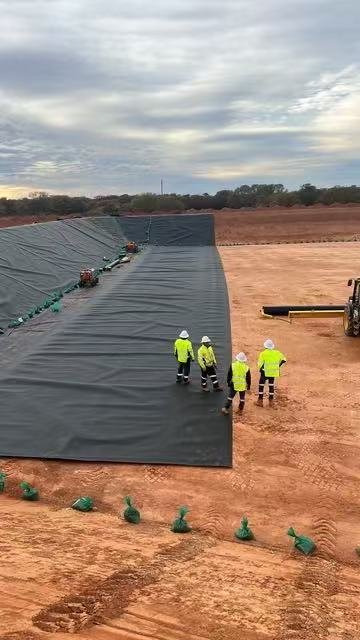
There is one hard rule during placement: heavy trucks must never drive directly on exposed geotextile. The correct method is to dump the stone onto an already covered section and push it forward across the fabric. If a 10-ton dump truck drives onto exposed woven geotextile, the tire torque can tear polypropylene strands instantly. Once that happens, the fabric’s tensile strength can drop by more than 40%, and it is no longer structurally reliable.
For long-term ground improvement, the fabric cannot be too impermeable either. If water accumulates beneath it, the subgrade becomes even weaker. A good woven geotextile can typically pass about 4 to 10 gallons per minute per square foot. That is slower than non-woven fabric, but still enough for most storm conditions. In soils with pH values ranging from 4 to 9, dense polypropylene woven fabric can remain intact for about 30 years. Even with a high groundwater table, its tear resistance will typically drop by less than 15% over the first decade.


Leave a reply