

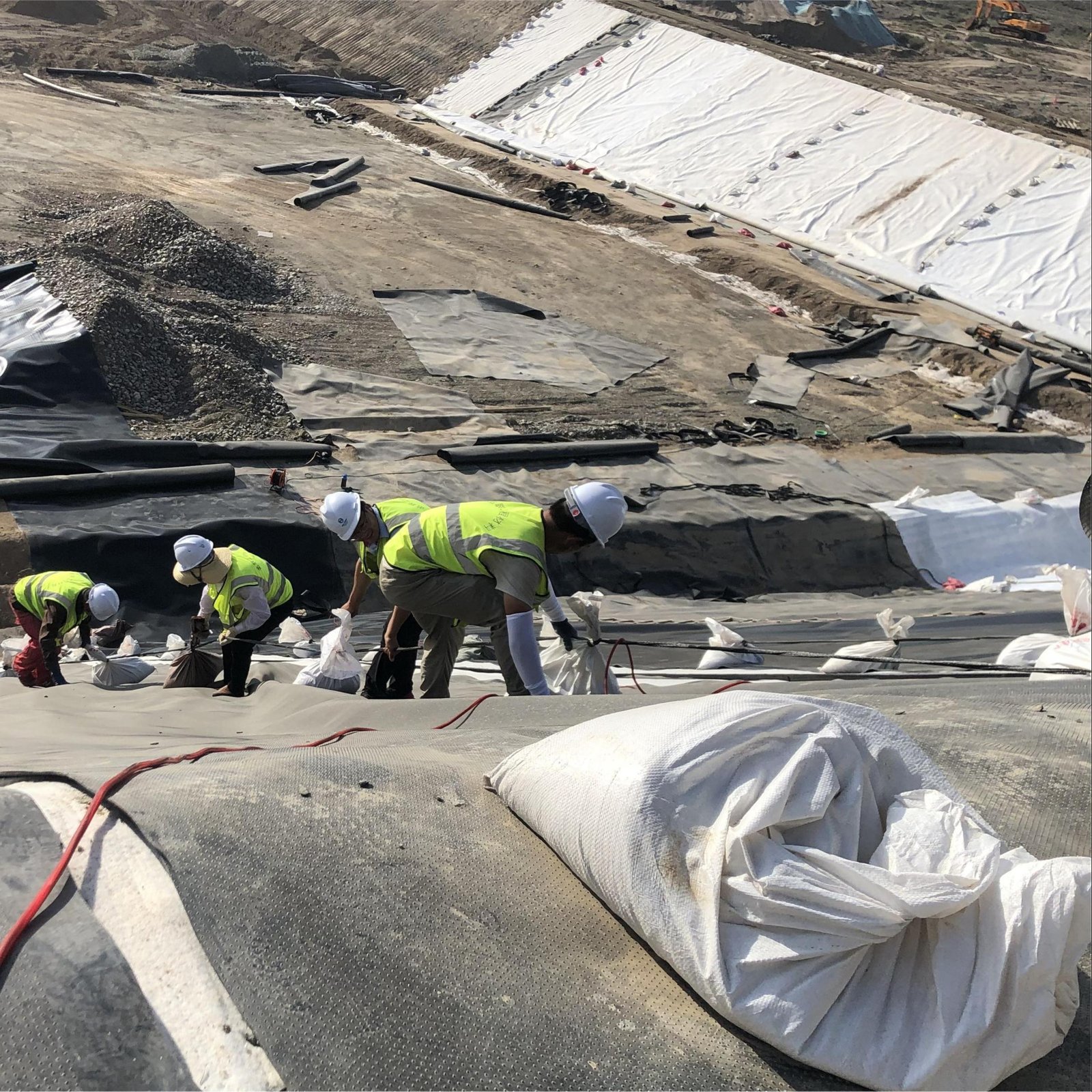
Woven geotextile offers higher strength, with tensile strength typically ranging from 50 to 200 kN/m, making it suitable for reinforcement and high-load applications such as road bases. Non-woven geotextile provides much better water permeability, with a permeability coefficient of about 10-1 to 10-3 cm/s, so it is better suited to drainage, filtration, and protection applications such as drainage layers.
Permeability
Non-woven Geotextile
Pick up a roll of 4 oz drainage fabric at a building supply store, and it feels like a thick wool felt. Thousands of fine plastic fibers are punched by machine thousands of times per square inch until they become tightly entangled.
Water moves through it surprisingly fast. A standard 4 oz fabric can pass about 110 to 150 gallons of water per minute per square foot.
By comparison, the black plastic weed barrier commonly used in yards is lucky to let even 2 gallons per minute leak through. After a heavy storm, that difference of more than 100 gallons per minute can determine whether your backyard turns into a mud pit.
The most common weights on the shelf are 4 oz, 6 oz, and 8 oz. Every additional 2 oz increases puncture resistance by roughly 40 to 50 pounds of force, but the water flow rate drops accordingly.
The heaviest 8 oz fabric usually drops to about 75 to 90 gallons per minute. For buried trench drainage, that slower flow rate is not a problem. The thicker fabric is actually better at blocking fine sand and silt carried in muddy water.
The right weight depends on the actual soil conditions in your yard:
- Clean sand or large stone: buy 4 oz; faster drainage is better.
- Half sand, half mud: buy 6 oz; it balances filtration and flow.
- Sticky yellow clay that clings to your boots: buy 8 oz; it helps keep fine clay from clogging the pipe.
- Sharp crushed-rock pits: start with at least 8 oz to prevent puncture.
Under magnification, the surface looks like an irregular three-dimensional maze. Manufacturers indicate pore size using standard sieve references. A good-quality 4 oz fabric usually has openings around a #70 sieve.
A #70 sieve corresponds to only about 0.212 mm. A normal grain of fine construction sand is roughly 0.25 mm in diameter. The sand is kept outside the fabric, while only water molecules far smaller than a pin tip can pass through.
When buying, always check whether the packaging says 100% virgin polypropylene. Cheaper products made from recycled scrap plastic can lose more than one-third of their tensile strength in less than 3 years once buried.
Virgin polypropylene fabric can easily last 50 to 100 years if it stays buried out of sunlight. But if it is left exposed under summer sun, the fibers can become brittle and tear easily in as little as 45 days.
Many people make costly mistakes when installing it. If you get the following steps wrong, the rework later can be expensive:
- Overlap adjacent sheets by at least 6 to 12 inches.
- Do not walk all over the fabric before stone is placed in the trench.
- Use U-shaped landscape staples and pin it down about every 3 feet.
- When wrapping black corrugated pipe, do not tie it so tightly that the fabric gets pulled out of shape.
To wrap a standard 4-inch perforated drain pipe, you need at least a roll of fabric 3 feet wide. If you dig a trench 18 inches deep and 12 inches wide, first place a 2-inch layer of rounded drainage stone at the bottom, ideally around 1.5 inches in size.
Set the pipe on top of the stone, fill the trench with gravel, then fold the extra fabric over the top like wrapping a spring roll so everything is fully enclosed. Finally, cover it with 3 to 4 inches of soil. That way, the outside dirt will never mix with the gravel inside.
Buried fabric also has to resist tree roots. A thick 8 oz fabric can withstand more than 400 pounds of puncture force. As roots gradually press against it, the fabric can stretch by 30% to 50%, giving it plenty of buffer instead of splitting suddenly.
Thicker fabric also works as a cushioning layer. Installing a 6 oz fabric behind a stone retaining wall helps absorb several tons of outward pressure when winter freeze expansion pushes against the wall.
When underground water freezes, its volume expands by about 9%. The dense three-dimensional voids inside the fabric provide room for that expansion. Pressure from ice and water is then spread across dozens of square feet instead of concentrating in one place.
Some contractors try to save time by selling pipe that comes pre-wrapped in a thin sock. That built-in wrap is often too tight, and clay soil can easily smear over the surface and eventually harden into an almost waterproof shell.
Lining the entire trench with fabric works much better than just putting a “jacket” around the pipe. The gravel is the first line of defense, and the fabric along the trench walls is the second. The total filtering surface area of the trench is about 10 times greater than the surface area of the pipe alone, which makes complete clogging far less likely.
Woven Geotextile
Walk to the other side of the yard-material section and pick up a roll of woven geotextile, and it feels like a heavy-duty truck tarp. In the factory, flat plastic tapes are woven tightly together in both directions like a bamboo basket, with almost no visible gaps.
Pour a cup of water onto a standard 200 lb woven fabric, and the water will sit on the surface for a long time before soaking through. Lab testing shows that it typically passes only about 4 to 8 gallons per minute per square foot.
If you place it in an area that actually needs drainage, even a half-inch rainfall can leave standing water for more than 48 hours. Extremely slow permeability is the price it pays for its “tough-guy” strength.
A woven geotextile 12.5 feet wide can easily reach a grab tensile strength of 200 pounds or even 315 pounds. When a 5,000-pound pickup drives over it, the weak mud underneath tries to push upward, but the fabric holds it down like a strong net.
Many older gravel driveways in front of houses fail because the stone gradually disappears into the mud. After roughly 15 wet-dry cycles per year, the soil can act like a suction cup and swallow the top 5 inches of aggregate.
In stores, woven fabrics are usually graded by tensile strength. For a household footpath, a 150 lb product is enough. For a residential driveway that regularly carries two full-size SUVs, you should step up to at least a 200 lb grade.
For swampy sites or areas that must support tracked excavators, only a heavy-duty 315 lb fabric can hold the base together. When installing it for a driveway base, the following details can save you from paying for skid-steer repairs later:
- Remove at least 4 to 6 inches of soft topsoil full of weeds.
- Overlap adjacent sheets by at least 18 to 24 inches.
- At curves, cut the fabric and re-overlap it instead of forcing it to fold.
- After laying it, dump stone immediately; do not let tires spin directly on the exposed fabric.
The first layer of stone placed on top should never be too small. Standard practice is to start with a base layer of large aggregate about 4 to 6 inches thick, often called #3 stone, with individual pieces around 2 to 3 inches in diameter.
Those large stones press onto the fabric and instantly spread the concentrated tire pressure over about 15 square feet of subgrade. Once the roller passes over them, the stones interlock tightly on top of the fabric.
Even though woven fabric may only pass about 5 gallons of water per minute, that is usually fine in a driveway application. Rainwater follows the surface slope—often around 0.2%—and drains off into the lawn on both sides. The base fabric is not meant to handle major water flow there.
It is also widely used beneath pavers and stamped concrete patios. You can excavate 8 inches of topsoil, install a 200 lb woven geotextile, and then backfill with machine-crushed limestone.
Even when moisture-rich clay beneath the patio freezes and heaves upward during winter temperatures of -10°F, it cannot break through the separating layer, so the pavers above remain level.
If you look closely at the surface, there are two very different manufacturing types on the market. The cheapest is slit-film woven fabric, made from flat plastic tapes, with very low permeability. The slightly more expensive option is monofilament woven fabric, made from round plastic yarns with slightly larger openings.
If you need to solve a drainage problem, put woven fabric back on the shelf immediately. It should not be used in the following situations:
- French drains in low-lying backyard areas
- Flower beds where you plan to plant apple trees and shrubs
- Gravel backfill zones beside basement walls for moisture control
- Wrapping any perforated corrugated drainage pipe
Many beginners go to the hardware store, see how thick and strong woven fabric feels, and bring it home to use as a weed barrier in a vegetable garden. The weeds do stop growing. But once summer arrives and a hose is running at 10 gallons per minute, the water simply runs across the smooth fabric surface into the neighbor’s lawn while the tomato roots never get even 1 inch of soil wet.
Exposure to sunlight is the weakness of all plastic fibers. A new 315 lb heavy-duty woven fabric left uncovered under the California sun for 500 hours can lose more than half of its original tensile strength. Covering it with at least 3 inches of soil or gravel is the only way to let it serve underground for 60 years.
Load Bearing & Stabilization
Tensile Deformation Comparison
In an ASTM D4632 grab tensile test, technicians clamp a sample using a 1-inch wide grip and pull it apart. A Woven 200 fabric is typically limited to no more than 15% elongation when subjected to a 200-pound load.
By contrast, a 4 oz non-woven geotextile may withstand around 100 pounds of load in the same test, but its elongation at break often exceeds 50%. In the field, that means when a 40-ton dump truck passes over the aggregate layer, the non-woven fabric underneath can stretch like a rubber band, allowing the stone to sink into the soft muddy subgrade.
When engineers review a stress-strain curve, the key number is the initial modulus. Woven geotextile, made from high-strength polypropylene slit tapes, has a very high initial modulus and can generate strong resistance at the very beginning of deformation. ASTM D4595 wide-width tensile testing gives a better picture of real performance over large installed areas. For high-grade highway projects, high-strength woven geotextiles can reach tensile strengths of up to 4800 lbs/ft at only 2% strain.
| Performance Metric | Woven Geotextile (Woven 315) | Non-woven Geotextile (Non-woven 8 oz) |
|---|---|---|
| Grab Tensile Strength (ASTM D4632) | 315 lbs | 205 lbs |
| Elongation at Break | 12% – 15% | 50% – 100% |
| Modulus at 2% Strain | About 3500 lbs/ft | Almost zero |
| Trapezoid Tear Strength (ASTM D4533) | 120 lbs | 85 lbs |
If you picture the contact area of one tire on an 18-wheel truck as an oval about 10 inches wide, the instantaneous pressure transmitted to the subgrade can reach 100 psi. A woven fabric with elongation below 15% helps maintain interlock between aggregate layers. If a high-elongation non-woven fabric is used instead, the fabric can sag into a “hammock” shape as the subgrade settles, and that deformation may cause reflective cracking in the asphalt layer above within a single season.
In highly moisture-sensitive clay regions such as Texas, CBR values often fluctuate between 1% and 5%. For very soft soils with CBR < 3, AASHTO recommends using Class 1 woven geotextile.
- Difference in tensile modulus: woven fabric carries load through the tensile action of aligned load-bearing tapes, while non-woven fabric depends on fiber rearrangement and stretching.
- Energy absorption: woven fabric absorbs more mechanical energy at low deformation, protecting the expensive aggregate base.
- Structural rigidity: woven fabrics weighing about 4 to 6 oz/yd² are stiff enough to support a small excavator moving slowly across the installed surface.
- Lateral restraint: aggregate tends to roll sideways under pressure, and woven fabric—with a typical friction coefficient of about 0.8—helps lock the stone in place.
When an excavator drops 2 tons of graded aggregate from a height of 3 feet, the impact load on the fabric is enormous. Low-elongation woven fabric stays flat and resists forming depressions that collect water. A non-woven fabric, however, can stretch locally under the impact and leave permanent depressions that later become weak spots for water accumulation.
For heavy-duty container yards, design life often exceeds 20 years. Using monofilament or slit-film woven polypropylene geotextile helps keep residual deformation within 5 mm even after millions of load cycles.
Field crews also have to calculate overlap width. For Woven 200 on firm subgrade, a 12-inch overlap is usually enough. But in extremely soft silty conditions, where even small tension movements can develop, overlap must be increased to 36 inches.
- Aggregate thickness savings: low-elongation fabric with about 15% stretch can replace roughly 4 inches of heavy stone base.
- Construction speed: high-modulus fabric is less likely to flip in the wind and can be covered with stone quickly without excessive manual flattening.
- Settlement control: in soft ground, woven fabric can reduce differential settlement by about 40%, cutting future repair frequency.
- Long-term strength: accelerated aging tests show that after 50 years underground, this structural fabric can still retain more than 80% of its original tensile modulus.
In Midwestern U.S. states that deal with freeze-thaw cycles, subgrade stability places especially high demands on tensile performance. During spring thaw, soil bearing capacity can drop to only about 20% of its normal value. At that point, the low-stretch characteristics of woven fabric are what keep the base stable. If a highly extensible material is used instead, thawed mud and water can quickly turn the entire foundation into a swamp-like mass.
California Bearing Ratio
On any subgrade jobsite, the California Bearing Ratio (CBR) is a core design value. Under the ASTM D1883 test method, 100% represents an ideal well-compacted crushed-stone condition, while the wet clay soils common in the eastern U.S. often test below 3%. On soil that weak, a driveway has almost no meaningful load-bearing capacity unless woven geotextile is installed.
This sponge-like subgrade can rut more than 4 inches deep the moment a heavy pickup rolls over it. Engineers typically refer to AASHTO M288 and require Woven 200 or stronger woven geotextile when CBR < 3%.
Ordinary non-woven geotextile typically stretches more than 50% under vertical load, behaving like a felt that easily pulls out of shape. It cannot provide real structural support in low-CBR conditions. Once the soil below settles by 1 inch, the non-woven layer sags with it, causing the surface above to crack quickly instead of reinforcing anything.
| Field Soil Condition (USCS) | Measured CBR | Recommended Geotextile Grade | Optimized Aggregate Thickness (Savings) |
|---|---|---|---|
| Firm clay (CL) | 5% – 8% | Woven 150 (light duty) | From 10″ down to 7″ (30% stone savings) |
| Saturated silt (ML) | 2% – 4% | Woven 200 (standard) | From 15″ down to 10″ (33% stone savings) |
| High-plasticity heavy clay (CH) | < 2% | Woven 315 (heavy duty) | From 22″ down to 12″ (45% stone savings) |
In rainy regions like Texas, soil moisture can send CBR values from 5% down to around 1% during the wet season. Woven geotextile is made from high-strength polypropylene slit tapes, with elongation strictly limited to under 15%. When an 80,000-pound loaded truck passes over the surface, the fabric barely deforms, acting as a rigid barrier that supports the aggregate layer.
Field crews know that without fabric, stone can settle roughly 1.5 inches per year into the mud. Installing Woven 200 blocks that “stone-mud mixing” effect. On a 1,000-square-foot driveway, simply reducing aggregate thickness can cut stone use by about 20 tons, saving more than USD 500.
Several installation details directly affect how much CBR improvement you actually get:
- Overlap width: in swamp-edge conditions where CBR < 1%, adjacent panels must overlap by 36 inches.
- Edge anchoring: edge trenches should be at least 12 inches deep and backfilled with compacted stone to prevent pullout under load.
- Dump height: never let a dump truck drop stone onto the fabric from heights above 3 feet.
- Initial compaction: the first 6-inch stone layer should be spread with a light grader; heavy equipment should never drive directly on exposed fabric.
When the subgrade CBR is only 2%, engineers may need to design more than 20 inches of aggregate if no reinforcement is used. With a heavy-duty woven fabric offering a 315 lb grab tensile strength, that thickness can be reduced to 12 inches.
Lab data is very direct. In a 0.1-inch penetration test, an untreated subgrade may fail at only 50 psi. With Woven 200 installed, the bearing pressure at the same deformation can increase to about 180 psi.
If you are only building a simple backyard walkway on soil with a CBR above 10%, the choice of fabric is less critical. But if you are building a private garage base that must support a 15-ton RV, you must pay close attention to the fabric’s breaking load. On low-CBR ground, the “snowshoe effect” provided by high-strength woven fabric is the only physical defense that keeps the foundation from collapsing.
Use Cases
Road Base Layers
When construction is carried out on soft subgrade with a California Bearing Ratio (CBR) below 3%, the pavement structure can shear under total wheel loads of up to 80,000 pounds. Installing a woven geotextile with a grab tensile strength of 315 pounds creates a strong membrane effect that helps stabilize the base.
If #57 stone is dumped directly onto wet clay, the stone is pressed downward while mud is forced up into the voids. Once that happens, the support modulus of the stone layer can drop by more than 40% within a single rainy season. Woven geotextile typically has an Apparent Opening Size (AOS) around U.S. Sieve #40 (0.425 mm). Its job is to keep materials of different sizes separated and preserve the full thickness of the pavement structure.
Using high-strength woven fabric can reduce required aggregate thickness from 14 inches to 10 inches. On a parking lot covering 10,000 square yards, that 4-inch reduction means saving nearly 2,500 cubic yards of aggregate.
- Overlap along road edges usually ranges from 1.5 feet to 3 feet.
- Woven fabric elongation must remain below 15%.
- Common roll widths are 12.5 feet, 15 feet, and 17.5 feet.
- ASTM D4632 is the primary test used to verify tensile performance for road applications.
- Construction vehicles must never turn in place on uncovered fabric.
- The initial stone cover should be at least 6 inches thick to protect the fabric.
If the subgrade has extremely high moisture content and some drainage function is also required, engineers may consider using an 8 oz non-woven geotextile. Its CBR puncture strength is around 500 pounds, enough to withstand track pressure from heavy bulldozers. With a permittivity as high as 1.26 sec-1, it allows pressurized groundwater to escape, helping prevent buildup of pore-water pressure inside the subgrade.
In heavy-traffic areas such as logging roads and mine haul roads, high-strength woven fabric limits the lateral movement of the aggregate layer through surface friction and interlock. This restraint can extend pavement fatigue life by 2 to 3 times, allowing the surface to remain stable even after tens of thousands of axle-load cycles.
| Performance Metric (ASTM) | 200W Woven | 315W Woven | 8 oz Non-woven |
|---|---|---|---|
| Grab Strength (lbs) | 200 | 315 | 205 |
| CBR Puncture Strength (lbs) | 700 | 900 | 535 |
| Trapezoid Tear Strength (lbs) | 75 | 120 | 85 |
| Water Flow Rate (gpm/ft²) | 5 | 4 | 90 |
| UV Stability (500 hrs) | 70% | 70% | 70% |
On wind-farm access roads, cranes can weigh more than 150 tons. Fabric selection here must consider ASTM D4533 trapezoid tear strength. Reinforced woven fabrics with tear strengths above 120 pounds are commonly used to prevent puncture under heavy aggregate loading. These fabrics help prevent rutting deeper than 3 inches.
Some subgrade conditions involve corrosive groundwater. Polypropylene (PP) geotextile can resist chemical attack across a pH range of 2 to 13. Even after being buried for 10 to 20 years, it can still retain more than 85% of its original tensile strength.
During installation, the fabric should be laid in the same direction as traffic flow. In extremely soft zones with CBR below 1%, overlaps may even need to be sewn in the field. Seam strength should reach at least 90% of the fabric’s own strength to ensure proper load transfer.
- 15-foot wide rolls are usually the most efficient for straight sections.
- Aggregate gradation should comply with AASHTO M43.
- Before installation, remove sharp roots or stones larger than 2 inches in diameter.
- U-shaped staples are typically 10 to 12 inches long.
- During compaction, rollers should work from the edge toward the center.
For interstate shoulders, use is infrequent but individual loads are high, so UV resistance under ASTM D4355 becomes important. Materials are usually required to retain at least 70% of their strength after 500 hours of exposure, in case construction delays leave them in sunlight for extended periods.
When temporary bypass roads are later removed, the aggregate can be recovered much more easily because the geotextile keeps the layers separated. Data shows that stone recovery rates can exceed 80%, with minimal contamination from underlying soil.
If the subgrade is a fine silty soil with a very small fineness modulus, a single woven layer may not adequately stop fine-particle migration. In that case, a geocomposite—a woven fabric heat-bonded to a light non-woven layer—may be used instead. This combination can provide both 4,000 lbs/ft tensile strength and a fine filtration opening size around 0.15 mm.
When material arrives on site, every roll should come with the manufacturer’s MTR (Material Test Report). The report must clearly list the MARV values, so the specified properties represent guaranteed minimum performance rather than averages.
Subsurface Drainage
French drains typically use 4 oz needle-punched non-woven geotextile. This fabric is about 40 mils thick and is used to wrap perforated pipes with diameters of 4 inches or 6 inches. Its permittivity is around 2.0 sec-1, which allows water to enter the pipe freely without forming a mud film around the pipe wall.
If the trench is filled with #57 gravel (typically 1/2 to 1 inch stone), the non-woven fabric is placed between the gravel and the surrounding soil. A standard 4 oz fabric can handle about 140 gpm/ft², so even during heavy storms water can pass through rapidly. Its AOS is typically around U.S. Sieve #70, which blocks most soil particles larger than 0.212 mm.
When drainage boards are installed around residential foundations, the non-woven fabric is usually attached to the drainage core of the geocomposite. It can withstand about 250 psi of lateral earth pressure without being pushed into the drainage core openings. In the ASTM D4632 grab test, this type of fabric typically shows strengths around 100 pounds, enough to withstand friction during backfilling.
For underground dry wells in soils containing large amounts of fine sand, a 6 oz non-woven fabric is usually a better choice. It is thicker, with grab strength increased to around 160 pounds. Underground, it can maintain its filtration function for more than 50 years without clogging easily from fines.
- 4 oz non-woven is suitable for light-duty drainage such as garden landscaping.
- Perforated drainage pipe must be wrapped 360 degrees.
- Overlap widths above 12 inches help prevent soil intrusion.
- Sod staples are typically installed about every 3 feet.
- The gravel envelope should generally be at least 6 inches thick.
- ASTM D4491 is the standard test method for drainage performance.
Retaining walls create much higher drainage pressure behind the wall, so an 8 oz heavy non-woven fabric is commonly used. When wall height exceeds 6 feet, trapped water can create significant lateral pressure. An 8 oz fabric typically reaches a CBR puncture strength around 500 pounds, enough to resist sharp stones in the backfill.
Beneath golf greens or football fields, a fabric with an opening size around U.S. Sieve #100 (0.15 mm) helps prevent fine sand from clogging branch drains. Flow rates usually remain around 110 gpm/ft², allowing turf surfaces to dry out within about 30 minutes after play.
| Property (U.S. Units) | 4 oz Non-woven | 8 oz Non-woven |
|---|---|---|
| Grab Strength (lbs) | 102 | 205 |
| Permittivity (sec-1) | 2.1 | 1.35 |
| Water Flow Rate (gpm/ft²) | 150 | 90 |
| Puncture Strength (lbs) | 300 | 535 |
| Trapezoid Tear (lbs) | 45 | 85 |
Groundwater around large commercial buildings can have widely fluctuating pH values. Polypropylene (PP) non-woven fabric remains stable in environments from pH 2 to 13. Unlike some polyester materials, it is less likely to degrade in alkaline soils, such as those near concrete foundations.
In septic leach fields, non-woven fabric is placed over the gravel layer to prevent cover soil from filtering down into the stone voids. Very high strength is not necessary here; a lightweight 4 oz product is usually enough. The main concern is drainage surface area and its flow capacity—often around 135 gallons per square yard. In areas with a high water table, the fabric also needs adequate transmissivity to handle upward pressure.
In cold climates, freeze-thaw cycles compress drainage systems. Needle-punched non-woven fabric can elongate by more than 50%, so it can deform with the expanding soil without splitting. Woven fabric, because it is much stiffer, is actually more prone to fatigue in this kind of application.
- Recommended soil cover over leach fields is about 12 to 18 inches.
- Drain pipe slope should generally be kept around 1% to 2%.
- Fabric selection should be based on the relationship between soil D15 and fabric AOS.
- Landfill blind drains often use 12 oz or even 16 oz heavy fabrics.
- PP is more resistant to acids and alkalis than PET.
Longitudinal edge drains under municipal roads often use 6 oz non-woven fabric. That weight is enough to handle the short-term high stresses caused by rollers working above it. Trapezoid tear strength is typically above 65 pounds, which helps prevent the fabric from tearing when a loader dumps stone onto it.
Some specialized rail-subgrade drainage systems use heavier non-woven materials. To stop ballast from pumping mud upward, the fabric must distribute load evenly. In these cases, permeability alone is not enough; engineers also look at modulus performance at 2 inches of displacement.
For high-salinity coastal subsurface-drainage projects, polypropylene fabric performs very well in salt-spray conditions. After burial for 720 hours, strength retention is usually above 90%.
Erosion Control
On riverbank slopes, when flow velocity exceeds 5 ft/s, soil can erode very easily. In this case, an 8 oz needle-punched non-woven fabric is commonly placed beneath the riprap. Its permittivity is around 1.26 sec-1, so it allows water inside the soil to escape—preventing uplift—while still retaining sand particles larger than about 0.15 mm.
On steep slopes such as 2:1, riprap alone is not enough. The non-woven fabric is usually around 100 mils thick and acts like a sponge cushion beneath large rock. In an ASTM D4833 puncture test, an 8 oz product can typically withstand more than 120 pounds without tearing.
- For gentler river sections, 4 oz or 6 oz non-woven is usually sufficient.
- Water flow through this type of fabric is typically around 90 gpm/ft².
- Its elongation is usually above 50%, so it will not snap if the riprap shifts.
- The needle-punched surface creates many fine fibers that increase friction with the soil.
- AOS is typically selected in the range of U.S. Sieve #70 to #100.
For coastal areas or locations exposed to strong waves, heavier products such as 12 oz or even 16 oz non-woven are preferred. These fabrics can reach grab tensile strengths above 300 pounds. When waves draw back, the suction force can be severe, and the thicker fabric helps prevent fine soil beneath the revetment from being pulled out to sea.
When the goal is to stop muddy runoff during construction, the correct product is usually a woven silt fence. This woven fabric has very small openings and can retain more than 90% of suspended sediment. A standard roll is typically 100 feet long and 24 to 36 inches high, supported by wooden stakes.
This woven silt-fence fabric typically has a tensile strength around 124 pounds, much stiffer than ordinary non-woven fabric. Under ASTM D4355, it can still retain more than 70% of its strength after 500 hours of sunlight exposure. Its purpose is not drainage but to physically hold back muddy water like a barrier wall.
| Performance Metric (U.S. Standard Units) | 6 oz Non-woven | 200 lb Woven |
|---|---|---|
| Grab Tensile Strength (lbs) | 160 | 200 |
| Trapezoid Tear Strength (lbs) | 65 | 75 |
| Water Flow Rate (gpm/ft²) | 110 | 5 |
| CBR Puncture Strength (lbs) | 450 | 700 |
| Equivalent Opening Size (U.S. Sieve) | 70 | 40 |
In high-velocity spillways where water may exceed 15 ft/s, engineers often use woven and non-woven layers together. The non-woven goes underneath to filter water, while a high-strength woven layer on top provides reinforcement. Because woven fabric has a high modulus and less than 15% elongation, it helps prevent movement in the soil beneath.
In some wetland projects with heavy silt loads, monofilament woven geotextile is used. It has better flow capacity than ordinary woven fabric—typically about 30 gpm/ft²—and is less likely to blind over, so water can keep flowing.
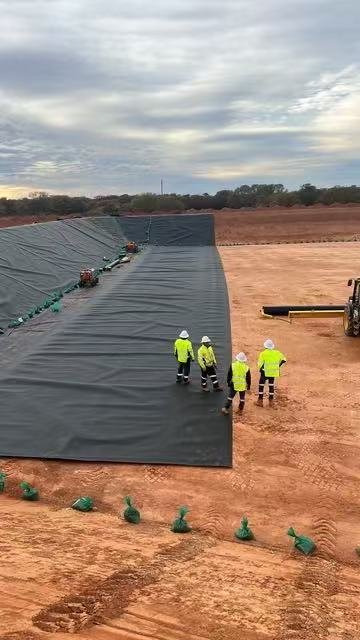
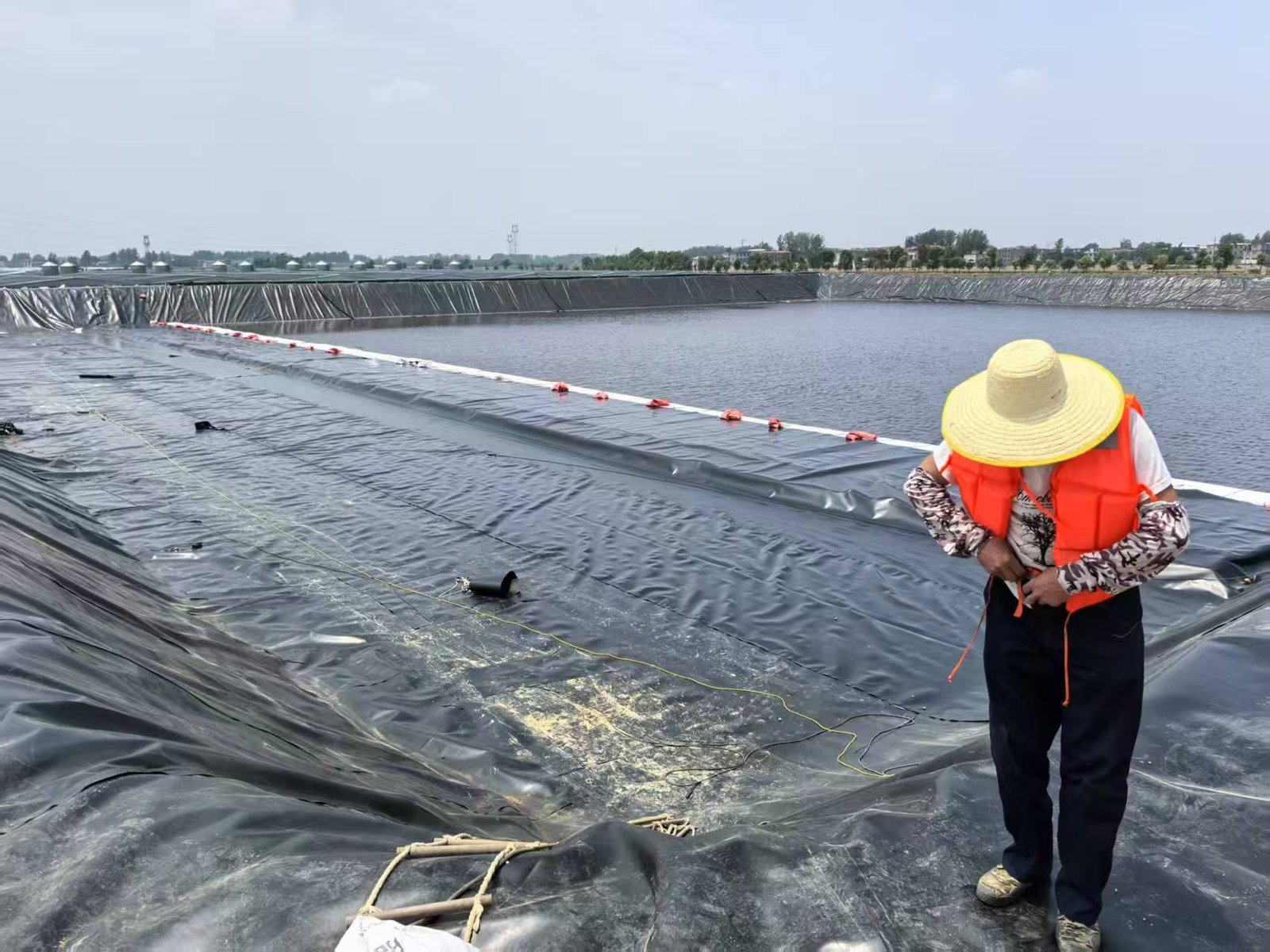
In landfills or artificial lakes, an HDPE geomembrane often needs a protective non-woven cushion layer of at least 10 oz beneath it. This is to keep sharp stones in the soil from puncturing the expensive liner. In such applications, CBR puncture strength is typically required to exceed 800 pounds.
In these systems, fabric thickness and weight are critical. If the basis weight per square yard is reduced by 10%, the fabric’s resistance to abrasion and friction will drop accordingly.
- Silt fence should be buried at least 6 inches into the ground.
- Adjacent rolls should overlap by at least 18 inches.
- For underwater installation, overlap should be increased to 36 inches.
- Staples are typically 6 to 12 inches long.
- Staple density is usually about 1 to 2 per square yard.
On industrial sites with strong acidic or alkaline conditions, polypropylene (PP) geotextile is generally a better choice than polyester (PET). Polypropylene can tolerate environments from pH 2 to 13, and after 50 years underground its physical properties typically degrade only slightly.
For coastal backfill near ports, if the fines content in the soil exceeds 15%, the selected non-woven fabric needs a higher permeability rate. Otherwise, fines can build up on the surface and form a “mud cake,” preventing drainage. As pressure builds, that can destabilize the entire revetment.
For low-CBR soils—especially below 3%, where the ground is extremely soft—a high-modulus woven geotextile must be used for base reinforcement. It prevents the overlying stone from sinking into the mud and helps keep the slope or foundation stable over the long term.


Leave a reply