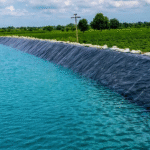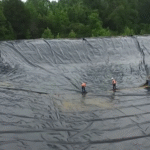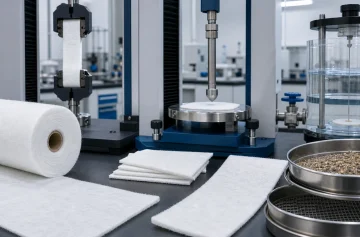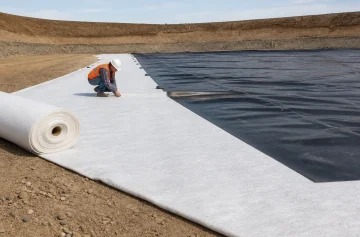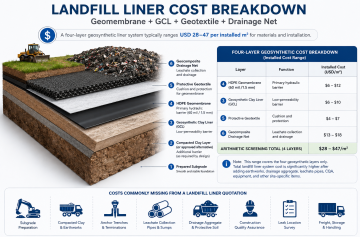

HDPE geomembrane has a buried lifespan of 30–50 years, which drops to 5–15 years when exposed to UV; high temperatures and chemical substances accelerate aging. It is recommended to provide shading, prevent chemical erosion, and regularly inspect welds and surfaces to extend service life.
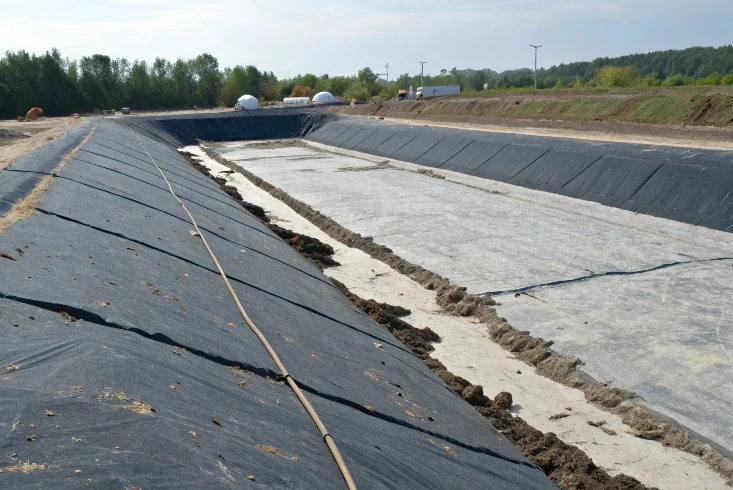
Environmental Factors
Temperature
Black HDPE geomembrane exposed to the sun becomes burning hot on the surface. In the heart of the Arizona desert, when the noon air temperature is only 40°C, the surface temperature of an uncovered geomembrane will soar all the way to 75°C.
High temperature acts like a water pump, rapidly draining the antioxidants (OIT) from the material. Thermodynamic data shows clearly that for every 10°C rise in ambient temperature, the rate of material aging doubles.
An HDPE membrane buried in cool soil at 20°C contains enough antioxidant components to last a full 200 years. If placed under the sun at 60°C continuously, the antioxidants will be completely exhausted in just 15 years.
When the temperature reaches the extreme environment of 80°C, the theoretical safe service period of high-density polyethylene will shorten rapidly, lasting less than 5 years.
High temperature causes significant physical deformation of the material:
- The expansion coefficient soars to 1.2×10⁻⁴/°C
- A 100-meter long membrane rising by 30°C will elongate by 36 cm
- A large number of wave-shaped wrinkles exceeding 10 cm in height bulge on the surface
- The plastic tensile strength at the peaks of the wrinkles drops to 8MPa
It bulges with heat expansion during the day and becomes tight with cooling contraction at night. In desert areas where the temperature difference between day and night reaches 30°C, the laid anti-seepage layer is constantly pulling every day, like a giant breathing net.
Day after day of physical fatigue causes the chemical bonds inside the material to slowly break. In extremely cold regions where temperatures drop below zero, monitors in northern Canada have recorded another type of destruction data.
Winter soil freezes layer by layer to a depth of 1.5 meters. After underground liquid water freezes, its volume expands by 9%, and this huge force pushes tightly against the geomembrane from the bottom up.
Underground ice and water gather together under capillary action, freezing into hard, giant ice lenses. Instrument probes measured that the squeezing force generated by local freezing expansion broke through the dangerous value of 2.5 MPa.
The physical blow of extreme cold on polymers is very obvious:
- At -40°C, the length the material can stretch is reduced by 40%
- The edge anchoring grooves are pulled by freezing and thawing to a looseness of 5 mm
- The probability of cold-shrinkage peeling at the splicing parts increases twofold
- Suspended parts form a “trampoline effect” and bear dangerous static loads
The air temperature drops sharply from 20°C in the afternoon to -20°C at night; a 100-meter long membrane body will shrink back by about 48 cm out of thin air due to thermal expansion and contraction.
The HDPE membrane originally laid at the bottom of the groove is forced straight, becoming a suspended and tight state. Dumping dozens of tons of solid waste onto it, the heavy pressure exceeding the nominal tensile strength of 18 N/mm can tear the film apart in a few seconds.
The low-temperature embrittlement point given by testing instruments draws a survival red line. When HDPE material drops to -77°C, it completely loses elasticity and degrades into a hard block that breaks upon touch like glass.
Staying in the low temperature of -30°C for a long time, the microscopic crystalline regions inside the material undergo a physical phase transition.
Violent thermal expansion and contraction make on-site high-temperature welding very troublesome. Two adjacent membrane sheets welded at 5°C in the morning and 35°C in the afternoon hold completely different internal deformation stresses.
The machine sprays high temperatures of 400°C to forcibly melt the edges and join them together. The internal stress left by the temperature difference causes the shear strength of the weld to lose 30%.
The thermal conductivity of soil is poor; the thermal conductivity coefficient of dry sandy soil is as low as 0.25 W/(m·K), blocking the speed of extreme heat and extreme cold conduction deep into the ground.
Engineering has prepared many quantitative methods to resist extreme temperatures:
- Leave an extra 2% wrinkle margin during laying to deal with nighttime cold shrinkage
- Cover the surface with white geotextile to reduce the sunlight temperature by 20°C
- Select special resins with high-pressure OIT test values greater than 400 minutes
- Hardly increase the preheating temperature to 150°C before winter welding in cold regions
- Extend the groove anchoring depth to 30 cm below the permafrost zone
Cover the anti-seepage membrane with a 60 cm thick layer of compacted clay to build a thick temperature-insulating wall. Temperature sensors continuously measured that when the sun bakes the surface to 50°C, the membrane surface temperature below the clay layer stays steadily at 25°C.
Chemical Corrosion
The black water at the bottom of the landfill pit is called leachate. This is a large pot of poisonous soup mixed with tens of thousands of chemicals. The EPA took samples with test tubes and measured that the pH value of the liquid at the bottom of some industrial waste pits dropped below 2.0.
High concentrations of sulfuric acid and nitric acid are mixed together, soaking the anti-seepage layer at the bottom of the pit every day. A 1.5 mm thick polyethylene plastic sheet is required by engineering to soak in extremely corrosive water for a full 50 years.
Plastic sheets made from new resin with a purity of 97.5% are inherently very resistant to acids and alkalis. Laboratory personnel dropped cut sample pieces into strong alkaline water with a 30% concentration of sodium hydroxide for soaking.
After soaking for a full 10,000 hours, they were taken out and pulled forcefully on a machine. The broken lines on the computer screen were flat and steady, and the material’s tensile strength limit only dropped a little, about 1.2%.
When encountering conventional acid and alkali water, the high-density plastic sheet is like a stone that cannot be bitten. Moving the focus to mine tailing dams and chemical plant sewage ponds, the protagonists of destruction change.
Toluene and xylene liquids with aromatic odors like to crawl into the molecular gaps of polyethylene most. Small organic molecules sneak into the non-crystalline regions inside through tiny holes on the surface of the plastic sheet.
Long plastic molecular chains are forcibly stretched open by high-concentration solvents, resulting in irreversible swelling and foaming.
A film originally 2.0 mm thick was soaked in waste liquid containing 500 ppm benzene series substances. Measured with a caliper six months later, the thickness bulged to 2.15 mm, and the volume expansion rate broke through 7%.
After the material absorbs water and becomes thicker:
- The overall puncture resistance strength drops by 45%
- The elongation at break drops from 700% to 400%
- The number of microscopic small holes inside increased by 1.5 times
- The ability to block gases collapsed by 10 orders of magnitude at once
The film saturated with toxic water feels soft, like an old sponge. The long hydrocarbon chains that were originally very close together have loosened, and if 30 meters of solid waste is pressed on top again, the film is extremely easy to tear.
The ASTM D5322 test standard is set very strictly. Experimenters pressed the material into simulated toxic water at 50°C and endured it for 120 days.
High temperature plus concentrated toxic water washed the additives out of the film’s belly bit by bit. As high as 2.5% proportion of black color carbon particles and anti-aging agents were drained completely clean.
The water at the bottom of the glass jar slowly became cloudy. Under the light of an instrument, the concentration of hindered phenolic agents used for anti-aging in the anti-seepage cloth decreased by a full 60%.
Highly oxidizing chemical water is like a miniature pair of scissors. Prepare a sodium hypochlorite aqueous solution with a concentration of five parts per thousand, and the chlorine ions inside will cut the carbon-carbon chains of polyethylene like crazy.
Long chains with a polymer weight exceeding 250,000 g/mol turned into countless sparse and shattered short sections. The sheet spit out by the gel permeation chromatograph stated that the weight-average molecular weight of the material was cut in half within three months.
The collateral destruction data is terrifying:
- The speed at which plastic melts and flows reached 3.5 g/10min
- The standard OIT time for measuring aging cannot last 20 minutes
- The persistence time for slow cracking falls within 150 hours
- Fine cracks as deep as 0.1 mm appear on the surface
Under a static tension of 15 MPa, tiny cracks rapidly tear into large openings. Toxic leachate leaks through the cracks into the underground soil, and the originally airtight anti-seepage system is completely scrapped.
To block fierce chemical water, material makers mixed special fluorinated gas into the formula. On the surface of the fluorinated anti-seepage cloth, a fluorinated protective film with a thickness of only 10 nanometers formed.
In experiments simulating the penetration of chlorine-containing solvents, the daily penetration of ordinary HDPE film reached 15 g/m². The test block covered with a fluorinated protective film managed to squeeze the penetration amount to below 0.1 g/m².
Mixed waste liquids can explode with even greater destructive power. Heavy metal ions combined with volatile organic compounds (VOCs) will undergo a violent catalytic reaction.
Copper ions and iron ions in acid water act as accelerators. They speed up the generation rate of free radicals on the plastic chain, shortening the time for oxidative rot by three-quarters.
The material is attacked by mixed toxic water:
- The speed at which free radicals emerge speeds up by 400%
- The edge tension of two cloths welded together loses 55 N/mm
- Punctured holes the size of pinholes are dissolved in locally stressed areas
The garbage pit bottom water that changes patterns every day forced single-formula materials to become unable to hold up. Construction sites began to lay the kind of composite anti-seepage cloth where 3 to 5 layers of resin are pressed together.
The top layer uses special resin with a thickness of 0.5 mm and a crystallinity as high as 65%. An EVOH barrier material is sandwiched in the middle, reducing the chance of organic solvents leaking through to one-millionth, which instruments cannot measure.
The very bottom is attached with 400 grams of non-woven fabric used to absorb stress deformation. This multi-layer defense system is placed in the EPA’s simulated 100-year accelerated aging test machine, and the decline of various indicators stays steadily within the safety line of 15%.
Mechanical Stress & Subgrade Conditions
Anti-seepage plastic cloth is laid on soil, crushed stones, or hard concrete, carrying dozens of meters of waste on its back. There is an old landfill pit in Staten Island, New York, where instruments measured that the vertical weight borne by the bottom of the pit broke through 350 kPa after being filled. A 1.5 mm thick polyethylene film is pressed tightly underneath by tens of thousands of tons of solid waste every day.
The underground soil layer will always collapse downward after being pressed by heavy objects for a long time. The hardness of the soil on the left and right sides of the landfill pit is completely different, and the old garbage buried underneath slowly rots and becomes empty, so the surface of the pit bottom will bulge or subside.
The subsiding soil forcibly drags the film covered above towards the bottom of the pit. Monitoring instruments captured the pulling data when the soil deformed; the soil on the left sank by 15 cm, while the soil on the right did not move, and the anti-seepage cloth sandwiched in the middle was pulled long by 8%.
The limit of polyethylene plastic stretching is stuck at 12%. Stretching beyond this number, the polymer chain is like an overstretched rubber band and can never bounce back.
Irregular subsidence at the bottom of the pit causes this layer of cloth to be pulled in several directions at the same time. Laboratories use machines to simulate this complex geological deformation; as long as it is stretched by 5%, white tiny cracks emerge inside the material.
Sharp crushed stones and hard plant roots that were not cleaned properly are hidden in the soil. A heavy bulldozer rolls over them, and a sharp stone only 2 cm in diameter pushes all 420N of point pressure onto the surface of the plastic cloth.
Destruction data when encountering sharp object impact:
- A 1.5 mm film suffered 400N of squeezing and developed obvious dents
- After continuous pressing for 72 hours, the thickness at the dent was forcibly reduced by 30%
- The local pressure at the tip of the stone soared to 15 MPa in an instant
- A 0.15 mm deep scratch on the surface is extremely easy to tear into a large opening
Before laying the plastic cloth, workers will lay a thick layer of non-woven geotextile on the hard soil. By laying a 400 g/m² buffer pad, the force of sharp stones stabbing up is mostly dissipated.
Performing a puncture resistance test according to the ASTM D4833 standard, the anti-seepage system with a geotextile cushion layer withstood a steel needle pushing down at 650N on the machine. The thicker the laid cloth, the smaller the chance of the plastic film being punctured by sharp stones.
Even if sharp stones do not puncture the film, pushing like this all year round will cause the material to slowly soften and undergo physical “creep”. After pressing for 10,000 hours on a machine, the pushed dent deepened by 3 mm, and the tensile strength here dropped a lot.
Wild animals with extreme destructive power are burrowing everywhere underground. There is a kind of groundhog in North America that loves to dig holes; the force of its claws digging soil is calculated to be as high as 80N, enough to scratch deep white marks on unprotected edge films.
Anti-seepage cloth laid on a large slope with a 30-degree incline carries a huge gravity sliding downward every day. On a 50-meter long smooth slope, the film’s own weight plus the 60 cm thick soil covered on top accumulated nearly 20 tons of downward sliding force.
Factories produced HDPE cloth with rough particles on the surface to grip the inclined soil. The bumpy surface forcibly increased the friction angle between plastic and soil from 12 degrees to 28 degrees, more than doubling the gripping force.
Mechanical changes brought by using a rough surface:
- Smooth film slid down 5 cm on a 15-degree slope
- The height of particles sprayed on the surface of the rough film is 0.25 mm
- The friction on the contact surface increased sharply, blocking 80% of the sliding distance
- The stress burden of pulling at the edge grooves at the top of the slope was reduced by 45%
UV Exposure
Material UV Resistance
Virgin polyethylene plastic particles appear translucent milky white, with a molecular weight of approximately 150,000 to 300,000 g/mol. The transparent quality allows 85% of short-wave solar rays to penetrate deep into the material without any obstruction. When manufacturing anti-seepage membranes, factories mix N110 or N220 industrial carbon black particles into the raw material mixing tower. Black substances naturally absorb light, and plastic with high-quality carbon black has its light absorption rate forcibly raised to the extreme value of 99.9%.
Carbon black particles are extremely small in size, with a single true diameter of only 20 to 25 nanometers. One gram of high-purity carbon black, if completely spread out, can cover a vast area of 110 to 140 square meters. Inside each cubic centimeter of the anti-seepage membrane matrix, nearly one trillion micro carbon spheres are densely packed. When high-energy destructive rays with a wavelength of 290 nanometers in sunlight hit the surface of the carbon spheres, the high amount of light energy will quickly turn into weak heat and dissipate back into the air along the surface of the membrane body.
The twin screws of a heavy extrusion machine rotate at a speed of 120 revolutions per minute at a high temperature of 210°C to 230°C. Strong mechanical shear force forcibly tears apart the black clumps that were originally stickily aggregated and evenly kneads them into the liquid HDPE long chains.
- ASTM D5596 microscope section test
- Observation field of view magnified a full 100 times
- Free carbon block diameter does not exceed 50 microns
- Rating compliance baseline strictly follows Category 1 or Category 2
- Category 3 dispersion is prone to causing local internal fractures
Relying solely on billions of black particles to block light in space cannot intercept 100% of photons; a tiny number of short-wave rays that slip through will violently break the polyethylene molecular chains. A primary chemical powder called hindered phenol (Irganox 1010) is added to the batching tank in an exact proportion of 0.5%. Hindered phenol molecules are pre-placed in various gaps of the plastic early on; once they detect broken large plastic molecular fragments, they will rush to repair and restore the break in a very short time of microsecond level.
Processing plastic at high temperatures of over 200 degrees will inevitably produce hydroperoxide by-products with strong destructive power. Phosphite antioxidants (Irgafos 168) are responsible for targeted chemical cleaning in high-temperature machine chambers. Free phosphorus atoms carrying lone pairs of electrons actively rush towards the chemical bonds of harmful substances, decomposing all dangerous hydroperoxides into harmless ordinary alcohol macromolecular compounds.
- International ASTM D3895 high-temperature test standard
- Placed in a pure oxygen high-temperature baking chamber at 200°C
- The basic formula survived 100 minutes without any trace of oxidation
- International ASTM D5885 ultra-high pressure environment test
- 150°C with 3.4MPa high-pressure pure oxygen pressure application
- The composite formula lasted over 400 minutes without showing any decay
Original hindered phenols are quickly consumed in the first few years of sun exposure. Heavyweight high-molecular-weight hindered amine light stabilizers (Chimassorb 944) take over the long-term defense work for decades. Hindered amines evolve into very active nitroxyl radical substances under intense sunlight. One hindered amine molecule can capture more than 1000 free small molecules attempting to destroy the plastic before it is completely scrapped. Its own molecular weight breaks through 2000 g/mol, firmly rooting itself inside the material without running around.
Quality inspectors put finished anti-seepage membrane samples into a QUV accelerated aging box, turning on UVA-340 lamps around the clock to simulate the harsh noon sun at the equator. The UV light intensity is fixed and locked at the extreme parameter of 0.76 W/(m²·nm), and the environmental temperature inside the sealed box is maintained at a baking 60°C. After as long as 1600 hours of continuous intense close-range irradiation, the tensile strength at break of the sample still firmly remains above 95% of its factory-original state.
Short-wave rays with a wavelength of 300 nanometers to 320 nanometers in sunlight have the most fierce destructive power, accounting for a full 78% of the overall photo-oxidation damage degree. N220 furnace carbon black is specifically designed to deal with this particular short-wave band, and its ability to absorb and intercept light in this band exceeds ordinary plastic additives by more than 400 times, neutralizing most of the penetrating damage.
A professional outdoor test site in Florida, USA, has recorded 25 years of real wind and sun environment data. The local area receives as much as 7000 MJ of ultra-strong solar heat radiation per square meter per year; unprotected transparent ordinary film is completely bleached into powder form in just 8 months. A 1.5 mm anti-seepage membrane with 2.5% ultra-fine carbon black and 0.8% hindered amine still maintains 82% of its initial tensile elasticity after 240 full months of wind and sun in nature.
The bimodal polyethylene biaxial stretching molding process used on the production line makes the plastic polymer molecules arranged exceptionally tightly and sturdily. The gap space inside the membrane material for free oxygen to penetrate is less than 40% of the total area, and the oxygen gas transmission rate drops straight to only 1.2 cc per square meter per day. Lacking a large amount of external oxygen drilling into the interior to provide ammunition, the deep destruction reactions triggered by sunlight are extremely weak.
The thickness of the membrane material itself is an insurmountable natural spatial isolation wall. The very top layer of the anti-seepage membrane with a tiny thickness of 0.05 mm forcibly blocks up to 90% of the UV light impact.
- At a depth of 0.1 mm, photon energy decays to 2%
- The middle core 0.5 mm area has abundant sunscreen reserves
- The bottom depth 1.0 mm area has no microstructural loss
- The very bottom layer close to the soil ground maintains original softness
Expected Lifespan
The Geosynthetic Research Institute in Pennsylvania, USA, used large excavators to dig up an underground anti-seepage layer. Workers used shovels to move away 1.2 meters of compacted gravel and heavy soil. Buried deep underground was a 1.5 mm thick black HDPE plastic membrane laid in 1990. Probing instruments were inserted into the soil, and the numbers on the screen showed that this two-meter-deep soil layer year-round maintains a cool feel of 12°C to 15°C.
The laboratory’s high-pressure differential scanning calorimeter performed 200°C high-temperature baking on the old samples dug back. The dial numbers of the oxidation induction time test instrument moved very slowly in a pure oxygen environment. The chemical sunscreen powder buried deep underground only sneaks away 0.5 minutes of defense quota each year. According to the exponential formula of the Arrhenius physical equation, the lifespan of plastic molecules underground completely isolated from sunlight is as long as 446 years.
- 0.5-meter thick heavy soil completely blocks sunlight in the 290 to 400 nanometer band
- For every 10°C drop in surrounding soil temperature, the plastic aging speed is halved
- The dissolved oxygen content in underground water bodies stays below the 3 mg/L scale year-round
- The destruction rate of soil microorganisms on the plastic grid in an anaerobic environment is less than 0.001%
- The 200kPa hydrostatic gravity from above presses the anti-seepage membrane tightly onto the bottom clay cushion layer
Open-pit mines in the Nevada desert, USA, staged real scenes of sun exposure destruction every day. The hot direct sunlight at noon in summer bakes the 2.0 mm thick black anti-seepage membrane to a hand-burning 72°C. Each square meter of black plastic forcibly withstands 8500 megajoules of ultra-high solar heat radiation per year. Violent photons hit the unobstructed plastic surface punctually every day.
The field inspection diaries for the first 60 months accurately recorded the real speed of plastic macromolecule fracture. 40% of the hindered amine chemical substances in the outermost 0.05 mm area of the membrane material were baked away by the sun. The outermost plastic thin skin violently bombarded by photons lost 12% of its initial tensile elasticity. The 1.95 mm of plastic at the bottom still maintains its factory physical form.
| Plastic Film Thickness | Laying Geographical Climate Region | Region Annual Average Temperature | Pure Exposed Physical Lifespan |
|---|---|---|---|
| 1.0 mm | Equatorial Tropical Arid Desert | 35℃ | 14 years – 16 years |
| 1.5 mm | Temperate Continental Climate Zone | 18℃ | 36 years – 40 years |
| 2.0 mm | Subarctic Boreal Forest Permafrost | -5℃ | 65 years – 75 years |
| 2.5 mm | High Altitude Strong UV Zone | 10℃ | 45 years – 50 years |
In temperate zones, increasing the film thickness by 0.5 mm traded for a long standby time of a full 20 years without needing a new film. The 2.0 mm thick sun-resistant film endured 60 springs and autumns in the cold boreal forest land at minus 5°C. Pulling it with a tension machine, its tensile strength was tested to still be firmly above the safety red line of 15 MPa, fully capable of withstanding the heavy pressure of hundreds of tons of ice and snow.
The plastic cover on top of the landfill site is suffering from double physical torture on both top and bottom sides every day. Methane biogas emerging from garbage fermentation deep underground keeps baking the layer of plastic close to the ground up to 45°C. The side facing the sky receives 12 hours of strong light irradiation and short-wave ray penetration punctually every day.
- The heat and cold difference in a desert day is 40°C, and the plastic film expands and shrinks wildly back and forth
- The physical coefficient of HDPE material expanding when heated is strictly fixed at 1.2×10^-4 /°C
- The wild wind on the open hillside pulls the plastic film, generating a wind pull force of 2.5 kPa
- Hail testing stipulates that the film must withstand a 25 mm ice ball hitting at 30 meters per second
- Intense sunlight plus 45°C biogas makes the plastic fracture speed soar by 300%
Quality inspectors climb the south-facing windward slope with electric cutters every 24 months. The blade precisely cuts a 10 cm square sample to be packed in a sealed bag and sent back to the city laboratory. The two large iron clamps of a universal tension machine pull the black plastic toward both ends at a constant speed of 50 mm per minute. Once the elongation reading on the instrument screen falls below 12%, the physical lifespan of the material is officially declared over.
The 3000-meter high altitude area of the Andes Mountains in South America is windy all year round and the air is very thin. The thin atmosphere cannot block cosmic rays, and the destructive power of UV-B short-wave rays penetrating the clouds soared by 35%. The 1.5 mm thick anti-seepage layer laid on the bare mountain lasted until the 18th year, and the black surface was densely covered with dry cracks a few microns wide.
The chemical sunscreen powder that comes with the plastic from the factory was completely exhausted in the 216th month by high mountain sunlight. Without the protection of chemical powder, the interior of the plastic began to produce tears from the edges of physical crystalline regions. The sample already baked brittle was clamped by the laboratory machine; it only stretched 50 mm before a crisp breaking sound was heard, and the fracture was full of shriveled plastic powder.
The polar permafrost zone in Alaska, USA, demonstrates the physical impact of ultra-low temperature environments on the material. Cold winds at minus 35°C blow crazily against the exposed heavy plastic for three consecutive months. The surface of the 2.5 mm anti-seepage membrane is covered with a hard ice shell up to 40 cm thick. Low temperature completely freezes the molecular activities of the material, and free oxygen simply cannot drill into the hard plastic gaps.
- Polar wind speeds reach 45 meters per second, crazily pulling the film in a frozen state
- Snow accumulation thickness breaks through 2.5 meters, applying heavy pressure to each square meter of plastic
- The polar night period lasting half a year completely cuts off the irradiation source of short-wave UV
- Ice-water mixtures during the spring snowmelt period suppress the plastic temperature at the freezing point of 0°C
- The 2.5 mm physical barrier easily withstands the friction of sharp ice shards
Maintenance Strategies
Inspection and Testing
By the 36th month, the consumption speed of anti-aging components in HDPE film accelerates. If the black carbon powder in the film is unevenly distributed, the temperature in some places will be 25°C higher than the surroundings when the sun shines. When the hot sun is overhead at noon, send a drone with a thermal imaging lens to fly around in the sky. As long as a grid block with a temperature difference exceeding 5°C is captured on the screen, the probability of aging and becoming brittle is 87%.
Scanning from the sky alone is not enough; close careful observation is essential. Inspectors have to use a portable microscope with 50x magnification. Along the edge of the pond down to half a meter range, mark an observation point of 10 square centimeters every 15 meters. Once a tiny crack like a hair strand as deep as 0.05 mm is found, the probability of the film being torn increases by 12%.
Microscopic problems that cannot be seen with the naked eye must be recorded into the system. Holding a tablet computer with an RTK centimeter-level positioning module, record wherever you go. Conventional indicators entered into the backend include:
- The area percentage of surface whitening and powdering (accurate to percentage)
- The average depth of tiny cracks and the tilt angle of growth
- The real thickness measured at the scratched part (accurate to millimeters)
- The size of the bending curvature measured at the bulging place
If the film becomes thinner, the soil padded underneath has likely collapsed. Take an ultrasonic thickness gauge, adjust the probe frequency to 5 to 10 MHz, apply a 0.1 mm thick coupling agent and stick it on the film surface. The propagation speed of sound waves in this layer of material is 2350 m/s. If the number jumping out on the screen is 0.15 mm less than the nominal 1.50 mm, the foundation is definitely in trouble.
Subsidence at the bottom of the pond will pull tightly on the film above. While the pond is empty, set up a laser level and sweep around for elevation. If the height difference in any 5-meter distance is more than 0.2 meters, the degree of film elongation and deformation has broken the red line of 4%. If the stretched state exceeds 5%, the time for material cracking and puncturing will be advanced by a full 70%.
The joint area where two films are ironed together is less than 1%, yet water leakage mess accounts for 90%. Places that are not ironed firmly are only 0.5 mm wide, and the human eye cannot distinguish them at all. Move out a transparent acrylic vacuum box with a shell 15 mm thick and press it tightly against the joints where stress is concentrated.
Before pressing it down, along both sides 50 mm away from the joint, brush on a layer of special foaming soapy water with a 15% concentration. Turn on the vacuum pump, pump the air pressure in the box to minus 35 kPa, and maintain the negative pressure state for 15 seconds. If the soapy water keeps spitting out bubbles with a diameter exceeding 2 mm, immediately draw circles with a pen to arrange for re-welding.
Some advanced dual-track seams are hollow in the middle, making testing easier. Stab a testing needle into this hollow air channel and pump air in to let the pressure reach between 200 and 250 kPa. Stop and let it sit for 5 minutes to let the gas temperature in the tube cool down to the same level as the outside environment, and record the initial pressure number.
After recording the initial number, observe for another 15 minutes. For a 30-meter long joint, if the pressure gauge pointer drops more than 15 kPa, it confirms that gas has escaped. Cut the edges at both ends of the air channel a little, squeeze in a little soapy liquid and re-inflate and pressurize, searching for the specific bubbling location along the tube.
Large-area screening can also use electrical methods. Conductive HDPE film allows for the use of a spark detector to sweep; a brass brush skims over at a speed of 0.3 meters per second. The output voltage is set between 10,000 and 20,000 volts. Even if the brass brush hits a pinhole only 0.1 mm wide, the air being broken through will emit a crisp popping sound.
Working to the sound of pops must follow rules. Operators must wear insulated rubber boots that can protect against 10 kV high voltage. The grounding wire of the detector must be stabbed half a meter deep into soil with humidity greater than 20%. If the sandy soil underneath is too dry, the loop resistance will go up to over 100 megohms, and even if the machine hits a hole, it will be too weak to light up the alarm lamp.
After finishing the surface, the groundwater also needs to be pumped up and checked. Drill a sampling well deep to the groundwater level 10 meters away from the outer edge of the pond’s anchor trench. Drop a bailer tube down and take 500 ml of groundwater in a refrigerated ice bucket for laboratory testing.
Use a portable spectrophotometer to test if there are specific luminescent substances in the water. If a fluorescein sodium component of five parts per million (5 ppm) is detected, seepage has indeed occurred underground. Insert 64 electrode arrays outside the pond and apply a 50 mA direct current. The soil resistivity at the leakage site will drop from 500 ohm·meter straight to below 10 ohm·meter.
After the film has been used for a full 10 years, a 300 by 300 mm square must be cut from a non-stressed area and sent to the laboratory. Conventional destructive tests in the laboratory include:
- Baking in a 200°C pure oxygen environment and recording how long it lasts
- Applying 3.4 MPa pressure and evaluating the remaining amount of anti-aging components
- Accurately measuring how much the speed of material melting and flowing has changed
- Looking under a high-magnification microscope to see if the 2% carbon powder is distributed evenly
Vegetation Isolation
Once a windy day passes, there will always be some troublesome things on the laid film surface of the pond. When wind speeds reach 15 meters per second, they can lightly lift sharp stones weighing 50 grams. When a stone hits the 1.5 mm thick anti-seepage surface hard, the piercing force generated at that moment can be higher than the factory tensile strength baseline of 530 Newtons.
If even a white mark only 0.2 mm deep is left on the film surface, the anti-aging lifespan of the entire film will be reduced by three years. Every week, send someone with an industrial high-pressure water gun to wash the open-air areas. The nozzle water pressure is strictly locked between 1200 and 1500 PSI. If the water pressure is low, it won’t wash away stuck silt; if the water column exceeds 1800 PSI and sprays for a long time, it will flip over the welding strips at the joints.
Before using the water gun, a large magnetic broom must be pushed through. Workers push a magnetic sucker with wheels and walk slowly at a height of 10 cm from the film surface. The pulling force of the sucker is set to 50 pounds, specifically to attract rusty iron nails and metal scraps left over from work. If a thin iron sheet adsorbed at the bottom is stepped on by a hard-soled shoe, the diameter of the hole stepped out is often larger than 5 mm.
Regular tool list for going out on this job:
- Magnetic broom with wheels and a 50-pound pulling force
- High-pressure cleaner with the pressure valve fixed at 1500 PSI
- Long-handled soft brush with bristles of Shore A60 hardness
- Anti-static wear-resistant thick canvas garbage bag capable of holding 30 kg
A thick canvas bag full of miscellaneous items must never be dragged on the film surface. Dragging a 30 kg bag of crushed stones for 10 meters, the heat generated by friction at the bottom can make the local surface temperature jump to 65°C. Collecting garbage must rely on a small cart equipped with pneumatic rubber tires. The air pressure inside the tires is kept at 25 PSI, and the tire surface must be smooth and trackless to prevent scuffing the top layer when turning.
When encountering clumped bird droppings or chemical crystals, strictly avoid hard contact with a metal scraper. Switch to a plastic scraper with an edge thickness polished to a 2 mm bevel. Spray neutral biodegradable water with a pH value between 6 and 8 on the dirty things. Wait for about 8 minutes to soften the clumps and slowly scrape them off at a certain tilt angle.
Once the dirty things in the pond are cleaned, the gaze must turn toward the outside of the anchor trench. Summer plants grow extremely fast, and the roots and stems of broad-leaved weeds can jump forward by 3 cm a day. To guard against this patch of roots, a grass-free isolation zone more than 2 meters wide is manually dug right next to the outside of the anchor trench. Making the isolation zone is not as simple as pulling out all the weeds.
A lawnmower levels the ground, and a circular root-guard trench 0.6 meters deep is dug in the soil. A high-density polyethylene plate 2.0 mm thick is placed vertically in the trench. The expansion thrust of plant root tips growing forward can reach 1.5 MPa. Without this physical plate, the roots will eventually drill into the tiny gaps of the compacted soil.
Once the root-guard plate is placed, backfilling and compacting the soil is very important. Start a small gasoline-powered plate compactor to backfill and compact the inorganic ratio sandy soil back and forth. The soil compaction degree should meet the 95% Proctor standard density. Loose soil is easy to hold rainwater, and moist places will attract outside plants to grow crazily toward the isolation zone.
To keep the isolation zone in a state where no grass grows, herbicide must be applied on time. Mix a 2% concentration of glyphosate aqueous solution and put it into a backpack sprayer. Keep the nozzle height 40 cm above the ground and walk two steps per minute while pressing the handle. The medicine must not drift onto the anti-seepage membrane; the surfactants inside will cause the material’s anti-cracking performance to drop by 15%.
Materials often prepared for daily care of the isolation zone:
- Mixed 2% glyphosate herbicide aqueous solution
- 2.0 mm thick high-density polyethylene plate resistant to squeezing
- Small plate machine with a vibration frequency of 5000 times per minute
- Inorganic backfill fine sand soil with a dry density of 1.9 g/cm³
Same Material Repair
Waterproof tapes on the market cannot stick to a broken HDPE film. This layer of material has extremely low surface tension, measured at only 31 dynes/cm, as slippery as the Teflon coating of a non-stick pan. During the day, the sun exposure temperature breaks 60°C, and at night it drops sharply to 15°C. After several rounds of alternating hot and cold pulling, the adhesive on the back of ordinary tape becomes brittle when cold and falls off completely when the wind blows.
Before starting the repair, tools must be used to grind away the yellowed and hardened aging surface around the hole. The worker holds an angle grinder with a speed of over ten thousand revolutions per minute, fitted with an 80-grit coarse sandpaper grinding disc. Carefully grind a 10 mm wide rough strip against the film surface. The hand must be steady, and the thickness ground off is kept in the 0.1 to 0.2 mm range.
A patch can never be just a square cut casually. Go to the warehouse to find HDPE scraps with the same 1.5 mm thickness and the same factory batch number. Use a ruler to measure and cut; the outer edge of the patch must exceed the boundary of the hole by 50 mm. Take a pair of scissors and follow the four right angles of the patch to snip out circular arcs with a radius of 30 mm.
Leaving right angles on the patch will cause big trouble. When the air temperature drops sharply and the film surface shrinks, the pulling force is all squeezed onto the sharp 90-degree right angles. The local tension borne instantly breaks through 20 MPa. In less than three months, the tip of the right angle will be forcibly torn open along the seam, ripping a leaking opening more than ten centimeters long.
When doing repair work, the master carries a tool bag full of the tools of the trade:
- Angle grinder with 10,000 RPM and 80-grit sandpaper
- Hand-held welding gun with 3000W power and LCD temperature control display
- 4 mm diameter solid long welding rod from the same plastic batch
- Stainless steel scissors whose blades can cut 30 mm circular curved corners
Turning on the machine to preheat the hand-held extrusion welding gun requires patience. Set the temperature at the machine’s inlet to 220°C and raise the temperature at the extrusion nozzle to 260°C. Stare closely at the jumping numbers on the LCD screen; once both temperatures have reached the standard, the machine still has to be left on the ground to dry burn for a full 5 minutes.
Push the 4 mm thick solid welding rod into the welder’s inlet. The burning hot gun nozzle is pressed tightly against the edge of the patch, and pressing the trigger squeezes out semi-molten resin paste. The hand’s movement speed is steadily kept at 0.5 meters per minute. The squeezed weld is full and thick; measuring it shows a width of 15 mm, 2.5 mm higher than the original film surface.
A newly ironed weld has a temperature as high as 250°C and feels soft if pinched. Splashing a bucket of cold water on it to cool it down is a fatal and bad operation. An instantaneous temperature difference of 80°C will cause the plastic molecular chains to tangle into dead knots inside. It must be left to cool completely in natural wind, even if it means waiting for 40 minutes for it to cool down on its own.
Old hands work by rote memory of several parameters to follow standards:
| Construction Action | Machine and Material Setting Values | Allowable Deviation Values |
|---|---|---|
| Grinding aging layer | Grinding depth 0.15 mm | ± 0.05 mm |
| Cutting same material patch | Exceeds damage edge 50 mm | + 10 mm |
| Heating extrusion gun | Extrusion nozzle temperature 260 °C | ± 5 °C |
| Welding nozzle movement | Push forward 0.5 meters per minute | ± 0.1 meters |
Once the patch is pasted and the weld surface has cooled below 35°C, pull out a flat-head screwdriver and scrape hard along the joint. If a 0.5 mm thick metal feeler gauge can be forcibly stuffed under the welding strip, a false weld is certain. Rip off the bad patch and start over by drawing a circle 50 mm wider along the grinding marks.
If encountering a giant patch larger than 0.5 square meters, move the transparent acrylic vacuum box out to inspect the goods. Brush the joint area with 15% concentration soapy water, suck out the air to let the pressure in the box drop to minus 35 kPa, and count 15 seconds. If bubbles larger than 2 mm emerge beside the patch, pick up the angle grinder to grind through that section and repair it again.