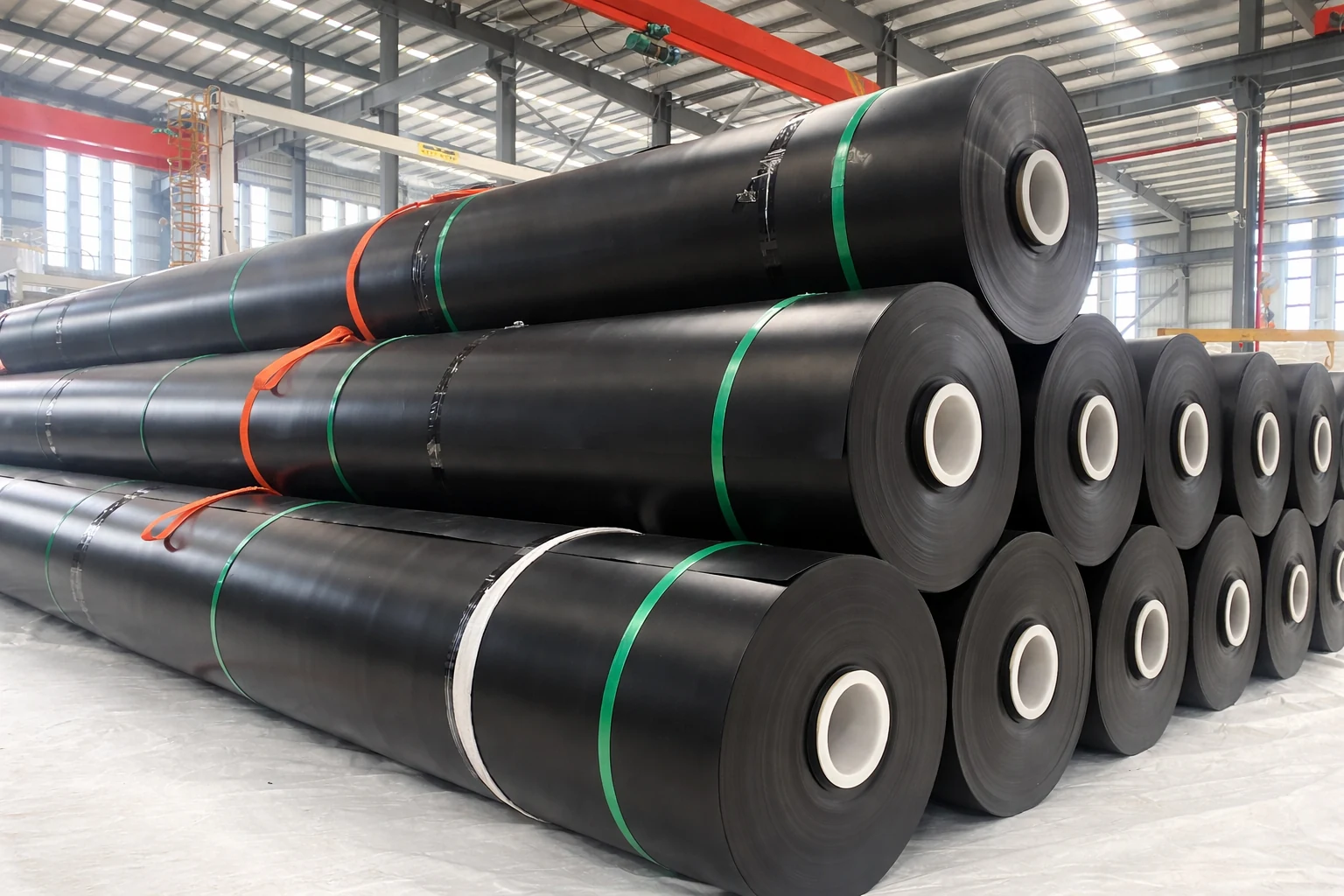
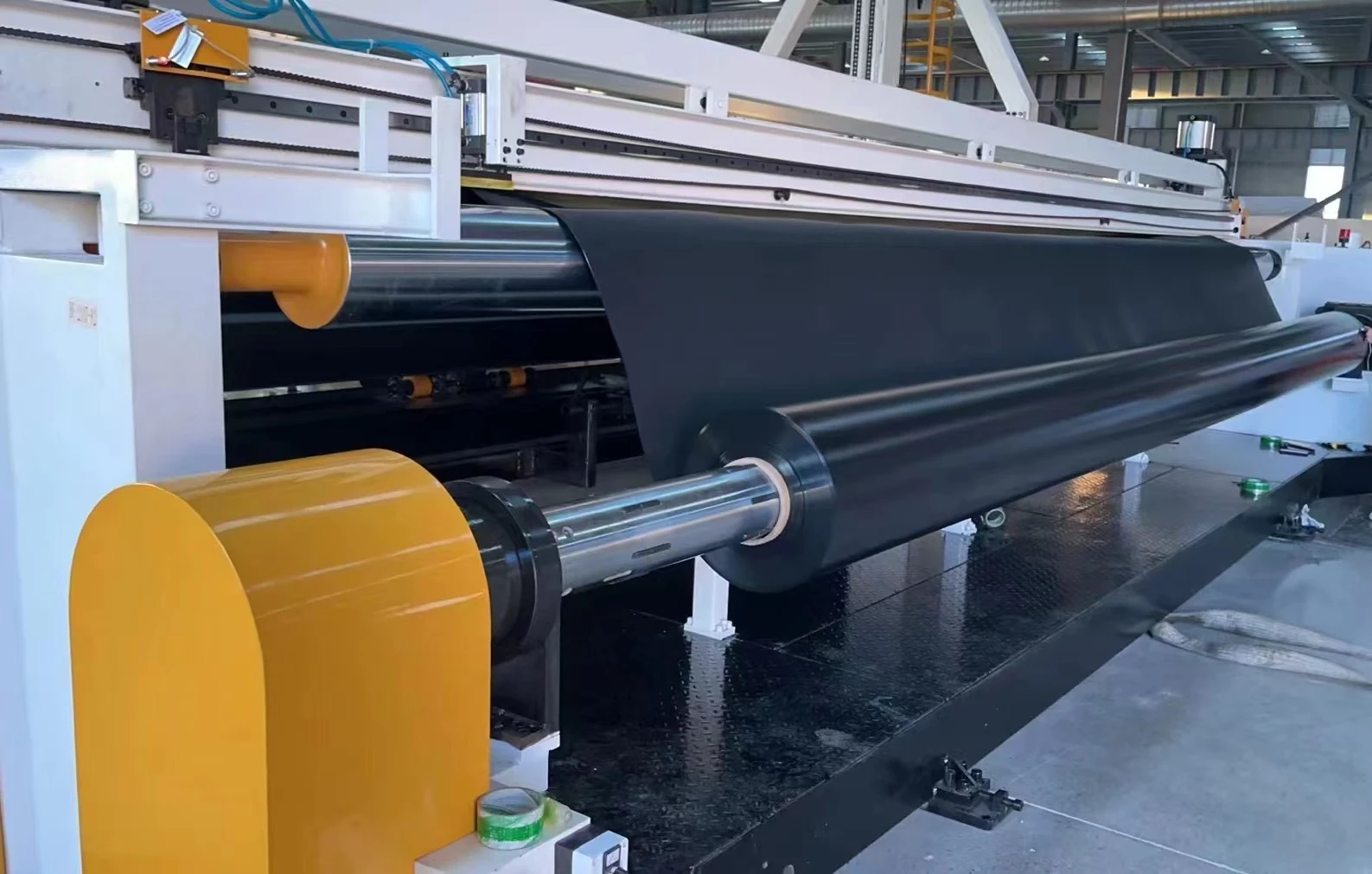
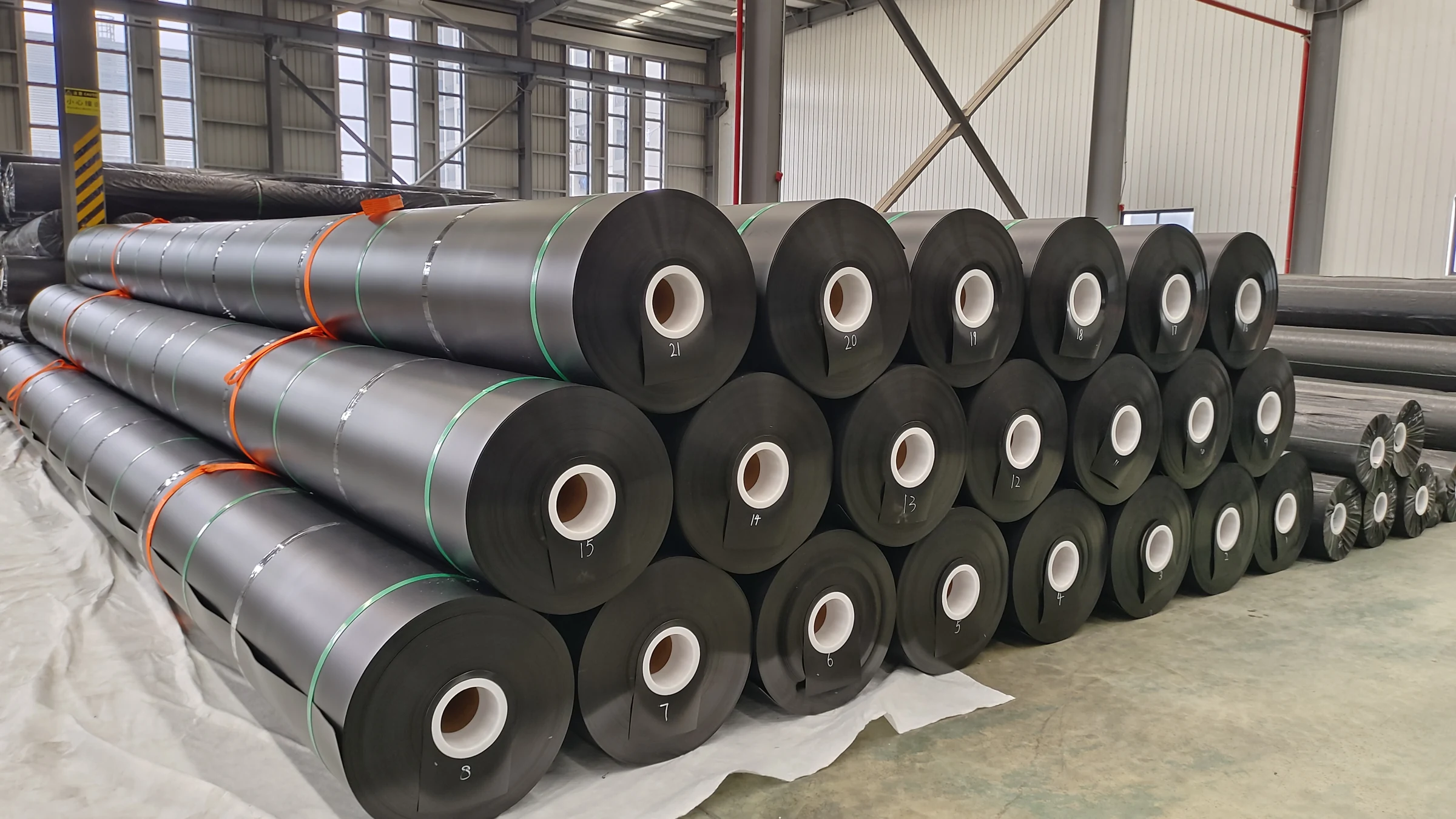
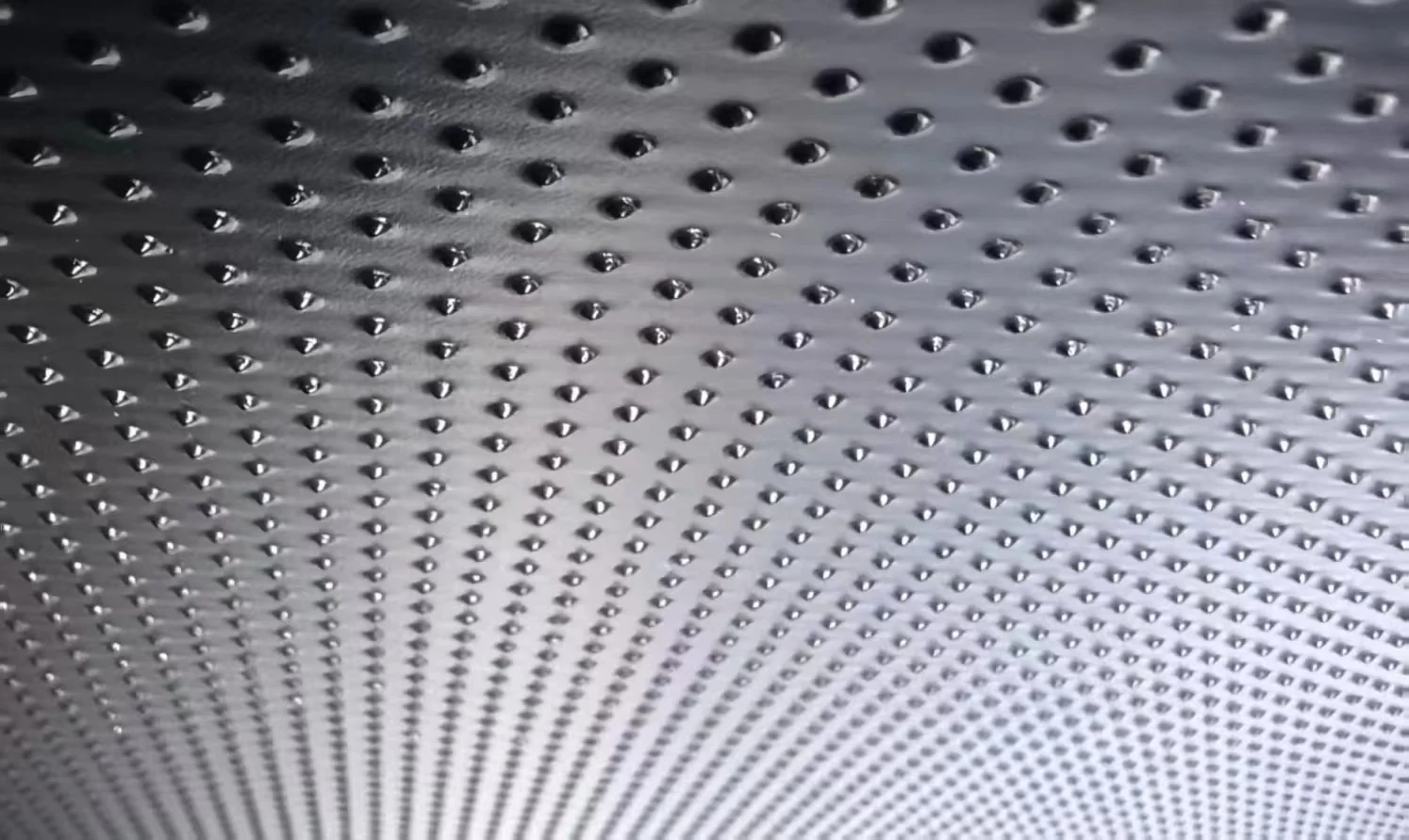
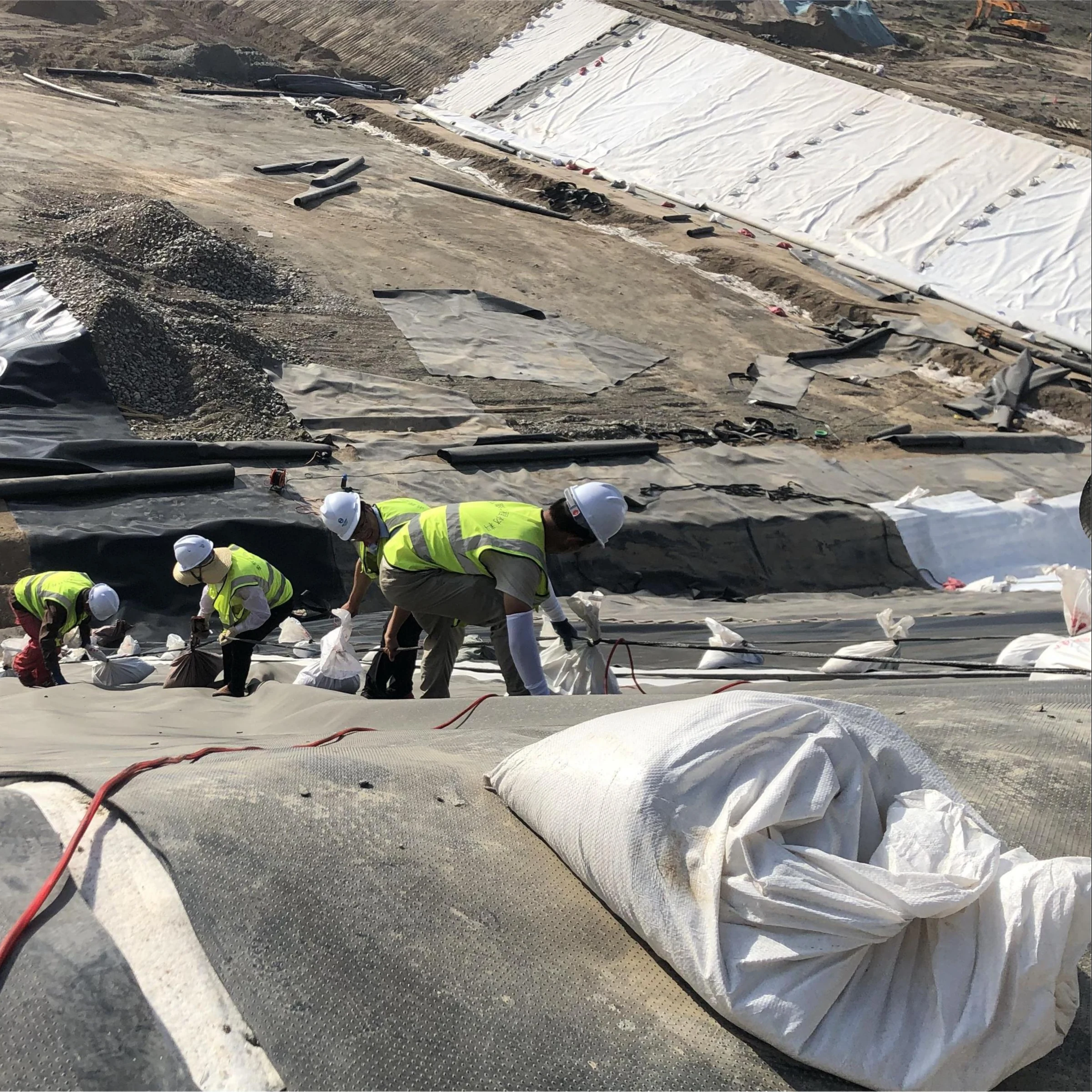
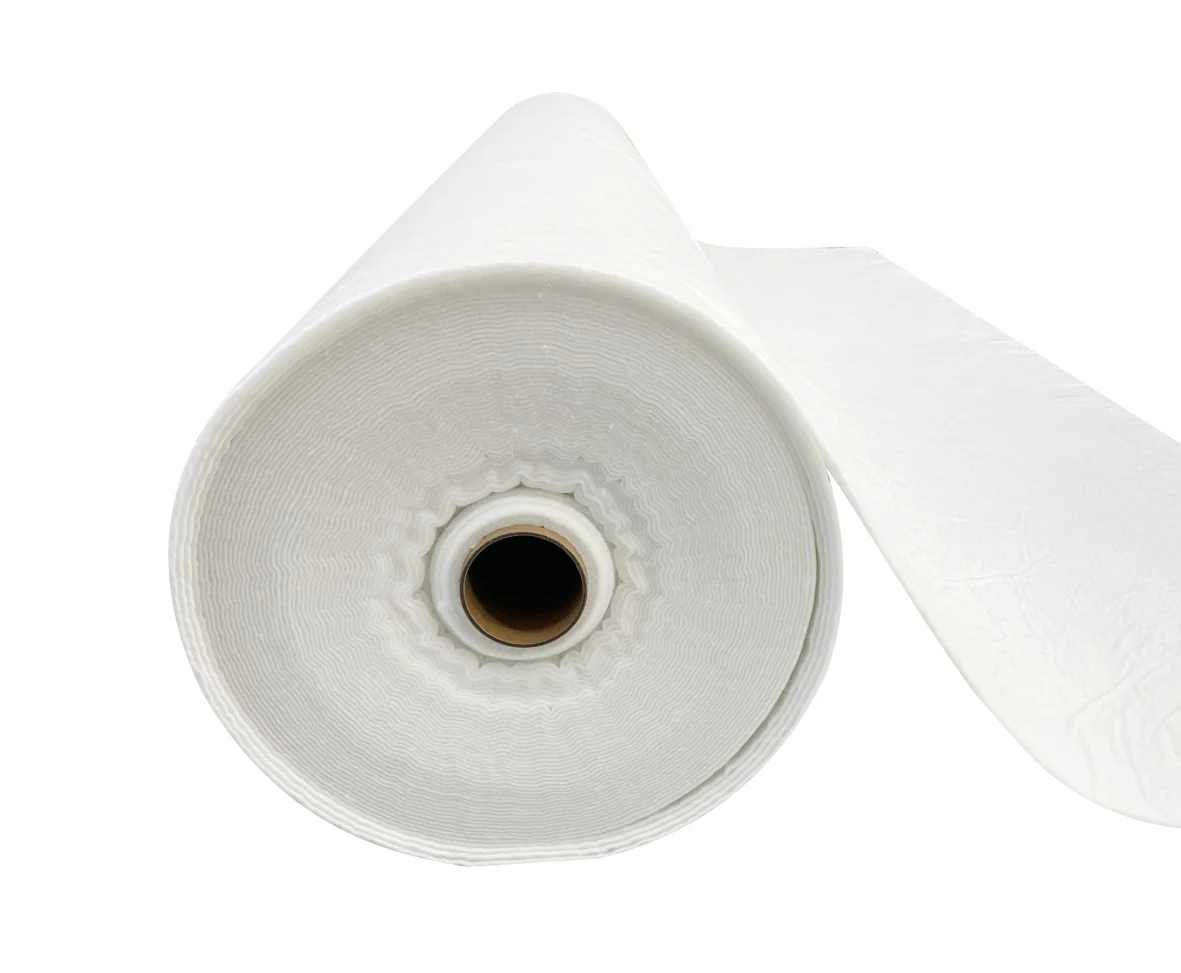

Geomembrane roll handling and storage influence the condition of HDPE, LLDPE, and textured geomembrane before installation begins. Rolls used for landfill containment, mining pads, reservoirs, wastewater ponds, aquaculture ponds, and secondary containment areas are heavy, wide, and sensitive to edge crushing, surface abrasion, contamination, and poor traceability. A controlled site procedure should cover lifting capacity, load support, covered storage, exposure control, clean laydown surfaces, and pre-installation inspection. Good storage practice does not replace field seam testing or quality assurance, but it reduces avoidable damage before welding, leak testing, and cover placement.
Forklift Safety
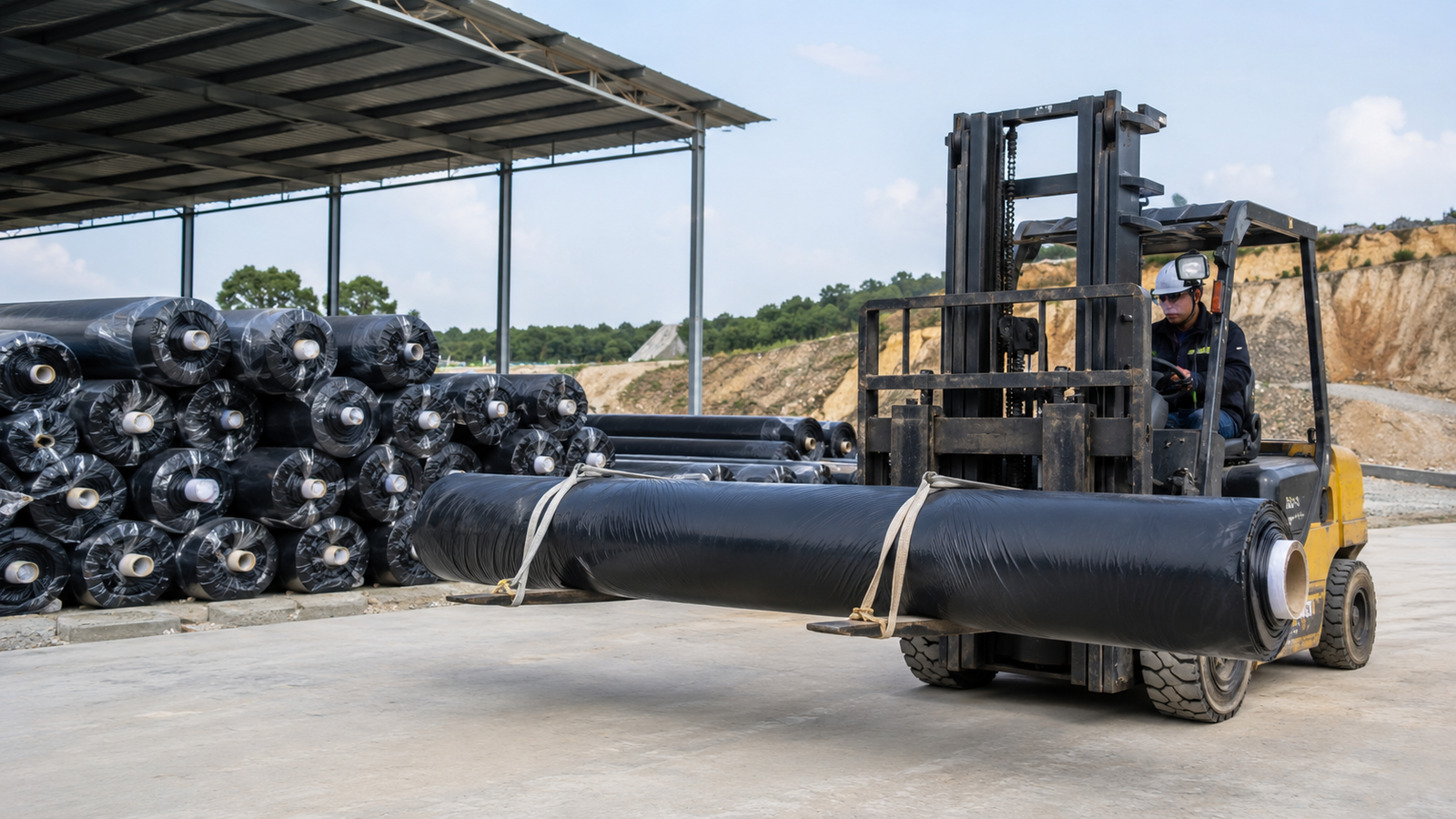
Forklift handling controls whether geomembrane rolls reach the installation area without core bending, edge crushing, surface scratches, or dropped-load damage. A single HDPE or LLDPE geomembrane roll can weigh from several hundred kilograms to several tonnes, depending on thickness, roll width, length, and core type. The forklift rating must exceed the full lifted load, including fork extensions, lifting beam, pipe core, and slings. Operators should keep the roll low during travel, avoid sharp turning, and use stable haul routes with compacted ground. For wide rolls, a spreader bar or core pipe reduces point loading and prevents deformation before welding begins.
Forklift Capacity and Roll Weight Check
Forklift selection should start with the actual roll weight, not only the nominal product thickness. A 1.5 mm HDPE geomembrane roll, 7 m wide and 100 m long, contains about 700 m² of liner. With HDPE density around 0.94 g/cm³, the sheet weight alone is roughly 987 kg before adding the core, packaging, lifting pipe, straps, and handling accessories. Thicker or longer rolls can move quickly into multi-tonne lifting conditions.
The forklift nameplate capacity must be checked under the actual load center. A machine rated for 3 tonnes at a 500 mm load center may not safely lift the same weight when a long geomembrane roll shifts the load center forward. This is a common handling issue on landfill cells, mining pads, reservoirs, and industrial wastewater pond projects.
| Check Item | What to Confirm | Why It Matters |
|---|---|---|
| Roll weight | Product weight plus core and packaging | Prevents forklift overload |
| Load center | Distance from mast to roll center | Long rolls reduce rated capacity |
| Attachment weight | Fork extensions, boom, pipe, or spreader bar | Attachments reduce available lifting capacity |
| Travel condition | Slope, turning radius, surface firmness, and ground drainage | Controls tipping, roll shift, and route failure |
Before unloading, the site team should confirm roll weight from the packing list, production label, or shipping document. The weight of the lifting pipe, fork extensions, straps, and protective supports should be added to the load calculation. If the forklift is close to its rated limit, the handling method should be changed. A higher-capacity forklift, crane-assisted unloading, a longer spreader beam, or staged movement to a prepared laydown area is safer than lifting at the edge of the machine rating.
- Keep the roll centered across both forks or across the lifting beam.
- Do not lift from one roll edge or one side of the core.
- Keep the load low during travel and raise it only when needed for placement.
- Avoid sudden braking, sharp turning, and travel across soft shoulders.
- Separate unloading traffic from welding areas, liner panels, fuel storage, and active earthworks.
Fork Extensions and Spreader Bar Use
Geomembrane rolls should not be handled like short palletized goods. Wide rolls create long bending spans, and direct fork pressure can crush the roll edge, deform the core, or leave compression marks on the outer wraps. Fork extensions may be used only when they are rated for the load and properly locked to the forks. Loose extensions can slide during turning, especially on uneven ground.
For many site conditions, the preferred method is to pass a steel pipe or lifting shaft through the roll core and support it from both ends. This spreads the load along the core instead of pressing directly into the membrane surface. A spreader bar helps keep slings vertical and reduces inward compression on the roll edges.
| Handling Element | Recommended Control | Risk If Ignored |
|---|---|---|
| Core pipe | Use a pipe with enough stiffness and length beyond both roll ends | Core bending, roll edge compression, unstable lifting |
| Spreader bar | Keep slings near vertical and reduce side pressure | Inward roll-edge crushing and roll shape distortion |
| Fork extensions | Use rated, locked extensions only | Sliding extensions, uneven support, uncontrolled load movement |
| Roll rotation | Control movement with slow travel and site-approved tag line methods | Impact damage or uncontrolled swing during placement |
After each lift, the roll should be checked before it is stacked or moved into the installation sequence. The roll core should remain straight, the outer wrap should not show cuts or abrasion, and the roll shape should remain round and stable. If the roll bends during lifting, the support method is not suitable for that roll size.
- Use padded contact points where the lifting system touches the roll.
- Do not drag rolls across gravel, concrete edges, rebar, or compacted fill.
- Protect roll ends with edge guards, timber blocks, or smooth supports.
- Keep slings and lifting accessories away from direct contact with the membrane surface.
- Mark torn wrapping, crushed edges, or visible deformation before storage.
Loading Area Ground Stability
The loading and storage area should be prepared before trucks arrive. Geomembrane rolls are long, heavy, and difficult to control once the forklift enters soft ground, ruts, loose aggregate, or wet clay. Ground failure can lead to forklift tilting, roll sliding, edge impact, or contact with sharp objects.
A suitable unloading area should be level, compacted, drained, and free of debris. On mining, landfill, reservoir, and industrial pond projects, the laydown zone should also be separated from active earthworks, welding areas, traffic lanes, and fuel storage areas. Rolls should not be placed directly on angular rock, scrap steel, exposed reinforcement, broken concrete, or wet unstable soil.
| Site Condition | Handling Risk | Control Measure |
|---|---|---|
| Soft soil or wet subgrade | Forklift rutting and tilt | Use mats, compacted platform, or another unloading point |
| Loose gravel | Reduced traction and roll movement | Level and compact the surface before unloading |
| Sharp aggregate | Membrane abrasion during staging | Use dunnage or a clean protection layer under rolls |
| Cross-slope | Side shift during travel | Regrade the route or use assisted handling |
| Tight turning area | Roll impact with vehicles, stockpiles, or equipment | Create clear turning radius before unloading |
Ground slope should be controlled because long rolls can shift laterally during travel. Even a small cross-slope can create handling difficulty when the forklift turns or brakes. If unloading must occur near a slope, the route should be reviewed before the roll is moved.
- Grade the unloading area before delivery.
- Remove stones, metal scraps, timber nails, and sharp debris.
- Use timber dunnage or smooth supports under rolls.
- Keep rolls parallel to the planned deployment direction where possible.
- Provide drainage so standing water does not collect under stored rolls.
UV Protection on Site
UV protection during site storage reduces premature surface oxidation, packaging breakdown, label loss, and heat-related roll deformation before installation. Black HDPE and LLDPE geomembranes are normally UV-stabilized with carbon black, often specified around 2%–3% for polyethylene liners, but this does not mean rolls should remain uncovered for long site storage. Storage control should separate short-term installation staging from long-term exposure. Rolls should be placed on clean dunnage, covered with light-colored weatherproof sheeting, ventilated to reduce heat buildup, and recorded by delivery date. Labels, batch numbers, thickness marks, and roll direction marks must remain readable for traceability before deployment and welding.
Temporary Covered Storage Area
A temporary covered storage area should be prepared before geomembrane rolls arrive at the project site. This area does not need to be a permanent warehouse, but it must protect rolls from direct sunlight, standing water, mud, sharp debris, and uncontrolled traffic. For reservoir lining, landfill containment, mining pads, industrial wastewater ponds, and aquaculture projects, poor storage layout can create damage before installation begins.
| Storage Requirement | Practical Control | Site Reason |
|---|---|---|
| Sun protection | Use light-colored tarpaulin, shade structure, or temporary canopy | Reduces direct UV and surface heating |
| Ventilation | Leave airflow gaps under covers | Prevents heat and moisture buildup |
| Clean base | Use timber dunnage, smooth beams, or prepared pads | Reduces abrasion and puncture risk |
| Drainage | Keep rolls above standing water | Protects packaging, labels, and roll edges |
| Traffic separation | Mark the storage boundary and forklift route | Reduces impact damage and uncontrolled contact |
The cover should not be placed tightly against the roll surface in hot weather. Tight dark covers can increase heat buildup, especially in desert, mining, or exposed civil worksites. A light-colored cover with airflow space is more suitable for short-term outdoor storage.
- Store rolls on level, compacted ground.
- Keep rolls off angular rock, concrete debris, and scrap metal.
- Place rolls parallel and spaced enough for forklift access.
- Keep storage away from fuel tanks, welding sparks, rebar work, and active truck routes.
- Do not place heavy materials on top of geomembrane rolls.
- Keep roll ends protected from rain splash, soil, and impact.
For textured geomembrane rolls, edge and surface protection need more attention. Textured surfaces can trap dust, sand, or small particles during storage. If the roll surface becomes contaminated before seaming, cleaning time increases and weld preparation becomes less predictable.
Roll Exposure Time Control
Exposure time should be controlled by storage planning, not guessed after the rolls have been left outside. UV-stabilized geomembranes are designed for outdoor engineering use, but roll storage is different from installed service. During storage, only the outer wraps receive direct sunlight, while heat can build up around the roll surface and packaging film. This can weaken packaging, fade labels, distort edge wrapping, or cause local surface stress before installation.
A first-in, first-out system helps reduce uneven exposure. Rolls delivered first should normally be installed first, unless the installation sequence requires a different thickness, width, surface type, or panel layout.
| Roll Status | Storage Control | Handling Priority |
|---|---|---|
| Immediate installation | Stage near deployment area with short exposure | Use first where installation sequence allows |
| Short-term storage | Covered outdoor storage with date record | Inspect weekly and after weather events |
| Long-term storage | Covered, ventilated, controlled laydown area | Protect labels and inspect more often |
- Record delivery date and planned installation area.
- Mark rolls by project zone, thickness, material type, and surface finish.
- Avoid opening protective wrapping until the roll is needed.
- Do not leave partially unwrapped rolls exposed overnight unless deployment is active.
- Re-cover rolls after inspection, relocation, or weather preparation.
- Check outer wraps after high heat, strong wind, or heavy rain.
The storage period allowed by the project specification should control acceptance. If no site-specific storage limit is stated, the safer method is to keep exposure as short as practical and document visible condition before installation. During hot weather, geomembrane rolls can expand and contract through daily temperature cycles. This does not automatically mean the material is defective, but it can affect roll tightness, packaging condition, and edge alignment.
| Exposure Log Item | Example Field |
|---|---|
| Roll number | Roll ID from label |
| Material type | HDPE, LLDPE, textured, or smooth |
| Thickness | Project-specified thickness such as 1.0 mm, 1.5 mm, or 2.0 mm |
| Delivery date | Date received on site |
| Cover condition | Covered, partly covered, or uncovered |
| Visible issue | Torn wrap, faded label, edge damage, or contamination |
Packaging Film and Label Protection
Packaging film, roll labels, end caps, and batch markings are part of site quality control. They help confirm material type, thickness, roll width, roll length, surface finish, production batch, and installation sequence. If labels become unreadable, the site team may lose traceability between supplied rolls, panel layout, welding records, and quality control documentation.
Packaging protection should focus on the outer wrapping, roll-end protection, and label readability. The outer film protects the roll surface from dust, moisture, abrasion, and short-term weather. Roll ends are exposed during lifting, stacking, and staging. Product labels should be protected or copied into the site record before long storage.
- Photograph each roll label during delivery inspection.
- Record roll number, thickness, material type, width, and length.
- Keep labels facing outward where possible.
- Do not cover labels with mud, tape, or unreadable markings.
- Replace loose labels with temporary site tags linked to the original roll data.
- Keep packaging intact until the roll is assigned for deployment.
| Inspection Point | Acceptable Condition | Action If Problem Is Found |
|---|---|---|
| Packaging film | Intact or repaired, with no open tears exposing liner | Re-cover and inspect exposed area |
| Roll label | Readable roll ID and material details | Use delivery record or photo to confirm traceability |
| End cap | Secure and not crushed | Inspect roll edge before deployment |
| Surface contamination | No mud, oil, sharp debris, or excessive dust | Clean according to site procedure |
| Outer layer | No visible cuts, gouges, or abrasion | Mark area for repair review or removal |
Packaging should not be removed early only to make storage look orderly. Early removal increases dust exposure, UV exposure, and handling damage. The better practice is to keep the roll protected, maintain readable identification, and open only the rolls scheduled for installation.
Damage Prevention
Damage prevention starts before deployment because geomembrane rolls can be affected by edge crushing, surface abrasion, core deformation, contamination, and hidden cuts during transport and storage. HDPE and LLDPE geomembranes used in reservoirs, landfill cells, mining pads, wastewater ponds, and secondary containment areas commonly range from 0.75 mm to 2.5 mm in thickness, while roll widths may exceed 5–8 m. Even small cuts or deep scratches can affect welding, leak testing, and liner acceptance. Site control should cover roll-edge protection, clean storage support, stacking limits, traffic separation, and visual inspection before panels are unrolled for installation.
Roll Edge Protection During Transport
Roll edges are exposed during truck loading, unloading, forklift handling, and movement across the site. Edge damage is common because the outer wraps and roll ends are the first contact points when the roll shifts, touches a truck sidewall, hits dunnage, or rests on uneven ground.
| Stage | Main Risk | Required Control |
|---|---|---|
| Truck transport | Roll movement, side impact, strap pressure | Secure rolls with wide straps and edge protection |
| Unloading | Fork impact, core bending, edge crushing | Lift through the core or use padded support points |
| Site movement | Contact with gravel, concrete, debris, or equipment | Keep rolls elevated and avoid dragging |
Rolls should not be dragged from trucks or pulled across the ground. Dragging can create abrasion lines on the outer layer and may also pull soil, stones, or metal fragments into the roll edge. If the outer wrap is damaged, the affected area should be marked before the roll is opened.
- Keep rolls chocked during truck transport.
- Use smooth timber dunnage under the roll.
- Place dunnage so it does not deform the core.
- Avoid direct contact with steel truck edges.
- Protect roll ends from rain splash, mud, and sharp aggregate.
- Keep labels and end markings visible for traceability.
- Inspect roll ends before moving rolls into the storage zone.
| Observed Condition | Possible Effect | Site Action |
|---|---|---|
| Crushed edge | Wrinkle, fold memory, panel distortion | Mark and inspect during unrolling |
| Torn outer wrap | UV, dust, or water exposure | Re-cover and check outer layer |
| Exposed liner surface | Surface abrasion or contamination | Clean and inspect before deployment |
| Damaged core | Poor roll support during lifting | Change handling method |
| Deep gouge or cut | Possible repair or panel rejection | Mark, photograph, and assess under the QA procedure |
For textured geomembrane, edge protection is more sensitive because the surface profile can trap sand or debris. If contaminated roll edges are later used near weld areas, cleaning time increases and seam preparation becomes less consistent.
Storage Surface and Stacking Height Control
The storage surface has direct influence on roll condition. Geomembrane rolls should be stored on a clean, level, drained, and compacted area. The surface should not contain angular rock, broken concrete, exposed rebar, metal scrap, timber nails, or sharp aggregate. These objects can damage outer wraps and may puncture or scratch the liner when the roll settles under its own weight.
A suitable storage base should include smooth supports. Timber dunnage, padded beams, or prepared storage cradles help keep rolls above the ground and reduce contact pressure. Dunnage should be aligned so the roll does not sag, twist, or rest on a narrow point.
| Storage Factor | Acceptable Condition | Risk If Poorly Controlled |
|---|---|---|
| Ground level | Flat and stable | Roll movement or edge pressure |
| Drainage | No standing water under rolls | Packaging damage and label loss |
| Surface cleanliness | No sharp debris | Cuts, abrasion, puncture marks |
| Support type | Smooth dunnage or cradle | Reduced point loading |
| Traffic control | Clear separation from work routes | Forklift impact or accidental contact |
Stacking height should follow the manufacturer’s packing instruction and the project specification. Large geomembrane rolls are often best stored in a single layer because high stacking can deform lower rolls, crush cores, and make safe lifting difficult. If stacking is allowed, the lower layer must be supported evenly, and the upper rolls must not create point pressure on roll edges.
- Do not stack rolls directly on uneven soil.
- Do not place rolls on sharp stones or loose rubble.
- Avoid stacking different roll diameters in the same pile.
- Keep large-diameter rolls at the bottom if stacking is permitted.
- Use chocks to prevent rolling.
- Do not store heavy pallets, pipes, equipment, or geotextile bales on top of geomembrane rolls.
- Leave enough spacing for forklift access without side impact.
Storage should also consider material type and installation sequence. HDPE geomembrane, LLDPE geomembrane, textured geomembrane, and PET non-woven geotextile protection layers should be separated clearly if they are delivered to the same site. Mixing rolls can cause handling errors, wrong deployment order, or delays during panel layout.
| Site Storage Checklist | Review Point |
|---|---|
| Roll support | Rolls are stored on smooth dunnage or prepared cradles |
| Storage area | Area is free of sharp debris and standing water |
| Label condition | Roll labels remain readable |
| Cover condition | Covers are secure but ventilated |
| Roll edge condition | No crushed roll edges are visible |
| Traffic separation | Forklift route is separated from the storage pile |
| Packaging damage | Damaged packaging is marked for review |
Storage conditions should be checked after delivery, after heavy rain, after strong wind, and before installation. A roll that was acceptable during delivery can still become damaged if it shifts, loses cover, or is hit by equipment during site work.
Pre-installation Visual Inspection and Repair Marking
Before deployment, each roll should receive a visual inspection. This inspection does not replace formal field quality control testing, but it reduces the chance that visible damage reaches the welding area unnoticed. The inspection should focus on the roll surface, roll edge, packaging condition, contamination, core condition, and label traceability.
Pre-installation inspection should be done before the roll is moved to the active installation area and again when the panel is unrolled. Some defects are hidden inside the roll and only appear during deployment.
| Inspection Area | What to Check | Site Response |
|---|---|---|
| Roll edge | Crushing, cuts, folds, exposed liner | Mark and inspect after unrolling |
| Outer wrap | Tears, holes, missing cover | Check exposed area before deployment |
| Surface | Scratches, gouges, abrasion, oil, mud | Clean, mark, or repair as specified |
| Core | Cracked, bent, or collapsed core | Adjust lifting method |
| Label | Roll ID, thickness, material type, batch | Record before installation |
| Textured surface | Sand, dust, or debris in profile | Clean before seaming area is prepared |
Damage marking should be clear but should not create new damage. Site teams can use non-contaminating markers, flags, tags, or temporary tape outside the weld zone. Sharp tools, nails, staples, or paint that may contaminate the welding surface should not be used.
- Confirm the roll ID against the panel layout.
- Check packaging and roll ends before lifting.
- Move the roll using the approved handling method.
- Unroll slowly on prepared subgrade.
- Stop if cuts, deep scratches, or contamination appear.
- Mark the affected area without damaging the liner.
- Record the issue in the site inspection log.
- Complete repair or removal before cover placement or final acceptance.
Repair marking should include the roll number or panel number, visible damage location, damage type, approximate size, photo record if required, and repair status. Not every surface mark requires repair, but every suspect cut, puncture, or deep gouge should be assessed before the area is covered or welded. Repair decisions should follow the project specification, manufacturer guidance, and field quality assurance plan. Common repair methods may include cleaning, patching, extrusion welding, cap stripping, or cutting out affected material, depending on the damage type and location.
For geomembrane systems combined with PET non-woven geotextile protection layers, visual inspection should still be completed before the geotextile is placed over the liner. A protection layer reduces puncture risk from cover soil, aggregate, and operational loading, but it should not be used to hide unresolved liner damage.
| Final Review Before Welding | Required Condition |
|---|---|
| Weld overlap area | Clean, dry, and free from soil, oil, and loose particles |
| Damaged edge | Trimmed, repaired, or marked for repair review |
| Subgrade under liner | No stones, debris, or sharp objects remain under the panel |
| Wrinkle area | No sharp objects trapped under folds or overlaps |
| Repair location | Recorded for later testing and quality documentation |
FAQ
How should geomembrane rolls be stored if installation is delayed?
They should be placed on smooth dunnage in a level, drained, and controlled laydown area. Rolls should remain covered with light-colored, weather-resistant sheeting that allows ventilation. Labels should be photographed or recorded before long storage.
Can geomembrane rolls be stored outdoors?
Outdoor storage is common on civil, mining, landfill, and pond projects, but it should be controlled. Rolls should not sit directly on sharp ground, standing water, or loose debris. UV exposure, heat buildup, packaging damage, and label readability should be checked during storage.
Should damaged outer wrapping always lead to roll rejection?
Not always. Torn packaging requires inspection of the exposed area. If the liner surface is clean and undamaged, the roll may still be used under the project quality procedure. Deep cuts, gouges, punctures, or crushed edges should be marked and assessed before deployment.
Why is label protection important during roll storage?
Labels connect the roll to material type, thickness, batch information, panel layout, and welding records. If the label is lost or unreadable, traceability becomes weaker and installation documentation may be delayed.
Conclusion
Geomembrane roll handling and storage should be treated as part of site quality control, not as a simple logistics step. Forklift capacity, load center, lifting accessories, ground stability, covered storage, exposure records, roll-edge protection, and pre-installation inspection all affect liner condition before welding. For HDPE geomembrane, LLDPE geomembrane, textured geomembrane, and systems using PET non-woven geotextile protection layers, the practical target is simple: keep rolls supported, covered, traceable, clean, and free from avoidable handling damage before installation starts.