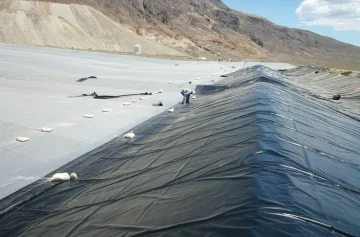
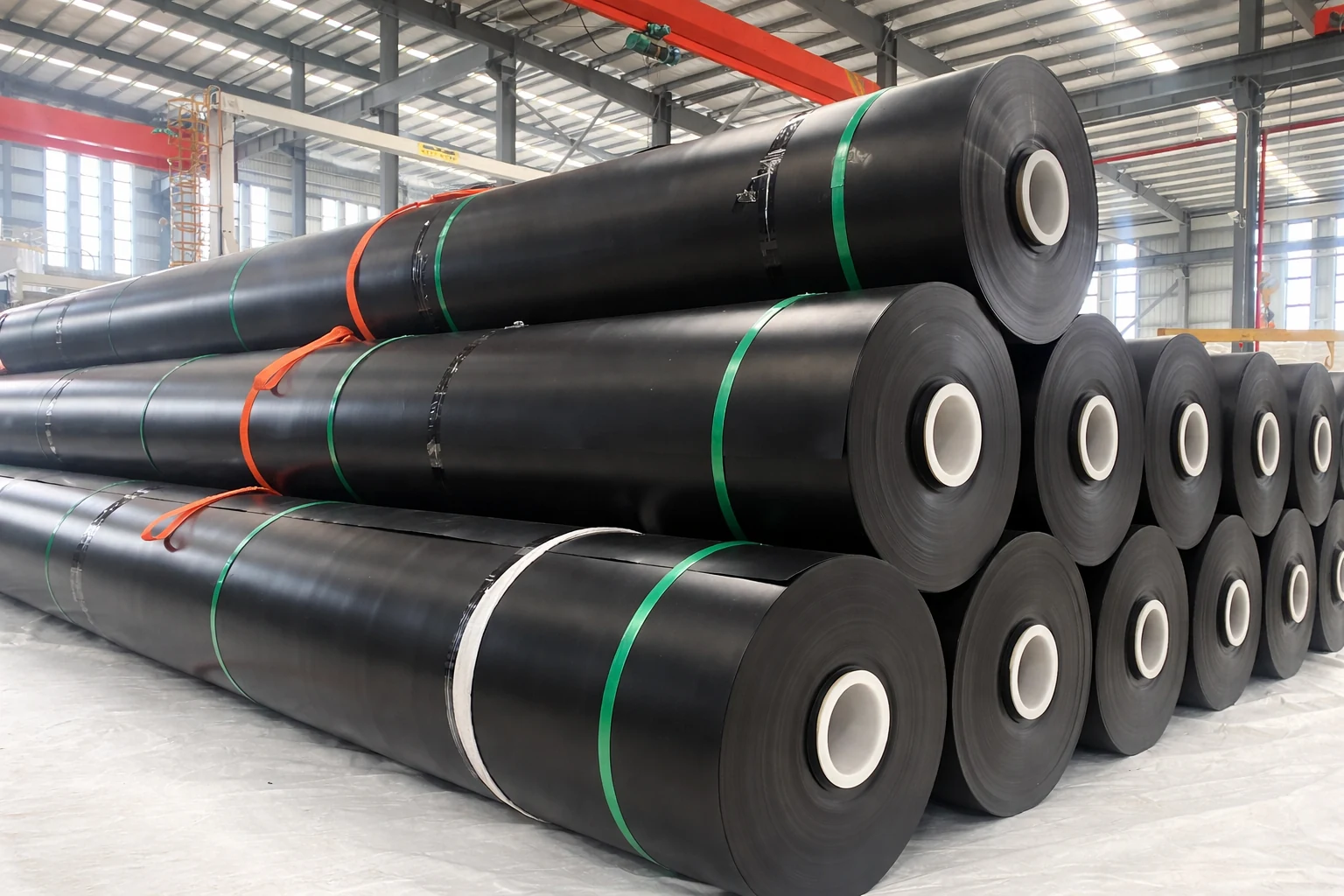
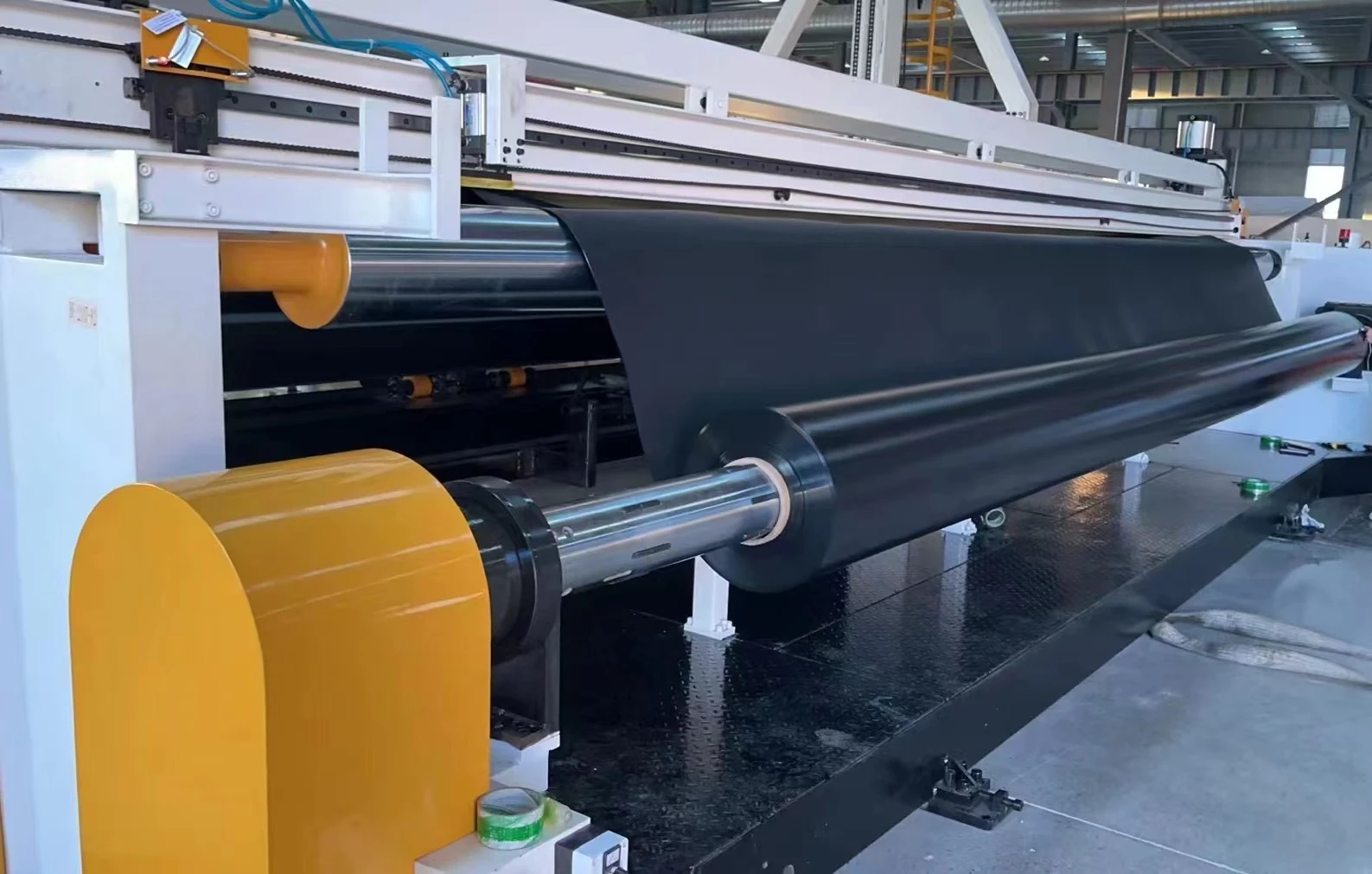
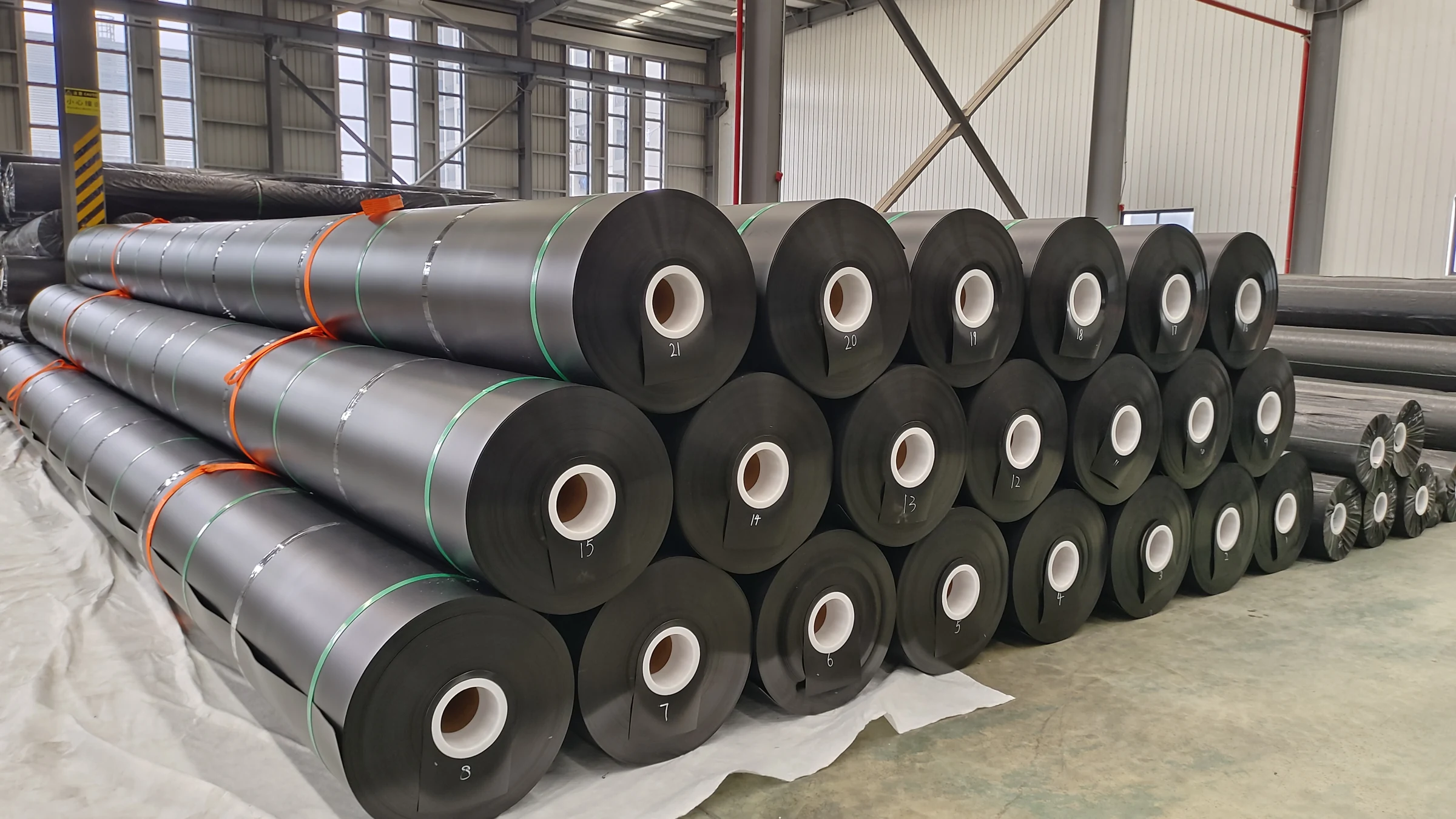
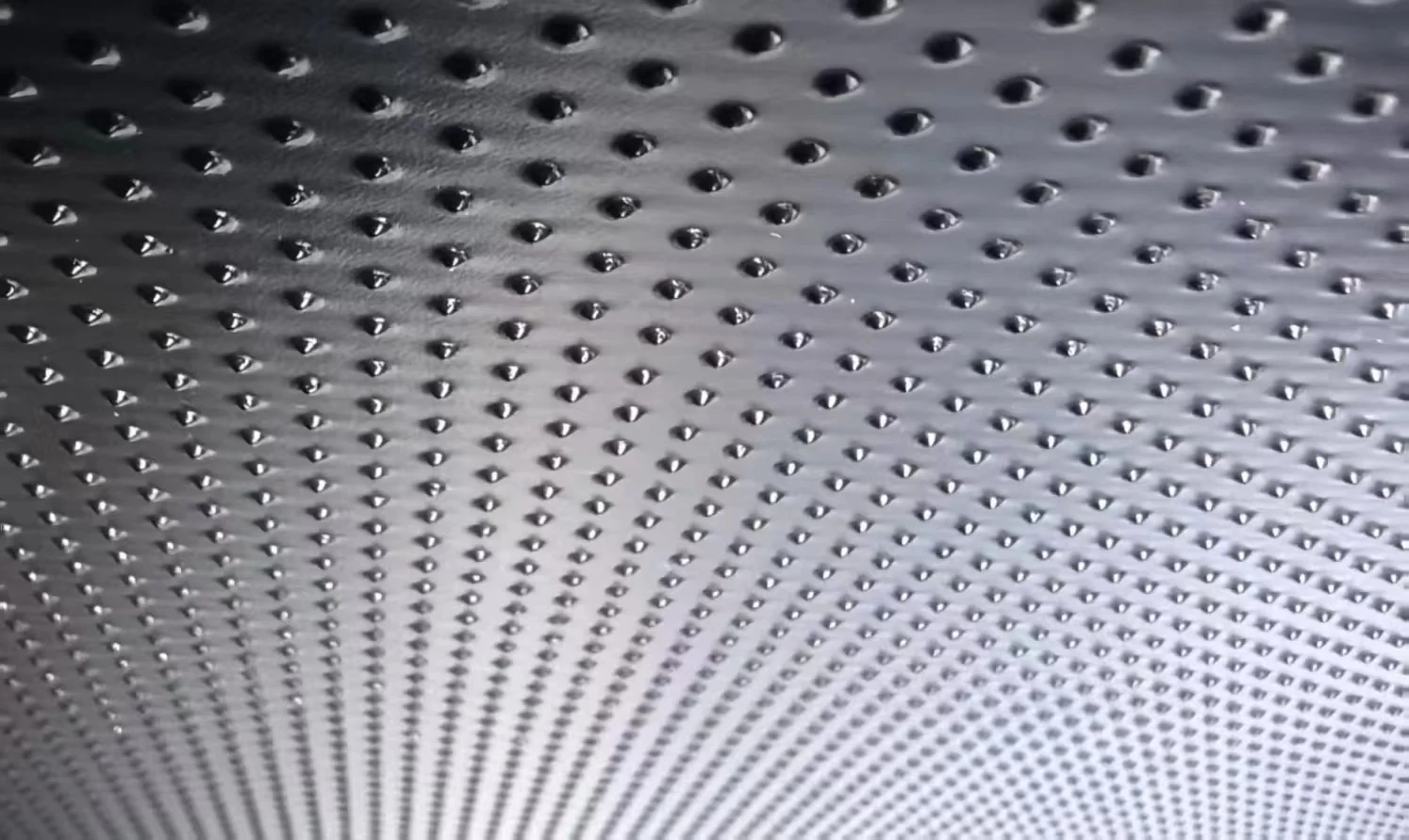
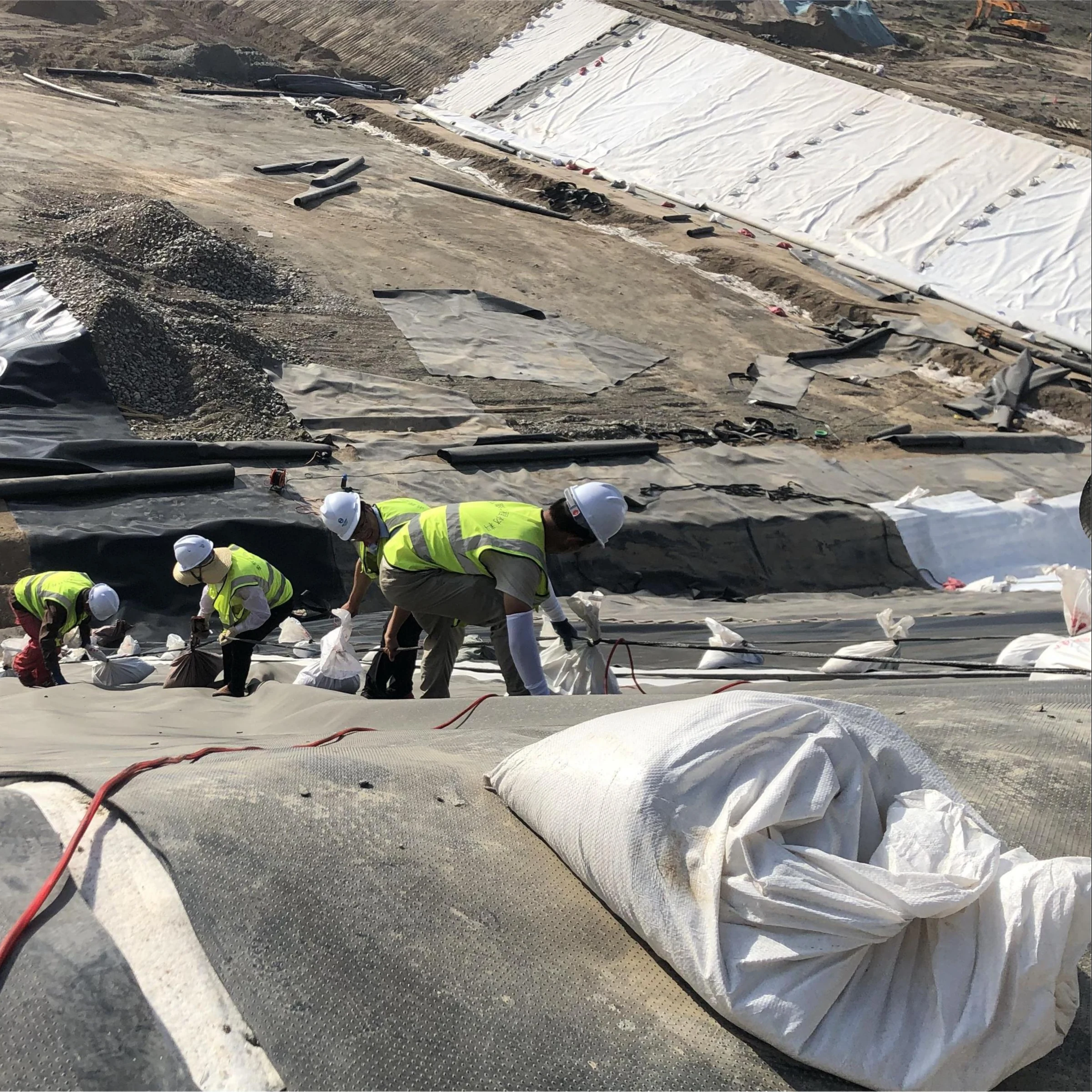
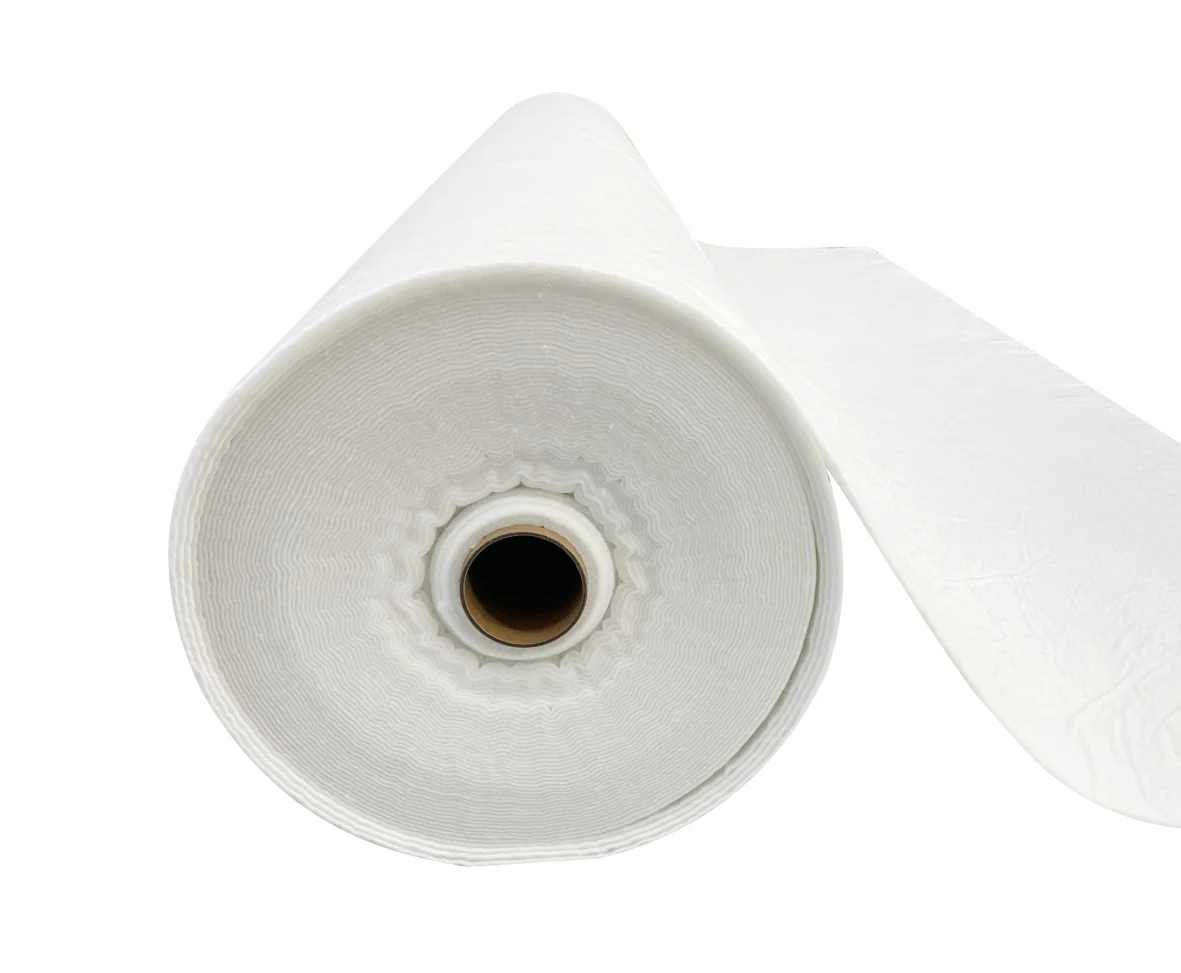

Calculate pond liner quantity from the developed surface of the pond, then add the actual anchorage, panel overlaps, details and a separately identified reserve. Floor area alone is insufficient. A material standard such as GRI-GM13 does not supply a pond-area formula or a universal waste percentage.
The worked examples below assume a rectangular pond with a level floor and uniform planar side slopes. They illustrate estimating methods, not an approved installation design or a Jinseed project record. Use the final survey and fabricator’s panel schedule before placing an order.
1. Record floor dimensions, crest dimensions and depth separately
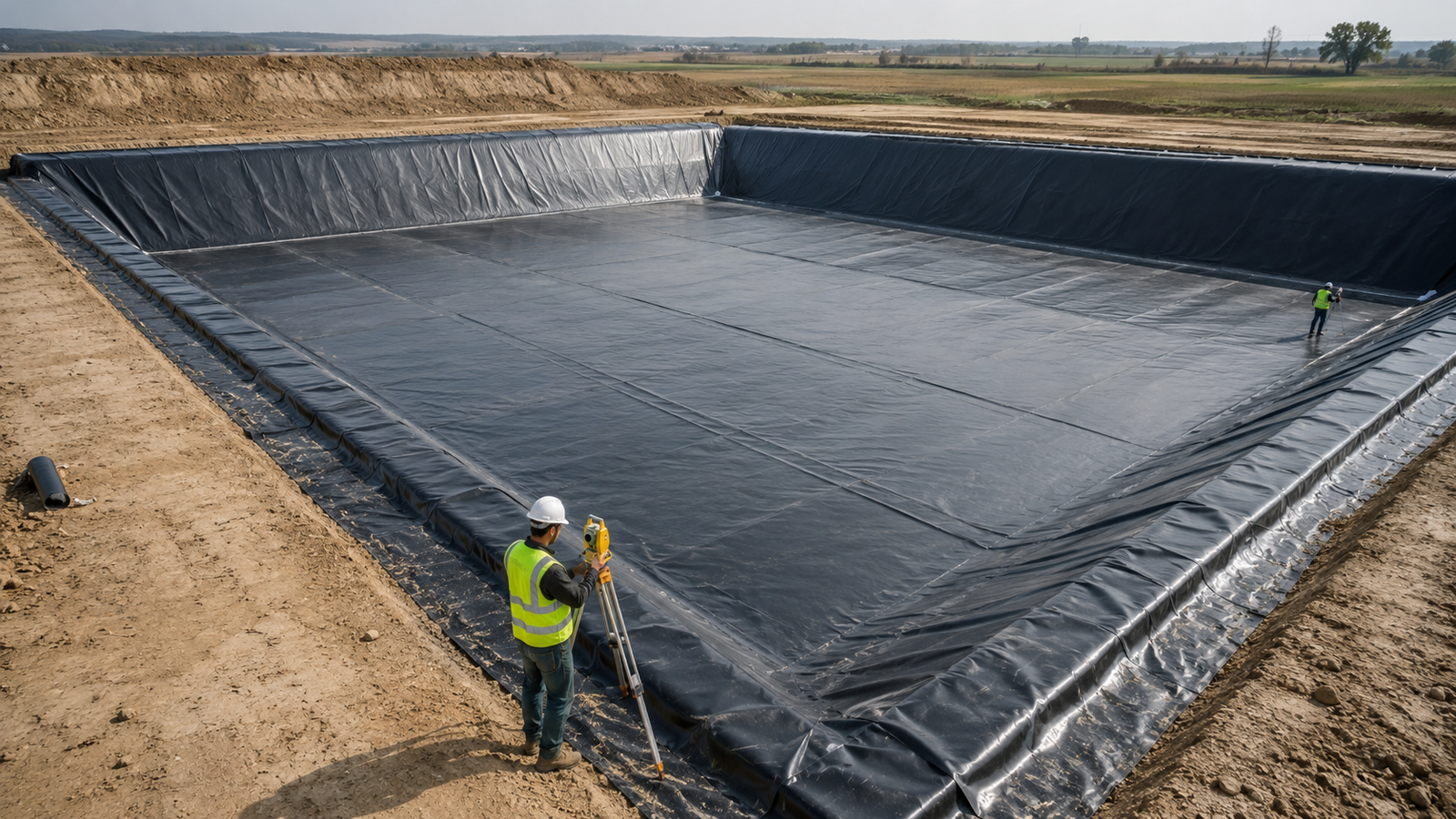
Mark whether each measurement refers to the floor, waterline, slope crest or outer anchor limit. Also record benches, sumps, pipes, slope breaks, rounded corners and local depressions. Depth to the liner’s crest differs from operating water depth where freeboard is provided.
For a uniform slope ratio mH:1V and depth d, the horizontal run of one side is r = md, and its true slope length is s = d√(1 + m²). A 2.5H:1V slope means 2.5 m horizontally per 1 m vertically.
For a rectangular floor of length L and width W with the same slope on all sides, crest dimensions are L + 2md and W + 2md. Conversely, subtract 2md from measured crest dimensions to obtain the floor dimensions, provided that the assumed geometry actually matches the pond.
For example, a 32.4 m × 22.4 m crest, 3.2 m depth and 2.5H:1V slopes give an 8.0 m run per side and a 16.4 m × 6.4 m floor. If those values disagree with the survey, resolve the geometry rather than hiding the discrepancy in a waste factor.
2. Calculate the floor and all four side slopes
Consider a 30 m × 20 m floor, 3 m depth and 2.5H:1V slopes. The crest is 45 m × 35 m, and each side’s true slope length is √(7.5² + 3²) = 8.0777 m.
| Surface | Calculation | Area |
|---|---|---|
| Floor | 30 × 20 | 600.00 m² |
| Two long slopes | 2 × [(30 + 45)/2] × 8.0777 | 605.83 m² |
| Two short slopes | 2 × [(20 + 35)/2] × 8.0777 | 444.28 m² |
| Total inside the crest | Floor + four slopes | 1,650.11 m² |
The sloping faces are trapezoids. Using their average upper and lower edge lengths accounts for the corner geometry in this idealized pond; do not add the same corner triangles again. This surface area is approximately 2.75 times the floor area, before anchorage and fabrication allowances.
The 8.0777 m slope length is 7.7% greater than its 7.5 m horizontal projection. Using projection as the slope length underestimates the true slope area by about 7.2% relative to that true area. State the denominator when reporting percentage differences.
Recalculate when the surveyed depth changes
At the same 2.5H:1V ratio, increasing depth from 3.0 to 3.5 m increases the slope length from 8.0777 to 9.4240 m, a 16.7% increase. The crest dimensions also change if the floor remains fixed. Recalculate both the slope lengths and the trapezoid widths instead of applying that percentage only to the original order.
For irregular ponds, split the surveyed surface into measured planes or use an appropriate triangulated surface model. Include sumps and transitions explicitly. The deepest point does not automatically have the greatest membrane tensile stress; support, deformation and detailing also govern. Do not select HDPE versus LLDPE or add a blanket 2% area solely from the maximum depth.
3. Separate covered area from purchased panel area
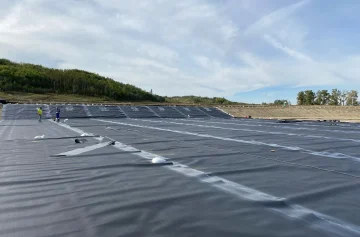
The developed surface calculation gives the area to cover. Procurement depends on roll widths, cut lengths, seam overlaps, corner folds and usable offcuts. A rectangle large enough to drape across the whole pond is a different quantity from the exact sum of the floor and trapezoidal faces. Its surplus corner material must be accounted for in the fabrication method.
For N parallel equal-width panels of width W with an overlap o at each adjacent joint, the net coverage across a flat strip is N × W − (N − 1) × o. To cover a required strip width B, a useful planning count is N = ceiling[(B − o)/(W − o)], subject to edge and detailing requirements.
Example: with 7.01 m rolls, 0.15 m overlaps and a 30 m target strip, four full panels cover only 27.59 m, not 28.04 m. A fifth strip would need 2.56 m gross width to cover the remaining 2.41 m plus its overlap. Whether the rest of that fifth roll can be reused depends on the panel schedule. This strip calculation does not, by itself, lay out the whole sloped pond.
Overlap width is not weld-track width
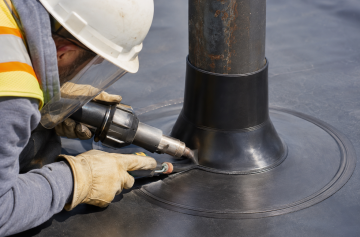
A 150 mm planning overlap describes sheet laid over sheet. It is not necessarily the width of the fused weld tracks. Use the approved equipment and welding procedure to establish the overlap, track geometry and trial-seam requirements.
ASTM D6392 addresses destructive seam testing for nonreinforced thermofused geomembranes; GRI-GM19a provides related seam acceptance properties. Neither makes a wider overlap an automatic substitute for adequate weld quality. GRI-GM9 addresses cold-weather seaming: use qualified field procedures and trial seams rather than an unsupported rule to increase every overlap from 100 to 150 to 200 mm below 5°C.
Plan seams and details to support installation, inspection and deformation requirements. A rule that all panels must run along the pond’s long axis will not suit every slope and corner. Use the approved panel layout, and avoid importing a fixed friction angle from the label “textured geomembrane.”
4. Measure the complete path into the anchor trench
The liner’s developed anchorage length can include the horizontal crest setback, a downward leg, the trench base and a return leg if the detail has one. Trench depth alone is not that length. An L-shaped detail with 0.5 m setback, 0.6 m descent and 0.6 m across the base has a 1.7 m path before any other extension. A U-shaped detail adds a return leg.
The FGI anchor-trench calculator distinguishes one-side, L-shaped and U-shaped arrangements and evaluates pullout using geometry and material properties. Quantity take-off follows the approved detail; choosing trench dimensions merely to fit an area allowance reverses the process.
For the 45 m × 35 m crest example, a 0.5 m horizontal apron around the outside has area (46 × 36) − (45 × 35) = 81 m². Its outer perimeter is 164 m. A preliminary allowance for a 0.6 m downward leg plus 0.6 m base is 164 × 1.2 = 196.8 m², before resolving corner folds, seams and exact trench geometry. Keep the approximation identified and replace it with the developed panel details.
Do not count the same apron once as measured area and again as a generic “edge allowance.” Likewise, a nominal 600 mm trench depth cannot justify adding only perimeter × 0.6 m if the liner also crosses a base and a setback.
5. Add seam, detail and reserve quantities without double-counting
| Budget line | Assumption | Quantity |
|---|---|---|
| Pond surface | Calculated floor and four slopes | 1,650.11 m² |
| Horizontal apron | 0.5 m band around the crest | 81.00 m² |
| Trench legs | Preliminary 164 m × (0.6 + 0.6 m) | 196.80 m² |
| Seam overlap | Assumed total seam length 240 m × 0.15 m | 36.00 m² |
| Corner and penetration details | Assumed measured fabrication allowance | 12.00 m² |
| QA samples and trial-weld material | Assumed separate allowance | 20.00 m² |
| Subtotal | Before remaining contingency | 1,995.91 m² |
| Additional contingency | Illustrative 5% of subtotal, excluding items already itemized | 99.80 m² |
| Planning total | Before final roll/cut-length rounding | 2,095.71 m² |
This example could be described as a rough 2,100 m² planning quantity, subject to the approved layout and supplied roll sizes. The assumed 240 m seam total, 12 m² details and 20 m² QA allowance are not measurements of an actual project. Confirm them before buying. If procurement uses full rolls, round to sufficient compatible rolls or cuts; do not round the calculated requirement down.
The earlier simplified approach of 1,650.11 m² surface + 96 m² anchorage, then 1% and 8% allowances, would give about 1,904.65 m²—not a sufficient basis to order only 1,900 m². More importantly, it assumes only 0.6 m of developed anchorage and does not substantiate a 0.6 m-deep trench with its other legs. The complete geometry matters more than a familiar waste percentage.
Choose a reserve from the cutting plan and construction conditions
Separate identifiable waste and consumables from contingency: edge trimming, offcuts that cannot be reused, trial seams, destructive samples, approved repairs and maintenance stock. If these are explicitly counted, a further percentage should cover remaining uncertainty rather than duplicate them.
No universal 8–12% waste range proves efficient management, and exceeding 12% does not itself show poor workmanship. Complex shapes, roll constraints and prefabrication can create legitimate offcuts. Weather delays cost time but do not automatically consume a fixed area of liner.
Reserve compatible repair material with traceable identification and the approved welding procedure. Do not require every repair to be a pre-cut 1 m square or presume an arbitrary 5% property tolerance guarantees welding compatibility. Verify the actual repair dimensions, material and retesting under the construction quality plan.
6. Issue a procurement sheet that can be checked
- Survey revision, datum and units; distinguish floor, crest, waterline and outer anchorage.
- Depth and side slopes, including benches, sumps, transitions and penetrations.
- Developed area calculations and any approximations still awaiting detailed layout.
- Roll width and length, panel cuts, overlaps, seam map and usable offcuts.
- Anchorage cross-section, apron, corners and termination details.
- Separate QA material, repair stock and contingency allowances.
- Final ordered quantity, roll rounding and reconciliation against delivered labels.
GRI-GM13 addresses HDPE geomembrane material properties. ASTM D4873/D4873M addresses identification, storage and handling of geosynthetic rolls and samples; it is not an area or waste-factor standard. Keep those quality requirements alongside the take-off, with seam testing and installation records handled under the project plan.
For more detailed seam-layout arithmetic, see geomembrane overlap requirements. Send the surveyed section and panel requirements with an enquiry so that the quotation can distinguish net lined area from the gross material to be delivered.