

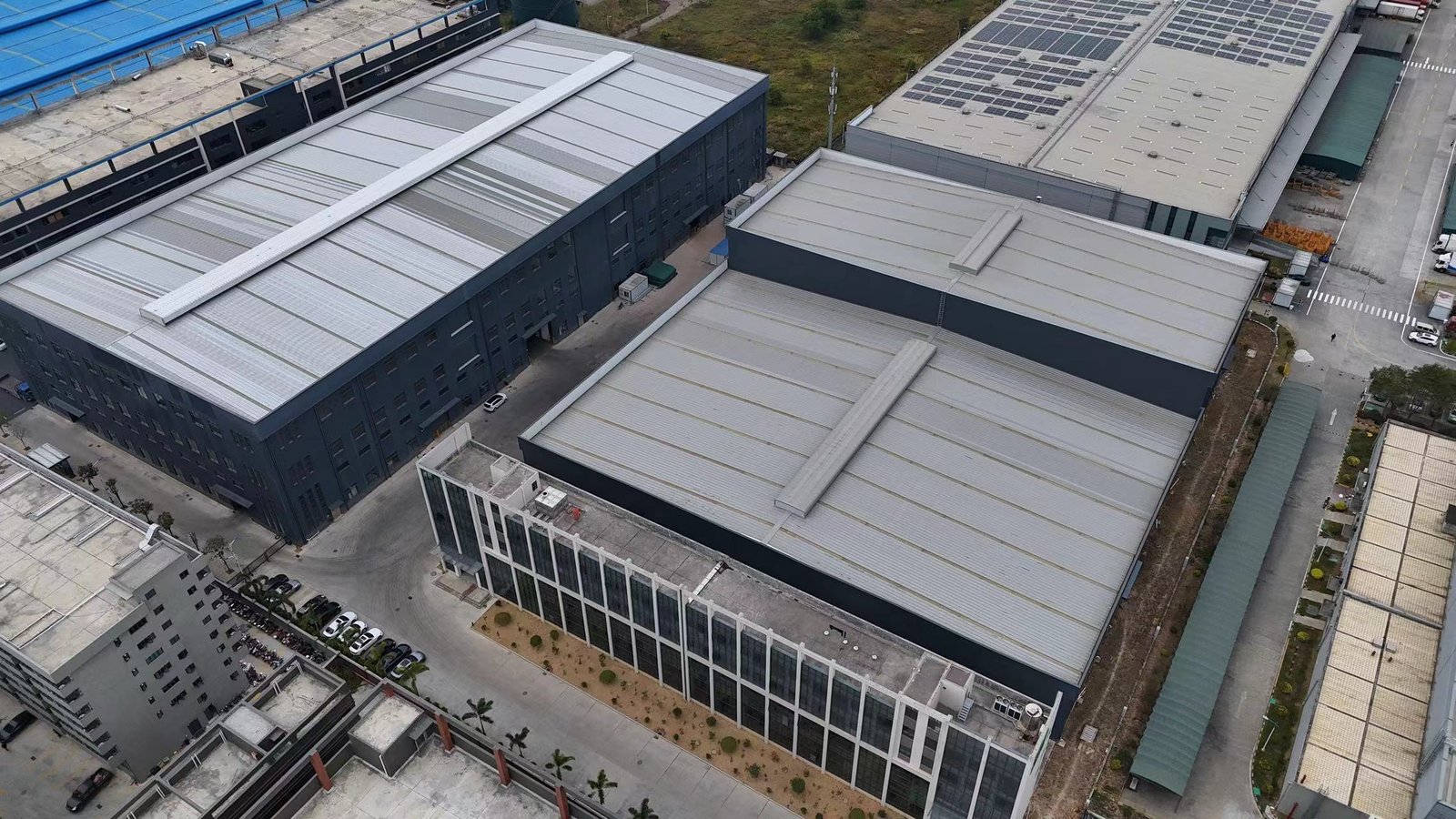
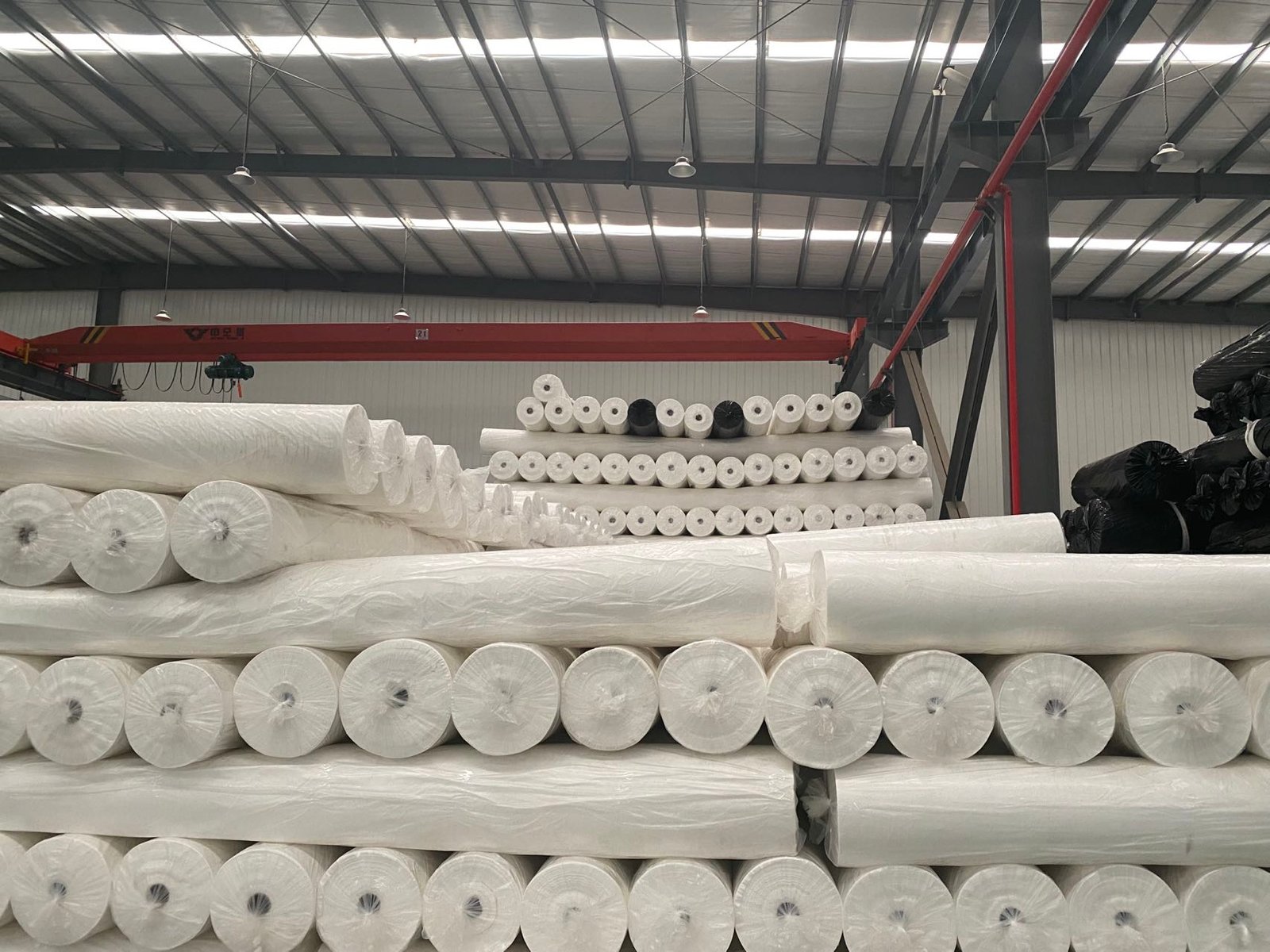
HDPE geomembrane rolls should be stacked in no more than 2 layers, kept at least 15 cm above the ground, and covered with a 0.5 mm waterproof tarp. Outdoor storage should not exceed 6 months, with ambient temperatures maintained between -10°C and 40°C. Prolonged sun exposure must be avoided, as it can reduce OIT by 30% or more. Packaging should be checked weekly.
Site Foundation and Ground Preparation
Site Selection
On paper, a storage area may look like nothing more than a box, but deciding where to unload dozens of 8-meter-long, 1.5-ton rolls is a serious matter. Even a 10-meter positioning error can create constant problems later. The storage area should be set 30 to 50 meters away from the active excavation zone. When heavy excavators swing during operation, a counterweight striking the packaging can instantly rip open a tear more than 2 meters long.
The ground should be built up so it sits at least 0.5 meters higher than the highest local water accumulation level recorded over the past 50 years. Rising groundwater can be extremely aggressive. Even if the surface looks dry, once soil moisture exceeds 30%, a single rainfall can turn the area into mud within 24 hours.
- Avoid natural drainage paths and low-lying ground.
- Keep well away from sewage lines serving worker accommodation, with a minimum clearance of 50 meters.
- Dig a soil drainage ditch 300 mm deep.
- Make sure it can discharge at least 1.5 liters of rainwater per second.
Unused land is often covered with cogon grass and shrubs, with deep root systems below the surface. A loader must strip away 20 cm of topsoil, and any roots thicker than 5 mm must be completely cut out. If buried plant roots decay underground, they can release marsh gas. Once the concentration reaches 5%, even a nearby worker lighting a cigarette could trigger a small explosion.
A semi-trailer carrying rolls is about 17.5 meters long and needs a large flat area to reverse and unload. The site must provide a turning width of at least 18 meters. When a fully loaded 40-ton truck turns its wheels in place, the ground shear force can reach several hundred kilonewtons, easily tearing up even hard-packed soil.
When a loader lifts material using a long handling beam, the whole machine shifts forward under the suspended load. The supporting ground beneath the tires must have a bearing capacity greater than 120 kPa. Ordinary soil cannot handle that pressure. A 30 cm layer of crushed stone should be laid first, then compacted with a heavy roller for 8 passes.
Wind direction also matters when choosing where to place the rolls. Once multiple 8-meter-long cylinders are stacked together, the wind-catching area increases dramatically. In Force 6 gusts, with wind speeds of 10.8 to 13.8 m/s, unsecured rolls can easily start rolling downhill. A low hill or solid building can serve as an effective windbreak. Placing the material 15 to 20 meters from a building significantly reduces wind force.
- Install a 2.5-meter-high wire mesh fence on the windward side.
- Place 500 kg concrete blocks at both high-wind ends.
- Leave a 4-meter-wide vehicle lane in the direction of the prevailing wind.
- Spread 10 cm of anti-slip coarse sand beneath the mesh fence.
In summer, black geomembrane left in direct sun becomes too hot to touch. By around 1:00 p.m., the surface temperature can exceed 70°C. Sustained heat acts like an oven, driving anti-aging additives out of the material. Once accumulated ultraviolet radiation reaches 300 MJ/m², the outer protective film can become brittle enough to crumble at a touch.
Choose a shaded location and install a breathable sunshade canopy about 4 meters overhead. Under shade, the surface temperature of the rolls can drop by about 20°C immediately. With temperature cycling, an 8-meter roll can shrink by 2 to 3 cm. A shelter helps keep its dimensions stable.
Measure how far the storage area is from nearby hazardous work. If steel reinforcing bars are being welded nearby, sparks can travel up to 15 meters with the wind. Molten metal at 800°C can burn through 1.5 mm geomembrane in just 0.5 seconds.
Generators and diesel tanks should never be placed within 20 meters of the storage area. Even a small diesel spill can flow downhill across slightly sloped ground. Once the material is contaminated with oil, the polymer can swell within 12 hours, completely destroying its waterproofing function.
- Install a 1.8-meter-high rigid plastic fence around the site.
- Set aside a dedicated 50 m² open area for reversing and unloading.
- Place two 65-liter wheeled water-based fire extinguishers in clearly visible locations.
In winter, frost heave can deform the ground, and freeze-thaw cycles can cause subsidence. If the frozen layer exceeds 40 cm, spring thawing may cause the surface to settle by more than 50 mm. A sandy site with groundwater deeper than 3 meters is a much safer choice. Because sand has large voids, capillary rise will not exceed 1.5 meters.
Soil strength testing is troublesome but necessary. Loose silty sand may show a bearing test value of less than 8%. If rolls are stored on it for 30 days, the ground may settle by 15 mm. With trucks moving in and out daily, tire ruts can deepen beyond 50 mm, and after a heavy rain, as much as 40% of the site may be covered in standing water.
The rolls should be laid out in a long row aligned with the direction of installation in the field. If a loader has to travel an extra 100 meters for each 1.2-ton roll, each trip takes about 3 minutes longer. A medium-sized pond project may use 500 rolls. Choosing the right location can save a full 25 hours of handling time.
Ground Clearing
For geomembrane work, preparing the storage ground is one of the most labor-intensive tasks. A single black roll can weigh as much as 1,500 kg. Small stones that seem harmless underfoot can become major hazards. A broken brick fragment only 10 mm wide, trapped under a 1.5 mm membrane beneath that weight, can puncture a leak point in less than two days.
Workers line up with steel rakes and clear the site inch by inch. For an open area of 500 m², 6 skilled workers may need 2 full days. Within the top 150 mm of soil, every sharp or hard object must be removed and discarded.
- No gravel larger than 12 mm may remain.
- All dried branches longer than 3 cm must be removed.
- Rusted nails and scrap rebar must be cleared away.
- No broken glass fragments should be left behind.
After visible debris is removed, buried roots become the bigger problem. A bulldozer turns over the top 20 cm of soil completely. If large wild roots as thick as an arm are found, an excavator fitted with a 400 mm narrow bucket must trace the main root down 0.5 meters and remove it entirely.
Any broken root pieces left in the soil will eventually grow upward again. In spring, new shoots can easily puncture a thin geomembrane. Workers therefore spray a 5% herbicide solution evenly over the freshly turned soil at a controlled application rate of 200 ml/m².
Leveling the site is a major operation. A grader fitted with a 3-meter-wide steel blade travels back and forth at 5 km/h for 4 passes. High and low spots are cut down flat. Experienced technicians then place a 3-meter aluminum straightedge on the surface, and the gap beneath it must not exceed 20 mm.
If it rained recently, wet mud can cling to the blade and make grading ineffective. In that case, dry yellow soil with a moisture content of 8% to 12% is trucked in for replacement fill. A 5-ton dump truck unloads the soil, and workers spread it layer by layer with shovels, raising the uneven ground by 10 cm.
- The imported yellow soil must not contain fist-sized hard clods.
- The spread thickness must be maintained at 100 mm using a measuring rule.
- A natural slope of about 30 degrees should be left at the edge.
- After spreading, the surface should be lightly patted with flat shovels to reduce dust.
Once the replacement soil is in place, it must be compacted. Several workers push 80 kg electric tampers around the 50-meter perimeter in repeated circles. Each impact delivers more than 2 tons of force, compacting the loose soil by 3 to 5 cm. The finished surface develops a hard sheen.
For large open areas, an 18-ton roller is used instead. With vibration turned off, it relies on dead weight alone and rolls at 3 km/h for 6 passes. Each tire track must overlap the previous one by at least 20 cm to ensure full coverage.
After compaction, a veteran worker may test the ground by stomping hard with his heel. It should not even leave a pale shoe mark. An experienced technician may also drive a 1-meter-long No. 16 steel rod into the ground with both hands. If the rod cannot penetrate deeper than 5 cm, the surface is considered qualified and strong enough to handle dozens of daily forklift passes.
- Each tamping pass should overlap the previous depression by one-third.
- Corners inaccessible to machines must be compacted manually with sledgehammers.
- Rollers must turn around outside the prepared area.
- Freshly compacted ground should be cordoned off for 24 hours.
Bare soil can become damp and muddy in rainy weather. Workers therefore purchase river sand and screen it carefully through a 2 mm mesh wire sieve. Two workers face each other and toss the sand back and forth with shovels to remove clay lumps and shell fragments.
The cleaned sand is then spread in a 50 mm layer over the compacted surface. Dry sand feels soft underfoot and fills small depressions just a few millimeters deep. Any small metal wire left behind during earlier cleaning becomes fully embedded in the sand bed and cannot reach the geomembrane above.
In autumn, strong winds can blow away most of the freshly laid sand in less than half a day. A water truck fitted with a garden-style spray head is used to mist the surface every 4 hours. The sand should remain damp but never waterlogged, so that it can form a loose clump when squeezed in the hand, even in strong wind.
Cushioning and Support
Even after loose soil and stones have been cleared away, bare hard ground is still unsuitable for storing geomembrane. If a 1,500 kg roll sits directly on flat ground for too long, the lower layers will be crushed under their own weight. After more than 72 hours, the originally round outer profile will likely become oval, with permanent creases.
Experienced workers know that a thick soft cushion must be laid on the hard surface first. Discarded nonwoven geotextile from previous jobs works well, especially material weighing 400 g/m². Several workers can unroll it across the site to create a 5 mm thick soft mat.
- Overlap the seams by 50 cm to prevent them from opening.
- Anchor the four corners with 20 kg sandbags against wind.
- Cover any holes with a 30 cm × 30 cm patch.
- The edges of the fabric should extend at least 80 cm beyond the storage footprint.
“There’s no need to buy new underlayment. Offcuts from the last job can be stitched together and used just fine. On a construction site, you learn to use whatever scraps you have to protect the good membrane from being abraded by sand.”
In low-lying areas prone to standing water, raising the rolls off the ground is the safest solution. Ordinary short delivery pallets cannot support an 8-meter roll. The site should use custom heavy-duty hardwood pallets measuring 2 m × 1 m. Four of these placed in a row will support one entire roll securely.
These wooden pallets must be designed with generous load-bearing capacity. Each pallet at the base should support 2,500 kg without deformation. The gaps between the top slats must be kept within 50 mm. If the gaps are too wide, the heavy roll can sink into them and become trapped.
A skilled carpenter should inspect every inch of the pallet surface with coarse sandpaper and a screwdriver. Even a protruding nail only 5 mm long can puncture through 7 layers of outer packaging and into the membrane under 1.5 tons of load. Any wood splinters must be sanded smooth with 60-grit paper.
Round rolls do not stay still easily on a pallet. Even slight movement can send them rolling downhill. No number of workers can stop a 1.5-ton roll once it starts moving. Solid wooden chocks must be prepared in advance and kept within easy reach near the unloading truck.
- Use solid square timber with a 20 cm × 20 cm cross-section.
- Cut it diagonally into 45-degree right triangles with a power saw.
- Insert one chock every 2 meters along the roll base.
- Drive each chock firmly into place with an 8-pound sledgehammer.
“Never try to save time by using ordinary clay bricks as wheel stops. Hollow bricks cannot withstand even half a ton of impact and will be crushed into powder within seconds.”
When the site is small and dozens of rolls arrive, stacking becomes unavoidable. But there is a strict height limit: never more than 3 layers. The total stack height must be held below 2.5 meters, which keeps it within the safe line of sight of the loader operator using a handling beam.
The core tube inside the geomembrane roll is made of hard paperboard. It has an inner diameter of 150 mm and a wall thickness of 15 mm. If it absorbs moisture and softens, its load-bearing capacity drops sharply. If more than two layers are stacked above it, the bottom paper core can collapse on the spot.
Once the core tube collapses, the central opening of the roll becomes blocked. A steel spreading shaft with an outer diameter of 130 mm can no longer pass through it, which means the roll cannot be unrolled smoothly at the installation area. A full 1.5-ton roll can become unusable and must be cut open manually with a small knife.
There is also a method to stacking. The core positions in adjacent layers must be staggered rather than aligned vertically. The timber spacers for the second layer should sit in the grooves formed between two rolls below. Workers then use polyester webbing rated at 5 tons to strap the upper three layers into a single stable unit, preventing nighttime winds from shifting the top rolls.
The straps should never be tightened directly against thin outer packaging. A 5 cm wide strap pulled tight with a winch can leave a deep indentation in the outer wrap. At edges and corners where the strap bears pressure, place 20 mm thick scrap rubber from truck tires underneath to spread the load across a wider surface.
A bright red-and-white warning tape should be strung around the storage area. Reflective metal signs should be hung at a height of 1.2 meters. The driver of a heavy forklift has major blind spots in the cab, so a dedicated 3-meter-wide reversing lane must be kept clear nearby. Before nightfall, the pallets beneath the rolls should be checked with a flashlight to ensure that nothing has shifted or loosened.
Stacking Techniques
Pyramid Stacking
A ground bearing capacity of 150 kPa is the minimum threshold for pyramid stacking. The site should be compacted by roller until the flatness deviation is no more than 3 cm per 10 meters. Workers then lay a 20 cm crushed stone base and cover it with discarded 400 g nonwoven fabric as a moisture barrier.
A 12-meter flatbed trailer at the site may unload up to 80 rolls per day. Before unloading, the truck wheels are secured with triangular rubber wheel chocks 15 cm high. Forklifts then shuttle back and forth on a sand-gravel access lane compacted to 95%, at a speed of 8 km/h.
Bottom-layer HDPE rolls weighing 1 to 1.5 tons are laid flat. A gap of 2 to 3 cm is left between adjacent rolls so that C-hooks can pass through smoothly. The level difference between the two ends of an 8-meter roll must be controlled within 5 mm. Each roll is marked at both ends with a 7 cm × 10 cm traceability QR code.
Solid wooden anti-slip stakes with a 15 cm × 15 cm cross-section are driven into the outer edges. Their embedment depth must reach 40 cm to resist the lateral force of the massive rolls. The lifting parameters of the handling equipment determine the safe fall path of the upper rolls.
- Fork spacing must be fixed between 1.8 and 2.2 meters.
- The unsupported overhang at either end of the roll must stay within 1.5 meters.
- Sling attachment points should be 1.2 meters from each end.
- Suspend the load motionless in the air for 3 seconds before lowering.
A 5-ton forklift carrying a 1.2-ton roll moves it toward the base layer. The operator aligns it precisely with the 60-degree trough formed between two rolls below. The lowering speed must be strictly limited to 0.2 m/s or less.
A violent impact can generate more than 3 tons of dynamic load and instantly rupture the bottom layer’s 0.15 mm UV-protective packaging. Two spotters stand at 45-degree angles on either end of the roll, using radios to guide the forklift driver, whose blind zone may extend as far as 3 meters.
Forks of 2.5 or 3.0 meters in length can safely support a mother roll with a diameter of 80 cm. The 1,500 kg load is distributed evenly through the curved surface below, reducing the contact pressure on the bottom layer by 50%.
In winter conditions as cold as -15°C, the outer surface of the rolls becomes exceptionally hard, and sling friction against the packaging drops by 30%. Once the tilt angle exceeds 5 degrees, slippage can occur. Operators must therefore use wider lifting slings coated with polyurethane anti-slip surfaces and at least 150 mm wide.
A single lifting cycle may then take as long as 6 minutes, and each diesel-powered transport movement consumes about 0.8 liters of fuel. By the third layer, tolerance for yaw is extremely low. For a 6-meter-wide roll, if the yaw angle in the air exceeds 2 degrees, the stress balance of the base layer becomes unstable.
When polyethylene is compressed beyond 20% above its yield strength, its internal crystal structure undergoes irreversible plastic deformation. For that reason, heavy lifting operations should be scheduled between 6:00 a.m. and 10:00 a.m., when the roll temperature stays below 30°C.
At midday, when temperatures reach 75°C, the material stiffness can drop by 40%. Two workers use a 4-meter aluminum straightedge against the side of the stack to verify the offset between the top and bottom roll ends, keeping it within 5 cm.
A staggered windward face forms a streamlined slope that lowers the overall drag coefficient to below 0.3. To resist winds of 20 m/s, operators must install external restraints as required.
- Cover every layer joint with a 150 g windproof mesh.
- Place 10 kg sandbags every 2.5 meters.
- Extend the covering mesh down to 0.8 meters above the ground.
- Drive 0.6-meter steel stakes into the ground at the edges.
After the bottom rolls remain under compression outdoors for 30 days, measured oval deformation should still be held within 2 mm, well below the 1% tolerance limit. An operator then spends about 5 minutes visually confirming that label orientation deviates by less than 15 degrees from the centerline of the aisle, after which the unloading and stacking operation can be accepted as complete.
Strict Height Limits
On site, geomembrane rolls must never be stacked higher than 2.0 meters. A typical 8-meter-wide roll already occupies a large ground footprint when laid flat. Adding more layers can easily crush the bottom core.
A single 1.0 mm thick HDPE roll weighs about 800 kg, and the maximum stack height is 4 layers. For 1.5 mm and 2.0 mm materials, individual roll weights climb to 1,200 to 1,500 kg.
The load on the bottom layer rises geometrically with each additional layer. Site supervisors therefore reduce the maximum allowed stacking height to 3 layers for these thicker materials. For extra-thick geomembrane of 2.5 mm or above, a single roll can approach 1,800 kg, making 2 layers the absolute ceiling.
Mandatory thickness-to-stack-height limits are as follows:
- 1.0 mm geomembrane: about 800 kg/roll, maximum 4 layers
- 1.5 mm geomembrane: about 1,200 kg/roll, maximum 3 layers
- 2.0 mm geomembrane: about 1,500 kg/roll, maximum 3 layers
- 2.5 mm and above: about 1,800 kg/roll, maximum 2 layers
Once the height exceeds 2 meters, the resulting compressive stress can easily surpass 200 kPa. The hollow plastic or paper core at the bottom may deform by more than 5 mm. Under continuous compression for 72 hours, a once-round core opening can turn into an oval whose major and minor axes differ by 4 cm.
Under continuous compression over 30 days, the long hydrocarbon chains inside the polymer begin to break down. The black membrane surface gradually develops whitish creases up to 2 mm wide. These permanent creases, known in the trade as dead folds, cause the material to lose tensile performance.
If membrane with dead folds is later installed and stretched across the bottom of a large pond, the tensile strength in the damaged zone can drop by 40%. Large temperature swings make height control even more critical.
On a summer afternoon, exposed ground temperatures can rise to 60°C. The HDPE softens, and its yield point drops by nearly 30%. A bottom roll that could normally support 3 layers may undergo irreversible deformation under just 2 layers in such heat.
Emergency layer-reduction rules under changing weather conditions:
- If surface temperature exceeds 40°C, reduce the total stack by 1 layer.
- If rolls have remained stacked in place for 60 days, restack them with a forklift.
- Measure the outside diameter of the bottom roll every 7 days with calipers.
- If the deformation rate reaches the 1.5% red line, dismantle the stack within 2 hours.
A 5-ton internal combustion forklift typically has a maximum safe lifting height of about 3.5 meters. Once a heavy load is raised above 2 meters, the carrying capacity of the metal forks drops by 25%.
A 1.5-ton roll suspended at 2 meters may sway slightly under engine vibration. The rear counterweight wheels of the forklift can lift 3 to 5 cm off the ground, putting the whole machine at serious risk of tipping over.
In open outdoor areas, wind shear increases exponentially with height. Once stacking height exceeds 2.5 meters, the windward area doubles. The side wind load can then reach 3,000 N.
The solid wooden wedges at the base cannot resist such lateral force indefinitely. Under Force 8 gusts, the top cylindrical roll can easily break free and roll away. Each additional layer also increases ground pressure by about 15 kPa.
If compacted soil is then hit by 20 mm of rainfall, its bearing capacity may drop by half. Overloaded stacking can lead to uneven settlement of more than 5 cm in weak subgrade.
A neat stack can begin creeping downhill in as little as 10 minutes. Every morning at 8:00 a.m., inspectors enter the site with infrared laser rangefinders. Standing 5 meters from the stack, they measure its height by laser targeting.
Monitoring tools required for shape control:
- Infrared laser rangefinder: distance measurement accuracy up to 1 mm
- Aluminum straightedge: minimum length 3 meters for verticality checks
- Stainless steel feeler gauge: early warning when core compression gaps fall below 2 mm
- Industrial vernier caliper: detects deformation as small as 0.1 mm
If the measured height deviates from the baseline by more than 2 cm, it must be recorded. If cumulative settlement reaches 4 cm over 3 consecutive days, a 50-ton truck crane must be brought in immediately to remove the top layer.
Storage planning must be based on the total square meterage of the rolls, not on attempts to save space by stacking higher. If the site becomes too crowded, the contractor should rather spend 50 liters of diesel to open up a new level storage area 2 kilometers away than violate the height limit.
Signs marked “2 m Height Limit” should be installed every 10 meters along both sides of the gravel aisle. Operators should also paint a horizontal reference line across the flat end face of the first-layer rolls using yellow fluorescent paint.
After two weeks of sun and rain, if that reference line tilts by more than 3 degrees, it indicates that the load above has disrupted the stress balance of the bottom layer. Stacking must stop immediately, even if the total height is still 15 cm below the 2-meter limit.
Securing the Base
The static friction coefficient of polymer material is only about 0.15. A 1,500 kg geomembrane roll with an outer diameter of 80 cm placed on ground sloped more than 2 degrees can begin rolling within seconds. The blocking devices placed beneath the base must therefore be extremely solid.
A 1.5-ton roll moving at 0.5 m/s carries more than 180 joules of kinetic energy. Trying to stop it by hand or with a thin stick will result in immediate failure within 0.2 seconds.
Workers place solid timber blocks with a cross-section of 15 cm × 15 cm beneath the bottom of the roll. Each block must be at least 50 cm long. Using a sledgehammer, the block is driven firmly into the gap below the roll, with a positioning tolerance controlled within 3 mm.
Physical requirements for acceptable blocking timber:
- Solid oak or pine, with density above 0.6 g/cm³
- Contact face cut to a 45-degree angle to match the curvature of the roll
- Timber kiln-dried to moisture content below 18%
- Each solid wedge weighing more than 8 kg
Using a 5-meter tape, workers place one wedge every 2 meters along the length of the 8-meter roll. That means 4 wedges on one side. The outward thrust of the 1,500 kg roll is then distributed over four support points.
Each point may still bear as much as 375 kg of force. Fine cracks can develop in the soil behind the wedge. To reinforce it, the crew drives 20 mm diameter threaded steel rods directly behind the timber blocks.
These 60 cm long rods are driven into the ground at a 60-degree angle to a depth of 40 cm. In prolonged wet weather, softened soil can reduce pull-out resistance below 500 N, at which point the rods are no longer effective.
In that case, workers switch to heavy-duty flood-control sandbags weighing 25 kg each and build a continuous retaining wall 40 cm high and 50 cm wide along the outer edge.
The sandbags must be filled with rounded river sand of particle size below 5 mm. Sharp-edged broken bricks are strictly forbidden as blocking material. If inspectors find that a crew has used irregular stones or rubble as support, work by that crew is suspended for 15 minutes pending a violation review.
Sharp stones under 300 kPa of pressure effectively become blades. They can easily puncture the 0.15 mm UV-resistant outer packaging, and under hundreds of kilograms of static load, the same sharp edge can then gouge into the main geomembrane itself.
A 1.5 mm HDPE membrane scratched to a depth of 0.3 mm over a 5-meter section will frequently fail tensile testing after dual-track hot wedge welding. Strict anti-puncture control is therefore enforced on site.
- Clear all construction debris within a 3-meter radius of the storage base.
- No exposed nails or wooden splinters are allowed on blocking timber.
- Fill the gap between timber and membrane with 5 mm industrial rubber pads.
- Inspect the base with flashlights twice daily, on morning and evening shifts.
To improve contact support, workers spread a fine sand cushion 80 cm wide and 5 cm thick directly under the bottom roll. The cylindrical roll sinks about 2 cm into the sand, and the sand rises naturally at both edges, forming a curved cradle that increases the contact area by 3 times.
Precise placement during unloading depends on centimeter-level control. A 5-ton forklift lowers the load to 10 cm above the ground, then nudges it forward to a landing point about 5 cm from the blocking wedge. The hydraulic system then releases slowly so the roll settles into the sand bed and presses tightly against the 45-degree face of the timber.
The guide crew must never stand in the downhill path where the roll could move outward. Two receiving workers should remain in a marked safety zone 2 meters behind the ends of the roll, giving precise landing commands to the operator by radio.
During continuous rain, the surface friction coefficient of the membrane can drop to 0.08. Saturated soil may also lose 15% of its supporting volume. The outward thrust on the timber blocking system can then rise by 40% because of reduced friction and softened ground. Inspectors crouch in the mud and measure displacement behind the wedges with a tape.
- Tighten wedge spacing from 2 meters to 1.5 meters.
- Add two layers of 25 kg flood-control sandbags directly outside each timber stop.
- Extend the sandbag retaining line 1 meter beyond both ends of the roll.
- Dig a drainage ditch 30 cm deep at least 1 meter outside the base line.
Workers shake a can of red spray paint and mark a 10 cm calibration line at the interface between the wedge and the soil. A line sprayed at 10:00 a.m. must be rechecked with calipers by 4:00 p.m.. If the measured displacement gap reaches 10 mm, it indicates that the soil layer has failed.
When displacement exceeds 10 mm, a 50-ton crane must be mobilized within 15 minutes. Riggers wrap a 150 mm wide polyurethane soft sling around the outer mother roll and lift it clear. Emergency workers then excavate the loosened 50 cm wide soft soil beneath it, refill the void with hard crushed stone, and compact it for 5 minutes using an 80 kg gasoline rammer. Once a new subbase with density up to 2.0 g/cm³ has been formed, the roll is lowered back into position.
Weatherproofing and UV Mitigation
UV Mitigation
HDPE geomembrane is compounded in the factory with 2.5% premium carbon black. Fresh from production, it can resist oxidative aging for as long as 130 minutes under laboratory testing. But if it is left outdoors under a UV index above 8, the polymer chains will begin to break down. The anti-aging additives in the surface layer can be consumed at a rate of 15% to 18% per month.
Manufacturers wrap the rolls in an outer layer of 0.15 mm white PE film. This layer blocks about 90% of incoming light. If it is removed too early, a 1.5 mm membrane exposed for just 21 days can develop microscopic cracks that are invisible to the naked eye. Its elongation performance may quietly drop by 10% to 15%.
- Use wide nylon slings instead of steel hooks during unloading.
- If the outer packaging tears by 5 cm, seal it immediately with tape.
- Keep the rolls at least 5 meters away from welding or steel cutting.
- Retain the factory barcode to track how many days the material has been stored outdoors.
The original wrapping cannot withstand long-term sun exposure beyond 30 days. If storage extends beyond that, the rolls must be covered with a heavy-duty blackout waterproof tarp. Ordinary roadside blue plastic tarps still allow 20% to 25% light transmission. Only a custom shade cloth with light transmission below 2% can truly block strong sunlight.
Choose a high-density woven polyethylene cover with a 14 × 14 weave and a weight of at least 200 g/m². A silver-white double-sided tarp performs especially well. Lay it with the silver side facing upward, so it can reflect 85% of solar heat away.
Every 10°C increase in surface temperature doubles the rate of material aging. In summer, the surface temperature of exposed black geomembrane can rise to 75°C to 80°C. Once covered with reflective silver sheeting, the internal temperature can drop immediately to below 40°C.
- Overlap adjacent covers by 50 cm.
- Tie down wind ropes every 1.5 meters using secure dead knots.
- Let all four corners of the cover hang down to the ground to block reflected light.
- Sweep dust off weekly to maintain 70% reflectivity.
The orientation of stored rolls also matters. If the rows run east-west, the outermost rolls are exposed to direct sun all day. If they are instead stacked north-south, the sun angle shifts across the face during the day, reducing one-sided exposure time by nearly 45%.
Stack height also changes the total sunlit area. The site should permit no more than 3 layers, with total height limited to 1.8 meters. Once the stack rises to 4 layers or more, the top rolls can no longer benefit from shading. The top layer may receive three times the sunlight exposure of the bottom layer.
Warehouse personnel should keep daily stock records and use the oldest rolls first. If a roll has been stored outdoors for more than 90 days, a sample should be cut and tested for melt flow rate. If the measured value is 20% higher than the factory baseline, the entire roll must be discarded as waste.
- Before removing the wrapping, check whether the surface is powdering.
- Cut a 10 cm square sample and fold it 180 degrees to see whether whitening occurs.
- Compare the brightness of the outer surface with material 3 meters deep inside the roll.
- Cross-check the laboratory report against the actual outdoor storage time.
Even thick clouds cannot block shortwave ultraviolet radiation. On cloudy or rainy days, about 70% of UVA still reaches the ground. Never assume the cover can be removed just because the sun is hidden. Keeping the rolls protected from light until installation directly affects the service life of projects covering tens of thousands of square meters.
Weatherproofing
A single geomembrane roll can weigh 1.5 to 2 tons. If it is left directly on flat ground, rainwater can seep 30 cm into the layers from below. If that contaminated membrane is then welded, the dual-track welder may leave pinhole leaks all along the seam.
Raising the rolls on a 15 cm high nine-foot plastic pallet keeps them out of standing water. This type of pallet, commonly used on construction sites, can support 2.5 tons and can safely carry one roll of 50-meter-long, 1.5 mm geomembrane.
A 10 cm layer of crushed stone should be laid below the pallet. In heavy rain, water can drain away through the stone voids in about 30 minutes. Storing the rolls above ground cuts off rising moisture and helps keep the internal humidity below the safe limit of 45%.
- Place a 15 cm high timber block every 2 meters, wrapped in old velvet or cloth.
- On sloped ground, stack the rolls perpendicular to the slope and secure the bottom with two triangular blocks.
- If mud splashes onto the rolls, clean it off within 48 hours using a high-pressure water jet.
- Dig an open drain 30 cm wide and 20 cm deep beside the storage area.
Rainwater can run into the tightly wound layers and form a thin film only 0.1 mm thick. When the welding machine passes over it at 380°C, that moisture instantly turns to vapor and expands by 1,700 times.
The hot steam then ruptures the softened material, leaving dense micro-bubbles in the seam. If an inspector performs an air pressure test on the dual-track weld at 250 kPa, the gauge may drop to 150 kPa in under a minute.
Wind protection is a daily concern on site. On open flat ground, Force 7 winds can reach 15 m/s. Once wind gets underneath a waterproof cover, it can rip a 50 m² heavy tarp straight into the air.
| Wind Level | Visible Signs | How to Secure the Tarp | How to Protect the Rolls |
|---|---|---|---|
| Force 4–5 | Branches sway, dust rises | Reduce sandbag spacing to 1 meter | Place one weighted sandbag at each end |
| Force 6–7 | Walking into the wind becomes difficult, umbrellas cannot be opened | Add two transverse webbing straps | Stop lifting operations and wedge the pallets |
| Force 8+ | Branches break, people struggle to stand | Cover with two layers of wind net fully anchored to the ground | Lash everything down with 10 mm steel wire rope |
Woven bags should be filled with dry sand to a weight of 15 to 20 kg each. Lighter bags cannot resist strong gusts, and heavier ones are too difficult for workers to handle. Place one bag every 1.5 meters along the edges of the cover and tie the top with three 8 mm wind ropes.
Never use scrap rebar or sharp stones as weights. In strong wind, the cover will flap against them, and a sharp edge can wear through a 0.3 mm tarp within half a day, and then puncture the geomembrane underneath.
Scrap tires work extremely well as ballast. A discarded 14-inch car tire weighs about 8 kg and provides its own cushioning effect. If its hollow center is filled with sand or soil, the weight rises to 30 kg, making it virtually impossible for even typhoon winds to dislodge it.
Thermal expansion and contraction constantly change how the material behaves. At -5°C, the once-flexible membrane becomes stiff, and its flexural modulus doubles compared with its behavior at 20°C. If it is forced open in that condition, invisible whitening marks can appear at the folds.
A frozen roll is especially vulnerable to impact. At -10°C, if a forklift accidentally drops a roll from just 0.5 meters, the cold-brittle outer layer may crack on impact.
In summer, when ambient temperature reaches 40°C, the black material absorbs heat rapidly and its internal temperature can approach 65°C. The membrane softens like dough, and its yield strength drops by 30%.
If a crane lifts such a softened roll using two thin steel wire ropes, uneven force distribution may bend it like a banana in midair. The squeezed center section can stretch and deform, and once laid out, the thickness may be reduced by 0.2 mm.
- Do not force manual unrolling when the temperature is below 5°C; wait until midday when the material has warmed up in the sun.
- In summer, use 20 cm wide flat nylon lifting straps.
- Limit transport speed on site to 5 km/h or less.
- If the roll ends curl outward after heating, cut off the first 2 meters before use.
Outdoor storage during snow and ice creates major problems. During the day, meltwater enters the gaps at both ends of the roll core. At night, falling temperature turns that water into solid ice. A single 6-meter roll can trap tens of kilograms of solid ice inside, making it impossible even for an excavator to pull it apart.
Using a blowtorch to thaw it is completely wrong. The flame will scorch and carbonize the outer layer immediately. Workers can only tap along the surface inch by inch with wooden rods, using vibration to break up the ice crystals inside. That process alone can waste 3 hours of labor.

Leave a reply