

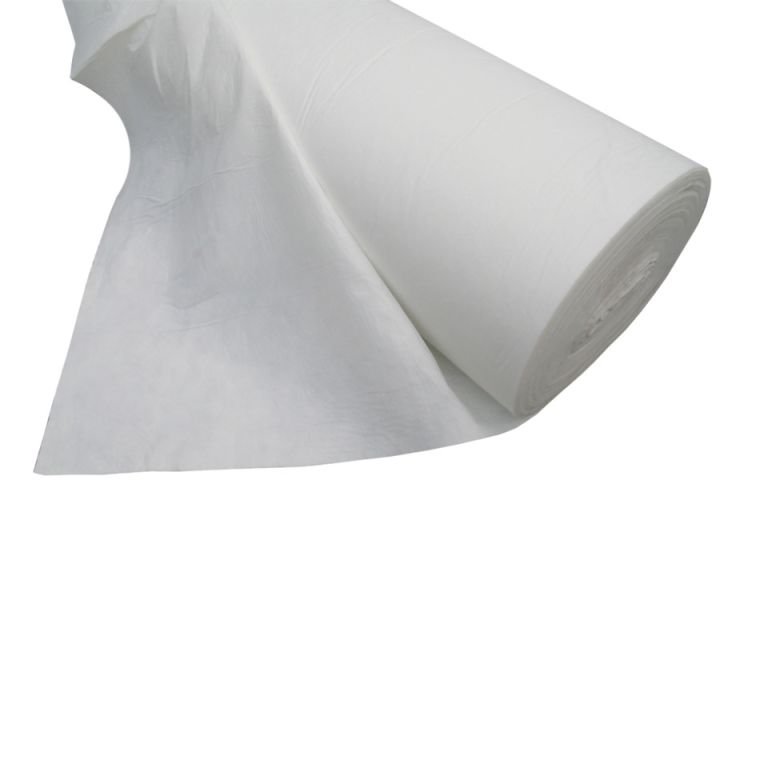
Testing the strength of landscape geotextile comes down to two key questions: how it is tested and which values matter. Two methods are used most often:
1) Grab Tensile Strength (ASTM D4632)
A specimen 100 mm wide and 200 mm long is prepared, with a 25 mm-wide section clamped in the center. It is pulled on a tensile tester at 300 mm/min until failure. The peak load is recorded. Typical landscape fabrics range from about 400–900 N for light-duty products, while heavy-duty grades may reach 900–1500 N.
2) CBR Burst / Puncture Resistance (ASTM D6241)
The specimen is secured in a circular clamp, then loaded with a 50 mm-diameter steel plunger at 50 mm/min until rupture. The maximum force is recorded, typically falling in the 700–2000 N range.
Samples should be dry and flat, and each test should be repeated at least five times to obtain an average. The failure mode should also be documented, such as tearing or elongation, to make material selection more reliable.
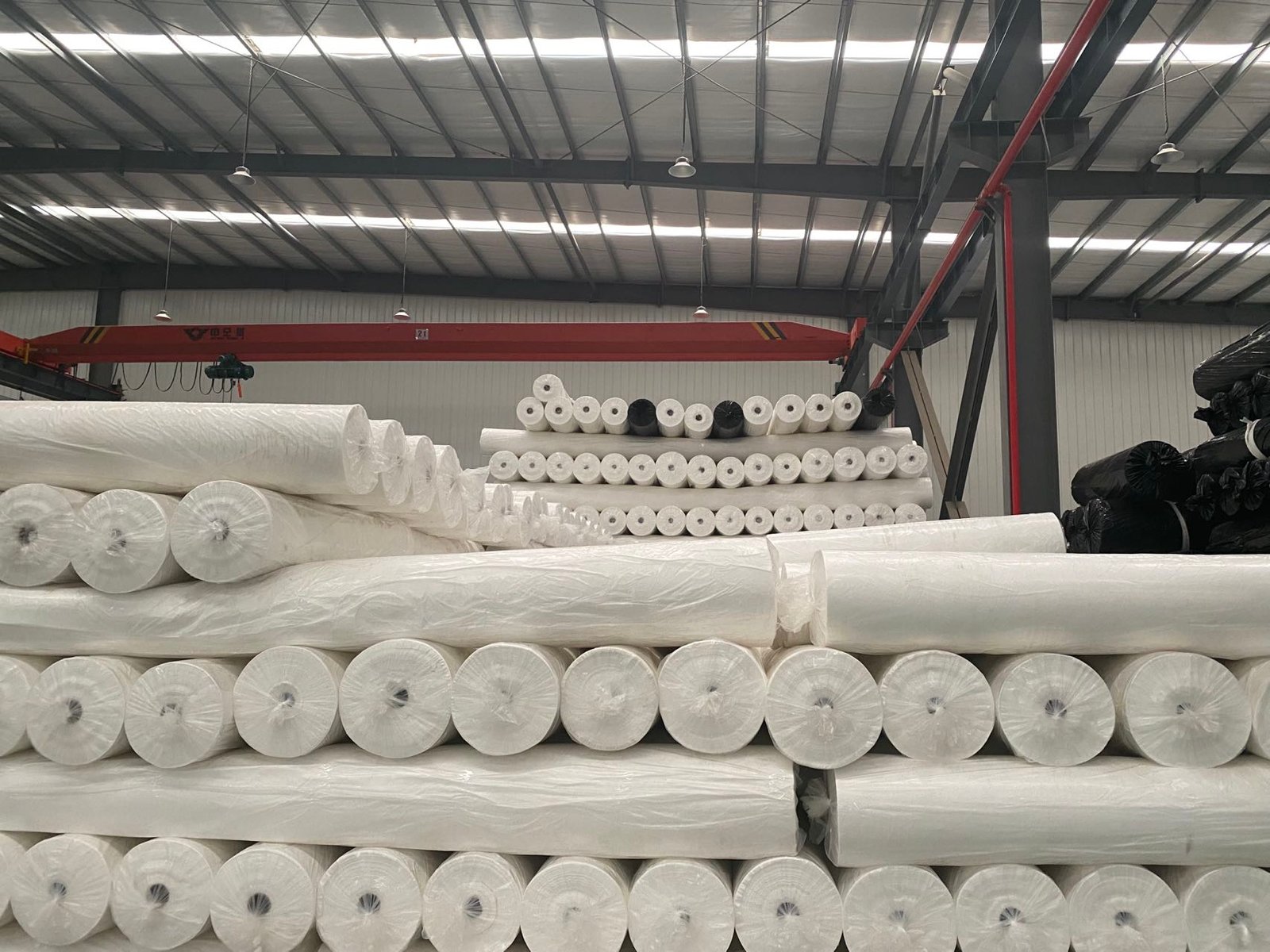
Grab Tensile Strength
ASTM D4632 Test Standard
The test room is maintained at 21°C, with relative humidity fixed at 65%. In the center stands a 1,500-pound tensile testing machine, with load-cell accuracy controlled within 0.5%.
The machine is fitted with upper and lower high-carbon steel grips, each providing a contact area of exactly 1 inch by 2 inches. Their surfaces are embossed with 1.5 mm-deep diamond serrations, designed to prevent polypropylene yarns from slipping during the test.
At 60 psi pneumatic pressure, the grips clamp down tightly on a piece of weed barrier fabric measuring 4 inches wide by 8 inches long. The initial gauge length between the grips is set at 3 inches, and the hydraulic system begins pulling upward at 12 inches per minute.
Under increasing tension, the polypropylene molecular chains begin to deform. The instrument display climbs to 180 lbs, and a faint cracking sound comes from the center of the fabric. One warp yarn fails first, and the remaining yarns immediately begin carrying the redistributed load.
When the force reaches 215 lbs, the fabric tears open into a 2-inch-long split, while the whole specimen elongates by 18%. That laboratory failure value mirrors what happens in a real backyard installation when a 2-inch-diameter piece of granite falls from a wheelbarrow onto the ground:
- Impact speed of about 1.5 m/s
- Contact area of less than 0.5 sq. in.
- Impact force exceeding 80 lbs
- Localized pressure reaching 300 psi
The sharp edges of crushed stone wedge into the tiny openings of the fabric. Workers in 2.5-pound steel-toe boots then walk over it. A full 180 lbs of body weight is concentrated through the tread pattern of the boot sole, rubbing and dragging repeatedly across the rough surface.
In landscaping, damage almost always concentrates at a few points. Fabric buried beneath a French drain is subjected to another type of load. After rainfall, dry soil weighing 80 lbs/cu.ft. can rise to 120 lbs/cu.ft. once fully saturated.
That extra 40 lbs of absorbed water expands the soil and presses hard against the weed barrier wrapped around the drainage pipe. In clay soil, water absorption can increase volume by 15%. With every additional foot of burial depth, lateral earth pressure can increase by another 40 lbs.
Deep underground, the stress environment becomes extremely confined, and the interwoven yarns inside the geotextile are stretched like a fully drawn bow.
- A 6-inch drainage pipe may experience 10 lbs/ft of pressure
- The fabric may be subjected to 250 lbs of lateral shear
- Freeze displacement below 0°C can reach 500 lbs/sq.ft.
- Saturated soil may weigh 120 lbs/cu.ft.
Frozen ground can also force sharp sand upward. Meanwhile, an oak root can grow to 2 inches thick and extend at a rate of half an inch per year. The root tip may press upward against the fabric with a force of 50 psi.
A woven fabric, with its tightly packed plastic tapes, can resist that 50 psi upward force. A nonwoven fabric, however, may have its fine pores stretched open, allowing sand to migrate into the gravel layer through a 2 mm-wide gap.
Now imagine a 6,500-pound skid-steer loader driving into the yard. The total contact area of its four rubber tires is only about 200 sq. in. As the operator pivots in place, the vehicle twists heavily against the ground surface.
The tire tread bites deeply into the 2-inch-thick gravel base.
- Tire rotation generates 800 lb·ft of torque
- Static load per wheel is 1,625 lbs
- Tire friction coefficient reaches 0.8
- The gravel base settles by 1.5 inches
After 500 hours of sun exposure, the tensile strength of polypropylene can drop from 200 lbs to 140 lbs. A 3-inch gravel cover is enough to block UV exposure. That gravel weighs around 30 lbs/sq.ft. and applies constant pressure to the fabric year-round.
In creep testing, the machine re-clamps the fabric and holds it under 20% of its ultimate tensile load for 1,000 hours. High-quality fabric should deform by no more than 2% of its original length.
Stress in Real Engineering Applications
A 5,800-pound pickup truck drives into a yard. The total tire contact area is roughly 240 sq. in. The 3-inch-thick gravel base crunches under load, while the fabric beneath it resists the weight being transferred downward.
The geotextile may carry a static load of 350 lbs/sq.ft. When the driver hits the brakes, the tires slide forward with the mass of the truck behind them. That forward momentum pushes sharp limestone pieces through the gravel layer.
These stones, angled at 45 degrees, stab directly into the plastic mesh of the fabric.
- Load per wheel: 1,450 lbs
- Approximate tire pressure: 35 psi
- Each additional 1 inch of gravel reduces damage by about 10%
- Braking-induced forward shear may reach 2,000 lbs
- The underlying fabric should have at least 250 lbs of tensile capacity
Workers then bring in a 160-pound gasoline plate compactor with a 20-inch-wide steel base plate. Once the engine starts, the machine vibrates violently over the gravel. It strikes the ground 5,500 times per minute, and each impact can deliver 3,000 lbs of force.
Loose stone is hammered down into shallow pockets in the soil. The geotextile is trapped in between—above it, cast-iron impact at 90 blows per second; below it, hard irregular subgrade. At one small point, the force gauge shows tension briefly spiking to 190 lbs.
The fabric is stretched to its limit. Irregular stone opens the woven structure, displacing the originally aligned yarns by 2 mm. If the fabric did not have a base strength of at least 200 lbs, it would already have shattered under that vibration. Mud would rise through the damaged area and ruin the entire drainage layer.
Now consider a 4-foot-high retaining wall. Behind it are 12 cubic yards of compacted soil and gravel. In dry weather, that backfill weighs about 32,000 lbs. The fabric is placed against the back of the wall, separating soil from aggregate.
After three days of heavy rain, the soil absorbs an additional 150 gallons of water. Moisture content climbs from 12% to 35%, adding 12,500 lbs to the total mass. If drainage is poor, hydrostatic pressure reaches 62.4 lbs/sq.ft.
- At the base of a 4-foot wall, loading may reach 250 lbs/sq.ft.
- Saturated soil may weigh 120 lbs/cu.ft.
- Stone voids make up 40% of the backfill volume
- The fabric may be pulled outward by 150–180 lbs
The wet soil mass begins creeping downslope. The geotextile is pinned tightly against the rough concrete wall while being dragged downward. On the aggregate side, 3/4-inch crushed stone presses outward into the fabric as sharp nodules. At the base of the wall, the fabric must withstand a tearing force of about 180 lbs.
In low-lying areas, a trench may be dug 50 feet long and 2 feet deep, with a 4-inch perforated plastic pipe lying at the bottom. The trench is then filled with 3 tons of rounded river stone. The geotextile functions like a heavy-duty sack, wrapping the stone and pipe together.
Small holes are spaced every 2 inches along the pipe. Groundwater, carrying soil fines under pressure, tries to force its way toward those openings. The geotextile holds back the fine particles while water pushes through at around 0.5 psi.
Then a lawn mower drives over the trench. Combined machine and operator weight reaches 800 lbs. Two wide tires concentrate that load onto only 12 inches of soil width. The force passes through 6 inches of topsoil and lands directly on the geotextile seam below.
- The 50-foot trench contains about 6,000 lbs of stone
- Groundwater pressure is about 0.5 psi
- Dynamic load from the mower is 800 lbs
- Fabric elongation must stay below 10%
At the overlap seam, the two layers are being pulled apart by 80 lbs of force. The bottom fabric is crushed under the weight of pipe and stone. Groundwater quietly erodes away just 0.5% of the soil beneath the pipe, causing a localized void and leaving the fabric suspended by 0.1 inch.
The weight of 3 tons of stone above seeks a new bearing point. The geotextile catches that settling load, and the plastic yarns emit a faint friction sound. At one point, 120 lbs of force stretches the fabric by 0.5 inch, holding steady in midair. The pipe remains intact, and the mud stays out.
AASHTO M288 Classification
A 300-page engineering handbook lies open on the hood of a pickup truck. Printed on those pages are the material requirement tables from AASHTO M288, used to estimate how well geotextile will survive once buried in weak, muddy subgrade.
When a tensile machine pulls a fabric sample to failure, any material that stretches beyond 50% of its original length is classified as nonwoven. If it breaks before reaching 50% elongation, it is treated as woven polypropylene. These two material types fall under completely different field performance expectations.
A Class 3 geotextile feels relatively light in hand. If the lab report shows it can withstand 120 lbs of tensile force without failing, it passes. Because nonwoven fabrics are more elastic, their minimum passing value is slightly lower, at 112 lbs.
Workers use shovels to dig a shallow trench 18 inches wide. The trench bottom is raked smooth, with no exposed roots longer than half an inch. A roll of black fabric is unrolled carefully along the base.
Next to the trench are bags of bark mulch and rounded river stone less than 1 inch in diameter. No tracked equipment will enter this work zone. A 180-pound man stands on the fabric holding two buckets, each containing 40 lbs of wet soil.
Under a total load of 260 lbs, the fabric depresses into the subgrade by only 3 mm.
- Recommended material type: needle-punched polyester nonwoven
- Minimum tear load: 50 lbs
- Minimum puncture resistance: over 310 lbs
- Maximum surface load: 15 lbs/sq.ft.
Turn two pages, and the numbers for Class 2 increase sharply. The test machine now begins at 160 lbs. Woven polypropylene with low elongation must withstand a pull of 248 lbs.
Outside the yard, an old driveway has already developed 2-inch-deep ruts. A Bobcat S185 drives in and drops 2,000 lbs of mixed aggregate onto the freshly laid fabric.
The pile includes angular granite pieces 1 to 2 inches across. The fabric underneath absorbs a series of heavy thuds. Some stones strike downward with as much as 150 lbs of force.
The plastic yarns withstand the puncture load. The stone tips leave only pale stress marks on the surface. Measured tear resistance reaches 56 lbs.
| Classification | Elongation Limit | Minimum Grab Tensile Strength (lbs) | Minimum Seam Strength (lbs) |
|---|---|---|---|
| Class 3 | Greater than 50% | 112 | 100 |
| Class 2 | Less than 50% | 248 | 220 |
| Class 1 | Less than 50% | 315 | 283 |
When the project involves extremely soft, pumping soil, the construction drawings will clearly specify Class 1. On site, moisture content is so high that every step sinks 3 inches into the mud, even through rubber boots.
The screen on the tensile tester must climb all the way to 315 lbs before the product is approved. Then a 15,000-pound Caterpillar excavator crawls across the aggregate surface. Ground pressure under the tracks instantly exceeds 2,000 psf.
A 2-foot-thick layer of stone is forced to grind and shift under the tracks. Hundreds of pounds of lateral shear are transmitted through the stone and down into the fabric at the base. In muddy conditions, the woven Class 1 geotextile is stretched taut like a bowstring.
Its 112-lb tear resistance now matters. A pre-existing half-inch cut in the fabric cannot continue propagating. Overlap seams stitched with thick nylon thread remain locked together under 283 lbs of repeated pulling.
The muddy slurry stays sealed below the plastic grid. Even after the excavator passes over it, rut depth remains controlled within half an inch. These three classes correspond to three very different survival environments.
Lay a light Class 3 fabric beneath a 15,000-pound tracked machine, and within 30 minutes it will be crushed into plastic fragments. Those broken scraps mix upward with black slurry.
The slurry then combines with the 30 tons of dry aggregate above, turning the entire area into a bog. No matter how hard the excavator revs, the steel tracks will simply spin in place. Replace that material with a heavy-duty product offering 620 lbs of puncture resistance, and the outcome changes completely.
A dense black reinforcement layer now holds up 30 tons of stone and resists the destructive force of tracked equipment.
- Light survival condition: smooth base with irregularities under 0.5 inch
- Moderate survival condition: ruts and light vehicle loading up to 2 inches
- Severe survival condition: mud pits over 3 inches deep and heavy tracked loading
The numbers printed on the back of a geotextile package determine how much settlement your foundation may face over the next ten years. Spending a few more dollars per square yard for a fabric that is just 2 ounces heavier can mean a major jump in pullout and survival capacity.
That extra mass can stop tens of tons of soil fines from pumping upward over the next five years. A pull resistance as high as 315 lbs depends entirely on those densely packed plastic tapes carrying the load.
Place a caliper against 1 square meter of woven fabric and you will see that a heavy plastic yarn appears every 1.5 mm. As gears in the weaving machine once pulled those yarns tight, forces of 300–400 lbs became distributed across thousands of tiny openings in the grid.
Puncture Resistance
Laboratory Testing
The technician carries a full 100-foot roll of geotextile into a conditioning room. The thermometer and humidity gauge have remained fixed at 21°C and 65% RH for years. The fabric rests quietly on a stainless steel rack for 24 hours. After long-distance shipping, the fibers can remain under tension, and a full day of conditioning allows them to relax.
Ordinary tailor’s scissors are useless here. A precision cutting knife with a vernier-guided edge is drawn along the length of the roll. The outermost one-tenth of the material is discarded, because the edge yarns are often unevenly stressed and can distort the test results.
A heavy metal punch press then drops onto the sheet. Ten perfectly round specimens fall into a tray. Their diameter is checked with calipers and must be exactly 150 mm. Any disc even slightly too large or too small is rejected immediately.
The digital balance reads to three decimal places. A 135 g/m² nonwoven disc is placed on the scale, and the reading settles at 2.385 g. Then a thickness gauge applies a light pressure of 2 kPa, and the display instantly reads 1.85 mm.
A massive testing frame, 2.2 meters tall, dominates the room. Its top sensor can detect slight changes in load and withstand forces up to 50 kN. The circular specimen is laid flat across the lower cast-iron clamp.
- Inner opening diameter of clamp: 150 mm
- Outside diameter of stainless steel plunger: 50 mm
- Clamp tightening torque: 50 N·m
- Plunger material: 316L medical-grade stainless steel
The upper ring lowers slowly and grips the specimen edge firmly. The plunger is a flat-ended steel cylinder polished smooth like a mirror. The motor hums to life. At 50 mm/min, the steel head begins pressing down into the exact center of the sample.
The flat fabric deforms gradually into a funnel shape nearly 30 mm deep. The computer records force data 1,000 times per second. One fiber after another tightens to its limit, then the specimen fails with a sharp tearing sound. A rough hole is driven through the center.
The force display races upward and stops at 1,350 N. The operator brushes away tiny scraps smaller than a fingernail. Ten discs are taken from different areas of the roll, including opposite diagonal positions. Once all ten are punctured, the data are fed into the system together for calculation.
The bench is then changed over to a smaller stainless steel puncture setup. This time the large plunger is replaced with a solid steel pin only 8 mm in diameter, and the inner clamp opening is reduced to 45 mm.
- Needle diameter: 8 mm
- Chamfer at needle tip: 0.8 mm
- Effective loading area: 45 mm
- Penetration speed: 300 mm/min
The pin tip is machined with a slight bevel to simulate the irregular shape of roots or crushed stone in the field. The pneumatic clamping force exceeds 300 N. After the parameters are reset, the puncture speed is increased dramatically.
The steel pin drives straight down into the center. A stiff woven fabric lasts only about 15 mm of deflection before it ruptures. The plastic yarns split along a cross-shaped pattern. By contrast, a staple-fiber polyester nonwoven behaves more like chewing gum.
The pin travels as much as 45 mm into the nonwoven before rupture. At the moment of failure, the machine records 420 N. The computer automatically converts the force–deformation curve into joules, calculating how much destructive energy the fabric absorbed. Beside the machine, a printer spits out reports with colored curves.
The technician crosses out the highest and lowest values from the ten tests. The remaining eight are entered into the calculation formula. The final reported value—say 890 N—is what appears on the label. That number is then entered into the warehouse database, confirming that this production lot has passed pre-shipment inspection.
Woven vs. Nonwoven
Look closely at the surface of the two black fabrics. Woven geotextile resembles the plastic woven sacks used for rice: flat plastic tapes about 2 mm wide crossing over one another. In every square inch, roughly 12 yarns run in each direction. Light passes through the tiny square openings at their intersections.
Nonwoven fabric feels fuzzy to the touch. Millions of 50 mm polypropylene staple fibers are randomly entangled together. In the factory, a machine drives 500 barbed needles per square inch through the web. The material is consolidated into something dense and felt-like.
When a sharp stone strikes woven fabric, its tip lodges in the gap between two flat tapes. Because the rigid plastic tapes cannot elongate much, the stone’s weight forces them apart. A 1 mm opening can be expanded instantly to 10 mm, and adjacent yarns may snap.
The same stone striking needle-punched nonwoven meets a 2 mm-thick three-dimensional fiber cushion. The fibers deform and stretch around the stone tip, sometimes beyond 50% of their own length. Dozens of fibers wrap around the point and prevent it from penetrating all the way through.
| Comparison | Woven Plastic Tape Fabric | Needle-Punched Nonwoven |
|---|---|---|
| Manufacturing method | Interlaced warp and weft tapes | Barbed-needle entanglement |
| Typical thickness | 0.5 mm | 1.8–2.5 mm |
| Elongation under load | 10%–15% | 50%–70% |
| Maximum water flow rate | 5 gal/min/sq.ft. | 110 gal/min/sq.ft. |
| Pore structure | Uniform square openings | Random 3D flow paths |
Water moves very differently through these two materials. The smooth surface of woven fabric allows only about 5 gallons per minute per square foot to pass. Nonwoven fabric contains countless tortuous three-dimensional pathways. Under the same storm, as much as 110 gallons per minute can pass through the same area.
Machine-direction tensile test results are also very different. Woven fabric is exceptionally strong in one direction. Pull a 3-foot-wide woven strip between two trucks in opposite directions, and the force may rise to 200 lbs before it tears. That makes it well suited beneath stable road bases where a 4,000-pound pickup can drive repeatedly.
Typical uses include:
- Under heavy gravel driveways designed for vehicles
- On level sand bases beneath pavers and thick walkway stones
- Across large open areas where no plant growth is desired
- Along flat soil walkways inside greenhouses
But the woven structure has a physical weakness. Cut a 1-inch slit at the edge and tear lightly along the yarn direction, and the entire sheet may split into a long strip. If a root grows into that opening, it can pry the fabric open completely within three months.
Needle-punched nonwoven has no obvious directional weave. Cut a 5-inch slit with a utility knife and pull hard from both ends—the thick fiber mass remains locked together. Even with full hand force, it is difficult to extend the tear by another 1 mm.
Typical nonwoven applications include:
- Beneath 3/4-inch sharp angular gravel
- Wrapped around drainage pipes buried 2 feet underground
- Below bark mulch with rough texture
- In planting beds containing dozens of flowers and shrubs
At just 1 foot below ground, soil particles may be as fine as powder. Fine silt of 0.05 mm can migrate easily with water. A woven fabric with 1 mm openings cannot stop that muddy slurry. The internal pore network of nonwoven fabric keeps those fine particles above the separator layer. A pathway topped with fine sand can remain unmixed with the subgrade even after five years.
In the soil, insects and bacteria are active year-round, releasing mildly acidic substances that attack buried materials. Polyester is highly resistant to normal soil pH variation. A quality staple-fiber nonwoven excavated after 10 years underground can still retain 80% of its original tensile strength after washing.
Set two rolls of equal length side by side. A 100-foot roll of woven fabric may be only 6 inches in diameter and light enough to carry under one arm. A heavy-duty nonwoven roll of the same length may resemble a fuel drum, measuring 15 inches in diameter. That added bulk is what gives it enough cushion to withstand aggregate pressure.
Practical Field Experience
At a building supply store, you may see rolls of black weed barrier marketed with 20-year warranties. Pick up a roll measuring 100 feet by 4 feet and it weighs only 15 lbs. In hand, it may feel as thin as a single-ply kitchen towel. Drop a piece of 3/4-inch angular limestone onto it from 3 feet, and a visible puncture appears immediately.
When installing heavy landscape stone, the entire system depends on a strong support layer below. 2-inch river stones create extremely high local pressure. Different aggregate sizes call for different fabric weights.
- 3 oz nonwoven for 3/8-inch pea gravel
- 5 oz nonwoven for 3/4-inch angular crushed stone
- 8 oz nonwoven behind retaining walls filled with large cobbles
- 1.5 oz light fabric under lightweight pine bark mulch
When buying material, tear open the packaging and test it by hand. Pull on one of the flat plastic tapes in a woven sample. A low-grade yarn may snap under less than 5 lbs of force. Then take a car key and press the rounded metal tip into a nonwoven sample. A true needle-punched nonwoven should deflect a full inch before it punctures.
The most honest check is still the scale. Put a 4-foot by 100-foot roll labeled 5 oz onto the store scale, and it should weigh about 12.5 lbs. Rolls made from recycled material filled with talc can show large discrepancies. Rub a clean sheet of white paper hard against the black fabric 10 times. A black residue on the paper may reveal cheap carbon black being used to hide recycled plastic.
Even the best fabric will fail if installed badly. Dumping a 50-lb bag of river stone directly from a wheelbarrow means sharp stone can hit the surface at about 10 ft/s. Spread a 1-inch layer of fine sand over the fabric first. The sand acts like a thick sponge, absorbing the impact energy from falling stone.
Weed roots will always seek out small gaps. Proper pin spacing determines whether wind can lift the entire sheet.
- Overlap adjacent sheets by 6 inches
- Use 6-inch long pins made from 11-gauge steel
- Install one pin every 3 feet along overlaps
- Install pins every 1 foot around the outer perimeter
In July, strong sunlight can rapidly degrade polypropylene. Leave a roll unprotected on a backyard lawn for 30 days, and UV will silently sever the polymer chains. The fabric may lose half its strength in a single month. After installation, it should be covered with 3 inches of gravel within 48 hours.
Pour water over the fabric to test its drainage performance. Dump 1 gallon of clean water onto a suspended 1 sq.ft. sample. A breathable, high-quality nonwoven should drain through in under 10 seconds. Thick plastic woven fabric, by contrast, may hold water on the surface like a pond. Plant roots sitting in 3 inches of stagnant water can start rotting within a week.
When temperatures swing, the soil beneath also moves dramatically. Freeze–thaw cycles can heave the ground by 2 inches. A nonwoven made from 100% virgin polypropylene may stretch by 50%, allowing it to move with the expanding soil. Brittle recycled material may split open into a 5-inch crack under the same movement.
Planting through the fabric is another common source of damage. Installing a shrub from a 5-gallon container requires cutting a large opening. A clean 8-inch cross-shaped slit should be made with a utility knife so the four triangular flaps can fold back neatly. If a dull shovel is forced through the fabric instead, it can create a ragged tear as long as 15 inches.
Nylon trimmer line spinning at 8,000 rpm can also destroy exposed fabric edges. Once the line catches a loose woven edge, it can pull out a 3-foot strand and wrap it into the mower housing. Fabric edges should always be buried 2 inches deep at lawn transitions.
- Replace the utility blade every 50 feet of cutting
- Keep rake teeth at least 2 inches above the fabric surface
- Maintain a 4-inch clearance between the trimmer line and fabric edge
Simply walking on the fabric can also create micro-damage invisible to the eye. The heavy tread of a work boot may land on a hard clod beneath the sheet. A 200-pound worker can concentrate full body weight onto a heel area of only 2 sq. in. Placing a flat board underfoot spreads that weight across 4 sq.ft., greatly reducing localized damage.
UV Resistance
Laboratory Testing
The lab temperature is fixed at 23°C. A metal weathering chamber covering about 2 square meters and weighing 400 kg stands quietly on an anti-static floor. Its door is over 8 cm thick. Inside is a 6,500-watt water-cooled xenon arc lamp.
Heavy transparent cooling lines connect to both ends of the lamp. The instant power is applied, an intense white light floods the chamber. A broad spectrum from 290 nm to 800 nm is artificially reproduced inside. It is essentially equatorial noon sunlight, forced into a sealed steel enclosure.
The technician stands beside a stainless steel bench holding a precision cutting die. The blade edge is razor sharp. Large rolls of geotextile are cut into strips 50 mm wide and 150 mm long, with five specimens taken in each principal direction.
These ten pieces form one standard test set. Stainless steel clamps and hooks fix the samples onto a rotating cylindrical rack. Measured with a ruler, the sample surface sits exactly 25 cm from the lamp.
The instrument parameters are fixed as follows:
- Black panel temperature: 65°C, within ±3°C
- Relative humidity: 50%
- Irradiance at 340 nm: 0.35 W/m²
- One complete exposure cycle: 120 minutes
Each 120-minute cycle is split into two phases. For the first 102 minutes, intense heat and light bake the dry specimens. For the last 18 minutes, four high-pressure nozzles spray a fine mist of deionized water, consuming about 2 liters per minute. The tiny droplets thoroughly wet the rough surface of the polypropylene fibers.
Photo-oxidation begins under the alternating action of strong light and water. The rotating rack turns steadily at 1 rpm, continuously, 24 hours a day. Some low-grade samples begin fading and turning chalky at the edges after 150 hours.
By 300 hours, the technician wearing rubber gloves touches the samples and finds that poor-quality fibers shed large amounts of micron-scale white powder. The machine must keep running for a full 21 days to complete the 500-hour extreme exposure test. The sound of circulating water pumps and exhaust fans fills the room.
When the 500-hour timer reaches zero, the heavy metal door opens and a wave of heat escapes. The once-deep black weed barrier has faded to a dull gray-brown, and its original gloss is gone. The engineer removes the ten brittle specimens.
A universal testing machine, nearly 2 meters tall, clamps the 50 mm wide strip between serrated steel grips. The motor starts, pulling the grips apart at a constant 300 mm/min.
The fibers snap with a crisp tearing sound. The computer records the peak load at the moment of failure. The tensile reading flashes rapidly, then settles at 720.5 N.
Untested control samples from the same lot have been stored sealed in a drawer. The day before, the original unexposed samples were tested and showed an average breaking force of 1,000 N. Divide 720.5 by 1,000, and the calculator gives a retained strength of 72%.
An ordinary white nonwoven with no carbon black additive would never survive the full 500 hours:
- After 48 hours, the entire surface turns yellow and hard
- After 96 hours, visible fine cracks appear
- At 150 hours, it breaks instantly under only 20 N
- Final strength retention falls below 4%
Under 500× magnification, the fiber surface of such untreated material resembles a dried riverbed covered with long cracks. Ultraviolet light at 340 nm has broken the polymer chains into fragmented pieces.
A fabric containing 2.5% by weight nano-scale carbon black behaves completely differently. Black particles about 20 nm in diameter are distributed deeply through the resin. They absorb the light energy and dissipate it as mild heat into the surrounding air, leaving the fiber structure intact.
Maintenance of the weathering equipment follows an extremely strict schedule. Each xenon lamp is forcibly replaced after 1,500 hours of service. Three workers wearing protective goggles install a new factory-sealed lamp. Next to the chamber, a half-height pure water unit runs continuously.
The spray water conductivity is kept below 0.1 μS/cm. No calcium or magnesium ions are allowed in the water. Even after 21 days of wet exposure, no white mineral deposits can form on the specimen surface. The light path remains completely unobstructed.
At the computer, the quality inspector checks the results sheet. Ten individual tensile values are arranged in two columns. The average retained strength in both principal directions exceeds 70%. An ISO-stamped paper report is sealed in a large envelope and mailed to a slope-protection project site 200 kilometers away.
Selection and Use
Take two pieces of black weed barrier into bright sunlight. Hold them overhead and look through them. A high-quality fabric containing at least 2.5% industrial carbon black should have a light transmittance below 5%. Poor-quality material will show small bright pinpoints, like sparse stars in the night sky.
Rub the surface between your fingers and judge the density of the weave. Fabric thicker than 0.15 mm can hold more UV-stabilizing additives. Check the label for mass per unit area: 100 GSM is the minimum practical threshold. Once the product falls below 70 GSM, it cannot hold enough UV protection.
| Exposure Condition | Recommended GSM | Expected Exposure Duration | Minimum Carbon Black Content |
|---|---|---|---|
| Fully exposed | 150 GSM+ | 36 months or more | 2.5%–3% |
| Covered with 3 cm wood chips | 100–120 GSM | 12 months | 1.5%–2% |
| Buried under 10 cm crushed stone | 80–90 GSM | Within 14 days | Less than 1% is sufficient |
A 10 cm layer of river stone blocks out 340 nm UV almost completely. If the fabric is buried under that stone and sees no light, a cheaper low-carbon-black product may be perfectly acceptable. But in greenhouse walkways left exposed year-round, a high-UV-resistant grade of at least 150 GSM is essential.
On jobsites, workers often unroll geotextile onto bare soil two weeks before backfilling. In 35°C summer weather, with more than 8 hours of harsh sun per day, untreated polypropylene tapes can lose 15% of their original tensile strength in just 14 days. The longer backfilling and stone placement are delayed, the worse the UV damage becomes.
- Limit each installation section to 50 meters
- Cover the material with at least 2 cm of soil within 48 hours of unrolling
- Reduce plastic anchor pin spacing to 30 cm in windy conditions
- Provide 15 cm of overlap at sheet joints
- Avoid working under direct sun from 11:00 a.m. to 3:00 p.m.
Stored material faces the same problem. The few-millimeter-thick transparent outer wrap on a roll does not block shortwave UV radiation. Strong sunlight passes through the wrap and embrittles the outer three or four layers of the roll. If rolls are stored outdoors for more than 6 months, they must be fully covered with opaque black waterproof sheeting.
Cut open a roll of weed barrier that has sat outdoors for a full year, and the outer three wraps may be covered with a fine gray-white powder. The polyester chain structure has been broken into fragments only a few microns long. A worker wearing gloves can then tear a half-meter-long rip into what was once a 1,000 N fabric simply by pulling on the edge.
Tensioned plastic yarns are even more vulnerable to UV. On slope-protection jobs, if the fabric is stretched drum-tight, each warp and weft yarn carries tens of newtons of internal stress. That tension accelerates bond breakage under sunlight. A polypropylene fiber stretched by 10% can age nearly 25% faster than one left relaxed.
Weave density also determines how light is reflected and refracted. A dense construction with 12 warp and 12 weft tapes per inch keeps sunlight from penetrating deeply. A loose fabric with fewer than 8 warp tapes per inch leaves visible gaps. Sunlight passes through those 2–3 mm openings and directly bakes each plastic tape.
After six months in service, an orchard worker may walk through the site and press down on the exposed fabric beside a tree root by about 2 cm with a thumb. The rebound tells the story. A healthy fabric will still feel resilient. A degraded area will feel brittle, like dried noodles. Any embrittled zone should be patched immediately with a 60 cm × 60 cm piece of new fabric.
Altitude changes the behavior of UV as well. For every 1,000 meters of elevation gain, UVB radiation rises by 10%–12%. A nursery at 3,000 meters may receive about 1.3 times the UV exposure of a plain at low altitude. A 120 GSM weed barrier that lasts 36 months on flat ground may fail after only 18 months at high elevation.
You may occasionally see green woven weed barrier on the market. The green pigment contains special antioxidant zinc particles. Zinc oxide powder around 2.5 microns in size is blended into the polypropylene pellets. Green fabric reflects some sunlight, but its UV resistance is only about 80% of that of true black fabric. It is rarely used in orchards exposed all year.
Plastic ground pins used to secure the edges are also exposed to sunlight every day. A standard 15 cm recycled-plastic pin may become brittle and snap after two summers outdoors. Once the head breaks off, the pin can no longer hold the fabric down, and a strong gust may lift it several meters away. New polyoxymethylene pins labeled UV resistant can withstand four continuous years of direct sun without deformation.
A cut fabric edge exposes dozens of fiber ends that are not fully protected by carbon black. Strong sunlight can travel down those tiny cut openings. A hot knife at 400°C instantly melts and seals the cut edge. The re-solidified plastic blocks the fiber channels and stops UV from penetrating deeper into the material.


Leave a reply