

High-strength nonwoven geotextiles are used for subgrade reinforcement and separation. They can increase load-bearing capacity by 30%–50%, offer a permeability coefficient of 10⁻¹ to 10⁻³ cm/s, reduce settlement and cracking, and extend pavement service life by 5 to 10 years.
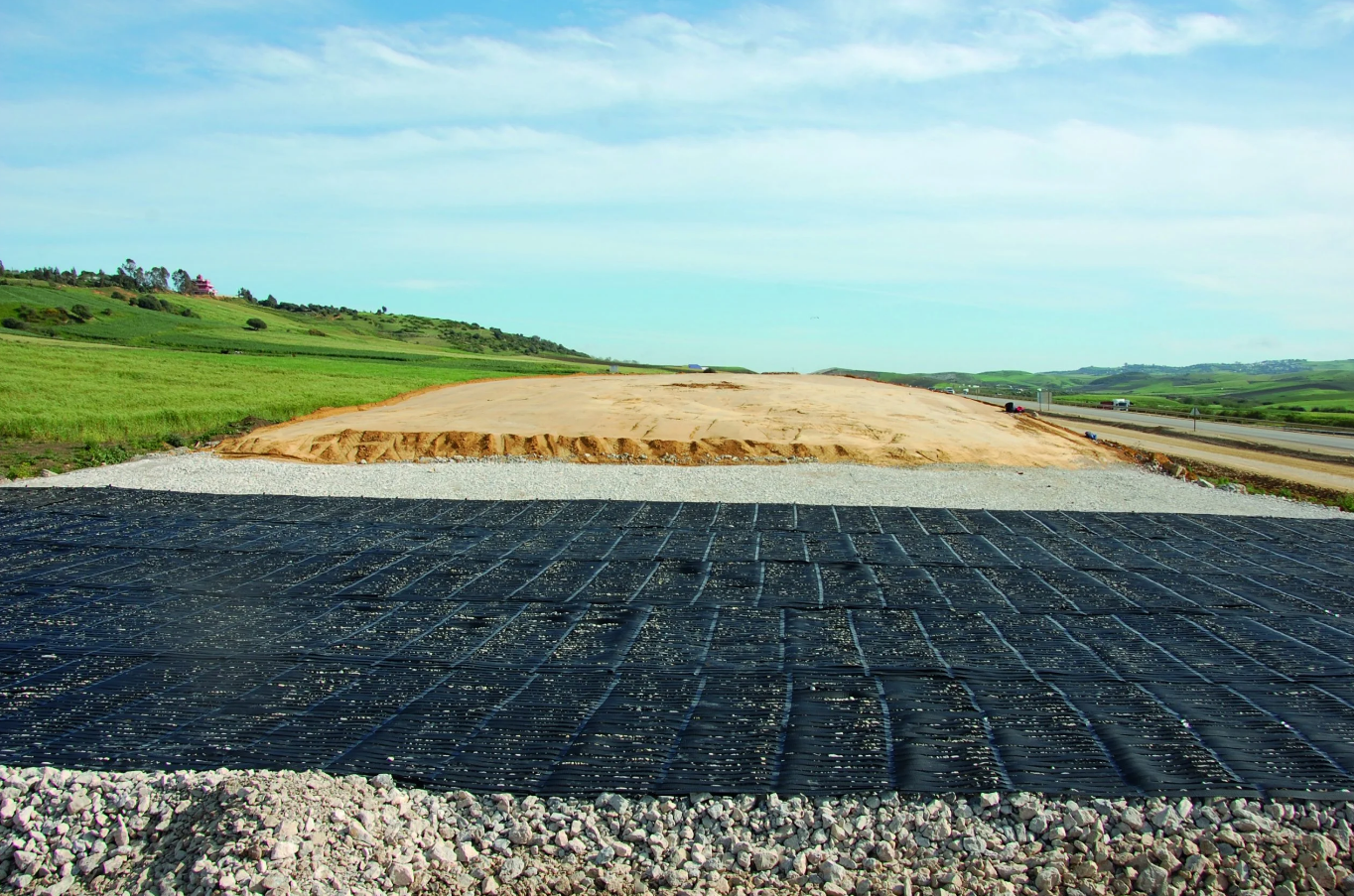
Asphalt
Stress Absorption
Roadways endure thousands upon thousands of repeated tire loads every day. When a fully loaded heavy truck passes over the surface, the axle load pressing down on the pavement is roughly 10 tons (about 100 kN). Beneath the surface, aging concrete bases and old asphalt layers have often already fractured. The road may still look smooth, but underneath, several major cracks may already be spreading.
A subsurface crack just 5 mm wide can cause serious trouble. On a winter night when the temperature drops to -5°C, old pavement slabs contract as they freeze and stiffen. At the joints between adjacent concrete slabs, tensile stress can reach as high as 1.5 MPa. That concentrated tearing force moves upward along the crack toward the newly placed asphalt overlay.
In cold weather, asphalt becomes stiff and loses nearly all elasticity. Cracks in the underlying layer propagate upward by about 0.2 to 0.5 mm per day. No matter how thick the new overlay is, after two or three months of sun, wind, and traffic, the surface will begin to show a network of fine reflective cracks.
- Surface cracks are usually less than 2 mm wide
- Crack edges are jagged and irregular
- During rain, water can seep as deep as 3 cm through the openings
- Aggregate next to the cracks loosens and begins to ravel out
Before placing a new surface layer, paving crews often install a layer of high-strength nonwoven geotextile between the old and new pavement. The fabric weighs only 150 to 250 g/m² and is less than 2 mm thick. Under 200x magnification, it appears as a dense mass of fine synthetic fibers entangled together by high-speed needling.
Once the production line starts, the factory can produce rolls up to 6 meters wide every minute. If the fabric were woven in a regular grid like knitted cloth, heavy traffic would tear it apart far too easily. Instead, the fibers are needle-punched in a random pattern, creating millions of irregular breathable pores in every square meter.
On site, a distributor truck sprays hot liquid asphalt at about 80°C evenly over the old pavement. The application rate is tightly controlled at around 0.9 to 1.1 kg/m². The thin synthetic fabric is then laid over the surface, and its tiny pores immediately absorb the hot black binder. Once the material cools and stiffens, it becomes a highly elastic black rubber-like membrane.
When temperatures suddenly drop again, the old crack below may contract another 3 mm. The asphalt-saturated fabric pad is pulled hard, but it can reach an elongation of more than 50%. The countless entangled filaments inside it deform together, acting like a mass of rubber bands that spread the concentrated tearing force in every direction.
- Each filament is finer than a human hair, with a diameter under 30 microns
- The fiber network can resist tensile loads of 8 kN/m
- Fiber-to-fiber contact points can slip slightly without breaking
- The material does not fully melt until temperatures reach 250°C
Sensors on paving equipment have tracked how that force dissipates. At the tip of a crack, the concentrated stress can reach nearly 2.0 MPa. Once it enters the 2 mm-thick synthetic layer, much of that force is spread laterally by the fabric. By the time it reaches the asphalt surface, the tensile stress has dropped to just 0.4 MPa.
Now picture a dump truck carrying 40 tons of material rumbling past. In the fraction of a second when the tire contacts the road, it applies a vertical pressure of 0.7 MPa. An old crack 15 cm wide in the lower layer tries to tear the surface apart. The fiber-rich interlayer between them deflects slightly, behaving like a mattress spring.
As soon as the truck moves on, the compressed elastic pad rebounds within 0.2 seconds. What would otherwise become a severe strain of 1200 microstrain in the surface layer is absorbed by that lower “spring mattress.” The new asphalt surface above—made with a 5 cm layer of 9.5 mm basalt aggregate mix—shows no visible cracking at all.
On the test track, large loading machines run day and night. Simulated heavy axle loads are applied to the pavement section 50,000 times per day. On the control section without the synthetic layer, a 3-meter-long deep rut formed after 1.2 million load cycles.
The section with the high-strength stress-absorbing layer endured 2.8 million load cycles. Even in extremely cold highway regions of the Northern Hemisphere, where asphalt shrinkage can reach 0.2% at -20°C, the synthetic interlayer buried 3 cm below the surface still retains the resilient feel of a thick rubber gasket.
- Cracking in the upper asphalt layer was delayed by more than 40 months
- The area requiring rain-related maintenance dropped by more than half
- Each kilometer of pavement saved about 15 m³ of patching material
Wearing reflective vests, paving crews move forward with a 6-meter-wide laydown machine. The white synthetic fabric unrolls at 40 meters per minute over the hot base. Behind it, a 12-ton roller compacts the layer with continuous vibration. Then 160°C black asphalt mix is placed on top, sealing the spring-like reinforcing layer permanently below the pavement.
Waterproofing and Seepage Control
A storm dropping 50 mm of rain pounds the street surface. To the eye, the black asphalt looks as solid and watertight as a steel plate. In reality, the pavement is filled with tiny cracks and pinhole-like voids around the aggregate skeleton.
Water silently seeps downward through those tiny openings. In less than 20 minutes, moisture can work its way 3 cm into the pavement structure. The basalt aggregate inside the asphalt layer sits trapped in countless tiny underground pockets of water, never touched by sunlight.
When a wheel load comes down hard, the water trapped in those voids has nowhere to go and turns instantly into a field of underground high-pressure water jets.
A passenger car traveling at 60 km/h over a wet pavement surface squeezes the trapped water inside the asphalt layer. Underground, dynamic hydraulic pressure spikes to 0.6 MPa, forcing water through the aggregate structure in search of an escape path.
That internal water pressure continually strips the black asphalt binder from the surface of the aggregate. As vehicle after vehicle passes over the pavement, the repeated hydraulic scouring gradually washes the binder off the stone. Once the aggregate loses its bond, it begins to loosen and shift beneath the surface.
- The asphalt film coating the aggregate is only a few tens of microns thick
- After more than a week of water exposure, asphalt adhesion can drop to less than 30% of its original value
- Loose aggregate is thrown free by vehicle tires, leaving bowl-shaped potholes in the surface
- After several days of continuous rain, a 1 km stretch of roadway can develop 70 to 80 damaged spots
To stop that damage, paving crews install a layer of high-strength synthetic fabric less than 2 mm thick below the surface. A distributor truck equipped with high-pressure spray bars applies hot asphalt at about 140°C across the old pavement. The spray rate is carefully controlled at roughly 1.1 L/m².
Rolls of synthetic fabric weighing 150 g/m² are then placed directly over the smoking-hot binder. The millions of tiny irregular pores in the fabric act like a giant sponge. In a matter of seconds, the fibers absorb the hot black binder completely, leaving no air bubbles behind.
Once the thin synthetic fabric is fully saturated with hot asphalt and allowed to cool, it becomes a heavy-duty waterproof jacket buried between the pavement layers.
A dense waterproof membrane, almost rubber-like in character, seals the interface between the upper and lower pavement layers. Laboratory permeability testing shows that the hydraulic conductivity of this membrane drops below 10⁻⁷ cm/s. Even if standing water on the road reaches calf depth, not a single drop can penetrate into the soil subgrade below.
Look at a cylindrical core sample drilled from the pavement. The upper 4 cm of asphalt may be fully saturated after a storm, dripping water when squeezed by hand. But once the flexible, asphalt-saturated synthetic layer is peeled back, the old base below is dry enough that there is no trace of soil moisture.
After half a month of continuous rain depositing a total of 300 mm of rainfall, the untreated section of roadway developed more than 50 potholes of varying sizes within a single kilometer. Maintenance crews had to drive daily with small trucks carrying 200 kg of hot patch mix to repair the damage.
- Pothole repairs consume substantial labor and patching materials
- Water damage accounts for more than 80% of early pavement failures
- Once the soil subgrade softens from saturation, the whole pavement structure begins to settle
- Pavers may use around 30 tons of aggregate per day just to repair water-related damage
Reinforcement
In summer, the sun can heat the pavement surface to 65°C. Asphalt softens so much that it feels tacky underfoot. Then an eighteen-wheel truck carrying 50 tons slowly rolls through an intersection. The heavy tires press two deep wheel paths into the softened pavement, each more than ten centimeters wide.
The tire contact area is less than 0.1 m², yet it supports tens of tons of load. Under that pressure, the aggregate inside the asphalt begins to move laterally. Those depressions are rutting. Once rut depth exceeds 15 mm, rainwater collects in the wheel paths, and smaller vehicles can begin to lose steering stability.
To resist softening and rutting, paving crews often install a high-strength synthetic fabric less than 2 mm thick before paving. The idea is not unlike the old practice of mixing chopped straw into mud brick: the dense mat of fine fibers between two asphalt layers acts like a flexible reinforcing steel within the pavement.
When 160°C hot asphalt mix is placed over the fabric, the effect is immediate. Countless semi-softened synthetic filaments mechanically interlock with basalt aggregate roughly 13 mm in size. What would otherwise behave like a loose mass of stone becomes held in place by millions of fine strands.
- The fibers bind the aggregate into a single stable layer
- The fabric’s micropores allow the two asphalt lifts to bond completely
- The space available for aggregate movement is drastically reduced
- The pavement’s overall resistance to tensile loading increases by more than twofold
The stress state inside a pavement is far more complex than it appears from the surface. As a heavy truck passes, the pavement sees not only vertical load from above but also lateral shear generated by tire action. With a tensile capacity exceeding 8 kN/m, the interlayer holds those lateral stresses in check.
After the wheel passes, asphalt’s viscoelastic nature causes it to keep trying to spread outward. But the fibers in the synthetic mesh can stretch to 50% of their original length, acting like a large elastic net and pulling the displaced material back into position. Laboratory fatigue equipment has simulated this effect on reinforced pavement specimens.
In indoor testing at 60°C, heavy-wheel loading was applied 8,000 times. The conventional asphalt specimen without the fiber layer developed a rut 12.5 mm deep. The reinforced specimen, by contrast, showed surface deformation of less than 4 mm.
- Each square meter of pavement can resist lateral tensile forces exceeding 700 N
- The shear force generated when a 50-ton truck starts moving is cut roughly in half
- At high temperatures, lateral asphalt movement is reduced by 70%
A four-lane arterial carrying 20,000 vehicles per day suffers its worst deformation at bus stops, where large buses brake and accelerate repeatedly. After installing a synthetic interlayer less than 2 mm thick, the bus stop pavement lasted an additional 45 months before major rehabilitation was needed.
When pavement cores from several years of service are examined under a microscope, the polymer filaments still retain their original toughness. At least 300 fiber intersections can be counted in every square centimeter of view. The destructive force from repeated heavy-wheel loading is quietly dissipated through those countless micro-scale knots.
When milling machines with toothed drums cut into old pavement during rehabilitation, the reclaimed material contains many black, fuzzy clumps. The synthetic material installed years earlier still clings tightly to the aggregate, and its hardness is nearly three grades higher than the surrounding plain asphalt. Pull it apart by force, and the load gauge rises to an astonishing 15 MPa.
Conventional asphalt is especially vulnerable where buses brake frequently when entering stations. The forward thrust of the vehicle body pushes the tires hard against the pavement, and within six months the surface can develop washboard-like ripples. With the highly tensile fiber layer underneath, that forward displacement is limited to within 2 mm.
- The pavement’s fatigue resistance exceeds 2.5 million loading cycles
- The service life of a 5 cm surface course is doubled
- At least 40 repairs can be avoided on every 1,000 m of downhill roadway
- The occurrence of wave-like distortion in bus stop areas drops by 80%
A rehabilitated suburban ring road has now been in service for 7 years. Every night, convoys of ten-wheel dump trucks loaded with soil pass over it, with hourly traffic volumes exceeding 300 vehicles. Laser scans of the pavement surface show rut depths remaining within the 3 mm green-limit threshold across the entire road.
Roads
Separation & Stabilization
A heavy truck carrying 45 tons of timber drives across a muddy road, applying 0.8 MPa of pressure through its tires. Beneath 40 cm of asphalt and crushed stone, a soft silty subgrade is being squeezed downward. Field testing shows a CBR of only 2.5—the soil behaves like a waterlogged sponge.
Crews place roughly 50 mm crushed stone directly over the soft mud. An 18-ton roller repeatedly compacts it, forcing the angular rock deep into the subgrade. About one quarter of the stone simply disappears into the mud. Within less than half a year of truck traffic, wheel-path ruts reach 8 cm in depth.
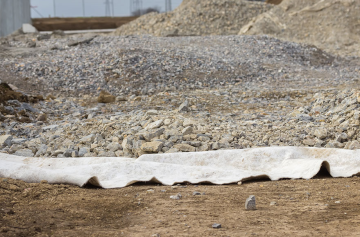
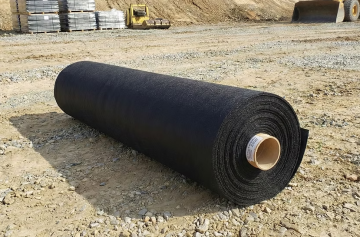
Then the contractor brings in a special material: a nonwoven fabric weighing about 350 g/m². Workers unroll giant sheets 6 m wide and 150 m long like carpeting. Though only 3.2 mm thick, the material consists of thousands of polymer fibers densely entangled by steel needles, with a tensile strength of 25 kN/m in a one-meter width.
- It withstands 300 kPa from crawler dozers
- It resists abrasion from angular stone up to 80 mm in size
- It tolerates freeze-thaw movement down to -25°C
- It resists upward flow of acidic groundwater with a pH of 4
The fabric surface is filled with microscopic openings ranging from 0.08 to 0.15 mm. The saturated mud below is held firmly beneath the fabric, while the coarse stone above remains stable on the surface. Two materials with completely different behavior—soft mud and hard aggregate—are cleanly separated by a single sheet.
The surface of the high-strength nonwoven geotextile is rough, so the stone layer sits on it as though held in a net. Loads from truck tires that would otherwise concentrate at one point are spread outward by the elastic fiber network. The pressure transmitted into the underlying soft mud is reduced by 45%.
In soft ground sections, that means there is no longer any need to keep dumping expensive rock into the subgrade. Based on instrumentation data, the required aggregate thickness can be reduced from 50 cm to 35 cm. Over a road section 1 km long and 4 lanes wide, that saves a total of 8,000 m³ of stone.
- Adjacent rolls must overlap by 40 cm
- On windy slopes, U-shaped staples are installed every 2 m
- Fully loaded dump trucks must never brake suddenly on exposed fabric
- The first layer of stone must be dumped from no more than 1 m in height
A dump truck carrying 20 tons of stone backs into position and unloads material onto the site. Angular rock with sharp edges falls hard onto the fiber layer from above. With a puncture resistance of up to 3500 N, the fabric only deflects slightly under impact and shows no visible damage.
The polymer filaments also resist long-term creep. Independent laboratory testing subjected the material to sustained loading for 10,000 hours, and even under extreme conditions, total elongation remained below 8%. No matter how severe the load above, the geotextile continues to support and contain the stone layer.
A highway built 15 years ago over coastal soft mud now carries 12,000 heavy trucks per day. Recent drilled soil samples show a perfectly distinct boundary between the aggregate and the mud. Over the full 15 years, settlement of the underlying soft ground has remained under 1.2 cm.
- Cut-and-replace work in weak soil was reduced by 20 days
- Truck trips for hauling waste soil out and new stone in dropped by 30%
- The onset of surface cracking was delayed by 5 years
At night, inspection crews check pavement smoothness with laser equipment. On an untreated section carrying the same traffic, rut depths have reached 65 mm. On the lane reinforced with the 3.2 mm geotextile layer, the deepest rut remains below the 18 mm safety limit.
Drainage & Filtration
After seven straight days of torrential rain, the roadside ditch along a mountain two-lane highway is filled with muddy runoff. The groundwater level beneath the road rises by 1.5 m, soaking the 40 cm crushed-stone base beneath the pavement. Soil that normally behaves like a hard plate turns into soft slurry.
As a 50-ton coach bus passes over the asphalt, the wheel loads force the saturated mud upward through the voids between the aggregate. A perforated plastic pipe 200 mm in diameter, buried 2 m below grade, becomes essentially useless.
Muddy water enters the pipe, and in only 14 days, sediment accumulates to a depth of 8 cm at the bottom. Flow slows to a crawl—just 0.5 liters per minute. With water unable to drain away, the structural strength of the road drops sharply.
The repair crew brings in an excavator and digs a trench 60 cm wide and 1.5 m deep along the shoulder. Instead of filling it immediately with stone, workers first line it with a white sheet of high-strength nonwoven geotextile. A 100-meter roll is unrolled to form a giant U-shaped pocket wrapping the entire trench.
| Filter Material | Surface Opening Size | Water Flow Rate | Actual Sediment Control Performance |
|---|---|---|---|
| Ordinary plastic mesh | 2.50 mm | 5.0 cm/s | Mud flows easily into the pipe |
| Dense coarse canvas | 0.01 mm | 0.001 cm/s | Water is blocked outside |
| Nonwoven synthetic fabric | 0.12 mm | 0.3 cm/s | Sediment is retained while clean water flows through |
The fabric contains millions of pores about 0.12 mm in size. Groundwater carrying 0.05 mm fine sediment flows toward the trench. Larger soil particles are blocked immediately at the surface, while the smallest fraction that enters the first fiber layer is trapped by the tangled three-dimensional structure behind it.
- After 3 minutes, a natural 2 mm-thick filter film forms on the outer face of the fabric
- Clear groundwater passes steadily through the white fabric at 0.3 cm/s
- The 150 mm PVC pipe at the bottom remains free of sediment for 12 months
- Within 4 hours after the rain stops, the water level beneath the roadway drops by 1.2 m
A dump truck carrying 15 tons of thumb-sized angular stone backs up to the trench edge. The rock falls like a waterfall from a height of 2 m. Even under that impact, the synthetic fabric, weighing 400 g/m², absorbs the full force without failure.
Workers inspect the trench bottom with flashlights. After tens of thousands of impacts and abrasions from sharp stone, they still cannot find a single hole the size of a sesame seed in the white fabric. The coarse aggregate stays securely inside the fabric “bag,” the mud remains outside, and the void space needed for drainage is preserved.
Some road sections are exposed to highly corrosive groundwater. In one area, lab testing showed a groundwater pH of 4.5. An ordinary steel mesh placed in such conditions would rust into red sludge in less than 6 months.
But the geotextile, made entirely of polypropylene filaments, remained immersed in acidic water for 2,500 days and nights. When tested afterward in the lab, a 1-meter-wide strip still withstood 20 kN of tensile load. The fibers showed virtually no loss in performance from chemical exposure.
- Fabric overlaps must be at least 30 cm
- After filling with stone, the excess fabric edge must wrap over by 50 cm
- Any thorny roots thicker than 10 cm encountered during excavation must be removed first
- The top backfill must be compacted with an 18-ton roller in 3 passes
Unwrapped subsurface drains can clog with mud in as little as 3 years, and reconstruction can cost 150,000 per kilometer. A system wrapped in high-strength geotextile, by contrast, can be excavated after 15 years with the drainage pipe still clean inside.
Maintenance crews insert water-pressure instruments into the ground, and the gauge stays safely below the 10 kPa red-line threshold. Even during an extreme storm delivering 60 mm/h of rainfall, the subsurface drainage system continues discharging at 80 L/min. The roadbed stays dry, and even when 60-ton overloaded trucks pass over the pavement, settlement remains under 1 mm.
Preventing Reflective Cracking
An old two-lane road outside the city, after 10 years of service, is cracked like a dried turtle shell. In summer, the pavement temperature rises to 65°C. In winter, it drops to -10°C. Under those repeated thermal cycles, fine surface cracks originally just 1 mm wide have widened to 5 mm.
Construction trucks bring in hot asphalt mix at 160°C to place a 5 cm overlay on the old road. Every day, thousands of fully loaded trucks pass over it, and each 10-ton axle generates strong upward shear stress at the edges of the old cracks below.
In less than a year, the smooth new overlay begins to “copy” the old cracks beneath it. Rainwater pours into the new openings, saturating the underlying soil. The rehabilitated pavement deteriorates in less than 18 months, forcing the maintenance crew to return once again.
The maintenance team adopts a new method. First, sweepers clear dust and standing water from the old pavement. Then a distributor truck moves slowly at 5 km/h, spraying hot asphalt binder at 150°C over the cracked surface at a rate of 1.1 kg/m².
Two paving workers then roll out a 150 g/m² high-strength nonwoven geotextile. The 4-meter-wide white fabric turns black almost instantly when it contacts the hot binder. The lightweight fiber network, only 2.5 mm thick, becomes a flexible, waterproof cushion.
- Depressions and bumps deeper than 6 mm in the old surface must be leveled first
- Binder temperature in the distributor must be strictly controlled between 150°C and 170°C
- The fabric must be pressed into place within 3 minutes before the binder cools
- If wrinkles appear, they must be slit and relaid flat
The upward tearing force from the old cracks is intercepted by the asphalt-saturated fiber network. Polyester fibers can elongate by more than 50% before breaking, so the interlayer behaves like a resilient trampoline. No matter how hard the crack below pulls, the fabric deforms only slightly and spreads the concentrated force across a surrounding zone of about 20 cm.
The new 5 cm asphalt overlay rests comfortably on top of the interlayer and is effectively isolated from the stress below. Laboratory impact testing confirms the effect: a large steel hammer strikes the specimen at a rate of 60 blows per minute. The unreinforced asphalt block breaks in half after only 1,200 blows.
The asphalt specimen reinforced with the saturated fabric, however, withstands 8,500 repeated impacts without developing even a hairline crack. Field performance tells the same story: pavements that once lasted only two years now remain smooth after 7 to 8 years of service.
A 15 km four-lane highway carrying 30,000 vehicles per day is due for rehabilitation. If the old method were used—removing and rebuilding the entire 40 cm pavement section—the project would require more than 4,000 fully loaded dump trucks just to haul away the old asphalt. Lane closures would last more than three months, causing severe traffic congestion.
- By avoiding large-scale excavation, mechanical milling costs equal to about 20% of total cost are saved
- Daily paving progress increases from 200 m to 800 m
- Emissions associated with 60,000 tons of old pavement waste are eliminated
- A 40 million project budget is reduced by 15 million
Roadbeds
Reinforcement
An eighteen-wheel truck fully loaded with cargo crosses a muddy section of subgrade. The axle load transmitted downward reaches 36,000 kg. Contact pressure under the tires approaches 700 kPa. The soft soil below, with a water content above 40%, cannot withstand that level of stress.
Testing shows that the saturated clay has an extremely low bearing index. Under repeated wheel loads, the mud squeezes sideways like toothpaste. But once a high-strength nonwoven geotextile is placed over the soil, that lateral escape path is cut off. The fiber network, with countless microscopic barbs, locks the soil particles firmly in place.
Strong physical interaction develops between the aggregate layer and the fibers:
- Polypropylene filaments tangle into a microscopic network
- Sharp aggregate edges bite into the pores of the fabric
- The interface friction coefficient rises from 0.3 to 0.8
- Horizontal shear is absorbed by the fiber network
Under a microscope, the polymer filaments form a random three-dimensional labyrinth. Once aggregate is placed and repeatedly compacted by a roller, the sharp lower edges of the stone become lodged in fiber gaps smaller than 0.2 mm. The bottom of what would otherwise be a loose aggregate layer gains a tough, supportive base.
The elastic network has a tensile strength of up to 40 kN/m. Without it, vertical wheel loads would concentrate into the soft soil in a roughly 45-degree stress path. The tensioned geotextile changes that stress path, converting part of the vertical load into lateral tensile stress.
As a result, peak stress reaching the soft foundation soil is reduced by 35% to 50%. Rutting records confirm the effect. On untreated sections, after 100,000 standard axle load passes, rut depths reach 75 mm. The lower mud layer effectively swallows the aggregate.
Replace that section with a nonwoven geotextile weighing 270 g/m², and under the same number of heavy wheel passes, rut depth stays within 25 mm. Thanks to the nonwoven structure, the material has a break elongation greater than 50%, allowing it to accommodate localized settlement.
Buried below the surface, the geotextile deflects like a highly elastic trampoline. The tensioned fibers absorb tons of downward force. Once the truck passes, the stretched network helps restore the road surface to its original shape. Engineering test vehicles ran over the completed test track continuously for 3 months.
Road designers were then able to revise the section design parameters:
- Reduce aggregate fill thickness by 150 to 200 mm
- Save 1,500 m³ of natural stone per kilometer
- Cut truck hauling trips by at least 150
- Reduce construction equipment carbon emissions by 20%
In the past, roads built on soft ground often needed 60 cm of crushed stone. With high-strength geotextile in the section, that thickness can be reduced to about 40 cm. Less quarrying is needed, and the project schedule can be shortened by a full three weeks. Every square meter of synthetic membrane replaces dozens of kilograms of natural rock.
Large basalt aggregate is expensive. By contrast, installing a geotextile layer only a few millimeters thick costs less than RMB 15/m². Compared with simply filling weak ground with stone, the membrane reduces total foundation cost by 12%. From a cost standpoint, the elastic fiber network is a very efficient solution.
Installation crews must follow strict construction procedures:
- Adjacent rolls must overlap by at least 45 cm
- Stainless-steel U-shaped pins must be installed every 2 m
- Crawler dozers may move only slowly over placed fill, not bare fabric
- Heavy equipment must never make sharp turns on exposed fabric
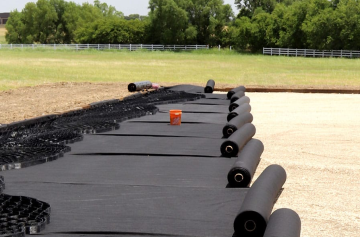
A hydraulic arm carries geotextile rolls weighing up to 200 kg as they are unrolled steadily across the subgrade. An installation speed of 5 km/h allows the fabric to lie flat without wrinkles. Even tiny undulations that are barely visible can create problems. Once a 12-ton roller starts vibrating over the fill above, wrinkles can trigger large tears in the material.
Seams in the overlap zones are stitched with high-strength Kevlar thread. The industrial sewing machine produces stitching with a tensile capacity of 150 lbs per inch. The underground reinforcement system is thus formed as a continuous barrier. Even when surface temperatures rise to 60°C in summer, the fabric buried 50 cm below remains physically stable.
Long-term monitoring sensors are installed 60 cm below the asphalt layer. The instruments record stress variation once every hour. During storms with rainfall above 50 mm, the soft soil water content rises sharply and subgrade bearing capacity drops to its lowest point.
Under those conditions, the buried geotextile layer is stretched tight under load. The fiber network alone absorbs 80% of the dynamic impact from the upper layers. Pore water pressure inside the voids rises quickly, but water escapes through the 0.1 mm openings while the soil particles remain in place. Heavy trucks traveling at 100 km/h pass over the section without causing even the water in a cup to ripple.
Separation
A newly paved asphalt road looks perfectly smooth. Beneath the 15 cm black surface lies a thick layer of crushed stone. Below that is the natural yellow clay subgrade. Then a fully loaded 20-ton truck comes speeding by, pressing all that weight through four tires onto the pavement.
Rainwater slips through tiny cracks in the road and reaches the soil below. The subgrade becomes saturated and turns into slurry. As truck after truck passes, the repeated wheel loads force the muddy water upward, driving it into the clean aggregate layer.
Road engineers call this the “pumping” effect. Extremely fine mud particles, smaller than 0.075 mm, migrate into the voids between the stone. Clean, angular aggregate becomes coated with a slick film of muddy slurry. The stone-to-stone interlock and friction that originally gave the base its strength are lost.
The high-value aggregate in the upper layer gradually sinks into the soft mud under traffic loading. Within just 2 years of opening to traffic, about 20% of the bottom portion of the aggregate layer may be swallowed by the soft subgrade. The roadway loses the rigid skeleton that once supported it.
- Void space in the aggregate fills with mud
- Water becomes trapped below and cannot drain
- Subgrade bearing capacity collapses
- The asphalt surface develops depressions as deep as 50 mm
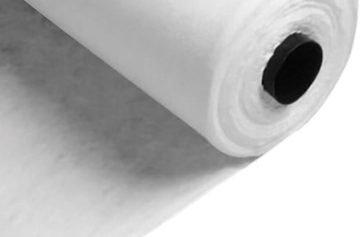
A high-strength nonwoven fabric laid between the mud and the stone changes that completely. In the factory, machines fitted with thousands of barbed needles punch through polymer fibers hundreds of times per minute, entangling them into a thick, durable filtration and separation layer.
The size of the openings across the fabric is carefully controlled. Pore diameters are held between 0.15 and 0.21 mm. Clean water rising from below can pass through freely, while the sticky, ultra-fine mud particles are held beneath the filter layer.
The coarse structural stone remains stable above the fabric. The tough membrane supports angular aggregate up to 40 mm in size without being punctured. The aggregate layer stays clean and maintains its original thickness. The stones remain tightly interlocked and continue to support heavy traffic loads.
- Puncture resistance exceeds 400 N
- Tear strength reaches 250 N
- The material withstands water pressure up to 300 kPa
- It can remain buried in soil for 100 years without decomposing
On a high-grade highway, aggregate is a major cost item. Building 1 km of two-lane road requires about 4,500 m³ of crushed stone. If the bottom 10 cm of that stone becomes contaminated by mud and is effectively lost, then all the effort and cost of quarrying, loading, and hauling it has been wasted.
In the past, contractors dealing with soft ground often had no choice but to add another 20 cm of stone simply to “feed” the mud. With a synthetic membrane in place, the mud and stone are completely separated. That extra stone layer is no longer needed, and the cost can be eliminated entirely.
On site, crews drag huge cylindrical fabric rolls forward by hand. At 300 g/m², the material is heavy enough that three or four strong workers are needed to pull it into place. Adjacent sheets must overlap by at least 50 cm. In winds above 25 km/h, the loose sheets can whip violently in the air.
On the test track, a giant steel wheel runs continuously over the surface. Each pass applies a load of 40 kN. After 1.5 million simulated heavy wheel loads, the untreated section has already become a muddy mixture of soil and stone.
Excavate the test section built with nonwoven geotextile and the difference is obvious: mud remains mud, stone remains stone, and the interface between them is still sharply defined. Measurement with a steel ruler shows that the aggregate layer has retained 98% of its original thickness. Pick up a stone from the bottom and it is still dry and clean, with no mud residue on its surface.
- Major road rehabilitation can be postponed by at least 8 years
- Patching and crack repair work drops by 60%
- Pavement smoothness remains consistently excellent
- Heavy trucks pass over the road without noticeable roughness
Filtration & Drainage
After 2 hours of heavy rain, 100 mm of water has accumulated on the ground. Water forces its way through the pavement cracks and into the yellow clay beneath the road. What was once a dry, brick-hard foundation reaches a moisture content above 30% in less than half a day. As trucks carrying tens of tons pass over it, the softened mud begins moving underground under wheel pressure.
Then winter arrives, and overnight temperatures fall to -15°C. Water trapped deep in the soil freezes. Since water expands by 9% when it turns to ice, the frozen subgrade heaves upward, creating cracks 3 to 4 mm wide in the road above.
When spring comes and the thick ice lenses melt, voids are left beneath the pavement where the ice once pushed it upward. The next heavy truck that passes causes the unsupported road surface to collapse suddenly, forming a pothole 10 cm deep. Maintenance crews end up driving around daily with pickup trucks full of asphalt patch mix, only to see the repairs fail again after the next rain.
To remove the water, the road edges have to be opened up. The construction team digs a trench 1.5 m deep along each side of the road. A perforated PVC pipe is placed at the bottom and surrounded by coarse aggregate. Groundwater seeps through the stone, enters the pipe, and drains away by gravity. In older designs without a lining, however, the flowing water carried large amounts of sediment into the trench.
Extremely fine clay particles work their way into the voids between the stone. In less than 6 months, the filter openings around the outside of the drain pipe can become completely sealed with sticky mud. The drain turns into a dead end. Later, crews changed methods and began wrapping the entire trench with black nonwoven fabric, sealing the mud out completely.
The fabric is only 2.5 mm thick, but in cross-section it reveals a complex three-dimensional network of synthetic fibers. About 85% of the sheet is open void space, and water passes through it at a rate of 0.3 cm/s. The membrane allows as much as 120 liters per minute of groundwater to flow through. Clean water enters the pipe freely, while sediment is held in place outside.
| Drainage Construction Method | Daily Installation Length | Required Trench Width | Clogging Rate After 5 Years | Number of Delivery Trips Required |
|---|---|---|---|---|
| Sand-and-stone filter trench | At most 50 m | At least 80 cm | As high as 65% | About 30 heavy truckloads |
| Drain trench wrapped in black fabric | More than 400 m | 40 cm is sufficient | Less than 5% | A few rolls carried by 1 light pickup truck |
The synthetic fabric placed in the trench is manufactured with pores around 0.1 mm. Groundwater carrying fine particles just 0.05 mm in size strikes the fabric surface. The coarser sand is trapped first outside the fabric. Smaller particles work partway into the three-dimensional fiber network and are then locked in place within the structure.
Over time, a natural “filter cake” forms on the soil-facing side of the fabric. Water continues to pass through without obstruction, while the surrounding yellow clay is completely retained. The perforated PVC pipe and the large stone inside the wrapped trench remain clean enough that not a single grain of sand can be wiped off by hand. Groundwater flows through the pipe year-round at a velocity of 2 m/s, draining smoothly into a natural river several kilometers away.
Road authorities installed dozens of moisture sensors underground and tracked the data over a full 8 years:
- After 3 days of heavy rain, subgrade moisture content dropped back to the safe threshold of 15% within 48 hours
- Sediment buildup inside the drain pipe remained under 2 mm, with no sign of clogging
- Winter frost heave was reduced from 50 mm to less than 5 mm
- For 3 consecutive years, maintenance crews did not need to patch a single water-damaged pothole
When excavators opened up blind drains that had been buried for 10 years, the condition inside was clear. The outer face of the nonwoven fabric was coated in yellow mud, but once it was cut open, the stone inside still showed its original bluish-gray color. Despite being under continuous soil pressure of up to 200 kPa, the fabric remained intact, without even a pinhole-sized tear.
Mountain road construction often involves cutting along cliff faces, where seepage can become a major problem. Hundreds of tons of spring water may emerge daily from fractures in the rock and flow directly toward the road foundation. To intercept it, workers hang vertical sheets of nonwoven fabric up to 4 m high along the slope face. The seepage water strikes the permeable fabric wall, then flows downward along its surface into the side ditch.
In the past, treating seepage at the toe of a mountain slope required building a stone drainage berm as much as 60 cm thick. Hauling hundreds of tons of rock along a narrow two-lane mountain road caused major traffic backups. By switching to a geotextile system, a single roll weighing 150 kg can be installed by four workers with powder-actuated fastening tools in just half a day.
The drainage and filtration economics beneath the roadway are straightforward:
- Seepage interception efficiency along the cliff face increases by 80%
- Nearly 90% of natural filter stone procurement costs are eliminated
- Storm-weather fieldwork time is cut in half
- No large crawler excavators are needed to occupy half the roadway
Once excess moisture is fully drained away, the asphalt pavement above becomes much less vulnerable to damage. The soil beneath the road remains dry year-round, and its load-bearing capacity under heavy trucks becomes three times higher than when saturated.

Leave a reply