

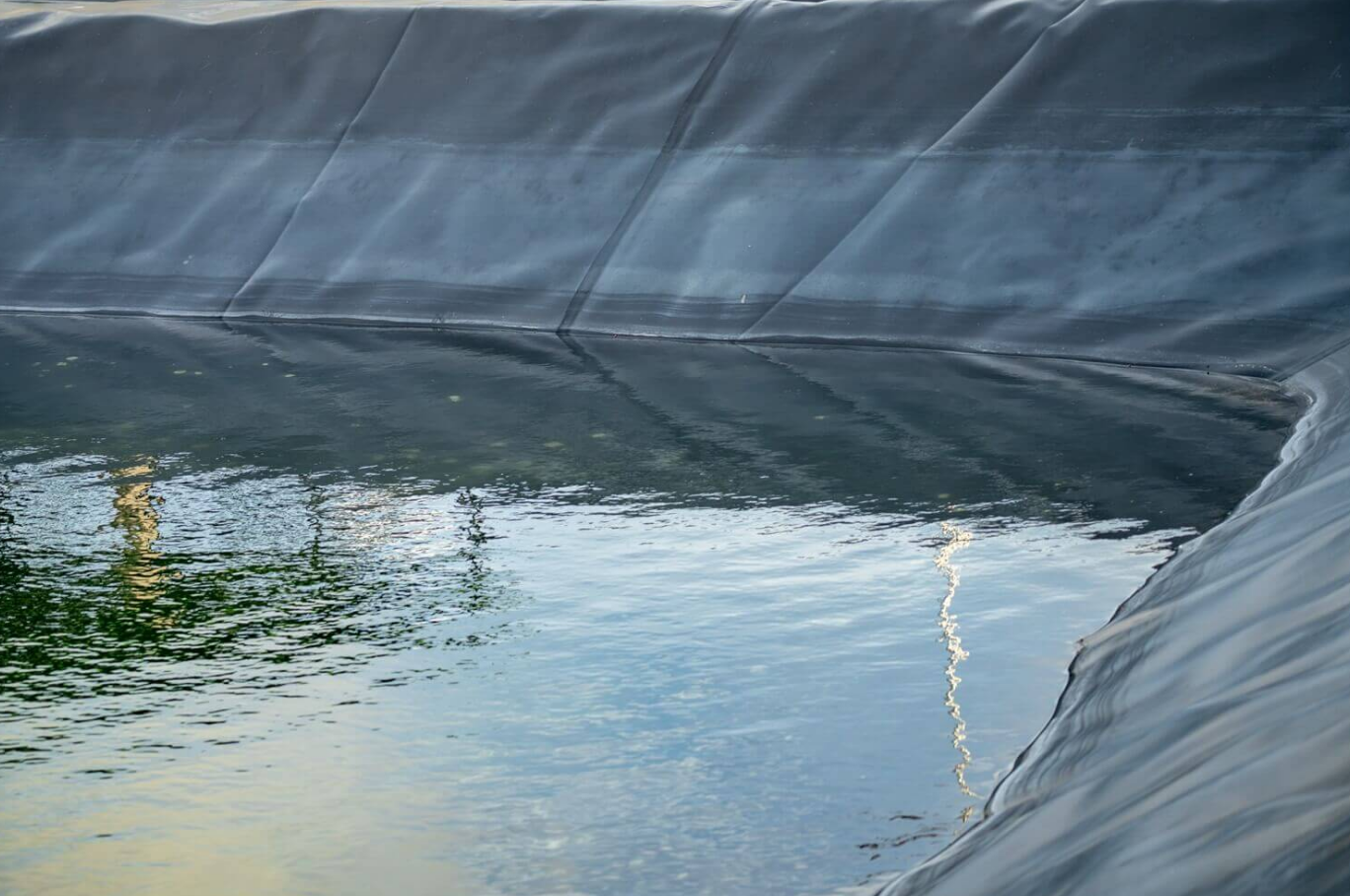
Geomembranes are impermeable lining materials made from HDPE or PVC, typically 0.5–2 mm thick, with a permeability coefficient of 10⁻¹³ cm/s. They are widely used in fish ponds and reservoirs, can reduce leakage by 90%, and generally last 10–30 years.
Types
HDPE Geomembrane
According to factory inspection reports, HDPE geomembranes contain 2.0%–3.0% carbon black. These fine black particles absorb ultraviolet radiation from sunlight, improving UV resistance and slowing aging.
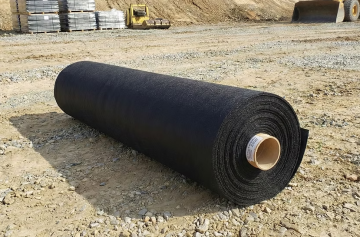
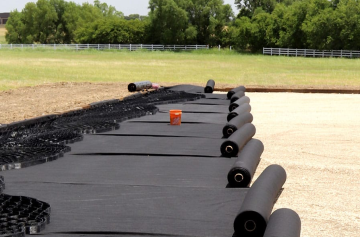
A 1.5 mm membrane weighs 1.42 kg/m². Full rolls delivered to construction sites are typically 6–8 meters wide and 50 meters long, with each roll weighing up to one ton. They cannot be moved by hand and must be lowered into trenches with a small crane and a dedicated lifting attachment.
After excavation, the subgrade must be compacted to at least 95%. On site, technicians test the soil density using the ring-knife method. Even pea-sized stones must be completely removed from the surface.
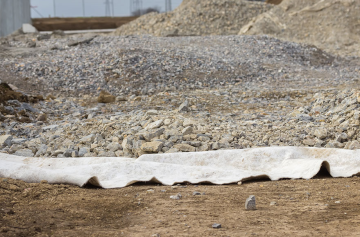
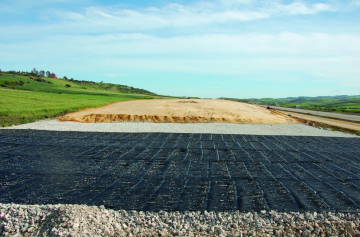
Once thousands of tons of water pressure are applied, sharp stone edges can easily puncture a 1.0 mm plastic liner. Before laying the black geomembrane, a thick layer of continuous-filament geotextile must be installed underneath.
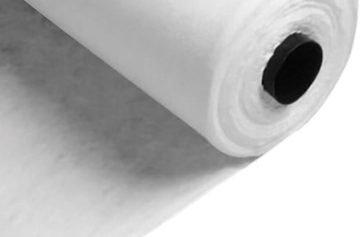
The white protective fabric used after installation has a mass of 300 g/m² and serves as a cushioning layer. The site preparation stage must meet several non-negotiable technical requirements:
- Slope gradient reduced to 1:2.5 or 1:3
- Surface flatness error kept below 5 mm per square meter
- Anchor trench excavated to 80 cm deep and 80 cm wide
- Groundwater lowered to 50 cm below the bedding layer
- Work must stop if the temperature is below 5°C or above 40°C
When joining two sheets, the overlap must be 10–15 cm. Workers move a double-track hot wedge welder along the seam line, with the temperature set between 380°C and 420°C.
The machine advances at 1.2–1.5 meters per minute. As the sheets soften under heat, the pressure rollers fuse them into a single piece. A 10 mm hollow channel is intentionally left between the two weld seams.
For quality inspection, a technician inserts a hollow needle into one of these channels and pumps in air with a pressure gauge, raising the pressure to 0.25 MPa, or roughly 2.5 kg of pressure.
After 5 minutes, the seam passes if the pressure drop is less than 0.015 MPa. If there is leakage, workers apply soapy water to locate bubbles and repair the defect.
At corners, tight spaces, or pipe penetrations where large machines cannot reach, workers use a handheld extrusion welder to melt 3 mm or 4 mm specialized welding rods and apply them by hand.
The extrusion gun can output 2–3 kg of molten plastic per minute. The repaired seam ends up about twice as thick as the original membrane.
Small field-cut samples are taken for destructive testing. Required performance data include:
- Yield tensile strength for 1.5 mm membrane: >22 N/mm
- Must not break at 700% elongation
- Right-angle tear resistance: >190 N
- Puncture resistance threshold: 400 N
A membrane sample is placed in a sealed chamber at 200°C and filled with pure oxygen to test oxidative induction time (OIT). If it lasts 400 minutes without failure, its projected outdoor service life is about 36 years.
The material is also soaked for 28 days in solutions ranging from pH 1 to pH 14. Afterward, when retested, a 1.5 mm membrane should still retain 95% of its original strength.
A notched sample is immersed in a detergent-type solution at 50°C and 10% concentration. It must withstand 500 hours without cracking before it can be approved for landfill applications.
Thickness tolerance is controlled within ±10%. A micrometer with a rounded probe is used to measure 10 points across the width.
For fish ponds, 0.5 mm membrane is usually sufficient. Mining waste and hazardous waste landfills require 1.5–2.0 mm membrane. Every additional 0.5 mm of thickness increases puncture resistance by about 150 N.
Under intense summer sun, the black surface of the liner can reach 60–70°C. Thermal expansion of 2%–3% causes wave-like wrinkles to form on flat ground.
Experienced crews prefer to backfill and anchor the edges in the morning when the temperature is around 20°C. If the edges are fixed during cooler hours, the expansion and contraction that occurs at midday is less likely to overturn even a 1-meter-deep anchor trench.
LLDPE Geomembrane
To the touch, LLDPE geomembrane feels much softer than rigid plastic of the same thickness. Factory-tested density is kept below 0.939 g/cm³. In production, resin pellets are melted and blown into a giant plastic tube more than ten meters high, then flattened and rolled. A single roll of 1.0 mm material can cover about 400 square meters when fully spread out.
The installation surface does not need to be perfectly flat. Even if the soil is uneven, the material can conform to the contours like thick leather. If the subgrade settles by 10%–15%, the membrane will gradually elongate rather than rupture. In laboratory testing, it can stretch to 800% of its original length before breaking.
Typical procurement specifications in engineering projects include:
- Thickness commonly specified at 0.75–1.5 mm
- 1.0 mm material weighs about 0.94 kg/m²
- Roll width commonly selected as 7 m or 8 m
- Freshly manufactured roll diameter can exceed 60 cm
- Core inner diameter is typically 150 mm
That added flexibility comes at the cost of lower tensile strength. In yield tensile testing, a 1.5 mm sheet usually reaches only about 15 N/mm, roughly one-third lower than high-density material. Under a 100 N puncture load, a steel needle can penetrate the waterproof layer quite easily.
On sloped earthworks, the smooth surface does not hold soil well. Design drawings often specify single-sided textured or double-textured membrane instead. With a textured surface, the friction angle increases from the low teens to over 26 degrees, making the overlying soil much less likely to slide.
When two rolls are laid side by side at the bottom of a trench, the overlap should be 15 cm. Before welding, workers must wipe the overlap area clean with a dry cloth. Even a trace of moisture will trap bubbles in the seam, causing the later pressure test to fail.
Crawling welding machines are typically set to 360–400°C. Because the material softens quickly under heat, the travel speed is usually adjusted to 1.5–1.8 meters per minute. If the operator hesitates for even a few seconds, the hot copper wedge can burn straight through the thin sheet.
Field acceptance criteria for seam quality include:
- Air pressure between the dual seams raised to 0.20 MPa
- Pressure held and observed for 5 minutes
- Pressure loss must not exceed 10%
- Peel strength must be above 10 N/mm
- Shear strength must exceed 14 N/mm
Before installation, a geotextile cushion layer must be placed under the membrane. Because the material is softer, the specified protective layer is usually increased to 400 g/m² or 500 g/m² nonwoven fabric. Even if a sharp stone fragment 2 cm long is hidden below, the thick fabric can keep it from puncturing the liner above.
The black material contains 2% carbon black. In OIT testing, a sample is placed in an oven, and it passes if it lasts 100 minutes without cracking. After more than a decade of outdoor exposure, the surface only gradually begins to harden and become brittle.
Installation can still proceed on frozen ground at -20°C. The material passes brittle-temperature testing by being stored for days in a -70°C freezer. When removed and struck with a hammer, it still remains flexible, with no spiderweb-like cracking on the surface.
Small accidental punctures do not require large repair equipment. Workers cut a circular patch about 15 cm in diameter, soften the edges with a hot-air gun, and press it firmly into place to seal the leak. The area around the patch must be aggressively roughened with coarse sandpaper, removing at least 0.5 mm from the surface layer.
Strict storage rules on site include:
- Rolls must never be stacked more than 5 rolls high
- They must be raised at least 10 cm above ground to prevent standing water
- In summer, outdoor storage requires a reflective sunshade cover
- Workers must never drag the rolls with tools fitted with metal hooks
EPDM Geomembrane
EPDM feels like the thick inner tube of a heavy truck tire. Material sold for koi ponds is almost always labeled 45 mil, or about 1.14 mm thick. A single sheet measuring 10 m by 10 m weighs about 140 kg. On site, it usually takes at least four or five strong workers to drag it from the truck into the excavated pond.
The material has strong elastic recovery. In testing, it can be stretched to three times its original length before it finally breaks. Even if several fist-sized stones are left on the pond bottom, the black rubber can wrap around them once the pond is filled. In puncture testing, it takes several hundred newtons of force to push a steel probe through it.
Freshly manufactured sheets are coated with white talc to prevent sticking. For fish ponds, buyers must check for the “Fish-safe” label. In those formulations, toxic ingredients have been removed. If industrial-grade material without that label is used in water, it can kill an entire pond of valuable ornamental fish in less than a day.
When joining two sheets, high-temperature welding cannot be used. Rubber scorches and blackens when exposed to extreme heat, so seams must be made with primer and double-sided seam tape. Workers apply primer repeatedly over a 15 cm overlap zone using a scrub pad.
Once the black surface turns dull and no longer feels tacky, a 7.5 cm waterproof seam tape is applied immediately. After peeling off the release paper, the upper sheet is pressed down and rolled repeatedly with a heavy steel roller. The goal is to fully compress the two sheets and adhesive together, leaving no air pocket even as small as a pinhole.
Several site rules must be followed:
- Overlap width must be at least 15 cm
- Primer must not be applied if the temperature falls below 5°C
- After taping, the seam must cure for 24 hours before the pond is filled
- Pipe penetrations must be wrapped with uncured soft rubber tape
This rubber liner performs extremely well in both hot and cold weather. After being frozen in a -40°C chamber for a full month, it can still be folded sharply without leaving any whitening or stress marks. Under intense summer sun, even when the surface reaches 80°C, it remains soft, gives off no sharp plastic odor, and does not turn brittle or crack.
| Test Item | Industry Minimum Requirement | Typical Field Result |
|---|---|---|
| Thickness tolerance | ±10% | Measured 45 mil material typically falls between 1.14 mm and 1.25 mm |
| Elongation at break | ≥300% | Can be stretched to three times its length like a rubber band without tearing |
| Ozone resistance | No cracking after 168 hours | Even after 5 years outdoors, the exposed edge above water shows no surface checking |
| Tear strength | >26 kN/m | Even with a starter cut at the edge, it is still very difficult to tear by hand |
For backyard stepped ponds with waterfalls, rigid plastic liners are difficult to fit properly. This rubber material behaves like a heavy bedsheet, folding neatly into corners and over steps. Where pump pipes penetrate the pond bottom, a specialized rubber flange with a circular opening is installed, sealed all around with polyurethane sealant, and tightened with stainless-steel screws to create a fully watertight connection.
Before installation, a protective underlayment is essential. Backyard excavations often contain roots and broken glass. A 250 g/m² nonwoven geotextile should be laid across the entire subgrade. If geotextile is unavailable, 3–5 cm of fine sand can be used, or in a pinch, even an old thick carpet, to block sharp objects.
Storage requirements are strict:
- The storage area must be free of gasoline, motor oil, and chemical solvents
- Rolls must be stored flat on clean wooden pallets and never upright
- Prolonged exposure to sunlight can cause the black surface to turn gray and develop a white haze
- Workers must never use rough rope to cinch and lift the rolls
Uses
Agriculture & Aquaculture
Large coastal white shrimp farms line 5-acre earthen ponds with 0.75 mm HDPE geomembrane. Natural pond bottoms contain many tiny seepage paths. A 1-acre pond can lose 15,000 gallons of water per day through seepage. Once the black liner is installed, the dirty pond soil is completely separated from the clean culture water.
The improvement in water quality is obvious on monitoring instruments. In unlined ponds, heavy rain can cause the pH to drop from 8.2 to 6.8. With a liner in place, acidic compounds from the soil are kept out of the water. Throughout the shrimp-growing season, ammonia nitrogen remains safely below 0.2 mg/L.
Geomembranes also change the day-to-day realities of aquaculture operations:
- Uneaten feed slides along the smooth liner into the drainage outlet
- Feed conversion ratio improves from 1.8 to 1.2
- Harvesting time with nets is reduced by 40%
- Water exchange frequency is cut in half
Previously, cleaning sludge from earthen ponds required large excavators. The black, foul mud then had to be sun-dried for 15 days to kill parasites. With lined ponds, once the water is drained, two workers with pressure washers can clean a 2-acre pond in just 4 hours. The turnaround time before the next batch of shrimp fry is stocked is shortened to 3 days.
To control parasites in muddy pond bottoms, fish farmers used to apply 100 pounds of quicklime per pond, but much of it was absorbed by the sediment, and disease still occurred. Smooth liner surfaces do not absorb chemicals. Just 30 pounds of safe disinfectant can eliminate pests in 30 minutes, reducing chemical costs by $50 per month.
The black material also absorbs solar heat efficiently in early spring. After 6 hours of sunlight, the surface water temperature rises by 2–3°C. Tropical fish feed more aggressively at 28°C, with feed intake increasing by 15%. In winter, lined ponds covered with plastic greenhouses retain heat better and can cut electricity bills by about 20% per month.
Pathogenic bacteria thrive in pond sludge. In the past, at high shrimp stocking densities, the incidence of white spot disease could reach 30%. The dense, smooth polymer liner gives harmful bacteria fewer places to colonize. Shrimp yield per acre can jump from 1,000 pounds to 2,000 pounds.
Now turn to almond orchards in California’s Central Valley. Farmers there build agricultural reservoirs capable of holding 5 million gallons of water. California can go four straight months without summer rain, placing heavy pressure on stored irrigation water. Unlined earthen reservoirs can lose 35% of their water during the dry season.
Contractors install 1.0 mm LLDPE across the surface of a 2-acre storage pond. At that thickness, the material can stretch 300% without failure. Along the edges, a 50 cm anchor trench is excavated to secure the liner and limit movement caused by daily temperature swings. Even when tractor tires weighing several hundred pounds roll over it, the liner’s 400 N puncture resistance prevents damage.
The farm’s irrigation system changes dramatically after lining:
- Pumps use 150 kWh less electricity per month
- Drip irrigation tubes clog 60% less often
- Liquid fertilizer losses stay below 5%
- When used with shade netting, 95% of the water can be retained
Landscaping & Residential
In Orlando, Florida, a homeowner dug a fish pond 15 feet long and 10 feet wide in the lawn. Two years earlier, workers had poured a 6-inch-thick concrete base. After two winters, it developed a 2 mm-wide crack. The pond’s 3,000 gallons of tap water leaked into the sandy soil in less than 48 hours, and an $800 Japanese Kohaku koi died after the water level dropped too low.
A crew used jackhammers to remove the broken concrete and replaced it with a single 45 mil EPDM liner. A 20-foot by 20-foot roll of black rubber weighs about 120 pounds, and two adults can carry and spread it over a flat lawn. Because the material can stretch 300% without tearing, the crew was able to press the excess into gaps between rocks entirely by hand.
Everyday pond maintenance became much easier:
- The rubber liner contains no foul-smelling chemical additives
- The black pond bottom makes the koi’s red-and-white markings stand out vividly
- A 0.5 cm layer of green algae on the liner becomes a natural snack for the fish
- Even when winter nighttime temperatures fall to -40°F, the liner remains flexible to the touch
Outside Phoenix, Arizona, a 150-acre championship golf course planned to build three connected lakes as water hazards, with a total storage volume exceeding 1 million gallons. In desert soil, just a shallow excavation reaches highly saline and alkaline earth. Groundwater tends to rise through the soil, turning clean lake water milky white.
Excavators spent three days digging lake basins 8 feet deep. Workers then laid rolls of 60 mil LLDPE geomembrane across the bottom. Five workers wearing leather gloves guided a four-wheel automatic hot-wedge welder around the basin. The edges of two giant 50-foot-wide sheets were heated to 260°C, and a single 200-meter seam was completed in 45 minutes.
| Type of Landscape Pond | Recommended Material | Thickness | Estimated Service Life | Crew Requirement |
|---|---|---|---|---|
| Residential koi pond | Rubber liner | 45 mil | At least 20 years | 1–2 people, manual installation |
| Community artificial stream | PVC liner | 30 mil | About 15 years | 2 people |
| Golf course lake | Polyethylene geomembrane | 60 mil | 30+ years | 5 people + 1 hot-wedge welder |
The 500-meter artificial stream in Central Park, New York City, is lined beneath with black waterproof membrane. Flowing water drops 2 meters over rock steps. Hidden under the mud is 30 mil PVC, laid beneath dozens of rounded stones weighing up to 500 pounds each. Every morning, a high-capacity pump circulates 80,000 gallons of water from a deep basin back to the stream source.
Routine maintenance is far easier for park crews:
- Fallen branches blown into the water do not puncture the black liner below
- Gardeners can remove accumulated leaves with a 5-foot long-handled net
- In hot summer weather, evaporated water—up to 50 gallons—is replenished automatically by a float valve
- If a shovel punctures the liner, a 6-inch adhesive patch can seal it in 5 minutes
Environmental & Industrial
In Ohio, a 50-acre municipal landfill receives more than 800 truckloads of waste per day, totaling 100,000 tons of household refuse. Rotting food waste and used batteries produce around 500 gallons of toxic black leachate per day at the base of the landfill. Environmental regulators require the bottom to be lined with 80 mil HDPE.
The underlying black geomembrane is 2.0 mm thick and feels as stiff as the sidewall of a tractor tire. The local groundwater supply lies just 50 feet below the pit. This heavy-duty black liner keeps the toxic leachate fully contained within the landfill, and monitoring well records over five consecutive years show zero heavy-metal leakage.
Once the thick liner is installed, landfill operations change significantly:
- Bulldozer steel tracks can travel over the liner safely once it is protected by a 0.5-meter layer of sand
- High-powered pumps remove 300 gallons of toxic liquid per hour and send it to dedicated treatment tanks
- Large plastic gas-drain pipes laid on the liner slope extend 30 meters out of the pit
- When the landfill is capped, an additional 40 mil cover liner is placed on top to block stormwater infiltration
Farther south, at a fertilizer plant in Louisiana, four wastewater ponds with a combined area of 5,000 m² were excavated behind the facility. The ponds hold acidic wash water from industrial equipment, with pH readings consistently around 2.0. Earlier reinforced-concrete ponds with 0.5-meter-thick walls developed walnut-sized holes in less than six months of acid exposure.
The owner invested heavily in custom 2.5 mm corrosion-resistant liner. A yellow crane lowered 2-ton rolls into a 10-meter-deep pond excavation. Even after long-term contact with dozens of high-concentration chemicals, the special heavy-duty plastic liner showed no sign of reaction. According to the plant’s accounting records, it saves $200,000 per year in materials and labor that would otherwise go toward repairing concrete ponds.
Five experienced welders in heavy protective gear operated double-track hot-wedge welders at the bottom of the pond. The wide black sheets were fused together at 300°C. A 5 mm hollow channel was intentionally left between seams for leak testing. Workers injected 30 Pa of compressed air and observed the gauge for 5 minutes; only when the needle remained perfectly still was the weld accepted.
| Major Industrial Containment Project | Recommended Liner Material | Required Thickness | Hazard Being Contained | Regulatory Penalty |
|---|---|---|---|---|
| Municipal solid waste landfill | Large-format HDPE liner | 80 mil | Toxic leachate from decomposing waste | $50,000 per violation for contaminated discharge |
| Chemical plant acid/alkali waste pond | Custom corrosion-resistant liner | 100 mil | High-concentration industrial acid and solvent waste | Production shutdown plus $100,000 fine |
| Gold mine waste rock pad | Thick textured geomembrane | 60 mil | Heavy metals from gold extraction residue | Mining license worth millions could be revoked |
At an open-pit gold mine in northern Nevada, massive volumes of waste rock were piled up after extraction. Cyanide-bearing process water and heavy metals were mixed into 2 million tons of crushed waste rock. The mine operator used dozens of excavators to build a tailings facility across 200 acres of desert terrain. Just the bottom liner required 800 standard rolls, each weighing about 1,000 pounds, delivered by truck.
Because the site is windy and sandy year-round, the installation team selected 60 mil textured geomembrane with raised surface patterns. The textured finish allows heavy dump trucks carrying 50 tons of waste rock to climb 30-degree slopes without slipping. Toxic yellow process water flows down the impermeable polymer-lined slopes into a deep collection pit at the base. Soil beneath the surrounding grassland remains free of even trace contamination.
Hundreds of electronic water-quality sensors buried beneath the liner send continuous green-status readings to the control room 24 hours a day. Each acre contains five probes, evenly spaced to track even the slightest change in subsurface moisture. The factory-produced liner was designed by chemical specialists for a 50-year service life. Ten miles away, families in the nearby town can still turn on their taps without detecting any metallic odor in the water.
Top Benefits
Leak Prevention
In an ordinary 1,000 m² pond, even a 50 cm compacted clay liner can still lose 3–5 tons of water per day. Replacing that with a 1.5 mm HDPE geomembrane transforms water retention performance. Laboratory testing shows an extremely low permeability coefficient of just 1.0 × 10^-13 cm/s. A single drop of still water would theoretically take tens of thousands of years to pass through the membrane under its own weight.
In manufacturing, virgin resin pellets are heated to 200°C, melted, and extruded into broad sheets. As the material cools, the membrane naturally develops a high-crystallinity molecular structure of around 40%–60%. The tightly packed polymer chains block the microscopic capillary pathways through which water normally moves in soil.
Even under very high pressure, the membrane remains watertight. With 1.5 MPa of water pressure on one side, the back of the membrane still feels completely dry. That pressure is equivalent to the load exerted by a 150-meter column of water on an area the size of a coin. The dense material structure allows the membrane to hold back tens of thousands of tons of water.
Large-area installation depends on welded seams. Two sheets are joined using a dual-track hot-wedge welder:
- Machine temperature set to 350°C–420°C
- Overlap width of 10–15 cm
- Two independent 12 mm weld seams fully fuse the plastic together
- Peel strength of the weld exceeds 120 N/cm
Between the two welds, a 10 mm test channel is intentionally left open. Workers pinch both ends shut, insert a test needle, and pump in compressed air until the gauge reaches 0.2 MPa, then observe it for 5 minutes.
If the gauge does not move during those five minutes, neither water nor air can escape. This is known as the dual-seam air pressure test. At pipe penetrations and curved details where the large welder cannot reach, workers use an extrusion welder—similar in appearance to an oversized heat gun—to apply molten plastic at around 280°C and seal tight corners completely.
Small stones and hard roots in the subgrade are among the most common causes of puncture from below. Before installation, workers rake the soil smooth and remove any sharp stone fragments larger than 5 mm. A 1.5 mm membrane itself can withstand a puncture force of 400 N.
Even vigorous root growth from below is absorbed by the membrane’s flexibility. The liner may rise slightly into a small bulge, but even under magnification no cracks appear. Soil moisture and pond water remain completely separated by the membrane.
Before any roll leaves the factory, destructive testing is carried out in the lab:
- Tensile strength at break exceeds 27 N/mm
- Elongation reaches 700%
- Right-angle tear resistance remains above 150 N
- Stress crack resistance in chemical testing lasts more than 500 hours
If a shovel accidentally cuts a slit less than 2 mm wide during installation, it can be repaired by heat-welding on a palm-sized patch with a handheld hot-air gun. Workers then place a transparent acrylic vacuum box over the patch and brush soapy solution around the edges.
A vacuum pump creates 0.05 MPa of negative pressure inside the box, and the repair is observed for 60 seconds with a stopwatch. If no bubbles appear, the puncture has been fully sealed. Pipe penetrations are another common leak point.
Before installation, pipes are fitted with a sleeve and flange assembly. Workers cut a matching hole in the liner and fit it over the sleeve. The membrane is then clamped tightly between the flange plate and a backing plate using specialized stainless-steel bolts. Tightening follows strict specifications:
- The outer flange diameter must exceed the sleeve diameter by 150 mm
- A 3 mm water-swelling rubber gasket is placed between the metal plates
- Stainless-steel M16 bolts are tightened gradually in a crisscross pattern
- Torque must be controlled between 40 and 50 N·m
Durability and Aging Resistance
When ponds are drained in summer, the black geomembrane can be left fully exposed outdoors. At noon in July and August, ground temperatures can reach 60–70°C, and UV radiation cuts into plastic like countless tiny blades. Ordinary white greenhouse film left outdoors often becomes brittle and shatters in as little as three months.
Geomembranes are manufactured with 2%–3% carbon black added directly into the raw material. These particles are extremely fine, typically 10–30 nanometers in diameter. When thoroughly mixed with polyethylene resin during production, they act like an internal, full-depth sunscreen for the membrane.
When sunlight strikes the black surface, ultraviolet radiation is absorbed by the carbon black and converted into small amounts of heat, which then dissipate into the air.
In outdoor exposure tests conducted in Sanya, Hainan—an area with extremely intense UV radiation—1.5 mm membrane samples retained 80% of their original strength even after 20 years of direct exposure.
Sunlight is not the only aging factor. Oxygen in the air also gradually causes plastic to yellow and become brittle—a process known as oxidative aging. To counter this, major manufacturers add 0.1%–0.5% antioxidant and light-stabilizer packages during production. Small 1.5 mm samples are then tested in sealed laboratory ovens to verify heat resistance.
Technicians set the oven to 200°C and flood it with high-pressure pure oxygen, forcing the material to age at accelerated speed. Low-quality membranes can fail in less than 30 minutes under these conditions.
Qualified HDPE geomembranes can last 110 minutes or more without any sign of degradation. Translated into real outdoor conditions, that means the antioxidant system is sufficient to resist weathering for decades.
In the coldest part of winter, shallow outdoor fish ponds in northeastern China can freeze solid. Since water expands by 9% when it turns to ice, the pond bottom and sidewalls are subjected to strong outward pressure. Concrete ponds often crack under repeated freeze-thaw stress.
Geomembranes, by contrast, are formulated to withstand exactly this type of movement. In the lab, samples are frozen for days in a -70°C ultra-low-temperature chamber.
- A heavy steel hammer is used to strike the frozen black membrane
- The polymer chains do not become brittle
- No fine spiderweb cracking appears on the surface
- The membrane still retains 700% elongation
No matter how much the ice expands above, the membrane simply stretches slightly with it.
The liner at the bottom of a pond is also continuously exposed to alkaline soils, acid rain, and treatment chemicals such as potassium permanganate settling into stagnant areas. In ordinary waterproofing materials, this kind of chemical exposure can quickly cause corrosion and failure.
High-quality geomembranes can tolerate a broad pH range of 2 to 13. Whether exposed to 30% strong acid or highly alkaline fertilizer salts, the membrane surface remains completely intact.
When buried underground and shielded from sunlight, geomembrane service life becomes especially long. Once installed, the black liner is often covered with 50 cm of compacted fine soil, blocking all sunlight. Underground temperatures remain relatively stable at 10–15°C year-round, and the polymer structure effectively enters a dormant state.
When old reservoirs in Europe and North America have been excavated for renovation, liners buried for more than 50 years have often emerged looking almost like new after rinsing. Anaerobic bacteria in submerged sediments cannot break through polyethylene’s dense chemical structure.
Field mice may tunnel through soil, but the black membrane gives off no scent that suggests food. When rodents encounter a 1.5 mm hard plastic barrier, their teeth simply slide off and they move elsewhere.
Quality inspection agencies also use a xenon arc aging tester to simulate decades of extreme sun, rain, and temperature cycling in just a few months.
- Xenon lamps expose the membrane to light far harsher than midsummer sun
- The machine alternates between cold-water spray and high-temperature drying
- Testing runs continuously for 8,000 hours
- Afterward, tensile performance drops by less than 10%
Flexibility and Conformability
When a contractor digs a koi pond in a rural yard, even a 60 cm excavator bucket rarely produces a perfectly rectangular pit. For visual appeal, the pond perimeter often ends up in irregular curves, while the base may include shallow shelves at 40 cm depth descending to a 1.5 meter wintering zone. In this kind of uneven excavation with vertical soil walls, forming curved concrete with narrow timber formwork is slow and difficult. Even three experienced masons may spend three full days without achieving a tight fit.
By contrast, liners made from LLDPE or EPDM feel like a heavy rubber blanket even in winter. In factory testing, a 10 cm-long, 1.0 mm-thick strip can be clamped in a tensile machine and stretched out to 75 cm before it finally snaps.
With more than 700% elongation, this kind of material is especially effective on vertical 90-degree pond steps. Four workers can carry a 200-pound, 6-meter-wide roll of black liner and unroll it down a 40 cm underwater step. At inside corners, there is no need for repeated cutting or adhesive seam work.
Workers wearing flat shoes can step into the excavation and push the liner tightly into the corner by hand, folding back a triangular “pig-ear” pleat along the vertical soil wall. Once that triangular fold is laid to one side, the membrane turns the corner neatly and continues flat across the next level of compacted earth.
| Material Used | Best Suited Pond Shape | Maximum Elongation Without Failure | Time to Install 100 m² |
|---|---|---|---|
| Reinforced concrete | Regular square or circular ponds | Less than 1% | 14 days including curing |
| Low-cost rigid HDPE | Large, flat open areas | 600% | 4 hours |
| Flexible LLDPE / EPDM | Uneven, irregular curved surfaces | Over 700% | 2.5 hours |
No matter how many times an excavator bucket scrapes the subgrade, the pond bottom will never be as smooth as polished interior stone flooring. Rounded cobbles the size of a fist often remain partly exposed, and track marks 15 cm deep are common. A highly flexible liner simply drapes over these irregularities like an oversized coat.
The membrane settles loosely over raised stones and naturally hangs into depressions. Once a pump fills the pond with 50 m³ of groundwater, the full 50-ton load presses evenly across the liner. This hydraulic weight forces the rubber-like sheet into closer contact with the soil and pushes trapped air outward toward the edges.
If the pond is drained two days later, the black liner is found sitting tightly in every small depression, with no remaining air pockets. Flexible liners also handle penetrations and landscaping elements easily:
- A 110 mm PVC pipe projecting from the pond floor can be wrapped by the liner into a tight cone and secured with a stainless-steel clamp
- On a steep soil slope of up to 45 degrees, a textured backing helps grip the earth so overlying sand does not slide down
- In a winding, gourd-shaped stream channel, excess liner can simply be rolled back twice by hand along the 30 cm side banks to hold its shape
Large ponds built over soft yellow soil or fill material often experience subgrade settlement in the first three years. Under the constant weight of more than 50 tons of water, a section of the base may suddenly sink 15–20 cm after heavy rainfall. A rigid fiberglass pond shell would crack open immediately under this kind of localized settlement, often creating a 5 mm-wide leaking fracture.
An elastic geomembrane responds differently. If the subsoil settles unexpectedly, the liner simply stretches locally by 3%–5% and conforms to the depression. That extra few centimeters of extension is enough to bridge the new void completely, while still remaining watertight. The excess liner around the pond edge should not be left exposed to the sun and must be properly buried.
Using a short-handled shovel, workers dig a narrow U-shaped trench 30 cm back from the waterline, typically 20 cm deep and 15 cm wide, all the way around the pond. The extra liner is tucked into this trench and backfilled with compacted soil. Several landscaping boulders weighing 70–80 pounds can then be placed on top to lock the edge in place so wind cannot lift it.

Leave a reply