

Nonwoven geotextiles are used for filtration and drainage, with a permeability of about 10⁻² cm/s. Woven geotextiles are used for reinforcement, with tensile strength of at least 50 kN/m. Both are commonly used in landfills and sumps to prevent seepage and clogging.
Sump
Superior Filtration
Sumps are typically excavated to depths of 8 to 15 meters below ground. Groundwater flows into them at rates of 0.5 to 2 cm/s. The flow acts like a vast underground conveyor belt, carrying surrounding soil and sediment with it. Pumps at the bottom discharge as much as 800 liters per minute, creating strong inward suction in the surrounding soil.
The water carries sand particles of very different sizes and shapes. Fine silt, too small to be seen clearly with the naked eye, churns continuously in the water.
- Gravel larger than 2.0 mm: heavy enough to remain at the bottom
- Coarse sand from 0.5 to 2.0 mm: settles quickly on its own
- Fine sand from 0.075 to 0.25 mm: remains suspended and drifts with the flow
- Silt smaller than 0.075 mm: can stay suspended for four to five days
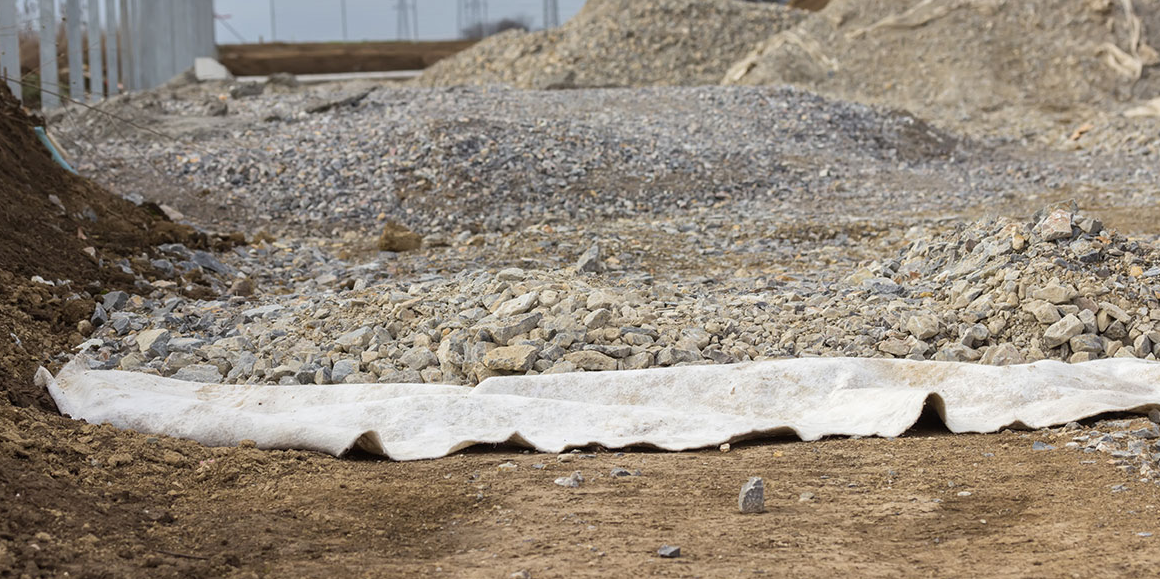
Workers place a layer of nonwoven geotextile with 0.15 mm micropores against the gravel around the sump. These tiny openings block 0.25 mm fine sand while allowing only the finest flour-like silt to pass. During the first 24 hours of pumping, the discharge is typically muddy yellow water.
The fine silt is carried away by the pump into the discharge line. Coarser sand particles between 0.2 and 0.5 mm cannot pass through, so they gradually accumulate outside the fabric. Tens of millions of grains pack together to form a sand layer 2 to 5 cm thick. Over time, a natural filter cake develops.
Once that stable sand layer forms, the pumped water becomes visibly clearer. The coarse-sand filter wall becomes the first line of defense, intercepting even very fine sand several centimeters away from the fabric. The geotextile then serves primarily as the structural support behind that natural filtration layer.
The nonwoven fabric itself is made of randomly entangled polyester staple fibers, with void space accounting for more than 85% of the material volume. A 300 g/m² fabric contains millions of winding microscopic flow paths in every square meter.
- Long-term permittivity remains steady at 1.8 sec⁻¹
- Tensile strength reaches 15 kN/m
- Cross-plane permeability is 0.2 cm/s
- In-plane transmissivity remains at 0.05 cm²/s
Inside the pump is a cast-iron impeller rotating at 2,900 rpm. Quartz sand has a Mohs hardness of 7. When carried into the pump at high speed, it behaves like an abrasive steel file scraping against the metal interior.
If the water contains just 2% sand, pump life drops sharply. Under continuous impact, the quartz particles wear the thick cast-iron impeller edges down until they become razor-thin.
- After 12 hours: the mechanical seal wears by 0.5 mm
- After 24 hours: a groove 1.2 mm deep forms inside the casing
- After 48 hours: 15% of the impeller’s outer edge is worn away
- After 72 hours: the pump motor overheats and burns out
Cushioning & Protection
At landfills, sumps are usually located at the lowest point of the site and are often excavated to depths of 30 meters below grade. They continuously collect toxic leachate flowing in from all directions, while also bearing the enormous weight of piled waste above.
Waste masses tens of meters high impose vertical pressures of 400 to 600 kPa on the sump floor. At the bottom lies a high-density polyethylene (HDPE) geomembrane installed as the primary containment layer.
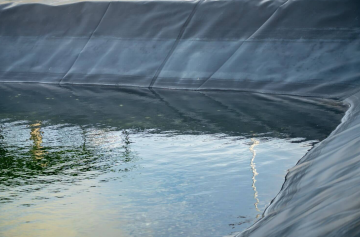
This black geomembrane is produced as a continuous blown film with a thickness of only 1.5 to 2.0 mm. To allow leachate to drain efficiently toward the pumps, workers place a 50 cm thick layer of drainage stone above it.
The stone ranges from 30 to 50 mm in diameter and has sharp fractured edges. Under 600 kPa of pressure, those angular points press directly into the thin 1.5 mm membrane below.
The actual contact area at the tip of a stone may be less than 2 mm², concentrating hundreds of kilograms of load into a needle-sized point. Without protection, the membrane can easily be punctured, creating tears several millimeters wide and allowing toxic leachate to escape into the groundwater below.
A heavy nonwoven geotextile placed between the stone and the membrane serves as the puncture-protection layer. Engineering-grade cushioning fabrics typically weigh 600 to 1200 g/m² and are 4 to 8 mm thick.
At the factory, the material is rolled into cylinders about 0.8 m in diameter and 6 m long, with each roll weighing more than 300 kg. On site, workers use a small crane to spread it across the sump floor. Countless high-strength polyester filaments are needle-punched together into a thick protective cushion.
- Load distribution: the force from each stone point is spread across about 20 cm² of cushioning fabric
- Edge encapsulation: the rough fibers settle into the stone surface and wrap around sharp edges
- Deformation control: tensile strain in the HDPE membrane below is kept below 3%
- Compression resistance: after 10 years of constant load, thickness loss remains under 15%
Laboratory CBR puncture testing under ASTM D6241 provides a clear comparison. A flat-ended steel plunger 50 mm in diameter is pressed downward at 60 mm/min against a suspended fabric specimen.
A standard 300 g/m² geotextile begins to show fiber breakage at around 1,500 N. A heavy-duty sump-grade fabric weighing 1200 g/m² can withstand more than 6,000 N without damage.
In addition to mechanical loading, the sump floor is exposed year-round to aggressive chemicals. Leachate temperatures during decomposition often approach 40°C, and the liquid contains concentrated acids, alkalis, and dissolved heavy-metal salts.
Staple fibers made from polyester or polypropylene resist most chemical attack. Even after soaking for 36 months in a strongly acidic solution at pH 3, the fabric still retains more than 90% of its original tensile strength.
At the bottom of the sump, 6-meter-wide fabric panels are joined to form a continuous protective cover, following strict construction standards.
- Overlap width: adjacent panels must overlap by at least 30 cm
- Hot-air bonding: seams are heat-fused using handheld guns at 300°C
- Settlement allowance: an extra 2% wrinkle allowance is left to accommodate future settlement
- Traffic restriction: after installation, only workers weighing less than 80 kg are allowed to walk directly on the fabric
Landfill Permeation
Woven Geotextile
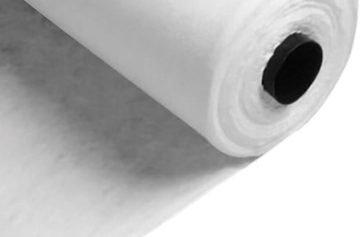
Making nonwoven geotextile is somewhat like building an extremely thick synthetic quilt. The process begins with white plastic sheet being cut into staple fibers 50 to 100 mm long. Large combing machines then align tons of loose fibers into a broad, fluffy web.
Tens of thousands of barbed steel needles punch through the web at a rate of 800 strokes per minute. The repeated needling entangles the upper and lower layers of staple fibers, transforming the loose web into a dense industrial felt 5 to 8 mm thick.
The geomembrane laid at the base of a landfill is actually quite vulnerable. Its thickness is typically limited to just 1.5 to 2.0 mm. A single broken brick with a sharp corner, or a short length of rusty rebar falling from the waste, can puncture it under only a few tens of kilograms of impact force.
To protect it, workers place thick nonwoven geotextile both above and below the membrane. Fabrics used in landfills are very heavy, commonly ranging from 600 g/m² up to 1000 g/m². In effect, the material acts like body armor for the fragile liner.
In the lab, puncture resistance is tested with a dedicated machine. A flat-ended steel plunger 50 mm in diameter is driven into the fabric surface. A nonwoven weighing 800 g/m² can typically resist around 6,500 N before puncturing.
Landfill projects commonly compare three typical fabric grades:
| Mass per Unit Area | Measured Thickness | Puncture Resistance | Typical Use in the Landfill |
|---|---|---|---|
| 400 g/m² | 3.5 mm | 3,200 N | Upper side slopes with relatively low pressure |
| 600 g/m² | 4.8 mm | 4,800 N | Bottom areas used for ordinary waste placement |
| 1000 g/m² | 7.2 mm | 8,500 N | High-load leachate collection sump zones |
Heavy nonwoven fabric also serves as a large-scale filter medium. At the bottom of the landfill are many perforated black plastic pipes with diameters from 200 to 400 mm. Dirty water flows into these pipes and is pumped away, while foul sludge and decomposing debris are kept outside.
The fabric contains a random three-dimensional pore structure. Manufacturers tightly control the pore size to the range of 0.15 to 0.21 mm. Contaminated water can pass through it smoothly at roughly 0.3 cm/s.
On a per-square-meter basis, the fabric can admit roughly 30 liters of dirty water per second. Sediment and debris are trapped by the fine pore network. Around the buried drainage pipes, several layers of filtration materials are typically arranged:
- At the center is a perforated main pipe 315 mm in diameter
- Around it is a 40 cm thick layer of washed stone sized 15 to 30 mm
- Outside the stone is a tightly wrapped nonwoven geotextile weighing 400 g/m²
- Beyond that are compacted soil and the hundreds of thousands of tons of waste above
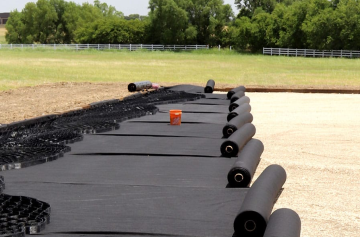
At the landfill base, the fabric is installed almost entirely by hand. Rolls of rough nonwoven are unrolled down the steep slopes, and adjacent sheets must overlap by at least 10 cm. Workers move along the seams with portable hot-air welders in one hand and silicone rollers in the other.
The welding nozzle delivers hot air at about 260°C. As soon as the edge fibers soften under the heat, the worker presses the sheets together with the roller, bonding the panels into a continuous layer.
A skilled installer can produce roughly 3 meters of weld per minute. Weld samples are cut out and tested in tension, and the seam strength must reach at least 60% of the original fabric strength. Quality inspectors typically cut 10 random seam samples per day and send them to the lab for testing.
Nonwoven synthetic fabric does have one weakness: in rainy weather it absorbs water like a sponge. A dry roll weighing 150 kg can exceed 300 kg after moderate rain. For that reason, rolls stored on site must be kept fully covered with waterproof tarpaulins.
White synthetic fibers are also highly sensitive to UV exposure. Even when UV stabilizers are added during manufacturing, there is still a strict exposure limit in the field. Nonwoven geotextile installed at the landfill base must be covered with at least 30 cm of soil within 14 days.
Non-Woven Geotextile
Plastic pellets are heated and melted, then extruded into long flat or round filaments. Large looms weave these plastic strands together in perpendicular directions much like conventional textile production. Common slit-film woven geotextiles on the market are typically 0.5 to 1.2 mm thick.
Landfills are often excavated with steep side slopes, commonly 1:3 or even 1:2.5. Tens of thousands of tons of waste create downslope forces of several hundred kilonewtons. The geomembrane at the base is extremely smooth.
The friction angle between the geomembrane and the soil beneath it is only about 8 to 12 degrees. Under the heavy waste load above, the liner system can easily slip and tear. To stabilize the system, engineers place woven geotextile directly beneath the geomembrane.
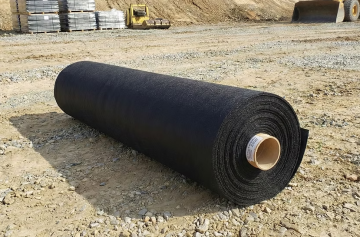
Industrial-grade woven geotextiles can provide tensile strengths from 200 to 1000 kN/m. A typical roll is 4 m wide, 100 m long, and weighs about 200 kg. The interlocking woven structure grips the soil particles below and improves overall stability.
The surface of woven geotextile is rough rather than smooth. Testing shows that once it is installed, the interface friction angle can increase to more than 25 degrees. The previously unstable soil-membrane interface becomes far more secure.
Waste decomposition in a landfill can continue for 20 to 30 years. Under sustained loads, plastics gradually deform and stretch over time, so creep resistance is a critical property for polypropylene-based materials.
In laboratory creep testing, the temperature is held constant at 20°C. The fabric specimen is loaded continuously for 10,000 hours. A qualified woven geotextile must show total deformation of no more than 10%.
The lowest point in a landfill is usually the leachate collection sump. With a waste column 50 meters high above it, the pressure can approach 500 kPa. The sump itself is filled with hard crushed stone sized 30 to 50 mm.
Beneath the stone layer is a high-strength woven fabric made from polyester. Polyester performs better than ordinary polypropylene in resisting long-term deformation under stone loading. Different woven geotextiles are used in different parts of the system:
- Slit-film woven geotextile: individual tapes about 2.5 mm wide, tensile strength around 50 kN/m, used on level ground for soil reinforcement
- Monofilament woven geotextile: visible open area of 5% to 15%, permeability greater than 0.1 cm/s, used around main drainage pipes
- Multifilament woven geotextile: made from bundles of extremely fine filaments, tensile strength up to 800 kN/m, used to stabilize the steepest slopes
The toxic leachate generated by waste often swings to chemical extremes. Free ammonia nitrogen concentrations can exceed 2,000 mg/L. Plastic woven fabrics are generally resistant to both strong acids and strong alkalis.
Before approval for use, the materials undergo a 28-day immersion test in aggressive chemical solutions. Samples are soaked in acid at pH 2 and alkali at pH 13. After exposure, tensile strength must still remain above 90% of the original value.
In outdoor construction, UV exposure can make plastics brittle. To address this, manufacturers add 2% to 3% carbon black during filament production. After 500 hours of xenon-arc exposure, the black woven fabric loses less than 30% of its original strength.
At the jobsite, hundreds of thousands of square meters of woven rolls are joined by hand. Workers use portable industrial sewing machines and lock-stitch the seams with two heavy threads. A single high-strength polyester thread can withstand about 15 kg of tensile load.
Adjacent sheets are overlapped by 150 to 300 mm. After sewing, the seam must retain at least 80% of the parent fabric’s tensile strength. Every batch delivered to site is sampled and sent to the lab for testing.
In the lab, a 200 mm wide strip is clamped in a tensile testing machine. A servo motor pulls it apart at 10 mm/min. The breaking strength measured in the test must not differ by more than 5% from the value printed on the packaging.
Heavy trucks are never allowed to drive directly on the installed black woven fabric. Workers on the slope wear only soft-soled rubber shoes without metal cleats. A small crawler dozer then spreads a protective soil layer 30 cm thick over the fabric.
The pressure from the dozer tracks on the fabric must not exceed 30 kPa. The operator is not allowed to pivot-turn in place. Track rotation can break fibers beneath the surface, even when no damage is visible from above.
Prevention Protection
Protection
The waterproof geomembrane at the bottom of a landfill is only 1.5 mm thick. Every day, dozens of heavy trucks dump thousands of tons of construction waste into the cell. Mixed into the waste are sharp broken glass and rusted reinforcing steel. A hole no larger than a pinhead can leak hundreds of liters of toxic black leachate per day.
When winter temperatures drop to -20°C, the plastic membrane becomes stiff and brittle. To protect it, crews place a heavy nonwoven geotextile above the liner. The fabric weighs about 800 g/m², and its 8 mm thickness is packed with hundreds of thousands of entangled staple fibers.
Large concrete chunks can roll down a 5-meter slope and strike the base of the landfill with tremendous force. The fibers in the fabric elongate under impact, spreading the force generated over a contact area of about 6 cm². The membrane below remains intact, without even a visible whitening mark.
At the factory, the fiber web is needle-punched by about 1,500 needles per minute. Every square centimeter is filled with dense needle penetrations. That highly compact three-dimensional structure gives the material sponge-like compressive resilience.
- It can withstand 200 kPa of static water pressure
- Compression is limited to no more than 15% of the original thickness
- It dissipates more than 70% of falling impact force
- It can remain submerged for decades without fiber loss
The walls of a 10-meter-deep sump can be as slippery as ice. Morning condensation makes them hazardous, and workers can easily fall. Once the rough geotextile is placed, it provides secure grip under rubber-soled boots and eliminates the slipping hazard.
On slopes as steep as 1:3, even tens of thousands of kilograms of rounded drainage stone can remain in place without rolling to the bottom. The stone interlocks with the rough fabric surface, and the interface friction angle remains above 28 degrees.
Several meters below ground, the material is completely shielded from sunlight. The surrounding soil temperature remains around 15°C year-round. With no UV exposure, the plastic fibers age very slowly. Even after 50 years underground, tensile strength still remains at 95% when tested.
Factory rolls are typically 100 meters long and 6 meters wide. A single roll can weigh 480 kg. Two forklifts transport the rolls to the edge of the excavation, and crews roll them down the slope and spread them out like oversized carpet.
Adjacent panels are installed with a 40 cm overlap. Workers heat the edges with handheld hot-air guns at about 300°C, then press them together with rollers. The entire base is sealed tightly, without even a hairline gap.
Leachate in a landfill can reach alkalinity levels as high as pH 13. Ordinary cotton fabric would decompose into pulp in as little as two months. Polypropylene fibers, by contrast, remain chemically stable in strong alkaline liquid. With void space making up about 80% of the material volume, leachate can still flow through the structure toward the sump.
The sump pumps may remove as much as 500 m³ of waste liquid per day. The filtration layer can pass water at a rate of 30 L/m²/s. The large void space promotes rapid drainage, but it can also attract underground biological growth, and the surface may soon become coated with slippery green algae.
- Hungry insects cannot chew through the coarse fibers
- Algae cannot fully block all the microscopic pores
- The fabric resists the claws of burrowing rodents
- Main tree roots cannot penetrate the thick layer
- It withstands attack from foul anaerobic bacteria
Landfill waste ferments continuously, generating hundreds of cubic meters of methane gas each day. Gas trapped beneath the base can build up pressure of about 50 kPa. The textured underside of the protective layer effectively acts as a network of gas channels.
The gas migrates upward along the slope and is discharged through large vent pipes at higher elevations. This prevents gas bubbles from lifting the geomembrane and protects the liner from being torn by pressure buildup.
Above the protective layer, drainage stone about 38 mm in diameter is installed. Excavator tracks move back and forth over the surface, creating pressures of several tens of kilograms per square centimeter. The fabric compresses under the load, but the membrane below remains unharmed.
For six months, the site may be exposed to constant wind, with hundreds of grams of dust settling on the fabric every day. Because the polymer contains a proportion of carbon black, prolonged sun exposure over several months does not reduce its tensile performance.
During the rainy season, groundwater beneath the deep excavation can rise upward in reverse flow. Thousands of liters of muddy water may press up from below each day. The heavy geotextile layer holds the waterproof membrane firmly in place while trapping the sediment in the soil. Even particles as fine as 0.15 mm cannot pass through.
Oil leaks from heavy dump trucks are also a recurring hazard. Hot engine oil, often above 100°C, can drip onto the ground and seep downward through the drainage stone. The geotextile does not immediately melt or perforate, giving emergency crews enough time to clean up the spill.
Engineering drawings often require a double-protection system: one fabric layer below the membrane and another above it. Two 600 g/m² heavy fabrics sandwich the fragile liner in the middle, like two thick impact pads protecting an egg. The long-term environmental safety of the system depends on that arrangement.
Prevention
Road construction inside a landfill is especially vulnerable on weak, unstable subgrade. A fully loaded refuse dump truck can weigh 40 tons. Its four large rear tires press into a 30 cm stone road surface, and the load can drive the coarse aggregate directly into the mud below.
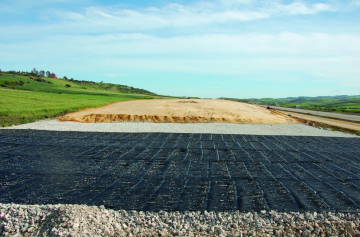
The soft black mud then pumps upward through the stone voids. In less than two weeks, hundreds of cubic meters of expensive imported stone can disappear into the sludge. To prevent this, crews place woven geotextile flat between the mud and the stone, like an extremely strong synthetic support sheet.
The rough woven fabric keeps the two dissimilar materials completely separated. Under hundreds of heavy truck passes per day from 40-ton refuse vehicles, rut depth drops from 15 cm without geotextile to just 3 cm with it. The contractor saves the cost of replacing about 30% of the aggregate.
At the bottom of the sump are perforated black drainage pipes 200 mm in diameter. During storms, muddy water carrying fine sand rushes toward them. Over time, that sand can build up into deposits 8 cm thick on the inside of the pipe wall. Once the drainage system clogs, leachate in the sump can rise by 2 meters in a single day.
Nonwoven geotextile wrapped tightly around the drainage pipe prevents that. The fabric opening size is precisely controlled at 0.15 mm. Groundwater passes through it at an impressive rate of 20 L/m²/s, while 99% of fine sediment is retained outside the pipe.
As a result, clogging around the pipe is effectively eliminated.
- It blocks fine silt as small as 0.075 mm
- It retains the larger drainage gravel in place
- It intercepts decaying branches carried by the flow
- It stops plastic fragments transported in the water
Torrential rain can scour the 45-degree side slopes of a sump with flows reaching 2 m/s, enough to strip away large sections of surface soil. In the past, a single storm could erode as much as 5 kg/m² of soil. Once the slope is covered with heavy geotextile, erosion drops to only 0.1 kg/m².
The interlocked fiber network grips the soil tightly and protects the slope from aggressive hydraulic cutting. Deep slopes several tens of meters high remain stable, and the expensive pumps at the bottom no longer draw in thick abrasive slurry.
Woven geotextile is made from tens of thousands of high-strength polypropylene tapes woven together. Its tensile performance in both directions is remarkable. Laboratory testing shows an ultimate tensile strength of 50 kN/m, equivalent to suspending a 5-ton crane from the edge of a thin sheet.
A 30-ton crawler excavator parked on a soft landfill work platform transfers its load directly to the geotextile beneath. Tens of thousands of fibers tighten instantly under stress, while elongation remains only about 5%. The downward vertical load is redistributed into lateral tensile forces.
That prevents local subgrade collapse.
- Dump truck tires no longer sink into the mud
- Excavator undercarriages avoid bottoming out
- Soil at the crest of the slope stops sliding downward
- Differential settlement over sections several tens of meters long stays below 2 cm
Deep inside the landfill, hot foul leachate generated by fermentation can reach temperatures of 60°C. Ordinary cotton fabric would soften and rot within three months under those conditions. Polypropylene withstands degradation even in hot acidic liquid, and its polymer chains remain dense and stable.
In heavy industrial areas, groundwater often contains corrosive sulfates, with pH fluctuating between 3 and 12. Even after 10 years of exposure, the geotextile surface shows no meaningful chemical deterioration. It protects the system from the severe underground environment.
In winter, overnight temperatures can drop to -15°C. Water in the underlying soil freezes and expands by 9%, causing frost heave that can crack concrete slabs above into openings several centimeters wide.
The dense pore structure of nonwoven fabric drains away capillary water from the soil. Without free water present, the expansion associated with freezing is eliminated. When spring thaw arrives, the large containment foundation remains level and intact.
Underground seepage channels can also erode the sandy foundation beneath a landfill. If even 10% of the sand is washed away, the hundreds of thousands of tons of waste above may begin to tilt. The geotextile installed at the bottom holds the sand firmly in place. Even with year-round groundwater flow, the 50 cm sand cushion remains unchanged.
Much of the risk prevention depends on seam details:
- Overlaps must be at least 50 cm wide
- Seams are stitched with high-strength nylon thread 2 mm in diameter
- Stitch spacing is controlled within 1.5 cm
- Excess fabric at edges is folded inward and flattened
Dozens of workers unroll three massive 6-meter-wide panels side by side across the bottom of the excavation. Two heavy nylon seams stitch the joints so tightly that even water cannot pass through. Tensile testing shows seam strength reaches 80% of the parent material. Across tens of thousands of square meters underground, the result is a single continuous and durable separation layer. Not a drop of clean groundwater is allowed to mix in.

Leave a reply