

Woven geotextiles offer high strength (100–400 kN/m) with elongation under 15%, making them well suited for reinforcement. Nonwoven geotextiles provide high permeability (10⁻³–10⁻¹ m/s) with 40–80% elongation, making them ideal for drainage and filtration.
Strength
Woven
Plastic resin is melted at 200°C and extruded into flat tapes 2 to 3 mm wide. On the loom, the shuttle runs more than 600 times per minute, tightly interlacing thousands of tapes into a dense woven structure.
The open area in the fabric is compressed to below 5%, with pore sizes roughly equivalent to U.S. Sieve No. 40 to 70. Water flow is limited to just 4 to 10 gallons per minute per square foot. That lower flow rate comes with exceptional stiffness and strength.
A common commercial 200W grade can withstand 200 pounds of tensile force in both the machine and cross-machine directions. When a 30-ton truck fully loaded with crushed stone drives over it, the pressure under the tires can exceed 100 psi.
The dense woven grid spreads the wheel load over a much wider area. As a result, the pressure transmitted into the weak subgrade can drop by 70%, making rutting far less likely.
In engineering practice, material selection is typically based on AASHTO M288. For roadway stabilization, contractors often choose heavier Class 1 or Class 2 fabrics.
To meet Class 1 requirements, tear strength must exceed 75 pounds. Workers can drag a 300-foot roll across rough ground full of stumps and branches without leaving so much as a slit in the fabric.
Heavy-duty woven fabrics can withstand puncture loads above 700 pounds. Even when a tracked excavator turns in place on the fabric, or several tons of angular 3/4-inch stone are dropped onto it, the plastic tapes remain tightly interlocked.
During installation, overlap widths must be controlled carefully:
- Firm, stable ground: 12 to 18 inches
- Soft muddy ground: 24 to 36 inches
- Underwater work: more than 36 inches
- Sewn seams: seam strength must reach 90% of the parent fabric’s tensile strength
If the overlap is too narrow, wheel loading can force underlying mud upward through the joint at pressures of around 20 psi. At the overlap, the fabric must also be pinned in place, typically with one anchor every 3 to 5 feet.
The size and type of anchor depend on soil conditions. In ordinary dry soil, 6-inch, 11-gauge U-shaped steel pins are commonly used. In soft sand where a person’s foot sinks in, 10-inch round-head stakes with large steel washers are preferred.
This plastic reinforcement layer is chemically stable in both acidic and alkaline soils and can tolerate environments with a pH of 3 to 12. Even after being buried for 10 years, testing shows it retains 95% of its original tensile strength.
Ultraviolet radiation in sunlight breaks down plastic polymers. After 500 hours of direct exposure, untreated fabric can lose more than half its strength and tear easily.
To improve UV resistance, manufacturers blend in 2% carbon black during extrusion. Black woven fabric made this way can remain outdoors for 150 days with strength loss held below 30%.
Before selecting a fabric, engineers typically match it to California Bearing Ratio (CBR) values:
- CBR > 3: standard 200-pound grade
- CBR 1 to 3: heavier 250- to 315-pound grade
- CBR < 1: composite fabric with polyester reinforcement
- If aggregate thickness exceeds 12 inches: the fabric must support a dead load of 600 kg/m²
On rain-soaked muddy ground, footprints sink in immediately. Once this stiff woven layer is installed, clean #57 stone placed above it will no longer mix into the mud below.
If aggregate sinks just 1 inch into the subgrade, a 1,000-square-foot area can lose about 4 tons of stone. Unrolling a sheet 12.5 feet wide by 432 feet long can save several tons of fill.
Cutting woven fabric with an ordinary utility knife is difficult, and the blade dulls quickly after a few feet. Field crews often carry portable hot knives instead. At around 500°C, the heat melts through the plastic tapes instantly, leaving a clean edge with no fraying.
Non Woven
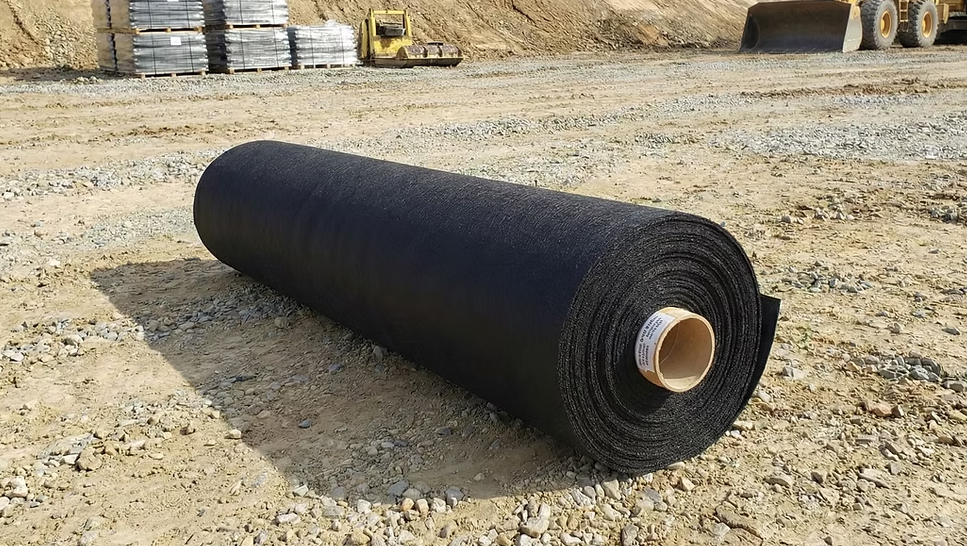
Short plastic fibers are piled together in a loose mass. A machine fitted with dense rows of barbed steel needles punches through the material 800 times per minute, tangling and locking the fibers together. The finished product feels like a thick gray-black wool felt. No yarn spinning or weaving is involved in the process.
Nonwoven rolls are usually selected by weight per square yard. Lightweight products start at just 3 oz/yd², common commercial grades range from 4 to 8 oz/yd², and heavy industrial grades go up to 10 to 12 oz/yd². Thickness typically ranges from 1.5 mm to 4.5 mm.
Inside the felt-like structure are millions of tiny, winding pores, allowing water to pass through extremely easily. A 4 oz nonwoven, for example, can transmit up to 140 gallons per minute per square foot.
At the same time, sediment is held back effectively. The pore size is typically around U.S. Sieve No. 70. Even very fine sand particles as small as 0.21 mm are trapped by the complex fiber network and prevented from reaching the drainage pipe.
Take a typical French drain installation in a yard: a trench 2 feet deep and 1.5 feet wide is excavated, lined with 6 oz nonwoven fabric, and covered with a 4-inch layer of #57 stone. A 4-inch perforated PVC pipe is placed inside, then fully surrounded with angular stone.
The fabric wrapping around the aggregate must follow strict overlap rules:
- Top overlap must be at least 12 inches
- At corners, leave 24 inches of extra fabric for folding
- All seams should face upward and be weighted down firmly with large stones
- The open ends of the pipe should be tied off to keep rodents from nesting inside
When several tons of sharp-edged stone are dumped into the trench, the surrounding soil settles and exerts inward pressure of several hundred pounds. Instead of tearing, the felt-like fabric stretches by 50% to 70%, absorbing the force without failing.
It does not try to resist hard points rigidly. When sharp stone edges press into it, the fabric deforms around them. That highly elastic cushion disperses the impact from each point load and protects the fragile plastic drainage pipe underneath.
Laboratory testing confirms the load capacity. A medium-weight 8 oz fabric can withstand puncture loads of 400 pounds. Even when an excavator track bears down on stone at the edge of the fabric, the fibers remain tightly interlocked with no visible damage.
Now consider a 5,000-square-foot landscape pond. The clay excavation must be lined with an expensive 45 mil EPDM waterproof membrane. Even a pinhole-sized puncture in that liner can drain tens of thousands of gallons of water in just a few days.
To protect it, a heavy nonwoven underlayment of at least 10 oz is required beneath the liner. Half-inch roots, hard clods, and other irregularities in the soil are absorbed by the thick felt under the immense hydrostatic pressure of the water above, protecting the vulnerable membrane.
If a 4 oz nonwoven is pulled on a testing machine, it tears apart completely at around 115 pounds. It is useless beneath a heavy truck gravel driveway: once a 30-ton vehicle passes over it, the fabric will deform deeply into the mud.
Because it is made entirely of synthetic fibers, buried nonwoven geotextile is not affected by fungi or bacteria in wet soil. Even after 20 years in mineral-rich groundwater, the pore structure usually loses no more than 15% of its flow capacity, while puncture resistance remains largely intact.
Its service life in direct sunlight, however, is very short. If it is left uncovered on site for 45 days under strong UV exposure, the tough fiber network can become brittle enough to crumble under a fingernail.
Long-term immersion in thick muddy water can also clog the pores:
- In mud with clay content above 50%, fine slurry can seal off the pore structure completely
- In fast-flowing channels, hydraulic pressure can force fine sand deep into the fabric
- Access points with covers should be left in place so the system can be backflushed with a high-pressure water jet
On site, cutting nonwoven fabric is far easier than cutting stiff woven material. Heavy-duty scissors can slice through long strips in a single pass along a chalk line. For thicker grades, a fresh utility knife blade will usually do the job in just a few strokes.
The rough, fuzzy surface also creates strong friction. On a 30-degree soil slope, a roll of nonwoven fabric can be unrolled and covered with a 2-inch layer of wood mulch. Even during intense summer storms, the soaked mulch grips the fabric securely with no sign of sliding.
The required fabric weight depends on the local soil gradation. In dry, clean sand, a lightweight 3 oz fabric is often enough for stormwater filtration. In very fine, saturated clay, an 8 oz fabric is necessary to retain the thick, adhesive slurry suspended in the water.
Permeability
Non-Woven
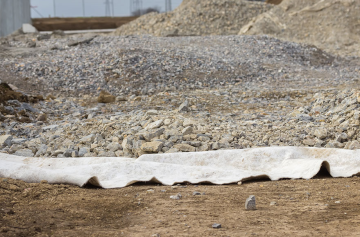
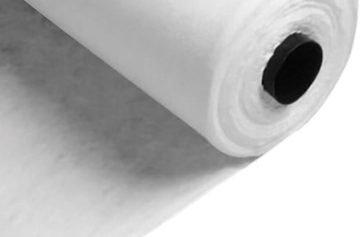
Take a thick, felt-like roll of geotextile and cut it open: inside is a chaotic network of fine white plastic fibers. In the factory, barbed needles punch through the loose fiber mass 1,000 times per minute, consolidating it into a single sheet.
Unlike woven products, it has no regular crisscross grid. Instead, it contains a three-dimensional network of tiny pores throughout a thickness of 40 to 120 mils.
Its water flow properties are tested using ASTM D4491. In physical terms, water passing through it behaves much like water dripping through a large pour-over coffee filter.
- A lightweight 4 oz/yd² fabric can deliver up to 140 gpm/ft².
- When the weight increases to 8 oz/yd², flow drops to about 90 gpm/ft².
Suppose a 50-foot-long, 18-inch-deep trench is dug in a backyard and filled with clean 5/8-inch stone. During a storm, 300 gallons of muddy water per hour flow into the trench. A fabric with a flow rate of 140 gpm/ft² allows that water to pass quickly into the stone layer and then into the 4-inch perforated pipe at the bottom.
Keeping soil completely out of the system is a very real engineering requirement. Once large amounts of sediment enter the stone voids, the trench can clog and fail in less than three years.
Fabric selection depends heavily on AOS, the apparent opening size listed in the test report. In soils made up of coarse sand mixed with small gravel, a No. 70 sieve fabric with a pore size of 0.212 mm is typically chosen.
If the excavated soil consists mainly of very fine clay, the seepage pressure from slurry can be much higher. In that case, a denser fiber matrix rated at No. 100 sieve, or 0.150 mm, is more appropriate. Testing shows it can retain more than 85% of the fine sediment.
For a retaining wall built on a slope with a high groundwater table, a 6 oz fabric is installed vertically against the backfill, followed by 12 inches of drainage stone. That 6 oz material can withstand 160 pounds of puncture force, so the fabric will not tear when sharp basalt drainage rock is placed against it.
Groundwater flowing out of the hillside may carry nearly 40 pounds of fine sediment per cubic yard. When the slurry reaches the fabric, the water passes through, while the 40 pounds of sediment are retained outside the sheet and gradually build up into a dense filter cake.
In septic drain fields, the subsurface pipe network is exposed year-round to concentrated domestic wastewater. About 250 gallons of effluent enter the stone trench each day, with temperatures ranging from 60°F to 80°F. During the first 6 months, a biofilm can develop on the pore surface and help trap larger grease particles.
When two fabric sheets are overlapped on level, firm soil, the overlap should be kept between 12 and 18 inches. In soft mud where a person sinks underfoot, the overlap must be widened to 24 to 36 inches.
- Use 6-inch U-shaped steel pins, driven in every 3 to 5 feet.
- Before installation, the trench bottom must be leveled with a shovel. If depressions deeper than 2 inches are left untreated, the fabric may bridge over them and tear when stone is placed.
Plastic geotextiles are highly vulnerable to sunlight. Even with 3% carbon black added for UV resistance, tensile strength can still drop by half after just 14 to 21 days of full exposure.
Once the fabric is unrolled, construction specifications generally require it to be covered with soil or stone within 48 hours. After that, 3/4-inch to 1.5-inch stone is dumped over it, and a 6-ton tracked excavator can move directly over the aggregate to spread and level it.
An 8 oz fabric has puncture resistance above 220 pounds, and even the friction and pressure from a 6-ton track moving over thick stone will not pierce it.
In an equestrian track, a 7 oz fabric is placed over the clay subbase and covered with 4 inches of clean river sand. When a 1,200-pound adult horse gallops at full speed, each hoof strike can generate an impact force exceeding 2,000 pounds. The fabric layer spreads that concentrated load over roughly 2 square feet.
Wrapping subsurface drainpipe is straightforward. The perforated plastic pipe is wrapped tightly like a bedroll. If the pipe has three 1/2-inch holes drilled per foot, a 3 mm felt layer around it will keep even nearby roots from entering the pipe after 15 years underground.
In green roof systems, geotextile is laid directly over the waterproofing layer. Once 2 inches of growth media are saturated, the dead load reaches 15 pounds per square foot. A 5 oz fabric can support all of that wet soil securely while allowing excess water to drain through the drainage board below and into the roof drains.
Water flow is driven entirely by gravity. Once subsurface water pressure rises above 2.0 psi, the hydrostatic force overcomes the resistance at the fiber surface and can force as much as 0.5 liters per second into the buried collection pipe.
Underground conditions are harsh and airless. Even in soils as acidic as pH 3 or as alkaline as pH 11, a fabric buried for 20 years typically shows only a 5% reduction in tensile strength when excavated and tested.
Woven
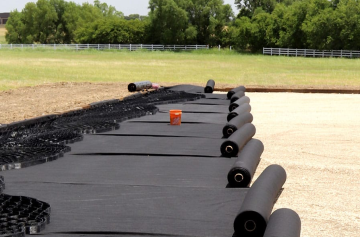
Once the outer packaging is removed, woven geotextile looks much like a rural tarp used to cover haystacks. A standard roll is 12.5 feet wide and 300 feet long. Tens of thousands of black plastic tapes are woven together by industrial looms, packing 12 to 15 tapes into every inch of fabric width.
Measured with calipers, its thickness is only 15 to 30 mils—less than half that of a felt-like nonwoven. The entire product is engineered for one purpose: resisting heavy tensile loads. Cutting it with a utility knife takes real effort.
When a 4 oz/yd² lightweight woven sample is clamped in a test machine and pulled, the force can rise to 200 pounds before the tapes finally snap. Heavier grades can reach 315 pounds.
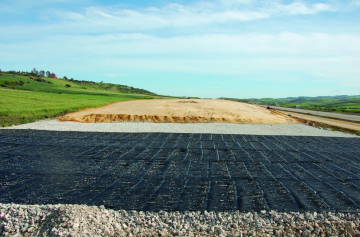
Suppose you are building a new 100-foot driveway. A truck delivers 20 tons of aggregate onto muddy ground with a water content of 20%. A 4,000-pound pickup truck driving over it causes the stone to sink immediately into the mud.
Unrolling this cross-pattern woven plastic fabric over the mud is like stretching an industrial trampoline across the ground. Under wheel load, it deflects only slightly. In the test report, the number is clear: elongation under tension is less than 15%.
- Excavate at least 6 to 8 inches of soft topsoil and root-filled organic material.
- Leave 12 inches of extra fabric on each side and fold it upward to wrap the aggregate layer.
- Place a road base mix containing 3/4-inch stone and fine stone dust.
- Compact it with a heavy roller for at least 4 passes.
- The compacted aggregate layer must remain between 4 and 6 inches thick.
The rough, angular stone interlocks tightly with the woven surface texture, creating very high friction. When a ten-wheel dump truck carrying 15 tons backs in to unload, the wheel torque is distributed across the entire roadbed through the interwoven plastic tapes.
This tightly woven structure gives the material a very one-sided performance profile: it resists water flow. When tested under D4491, only about 4 to 8 gallons per minute per square foot pass through it.
Water tends to pond on the surface and can only drip slowly through the tiny openings between the plastic tapes. When used over a soft load-bearing subgrade, it slows infiltration enough to keep the underlying clay relatively dry and firm.
During three straight days of heavy rain, surface water runs off along a 2% cross slope into the side ditches. The rain does not have enough time to saturate the bearing soil beneath the woven layer.
The same design logic is used for winter parking pads for heavy RVs. A 38-foot Class A motorhome can weigh as much as 22,000 pounds and may remain parked in one spot for 5 months without moving.
The contact pressure under its six tires is extremely high. Without woven geotextile underneath, by spring the vehicle would almost certainly leave mud depressions as deep as 5 inches beneath the tires.
- On dry, firm soil, overlaps should be 12 to 18 inches.
- On saturated soft ground, overlaps must be widened to 3 feet.
- In winds above 15 mph, drive one stake every 10 feet.
- The joints should be shingled in the direction of water flow.
If you are building a brick garden path or installing a 500-square-foot paver patio, the same material can be used above the soil to separate it from the soft subgrade. Workers place a 1-inch layer of coarse river sand over the fabric, then install 2.3-inch-thick paving bricks on top.
In northern climates, freeze-thaw action can be extremely destructive. Ice in the soil expands by 9%, pushing the ground upward. The woven fabric acts like a tensioned net that restrains this movement, helping keep the sand and pavers level through the winter.
The UV stabilizers blended into the resin allow the product to withstand about three weeks of intense exposure outdoors with no cover. Once buried under 6 inches of soil or coarse stone and protected from sunlight, its physical structure can remain unchanged for 50 years.
For temporary logging roads carrying heavy timber trucks, contractors often order special woven grades reinforced with high-strength polyester yarns. Testing shows breaking strength approaching 400 pounds. Even after a truck carrying more than 80,000 pounds of logs makes 100 passes, rut depth can still remain below 0.5 inch.
Material Selection Guide
On a typical purchasing sheet, the test data for woven and nonwoven geotextiles appear side by side. A 4 oz felt-like nonwoven may be listed at 140 gpm/ft², while a 200-pound woven fabric beside it may allow only 4 gpm/ft².
That 35-fold difference in flow capacity sends the two black plastic materials into completely different applications. At the supply yard, a roll of 200-pound woven fabric measuring 12.5 by 300 feet typically weighs around 180 pounds.
With the same dimensions, an 8 oz heavy nonwoven can weigh as much as 350 pounds. Workers cannot unload it by hand; a small forklift is usually needed to lift it out of a pickup truck bed.
If the site is a poorly drained yard where water ponds after rain, and you need to dig a 2-foot-wide trench filled with extremely sharp 1.5-inch stone, then the purchase order should specify heavy nonwoven fabric:
- 6 to 8 oz/yd² weight
- No. 70 sieve opening size, or 0.212 mm
- CBR puncture strength above 180 pounds
- UV resistance sufficient to retain 70% strength after 500 hours
- Budget about $250 to $350 per roll
When large volumes of stormwater enter the trench, a permeability of 140 gpm/ft² allows water to move through the fabric and into the perforated corrugated pipe below almost as easily as through an old cotton undershirt. Its elongation of more than 50% also matters structurally.
Under the weight of several tons of stone, the fabric stretches and conforms closely to every irregularity in the trench wall. Even though sharp stone points bear directly against it, they cannot puncture this protective layer, which is about 40 mils thick.
By contrast, if the goal is to build a gravel road for heavy trucks across open overgrown ground, the priorities are completely reversed. The fabric does not need to absorb water or promote drainage. What you want is the woven product that feels more like a coarse sackcloth.
- Minimum tensile strength: 200 pounds
- Elongation under load: less than 15%
- A flow rate of only 5 gpm is perfectly acceptable
- Tear resistance must still reach 75 pounds even if the fabric is nicked
- A roll measuring 12.5 x 300 feet typically costs $120 to $180
A ten-wheel dump truck with a gross weight of 12,000 pounds drives over the section. With elongation held below 15%, the woven sheet stays taut and firm, almost like a rigid plate. The heavy tires press down onto a 6-inch crushed stone base.
Below that, the woven fabric—only about 20 mils thick—supports the aggregate layer and prevents the stone from being pushed into the weak subgrade. After the truck passes, there is not even a 1/2-inch-deep rut in the soil below.
Understanding the laboratory data is what makes the difference when buying materials at a hardware or supply store. Put the standards from two manufacturers side by side and compare them carefully. Misreading even one line can mean hiring an excavator in three years to dig everything back up and do the job over.
| Property | 4 oz Nonwoven Felt | 200 lb Woven Fabric |
|---|---|---|
| Appearance | Loose, felt-like pad | Crosswoven plastic tapes |
| Water flow rate | 140 gpm/ft² | 5 gpm/ft² |
| Tensile strength | 100 lb | 200 lb |
| Elongation | > 50% (rubber-band-like) | < 15% (kept very taut) |
| Opening size for soil retention | No. 70 sieve (very small openings) | No. 40 sieve (relatively large openings) |
| Best suited for | Soft clay and silt | Coarse sand and firm soils |
At the factory level, high water flow and high tensile stiffness are fundamentally at odds. Current industrial textile processes cannot produce a material that passes 150 gallons per minute while also resisting 300 pounds of tension with almost no deformation.
An ultra-tight woven structure blocks the physical pathways for water flow. On the other hand, once fibers are needle-punched into a lofty, open structure to create drainage pores, tensile stiffness is inevitably reduced.
Consider a sand-and-gravel septic leach field receiving 200 gallons of wastewater per day. If the wrong material is used—say, a woven fabric with a flow rate of only 5 gpm/ft²—then within a month, greasy wastewater from dishwashing can infiltrate more slowly than it is discharged from the pipe, causing a foul, water-filled mound to rise at the surface.
Replace it with a felt-like nonwoven filled with microscopic pores, and the 140 gpm/ft² flow rate allows wastewater to pass through the fabric immediately on contact. Within a week, the fine pore structure develops a slimy biological film that begins breaking down contaminants underground.
Now picture a timber retaining wall at the base of a slope, 4 feet high and 50 feet long. During rainy months, more than 10 tons of groundwater may build up behind the wall. A drainpipe is installed at the base and wrapped tightly with a 6 oz nonwoven fabric rated at 90 gpm/ft².
Under intense hydrostatic pressure, very fine clay particles are blocked by the No. 100 sieve openings (0.150 mm). Only clear groundwater is allowed to flow into the pipe.
For a heavy equipment parking pad beside a barn, imagine a tractor with a front loader and trailer weighing more than 15,000 pounds. If the subbase is mistakenly built over a felt-like nonwoven with more than 50% elongation, the problem shows up quickly.
As the wide treaded tires roll onto the surface, the fabric stretches downward like a rubber band. The road base aggregate above is pushed into the weak mud below along the deformed area, wasting the $2,000 spent on stone.
Replace it with a heavy woven fabric rated at 315 pounds tensile strength, and the whole section changes. Even with tens of thousands of pounds of machinery parked on it every day, the surface can remain free of settlement for 50 years.

Leave a reply