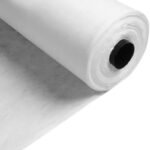
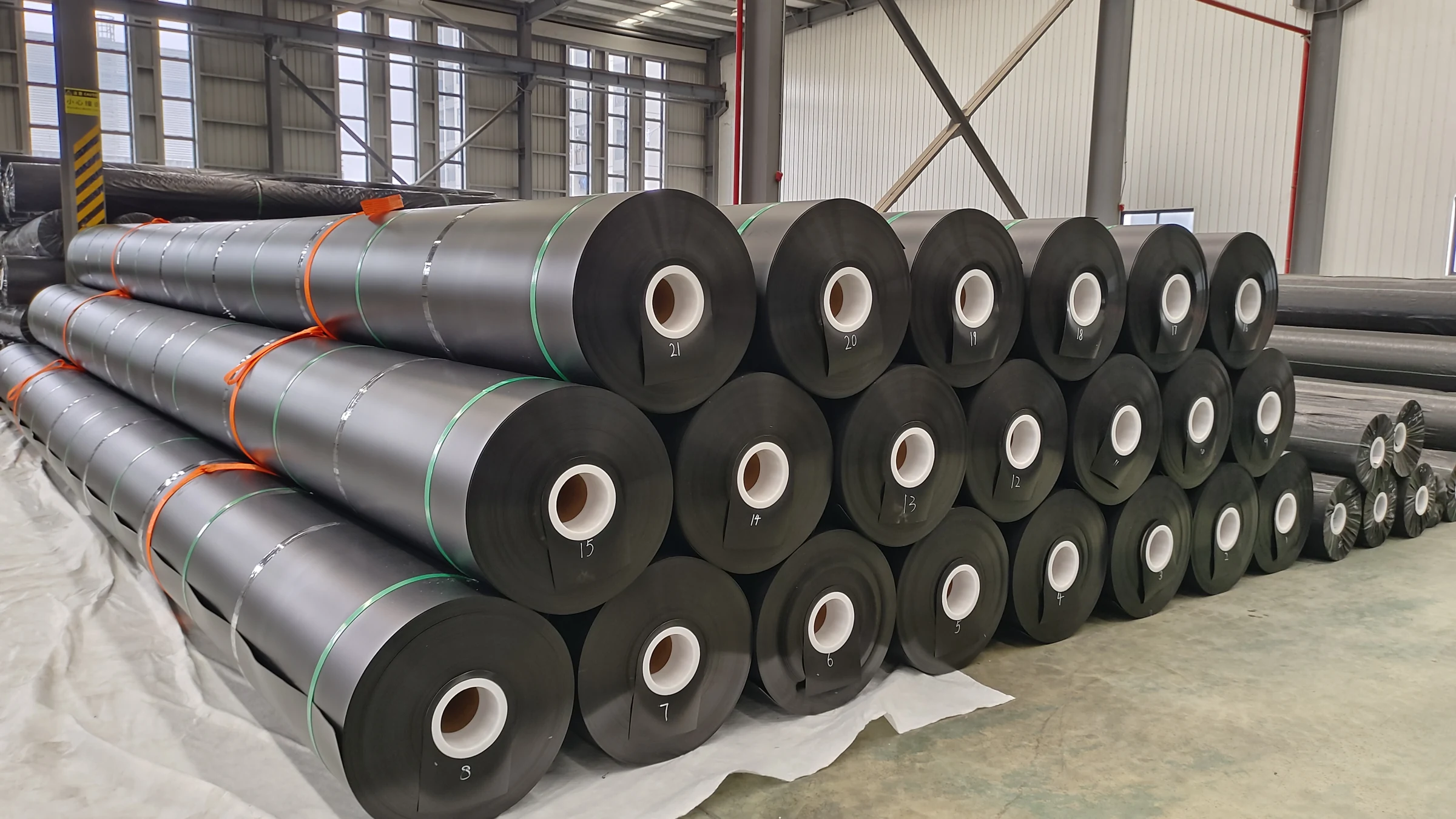
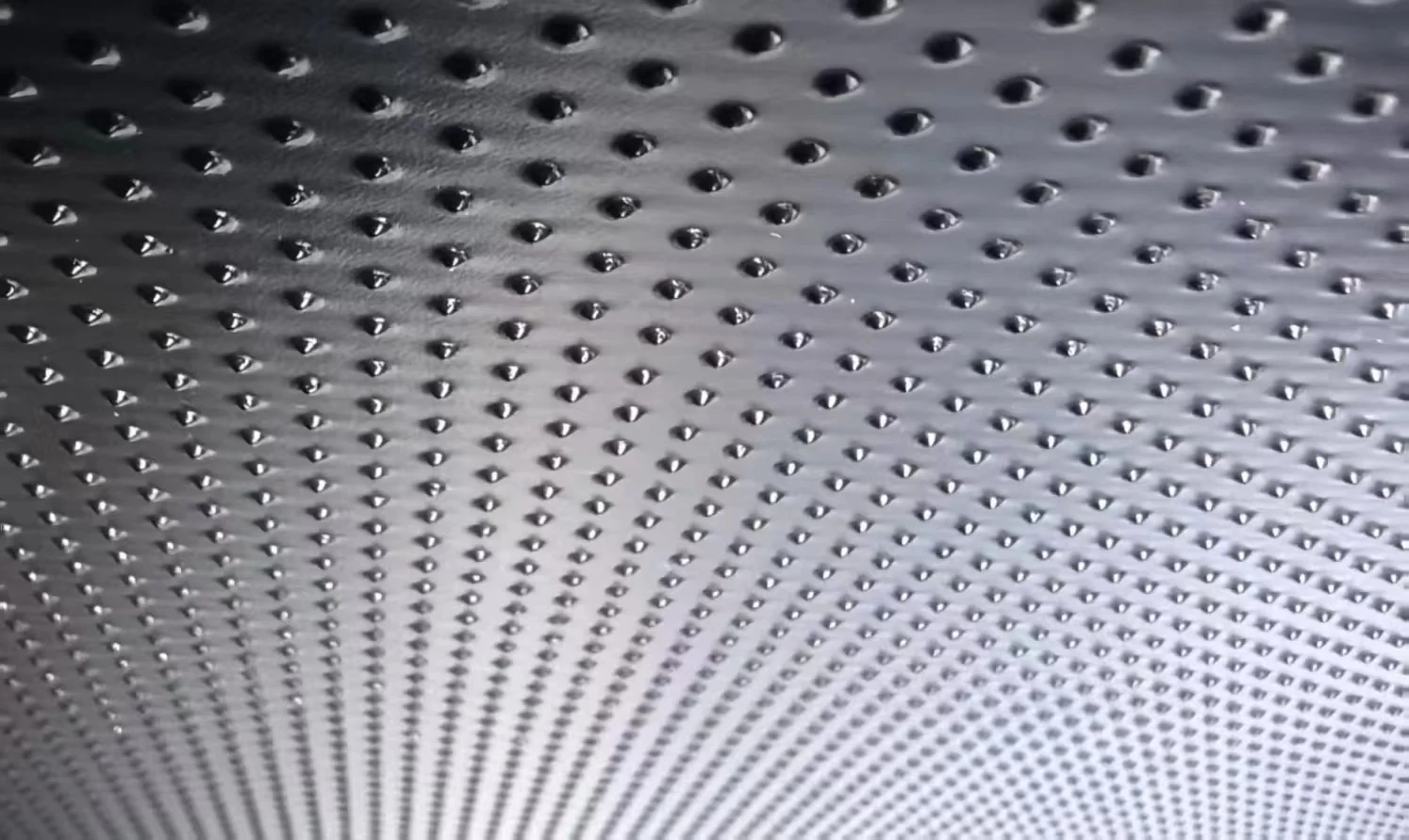
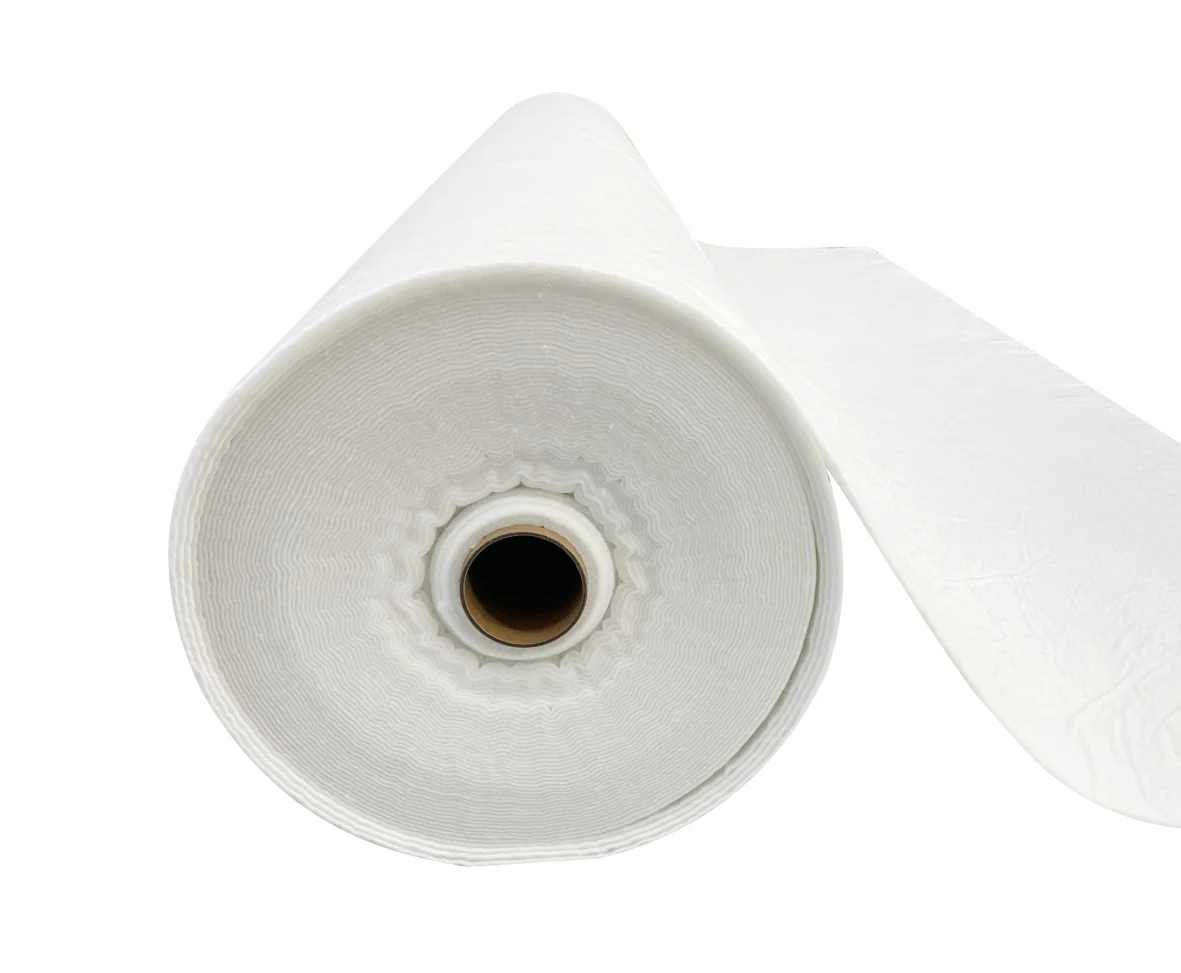

Spunbond fabric offers high strength (tensile strength of ≥8–20 kN/m) and good permeability (coefficient of permeability 10⁻²–10⁻¹ cm/s), making it well suited to drainage and reinforcement. Standard nonwoven geotextiles are typically needle-punched staple fiber: they provide finer filtration but slightly lower strength. In terms of cost, spunbond generally runs about RMB 2–6/m², while needle-punched fabric is usually about RMB 3–8/m².
Specs
Five Key Specifications
Clamp a caliper onto the edge of the fabric and the reading on spunbond stops at 0.4 mm; needle-punched fabric comes in at 1.2 mm. Put both on the scale and they may each read 3.5 oz/sq yd, yet the internal fiber structure is completely different. Spunbond continuous filaments are flattened by rollers at 200°C, forming a thin, stiff sheet. Needle-punched staple fiber, by contrast, traps free air left behind by 20,000 steel needles.
On site, there are five standard spot-checks crews use to verify performance:
- Measure thickness at the edge with a caliper and confirm the millimeter reading against the product grade.
- Cut a 1 sq yd sample and weigh it on a precision scale to check the ounce rating.
- Mount the fabric in a tensile tester and pull it in both directions to record ultimate breaking strength in pounds.
- Apply a 50 mm water head and read the leakage/permeability rate in gallons.
- Pour 0.425 mm fine glass beads across the surface and check the pass-through rate to verify sieve opening size.
With the sample clamped at both ends and pulled at 12 in/min, a 0.4 mm spunbond sheet holds until 150 lbs before it snaps, with elongation stopping at 18%. A thicker needle-punched fabric starts fuzzing at 90 lbs. The machine keeps pulling, stretching it to 85% before it still refuses to break completely.
A 50-ton excavator tracks across an 8-inch layer of crushed granite. The spunbond fabric laid underneath takes the full force of the sharp aggregate, limiting indentation to 0.2 inches. Under the same load, needle-punched fabric sinks into a 6-inch depression in the subgrade, stretching to match the shape of the void and conforming to more than 95% of the soil surface.
Open the permeameter valve and apply a 50 mm water head. Spunbond lets through 12 gallons in one minute, and under a 2 in/hr storm it can leave a 3 cm puddle on the surface. Needle-punched fabric drives the gauge to 135 gpm/sq ft in just 3 seconds. In a 3 in/hr storm, water penetrates the fabric in 0.5 seconds and enters a 4-inch perforated drain.
Pour slurry containing 0.425 mm sand across the test bench. After 10 minutes, spunbond develops a caked mud layer and the permeability reading drops all the way to 0.5 gpm. Its physical openings are only about 0.425 mm, all arranged on the same flat plane. Replace it with 1.5 mm needle-punched fabric and start the clock again.
0.1 mm sand particles lodge deep inside the tangled fiber structure and are held in place. Water molecules continue moving downward through the extra voids around them. When crews excavated a buried pipe section with two excavators, sliced samples showed that after 2 years of service, only 3% of the filter layer had been clogged by sediment.
Switch to an ASTM D6241 static puncture setup with a 50 mm flat steel probe. Press it into a 6 oz spunbond sample: the dial reaches 300 lbs before the specimen fails with a sharp pop. Test an equivalent-weight needle-punched fabric, and the same probe punches through at 250 lbs.
A 15-ton truck dumps a full load of 3-inch granite on a roadbed. The spunbond fabric spread directly over the soil remains intact, absorbing about 80% of the stone impact. Workers install these rolls across a 20,000 sq ft site; each roll is 300 ft long and weighs 180 lbs.
| Five Key Specs | Measurement Method & Standard | Spunbond Performance | Needle-Punched Performance | Typical Field Use |
|---|---|---|---|---|
| Mass per unit area (oz/sq yd) | Weigh the exact mass of a 1 sq yd sample | 1.5–4 oz range | 3–16 oz range | Estimate labor for handling rolls and truck capacity |
| Tensile strength (lbs) | Pull to failure and record the breaking load | 4 oz reaches 120+ lbs | 4 oz stays around 100–115 lbs | Prevent settlement under gravel driveways |
| Elongation (%) | Record percent stretch before failure | Below 50% | Above 50% | Fill irregular voids or wrap underground pipe |
| Flow rate (gpm/sq ft) | Measure how many gallons pass through in 1 minute under load | 5–20 gallons | 90–150 gallons | Move surface water quickly into French drains |
| Sieve opening (US Sieve) | Use glass beads to determine effective opening size | US Sieve 30–50 | US Sieve 70–100+ | Hold back fine slurry and protect drainage pipes from clogging |
Place the fabric in an ASTM D4355 chamber and expose it to intense xenon-arc light for 500 hours. A spunbond fabric containing 2% carbon black retains 70% of its original tensile strength. A needle-punched fabric without UV stabilizer drops to 30% strength after 300 hours in the same light box. Bury it 3 ft underground in a drain trench, though, and sunlight exposure drops to zero.
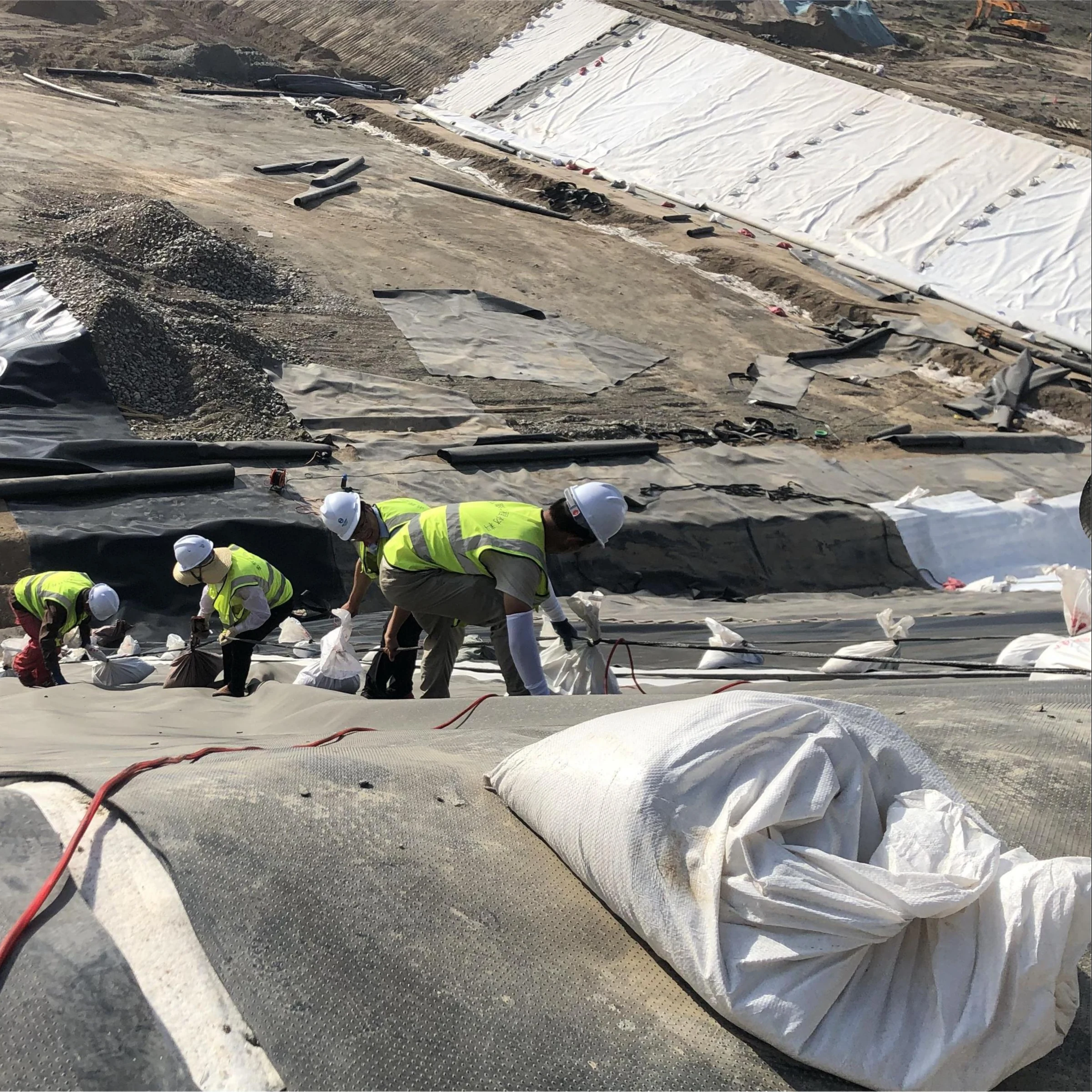
Three workers spend 2 hours carrying rolls across 500 ft of muddy slope. They unroll a 12 ft-wide sheet and pin the edges with 6-inch steel staples every 2 ft. The slope is at 45 degrees, with 80 lb sandbags laid across the surface.
Then comes a 48-hour autumn storm dumping more than 15 inches of rain. A buried 6-inch perforated pipe at the toe of the slope runs at full capacity, draining 80 gallons per minute of muddy water. The hydrology gauge stays in the green, and laser readings from the survey stakes show 0 mm of movement at the top of the slope.
Excavate the adjacent 50 ft test section where no fabric was installed. A 2-ton roller passes back and forth 5 times, pressing the 6-inch crushed stone layer straight into the mud. Workers have to dig down 10 inches with shovels just to find the stone again. The granite and the soft subgrade have completely mixed together, cutting the roadway’s load-bearing capacity by 60%.
Cut out a 10 sq in sample of aged fabric and dry it in a lab oven at 105°C for 24 hours. Place it on a precision balance. The retained dry soil weighs 15 g; the original fabric itself weighed only 4 g. The pores are 85% blocked, and it can no longer pass even 1 gallon of water.
Replace the remaining 200 ft of drain trench with a more open 8 oz needle-punched fabric. Cover it with 2 ft of medium-coarse sand and plant Kentucky bluegrass sod with roots extending about 4 inches deep. Then let it go through 3 winters of freeze-thaw cycling, with temperatures swinging between -10°F and 50°F.
At a depth of 20 inches, the drainage network continues to run clear, with a steady flow rate of 45 gpm year-round. In spring, lab tests on sod plugs show that the root system has not penetrated the 1.5 mm fabric layer at all. Probe data from the buried pipe section shows less than 0.1 mm of wall wear, with an estimated remaining service life of 15 years.
Spunbond vs. Non-Woven
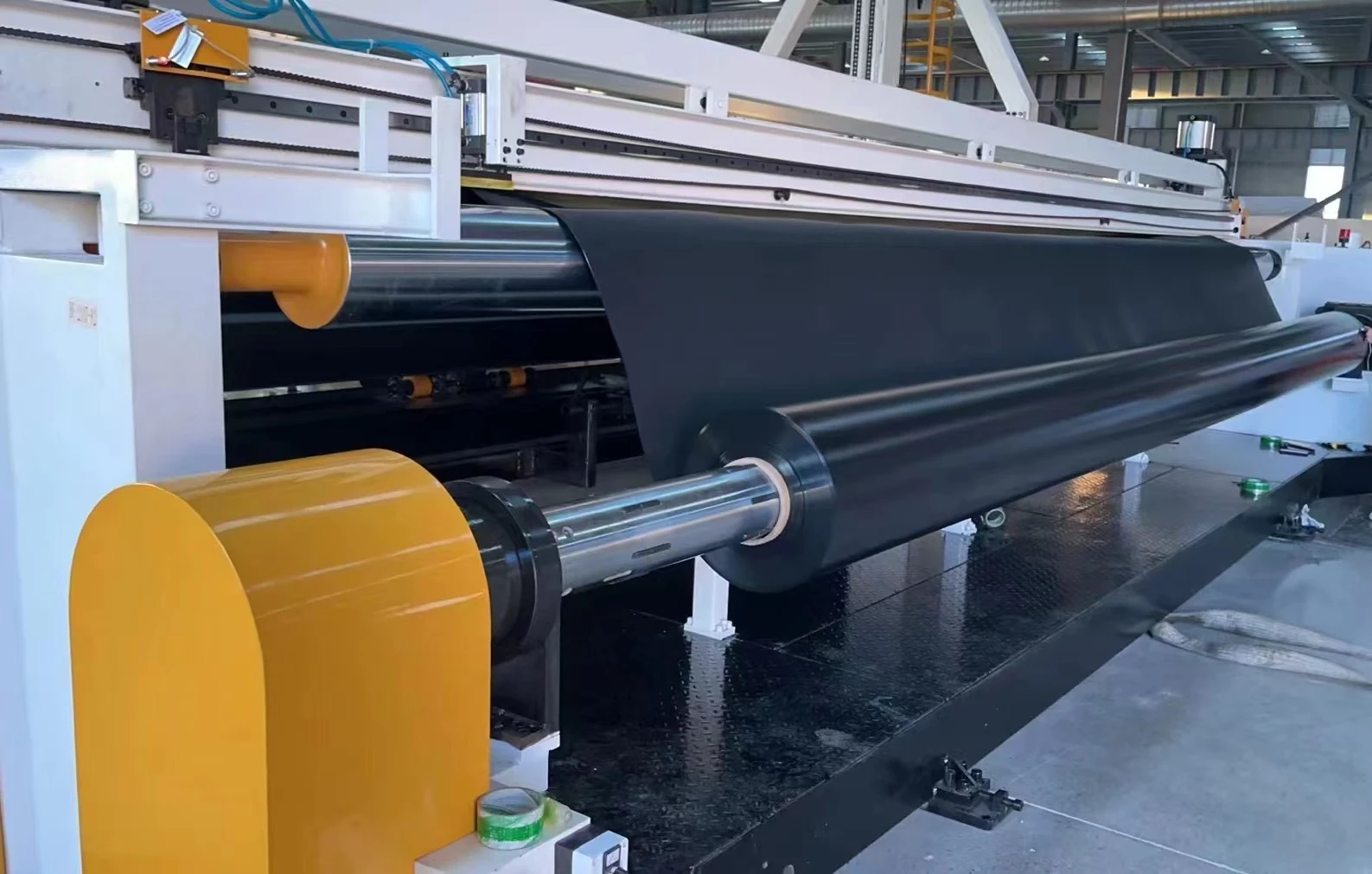
At 250°C, polypropylene is melted and extruded into continuous filaments. Heated rollers apply 300 lbs of pressure, compressing the filaments into a stiff sheet about 0.4 mm thick. That is spunbond fabric. Needle-punched fabric follows a different process: polyester is cut into 2-inch staple fibers, and 20,000 barbed steel needles punch through the mat 800 times per minute, turning it into a felt-like layer about 1.2 mm thick.
A roll of 4 oz spunbond measuring 12.5 ft wide by 360 ft long weighs about 130 lbs, light enough for two people to throw into the bed of an F-250. A same-coverage roll of 8 oz needle-punched fabric pushes the scale to 260 lbs. Moving it requires a small forklift rated for 500 lbs.
Workers cutting spunbond with a utility knife find the blade skidding across the smooth surface; slicing 15 ft takes real effort. Cut through needle-punched fabric and the dense staple fiber wraps around the blade. After cutting 40 ft, a brand-new high-carbon blade is completely spent.
In 25 mph gusts, the unsecured edge of spunbond can lift off the ground. A 2-inch slit tears open with the wind and becomes a 15 ft rip in just 4 seconds. Hit a thick needle-punched fabric with the same wind, and its tangled short fibers resist propagation: a 2-inch cut extends only 1 inch before stopping.
- 3 oz spunbond blocks 98% of sunlight; under 2 inches of mulch, it can keep dandelions from sprouting for 5 years.
- Needle-punched fabric has larger pore space; within 8 months, it can accumulate a 0.5-inch layer of humus, and crabgrass can pierce the 1.2 mm fabric.
- 4 oz spunbond wrapped around a 4-inch pipe under a 10 ft water head leaks about 15 gpm.
- Wrap the same pipe in 4 oz needle-punched fabric, and discharge jumps to 120 gpm.
On sandy soil with a particle size of 0.5 mm, a spunbond fabric rated at US Sieve 40 is just tight enough to retain the sand. Put it against silty clay with particles around 0.05 mm, and after 48 hours the surface cakes over with mud. Needle-punched fabric at US Sieve 80 traps the silt in its three-dimensional pore network while still draining 40 gallons per minute of accumulated water.
Measure interface friction angle and the difference is just as clear. Spunbond has a smooth surface and reads about 22°, allowing saturated clay to slide downslope. Needle-punched fabric has a fuzzy surface and reaches 34°. Under 100 lbs of topsoil, it stays in place on a steep 3:1 slope.
| Test Condition | Spunbond Performance | Needle-Punched Performance | Best Construction Use |
|---|---|---|---|
| Compacted under 3/4-inch aggregate | 0.4 mm thickness, no stretch | Sinks 5 inches into soft mud | Separate the base layer from clay |
| 30-ton truck emergency braking at 15 mph | Locks the underlying soil firmly in place | Stretches 30% under the tires, creating 4-inch ruts | High-load driveways |
| Untreated exposure at 90°F | Becomes brittle and breaks apart in 60 days | Fails tensile requirements after 45 days | Avoid uncovered outdoor storage |
| Alkaline immersion above pH 9 | Retains factory tensile values | Loses 40% tensile strength after 60 days | Use under freshly placed limestone |
Drag an excavator bucket across spunbond and it leaves a few white scuff marks on the stiff 0.4 mm surface. The same bucket teeth rake across needle-punched fabric and pull up a 5 ft trail of loose fiber. The damaged zone thins from 1.2 mm to 0.8 mm.
Cost
Upfront Purchase Cost
At a hardware store, a roll of 3 oz spunbond measuring 3 ft x 50 ft is tagged at $14.98, or about $0.10/sq ft. Buy an industrial roll from a wholesaler at 12.5 ft x 360 ft, and it may cost only $180, working out to just $0.04/sq ft. The unit price difference between small retail rolls and full-size industrial rolls is about 2.5 times.
Packaging also changes the math. Short retail rolls require separate cutting and handling. The light paper core costs about $0.80, and the shrink wrap around it another $0.30. On a 50 ft roll, that $1.10 in packaging alone accounts for 18% of the factory price. A full-width 12.5 ft roll avoids most of that extra processing.
The higher the basis weight, the more you pay. For every additional ounce on the spec sheet, the purchase price of the full roll rises about 15% to 20%. Municipal procurement schedules commonly list needle-punched ex-factory prices in tiers like these:
- 3.5 oz: $0.38/sq yd
- 4.0 oz: $0.45/sq yd
- 6.0 oz: $0.68/sq yd
- 8.0 oz: $0.92/sq yd
The cost of machine wear is ultimately passed on to the buyer. Making an 8 oz roll requires twice as much resin as a 4 oz product. When a production line punches 8 oz needle-punched fabric, the needles cycle 800 to 1200 times per minute. For every 10,000 m² produced, replacement specialty needles add about $120 in parts cost, and that wear is built into the final selling price.
Raw material pricing sets the floor for factory quotes. Virgin PP resin costs about $0.45–0.55/lb. Recycled material can be bought for as little as $0.20/lb. On a 150 g/m² fabric, using recycled feedstock can cut cost by about $0.08/m².
That savings comes with a trade-off in tensile performance. Under ASTM D4632, virgin-material fabric can withstand about 120 lbs of tensile load. Fabric containing recycled content may tear apart completely at just 75 lbs. Freight is another cost that is often overlooked during budgeting.
| Specification (12.5′ x 360′) | Weight per Roll | Full 53-ft Trailer Capacity | Average Freight Cost per Roll |
|---|---|---|---|
| 3.1 oz spunbond | 115 lbs | 320 rolls | $11.50 |
| 4.0 oz needle-punched | 148 lbs | 250 rolls | $14.80 |
| 8.0 oz needle-punched | 295 lbs | 120 rolls | $30.80 |
A truck can carry at most about 45,000 lbs of freight. Because 8 oz needle-punched rolls are bulky and heavy, a 53 ft trailer can take only about 120 rolls. Freight per roll ends up nearly $20 higher than for lighter spunbond. For interstate shipments, freight can account for 15% to 25% of total project cost.
Storage space drives cost up as well. A 3.1 oz spunbond master roll at 12.5 ft width typically measures about 14–16 inches in diameter. A 4 oz needle-punched roll is much bulkier, at around 22 inches in diameter. Industrial warehouse space rents for about $0.85/sq ft per month.
One pallet can hold about 12 rolls of light spunbond, but only 6 to 8 rolls of needle-punched fabric. That higher storage burden is reflected in distributor pricing. UV stabilization changes the factory price too.
A white fabric with no UV additive can lose 70% of its tensile strength after 500 hours in the sun. Black fabric with 2% UV stabilizer costs about 20% more. A roll priced at $180 becomes $216 once the UV package is added.
Custom colors come with machine startup costs. Bringing a large production line up to temperature consumes roughly 2,000 kWh. Factories often require a minimum order of 50,000 m² for special colors. If the order is smaller, an extra 30% setup charge is typically added.
Distributor markup can easily double the delivered price. A 4 oz needle-punched roll leaving the factory at $45 is trucked to a regional warehouse, with freight running about $2.5–3.2 per mile. Once a regional dealer adds a 25%–35% margin, the invoiced price at the jobsite climbs to $85+.
Even the paper core affects shipping efficiency. Thin spunbond rolls use a 1.5-inch inner core costing about $0.50. Thick needle-punched rolls need a 3-inch core with a 5 mm wall, costing about $2.80 each. The larger cores also take up more cargo space inside containers.
Testing and certification costs are built into inventory pricing. Material sold with an ASTM D4533 trapezoidal tear certificate may carry a prorated lab cost of $400–600 per test round. Commodity-grade fabric without AASHTO certification may be priced $4–7 lower per roll. Products sold with engineering drawings and compliance documentation command a higher price.
Color additives also affect the final ex-factory price. Plain white polypropylene is the lowest-cost option. Black fabric requires 2%–3% carbon black masterbatch. High-quality carbon black concentrate can sell for close to $2,500 per ton. On a 300 lb black roll, the added 1.5 lbs of carbon black raises the factory price by about $3–5.
Timing matters too. Prices tend to peak from April through August. At the end of the first quarter, chemical suppliers often raise polypropylene by $0.03–0.05. By the time that reaches the geotextile market, wholesale pricing may increase about $0.02/sq yd. Buying in winter can save roughly 10%.
Budget Allocation
For weed barrier under flower beds, 1.5–2 oz spunbond is enough. A 3 ft x 100 ft roll from a retail store costs around $25. Add a $10 box of U-shaped staples and you can pin down roughly 300 sq ft of edges. The whole job comes in under $40 and will easily last through five years and two rounds of planting.
For a backyard gravel walkway, the money is best spent on 3 oz spunbond. A 4 ft x 100 ft roll runs about $35. Cover it with 2 inches of pea gravel and it will block about 95% of weeds in foot-traffic areas. Spending an extra $60 on heavier needle-punched fabric would be unnecessary.
Once you move up to a gravel driveway for a Ford F-150, the math changes. Repeated wheel loads will churn the stone and subgrade into mud unless the separation layer is robust. At that point, the budget should go toward 4 oz or even 6 oz needle-punched fabric. A cut section measuring 12.5 ft x 50 ft in 4 oz material costs about $75.
Lay it flat over dry soil and cover it with 4 inches of #57 Stone. Over the next ten years, the stone stays where it belongs. Without the fabric, you may end up adding 2 tons of fresh aggregate every other year. With it, you save about $80 in stone each cycle, plus roughly $150 in labor for two day workers.
If you are building a 3 ft retaining wall out of treated timber or precast concrete block, the budget needs to prioritize the drainage layer behind the wall. The gravel-wrapped filter layer directly against the back face should use 4 oz needle-punched fabric. A starter roll costs about $55. If water cannot drain, saturated soil expands and can push over a wall weighing tens of tons.
Once a wall fails, the repair bill becomes enormous. Bringing in a mid-size excavator and reopening the base costs around $450 per day in equipment rental alone. Cutting corners on the drainage fabric behind the wall is never worth it. The service life of a backyard French drain depends heavily on the permeability of the nonwoven layer.
For that application, choose a 4 oz needle-punched fabric rated to pass about 110 gpm. Wrap it tightly around a 4-inch perforated corrugated pipe and clean stone. For a 50 ft trench in a yard, the fabric costs around $35. Two efficient laborers can excavate the trench in a day for about $300.
Save $15 by buying a tighter spunbond instead, and after two years clay fines can seal the drainage path completely. Two workers may then spend 2 full days digging out the sticky aggregate, pushing labor up to $1,200. Hauling the sludge to landfill adds another $45 per ton. Spending the right $35 on material avoids a $1,500 rework bill.
Septic leach fields are among the most heavily scrutinized civil works by local inspectors. Specifications commonly require a nonwoven geotextile meeting AASHTO M288. A compliant 6 oz product costs more than $120 per roll. Buying an uncertified off-brand might save $40 up front.
But if the inspector tests permeability and it fails, the fine starts at $500. The same precision matters under artificial turf. After removing weeds and grading the soil, lay down a 3.5 oz needle-punched fabric. A 100 ft roll costs around $50.
That thin layer keeps mole crickets and burrowing insects from chewing upward into the turf, protecting synthetic grass that may cost $4/sq ft. When buying staples and accessories, focus on three hard requirements:
- Use 6-inch U-shaped staples made from 11-gauge steel.
- On flat ground, install one staple every 3 ft.
- On slopes steeper than 30°, reduce spacing to 1.5 ft.
A bulk carton of 1,000 galvanized staples costs about $45. When temperatures drop below freezing, cheap $8 plastic staples can snap in half underfoot. In severe wind, saving a few dollars on anchors can send the entire weed barrier airborne.
Rebuilding a muddy horse paddock is a much larger-ticket job. Because of the repeated force of hoof impact, the base should use heavy-duty needle-punched fabric at 6 oz or more. A roll of 8 oz material measuring 12.5 ft x 360 ft costs around $400. Cover it with a 6-inch blend of coarse sand and crushed stone.
A mature thoroughbred weighs about 1,200 lbs, but even with daily traffic, the yellow subsoil stays buried. Paying more for a heavy base layer avoids spending thousands each spring to bring in a tractor and regrade the mud. On larger jobs, volume discounts are available.
| Project Type | Recommended Material | Typical Size / Coverage | Estimated Material Cost (USD) |
|---|---|---|---|
| Backyard flower bed | 1.5–2 oz spunbond | 3′ x 50′ roll | 15–20 |
| Pedestrian gravel path | 3 oz spunbond | 4′ x 100′ roll | 30–40 |
| Residential septic leach trench | 4 oz needle-punched | 3′ x 100′ roll | 45–55 |
| Two-car residential gravel driveway | 4–6 oz needle-punched | 12.5′ x 50′ cut section | 75–90 |
| Heavy retaining wall drainage backfill | 6 oz needle-punched | 12.5′ x 360′ full roll | 320–350 |
| Heavy equipment yard | 8 oz needle-punched | 12.5′ x 360′ full roll | 400–450 |
If you buy 5 or more full-width 12.5 ft rolls from a regional wholesaler in one order, you can often negotiate the invoice price down by 12%–15% per roll. Ship a full pallet by truck, and long-haul freight per roll can drop from about $35 to roughly $15.
On large projects, labor is always the biggest line item. Two experienced installers can lay about 1,000 sq ft in roughly 2 hours, with labor exceeding $80. If the fabric is too thin, a sharp stone underfoot can rip it while they walk the surface.
Then the crew has to stop, patch the tear, and if the rip exceeds 2 ft, replace the section and re-staple it. The wasted half hour of labor can easily equal the cost difference between a thin fabric and a heavier, more suitable geotextile.
Filter
Denser Is Not Always Better
On a rainy day, surface water carrying soil particles moves downward until it reaches a nonwoven fabric buried 2 ft underground. The runoff contains coarse sand, silt, and fine clay. The fabric surface is covered with tiny openings. Under ASTM D4751, a No. 70 sieve corresponds to an opening size of 0.212 mm.
A mixed slurry with particles ranging from 0.002 mm to 2 mm washes across it. Coarse sand larger than 0.212 mm cannot pass through and is retained outside the fabric.
Simply stopping the larger grains is not enough. The drainage pipe survives long term only when coarse particles build a natural soil bridge one or two millimeters above the fabric surface.
Water pressure continues pushing from behind. 0.1 mm silt slams into the coarse grains and wedges into the gaps between them. Then 0.05 mm finer silt fills the spaces between the 0.1 mm particles. In just minutes, the particles assemble themselves into a natural 2–3 mm-thick filter cake on the upstream side.
Once that filter cake forms, even 0.002 mm clay gets trapped in the sediment maze. Clean water passes through the cake and then through the fabric’s 0.212 mm openings into the perforated plastic pipe behind it.
Under ASTM D4491, the permeability of that natural barrier is evaluated using several key numbers:
- 140 GPM/ft²: each square foot of fabric can pass 140 gallons per minute, enough to handle a 50 mm rain event.
- 0.1/sec: the lab-measured permittivity; the lower the number, the more resistance the water encounters.
- 80% retained flow: once the mud cake forms, flow slows down, so the specification requires the fabric to retain at least 80% of its original flow capacity.
If you wrap heavy clay with a tight No. 100 sieve fabric (0.15 mm openings), the whole filtration system can fail. Clay particles are too fine to build a stable graded bridge. Instead, the soft clay smears across the surface and seals off every 0.15 mm opening, causing full-scale surface blinding.
Open up a failed blind drain and the outer face of the fabric feels like it has been coated in thick, greasy paste. Water beads on the surface and will not infiltrate at all.
Use an overly open No. 40 sieve fabric (0.425 mm) against 0.05 mm fine silt and the opposite problem appears. No stable filter cake forms. The silt passes straight into the fabric and accumulates after every storm. The internal flow paths in the 0.06-inch thick fabric plug up completely, leading to internal clogging.
In the lab, clogging potential is checked with a Gradient Ratio Test. A high-pressure acrylic cylinder is filled with a 2-inch soil layer over a fabric sample. A 5 ft water head is applied from above and maintained for 24 hours. The water continuously drives sediment toward the fabric.
- GR < 3: the pressure gauges above and below the soil show a favorable ratio, meaning the soil-fabric system works well and the clogging risk is low.
- GR > 3: sediment locks up the microscopic openings, upstream pressure spikes, and the whole drainage design is effectively invalid.
- Match the D85 requirement: the design is strict—particles representing 85% of the soil mass must be larger than the fabric opening size, so a stable soil bridge can form on the upstream face.
Heavy blind drains buried 2–3 meters deep are subjected to major overburden. Each square meter of fabric may support more than 3,000 kg of static soil load. A fabric originally 0.05 inches thick can be compressed down to 0.04 inches. As the polypropylene fibers compress together, the original 0.212 mm openings shrink by 10%–15%.
That compression allowance has to be built into the design. If the drawings call for a No. 70 sieve opening, procurement should select a larger No. 50 sieve material (0.3 mm) to offset deformation loss.
On steep trench grades, faster water can wash away the freshly formed natural filter layer. If the trench bottom slope exceeds 2%, the lateral shear velocity along the fabric surface can exceed 0.3 m/s. Stable 0.1 mm silt is swept away, small tubular voids form in the soil body, and piping failure can begin.
The soil’s coefficient of uniformity (Cu) determines whether a stable filter cake can form. Cu is calculated by dividing the particle size at D60 by the particle size at D10. If Cu < 3, the soil is highly uniform. A deposit made up almost entirely of 0.05 mm silt, with no coarser particles to form the base of a graded bridge, will not build a stable stepped interception layer no matter how thick the fabric is.
Spunbond vs. Needle-Punched Nonwoven
In the factory, spunbond starts with polypropylene melted at about 160°C. The process is more like making a thin sheet: hot plastic filaments are laid onto a conveyor belt and then bonded under a pair of heated rollers. The line runs fast—up to 500 meters per minute. The finished fabric feels stiff, almost like the disposable shopping bags sold at supermarkets.
Needle-punched fabric is made in a completely different way, more like carding wool. The machine first aligns staple fibers 2 to 4 inches long into a loose batt several centimeters thick. Then a needle board carrying tens of thousands of barbed needles punches through at a rate of about 800 penetrations per square inch. The fibers become tightly entangled, and production speed drops to only about 20 meters per minute.
Measure the thickness with a caliper and the difference is obvious. Two fabrics with the same basis weight of 3 oz/sq yd behave very differently. Spunbond has been flattened by rollers to about 0.015 inches, with a rigid, uniform texture against the light. Needle-punched fabric, having never been heat-flattened, stands up to about 0.05 inches, and its cross-section reveals a full three-dimensional maze of flow paths.
Once muddy water hits them, the difference becomes even sharper. Spunbond is so thin that its pores form a flat two-dimensional structure. Fine clay around 0.02 mm travels with the flow and seals off those flat openings almost immediately. In less than a month, a dead film forms across the surface and water stops passing through.
The 0.05-inch thickness of needle-punched fabric changes the game. 0.1 mm coarse sand gets trapped in the outer layer. 0.05 mm silt works partway in and is caught by the second fiber layer. 0.01 mm fine clay is stopped by the denser network farther down. Sediment is captured in stages, while water bypasses the particles and keeps flowing through adjacent 0.06 mm voids.
On retail shelves, about 90% of weed barrier products are low-cost spunbond. It is stiff and strong, and under 2 inches of decorative stone it easily stops weed shoots from piercing the layer. But wrap it around a perforated subsurface drain pipe and it becomes the equivalent of putting a raincoat on the pipe: the first load of muddy groundwater can ruin the drainage system.
| Manufacturing Method | Fiber Length | Equipment | Operating Temperature | Internal Pore Geometry | Estimated Retail Price (4′ x 100′) |
|---|---|---|---|---|---|
| Spunbond | Continuous filaments | Heated calender rollers | 150°C–170°C | Flat 2D grid | $35–$45 |
| Needle-punched | 2–4 inch staple fiber | Barbed needle loom | No high heat, purely mechanical needling | 3D labyrinth structure | $70–$90 |
A 4 ft x 100 ft roll of needle-punched fabric may cost $80, while a same-size spunbond roll comes in at about $40. But if workers are excavating a 50 ft backyard drain trench, the labor plus 3 tons of aggregate can already cost at least $2,500. Saving $40 on the fabric only to have the pipe clog solid in three years means the entire system has to be dug up and rebuilt.
- Feel in hand: spunbond is stiff and boardy, like heavy plastic sheeting, and makes a crisp sound when stepped on. Needle-punched fabric is soft and drapes like an old blanket, conforming easily to uneven ground.
- Friction coefficient: under a 50 kPa load, the fuzzy surface of needle-punched fabric grips the soil and reaches a friction value above 0.8. Spunbond is much smoother, with a coefficient around 0.5, and is more prone to slippage on slopes.
- Tensile deformation: under a suspended load of 100 lbs for six months, spunbond stretches only about 2% because the filaments are bonded in place. Needle-punched fabric, relying on physical entanglement, can elongate 10%–15% as the fibers slip under load.
Apply just 0.5 PSI of water pressure in a hydraulic test. Water through spunbond sprays out like a watering can, with flow topping out around 50 gpm. Needle-punched fabric behaves more like a saturated sponge under compression, releasing a continuous sheet of water and exceeding 150 gpm.
Measure porosity in the lab and spunbond comes out dense: the plastic itself accounts for about 85% of the total volume, leaving only 15% for water flow. Needle-punched fabric is much more open—fibers occupy only 10% of the volume, while the remaining 90% is three-dimensional void space. Even after being compressed by stone, it still retains about 70% of its drainage capacity.
The amount of Carbon Black added to the formulation largely determines outdoor life under sunlight. Standard spunbond often contains only about 0.5% UV stabilizer and becomes brittle after just a couple of weeks. Engineering-grade needle-punched fabric may contain 2.5% high-concentration carbon black. After 500 hours in Arizona sun, it can still withstand 120 lbs on the tensile tester.
Selection & Testing
Start with basis weight. A 4 oz/sq yd nonwoven geotextile is about 0.06 inches thick and offers around 100 lbs of tensile strength—enough for a backyard French drain. If excavation reaches 1.5 meters deep or the project involves a large retaining wall, step up to 6 oz. At that weight, puncture resistance reaches about 90 lbs, enough to withstand sharp aggregate without tearing.
Nominal weight alone can be misleading, so field crews often improvise simple tests with whatever tools they have. Cut a strip about 20 cm wide, suspend it, and hold it taut. Then push down with an ordinary Phillips screwdriver using about 20 kg of force. Spunbond will split immediately. Needle-punched nonwoven will only dent inward; the fibers spread apart, and when the screwdriver is removed the opening rebounds and closes back up.
For a quick field filtration test, take a 5-gallon plastic bucket and drill 10 half-inch holes in the bottom. Line it with fabric, then add 2 kg of prepared mud made up of 50% coarse sand, 30% silt, and 20% clay. Pour in 3 gallons of water and stir vigorously. Put a basin underneath and time how much drains through in the first 5 minutes.
Spunbond usually clogs in less than 2 minutes, and what comes through is still muddy yellow water. Needle-punched nonwoven keeps flowing smoothly, and the water in the basin gradually turns semi-clear. The interlocking fiber network traps fine particles from about 0.05 mm down to 0.002 mm, building a natural 2 mm mud filter cake on the surface.
If you are buying engineering-grade material, ask the supplier for a Specification Sheet. The test values on that sheet determine how long the fabric is likely to survive once buried.
| Quality Test Item | ASTM Method | 4 oz Needle-Punched | 4 oz Spunbond | Field Implication |
|---|---|---|---|---|
| Grab tensile strength | D4632 | 115 lbs | 130 lbs | Spunbond pulls a bit stronger and is easier to tension flat |
| Trapezoidal tear strength | D4533 | 50 lbs | 55 lbs | The difference in tear force is relatively small |
| Filtration opening size | D4751 | No. 70 sieve | No. 40 sieve | Needle-punched fabric is finer and better at retaining fine silt |
| Flow rate | D4491 | 140 gpm/sq ft | 45 gpm/sq ft | Needle-punched drains faster in heavy storms |
Under ASTM D4751, a No. 70 sieve corresponds to an opening size of 0.212 mm, while No. 40 corresponds to 0.425 mm. In silty loam soils common in North American yards, about 60% of the particles fall between 0.002 mm and 0.05 mm. With openings of 0.425 mm, spunbond can allow the drainage pipe to fill with thick fines in just a few months.
Permittivity determines whether the system floods during heavy rain. A 50 mm storm over a 100 m² yard produces about 5 m³ of standing water. A needle-punched fabric rated at 140 gpm/sq ft can clear surface water from 1 m² in about 5 seconds. Swap it for spunbond at 45 gpm/sq ft, and water builds up behind the retaining wall, with hydrostatic pressure eventually cracking the outer masonry.
Materials often sit outside in the sun for a few days during construction. Under ASTM D4355, the fabric must still retain 70% of its toughness after 500 hours of UV exposure. Inferior products can become brittle after just 3 days in direct sun. Rub the edge with your fingers and white powder falls off—the roll is no longer fit for installation.
Backfill aggregate will also compress the filter layer. Cover the fabric with 1 meter of stone and each square meter takes about 1,800 kg of dead load. Under ASTM D5199, a 4 oz fabric under 20 kPa compression can lose about 15% of its thickness. As thickness drops, flow capacity falls with it, so the selected material should include about 20% extra hydraulic capacity as a design margin.