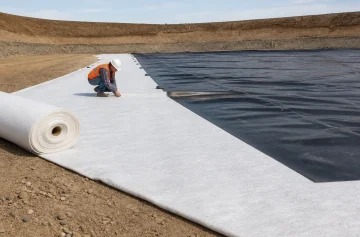

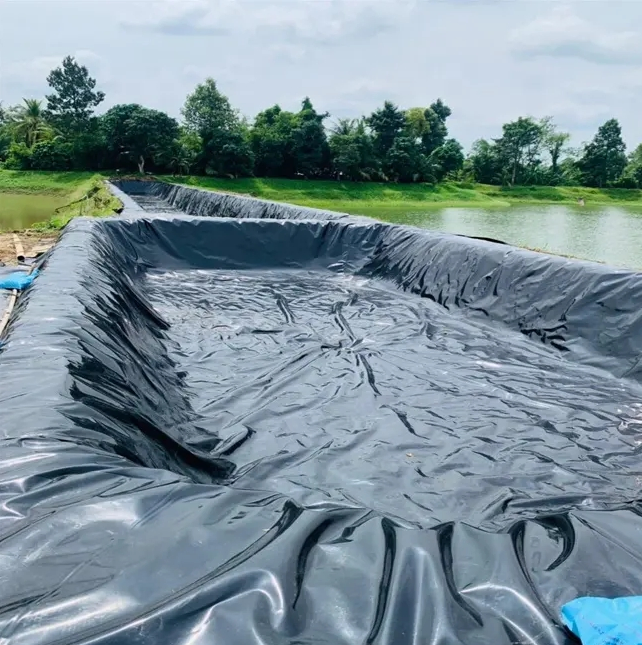
HDPE geomembranes (0.5–1.0 mm) are widely used in aquaculture ponds. With permeability as low as 10⁻¹³ cm/s, they can reduce seepage by more than 30%. Their UV-resistant service life typically reaches 8–10 years, and with proper welding, they can remain in use for up to 15 years. Maintenance costs are reduced by 20–40%, while overall water-quality stability improves.
Material Selection
Mainstream Materials
Factory-made waterproof liners are machine-cut into massive rolls 7.01 or 8 meters wide. Rigid polyethylene is melted down in steel drums at 200°C, then extruded into thick black sheets. A 1.0 mm impermeable liner weighs 940 grams per square meter when laid flat, and moving it around on site usually requires a crawler machine capable of lifting 6 tons.
This stiff material is built specifically to withstand extreme weather. Even when temperatures fall to -70°C or the ground surface is baked to 80°C, the molecular structure remains stable. Left soaking year-round in acidic water with a pH of 4.0, the surface will not even blister at the scale of a single hair.
Commercial shrimp ponds covering more than 5 hectares almost always use this type of high-rigidity plastic. Workers cannot fold a clean right angle into it by hand no matter how much force they use. Once the full water pressure of the pond bears down on it, its resistance to compression and deformation outperforms every other option.
Every roll delivered to site comes with a three-page inspection report. Quality-control staff cut the material into dumbbell-shaped test specimens and place them in a tensile machine that pulls at 50 mm per minute. Any defective sheet that deforms before reaching 12% elongation is rejected and shipped straight back to the factory.
On soft peat soil, however, a rigid liner can tear easily under tension. In these conditions, projects switch to a softer plastic with density reduced to 0.920 g/cm³, sacrificing some stiffness in exchange for rubber-like stretchability.
Even under mechanical pulling, the material can stretch to 800% of its original length before breaking. If the ground subsides and creates a hole as deep as 30 cm, a 0.75 mm sheet behaves like a giant piece of chewing gum, sinking into the depression without being punctured by loose debris at the bottom.
The formula still retains 2.0% to 3.0% carbon black for UV resistance. Crystallinity drops sharply from 60% to around 40%, making the sheet much softer. During installation, workers can simply step on it to press it into irregular muddy ditches and uneven channels.
Where the subgrade falls into any of the following categories, procurement specifications should be limited to high-elongation liners:
- Soil settlement exceeds 5 cm per year.
- More than 30% of the excavated pond-bottom soil consists of humic matter such as decayed leaves and grass.
- The excavated side slope is steeper than 1:2.
- In winter, the frost layer extends down to 1.5 meters.
Unscrupulous workshops make plastic feel soft like fabric by dumping in large amounts of chemical additives. Low-grade liners imitate the feel of rubber, with more than 30% of the material by weight consisting of phthalate plasticizers.
Once water temperature reaches 28°C, those additives begin leaching into the water at a rate of 0.5 mg/L every 24 hours. If trout fry are raised for one week in pond water containing 2.0 mg/L of plasticizer, large-scale mortality can surge to 40%.
Only liners carrying the NSF/ANSI 61 drinking-water certification are suitable for fish culture. Reputable manufacturers use high-grade polymer additives with molecular weights above 2000, forcing total chemical leachate after one full year of soaking down below 0.01 mg/L.
| Material Type | Factory Density (g/cm³) | Standard Elongation at Break | Outdoor Service Life | Factory Weight per Roll (tons) |
|---|---|---|---|---|
| Virgin rigid polyethylene | 0.940 – 0.950 | 700% | 20+ years | 1.3 – 1.5 |
| Flexible low-density polyethylene | 0.915 – 0.925 | 800% | 15+ years | 1.2 – 1.4 |
| Potable-water-grade PVC | 1.20 – 1.25 | 300% | 7 to 10 years | 0.8 – 1.0 |
| Virgin EPDM rubber | 1.15 – 1.20 | 300%+ | 20+ years | 1.5 – 1.8 |
Extremely flexible PVC does not need a heat-welding machine that costs tens of thousands. Workers simply brush tetrahydrofuran adhesive over a 10 cm overlap, and the two sheets bond together within 15 minutes, creating a joint stronger than the sheet itself.
EPDM rubber is cured in high-temperature vulcanizing ovens, and factory thickness is fixed precisely at either 1.02 mm or 1.52 mm. It is genuine solid rubber, made to withstand decades of outdoor exposure.
Take a small strip of rubber 1.14 mm thick, stretch it to 300% of its original size, and clamp it in place for a full 48 hours. Once the clamp is released, it snaps back like human skin, returning to its original dimensions with virtually no measurable difference.
The cost of one square meter of rubber liner is enough to buy three square meters of ordinary plastic film. Even after being placed in an ozone chamber at a concentration of one part per hundred million and exposed continuously for 168 hours, no surface cracking can be found, even under magnification.
When high-end rubber is purchased at premium cost, the acceptance checklist becomes extremely detailed:
- Before adhesive is applied, both rubber sheets must be cleaned with a dedicated solvent to remove surface talc.
- The butyl double-sided tape used for seams must be no less than 75 mm wide.
- Factory production records must confirm that the vulcanizing oven was held precisely at 160°C.
- Hardness testing must show a reading of 65 ± 5.
- After freezing solid at -45°C, the material must still bend without cracking.
Procurement Criteria
Buying a geomembrane is like buying structural materials: you have to guard against manufacturers quietly shaving thickness. A liner specified at 0.75 mm must never measure below 0.675 mm at its thinnest point, with total deviation tightly controlled within ±10%. On a roll 100 meters long and 50 meters wide, even a slight reduction in thickness can allow the manufacturer to save 50 kilograms of plastic resin.
Field thickness checks with a caliper should follow a strict procedure:
- Take one measurement every 1.5 meters across the full width of the roll.
- Never measure within 2 cm of the sheet edge.
- Take five consecutive readings and calculate the average; reject the batch if it falls more than 5% below nominal thickness.
- The caliper probe should be approximately 6.35 mm in diameter.
- The contact force on the sheet must be kept between 0.55 and 0.65 N.
Once the pond is full, the liner is placed under heavy tension by water pressure. Test personnel cut 50 mm-wide dumbbell specimens and place them in a tensile tester running at 50 mm per minute. A 1.0 mm sheet must withstand at least 15 kN/m without permanent deformation. If it fails after being stretched beyond 12%, small cracks will form in the pond bottom under even moderate water pressure.
No matter how carefully the pond bottom is excavated, some broken shells and sharp stones always remain. In the lab, an 8 mm blunt stainless-steel rod is driven downward at 300 mm per minute. A 0.75 mm liner passes only if it withstands 240 N without puncturing. If the design slope exceeds 1:3, the force imposed by crawler equipment compacting the slope can multiply the effect of sharp objects underneath.
Pure plastic is highly vulnerable to sunlight, so the formula must include 2.0% to 3.0% carbon black. Laboratory burn analysis can verify the content: if it is below 1.5%, UV resistance is inadequate; if it exceeds 3.0%, the sheet becomes brittle like dry bark. The uniformity of carbon-black dispersion during melt extrusion has a major effect on actual service life.
Microscopic examination of carbon-black dispersion reveals the manufacturer’s processing quality with complete clarity:
- At least eight out of ten cut samples must show highly uniform distribution.
- No large carbon-black agglomerates should appear anywhere in the field of view.
- The largest of the scattered dark particles must not exceed 50 microns in diameter.
- Lab microtome specimens should be cut to a thickness of 10 to 20 microns.
The liner is also tested in a pure-oxygen oven at 200°C to expose its true resistance to aging. A 1.0 mm sample must last 100 minutes in that environment without oxidizing or yellowing. In a separate test, it must withstand 400 minutes in pure oxygen at 150°C and 3.4 MPa. Any material that cannot pass both tests will develop spider-web cracking after just three months of exposure in tropical sunlight.
Efficiency
Water Retention Efficiency
Mud pond bottoms are full of microscopic voids, and water constantly seeps downward through them. In a sandy loam pond covering one hectare, daily water loss can reach 1.5 to 3 cm in depth. In volume terms, that means 150 to 300 cubic meters lost every day. To maintain a 1.5-meter culture depth, the farm operator has no choice but to run high-powered submersible pumps again and again to refill the pond.
That constant pump operation translates directly into real expense. A 5.5 kW pump can move 80 cubic meters per hour, and it must run 2 to 4 hours per day just to replace the lost water. At an electricity rate of $0.12 per kWh, a one-hectare pond spends more than $80 per month on refill pumping alone. Over a year, that means over $1,000 disappearing into the water, while motor bearings wear out prematurely.
Laying a 1.0 mm polyethylene geomembrane seals off those downward seepage paths. The specially engineered material has extremely low porosity, with water penetration slower than one ten-billionth of a centimeter per second. Once lined, the pond no longer loses water through infiltration, and daily water-level decline is driven only by natural evaporation of 0.5 to 0.8 cm under sunlight. Pump usage drops by more than 70%, and maintenance costs fall just as sharply.
Reduced groundwater pumping is also a major benefit for shrimp and crab culture. Deep groundwater often contains excess iron, manganese, or trace heavy metals, and repeatedly adding fresh water can cause severe fluctuations in pond chemistry. If a single water exchange exceeds 10% of total volume, crustaceans can easily suffer molting failure. A geomembrane keeps the existing water locked in place, creating a far more stable environment for growth.
- Water-temperature fluctuation stays within 0.5°C
- Dissolved oxygen variation remains below 1.2 mg/L
- Toxic mineral intake by cultured species drops by 90%
- Salinity remains stable within the ideal range of 15 to 20
Joining two geomembrane sheets is not done by simple overlap. Workers use dual-track thermal welding machines to fuse the sheet edges together, with equipment temperature held between 350°C and 400°C. A 1.5 cm-wide channel is intentionally left between the two weld lines. High-pressure air at 30 psi is injected for a 5-minute test, and if the pressure gauge does not move, the entire sheet is confirmed to be free of leaks down to hairline scale.
Some farms try to save money by buying inferior liners made from recycled plastic, but these can fail at loads below 15 N/mm and are prone to splitting at pond corners once full of water. Liners made from 100% virgin resin with 2% to 3% carbon black are far more resistant to aging. They can stretch to seven times their original length without breaking, conform smoothly to uneven settlement at the pond bottom, and withstand 500 kilograms of load per square meter.
Frequent water replacement also flushes away the planktonic microalgae that have already been established in the pond. Once the nutrient-rich surface layer is lost, the concentration of single-celled algae can collapse from 100,000 per milliliter to just 1,000. The water becomes too clear, with visibility increasing from 30 cm to more than 80 cm, allowing harsh sunlight to penetrate to the bottom and triggering repeated stress responses in bottom-dwelling fish and shrimp.
A lined pond functions like a giant outdoor glass tank. Beneficial bacterial populations accumulate more effectively, and nitrifying bacteria grow much more efficiently on biofilm surfaces. Microbial water-treatment products remain in the water instead of disappearing into the soil with seepage. As a result, only half the dosage is needed to achieve twice the previous effect.
- Ammonia nitrogen stays below 0.2 mg/L year-round
- Nitrite never exceeds the safety threshold of 0.05 mg/L
- Routine probiotic application is cut in half
- The water maintains a healthy tea-brown color for more than two months
- Settling speed of suspended waste increases by 30%
In high-salinity coastal farming zones, obtaining pure seawater is extremely expensive. Dedicated seawater pipelines cost $15,000 per kilometer to install. In a lined pond, the same body of water can be reused several times. Over a 120-day culture cycle, there is no need for large-volume exchange. After simple filtration and settling, the discharge water can go straight into the next batch of shrimp, saving 85% of seawater use over a single production cycle.
For inland brackish-water shrimp farming, salinity loss is a constant concern. In unlined earthen ponds, seepage carries dissolved salts out with the water, forcing operators to buy artificial sea salt. Raising salinity by just one unit in a one-hectare pond can consume 15 tons of salt and cost more than $2,000. A liner keeps the minerals in the water, so one adjustment at the start of the season can last for the whole year.
Improved Feed Conversion
A muddy pond bottom behaves like a giant dark sponge, silently swallowing high-protein feed the moment it sinks. As soon as sinking pellets touch the soft sediment, they disappear 3 to 5 cm into the mud within minutes. Bottom-feeding fish with poor eyesight often cannot detect the smell of feed once it is buried.
Farm workers may broadcast 100 kilograms of 40% crude-protein pellets into one hectare of pond each day. As much as 15 kilograms never reaches the animals at all, instead dissolving into sludge on the bottom. That invisible loss directly inflates total feed input over the culture cycle.
A 1.0 mm polyethylene geomembrane blocks that entire loss pathway. Its surface is smooth and even, and the slightly glossy black background makes brown feed pellets stand out clearly.
Shrimp crawl across the slick liner with their antennae sweeping, picking up fallen pellets one by one as if collecting breadcrumbs from a table.
That sharply reduces the time aquatic animals spend searching for food. In muddy ponds, they may spend 45 minutes locating leftover feed mixed into sediment. On the firm, even surface of a lined pond, a full daily ration of 300 kilograms can be consumed within 20 minutes, minimizing nutrient loss from prolonged soaking.
- Feed intake within 2 hours after feeding reaches 99%
- Fine feed particles remain suspended for less than 15 minutes
- Gut fullness in Pacific white shrimp increases by 40%
- Every 1.2 kilograms of dry feed produces 1 kilogram of fresh biomass
The bottom of a lined pond is usually built with a 2% to 3% slope, forming a funnel-like structure. Paddlewheel aerators are positioned at specific angles to drive the pond water in a counterclockwise rotation at 0.5 m/s. This strong centripetal spiral flow moves across the smooth liner surface without obstruction.
Uneaten feed fragments and shrimp waste are swept by inertia into the central sludge sump. Every four hours, workers open the outer drain pipe, and within three minutes the outlet discharges 60 liters of dark wastewater into the external filtration channel.
There is no longer any rotting leftover feed in the pond, and the dissolved oxygen meter holds steady at 6.5 mg/L all day long.
With abundant oxygen, digestive enzyme activity in fish and shrimp remains near peak levels. More than 85% of the nutrients in a 40% crude-protein feed can be absorbed. In muddy ponds, if the bottom is loaded with decaying fish and leftover feed, oxygen near the bottom can drop below 2.0 mg/L, and the stock may refuse to eat even when feed is directly in front of them.
The production records make the difference obvious. In a traditional earthen pond, producing one ton of tilapia may require at least 1,800 kilograms of dry feed. The same species raised in a pond lined with geomembrane can reach the same one-ton harvest with only 1,300 kilograms recorded on the feeding log.
- That means a direct saving of 500 kilograms of dry feed per ton of aquatic product
- Liver and gallbladder disease incidence in fish falls below 1%
- Fermentation load from high-protein feces in the water drops by 80%
- Waste removal frequency reaches four times per day during the culture cycle
- Visibility in the bottom water stays around 35 cm year-round
Fine shrimp liver feed and micro starter diets are especially vulnerable in muddy ponds. Powdered feed only 0.5 mm in diameter becomes almost impossible to recover once broadcast into an earthen pond. In a lined pond with no suspended sediment, shrimp postlarvae simply open their mouths and filter the water, taking in nearly every particle.
Pond Turnaround Time
Once the harvest seine has been pulled through a shrimp pond, the bottom is left covered by 20 cm of black, foul-smelling sludge. Months of feces and uneaten feed from tens of thousands of shrimp and crabs rot in the mud, releasing a strong hydrogen sulfide odor. Relying on sunlight alone to dry and sanitize that toxic layer takes 21 to 28 full days.
Heavy excavators often get bogged down when driven into that sludge. Removing and hauling away all bottom sediment from a one-hectare pond can keep two machines running continuously for three days and burn through 400 liters of diesel.
Rain can erase all of that drying effort overnight. A single 50 mm downpour turns a half-dried pond bottom back into sludge, pushing the next stocking date back by another 14 days. Meanwhile, farm workers sit idle in the dormitory and the pond lies empty.
Installing HDPE liner turns a rough mud basin into a smooth, hard-shell container. On the very afternoon the pond is drained, workers can walk in wearing flat-soled rain boots. Two people then use 3000 PSI pressure washers to blast the sidewalls and bottom clean.
Organic residue stuck to the plastic surface follows the 2% slope straight into the central drain. Across one hectare of lined surface, the original black liner can be fully exposed again within 48 hours.
- Sun-drying and disinfection time drops from 3 weeks to 24 hours
- The cost of renting heavy excavators to remove sludge falls to zero
- Workers expend far less energy cleaning ponds under direct sun
- The recurring muddy work of repairing collapsed pond slopes disappears
Disinfecting an earthen pond with chemicals is an uphill battle. Even if 1,000 kilograms of quicklime are applied per hectare, the treatment penetrates only the upper 5 cm of soil. Large numbers of highly resistant parasite eggs can remain dormant in the oxygen-poor layer 15 cm below the surface.
A smooth geomembrane surface has no pores at all, not even at micron scale. If the farmer prepares chlorinated disinfectant at 50 ppm and sprays the walls thoroughly, the surface bacteria can be wiped out within just 2 hours. Then a few hours of strong afternoon sunlight are enough to drive off the residual chlorine completely.
By the next morning, pumps can begin filling the pond with clear river water. With no suspended mud particles present, turbidity stays below 10 NTU. Just four days after the previous crop of market-size shrimp is harvested, the newly purchased postlarvae can already be stocked and feeding.
- Pond filling and disinfection can run in parallel
- The time needed for single-celled algae to establish green water is reduced to 3 days
- Fatal gill-clogging disease caused by turbid sediment disappears
- Survival in the first three days after stocking exceeds 98%
All of that saved time goes directly back into production. Pacific white shrimp typically need 90 to 110 days from stocking to reach 20 grams. In a standard earthen pond, farmers usually struggle to complete only two crops per year, with more than 80 idle days between cycles while ponds sit empty and overgrown.
Lined ponds make it possible to squeeze in a third production season. Three 100-day grow-out cycles take up 300 days. The remaining 65 days are enough for three pond cleanouts at 15 days each, still leaving the farmer with 20 days of buffer to deal with typhoon-related disruptions.
Longevity
Key Performance Indicators
How well a plastic liner resists sunlight and aging depends entirely on what goes into the formulation. When HDPE resin is produced, manufacturers blend in 2.0% to 3.0% carbon black.
These black particles are extremely fine, each measuring less than 50 nanometers, and they pack tightly into the gaps between polymer chains. When ultraviolet light in the 290 to 400 nm range strikes the surface, this black barrier absorbs it, preventing the plastic from becoming brittle.
High-quality liners also contain dedicated antioxidant stabilizers. When tested for oxidation induction time (OIT), the hard requirement is at least 100 minutes without degradation. If the sheet is then baked continuously at 85°C for 90 days, it should still retain more than 80% of its original tensile strength.
Liner thickness makes a major difference in resistance to puncture and tearing. For fish and shrimp culture, the usual range is 0.5 mm to 1.5 mm.
| Liner Thickness | Puncture Resistance | Tensile Break Strength | Applicable Farming Environment |
|---|---|---|---|
| 0.50 mm | 160 N | 7 N/mm | Level fine-sand subgrade |
| 0.75 mm | 240 N | 11 N/mm | Ordinary muddy subgrade |
| 1.00 mm | 320 N | 15 N/mm | Subgrades with more gravel and stones |
If a sharp rod is pressed into a 0.75 mm sheet, it must withstand 240 N without rupture. Under tensile loading, its yield strength must reach 11 N/mm. As the soil beneath a pond settles and the liner stretches downward with it, that strength becomes critical.
High-density polyethylene does not break until it has stretched to 700% of its original length, so ordinary soil settlement is nowhere near enough to tear it. In laboratory chemical exposure tests, the material can also withstand 400 hours without showing stress cracking.
When two sheets are joined, their edges are melted together by the high temperature of a dual-track thermal welder. During welding, the iron shoe temperature is kept firmly between 350°C and 420°C.
As the machine moves along the seam, track speed is held between 1.5 and 2.5 meters per minute. Too fast, and the material will not fuse properly; too slow, and it will burn through. A qualified welded seam must meet a precise set of criteria:
- Two parallel weld tracks must be formed
- Each weld track must be 15 mm wide
- A 10 mm air channel must remain between them
- That channel is specifically used for leak testing by air pressure
At the seam, the two sheets are fused into a single body and become stronger than the original material. If a machine is used to peel the seam apart, a transverse peel strength above 80 N/25mm is considered acceptable.
If the seam is cut parallel to its length and subjected to shear, it must withstand 120 N/25mm. In practice, the joint becomes the hardest part of the entire liner system to damage.
Field Installation Standards
Methane and hydrogen sulfide trapped beneath the pond bottom can build enough upward force—as much as 0.5 bar—to raise blisters over 1 meter in diameter. Before a 1.0 mm HDPE primary liner is installed, the subgrade must first be covered with a 300 mm-thick coarse sand drainage layer.
Perforated PVC pipes with an outer diameter of 100 mm should then be laid in a grid beneath the liner, with vent valves installed every 50 meters to keep subgrade gas pressure below 0.02 bar. During pond drawdown, the water level should not drop by more than 0.5 meters per day.
If the water drops too quickly, the pressure balance between the inside and outside shifts abruptly, and the 0.75 mm liner at the slope toe may not withstand the resulting tensile force. The perforated blind drains should be laid at a 2% slope so that water flows into a 2-meter-deep collection sump, where a 1.5 kW submersible pump can discharge it automatically.
Once the subgrade is fully drained, the HDPE liner can sit tight against the soil and withstand the equivalent of 10 tons of water load per square meter pressing down from above. However, the membrane can be damaged if disinfectants are used too aggressively.
When chemicals are applied to the pond, the following limits should be respected:
- Available chlorine from bleaching powder should be kept below 50 mg/L
- Potassium permanganate solution should be diluted to below 20 ppm
- When strong oxidants are used, pond-water pH should remain between 6.5 and 8.5
- After cleaning, the pond should be flushed continuously with high-flow pumping for 48 hours
A 2-horsepower paddlewheel aerator running every day can create water velocities of 1.5 m/s near the bottom. If sand is suspended in that flow around the clock, the liner can be worn down by 0.01 mm over the course of a year.
The areas beneath aerators and feeding machines therefore need extra protection. A 3 m by 3 m pad of 1.5 mm liner should be placed over the original 0.75 mm sheet. The edges should be sealed with two passes from a hot-air extrusion welder to prevent sediment from working its way into any 2 mm gap.
Crab claws can exert as much as 40 N of force. Over three months, a 0.5 mm liner can end up riddled with pinholes from repeated clawing. For the upper 0.8 meters of the pond slope, a heavier 1.2 mm membrane should be used instead.
Slope reinforcement should follow these hard construction criteria:
- Trim the slope back to a 1:3 load-bearing ratio
- Leave 15 cm of fold allowance at the slope toe for expansion and contraction
- Install 2 mm fiberglass-reinforced panels on the pond bottom beneath feeding zones
- Excavate the anchor trench to a depth of 0.5 to 0.8 meters
- Compact backfill in the trench to a density above 1.6 g/cm³
Mechanical scratches are a common risk during pond cleaning. When workers in hard-soled shoes step on the slope, the pressure underfoot can exceed 30 kg/cm², and spider-web cracking 0.1 mm deep can appear immediately on the liner surface. Anyone entering the pond to work should therefore switch to flat-soled soft rubber shoes with sole hardness below Shore 50A.
High-pressure washing for oyster removal and liner cleaning also has to be controlled carefully:
- Pressure must not exceed 1500 PSI
- The spray angle against the liner should be kept at 40 to 45 degrees
- The nozzle should remain 30 cm away from the liner surface
- Metal scrapers should be replaced with nylon brushes using 0.2 mm bristles
The 20 cm water-level fluctuation zone is especially vulnerable, with one side exposed to 60°C sunlight and the other constantly submerged. This is the area most likely to peel and degrade. Covering it with a UVA-340-rated shade net blocks more than 85% of incoming sunlight.
After five years in service, welded seams are more likely to crack from repeated thermal expansion and contraction. A special vacuum box should be used to test those areas under 0.025 MPa of negative pressure, with close observation focused on the stressed slope-toe zones for 10 minutes.
If edge curling exceeds 2 mm, the damaged section should be reheated with a hot-air gun and patched using a 4 mm-diameter virgin HDPE welding rod. The repair surface should be roughened to 0.5 mm so that new and old material can fuse to recover 90% of the original strength.
In winter, frozen liners become brittle and more prone to fracture. Once temperature drops to -15°C, molecular motion in the plastic slows down and flexibility falls by 40%. Before winter sets in, the pond should be filled to within 5 cm of the maximum water level.
The 5°C water below the deeper part of the pond continues releasing heat upward, keeping the liner temperature beneath the ice above 0°C. Along the windward shoreline, hollow plastic float balls 20 cm in diameter should be spread across the surface to absorb 60% of the impact from moving ice.
Oily feed used in hot summer conditions can accelerate liner aging. Animal fats soak in 35°C water, releasing free fatty acids that cling to the membrane surface and can corrode away 0.05 mm locally over 12 months.
Every half month, a 2.5-horsepower sludge pump should be used to remove leftover feed from the feeding zone. The inlet pipe should be fitted with a nylon screen cover with 5 mm openings to keep sharp fish bones and broken shells from being sucked in and scratching either the pipe interior or the bottom liner.
When removing and cleaning that screen cover, avoid knocking metal parts against the liner. Lift the machine onto a plastic floating platform positioned 50 cm above the water surface before disassembly. All small metal parts should be stored in a magnetic box. If even a 3 mm nut is dropped onto the pond floor, the next season’s water pressure could drive it straight through the bottom liner.