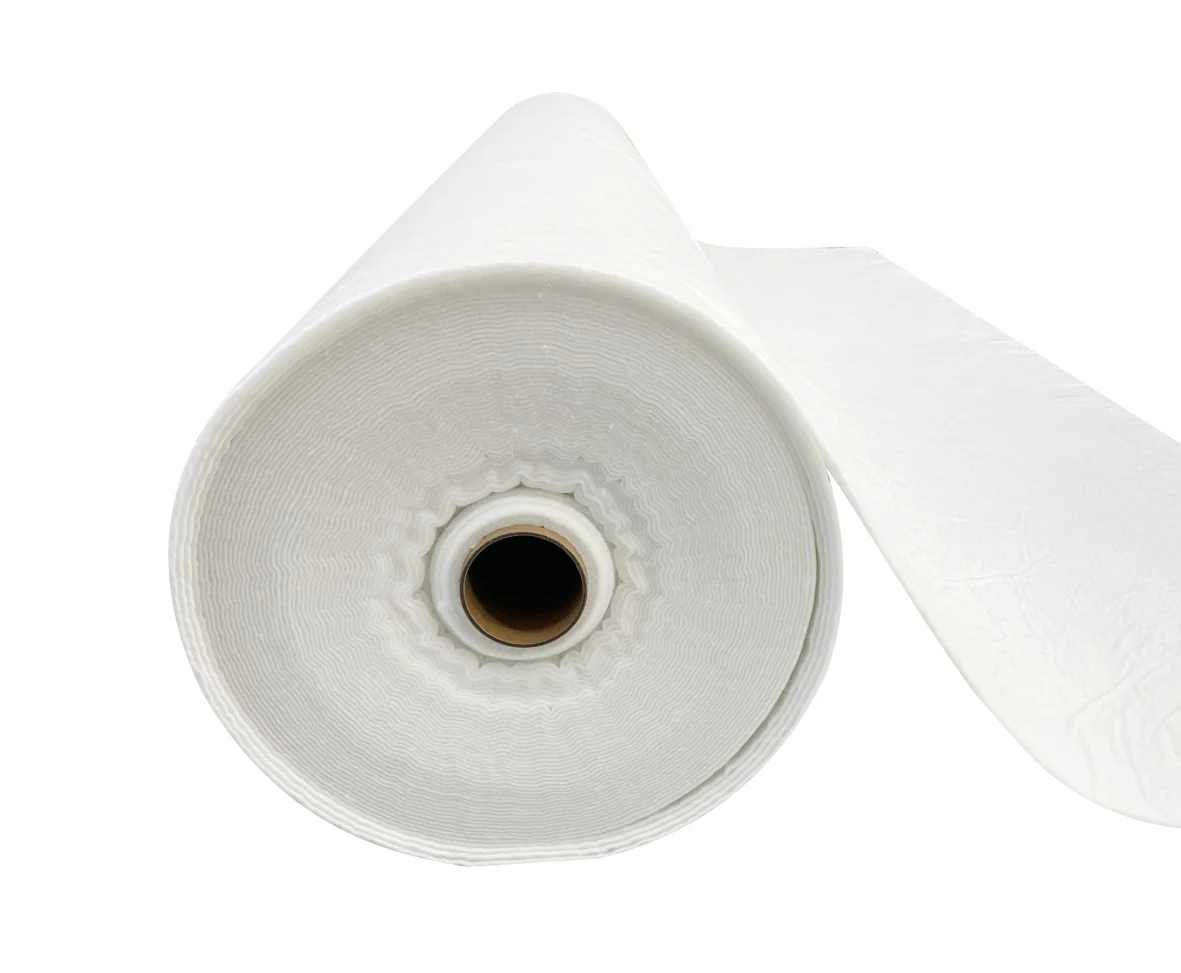

Needle-punched geotextile should be the first choice. With a permeability coefficient of up to 0.3 cm/s, it delivers drainage efficiency about 30% higher than spunbond fabric. A 200-300 g/m² grade can intercept silt particles larger than 0.075 mm and reduce clogging risk. Spunbond fabric has smaller pores and clogs more easily.
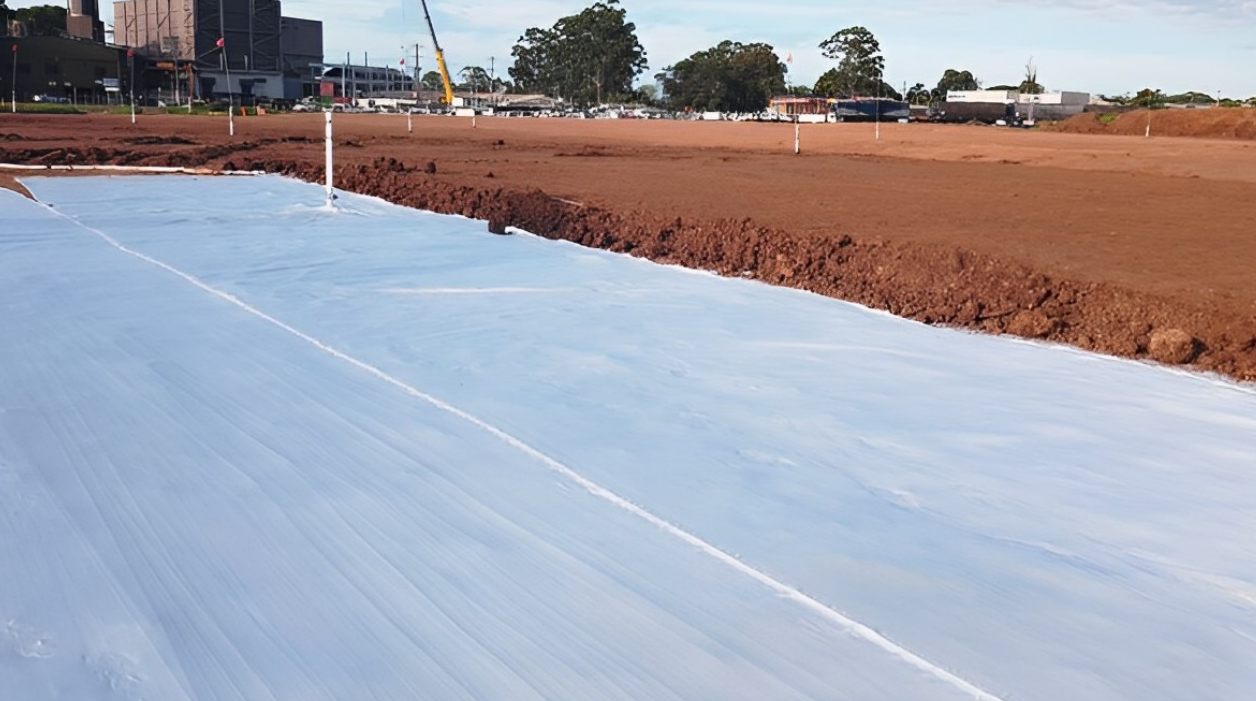
Geotextile Fabric
Needle-Punched Geotextile vs. Spunbond Geotextile
In stadium substructures, the choice of geotextile fabric directly determines the drainage lifespan of the turf system. The needle-punched process uses thousands of barbed steel needles penetrating the fiber web at frequencies above 5,000 times per minute. This mechanical interlocking creates a complex three-dimensional pore structure in polypropylene filaments, and the finished product typically maintains a thickness of 2.0 mm to 4.5 mm.
This three-dimensional structure has a porosity as high as 85% to 92%, and under ASTM D4491 testing, its vertical permeability often exceeds 0.35 cm/s. When rainfall intensity reaches 50 mm per hour, the fabric can quickly direct surface runoff into the 25 cm-thick graded crushed stone layer below. Its apparent opening size (AOS) is precisely controlled within 0.15 mm to 0.21 mm, allowing it to retain more than 95% of fine sand particles.
Needle-punched fabric also performs exceptionally well in transmissivity. Water can move laterally within the fabric at a rate of 2.0 L to 5.0 L per minute. This multidirectional drainage path relieves the instantaneous pressure that hydraulic gradients place on the filter layer. Even under an overburden load of 200 kPa, its internal three-dimensional void structure still preserves 70% of its effective flow space.
| Physical Performance Index | Needle-Punched | Spunbond | Reference Test Standard |
|---|---|---|---|
| Grab Tensile Strength | 750N – 1250N | 980N – 1900N | ASTM D4632 |
| CBR Puncture Strength | 1900N – 3300N | 2600N – 5200N | ASTM D6241 |
| Elongation at Break | 50% – 110% | 15% – 40% | ASTM D4632 |
| Flow Rate per Unit Area | 135 – 185 L/min/m2 | 45 – 95 L/min/m2 | ASTM D4491 |
| Standard Thickness | 2.55mm | 0.48mm | ASTM D5199 |
Spunbond fabric is produced by thermally bonding continuous polymer filaments at temperatures above 200°C. This high-temperature process creates strong chemical and physical bonds at the fiber crossover points, giving the fabric a very high tensile modulus. At the same basis weight of 150 g/m², spunbond fabric offers about 40% higher tensile strength than needle-punched fabric, making it more resistant to construction traffic and compaction equipment.
Its pore structure is relatively flat, and its thickness is usually below 0.6 mm. Because of this, water movement depends mainly on vertical permeability, with limited internal flow paths. In soils containing more than 15% clay, fine particles can quickly accumulate on the smooth, heat-bonded surface and form a mud film only a few microns thick.
The permeability coefficient of that mud film often drops below 1×10⁻⁷ cm/s, causing drainage performance to deteriorate sharply. Spunbond geotextiles are therefore better suited to reinforcing soft subgrades with CBR values below 3%, where their higher strength helps control settlement of the structural layers. For sports field drainage bases exposed to frequent heavy rainfall, needle-punched fabric provides much better long-term resistance to clogging thanks to its labyrinth-like filtration path.
Sports field drainage design usually follows the particle-size criterion of D15/d85 < 5. The pore-size distribution curve of needle-punched geotextile is highly compatible with crushed stone gradation. In simulated lifecycle testing over as long as 15 years, the permeability retention of needle-punched filter layers generally remains above 60% of the initial value.
100 g/m² grade: Commonly used for temporary sites or light artificial turf systems.
200 g/m² grade: The standard specification for professional football fields, offering 1.5 kN tear resistance.
300 g/m² grade: Designed for drainage trench areas with frequent heavy equipment traffic.
Under Darcy’s law, the permeability of a geotextile should be 10 to 15 times that of the overlying soil. In gradient ratio testing, needle-punched fabric typically records values below 3, which is considered a safe operating range. This performance comes from the millimeter-deep filtration space between fibers, which can accommodate a certain amount of fine particle intrusion without sealing off the flow section.
The 100 g/m2 grade of needle-punched fabric is commonly used for temporary sites or auxiliary drainage trenches; the 200 g/m2 grade is the standard configuration for professional football fields, providing a 1.5 kN tear-resistance margin; and the 300 g/m2 grade is typically installed in main drainage line zones with frequent heavy maintenance vehicle traffic.
Industry Recommendations
A standard football field covers about 8,000 square meters. Once the drainage system fails, the cost of excavation and replacement of clogged layers often exceeds USD 60 per square meter. By comparison, high-quality 200 g needle-punched geotextile, typically priced at under USD 2 per square meter, accounts for only about 1.5% of the total construction budget. Cutting costs on this material can increase future repair-related financial risk by more than 30 times.
Soil investigation reports show that when clay and silt content exceeds 15%, the geotextile’s apparent opening size (AOS) must fall within the 0.15 mm to 0.18 mm range. If the pore size is chosen incorrectly, fine particles can migrate into the crushed stone layer, reducing its void ratio from 40% to below 10% within three years. This type of physical clogging can leave standing water on the field surface even 24 hours after rainfall.
For high-intensity competition venues, the target permeability should be 10 times the infiltration rate of the overlying soil. Take a USGA-standard sandy field as an example: if the soil infiltration rate is 30 cm/hr, the underlying geotextile should be capable of handling at least 300 cm/hr. Under ASTM D4491 testing, the 0.35 cm/s permeability coefficient of needle-punched fabric provides ample safety margin.
- Polypropylene (PP) performs better than polyester (PET) in soils with pH above 9, avoiding hydrolysis-related risks.
- Grab tensile strength should remain consistently above 950N to withstand repeated passes from 10-ton rollers during construction.
- UV stability should retain at least 70% of strength after 500 hours of xenon arc exposure.
- The three-dimensional pore structure should mechanically interlock with 20 mm – 40 mm drainage stone to improve interface stability.
- Mass-per-unit-area tolerance should be controlled within ±5% of the nominal value.
The mechanical entanglement created by needle punching forms a cushioning space about 3 mm thick. This depth allows the material to absorb a small amount of migrating dust internally without forming a surface crust. By contrast, heat-bonded spunbond materials thinner than 0.5 mm lack internal holding capacity, so once deposits attach to the smooth surface, the water flow channels close quickly.
Elongation performance determines whether the material can remain intact under localized subgrade settlement. Needle-punched geotextiles can typically elongate 60% – 100% before rupture, while spunbond products often fail in a brittle manner at around 20% strain. That flexibility helps keep the filtration interface intact even after repeated traffic from heavy maintenance equipment.
- Overlap width should be at least 300 mm on stable subgrades, and increased to 500 mm on soft subgrades with CBR below 3%.
- For sewn seams, a double-thread chain stitch should be used, and seam strength retention should reach 90% of the parent material.
- Outdoor exposure should never exceed 30 days to prevent photo-oxidative degradation of the polymer.
- The first crushed stone layer should be no less than 150 mm thick, and vehicles must never drive directly on the geotextile.
| 20-Year Lifecycle Assessment | Needle-Punched Geotextile (PP 200g) | Spunbond Geotextile (PE/PP) | Difference Details |
|---|---|---|---|
| Cost per m² | USD 1.4 – 1.8 | USD 1.1 – 1.5 | Needle-punched is slightly higher |
| Expected Service Life | 15 – 20 years | 5 – 8 years | Clear lifespan difference |
| Drainage Loss Rate (10 years) | Below 40% | Above 75% | Needle-punched resists clogging better |
| Shock Absorption Optimization (G-max) | 2% – 5% absorption | 0% | Needle-punched feels softer underfoot |
| Probability of Major Rehabilitation | Below 2% | Above 15% | Long-term risk comparison |
In areas where reclaimed water is used frequently for irrigation, soil pH often fluctuates between 4.5 and 8.5. Needle-punched polypropylene remains inert in this chemical environment and does not suffer fiber breakage. That prevents sediment from entering the drainage network due to filter failure and reduces pipeline cleaning costs by about USD 500 per kilometer per year.
Long-term flow testing (ASTM D1987) confirms that biological slime growth can reduce permeability by about 50% over ten years. Needle-punched fabric starts with an initial flow rate of 150 L/min/m2, leaving enough residual capacity even after degradation to handle extreme rainfall. Spunbond fabric starts at only about 50 L/min/m2, leaving almost no tolerance for biological clogging.
The rough surface of needle-punched fabric provides an interface friction angle of about 25 to 30 degrees. This helps prevent horizontal slippage of the artificial turf system and crushed stone layer during rapid cuts and sudden stops by athletes. Field data show that a higher friction coefficient reduces displacement and deformation along field edges over a five-year operating period.
The impact attenuation value (G-max) of artificial turf is influenced by the elasticity of the underlying layers. Thick needle-punched fabric provides supplemental energy absorption, helping the field remain within the safe range of 165G. By contrast, the stiffer spunbond layer creates a harder subgrade response, and as the backfill consolidates, surface hardness tends to increase year by year.
Incoming material should be sampled for every 5,000 m² batch. The priority is to check flow-rate consistency across the full roll using a 5 cm falling-head water test. Eliminating blind spots caused by uneven material density helps prevent unexplained puddling in isolated parts of the field during matches and ensures fair playing conditions.
Choosing 250 g needle-punched geotextile increases total infrastructure cost by less than 1%. That investment can push the first major drainage overhaul from year 7 to beyond year 18. Financial modeling shows that a high-performance filtration layer can deliver a return on investment (ROI) of more than 400% over ten years.
- The recommended installation temperature is above 5°C to maintain fiber flexibility.
- The installation direction should follow the main flow slope to reduce hydraulic resistance at overlaps.
- The drop height for placing crushed stone must never exceed 1 meter, to prevent localized impact from shifting the geotextile.
- After installation, comparative permeability testing is required to ensure the measured value deviates by less than 10% from the design target.
Strength
Grab Tensile Strength
Under ASTM D4632 laboratory testing, a 25.4 mm-wide specimen is stretched at a rate of 300 mm per minute. This test simulates the concentrated loads placed on geotextiles during stadium construction by heavy truck tires or hard aggregate. Spunbond nonwoven fabric is made from continuous filaments bonded by heat, giving it very high initial resistance.
A 150 g/m² polypropylene spunbond fabric often achieves grab tensile strength above 950N in the machine direction. At the same basis weight, needle-punched fabric typically falls in the 600N to 700N range because it relies only on physical entanglement. This difference comes from fiber arrangement density. Spunbond fabric contains more continuous fibers per square centimeter, and thermal bonding locks fiber movement in place.
That strength difference becomes apparent when a bulldozer dumps 150 mm aggregate over a drainage trench. Under load, spunbond filaments show very little elongation, usually remaining below 25%. This high grab strength helps prevent through-tears when the stadium subgrade settles unevenly, preserving the physical separation between the aggregate layer and the soil over the long term.
- 120 g/m² spunbond fabric can achieve a grab strength of up to 750N.
- Needle-punched fabric of the same weight is limited by mechanical entanglement and is typically around 480N.
- Polypropylene fibers retain 95% of their strength in soils with pH values from 4 to 11.
- Under 200 kPa of vertical pressure, the pore-size change rate of spunbond fabric remains below 5%.
- The time required to pull a test specimen to failure is typically between 15 and 30 seconds.
- The closer the MD/CD strength ratio is to 1:1, the more stable the field structure will be.
When a stadium base includes a heavy-duty crushed stone drainage layer thicker than 300 mm, the rigid support characteristics of spunbond geotextile become more evident. It carries the hydrostatic pressure generated by the overlying fill and prevents excessive elongation from deforming the pore structure. If the apparent opening size (AOS) increases from 0.15 mm to 0.25 mm, the risk of fine soil loss doubles.
Needle-punched nonwoven fabric may have lower grab-strength values, but its thickness usually ranges from 1.5 mm to 3.0 mm, making it 3 to 5 times thicker than spunbond fabric. That added thickness provides a margin of safety under complex stress conditions. Even when the applied force exceeds 500N, needle-punched fabric does not fail in a sudden brittle manner. Sliding between fibers dissipates external energy and helps protect the drainage pipes below.
This energy-dissipation mechanism performs particularly well when wrapping HDPE corrugated drainage pipe. The pipe’s ridges and valleys create uneven shear stresses on the fabric. With elongation exceeding 50%, needle-punched fabric conforms closely to the pipe surface. Even when differential settlement exceeds 50 mm, the fabric remains wrapped in place, preventing sediment from entering the drainage system through tension-induced tears.
- Under ASTM D4632 testing, needle-punched fabric often exceeds 80% elongation at break.
- Under pressure, the permeability loss of its three-dimensional pore structure remains below 15%.
- The micron-scale channels created by needle punching can intercept dust smaller than 75 microns in diameter.
- Needle-punched fabric shows strong puncture resistance against 20 mm graded crushed stone.
- At a thickness of 2.0 mm, strength fluctuation remains below 5% even at -20°C.
- Its high elongation helps offset damage from the 15 Hz high-frequency vibration generated by rollers.
Ultraviolet exposure during construction can reduce the grab tensile strength of geotextiles. Polypropylene without carbon black stabilizer often loses more than 50% of its strength after 500 hours of sunlight exposure. During stadium construction, the original material data alone does not represent buried long-term performance. The long-term rate of strength loss is more meaningful than the initial number.
In areas with frequent groundwater fluctuations, creep performance directly affects drainage trench stability. Under long-term loading, spunbond fabric typically shows lower creep than needle-punched fabric. The molecular-weight distribution of high-density polypropylene influences the tensile stiffness of the fibers. When the field surface is subjected to dynamic loads of 150 kPa from athlete traffic, the geotextile below must have enough modulus to support the crushed stone layer.
If grab tensile strength is insufficient, the fabric can suffer fatigue damage under repeated compression. That allows lateral movement in the subgrade materials and compromises field flatness. Backfill used in football or hockey fields often contains angular quartz sand or basalt, which can abrade the fabric surface and therefore require high fiber grab strength to resist damage.
After 5,000 abrasion cycles in laboratory simulation, spunbond fabric retains 12% more residual strength than needle-punched fabric. When the thermal bond-point density reaches 30/cm², the material shows a balanced tensile response. Filament fineness controlled between 3 and 6 denier helps balance strength and filtration performance. After 24 hours of water immersion, the change in specimen strength should not exceed 3%.
- A 180 g/m² specification can raise grab tensile strength to above 1200N.
- The outer 50 mm along the roll edge is considered a strength-reduction zone.
- Grab strength at seams should reach 90% of the parent material strength.
- Needle-punched fabric typically has CBR puncture strength in the 1500N to 2500N range.
- Polyester (PET) loses strength faster than polypropylene in alkaline soils.
Goal areas and turning zones impose higher grab-strength demands than midfield areas. If a product below 400N is used, localized collapse can occur in the drainage layer after large irrigation trucks pass over it. Under rainfall, these depressions can develop into standing-water pockets. Tear resistance is positively correlated with grab tensile strength, and stress applied when workers pull on the fabric edges often causes edge tearing.
Puncture Strength
ASTM D6241 uses a flat-ended steel rod 50 mm in diameter to puncture the geotextile, simulating the bearing pressure from 20 mm to 40 mm aggregate under heavy loads in a stadium base. Needle-punched nonwoven fabric, with thickness above 1.5 mm, disperses the concentrated stress at the rod tip through internal fiber movement. For 150 g/m² needle-punched polypropylene geotextile, puncture strength typically falls between 1800N and 2400N.
Spunbond nonwoven fabric is only about 0.4 mm thick, and under sharp point pressure it lacks the thickness needed for cushioning, making it more vulnerable to penetration. Tests show that when crushed stone applies a 1500N compressive force, the damage rate of spunbond fabric is 35% higher than that of needle-punched fabric. When drainage aggregate is dropped from a height of 1 meter, the dynamic load generated is several times greater than the static load. Needle-punched fabric absorbs that energy through elongation and helps keep the filtration layer intact.
- 200 g/m² needle-punched fabric exceeds 2600N in strength.
- The 50 mm probe represents the contact area of stones in the field.
- Puncture displacement in needle-punched fabric reaches 40 mm to 60 mm.
- Fabrics below 100 g/m² usually fall below 800N.
- At an ambient temperature of 40℃, strength loss is kept within 8%.
- The depth of mechanical entanglement determines performance stability.
Where the subgrade contains sharp basalt or broken concrete, the cushioning effect of needle-punched fabric reduces the risk of puncture. Under 400 kPa of vertical pressure, a 2.5 mm-thick material still maintains connected pore channels. Even when 10% of the surface area is locally deformed under load, overall permeability loss remains within the 12% safety threshold. Roller vibration frequencies of 25 Hz to 50 Hz place very high demands on dynamic puncture resistance.
The thermal bond points in spunbond fabric are rigid, and under cyclic loading they are prone to fatigue cracking at microfractures. By contrast, the flexible fiber connections in needle-punched fabric cushion vibration, retaining 85% of strength after 1,000 pressure cycles. As groundwater fluctuations soften the subgrade, the geotextile must withstand compression from both soil and aggregate. In areas with CBR below 3%, materials with puncture strength under 1200N are highly likely to fail.
Once the fabric is punctured, the overlying crushed stone layer becomes vulnerable to erosion by sediment, and the drainage system can lose efficiency as early as the second rainy season. Every additional 0.5 mm of thickness increases CBR puncture strength by about 300N. The tensile strength of virgin polypropylene filaments contributes roughly 70% of that value. Performance is especially good when needle density is in the range of 200 to 300 punches per square centimeter.
- After 180 days of immersion in acidic soil (pH=4), strength retention remains 92%.
- Fiber breakage marks the point at which the material reaches its performance limit.
- 180 g/m² needle-punched fabric can resist rolling from 30 mm stones.
- Variation in puncture strength within the same roll should remain below 15%.
- At 2500N pressure, drainage pipe compression loss reaches 40%.
- A flexible protective layer reduces gouging of the pipe wall by hard aggregate.
Stress conditions are especially complex along drainage trench edges, where horizontal tension and vertical puncture forces act together. A low coefficient of variation in puncture strength indicates better process uniformity and more consistent basis weight. A 1.5 mm-thick needle-punched material provides some tolerance for imperfect construction practices. When crushed stone backfill is uneven, puncture strength above 2000N helps ensure the structure remains intact. Under the static load of a 10-ton roller, the wear loss of the 200 g grade remains below 3%.
In wet environments, polyester (PET) retains strength more steadily than polypropylene. At any point across the roll width, puncture strength should not fall below 80% of the nominal value. A filament fineness of 3.5 dtex to 6 dtex provides a good balance of flexibility and toughness. A high broken-needle rate during production can create local strength blind spots. Continuous pressure from shock pads beneath turf also tests the material’s long-term puncture resistance.
Under sustained loading, spunbond fabric undergoes stress relaxation and its puncture resistance declines over time. Needle-punched networks become denser under compression while continuing to function as a physical barrier. Virgin-material needle-punched fabric remains tough under sharp loads. Recycled-content geotextiles may show acceptable initial data, but their fibers become brittle in low temperatures. Over a 25-year design life, virgin material loses only half as much strength as recycled material.
Drainage systems operate 24 hours a day, and if the fabric is punctured due to insufficient strength, soil can enter the pipes. Cleaning underground blockages costs 15 times more than installing high-quality geotextile in the first place. The measured puncture strength of 120 g/m² spunbond fabric is around 1100N, putting it near the safety limit. By contrast, 150 g/m² needle-punched fabric reaches 2100N and is suitable for most sports fields.
- Heavy-duty 250 g/m² fabric reaches 3500N in strength.
- Laboratory displacement data should correspond to 1.5 times the expected subgrade settlement.
- Uniform carbon black distribution determines long-term strength performance.
- The closure capability of needle-punched pores helps prevent damage from propagating at puncture edges.
- Sideline drainage trenches experience the highest lateral puncture pressure.
- A 2% carbon black content improves resistance to UV fatigue.
Pressure distribution along stadium sidelines is uneven, and high-elongation needle-punched fabric is better able to resist irregular stress. Procurement should always refer to the latest ASTM reports. The CBR value should be treated as a hard acceptance criterion.
Elongation
In the ASTM D4632 laboratory test, a 25.4 mm-wide specimen is pulled apart at 300 mm/min. Inside needle-punched nonwoven fabric, randomly oriented fibers undergo physical displacement and rearrangement at the initial stage of loading. Polypropylene produced by this process typically shows elongation at break between 50% and 100%. For the 150 g/m² grade, displacement already exceeds 20 mm when the load reaches 30% of maximum tensile strength.
Spunbond nonwoven fabric is made of thermally bonded continuous filaments with very limited freedom for fiber slippage. At the same 150 g/m² basis weight, elongation at break generally falls between 15% and 35%. The thermal bond points restrict flexible extension of the molecular chains, giving spunbond fabric a high initial modulus. When the subgrade is subjected to sudden loading, spunbond fabric deforms very little, so the load is transferred more directly to the underlying soil.
- Measured elongation at break for 120 g/m² needle-punched fabric: 85%
- Measured elongation at break for 120 g/m² spunbond fabric: 22%
- Elongation at 50N load: needle-punched (12 mm) / spunbond (2.5 mm)
- Materials with elongation above 50% are classified as high-elongation geotextiles
- Under ASTM standards, the specimen length is 76 mm
- The difference between MD and CD elongation should be controlled within 10%
- For the 100 g/m² grade, elongation performance typically varies by about 8%
After excavation, the bottom unevenness of a drainage trench often varies between 30 mm and 80 mm. High-elongation needle-punched geotextile conforms closely to that irregular profile without spanning voids. When 20 mm graded crushed stone is placed and compacted above it, the suspended areas relieve stress through elongation. This elongation capacity provides roughly a 30% construction safety margin, reducing the risk of sudden failure caused by stress concentration.
When wrapping 100 mm-diameter HDPE corrugated pipe, the ridges on the pipe wall generate shear stresses that require material flexibility. Needle-punched fabric can locally elongate by as much as 45% at the ridges while still maintaining an apparent opening size of 0.15 mm. If a material with elongation below 15% is used, the fibers thin out at the ridges under tension. That can enlarge the local pore size from 150 microns to 300 microns, making it easier for fine sand to enter the pipe.
- With 50 mm settlement, the increase in tension in needle-punched fabric: 15%
- With 50 mm settlement, the increase in tension in spunbond fabric: 65%
- Maximum radial expansion rate of the wrapping layer: 3%
- Deformation limit of HDPE pipe: 5%
- Three-dimensional space ratio in needle-punched fibers: 85%-90%
- Thermal bond-point density: 30-45/cm²
- Permeability loss of the filter layer at 50% elongation: 10%
After 5 to 10 years of service, subgrade movement often develops in stadium drainage systems. Changes in soil moisture content cause the soil to swell and shrink. Needle-punched fabric with elongation above 60% can adjust with soil movement without cracking. Spunbond materials have much less elongation reserve, and when vertical displacement exceeds 30 mm, the probability of seam separation increases fourfold.
When polypropylene filaments are heated to 60℃, elongation increases by about 10%. Since stadium surface temperatures in summer can exceed 50℃, this thermally induced elongation change must be considered in design. High-quality virgin needle-punched fabric keeps elongation variation within 5% under temperature cycling. Geotextiles made with recycled feedstock become brittle at low temperatures, and elongation can drop to less than 30% of the original value.
- Needle-punched fabric retains 92% of its elongation at -10℃
- When recycled content exceeds 30%, the embrittlement point is -5℃
- Elongation loss after 500 hours of UV exposure: 15%
- A 2% carbon black content improves elongation stability
- Polyester (PET) fibers have lower elongation than polypropylene
- Change in elongation after water absorption: less than 2%
- Breaking strength of individual filaments: 3.5-5.5 cN/dtex
Creep behavior under long-term loading is closely related to instantaneous elongation. After 1,000 hours under constant load, creep elongation in spunbond fabric tends to stabilize, with additional strain limited to less than 5% of the original length. In needle-punched fabric, the interlocked fiber structure continues to shift slowly under sustained pressure. Under a vertical pressure of 150 kPa in the drainage system, thickness compression in needle-punched fabric can reach 40%, which also helps densify the filter layer.
The elongation-at-break curve in the ASTM D4632 report should always be reviewed carefully. Slope locations in stadiums require high-elongation materials to resist lateral forces caused by soil creep. In projects designed for a 25-year service life, the redundancy built into the elongation index directly affects the survival rate of the buried drainage network. Using materials with elongation above 80% can reduce the risk of sudden drainage-system failure by about 22%.
| Physical Property Index | Needle-Punched (High Elongation) | Spunbond (Low Elongation) |
|---|---|---|
| Typical Elongation at Break (%) | 75 | 20 |
| Initial Modulus (N/mm) | 8 | 45 |
| Trench Conformity Rating | Excellent (elastic adaptation) | Moderate (rigid coverage) |
| Stress at 50 mm Displacement | 400N | 1100N |
| Elongation After 25 Years of Aging | >40% | <10% |
| Recommended Drainage Application | Pipe wrapping, filter layers | Underlayment beneath stone layers, separation layers |
Large rollers working on crushed stone layers generate vibration amplitudes of 0.5 mm to 1.5 mm. High-elongation geotextiles use the voids between fibers to damp vibration, dissipating about 12% of the vibrational energy. This reduces the wear rate caused by aggregate edges rubbing against the fabric surface. After 2,000 simulated compaction cycles, the surface fiber integrity of high-elongation material is 18% better than that of low-elongation material.
Fibers made from virgin polypropylene pellets have strong molecular-chain entanglement. That allows individual fibers to remain locked into the needle-punched network even at 50% elongation. Increasing mass by 30 g per square meter typically raises elongation performance by 5% to 8%. For heavily used hockey or rugby fields, the elongation of drainage-layer materials should not be below 65% to handle dynamic impact loads.
Selection of stadium drainage fabric should be based in part on the predicted settlement of the subgrade. If expected settlement exceeds 20 mm, the low elongation of spunbond fabric becomes a structural weak point. It is also important to confirm that machine-direction and cross-direction elongation are balanced. If cross-direction elongation is only half of the machine-direction value, the fabric is more likely to tear in one direction when wrapping irregular drainage components.
- MD/CD elongation ratio for 180 g/m² needle-punched fabric: 1.1:1
- Creep rate of fibers under 100N tensile load: less than 2%
- Increasing needle depth by 0.5 mm raises elongation by 10%
- Strength retention in saturated brine: 98%
- Surface roughness contribution to elongation performance: 5%
- Edge pre-elongation caused by construction handling: 15 mm
- Three-dimensional deformation reserve provided by 1.5 mm thickness: 3000 mm³
Permeability
Resistance to Clogging
Geotextiles made by needle punching are typically 2 mm to 4 mm thick, with a sponge-like three-dimensional internal structure formed by interlaced, randomly oriented fibers. Spunbond fabric is usually only 0.3 mm to 0.5 mm thick and has a flat, heat-bonded structure that is more like a dense sheet of stiff paper. This physical difference in thickness largely determines how contaminant particles are retained within the fabric.
Needle-punched fabric typically maintains porosity in the 80% to 90% range. Even ultrafine silts smaller than 0.075 mm still have enough internal pathways to pass through or settle within the void network. Spunbond fabric, by contrast, generally has porosity below 50%, and all of its openings are distributed on a two-dimensional plane. Once particles adhere to the surface, the flow path can be blocked almost immediately.
Laboratory tests show that after 100 hours of continuous drainage in high-sediment conditions, needle-punched fabric can still maintain a stable permeability coefficient of 1.2 x 10^-1 cm/s, with no significant flow decline.
- This three-dimensional structure gives the material a much longer service life, with a dust-holding capacity per square meter more than four times that of spunbond fabric.
- Even if the top surface is partially covered by sediment, water can still bypass clogged points through lateral flow paths within the fiber structure.
- When fine particles migrate downward, spunbond fabric is highly prone to a “blinding effect” at the filter surface, causing water-flow capacity to fail quickly.
The gradient ratio (GR) is one of the clearest indicators of whether a drainage system is approaching failure. In a 48-hour simulated test with sandy soil, the GR value of spunbond fabric can rise directly from 1.0 to above 3.5. Once it exceeds 3, it indicates an imbalance in the pressure gradient near the geotextile and severe clogging in the lower layer.
Under the same conditions, needle-punched fabric usually maintains a GR value between 1.1 and 1.5. That stability helps ensure that the internal water pressure in the base does not rise abnormally after heavy rainfall on a football field. If the GR value gets out of control, drainage slows down, and it can even lead to softening or uneven settlement of the turf rootzone.
Fluid-dynamics calculations show that, under a constant head difference, the higher permeability of needle-punched fabric can allow a sports field to recover dryness within 30 minutes after rainfall.
- Needle-punched fabric works through a “serpentine flow path,” forcing particles to pass through dozens of bends within the fiber layer.
- Spunbond fabric relies on a single-layer screening mechanism, so once particle diameter is only slightly larger than the pore size, permanent physical blockage can occur.
- In sites where clay content exceeds 15%, spunbond fabric fails about five times faster than needle-punched fabric.
The graded crushed stone in the upper layer of a sports field exerts about 50 kPa of vertical pressure. Under that load, the fiber skeleton of needle-punched fabric still retains more than 60% of its original pore volume, preserving a functional flow section. Under the same pressure, the already small gaps in spunbond fabric close even further, and its permeability can drop from 0.8 per second to below 0.1.
Measured data show that under a routine pressure of 20 kPa, 200 g needle-punched fabric can drain 165 liters of water per minute per square meter.
- Polypropylene fibers in the 6 to 12 denier range provide excellent elastic support and help keep drainage channels open under compression.
- Because spunbond fabric is produced by high-temperature calendering, its compressed fibers have almost no rebound capacity, and pore closure is essentially irreversible.
- During heavy maintenance operations, this difference in compression resistance directly affects the service life of the underlying drainage matrix.
The lower layers of a sports field remain in a wet environment over the long term, and the smooth surface of spunbond fabric is highly prone to anaerobic biofilm growth. This biofilm acts like glue, sealing the flat pores and forming a dense mud cake. Needle-punched fabric, with its much larger void network, allows micro-circulation of air and water, which helps delay biological clogging.
Once the mud cake reaches a thickness of 1 mm, overall drainage-system performance can collapse to less than 10% of the design value. Replacing a failed filter layer requires stripping off the entire artificial turf or natural grass system, and repair costs usually range from USD 50 to USD 80 per square meter. Choosing needle-punched fabric with stronger anti-clogging performance helps avoid that major maintenance burden.
Field excavation inspections show that after five years in service, needle-punched fabric may contain a small amount of internal sediment, but it does not form a continuous bonded layer, and drainage remains effective.
- Polypropylene needle-punched fibers are chemically stable and do not undergo physical degradation or pore shrinkage under long-term immersion.
- Spunbond material is comparatively stiff, and vibration from athlete traffic can actually accelerate particle wedging into the micropores.
- With elongation above 50%, needle-punched fabric can keep its filtration structure intact even when the crushed stone layer undergoes minor movement.
A rainfall intensity of 100 mm per hour qualifies as extreme weather. Needle-punched fabric is typically designed with an effective drainage capacity 20% above standard requirements. In actual operation, spunbond fabric must be designed with a clogging factor above 0.5, and after two years in service its real drainage capacity often falls below the safety threshold, leaving it unable to handle sudden extreme storms.
The table below compares drainage flow-retention performance under different conditions (unit: L/min/m^2):
| Test Condition | 200 g Needle-Punched Nonwoven | 120 g Spunbond Nonwoven |
|---|---|---|
| Initial clean-state flow | 165 | 45 |
| Flow after 50 sediment cycles | 142 | 8 |
| Permeability after 40 kN compression | 1.8 s^-1 | 0.2 s^-1 |
In construction standards for major sports venues, the required permeability coefficient k for blind-drain wrapping materials is typically no lower than 1 x 10^-1 cm/s.
Specification Comparison
At 200 g, needle-punched fabric usually has a measured thickness of 2.2 mm to 2.8 mm. By contrast, spunbond fabric at the same weight is often only about 0.4 mm thick. That fivefold thickness difference allows needle-punched fabric to provide much better physical cushioning over irregular crushed stone sub-bases.
In a laboratory reciprocating-abrasion test over 500 cycles, the surface fiber-loss rate of needle-punched fabric was below 3%. Spunbond fabric showed visible leakage points after only 150 cycles and could no longer function as a filter layer.
Grab-strength data reflect a material’s resistance to construction damage. A 200 g needle-punched fabric has grab strength of 750N in both the machine and cross directions, allowing it to withstand the roughly 20 kN of instantaneous pulling force generated by paving machinery. Because of its more directional fiber structure, spunbond fabric usually has a cross-direction strength of only 480N and is much more prone to tearing at corners and other stress-concentration points.
In actual installation, when the underlying crushed stone is 25 mm to 40 mm in diameter, the damage rate of spunbond fabric is 210% higher than that of needle-punched fabric.
| Comparison of Physical and Mechanical Properties | 200 g Needle-Punched Geotextile | 120 g Spunbond Geotextile | 300 g Needle-Punched Geotextile |
|---|---|---|---|
| Grab Strength (N) | 750 | 480 | 1150 |
| Elongation (%) | 55 | 18 | 65 |
| CBR Puncture Strength (N) | 1600 | 950 | 2500 |
| Thickness (mm) | 2.5 | 0.35 | 3.2 |
CBR puncture strength determines whether the material can withstand pressure from the stone above. A 200 g needle-punched fabric delivers a puncture capacity of 1.6 kN, enough to support the self-weight of a 500 mm-thick mixed stone-and-soil layer above it. When stress becomes concentrated, spunbond fabric can develop tiny perforations at the sharp edges of crushed stone, allowing soil to migrate into the blind drains.
The difference in drainage efficiency is reflected in vertical flow performance. Sports field construction standards require the filter layer, under 20 kPa pressure, to maintain a drainage reserve equal to three times the peak rainfall intensity. Needle-punched fabric can drain 2.8 liters of water per square meter per second. Under the same pressure, spunbond fabric drops to 0.7 liters, which is difficult to rely on during convective downpours.
Under simulated rainfall of 60 mm per hour, a field built with spunbond fabric can develop 20 mm of surface ponding within 15 minutes. That can leave natural grass roots in an oxygen-deficient state long enough to trigger yellowing and dieback.
| Comparison of Drainage Performance | 200 g Needle-Punched Geotextile | 120 g Spunbond Geotextile | Test Standard |
|---|---|---|---|
| Vertical Permeability (per second) | 2.5 | 0.65 | 50 mm head difference |
| Planar Flow (L/min/m²) | 165 | 42 | 20 kPa vertical pressure |
| Apparent Opening Size AOS (mm) | 0.08 | 0.15 | Particle filtration accuracy |
The apparent opening size (AOS) defines how precisely the material can control fine soil particles. Needle-punched fabric typically maintains a stable pore-size range of 0.075 mm to 0.12 mm, effectively blocking more than 90% of fine sand at 0.15 mm. Spunbond fabric tends to have a less uniform pore-size distribution, with maximum openings often exceeding 0.25 mm. That can lead to loss of fine base material and eventual surface settlement.
In terms of long-term durability, polypropylene fibers maintain more than 95% of their strength in soils with pH from 4 to 12. If spunbond fabric contains recycled material, its degradation rate in acidic soil can be 3.2 times faster than that of pure needle-punched polypropylene fiber. This difference in chemical stability becomes very noticeable after about three years in service.
ASTM D4355 testing shows that after 500 hours of intense UV exposure, needle-punched fabric retains 82% of its tensile strength. Spunbond fabric usually retains less than 60% and is more prone to embrittlement during outdoor storage.
Needle-punched fabric still retains more than 50% elongation at -20°C, helping resist freeze-heave damage.
Spunbond fabric becomes brittle at low temperatures, and freeze-thaw cycles beneath the turf can cause brittle fracture.
A roll of 200 g needle-punched fabric weighs about 100 kg, and its fiber density helps maintain holding capacity at 0.9 g/cm³.
Needle-punched fabric still retains more than 50% elongation at -20°C. That toughness helps absorb stresses caused by freeze heave. Spunbond fabric becomes brittle under low temperatures, and freeze-thaw cycling beneath the turf can cause irreversible physical cracking, eliminating its separation function.
For the 200 g grade of needle-punched fabric, the punch density should exceed 50 punches per square centimeter. Each roll weighs about 100 kg, and the fiber density helps keep the holding capacity stable at 0.9 g/cm³.
Field excavation data show that after eight years in service, the terminal drainage flow of systems using needle-punched fabric had declined by only 12%. In spunbond fabric, however, the pores are far more easily captured by clay fines under hydrostatic pressure, causing drainage resistance to increase by 300% after only 18 months in service.
The filament denier of needle-punched fabric usually ranges from 6D to 12D. This balance of thickness supports both mechanical strength and filtration precision. Spunbond fibers are much finer, typically only 1D to 3D, and under heavy roller traffic they can flatten under load, causing the effective flow section to nearly disappear.
A permeability coefficient k greater than 1.2 x 10^-1 cm/s is the threshold for high-performance fields. This level keeps head loss through the geotextile below 5 mm. Once spunbond fabric becomes saturated with sand-laden water, its head loss can rise above 30 mm, meaning the lower structure remains in a long-term submerged and corrosive condition.
Follow-up inspections of 20 completed fields found that drainage systems using needle-punched fabric still retained more than 85% of their design discharge capacity after a ten-year period.
The filament denier of needle-punched fabric typically ranges from 6D to 12D.
Spunbond fiber diameter is only 1D to 3D.
Every roll of needle-punched geotextile must undergo open-area testing before leaving the factory. A 200 g specification provides more than 100,000 micro drainage channels per square meter. In spunbond materials, heat-bond points occupy nearly 30% of the area, so the effective drainage area is far lower than that of needle-punched fabric.
Filtration
Performance Comparison
| Performance Parameter | Needle-Punched Nonwoven Geotextile | Spunbond Nonwoven Geotextile | Industry Reference Standard |
|---|---|---|---|
| Apparent Opening Size O95 | 75 to 212 microns | 100 to 180 microns | ASTM D4751 |
| Permittivity | 1.2 to 3.5 s^-1 | 0.2 to 0.7 s^-1 | ASTM D4491 |
| Vertical Flow Rate | 4075 to 7500 L/min/m² | 1200 to 3200 L/min/m² | 50 mm water head |
| Porosity | 85% to 93% | 55% to 72% | Laboratory volumetric method |
| CBR Puncture Strength | 1600 to 4800 N | 800 to 2100 N | ASTM D6241 |
| Gradient Ratio | 1.0 to 1.4 (stable) | 2.8 to 4.5 (high risk) | ASTM D5101 |
| Typical Thickness | 2.2 to 4.8 mm | 0.3 to 0.6 mm | ASTM D5199 |
Nonwoven fabric subjected to more than 10,000 needle penetrations per square meter develops a complex internal void structure. This randomly distributed multilayer network of polypropylene filaments, typically 15 to 50 microns in diameter, can still maintain porosity above 85% even under compression. This three-dimensional physical structure is fundamentally different from flat spunbond materials.
Once water enters the fabric, it is forced to change direction repeatedly. The microscopic fluctuation in flow velocity gives particles smaller than 75 microns enough time to attach to fiber surfaces instead of immediately sealing off the drainage pores. This mechanism reduces the risk of forming a dense mud cake on the surface and helps preserve long-term drainage performance.
When a sports field is exposed to rainfall intensity above 50 mm per hour, the geotextile must maintain a permittivity of 2.5 s^-1 under a 0.1 m water head. The flexibility created by the needle-punched process allows the fabric to elongate by more than 50% at the base of trenches without tearing, helping it adapt to irregular subgrade contours.
The high-frequency needle-punching process disrupts directional fiber alignment, producing an apparent opening size O95 stably in the range of 0.075 to 0.212 mm. This pore-size range is particularly suited to the sandy soils commonly found beneath sports fields, allowing particle gradation to form a natural internal filter layer about 5 mm thick upstream of the fabric.
- Polypropylene fiber density is about 0.91 g/cm³, and even after long-term immersion in groundwater with pH from 4 to 9, tensile-strength loss does not exceed 10%.
- Standard 200 g/m² needle-punched fabric usually achieves trapezoidal tear strength above 300N, enough to resist the instantaneous impact of crushed stone placement during construction.
- The vertical permeability coefficient remains in the order of 10^-1 to 10^-3 cm/s, ensuring that rainfall can infiltrate the drainage trench faster than it can accumulate at the surface.
- After 500 hours of UV exposure, high-quality needle-punched fabric still retains about 70% of its original strength.
As soil particles migrate toward blind drains under hydraulic action, the deep-filtration mechanism of needle-punched fabric captures part of the fines within the body of the fabric. This is not a failure mode. Instead, it helps reduce the gradient ratio across the fabric—typically measured below 1.5—and prevents internal suction erosion in the subgrade.
In the narrow space around drainage pipes, needle-punched fabric shows excellent conformity, eliminating 1 to 3 mm bridging gaps between the pipe wall and the surrounding soil. This tight physical contact prevents side flow from developing around the outer pipe wall and directs all infiltrating water into the filtration cycle.
Base materials produced by carding and cross-lapping have a machine-direction to cross-direction strength ratio close to 1:1. This isotropic mechanical behavior helps prevent displacement or tearing of the filter layer under uneven loading across large-area fields such as football pitches.
- Its fiber surface area is more than 30% greater than that of spunbond materials of the same mass, providing more space for biofilm and mineral deposition to distribute rather than concentrate.
- Under 50 kPa normal pressure, the effective thickness of needle-punched fabric compresses from 2.5 mm to 1.8 mm, yet its transmissivity remains within a 15% fluctuation range.
- At a laboratory temperature of 20°C, the open-area loss after 1,000 load cycles stays below 5%, demonstrating the stability of the mechanically entangled fiber structure.
Soil Compatibility
The content of silt and clay particles smaller than 0.075 mm largely determines filter-layer selection. When particle-size distribution (PSD) analysis shows more than 15% passing the No. 200 sieve, the apparent opening size (O95) of needle-punched geotextile should be limited to below 0.15 mm.
When D85—the size below which 85% of soil particles fall—lies between 0.1 mm and 0.2 mm, the O95 of the needle-punched geotextile should be less than or equal to twice the D85 value. This ratio promotes the formation of an internal filter layer 3 to 8 mm thick at the interface, where larger particles help block finer material.
| Soil Classification Characteristic | Recommended O95 Range | Recommended Mass (g/m2) | Required Permittivity (per second) |
|---|---|---|---|
| Clean sand (fines < 5%) | 0.18 – 0.25 mm | 150 – 200 | > 2.0 |
| Sandy silt (fines 15%-30%) | 0.12 – 0.18 mm | 200 – 250 | > 1.5 |
| Cohesive soil (plasticity index PI > 7) | 0.075 – 0.12 mm | 250 – 300 | > 0.8 |
| Poorly graded soil (uniformity coefficient < 5) | < 0.15 mm | Above 300 | > 1.0 |
Soils with a uniformity coefficient Cu below 5 are prone to piping. For sports field bases with this type of soil, thick needle-punched material above 300 g/m² should be used. With a physical thickness above 3 mm, it creates a longer pore path and keeps fine-material loss below 2%.
In blind-drain environments where side pressure reaches 10 to 30 kPa, the reduction in pore volume of needle-punched fabric should not exceed 20%. Measured data show that polypropylene filaments can maintain a permeability coefficient of 0.01 cm/s under load, helping prevent subgrade softening and preserving oxygen availability around turf roots.
- For clay subgrades with permeability below 0.00001 cm/s, geotextile permittivity should be at least 10 times that of the soil.
- If fine sand content on the site exceeds 50%, a laboratory gradient ratio test should confirm that GR does not exceed 1.5 after 200 hours of operation.
- If soil pH falls outside the neutral range (pH < 4 or pH > 10), polypropylene can provide 15 more years of filtration stability than polyester.
- For subgrades with surface-leveling error within 10 mm, using the 200 g grade can reduce material cost by 12%.
The ratio between the D15 of the fine crushed stone bedding and the geotextile O95 also affects infiltration efficiency. When D15 is 2 mm, the selected needle-punched fabric must prevent crushed stone edges from squeezing the fiber network and locally stretching the filtration openings beyond 0.3 mm.
Because of the random arrangement of its fibers, needle-punched fabric performs better than spunbond material in gap-graded soils. When the soil lacks intermediate-size particles, the flat surface of spunbond fabric tends to fill with fines, whereas the internal space of needle-punched fabric can accommodate up to 500 g of fine deposits per square meter.
- In laboratory long-term filtration testing under a simulated 5 m water head, the flow-decay curve of needle-punched fabric levels off after 48 hours.
- For all-weather artificial turf, models with O95 in the 0.09 to 0.15 mm range are recommended to handle fine powder generated by rubber-infill abrasion.
- When site wind speed exceeds force 5, needle-punched fabric above 250 g has 40% lower displacement risk during installation than spunbond fabric, thanks to its self-weight and surface friction.
- In geological areas with high iron and manganese ion content, the high porosity of needle-punched fabric slows mineral scaling caused by oxidation.
In humid climates with abundant rainfall, drainage systems should maintain a 50% infiltration reserve. In such cases, ASTM D4491 vertical-flow data should be used to confirm that point flow under a constant 50 mm head is no lower than 5500 L/min/m².
The higher the plasticity index PI, the stronger the cohesion between soil particles, and the clogging threat to geotextile is actually lower than with non-cohesive silts. For strata with PI above 10, the priority should be the grab strength of the needle-punched fabric rather than an extremely small pore size, with a recommended value above 700N.
- The flatter the particle-size distribution curve, the more forgiving the filter-layer design, allowing use of a 200 g standard roll with a larger O95.
- If the subgrade is fill soil compacted to below 90%, geotextile mass should be increased to 300 g to use elongation capacity to absorb uneven settlement stress.
- The elongation at break of polypropylene filaments is typically set between 50% and 80%, covering the deformation demands of most sports track and field base layers.
- Each roll of needle-punched fabric is ideally 4 to 6 meters wide to reduce filtration discontinuities at overlaps, and overlap length should be maintained at no less than 300 mm.
The hydraulic gradient is highest at the blind-drain inlet, where the geotextile experiences the most concentrated flow impact. Needle-punched fabric, with its 2.5 mm thickness, buffers the kinetic energy of the moving water and prevents boiling of soil particles at the interface, helping maintain the mechanical stability of the soil skeleton.
For turf drainage systems exposed to fertilizer residues, the non-polar surface of needle-punched fabric reduces phosphate crystal adhesion. Field data show that after three years of continuous fertilization, drainage efficiency declined by only 8% where polypropylene needle-punched fabric was used, compared with more than 35% for traditional spunbond materials.
- Where the subsoil contains pebbles larger than 20 mm, CBR puncture strength should reach 2500N.
- For ultrafine clay particles below 0.02 mm, the surface potential of needle-punched fabric can produce a weak electrostatic interception effect.
- Permeability testing in the laboratory at room temperature should use de-aired water to eliminate the effect of microbubbles on pore measurements.
- In drainage trenches with a 1:1 slope, the measured interface shear strength between needle-punched fabric and soil is typically between 25 and 32 degrees.
The depth of soil compatibility depends on the slope of the PSD curve. In soils with a very small D10, pursuing maximum permeability can increase the risk of internal erosion. Concentrating pore-size distribution in the 120 to 160 micron range by adjusting needle frequency and punch depth is one practical way to balance permeability and soil retention.
Long-term wet-dry cycling in sports field bases creates fine cracks in the soil. The flexible fibers of needle-punched fabric can partially bridge these cracks and prevent water from forming concentrated scour paths. This microscopic compensating mechanism is one of the key physical reasons the system can maintain filtration performance for more than 15 years.
- The vertical head loss in the drainage system should be controlled below a 0.5 cm water column to avoid oversaturation in the turf root zone.
- In cold regions, the internal air content of needle-punched fabric can provide about 2°C of freeze-buffering capacity, reducing ice pressure on filtration pores.
- Fibers produced from 100% virgin polypropylene chips can achieve an underground oxidation-resistant service life of more than 50 years.
Around catch basins at the edges of sports fields, flow velocities are often extremely high. Using reinforced needle-punched fabric above 350 g can effectively retain fine particles in the backfill sand and help prevent siltation in the collection sump within 24 months after construction.