
Woven geotextiles offer high tensile strength (50–200 kN/m) and are used primarily for reinforcement and load support. Non-woven geotextiles have lower tensile strength (8–50 kN/m), but with porosity above 70% and permeability in the range of 10⁻¹ to 10⁻³ cm/s, they are better suited to drainage and filtration.
Tensile Strength
Woven Geotextile
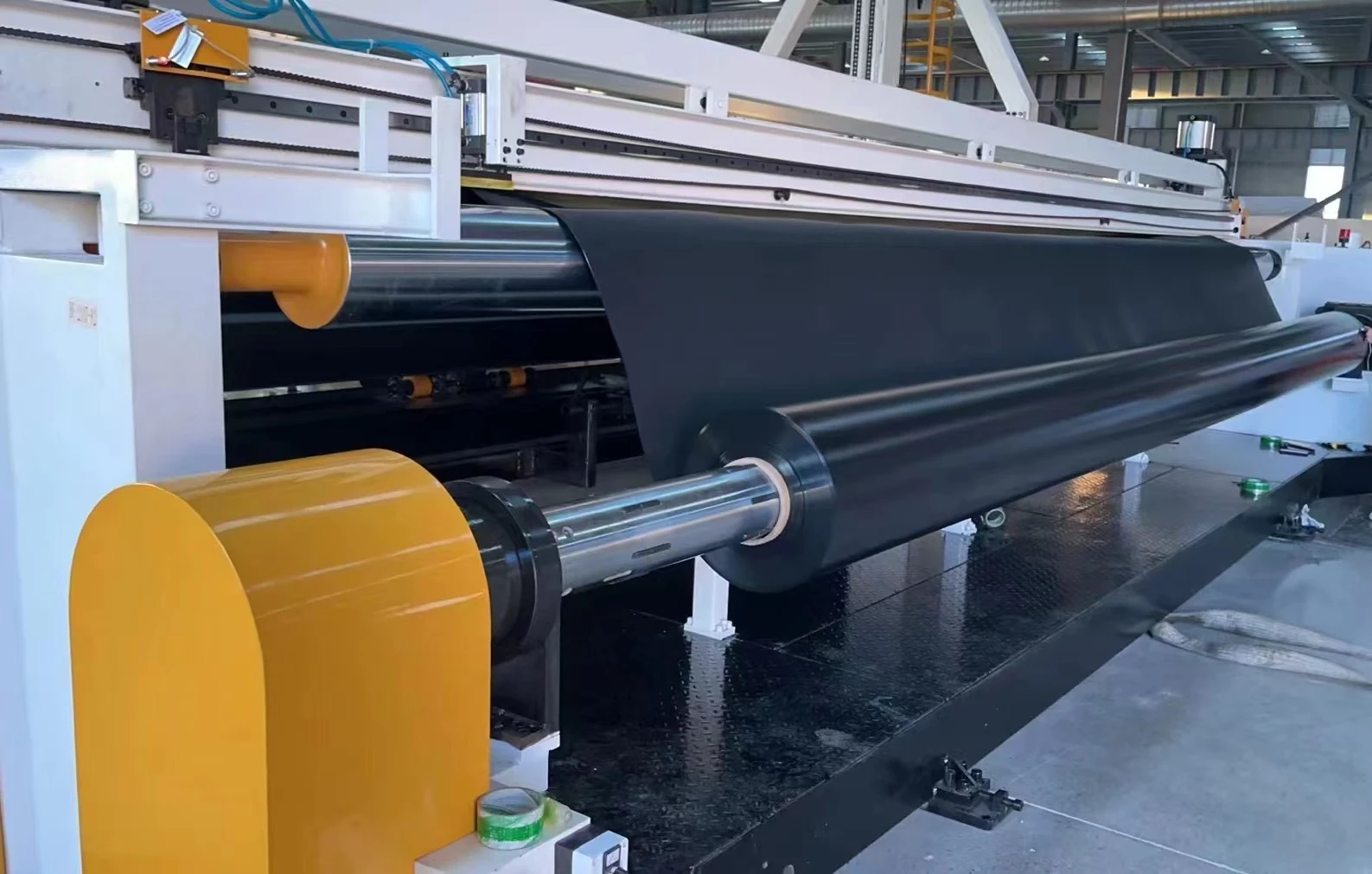
Small polypropylene pellets are fed into large machines, where they are heated and melted. The temperature is tightly controlled between 220°C and 280°C, and the molten polymer is forced out by a thick threaded steel screw. After passing through a cooling water bath, it is cut into noodle-like strips 2 to 5 mm wide. The machine then stretches these strips aggressively, pulling them to 4 to 8 times their original length. Heavy-duty looms shuttle back and forth at 300 to 500 cycles per minute, weaving thousands of these strands into large rolls of fabric.
The finished fabric seen on site typically contains about 10 to 40 intersecting plastic strands per inch in both directions.
- Slit-film woven fabric with a slick surface allows less than 10 gallons of water per square foot per minute to pass through.
- Monofilament woven fabric, with more open spacing, allows faster water flow, reaching 40 to 150 gallons.
- Heavy-load multifilament fabric twists thousands of fine strands into larger yarns, pushing tensile capacity beyond 1000 kN/m.
- Fabric made from high-strength polyester fiber can remain buried in soil for 120 years while keeping dimensional change below 1%.
In the lab, two heavy 1-inch-wide steel clamps with rough serrated faces grip each end of the fabric. A hydraulic tester pulls at a constant rate of 12 inches per minute until the material tears apart with an audible snap. The breaking force shown on the screen typically ranges from 200 to 600 pounds. In another test, a solid flat-ended steel plunger 50 mm in diameter is driven down into the fabric, requiring as much as 2000 pounds of force to puncture a single layer.
Strong outdoor sunlight can eventually break plastic fabric down.
- Fabric containing carbon black for UV protection can be exposed in a xenon-arc weathering chamber for 500 hours and still retain 70% to 90% of its original strength.
- White material with no UV stabilizer can lose half its strength after just 30 days of outdoor exposure.
- Testers scatter tiny glass beads across the fabric surface and use a high-frequency vibrating machine to filter them through the openings.
- If the effective opening size falls between 0.425 mm and 0.075 mm, any fabric with porosity below 4% is not suitable for wet ground.
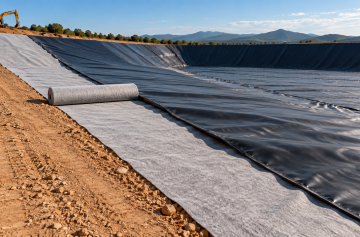
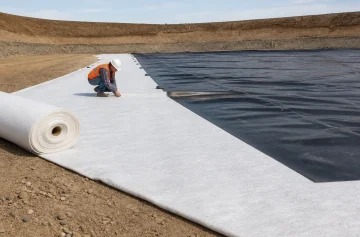
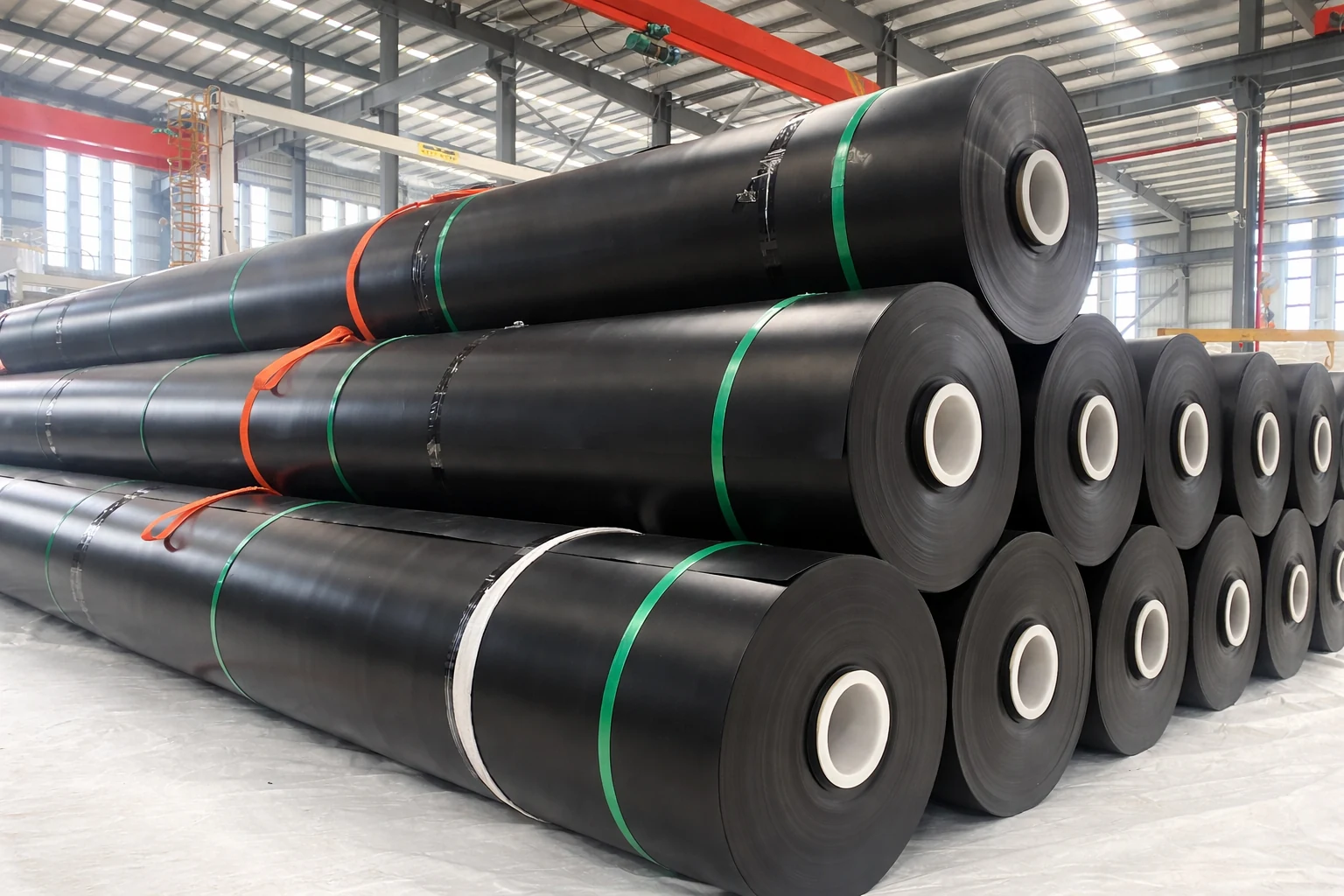
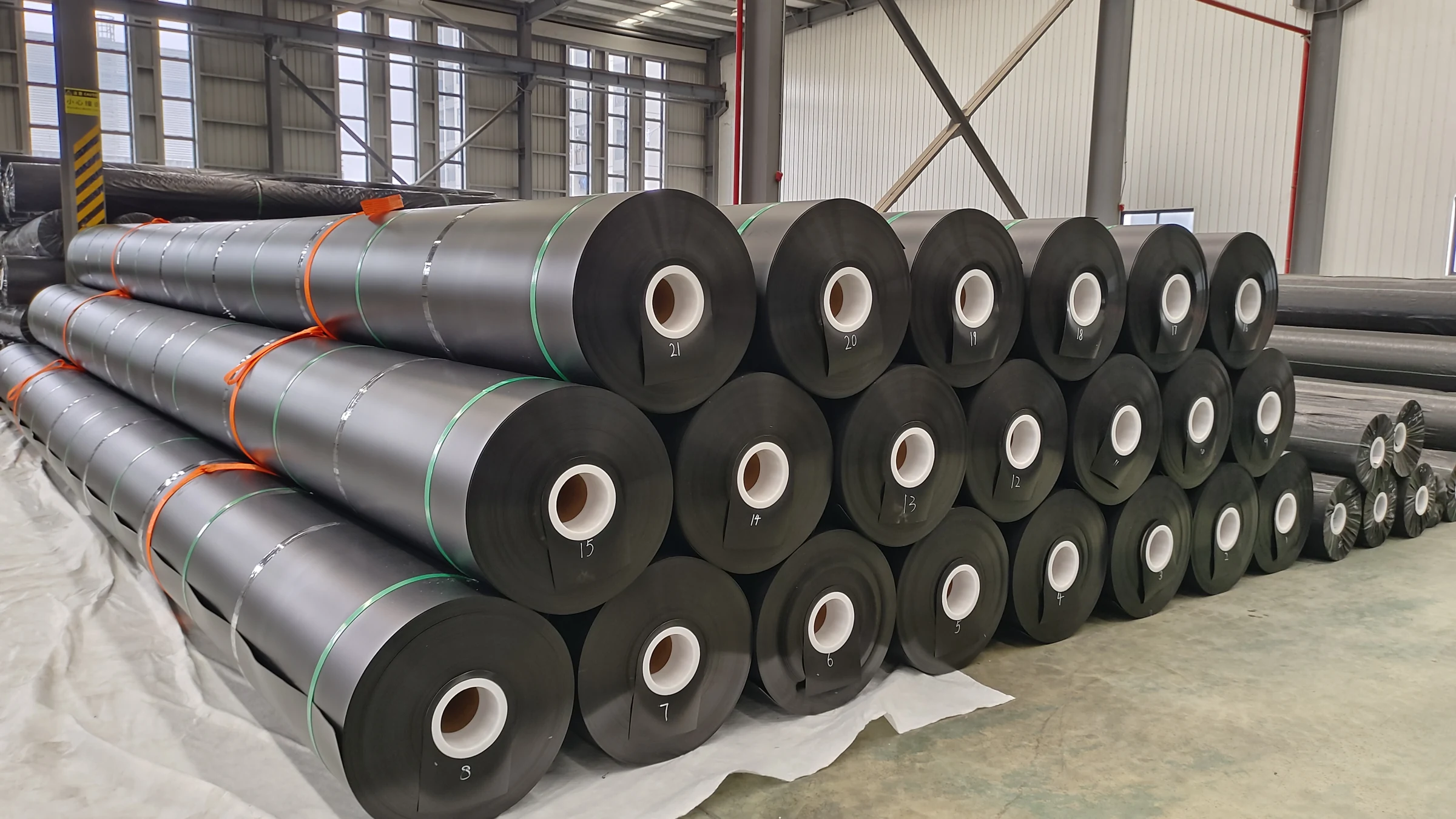
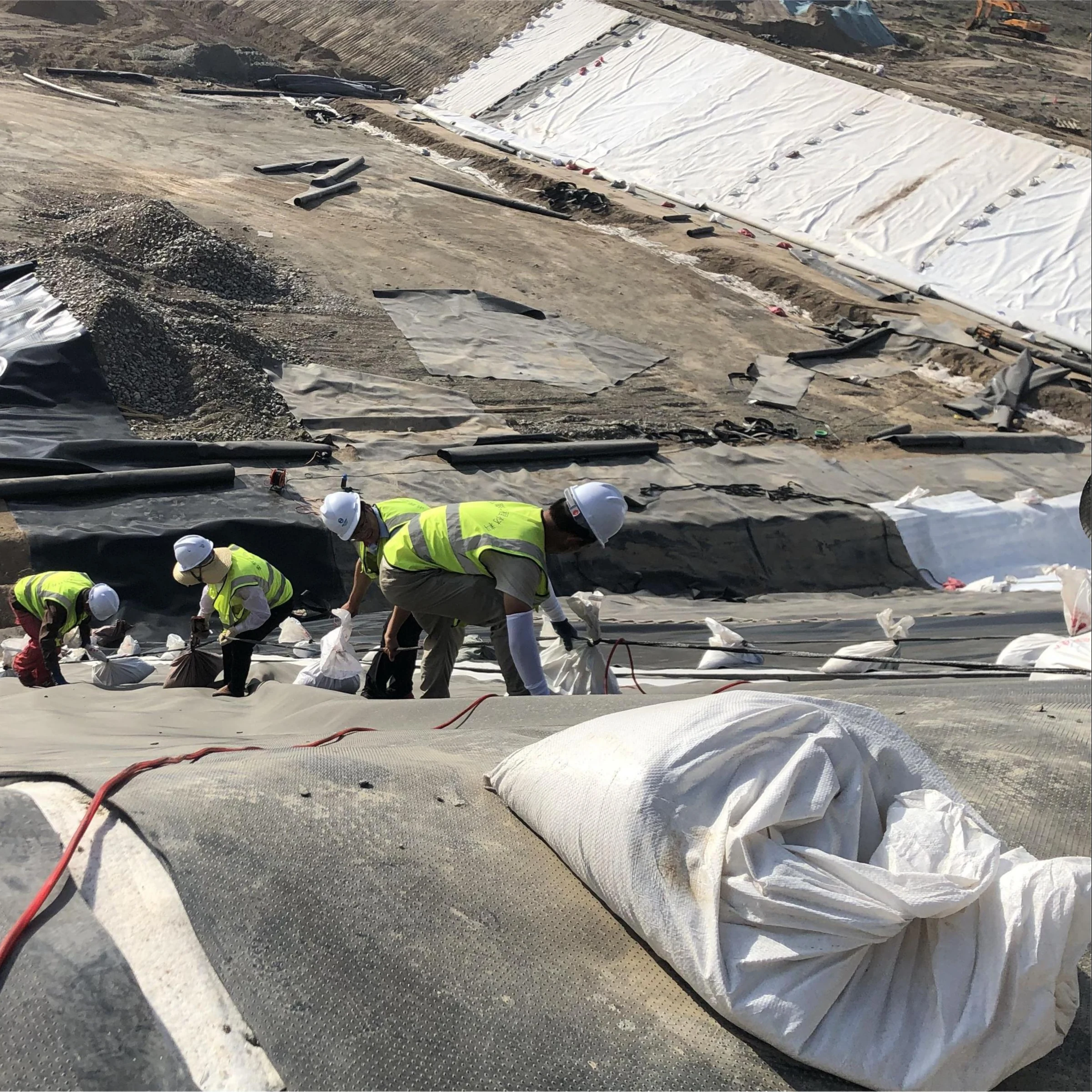
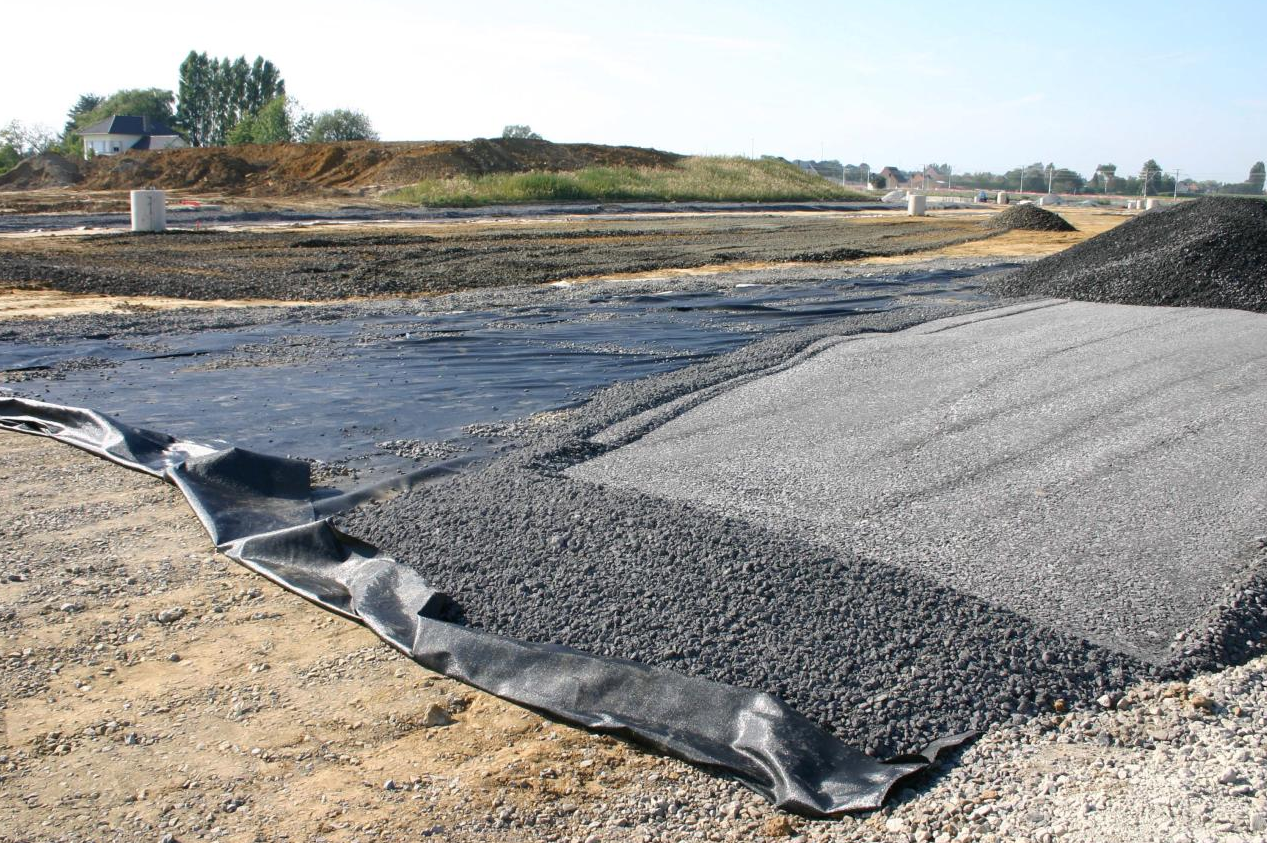
The finished black fabric is packaged into large cylindrical rolls, with standard widths of 12.5 feet, 15 feet, or 17.5 feet. Each roll is 300 to 450 feet long when unrolled and weighs anywhere from 200 to 500 pounds. Workers cannot move them by hand alone, so sites use heavy forklifts fitted with long metal carpet poles inserted through the core. Crews then slowly roll out hundreds of pounds of fabric across rough, uneven ground.
When placing the fabric, adjacent sheets must overlap, and the overlap width depends on how soft or firm the ground beneath is.
- On firm subgrade with a CBR value above 3, an overlap of 12 to 18 inches is usually sufficient.
- On ordinary soft ground with CBR values between 1 and 3, the overlap must be increased to 24 to 36 inches.
- In swampy mud with a CBR below 1, the seams must be factory-stitched using high-strength Kevlar yarn like that used in body armor.
- Workers use sewing machines to create double-lock stitch seams, placing 4 to 7 stitches per inch.
Once the fabric is in place, heavy bulldozers spread coarse crushed stone over the surface. The stone layer must be at least 8 inches thick, and individual stone size cannot exceed 1.5 to 2 inches. The bulldozer blade must stay at least 6 inches above the fabric, and loaded truck wheels are not allowed to turn on exposed fabric before stone cover is in place. A dual-drum roller then vibrates at 30 hertz to compact the stone layer until the soil reaches 95% of the required dry density.
Fabric buried deep in the ground must undergo long-term creep testing for 10,000 hours, with hundreds of pounds of dead weight hung from it to measure gradual elongation over time. In polar winters at -40°C, the material hardens and becomes brittle, sometimes failing before full tensile load is even reached, with deformation capacity reduced by 30%. In summer desert conditions at 50°C, the fabric softens and its resistance to external forces drops significantly.
On steep slopes, fabric with insufficient friction against the soil can slide directly downhill. Testers place a 300 mm square steel box filled with coarse sand and gravel on the fabric surface. Vertical pressure from 20 kPa to 100 kPa is applied on top, then the box is pushed 50 mm horizontally to measure interface shear resistance. The resulting friction coefficient typically falls between 0.6 and 0.9. If it drops below that lower limit, large-scale slope failure can occur.
Non-woven Geotextile
Tons of plastic feedstock are poured into a giant steel tank 8 meters tall and heated. A high-temperature pump pressurizes the molten material to 15 MPa. In a heavy steel plate full of openings, each hole measures only 0.2 to 0.4 mm across. The hot polymer is forced through these openings, and a blast of cold air instantly solidifies it into extremely fine filaments.
A conveyor belt carries the tangled filaments beneath a large needle-punching machine. Special barbed steel needles drive up and down 800 to 1200 times per minute, dragging and interlocking thousands of fibers together. What begins as a loose web is turned into a dense, heavy felt-like fabric.
The finished product feels slightly rough to the touch. Testers cut it into samples and weigh it, with mass ranging from 100 to 800 grams per square meter. When its edge is measured with a high-precision caliper, the reading falls somewhere between 0.8 mm and 5.5 mm. Inside the fabric are countless irregular microscopic voids.
A hydraulic tester grips both ends and pulls in opposite directions. The dial shows tensile strengths ranging from 5 kN/m to 30 kN/m. Under load, the fabric stretches like chewing gum, elongating 50% to 120% before the weakest point finally lets out a faint tearing sound.
Those dense microscopic voids produce a completely different set of hydraulic properties:
- Permittivity typically remains between 1.0 and 2.5 sec⁻¹.
- Water flow reaches 100 to 200 gallons per square foot per minute.
- The winding internal flow paths keep the effective opening size around 0.15 mm.
- Fine silt is carried away with the water, while larger soil particles are retained.
In the lab, a solid flat-ended steel plunger 50 mm in diameter is driven hard against the test fabric. The material deflects deeply but still does not tear. The load gauge rises steadily until it passes 1500 to 4000 pounds. Its high elongation allows it to absorb blunt puncture forces without failing.
In the field, an excavator cuts a straight trench 3 feet wide and 5 feet deep through heavy clay. Workers unroll the thick fabric and press it tightly against the irregular trench walls. A perforated PVC pipe 6 inches in diameter is laid at the bottom. Dump trucks then place several tons of 1- to 3-inch stone over the pipe.
The sharp edges of the stone press hard into the fabric. Because the material can deform so extensively, it wraps around the stones without puncturing. Workers fold the excess 2 feet of fabric over the top of the stone layer. Water passes into the pipe and drains away, while the surrounding mud is kept completely out.
Some factory-made versions are calendered flat under hot rollers:
- Two metal rollers heated to 180°C compress the thick fiber web under pressure.
- The surface becomes smooth like cardboard, and thickness drops sharply to 0.5 mm.
- Flow rate slows significantly to 20 to 50 gallons per minute.
- Fine soil particles accumulate on the smooth surface and form an impermeable crust.
How to Choose
At 6 a.m. every morning, field technicians swing an 8 kg metal cone and drive it into undeveloped ground. The cone tip, sharpened to a 60-degree angle, penetrates 800 mm into the soil, and the machine screen returns a CBR value of only 0.8. A 32-ton truck loaded with crushed granite drives over the saturated surface and immediately leaves a rut 30 cm deep.
Ground this soft cannot support a 15-ton roller repeatedly reversing and compacting over it. In these cases, workers bring in heavy woven geotextile with tensile strength above 100 kN/m. Large dark rolls are spread over the weak ground to distribute the load from the 32-ton truck. Then a 45 cm-thick stone layer is dumped on top, trapping the fabric firmly between soft mud below and rock above.
The weight of the overlying stone pushes the fabric downward, while the heavy plastic grid yarns remain tightly tensioned. The fabric acts like a giant trampoline, supporting hundreds of tons of stone while keeping the mud below from mixing with the aggregate above. Elongation is held below 5%, and total settlement stays within the 50 mm limit shown on the drawings.
Where the ground is slightly firmer and the cone gives CBR readings between 1.5 and 3.0, contractors reduce the aggregate layer to 30 cm. Procurement teams bring in mid-grade woven geotextiles with tensile strengths from 50 kN/m to 80 kN/m. Overlap width between adjacent sheets can be reduced to 60 cm, and double-lock stitching is no longer required.
| Field Soil Strength | Actual Site Condition | Required Fabric Strength (kN/m) | Maximum Allowable Elongation | Best Fabric Choice |
|---|---|---|---|---|
| Below 1.0 | Deep mud that swallows your leg in one step | Above 100 | Below 5% | Ultra-strong woven geotextile |
| 1.0 to 3.0 | Wet, soft mud that sticks underfoot | 50 to 80 | Below 10% | Medium-strength woven geotextile |
| Above 3.0 | Dry, hard, rough stony ground | 20 to 40 | Below 15% | Low-cost woven geotextile |
| Not based on this value | Deep trench filled with sharp stone | 10 to 20 | Above 50% | Soft non-woven geotextile |
When masons build a 15-meter-high retaining wall, hundreds of tons of soil behind it constantly push outward. For every 60 cm of wall height added, a layer of very strong polyester fabric must be placed horizontally. Tensile measurements show that the bottom layer can be subjected to nearly 200 kN/m of outward force. With thousands of tons of soil pushing against it, the fabric survives the full 120-year design life by deforming almost not at all.
A 30-ton excavator cuts a 2-meter-deep V-shaped trench beside a highway. The trench bottom is lined with sharp 2-inch crushed granite, and an 8-inch perforated plastic drainpipe is buried deep in the voids. Heavy rollers pass back and forth along both sides, and the vibration drives the sharp-edged stone violently downward.
- A soft felt-like non-woven geotextile lines the full 2-meter trench.
- Lab reports show that its tensile strength is only 15 kN/m.
- The sharp stones press hard into the fabric, which stretches around their irregular edges.
- Because the fabric can elongate 80%, it absorbs the puncture force with ease.
If a stiff woven geotextile with tensile strength above 100 kN/m were used to wrap stone in such a trench, the drainage pipe would not last long. The rigid intersecting strands do not have enough flexibility to deform around large sharp stones, and the fabric can tear open into centimeter-long slits under concentrated pressure. Dirty water carrying mud then rushes through the holes, and in less than three months the 8-inch drainpipe can be completely clogged.
The tensile values written into procurement documents are there to resist the extreme forces imposed by heavy construction equipment. When building a temporary access road for heavy crawler cranes, 50-ton steel tracks can apply pressures above 200 kPa to the mud surface. Contractors typically require an extra-heavy woven geotextile with tensile strength above 150 kN/m for the base layer.
If a soft non-woven fabric rated at only 20 kN/m is placed on a route used by a heavy crane, the track torque from a single turning movement can tear it into strips almost instantly. At the base of municipal solid-waste landfills, a 2.0 mm thick black geomembrane is laid first. Beneath it sits a dense soft non-woven cushion weighing 600 g/m².
Each day, tens of thousands of tons of household waste pile up overhead, while sharp stones below threaten to puncture the upper geomembrane. The thick soft non-woven layer acts as a heavy-duty protection pad, using its strong puncture resistance to shield the highly vulnerable liner above. Project inspectors review 40-page test reports and compare every tensile number line by line.
Filtration Capabilities
Non-woven
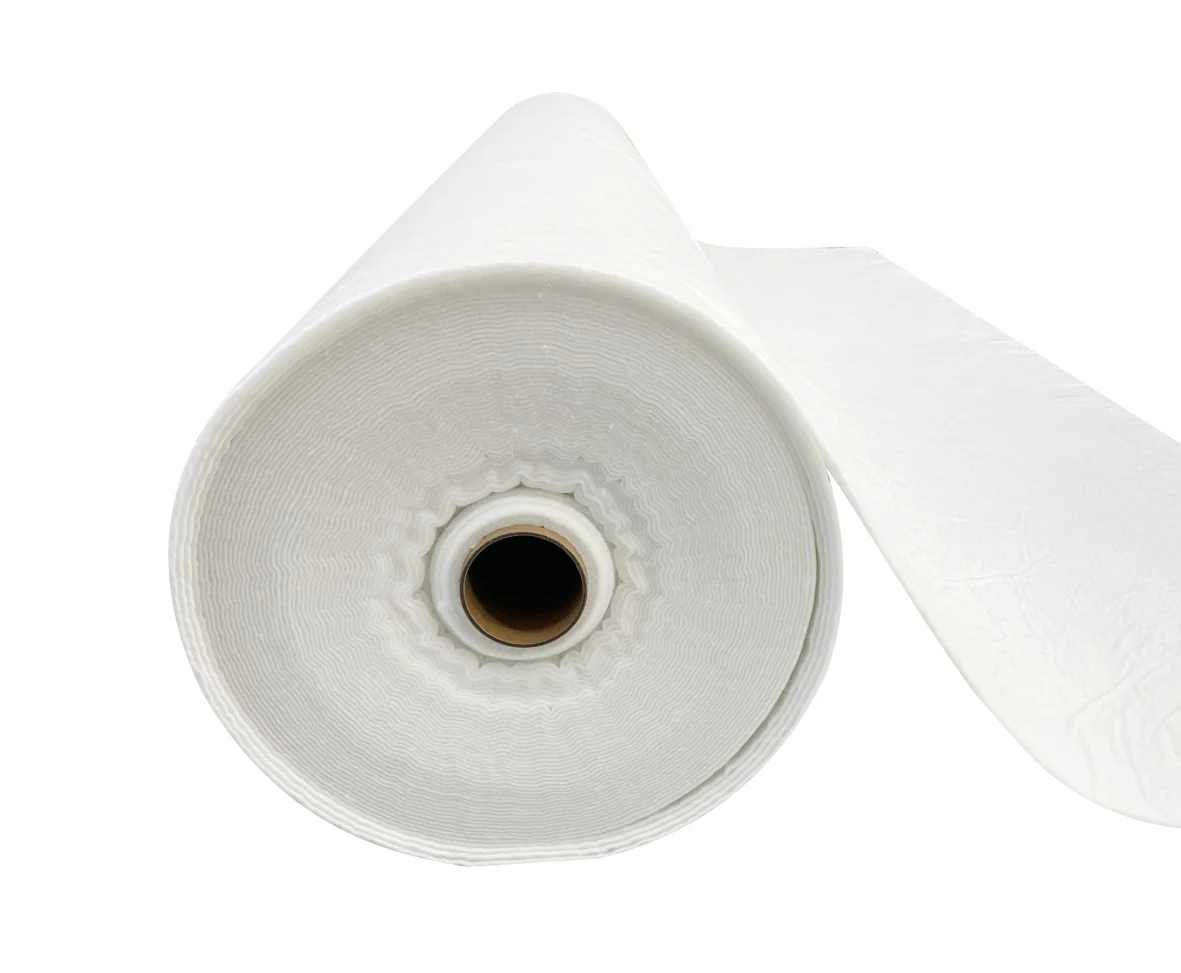
The machinery used in the factory works like a giant sewing machine, punching rapidly up and down through loose short fibers. At 800 to 1000 strokes per minute, the 2- to 4-inch fibers are tangled into a thick mat. The finished product comes off the line at a thickness of 60 to 150 mils and feels much like household felt.
In North America, this type of material is usually classified by ounces per square yard. ASTM D5261 requires technicians to cut ten circular samples, each 10 square inches in area, and weigh them. Common products on the market range from 3 oz to 16 oz.
A lighter 4 oz material has a puncture resistance of about 90 pounds. Even a 1.5-inch stone with a sharp edge can cut through it quite easily. An 8 oz product, by contrast, raises puncture resistance to 155 pounds. Even under 100 pounds of shear force from excavator tracks moving across sand-covered fabric, it still will not rupture.
Typical filtration pairings for different soils include:
- 3.5 oz – 150 gpm/ft² – matched with #70 sieve
- 4.0 oz – 135 gpm/ft² – retains 0.212 mm sandy soils
- 6.0 oz – 110 gpm/ft² – retains silt
- 8.0 oz – 90 gpm/ft² – matched with #80 sieve
- 12.0 oz – 65 gpm/ft² – retains 0.150 mm fine particles
For a backyard drainage trench, lightweight 3 to 4 oz material is usually enough. A standard trench is dug 12 inches wide and 18 to 24 inches deep. The fabric is laid at the bottom, leaving room for the pipe, and the two upper flaps must overlap by 12 to 18 inches.
If the overlap is too small, heavy rain can wash sediment through the seam. After just two storms with more than 2 inches of rainfall, 1 mm slurry entering through the gap can completely clog a 4-inch perforated drainpipe below.
The conditions behind a retaining wall are much harsher. When the wall exceeds 4 feet in height, the backfill places all its pressure on the fabric. In that setting, 6 to 8 oz heavy material is required. It is installed tightly against the concrete block wall to separate wet soil from 1-inch washed stone.
As water flows through this 8 oz fabric, velocity drops to 90 gallons per minute per square foot. Fine sand larger than 0.180 mm is trapped within the tortuous openings before it ever reaches the stone drainage layer.
In landfill lining systems, the issue is impact from very large stone. Here, 10 to 16 oz heavyweight material is used. It is placed above and below a 150 mil HDPE geomembrane to cushion the impact of 500-pound riprap dropped from above.
This thick protective layer has puncture and grab-tensile strength above 380 pounds. Sharp rock edges cannot pierce it, and the geomembrane below stays intact.
This material is highly vulnerable to sunlight. Before leaving the factory, samples must spend 500 hours in a xenon-arc weathering chamber, and the retained tensile strength must stay at 70% of the original value. Once unwrapped on site, it should not remain exposed to sunlight for more than 14 days.
After two weeks of exposure, ultraviolet radiation begins to break down the internal polymer structure. The originally strong fabric can then crumble into white powder under a light pull and may no longer withstand even 10 pounds of force.
Before installation, the ground surface must be graded smooth. Protruding rocks or large roots cannot vary more than 1.5 inches above the surrounding ground.
The fabric is supplied in rolls 12.5 or 15 feet wide and 360 feet long, with each roll weighing about 250 pounds. Workers unroll it using a loader and a steel pole. If it is dragged directly over rough ground, fine tears can appear on the surface.
On slopes, installation must proceed from the top downward. At the crest, a trench 6 inches deep and 6 inches wide must be excavated, the fabric edge buried into it, backfilled with crushed stone, and compacted with a roller.
On slopes as steep as 3:1, one 8-inch metal pin must be driven straight in every 3 feet. On flat ground, pins should be installed every 5 feet at overlapping seams.
Common seam types for joining multiple rolls include:
- J-seam – the edge is folded up 4 inches and stitched together
- Prayer seam – two flat overlaps sewn with double stitching
- Butterfly seam – used in soft ground prone to settlement
- Thread specification – 30-pound tensile polyester thread
Workers run industrial sewing machines along a line 2 inches in from the fabric edge. With 4 to 7 stitches per inch, the double-lock stitch method allows the seam to retain 90% of the original fabric strength.
Loaded 20-ton soil trucks must never be driven over exposed fabric that has not yet been covered. The friction from turning tires can damage the evenly distributed micropores and allow sediment to pass through.
At least 6 inches of soil or stone cover must be placed first. Track-type machinery must keep bearing pressure below 4 psi and turning radius above 30 feet. If a machine pivots in place on the surface, the underlying fabric can fail instantly.
Woven Geotextile
In the factory, plastic pellets are melted and drawn into flat plastic tapes. Looms weave these tapes together like a mat, crossing them in two directions. The finished product feels smooth and very strong.
The product known as slit-film allows very little water through. Under a magnifying glass, the gaps at the tape intersections are extremely small, and percent open area typically stays between 1% and 4%.
On a newly built driveway with weak muddy subgrade, a pickup truck can leave ruts 3 inches deep.
Once a 200-pound-class woven geotextile is laid down, the wheel load spreads outward in all directions, and the vehicle no longer sinks.
In grab tensile testing, laboratories clamp both ends of a 4-inch-wide strip and pull outward.
Minimum tensile standards for different product grades include:
- Basic 200X – 200 pounds in both machine and cross directions without failure
- Heavy-duty 315X – 315 pounds with elongation below 15%
- UV resistance – after 500 hours in xenon-arc exposure, at least 70% of tensile strength must remain
Three main types of woven material are available on the market:
- Slit-film woven – designed primarily for load support, with tensile strength starting at 200 pounds
- Monofilament woven – made from round plastic filaments, with percent open area above 10%
- Split-film woven – made by slitting and stretching plastic film, rarely used where water flow is important
When roads are built over muddy ground, dump trucks place an 8-inch layer of coarse crushed stone. Even when angular stone falls directly onto slit-film woven fabric, it does not puncture.
Rainwater seeps slowly through the very small openings in the fabric, at a rate of about 4 to 10 gallons per minute per square foot. But the fine soil suspended in that water can clog the openings within minutes.
This clogging effect is commonly called “blinding.” The fabric surface turns into a sealed crust, water can no longer pass through, and the soil below remains saturated.
On site, fabric rolls range from 12 to 24 feet in width. Overlap width between adjacent sheets depends entirely on how weak the subgrade is.
Overlap width is adjusted according to ground condition:
- Very poor bearing support – in mud with values below 1, overlap must be 3 feet
- Low bearing support – with values between 1 and 2, overlap can be reduced to 2 feet
- Sewn seams – if machine-sewn, overlap can be reduced to 6 inches
How to Read Product Specifications
When you receive a roll of geotextile, the data sheet is usually full of English abbreviations and dense numerical values. On North American job sites, contractors typically work down the chart and compare five core test results one by one. Those lab-certified numbers determine whether the material belongs under a highway or around a drainage pipe.
ASTM D4751 is essentially a sieve-style test. Technicians pour glass beads of varying sizes onto the fabric surface. The machine tray vibrates continuously for 20 minutes, and less than 5% of the critical bead size is allowed to pass through.
The diameter of that limiting bead size is then listed directly in the product data sheet as the opening-size value.
As sieve numbers go up, the actual openings in the fabric get smaller:
- #40 sieve – retains 0.425 mm particles, used for coarse sand
- #70 sieve – retains 0.212 mm particles, for typical silty soils
- #80 sieve – retains 0.180 mm particles, for very fine silt
- #100 sieve – retains 0.150 mm particles, for fine clay-sized material
Buyers often focus on Permittivity and flow rate. The value expressed in sec⁻¹ indicates how quickly water can pass through a thick fabric. A material rated at 1.5 sec⁻¹ can drain a 10-inch-deep puddle formed by a short, intense storm in just seconds.
The flow-rate value is even easier to understand. In the test, the fabric is mounted in a pipe apparatus under a constant 50 mm water head.
The instrument records how many gallons pass through each square foot in one minute. A value of 110 gpm/ft² on the data sheet means the fabric can easily feed a 4-inch subsurface drainage pipe in a residential yard.
In the tensile section, ASTM D4632 refers to the standard grab tensile test. A fabric strip 4 inches wide and 8 inches long is clamped at both ends. A hydraulic machine then pulls it apart at 12 inches per minute.
A product rated at 120 pounds is often used to wrap corrugated drainage pipe in yard systems. If the value jumps to 315 pounds, contractors place it beneath muddy roadbeds repeatedly crossed by heavy trucks. In woven materials made from flat plastic tapes, machine-direction and cross-direction tensile values are usually identical.
Because construction sites are full of angular stone, CBR puncture strength under ASTM D6241 is especially important. A flat-ended steel plunger 50 mm in diameter is driven vertically into the fabric.
The plunger advances at 2 inches per minute. The fluctuating pound readings on the screen simulate the concentrated pressure from excavator tracks pressing over sharp rock.
| Test Standard | Common North American Units | Residential Drainage Requirement | Heavy Highway Requirement |
|---|---|---|---|
| D4751 (Opening Size) | US Sieve / mm | #70 (0.212mm) | #40 (0.425mm) |
| D4491 (Flow Rate) | gpm/ft² | 110 – 150 | 4 – 10 |
| D4632 (Tensile Strength) | lbs | 90 – 120 | 250 – 315 |
| D6241 (Puncture Strength) | lbs | 250 – 350 | 700 – 1000 |
A 4 oz lightweight fabric may require 250 pounds of force to be punctured by the flat-ended plunger. A 16 oz heavy felt used beneath landfill liners can withstand more than 1000 pounds of blunt puncture. This is the number buyers rely on to make sure the fabric will not be pierced by hard roots or buried debris.
UV resistance is usually listed near the bottom of the data sheet. In hot, dry southern regions, inspectors pay close attention to the ASTM D4355 result. After 500 hours in a xenon-arc exposure chamber, the retained-strength percentage must still meet spec.
Cheap material showing only 50% retained strength should never be stored outdoors. If it is unrolled in a backyard and left in the sun for two weeks, a fabric originally rated at 200 pounds may no longer withstand even 80 pounds.
The plastic fibers become brittle and chalky. A small amount of pressure from the sole of a shoe is enough to open up a major tear.
Trapezoid tear testing under ASTM D4533 measures how a small cut will propagate. A rectangular specimen is notched, then clamped and pulled in the direction of the cut.
A light-grade fabric with a reading of only 40 pounds can rip apart quickly once the tear catches on a rusty nail or other sharp object. A heavier product rated at 120 pounds behaves very differently.
Even if workers pull it hard in windy conditions and a dry branch gouges a 2-inch slit near the edge, the tear stays localized instead of racing outward. On rough construction sites, the amount of wasted fabric from field damage is often determined by this one overlooked value.
Elongation tells you how far the fabric stretches before breaking. Heavy woven reinforcement materials usually keep elongation below 15%. When a 30-ton soil truck drives across a muddy road covered with crushed stone, this low-stretch plastic grid stays flat under extreme pressure and helps prevent deep wheel ruts.
Felt-like non-woven materials, by contrast, often show elongation values above 50% on the data sheet. When laid inside rocky drainage trenches, the highly deformable fabric sinks into the contours of the ground and fits tightly against the uneven subgrade.
Soil particles stay in place, and the filtration function continues quietly below the surface, right where the fabric is in direct contact with the earth.
Thickness under ASTM D5199 is reported in mils, where one mil equals one thousandth of an inch.
Testers use a thickness gauge with a 2 in² presser foot applying a light pressure of 0.29 psi. A lightweight 4 oz material typically reads about 60 mils.
A 16 oz heavy-duty product can reach 150 mils. At just over 2 mm thick, it forms an excellent impact-cushioning layer between a geomembrane and rough rock. When stones weighing hundreds of pounds are dropped onto it, the thick fiber structure quickly spreads the force outward.
Project Suitability
Woven Geotextile
At 400°F, polypropylene resin pellets are melted and extruded into flat film tapes 2 to 3 mm wide. Heavy looms tension these strands at 90 degrees to one another, packing 40 filaments into every square inch. The tightly woven grid deforms by less than 15% even under the wheel load of a 2500-pound pickup truck.
The standard field test for tensile performance is ASTM D4632 grab tensile testing. A 4-inch-wide sample is clamped at both ends and pulled apart. Basic retail-grade products break at about 150 pounds. Commercial-grade materials used beneath driveways and parking lots are typically held to fixed ratings of 200 pounds or 315 pounds.
Underground conditions are far more demanding than simple tension alone. Sharp aggregate presses downward, so the fabric relies heavily on puncture resistance to survive. Under ASTM D6241 CBR puncture testing, a flat-ended steel plunger is pressed into the sample. A 200-pound-class fabric can withstand 700 pounds of pressure. A 315-pound product pushes puncture resistance above 900 pounds and can endure repeated abrasion from crushed granite base rock.
Beyond aggregate pressure, the fabric may also be cut by tree roots or other buried debris. ASTM D4533 trapezoid tear testing measures whether that damage will continue spreading. A 200-pound fabric can resist 75 pounds of tearing force once a notch forms. The torque from a heavy crawler excavator pivoting in place is exactly the kind of load this value helps resist in the field.
| Industrial Grade | Grab Tensile (ASTM D4632) | Trapezoid Tear (ASTM D4533) | CBR Puncture (ASTM D6241) | AOS (ASTM D4751) |
|---|---|---|---|---|
| Light roadbase standard | 150 lbs | 60 lbs | 500 lbs | 40 US Sieve (0.425 mm) |
| Driveways and parking lots | 200 lbs | 75 lbs | 700 lbs | 40 US Sieve (0.425 mm) |
| Heavy arterial roads | 315 lbs | 120 lbs | 900 lbs | 40 US Sieve (0.425 mm) |
The tightly woven plastic grid can handle excavator loads, but it also blocks water almost too effectively. Looking at the ASTM D4491 permittivity report, a 200-pound-grade product may pass only 5 gallons per minute through 1 square foot. That is nowhere near enough to drain stormwater from a 2-inch-per-hour rainfall event. Within weeks, fine sediment fills the warp-and-weft openings, and the fabric effectively becomes an impermeable plastic barrier.
Poor permeability does not stop it from performing extremely well over weak mud. In saturated ground with a CBR below 3, truck tires can easily sink. A 200-pound woven fabric spreads concentrated wheel pressure outward by 40%. Once covered with 6 inches of #57 graded stone, the angular aggregate locks into the grid openings and creates a mechanical interlock effect, preventing the stone base from spreading laterally.
Before the aggregate is placed, however, the polymer must first pass UV aging requirements. After 500 hours in a laboratory xenon-arc chamber, a qualifying product must still retain 70% of its nominal tensile strength. Field specifications usually require full stone cover within 14 days of installation. If left exposed too long in direct sun, the polymer fibers become brittle and break.
As long as installation is completed before UV damage sets in, the required overlap between adjacent sheets depends entirely on subgrade strength.
- For roadbeds with CBR values between 1 and 2, overlaps of 30 to 36 inches are typically required.
- For deep mud with CBR below 1, overlap should exceed 36 inches, with steel U-pins driven in every 3 feet.
- Once CBR exceeds 3 on firm subgrade, an overlap of 12 to 18 inches is usually enough to transfer load safely.
On large open parking lots wider than 15 feet, multiple 12.5-foot rolls must be joined together. Manufacturers usually print bold alignment lines every 12 inches along the fabric edge. Workers use these marks to place overlaps accurately, so the seam does not pull apart even under the impact of the first 20-ton load of stone. At curves, the inside sheet is cut into fan-shaped sections and overlapped flat, with no raised wrinkles allowed.
Curves on level ground are manageable, but slopes steeper than 15% present a sliding hazard. Polypropylene has a very smooth surface, and its friction angle against soil is often below 25 degrees. If several tons of stone are dumped from the crest, the aggregate can slide down the slick surface in a construction-site avalanche.
Where both slope stability and drainage are required, contractors switch to monofilament woven fabric, even though it costs roughly three times more. The round strands replace flat tapes, leaving stable millimeter-scale openings at the intersections. Flow rate increases severalfold to 40 gallons per minute per square foot, while the apparent opening size remains at the 70 US Sieve level needed to retain soil.
Non-woven Geotextile
Barbed steel needles drive up and down a thousand times per minute, tangling short polypropylene staple fibers into a thick mass. The finished material has no visible warp-and-weft grid and feels dense and wool-like. Inside, it contains a chaotic three-dimensional network of tiny pores.
In the industry, this material is classified by ounces per square yard. Light 3.5 oz and 4 oz products are commonly used in backyard drainage trenches. Heavy 10 oz to 16 oz felt is used beneath coastal revetments and large retaining walls.
Under ASTM D4491 permeability testing, a 4 oz product can pass 135 gallons per minute through 1 square foot, while an 8 oz material drops to 90 gallons. Even during extreme rainfall of 4 inches per hour, groundwater can still drain away quickly.
At the same time, sediment is held back. AOS testing under ASTM D4751 shows that a 4 oz material has an opening size of 70 US Sieve, retaining particles down to 0.212 mm. An 8 oz material tightens that opening to 100 US Sieve, where even fine silt at 0.150 mm cannot pass.
| Common Industrial Grade | Grab Tensile (ASTM D4632) | CBR Puncture (ASTM D6241) | Flow Rate (ASTM D4491) | Retention Opening Size (ASTM D4751) |
|---|---|---|---|---|
| 4 oz class | 100 lbs | 250 lbs | 135 gpm/ft² | 70 US Sieve (0.212 mm) |
| 8 oz class | 205 lbs | 500 lbs | 90 gpm/ft² | 100 US Sieve (0.150 mm) |
| 12 oz class | 300 lbs | 800 lbs | 50 gpm/ft² | 100 US Sieve (0.150 mm) |
This soft structure is inherently weak in reinforcement applications. Under ASTM D4632 testing, a 4 oz sample may break at just 100 pounds. Before failure, the fabric can stretch to 50% beyond its original length, deforming heavily like a spring.
Placed under several tons of aggregate on weak ground with a California Bearing Ratio of only 2, it quickly compresses, deforms, and may even tear under repeated truck traffic. It cannot provide the rigid base support that crushed stone needs.
In a trench 24 inches deep and 12 inches wide, workers line the bottom and sides with 4 oz felt. A 4-inch perforated PVC pipe is placed inside, surrounded by #57 washed stone ranging from 3/4 inch to 1.5 inches. The excess fabric is then folded back over the top like closing a dumpling.
The two top flaps should overlap by 12 to 18 inches so that soil backfill cannot drop into the stone layer. Groundwater carrying suspended soil passes through the fabric, sediment is trapped on the outer face, and clean water flows into the pipe and drains away along the 1% slope.
Behind retaining walls, groundwater buildup is common. A 12-inch-wide gravel drainage zone is placed behind the wall, and a 6 oz felt fabric is installed between the gravel and the native soil. Water pressure passes through the fabric into the stone, relieving the wall of hydrostatic loading.
For riprap slope protection, a 4 oz fabric is far too light. If a truck drops individual rocks weighing 500 pounds onto the slope, the separator layer beneath must be upgraded to at least 10 oz to 12 oz heavy-duty felt.
A 12 oz fabric can achieve a CBR puncture value of 800 pounds. Its thick fiber mass acts as a large shock-absorbing pad, dissipating the impact of 500-pound stone. As waves surge through the rock voids and recede again, the soil beneath remains fully protected.
Ultraviolet light is the greatest weakness of this material. Under ASTM D4355 xenon-arc exposure for 500 hours, the fine surface fibers begin breaking down and turning to powder very quickly. Once the material is unwrapped and laid out, it must be covered with at least 6 inches of soil or stone within 14 days.
Buried underground, it is at its safest. Soil conditions ranging from pH 2 to pH 13 do not damage its polymer structure. Even if the underground temperature swings from -40°F to 170°F, a buried sample excavated after 50 years and washed clean can still show essentially no loss in tensile or hydraulic performance.
When joining wide 15-foot rolls in the field:
- Use a hot-air gun to heat both sheet edges until the surface begins to smoke and soften.
- While still hot, press the two fiber surfaces firmly together.
- The seam can then achieve 80% of the original material’s tearing strength.
- Even under constant groundwater flow, the heat-welded seam will not pull apart.