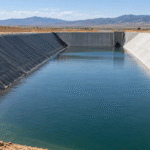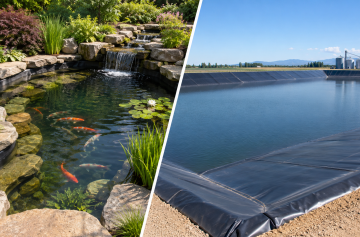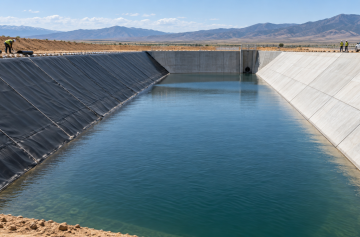

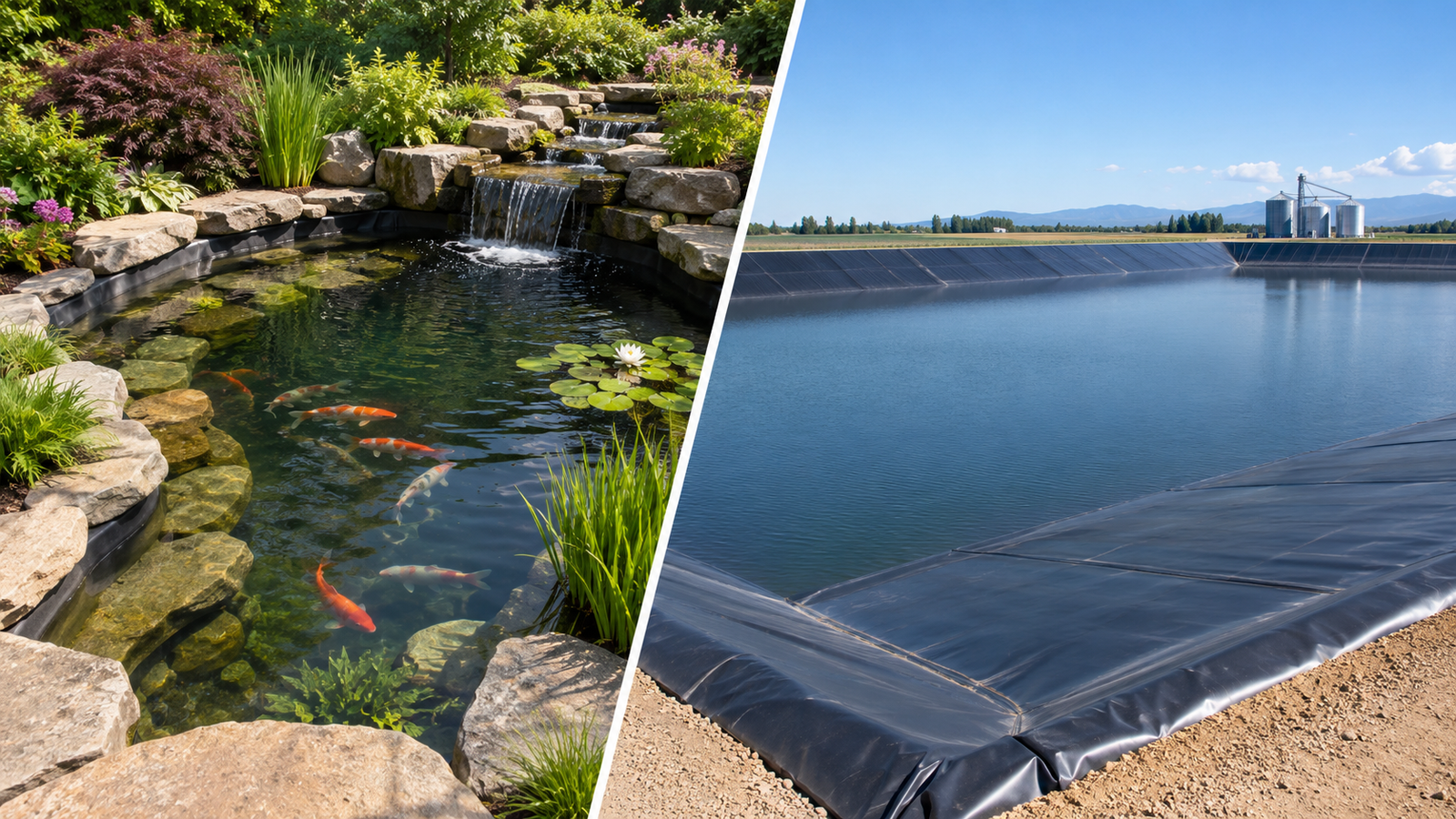
A 300-square-foot backyard pond has little in common with a 40,000-square-foot irrigation reservoir. The shape, depth, subgrade, water chemistry, seam layout and installation method can all change which liner makes more sense.
EPDM geomembranes commonly come in 45 mil and 60 mil thicknesses. Current GRI-GM13 specifications cover smooth and textured HDPE from 30 to 120 mil, while GRI-GM21 covers 45- and 60-mil EPDM geomembranes.[1][2]
| Decision Point | HDPE | EPDM |
|---|---|---|
| Small DIY pond | More difficult to seam and detail | Usually easier |
| Irregular curves and shelves | Requires more panel planning | Highly flexible |
| Large reservoir | Well suited | Possible, but material and handling costs rise |
| Typical field joining | Thermal welding | Approved tape or adhesive seam system |
| Large-scale material economics | Often favorable | Generally higher material cost |
| Chemical containment | Widely used, but compatibility must be verified | Compatibility must be verified |
| Steep engineered slopes | Textured grades available | Project-specific |
| Waterfalls and complex decorative features | More difficult to detail | Usually easier |
HDPE and EPDM Behave Very Differently During Installation
HDPE is a fairly stiff thermoplastic geomembrane. EPDM is a soft, flexible rubber membrane. You notice that difference as soon as the liner goes into the pond.
Take a koi pond with curved walls, shelves, a bottom drain, a skimmer and a narrow waterfall. EPDM can bend and fold around these details without turning every change in shape into a separate fabrication problem.
Now picture a 150 ft × 300 ft irrigation reservoir with long slopes and a wide, open bottom. Here, flexibility matters less. Roll width, seam length, welding speed, subgrade condition and installed cost matter much more.
On projects like this, an HDPE geomembrane liner can be laid in large panels and joined by thermal welding. The finished seams can also be tested during field quality control.
HDPE vs. EPDM Cost: Material Price Is Only Part of the Budget
EPDM usually costs more per square foot as raw membrane. HDPE often becomes more economical as the lined area gets larger. But that does not mean HDPE will always be cheaper on a small pond.
HDPE installation may require welding equipment, trained installers, mobilization and seam testing. Those costs matter much more on a small job.
Here is a simple example using $0.50/ft² for HDPE and $1.10/ft² for EPDM. These are only example figures to show how project size changes the calculation. They are not current market prices or quotations.
| Liner Area | HDPE Example at $0.50/ft² | EPDM Example at $1.10/ft² |
|---|---|---|
| 1,000 ft² | $500 | $1,100 |
| 10,000 ft² | $5,000 | $11,000 |
| 1 acre / 43,560 ft² | $21,780 | $47,916 |
Those numbers cover membrane only. A real liner budget may also include:
- extra membrane for slopes and anchor trenches;
- panel layout and unavoidable waste;
- geotextile cushioning or protection layers;
- earthwork and subgrade preparation;
- field seams;
- pipe penetrations and boots;
- anchor trenches;
- freight and unloading;
- installation labor;
- seam inspection and testing;
- protective cover where required.
This is why EPDM can still make sense for a small backyard pond even at a higher membrane price. One flexible sheet may cover most of the pond and avoid a lot of field-seaming work.
On a large reservoir, that advantage becomes less important. Thousands of square feet of membrane are involved, and long HDPE seams can be welded in a planned sequence.
Calculate the Real Liner Area Before Comparing Prices
Do not price a pond from surface length × width alone. That only gives the water footprint. The liner also has to travel down the sides and leave enough material around the perimeter.
For example, take a pond that is 15 ft × 20 ft and 3 ft deep. Allow another 2 ft of membrane at each outer edge:
Required liner length = 20 + (2 × 3) + 4 = 30 ft
Required liner width = 15 + (2 × 3) + 4 = 25 ft
So the approximate sheet area becomes:
30 × 25 = 750 ft²
The water surface is only 300 ft². The actual sheet in this example is about 2.5 times that area.
For a simple rectangular pond, an early estimate can use:
Liner length = pond length + twice the maximum depth + edge allowance
Liner width = pond width + twice the maximum depth + edge allowance
Irregular ponds need more material around folds, transitions, anchor points and awkward geometry. On commercial jobs, calculate this from the finished basin dimensions and panel layout instead of adding one fixed waste percentage to every project.
Need to calculate how much liner the pond actually requires?
Send the pond length, width, maximum depth and approximate side slopes. These dimensions can be used to estimate membrane area before thickness, roll size and freight are considered.
EPDM Is Easier to Place on Small Ponds; HDPE Is Easier to Systemize at Scale
A typical EPDM installation starts with preparing the excavation, removing sharp debris and adding any required cushioning layer. The membrane is then unfolded, fitted around drains and other penetrations, and secured at the edges.
Because the material is flexible, it is much easier to work around shelves, curves and rounded corners.
That does not mean a large EPDM sheet is light. Once the liner reaches several thousand square feet, moving it into position can take several people or lifting equipment.
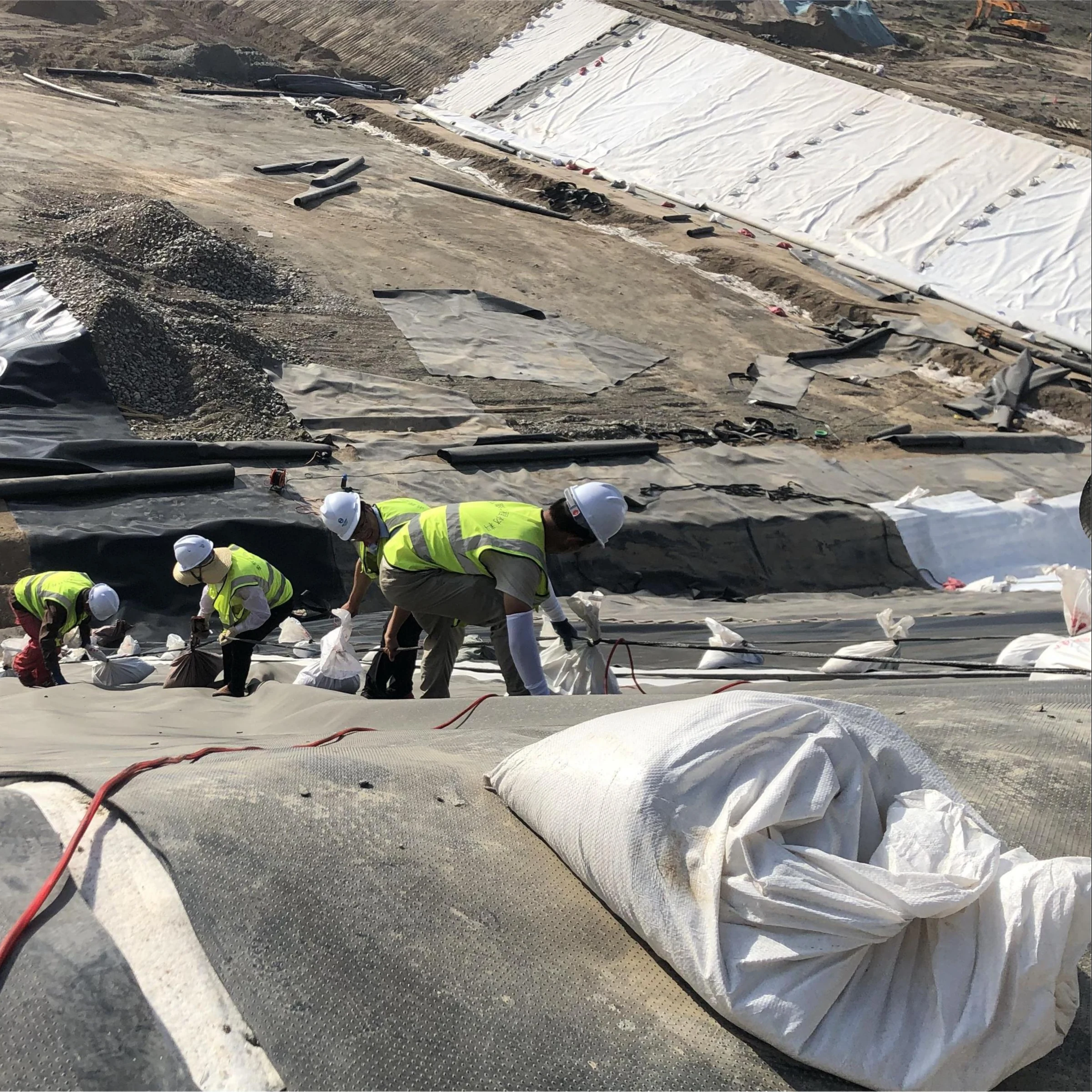
HDPE is installed differently. Large panels are placed according to a layout plan and welded together in the field.
Long production seams are commonly joined with dual-track hot-wedge welding. Extrusion welding is normally used for patches, penetrations and tight details where a wedge welder cannot work properly.
A dual-track weld leaves a small air channel between the two welds. That channel can be pressure tested, making it possible to check long field seams before the pond goes into service.
The U.S. EPA has identified temperature, moisture, supporting surface conditions, dirt, preparation and installer skill as factors that can affect field-seam performance.[3]
HDPE also moves as temperature changes. NRCS Code 521 states that HDPE and LLDPE liners should normally be allowed at least 24 hours before the anchor trench is backfilled, unless the manufacturer recommends otherwise, so the membrane can go through thermal expansion and contraction.[4]
Thickness Changes Mechanical Performance
For smooth HDPE, GRI-GM13 shows a clear increase in minimum mechanical values as thickness goes up:
| HDPE Thickness | Approx. Metric Thickness | Tear Resistance | Puncture Resistance |
|---|---|---|---|
| 30 mil | 0.75 mm | 21 lb | 54 lb |
| 40 mil | 1.0 mm | 28 lb | 72 lb |
| 60 mil | 1.5 mm | 42 lb | 108 lb |
| 80 mil | 2.0 mm | 56 lb | 144 lb |
| 100 mil | 2.5 mm | 70 lb | 180 lb |
These are laboratory test values. A 108-lb puncture result does not mean a 60-mil liner can safely sit on any rock applying less than 108 lb. A sharp point and a broad contact area behave very differently in the field. Support conditions and protection layers matter too.[5]
GRI-GM21 includes EPDM at 45 mil, about 1.14 mm, and 60 mil, about 1.52 mm.[6]
NRCS Code 521 gives another useful reference for certain agricultural impoundments. Its material table lists minimum HDPE thicknesses of 30 mil for clear water and 60 mil for wastewater. EPDM is listed at 45 mil for both.[7]
Those numbers are national NRCS minimums for specific conservation practices. They are not universal pond-liner rules. NRCS also notes that national Conservation Practice Standards should not be used by themselves to design or install a project. Local requirements and the actual project specification still control the final design.[8]
Jinseed’s HDPE liner range includes common engineered thicknesses from 1.0 to 3.0 mm. So the real question is not simply HDPE or EPDM. It is which material and thickness fit the ground, load, liquid and exposure conditions.
Subgrade Protection Can Matter as Much as Liner Thickness
A thicker liner will not fix a badly prepared base.
NRCS Code 521 requires the subgrade to be free from sharp angular stones and other objects that could damage the membrane. If angular particles still create a puncture risk, the guidance calls for a cushion layer. One option is a nonwoven geotextile weighing at least 10 oz/yd². Another is at least 6 inches of suitable soil meeting the stated particle requirements.[9]
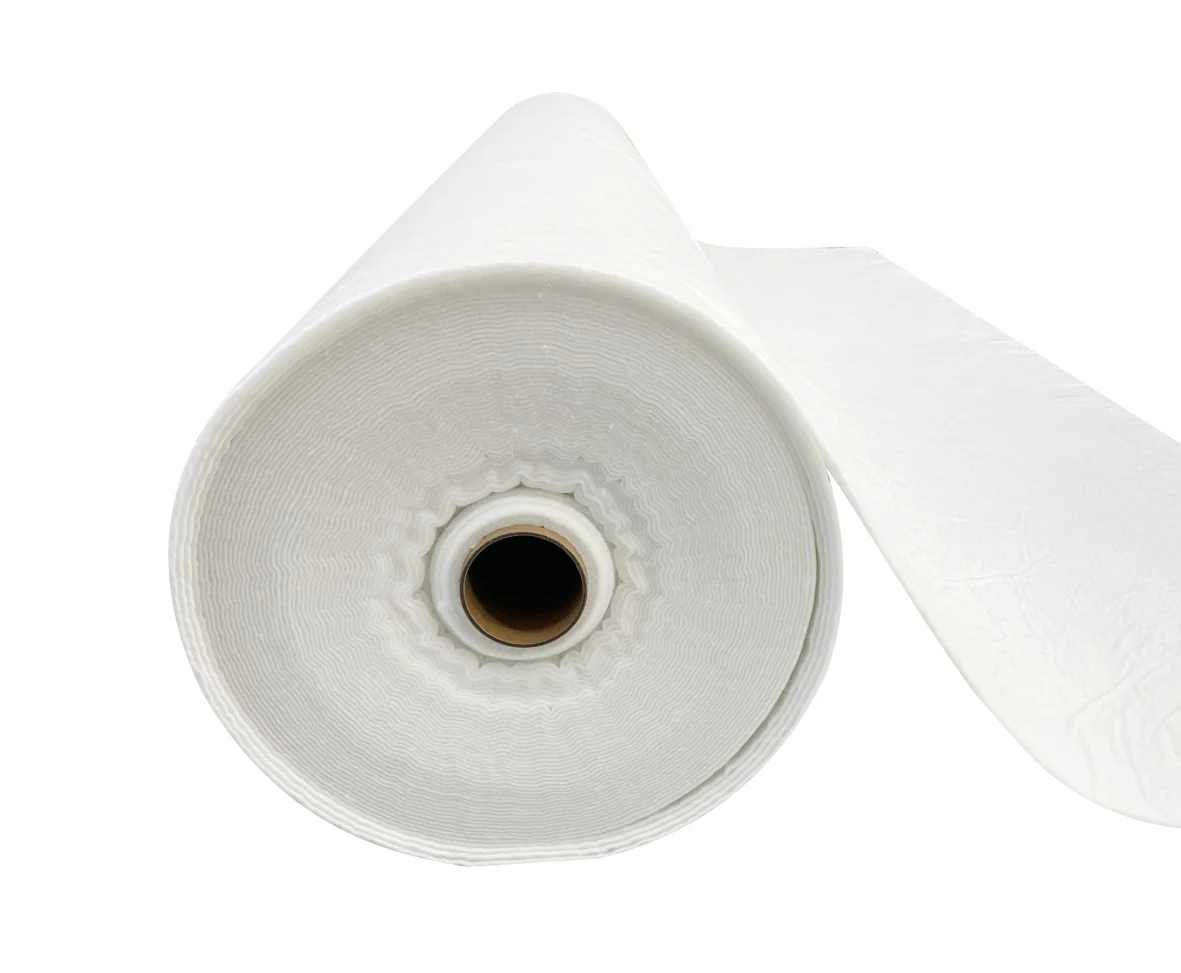
A nonwoven geotextile is often placed below the geomembrane when the prepared ground still has a meaningful puncture risk. The required weight depends on the actual site and loading.
Think beyond installation day as well. Pumps, stones, maintenance tools, equipment access and animal traffic can all create concentrated loads later.
Have the pond dimensions but not the membrane specification?
Provide the stored liquid, required service conditions, subgrade, slope and expected liner exposure. These details are needed to compare HDPE thickness, smooth or textured surface, and geotextile protection.
Durability Depends on Exposure, Formulation and Installation
There is no useful rule saying every HDPE liner lasts a fixed number of years and every EPDM liner lasts another fixed number.
Real service life depends on the formulation, antioxidant package, UV exposure, temperature, oxygen, chemicals, thickness, mechanical stress, seam quality and whether the liner stays exposed or is protected.
Research from the Geosynthetic Institute separates exposed and covered geomembranes because they age under very different conditions. The resin formulation and additive package matter as well.[10]
For qualifying HDPE geomembranes, GRI-GM13 specifies 2.0–3.0% carbon black and includes requirements for oxidative induction time, stress-crack resistance and UV performance.[11]
GRI-GM21 also includes durability and UV-related requirements for EPDM geomembranes.[12]
So a lifespan claim only means something when you know the exposure conditions. A black liner sitting on a hot, exposed embankment is working in a very different environment from one that stays underwater or beneath a protective layer.
For commercial orders, nominal thickness is not enough. Reviewing production testing and quality documentation helps confirm that the delivered material actually matches the requested specification.
Chemical Compatibility Must Be Checked for Both Liners
HDPE is widely used in wastewater and industrial containment, but the word “HDPE” does not prove that every formulation will work with every liquid.
U.S. EPA membrane-liner guidance looks at how chemicals can change the physical properties of a geomembrane. EPA Method 9090A is specifically designed to evaluate how chemicals from surface impoundments, waste piles and landfills affect flexible membrane liner materials.[13]
Concentration, temperature, exposure time and the full chemical mixture all matter.
The same applies to EPDM. If the pond contains anything more demanding than normal freshwater, check the exact membrane formulation against the actual liquid. A broad claim such as “chemical resistant” is not enough.
Fish Ponds: Residential Koi and Commercial Aquaculture Need Different Solutions
A residential koi pond may have shelves, drains, a skimmer, stone edges and a waterfall. Pond-grade EPDM often works well here because one flexible sheet can follow most of that geometry.
A commercial fish or shrimp pond is a different job. These ponds may cover thousands or tens of thousands of square feet and usually use larger, simpler shapes.
For that kind of site, large polyethylene panels and welded seams can make HDPE a practical option. The smooth surface is also easier to clean between production cycles. Jinseed’s aquaculture liner applications are aimed at this larger production environment rather than decorative backyard ponds.
Still, do not assume that every HDPE or EPDM sheet is automatically suitable for fish contact. The exact formulation and project requirements should be checked. NRCS guidance also tells users to consult manufacturers when selecting geomembranes for aquatic production applications.[14]
Large Farm Ponds and Irrigation Reservoirs Often Favor HDPE
Farm ponds and irrigation reservoirs usually have long slopes, wide bottoms and far fewer decorative details than a backyard pond.
One acre of lined area equals:
1 acre = 43,560 ft² = approximately 4,047 m².
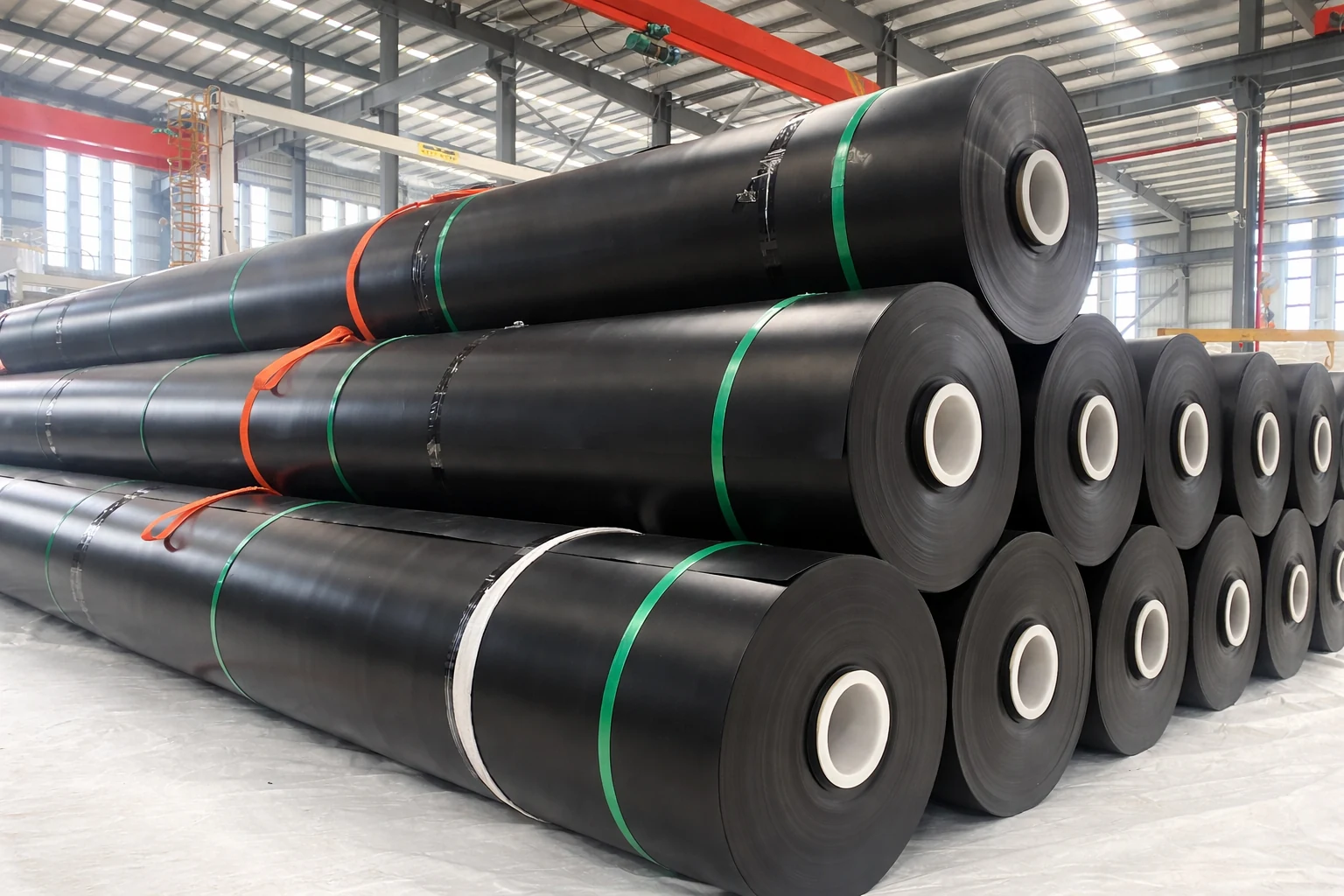
Using an HDPE density of about 0.94 g/cm³, a 1.0 mm membrane weighs roughly 0.94 kg/m². Across one acre, that is about 3.8 metric tons of HDPE before overlaps and waste.
At 1.5 mm, the same area is close to 5.7 metric tons.
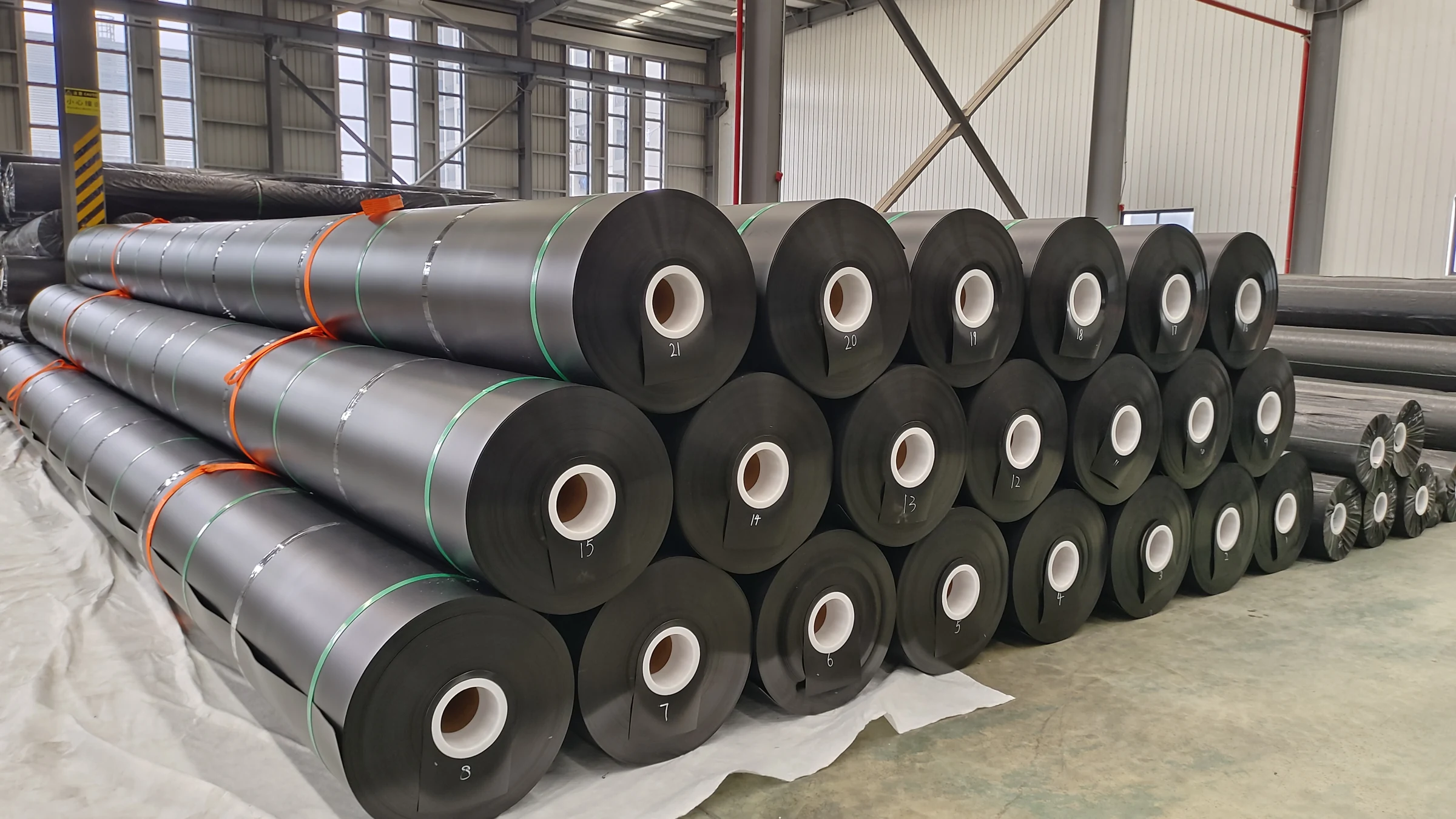
At this size, roll dimensions start to affect both labor and cost. Wider rolls mean fewer long seams, so there is less welding and fewer field joints to inspect.
That also means two HDPE quotations with the same price per square meter may not be equal. Roll width, roll length, specification and freight can change the real installed cost.
Reservoirs and canals may also need drainage, anchoring, slope design and protection layers. These are part of broader hydraulic engineering liner applications, not just the membrane purchase.
Steep Slopes May Need Textured HDPE
Smooth HDPE is widely used on pond floors and suitable slopes. On steeper slopes, though, the interface between the liner and soil, geotextile or cover material can become a stability issue.
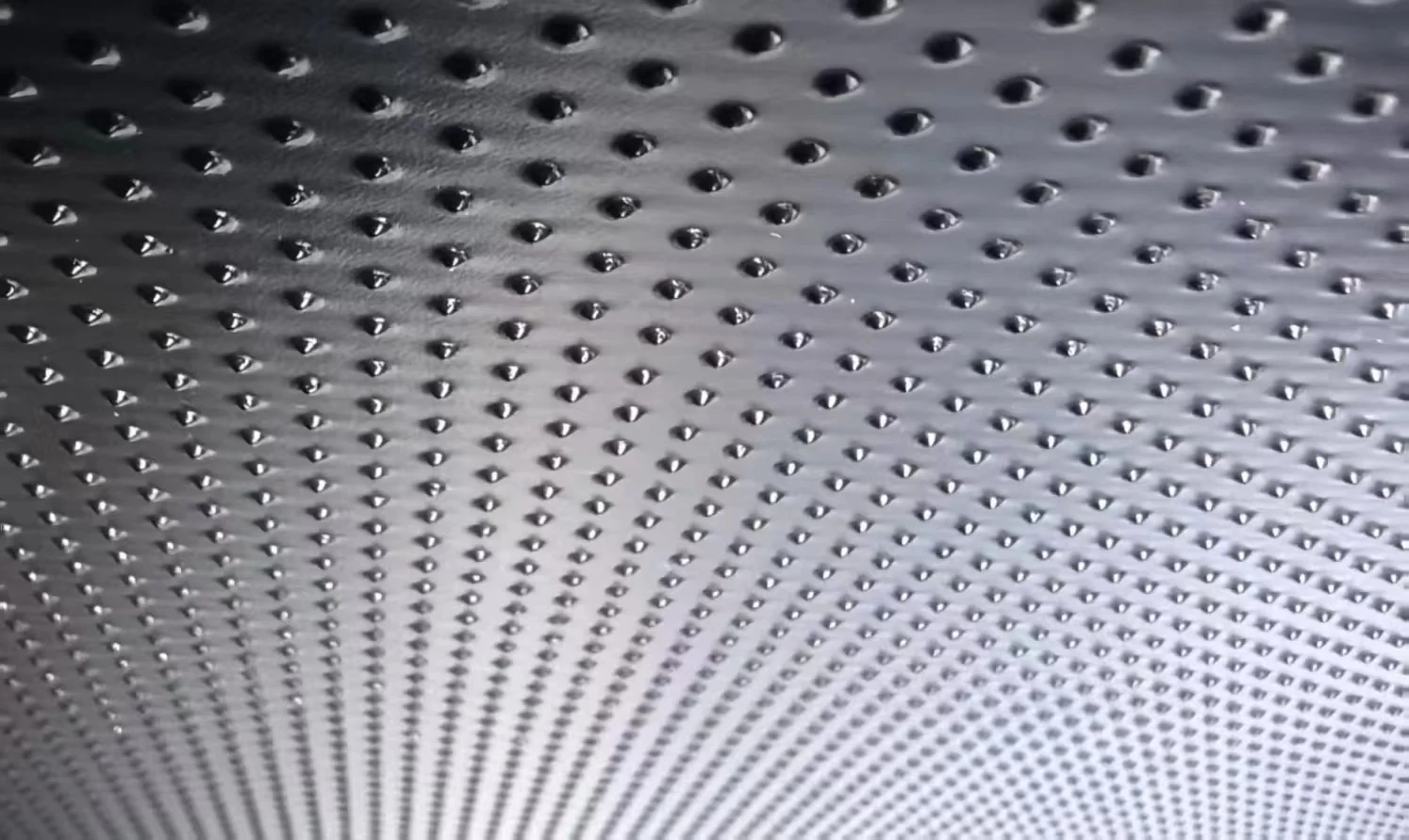
A textured HDPE liner has a rougher surface than smooth HDPE and can provide more interface friction.
Do not choose textured liner simply because the pond has a slope. The actual interface should be checked using the soil or geosynthetic in contact with the liner, the slope angle, loading and stability requirements.
For this reason, one reservoir may use different liner configurations on its floor and embankments.
Groundwater Can Create Uplift Beneath the Liner
Water escaping from the pond is not the only pressure a liner has to deal with.
If groundwater rises beneath an empty or partly empty reservoir, hydrostatic pressure can push the membrane upward. Trapped gas can do something similar in smaller areas.
Under NRCS Code 521, an appropriate drainage system is required when the pond invert is within 2 feet of the seasonal high water table. The same standard includes venting provisions where gas could build up below the liner.[15]
Sites with shallow groundwater, organic soils, old wastewater seepage or possible gas generation need this issue checked before the membrane is installed.
Repairs Are Different for HDPE and EPDM
EPDM repairs commonly use compatible cleaners, primers, tapes or patches specified by the membrane manufacturer.
HDPE is normally repaired by welding.
A damaged area can be covered with an HDPE patch and extrusion welded after the surface is properly prepared. Defective field seams can be repaired using the installation and quality-control procedure for the project.
That makes small EPDM repairs more approachable for many pond owners. HDPE repair is usually better left to someone with geomembrane welding equipment and experience.
Which Liner Fits Each Application?
| Application | Practical Starting Point | Main Reason |
|---|---|---|
| Small garden pond | EPDM | Flexible and easier to position |
| Koi pond with shelves | EPDM | Handles drains, curves and shelves more easily |
| Waterfall or narrow stream | EPDM | Conforms to irregular channels |
| Large farm pond | HDPE | Scalable panel installation and material efficiency |
| Irrigation reservoir | HDPE | Large panel runs and welded seams |
| Commercial aquaculture pond | HDPE or another suitable polyethylene system | Suitable for large repetitive pond geometry |
| Wastewater pond | Often HDPE, subject to compatibility testing | Widely used in engineered containment |
| Industrial process pond | Project-specific | Chemical compatibility controls the decision |
| Large steep-sided reservoir | Textured HDPE may be required | Higher interface friction may be needed |
Ready to price a reservoir, farm pond or aquaculture project?
Provide the application, dimensions, required thickness or specification, estimated quantity and delivery destination. Roll configuration, approximate shipment quantity and project pricing can then be compared on the same basis.
Before Ordering, Confirm Three Details
Finalize the quantity and panel layout. A rough pond-area calculation is fine for early budgeting. Large projects should be ordered from the final dimensions, slopes, anchor details and panel plan.
Finalize penetrations. Pipes, drains and concrete structures all create liner details. Moving a pipe after the membrane has been ordered can add extra seams and patch-style work that could have been avoided.
Define responsibility for field seams. For HDPE, confirm who handles trial welds, production welding, nondestructive testing and repairs. For EPDM, use the seam system specified for that membrane rather than choosing a generic tape or adhesive because it is cheaper.
Finally
Use EPDM for small, curved ponds where easy shaping matters most. Use HDPE for large reservoirs, farm ponds and engineered containment where welded seams and scale matter more. Before choosing, compare total installed cost, thickness, subgrade protection, chemical compatibility and seam quality.