

For residential French drains, a specification of 100-150g/㎡ is recommended for its permeability and anti-clogging properties; for driveway or foundation reinforcement requiring load-bearing capacity, it is advised to select 200-350g/㎡ for higher tensile strength.
Ensure you identify virgin PP/PET materials (national standards for elongation at break >40%) and request quality inspection reports from the supplier.
High-quality materials can have an underground lifespan exceeding 50 years. Do not use perishable recycled materials to save money, as this leads to exorbitant rework costs.
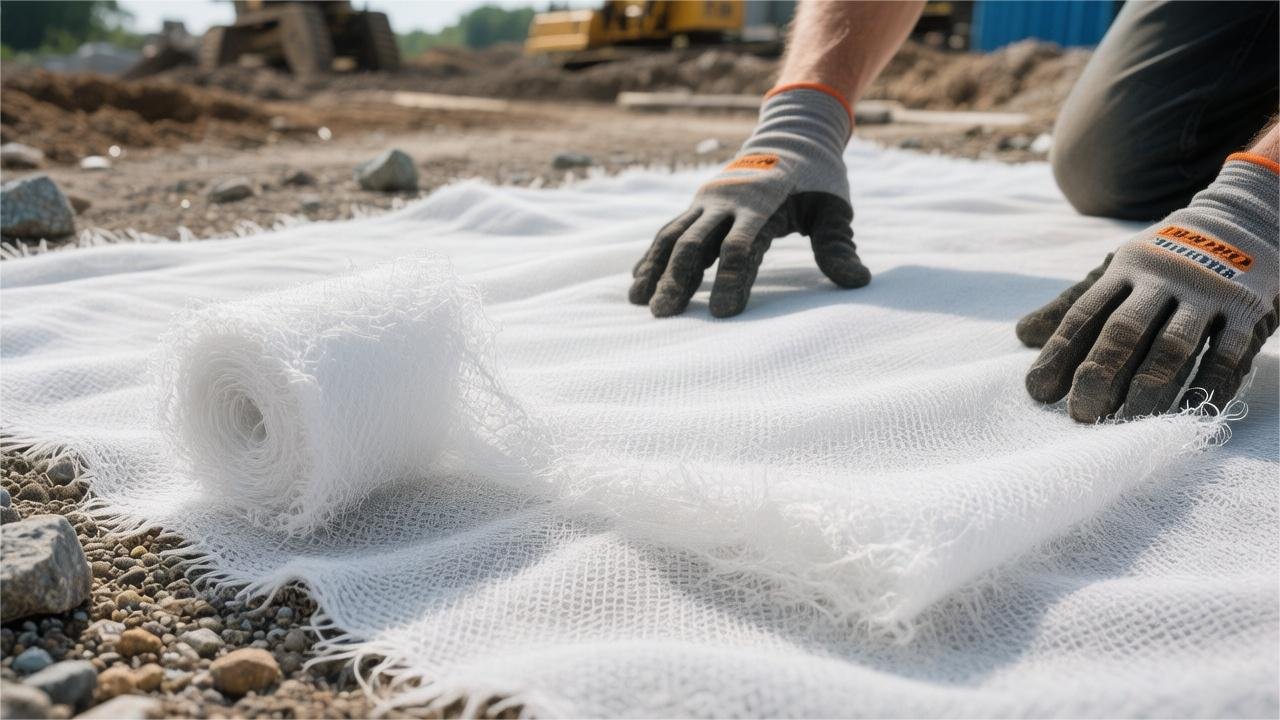
Project Application & Matching
Matching non-woven geotextiles requires cross-referencing AASHTO M288 standards and ASTM test data. For the filtration layer of a French drain, a specification of 3-4 oz/yd² (approx. 100-135 g/m²) with a permittivity greater than 110 gpm/ft² (ASTM D4491) should be selected; heavy traffic paving (such as highway sub-bases) requires 8 oz/yd² (approx. 270 g/m²) or more, with puncture resistance reaching 120 lbs (ASTM D4833).
Subsurface Drainage
In a standard French drain system, non-woven geotextile wraps around washed gravel and perforated PVC pipe. Trench excavation width is typically between 12 to 24 inches, with depths set at 18 to 24 inches to ensure it sits below the local frost line. The geotextile acts as a physical filter, blocking surrounding soil particles from entering the 4-inch or 6-inch corrugated drainage pipe.
While performing the filtration role, it must not block water flow. The Apparent Opening Size (AOS) of the geotextile must match the native soil profile of the construction site. Engineers determine the AOS value based on the ASTM D4751 test standard, with values expressed in millimeters or US Sieve numbers.
When laying drainage systems in sandy or coarse-grained soil environments, the AOS should correspond to US Sieve #70, with an equivalent opening size of 0.212 mm. If the trench is excavated in environments with a high clay proportion or silt, the requirements for the opening size will undergo specific numerical changes.
Silty environments require an AOS reaching US Sieve #100 or #120, with the corresponding physical opening size shrinking to 0.150 mm or 0.125 mm. Using #70 sieve geotextile in clay will allow fine particles to penetrate the fabric, filling the internal space of the corrugated pipe within 12 to 18 months.
Blocking silt and sand accounts for only half of the filtration system considerations; the material itself must allow water to pass at a specific volume. Permeability testing (ASTM D4491) quantifies the physical flow capacity, measured in gallons per minute per square foot (gpm/ft²).
Lightweight non-woven geotextiles weighing between 3.5 oz/yd² and 4.0 oz/yd² show permeability readings distributed in the range of 135 gpm/ft² to 150 gpm/ft². Standard residential French drains require a minimum permeability of 110 gpm/ft² to handle peak storm runoff.
For materials weighing over 6 oz/yd², permeability typically drops below 75 gpm/ft², creating a physical water barrier around the trench. Thicker materials possess higher grab tensile strength, but the filtration layer for drainage projects has very low demand for high-strength puncture testing.
The physical strength required only needs to survive the washed gravel backfilling operation during the construction phase. A grab tensile strength (ASTM D4632) of 100 lbs to 120 lbs is sufficient to resist the pulling and friction generated when 1-inch to 1.5-inch river stones are dumped into the trench.
After the gravel completely covers the drain pipe, the fabric on both sides must be folded over the top to complete the physical enclosure of the system. The overlap requires a minimum margin of 12 to 18 inches to prevent surface soil from infiltrating through gaps at the top.
A standard trench 50 feet long, 18 inches wide, and 18 inches deep requires a geotextile roll with a width of at least 6 feet (72 inches). The breakdown of material size allocation is as follows:
- The two trench walls account for a total of 36 inches of material to interface with the soil.
- The bottom of the trench requires 18 inches of material to support the washed gravel.
- The top covering over the drainage pipe requires an 18-inch margin to complete the overlapping encapsulation.
Securing the overlap according to the above dimensions ensures physical structural integrity; the long-term operation of the piping system is based on preventing the phenomenon of “clogging.”
Engineers use the Gradient Ratio (GR) test within the ASTM D5101 specification to evaluate the probability of material clogging.
A GR value of less than 3 indicates that the test material will not undergo physical pore clogging under normal water pressure.
Another data point introduced alongside the Gradient Ratio for drainage system evaluation is Permittivity, defined as the volumetric flow rate per unit cross-sectional area.
Subsurface drainage systems require the permittivity of the material to be maintained between 1.5 sec⁻¹ and 2.0 sec⁻¹. When the reading falls below 1.0 sec⁻¹, hydrostatic pressure accumulates behind the trench wall, and water can backflow into the building’s foundation structure.
Year-round exposure to underground moisture and soil chemicals requires materials to have quantified durability attributes to protect foundation infrastructure.
ASTM D5322 test reports indicate that in soil environments with pH values ranging from 2.0 to 13.0, PP geotextiles can maintain over 95% of their structural integrity. The physical lifespan of the filtration layer in such chemical environments can reach 30 to 50 years.
While showing high inertness in underground chemical environments, this material is subject to strict sunlight exposure limits during the trenching and laying phase.
A 4 oz/yd² drainage geotextile, after 500 hours of exposure under a xenon arc lamp, retains 70% of its tensile strength. Once the geotextile rolls are unpacked and unfolded, limited by UV resistance data, gravel backfilling must be completed within 14 days to prevent photodegradation from stripping the material’s strength.
Roadway Separation
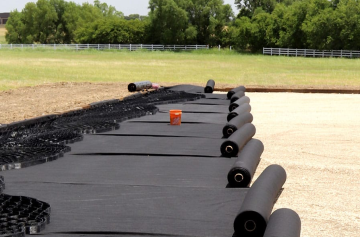
Before laying asphalt roads or high-strength commercial-grade gravel driveways, construction crews spread non-woven geotextile over the native subgrade excavated to the design elevation. The spreading operation covers weak cohesive soils with compaction levels typically having a California Bearing Ratio (CBR) of only 1.0 to 3.0.
Under the static and dynamic pressure of heavy dump trucks or rollers, weak cohesive soils will squeeze upward into the newly laid sub-base aggregate. Infiltrating 20% fine-grained clay into the aggregate layer will result in a more than 50% decrease in the structural load-bearing capacity of the entire gravel sub-base.
A decrease in structural load-bearing capacity of over 50% requires engineers to increase additional gravel thickness to compensate for the loss of physical strength. Introducing non-woven geotextile materials weighing 6 oz/yd² to 8 oz/yd² in sub-base separation applications can replace approximately 3 to 4 inches of compacted gravel aggregate.
The premise for replacing approximately 3 to 4 inches of compacted gravel aggregate is that the material meets the physical index requirements of the American Association of State Highway and Transportation Officials (AASHTO) M288 specification. AASHTO M288 classifies geotextiles into three levels, Class 1 to Class 3, based on the machinery weight and ground conditions of the construction site.
Specific classification standards and corresponding indicators are listed in the table below.
| AASHTO M288 Class | Applicable Ground Environment | Grab Tensile Strength (ASTM D4632) | Puncture Strength (ASTM D6241) | Tear Strength (ASTM D4533) |
|---|---|---|---|---|
| Class 1 | Heavy-duty trucks, low-bearing capacity soil (CBR < 3) | 205 lbs | 430 lbs | 80 lbs |
| Class 2 | Medium construction equipment, normal soil (CBR 3-5) | 160 lbs | 310 lbs | 56 lbs |
| Class 3 | Lightweight vehicles, high-bearing capacity compacted soil | 120 lbs | 220 lbs | 40 lbs |
Mandatory standards stipulate that Class 1 materials must have a grab tensile strength (ASTM D4632) test reading of no less than 205 pounds.
The bearing limit without physical rupture also depends on the material’s puncture strength (ASTM D6241) against the downward pressure of angular gravel from above. When dumping 1.5-inch to 3-inch sharp stones compacted by a 10-ton vibratory roller, the material must withstand a puncture reading of at least 430 pounds.
Withstanding at least a 430-pound puncture reading ensures that non-woven materials weighing 8 oz/yd² to 10 oz/yd² are not pierced during the construction phase. The material forms a physical barrier with a thickness of 80 mils to 100 mils (ASTM D5199) between the gravel and the soil.
Besides intercepting particle mixing, the physical barrier allows underground water to drain vertically according to the permeability of the ASTM D4491 test standard.
Permeability requirements for separation-grade geotextiles are relatively lower than for drainage trench applications; maintaining a permeability between 70 gpm/ft² and 90 gpm/ft² satisfies the downward drainage of surface water that infiltrates the gravel base during rainfall into the subgrade soil. 36 inches to 48 inches.
Edge overlap width must reach 36 to 48 inches, and some designs require on-site sewn seams along the joints to ensure they do not pull apart under stress. Using high-strength polyester thread for double-thread lock-stitching, the tensile strength at the seam must reach 90% of the parent material’s strength (above 185 pounds).
A seam tensile strength reaching 90% of the parent material’s strength (above 185 pounds) prevents shear stress generated by vehicles accelerating or braking from pulling the two fabric widths apart. For ordinary soft soil subgrades with CBR values between 1.0 and 2.0, the joint overlap width can be reduced to 24 to 36 inches.
Erosion Control & Retaining Walls
Riverbank embankments use a slope ratio of 3:1 or 2:1 to place riprap to resist water erosion, or backfill gravel behind a 10-foot-high segmental retaining wall. The non-woven geotextile covering beneath these two types of structures bears the physical compression and falling impact from hard stones.
According to Federal Highway Administration (FHWA) classification, Class I and Class II riprap weights range from 50 to 150 pounds, and are typically dropped onto the soil slope surface by excavators from a height of 3 feet.
Stone materials dropped onto the soil slope surface require the underlying geotextile mat to have a matching CBR puncture strength (ASTM D6241). 6 oz/yd² material provides a puncture reading of approximately 410 pounds, while the 8 oz/yd² specification increases the test reading to 575 pounds, meeting the buffering requirements for heavy stones dropped from standard heights.
Transverse and longitudinal tensile limits on 8 oz/yd² non-woven material reach baseline values of 205 pounds respectively. In 1.5:1 steep slope protection projects, using a 10 oz/yd² specification increases the longitudinal tensile value to 250 pounds, preventing gravity from tearing the filtration layer along the slope face.
To prevent stone gravity from tearing the filtration layer along the slope, construction personnel need to excavate an anchor trench at the top of the slope. A standard V-shaped anchor trench is 18 inches deep and 12 inches wide, set on flat ground at least 2 feet from the edge of the slope top.
Within the trench set on flat ground at least 2 feet from the edge of the slope top, compacted soil needs to be filled to lock the edge of the geotextile.
When laying down the slope face, the overlap width of adjacent rolls is constrained by the following physical data:
- The overlap length in gentle flow areas is fixed between 18 and 24 inches.
- In wave impact zones with water velocities exceeding 10 feet/second, the overlap length increases to 36 inches.
- Joints of adjacent materials are fixed using steel U-shaped pins with a length of 6 to 8 inches.
Steel U-shaped pins with a length of 6 to 8 inches ensure the tightness of the coverage area; the interception of underlying soil particles is controlled by the Apparent Opening Size (AOS) of the material. The soil under riprap slope protection is mostly silty clay or sandy loam, and AOS value testing adopts the ASTM D4751 standard.
AOS value testing adopts the ASTM D4751 standard; slope protection materials usually require an equivalent opening size matching US Sieve #70 (0.212 mm). When the fine-grained silt content in the slope foundation soil exceeds 50%, the AOS index tightens to US Sieve #100 (0.150 mm) to intercept tiny particles from seeping out with the water flow.
While intercepting tiny particles from seeping out with the water flow, the permittivity of the material is responsible for maintaining water discharge. The permittivity under ASTM D4491 testing must be greater than 1.2 sec⁻¹ to prevent underground water from accumulating at the base of the slope protection and generating buoyancy.
To prevent underground water from accumulating at the base of the slope protection and generating buoyancy, for every 1 foot depth of water accumulated behind a retaining wall, a hydrostatic lateral pressure of 62.4 lbs/ft² will be exerted on the wall surface.
To handle a hydrostatic lateral pressure of 62.4 lbs/ft², construction involves placing a 12 to 18-inch thick layer of 3/4-inch clean gravel as a drainage column behind the wall.
Placed between the native soil and clean gravel to complete the physical separation of the two materials, a weight specification of 4.5 oz/yd² to 6.0 oz/yd² is usually selected. Thickness (ASTM D5199) is maintained between 60 mils and 80 mils, allowing 20 gallons/ft² of soil seepage to pass through the fabric daily.
Fabric Weight and Thickness
The weight of non-woven geotextile is measured in oz/yd² or GSM, and thickness is indicated in mils. Making a French drain requires a permeability exceeding 100 gal/min/ft², so a 3-4 oz/yd² (100-135 GSM) specification should be chosen. For laying a gravel driveway base to prevent stone sinking, 6-8 oz/yd² (200-270 GSM) material is needed to meet AASHTO H-20 standards.
To protect geomembranes in landfills or artificial lakes, materials with a thickness of 100-150 mils and a weight of 10-16 oz/yd² should be selected, as their puncture resistance is typically greater than 120 lbs.
Three Weight Classes
North American engineering specification AASHTO M288 classifies non-woven geotextiles into three survivability levels, Class 1 to Class 3, according to physical weight and resistance to mechanical damage. Weight specifications span from 3 oz/yd² thin filter fabrics to 16 oz/yd² heavy protective cushioning layers.
On-site civil engineers will match the corresponding fabric weight based on the soil particle size distribution curve and groundwater depth before issuing a construction permit.
Materials of different weight classes have significant physical parameter differences in logistics transportation and on-site deployment:
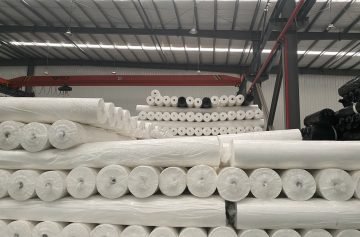
- Standard roll width is mostly 12.5 feet or 15.0 feet.
- Lightweight roll length can reach 360 feet, with a single roll weighing about 150 lbs.
- Mediumweight rolls are usually 300 feet long and weigh about 250 lbs.
- Heavyweight 16 oz/yd² rolls are only 150 feet long and weigh over 350 lbs.
- All rolls are wound on rigid paper core tubes with an inner diameter of 4 inches.
Materials from 3 to 5 oz/yd² are categorized as lightweight, with physical thickness typically maintained in the range of 40 to 60 mils. Due to the lower needle-punch density of polypropylene short fibers, this class of material retains a high permeability of up to 135 gallons/minute/square foot.
When dealing with pure sandy soil geology common in the Southeast United States, the diameter distribution of fine sand grains is between 0.1 and 0.5 mm. The Apparent Opening Size (AOS) of lightweight geotextile corresponds to US Standard Sieve #70, with 0.21 mm mesh precisely intercepting fine sand from entering French drains.
In scenarios such as gravel driveway base separation or light slope protection, the 6 to 8 oz/yd² medium weight class becomes a priority. Thickness rises to 80 to 100 mils, and CBR puncture strength (ASTM D6241 test) crosses the industrial threshold of 410 lbs.
The increase in mechanical bearing capacity is accompanied by a physical reduction in hydraulic data, with permeability for medium classes falling to around 90 gpm/ft². When laying a base of #57 gravel (particle size 1.0 to 1.5 inches), a tensile strength of 160 lbs can resist local shear forces caused by tracked equipment rolling over it.
According to AASHTO highway material standards, the minimum grab tensile strength specifications for different weight classes are as follows:
- Class 3 (Light Survivability): Tensile strength must be greater than 112 lbs.
- Class 2 (Medium Survivability): Tensile strength must be greater than 157 lbs.
- Class 1 (Heavy Survivability): Tensile strength must be greater than 202 lbs.
- UV Resistance Test (500 hours): Requires retention of over 50% of initial strength.
The heavyweight class covers specifications from 10 to 16 oz/yd², with metric weights exceeding 340 GSM and physical thickness reaching over 150 mils. Extremely high fiber interlacing density shrinks its AOS to US Standard Sieve #100 (0.15 mm), and permeability falls below 50 gpm/ft².
Impermeable liner systems for municipal solid waste landfills or large artificial lakes rely heavily on the buffering performance of heavy materials. Spreading a layer of 16 oz/yd² non-woven fabric over a 60-mil HDPE geomembrane can disperse the physical compression of the 18-inch drainage gravel above into the three-dimensional fiber network.
A CBR puncture strength exceeding 1000 lbs allows heavyweight materials to handle the direct physical impact of Class IV riprap (weighing up to 1000 lbs per piece). In coastline erosion prevention projects, after the rolls are unfolded along the slope, they must be fixed with J-shaped rebar ground anchors as long as 18 inches driven into the subsoil.
The engineering physical requirements for overlapping and sewing the three classes during on-site construction show an increasing trend:
- Level and firm soil base (CBR greater than 3): Light/medium overlap of 12 to 18 inches.
- Weak settling soil base (CBR 1 to 3): Medium/heavy overlap of 24 to 36 inches.
- Underwater riprap operation area: Heavyweight materials must be sewn; overlapping is prohibited.
- Seam Tensile Strength (ASTM D4884): Must be equal to 90% of the fabric’s own strength.
UV degradation is an inherent physical property of polymer materials; lighter specifications lose strength faster under sunlight exposure. Construction specifications require that lightweight materials of 3 to 5 oz/yd², after being laid, must be covered with gravel or native soil within 14 days.
Even for 16 oz/yd² heavyweight specifications with added UV stabilizers, physical tensile strength will undergo an irreversible decline after more than 30 days of unshielded outdoor exposure.
Common Thicknesses
According to the ASTM D5199 test specification, the North American engineering community is accustomed to using mils as the procurement scale, where 1 mil equals one-thousandth of an inch. The needle-punch process intertwines polypropylene short fibers to form a porous three-dimensional structure with thicknesses ranging from 40 mils to over 160 mils.
In groundwater interceptor trench designs common in Colorado, construction drawings stipulate laying non-woven material with a thickness of 90 mils at the bottom and sidewalls of the trench. After backfilling with 8 feet of compacted soil, the material bears a normal pressure of approximately 1000 lbs/ft² (psf), and its physical thickness will compress to about 60% of its initial state.
To handle burial pressure at different depths, manufacturing plants have calibrated physical attenuation parameters for different thickness specifications in simulated landfill environments:
| Nominal Thickness (mils) | Corresponding Weight (oz/yd²) | Thickness after compression under 1000 psf (mils) | ASTM D4716 In-plane Permeability (m²/sec) |
|---|---|---|---|
| 45 – 55 | 4.0 | 25 – 30 | 1.5 x 10⁻⁶ |
| 85 – 95 | 8.0 | 50 – 55 | 4.2 x 10⁻⁵ |
| 145 – 160 | 16.0 | 90 – 100 | 2.8 x 10⁻⁴ |
Thin materials in the 40 to 60 mil range have fewer internal fiber layers and very low in-plane lateral transmissivity; the physical path of water flow is primarily vertical penetration through the fabric. When digging a French drain 2 feet deep and 1 foot wide in a residential backyard, a 50 mil thickness is just enough to wrap around a 4-inch diameter perforated PVC pipe without occupying too much trench volume.
When the thickness increases to medium specifications of 80 to 100 mils, the fabric’s interior has enough space to accommodate liquid substances. In asphalt overlay operations across US states, contractors utilize the sponge effect of 90 mil geotextile to absorb liquid asphalt tack coat at temperatures as high as 300°F (149°C).
Every square yard of 90 mil thick fabric can absorb 0.20 to 0.25 gallons of liquid asphalt. After cooling and curing, the thickness of the asphalt-saturated geotextile stabilizes at about 60 mils, forming a waterproof and physical stress-absorbing interlayer between the old pavement and the newly laid 2-inch Hot Mix Asphalt (HMA) surface layer.
Entering the heavyweight range of 120 to 160 mils, the material’s physical function shifts from permeability filtration to cushioning. US EPA Subtitle D specifications require that the liner system at the bottom of solid waste landfills must ensure the 60 mil high-density polyethylene (HDPE) membrane is not punctured by the gravel of the drainage layer above.
When construction vehicles spread a 18 to 24-inch thick gravel drainage layer over the geomembrane, the ground pressure applied by tracks reaches 7 to 10 psi. 150 mil thick non-woven geotextile laid atop the HDPE membrane absorbs the downward shear force of gravel edges with its thick polypropylene fiber clumps.
Different thickness specifications have clear distinctions in physical operational limits during on-site deployment:
- 40-60 mils: Soft texture, can be cut single-handedly with a regular utility knife, easy to fold to fit the 90-degree right angles of a trench.
- 80-100 mils: Increased tensile strength, requires 6-inch long U-shaped steel pins every 5 feet for fixation when unfolded along a slope.
- 120-160+ mils: Extremely stiff, overlapping is prone to gaps, must be joined using a double-thread chain-stitch industrial sewing machine.
According to the ASTM D6241 puncture strength test, 150 mil thick geotextile can withstand over 1000 lbs of steel column puncture force. Arizona mining districts, when building tailings dams, lay 160 mil heavy fabric at the bottom to handle the physical impact energy of heavy dump trucks tipping quartz slag containing sharp edges.
The US Army Corps of Engineers (USACE) geomembrane protection manual stipulates that when the maximum particle size of the drainage layer aggregate exceeds 1.5 inches and the static surcharge height above is greater than 100 feet, the initial test thickness of the protective cushion geotextile must not be less than 120 mils.
The creep behavior of materials under constant heavy pressure over decades leads to a continuous reduction in physical thickness. Accelerated aging tests in laboratories show that 160 mil polypropylene non-woven fabric under a continuous normal load of 5000 psf, after 10,000 hours, will have its retained thickness drop to about 45% of its initial value.
To compensate for the loss of thickness and reduction in buffering capacity caused by long-term pressure, civil engineers calculating landfill base design drawings will multiply the theoretically required geotextile thickness value by a safety factor of 1.5 to 2.0 to derive the nominal thickness on the procurement list.
Permeability vs. Strength
According to ASTM test standards, the permeability of 4oz lightweight fabric is typically around 140 gpm/ft² (gallons/minute/square foot), with a grab tensile strength (ASTM D4632) of about 115 lbs; when the material weight increases to 12oz, its CBR static puncture strength (ASTM D6241) is as high as over 700 lbs, capable of withstanding the heavy pressure of large riprap, but permeability drops significantly to 15 gpm/ft².
Procurement personnel need to balance these two sets of data by calculating the weight of the fill and the runoff from a single precipitation event.
Testing Comparison
The North American Federal Highway Administration (FHWA) uses the AASHTO M288 specification to physically grade geotextiles. Laboratory data needs to be multidimensionally calculated based on the material’s grab tensile strength, puncture resistance, and permeability. The American Society for Testing and Materials (ASTM) has established unified physical stress application parameters.
4oz lightweight non-woven polypropylene geotextile has a rupture limit of 115 pounds in the ASTM D4632 grab tensile test. At this thickness, water penetration is extremely strong, with the ASTM D4491 test showing its permeability at 140 gpm/ft². When facing coarse aggregate, its CBR static puncture strength (ASTM D6241) remains at only 320 pounds.
Increasing to a 6oz specification, the grab tensile strength recorded in the lab rises to 160 pounds. The density of polypropylene fibers interlaced inside the material increases, and trapezoidal tear strength (ASTM D4533) improves from 50 to 65 pounds. After the fiber pores are physically compressed, permeability slightly decreases to 110 gpm/ft².
When the weight rating reaches 8oz, the material enters the medium-heavy physical range, with tensile strength breaking the 220-pound mark. Under the constant head pressure of 50 mm in the ASTM D4491 permeability test equipment, 90 gallons of water pass through every square foot per minute. Its CBR puncture resistance jumps to 600 pounds.
| Spec (oz/yd²) | Grab Strength (lbs) ASTM D4632 | Permeability (gpm/ft²) ASTM D4491 | CBR Puncture (lbs) ASTM D6241 | Trapezoidal Tear (lbs) ASTM D4533 |
|---|---|---|---|---|
| 3.5oz | 90 | 150 | 250 | 40 |
| 4oz | 115 | 140 | 320 | 50 |
| 6oz | 160 | 110 | 410 | 65 |
| 8oz | 220 | 90 | 600 | 90 |
| 10oz | 250 | 75 | 700 | 100 |
| 12oz | 300 | 15 | 800 | 115 |
Permittivity is measured in units of inverse seconds (sec⁻¹) to gauge vertical water flow efficiency. The permittivity of 4oz material is around 2.0 sec⁻¹, allowing surface water to drain quickly. For 12oz heavyweight fabric, the intricate fibers increase water flow resistance manifold, causing permittivity to drop to 0.7 sec⁻¹.
When dumping granite with a diameter of 24 inches in coastal engineering, there is a heavy reliance on CBR static puncture data. Laboratories use a flat-head steel column with a diameter of 50 mm pressed into the fabric at a constant rate. 12oz non-woven fabric can absorb 800 pounds of physical pressure before being pierced, preventing angular rocks from cutting the underlying fibers.
The trapezoidal tear test (ASTM D4533) simulates the stress situation after an initial 15 mm cut appears at the edge of the material. The machine applies reverse tensile force along the direction of the cut; 8oz fabric requires 90 pounds of constant tensile force for the tear to continue spreading through the polypropylene fiber network.
The non-woven process endows the material with extremely high elongation at break. When the tensile machine separates the clamps on both sides, 10oz needle-punched non-woven fabric can generate over 50% physical deformation before breaking. Woven geotextiles of the same weight have a deformation rate below 15% under tension.
The AASHTO M288 specification divides survivability into three physical levels. Class 1 handles harsh construction wear and tear, requiring non-woven fabrics with over 50% elongation at break to have a tensile strength exceeding 225 pounds. Class 3 corresponds to light wear, with a tensile strength baseline of 120 pounds.
- Class 1 (Min 225 lbs): Used for soft soil subgrades with rut depths greater than 150 mm, subjected to physical rolling by heavy machinery.
- Class 2 (Min 160 lbs): Used for medium subgrade separation layers with rut depths of 50 to 150 mm.
- Class 3 (Min 120 lbs): Used for outer wrapping of blind drain pipes, with no heavy machinery rolling during the entire construction process.
The harsh sunlight environment of Florida introduced UV resistance attenuation data (ASTM D4355). After continuous exposure of the geotextile under a xenon arc lamp for 500 hours, engineering compliance standards require the fabric to retain at least 70% of its initial tensile strength. Polypropylene chips are mixed with carbon black particles in proportion before extrusion into filaments to block UV rays.
Thickness parameters (ASTM D5199) are measured using a micrometer under a mechanically applied pressure of 2 kPa. 4oz lightweight fabric has a thickness of around 1.5 mm. 12oz material thickness reaches 3.8 mm. Increased thickness brings three-dimensional filtration depth, allowing 0.05 mm silt particles to be physically intercepted within the 3.8 mm fiber labyrinth.
In a lateral comparison with woven materials on the North American market, slit-film woven fabric with a 200-pound tensile strength has a permeability that stays at 5 gpm/ft². 6oz needle-punched non-woven fabric, while maintaining 160 pounds of tensile strength, provides a broad vertical water flow channel of 110 gpm/ft².
Specifications issued by factories all use the Minimum Average Roll Value (MARV) for data labeling. For 4oz material labeled with a grab strength of 115 pounds, statistical parameters ensure that 97.5% of the rolls in the production batch test higher than the labeled value. Sampling results lower than 115 pounds will result in the entire batch being returned to the furnace.
Apparent Opening Size Intervention
The physical basis of AOS is established on the ASTM D4751 test standard, which determines the equivalent physical size of the largest pores in non-woven geotextile through dry sieving. In the test, round glass beads of known diameter are shaken over the geotextile for sieving. When 5% of the glass beads pass through the fabric, the corresponding bead diameter is recorded as the AOS value. This value is expressed in US Standard Sieve numbers; the larger the number, the smaller the actual physical opening size. For example, a #40 sieve corresponds to a physical opening of 0.425 mm, while a #100 sieve corresponds to 0.150 mm.
Engineers extract the physical sieve size through which 85% of soil particles can pass, labeled as the D85 indicator on drawings. Assuming material is laid in glacial till sand layers common in Michigan, the D85 value of extracted gravel is typically between 0.5 mm and 1 mm. To stop fine sand from entering drainage pipes with the water flow, the AOS physical opening of non-woven geotextile must be equal to or slightly smaller than the soil’s D85 value. If the AOS is larger than D85, sand and soil will pass through the fabric unhindered.
To precisely match soil types across North American states, the correspondence between high-frequency AOS specifications in engineering procurement orders and physical sizes is listed below:
- 30 US Sieve = 0.600 mm
- 40 US Sieve = 0.425 mm
- 50 US Sieve = 0.300 mm
- 70 US Sieve = 0.212 mm
- 100 US Sieve = 0.150 mm
When dealing with silty clay common in Colorado, the soil contains a large amount of extremely fine particles with diameters between 0.002 mm and 0.05 mm. As water flows through the soil layer, it carries fine particles with it. If 8oz medium-thick geotextile with an AOS of 100 (0.150 mm) is used in this geological environment, tiny clay particles will get stuck inside the interlaced polypropylene fibers.
Once internal physical channels are filled, permeability will drop precipitously within a few weeks from 90 gpm/ft² to less than 5 gpm/ft². Engineering terminology refers to internal physical blockage as “Plugging” and surface mud cake formation as “Blinding.”
When encountering silty or extremely fine cohesive soils, simply increasing the thickness of non-woven geotextile or choosing an extremely fine AOS specification will cause water flow to stop completely. Civil construction standards require adopting a gradient filtration method. Workers will first lay a 2 to 4-inch thick layer of C33-grade medium-coarse sand on the outside of the geotextile.
The presence of the coarse sand layer changes the physical grading near the geotextile. It first blocks most clay under 0.05 mm, letting filtered water contact the 6oz geotextile with an AOS of 70, eventually allowing water to flow smoothly into the corrugated plastic drainage pipe.
AOS physical adaptation in different geological environments has strict data reference ranges. The Federal Highway Administration (FHWA) provides baseline guidance for deployment:
- Gravelly Sand: Choose AOS 30 – 40 US Sieve
- Fine Sandy Soil: Choose AOS 50 – 70 US Sieve
- Silt/Clay: Choose AOS 70 – 100 US Sieve (requires coarse sand bedding)
- Highly cohesive soil with over 50% silt content: Avoid relying solely on non-woven geotextile for filtration
AOS, fabric weight, and permeability are in a three-dimensional state of mutual constraint. 12oz heavyweight non-woven geotextile has a grab tensile strength of up to 300 pounds, capable of withstanding heavy machinery construction. High-density needle-punching usually results in an AOS of 100 to 120 US Sieve (0.150 mm to 0.125 mm), with very low permeability. When laying heavyweight traffic lanes in coastal wetlands in Florida, if 12oz fabric is laid to separate bottom mud from upper gravel, moisture within the roadbed will not be able to drain downward quickly through the small #100 holes when it rains.
When encountering such water accumulation situations, engineers will change the physical structure of the material. Woven Geotextiles have greater individual filament tension. A medium monofilament woven fabric with a 200-pound tension can have an AOS of 40 US Sieve (0.425 mm), maintaining permeability above 100 gpm/ft². The three-dimensional felt structure of non-woven geotextile provides more uniform filtration, but when engineering indicators require simultaneously meeting 300 pounds of high strength and a large 0.4 mm drainage opening, non-woven processes cannot achieve these parameters at the physical level.
When accepting AOS data for procurement, laboratory sampling reports must verify multiple physical test conditions to ensure the error-resistance of the certificate data:
- Dry Sieve Time: Mechanical vibration sieving must run continuously for 10 minutes.
- Glass Bead Grading: Diameter error of used beads must not exceed ±5%.
- Static Elimination: Relative humidity in the sieving environment must be maintained between 50% and 70%.
- Damage Inspection: Any abnormal holes with a diameter greater than 20% of the AOS are judged as batch disqualification.
After the on-site construction team determines the filtration grade through AOS data, they also need to calculate the local historical maximum rainfall intensity. A 100-year storm event in the Houston area of Texas will generate 4 to 6 inches of surface runoff per hour. The actual working area, AOS porosity, and final gpm permeability indicators of the non-woven geotextile laid on both sides of an underground catchment trench need to be combined into a complete water supply and drainage formula to verify that the fabric will not undergo physical bulging or fiber tearing under extreme water pressure.


Leave a reply