

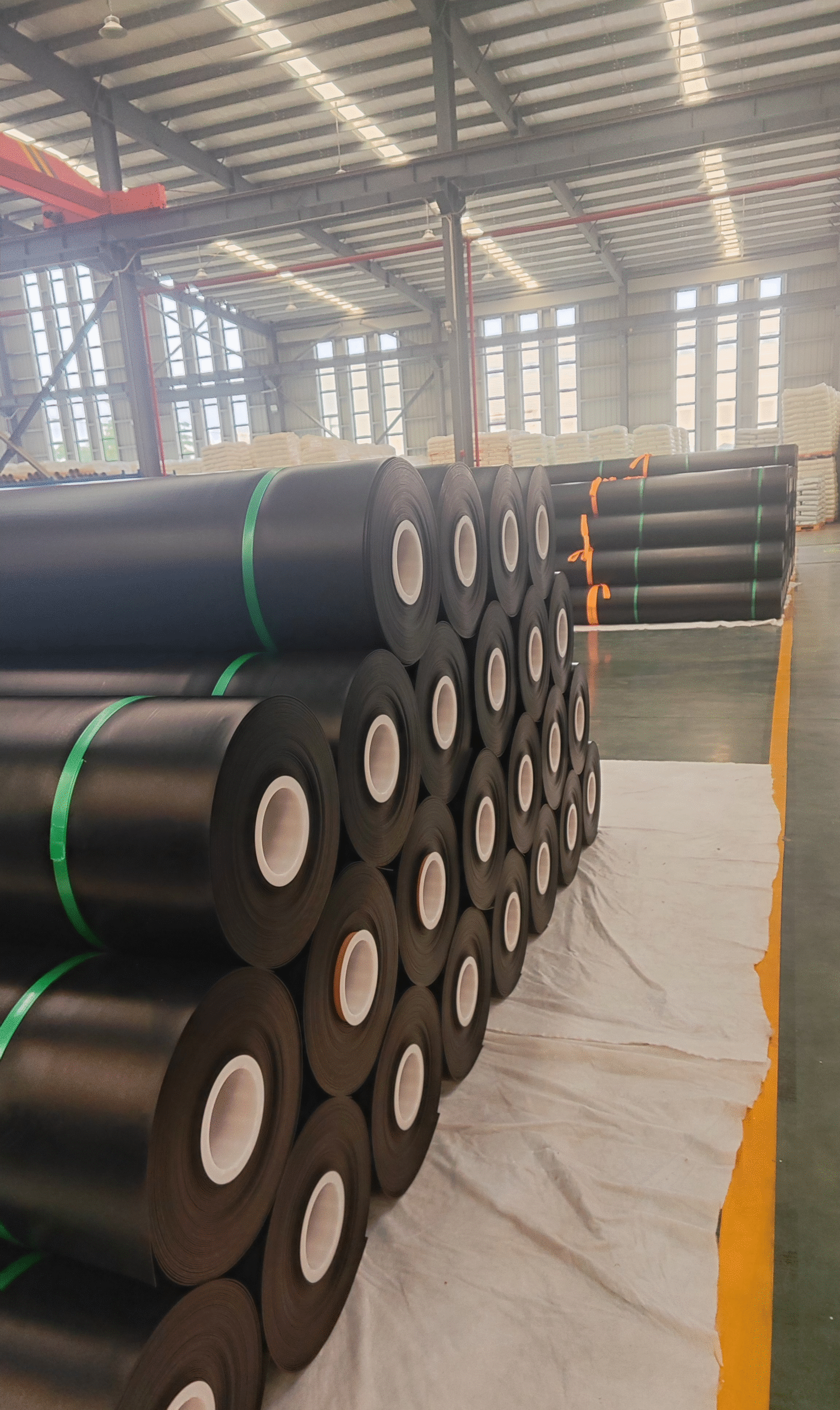
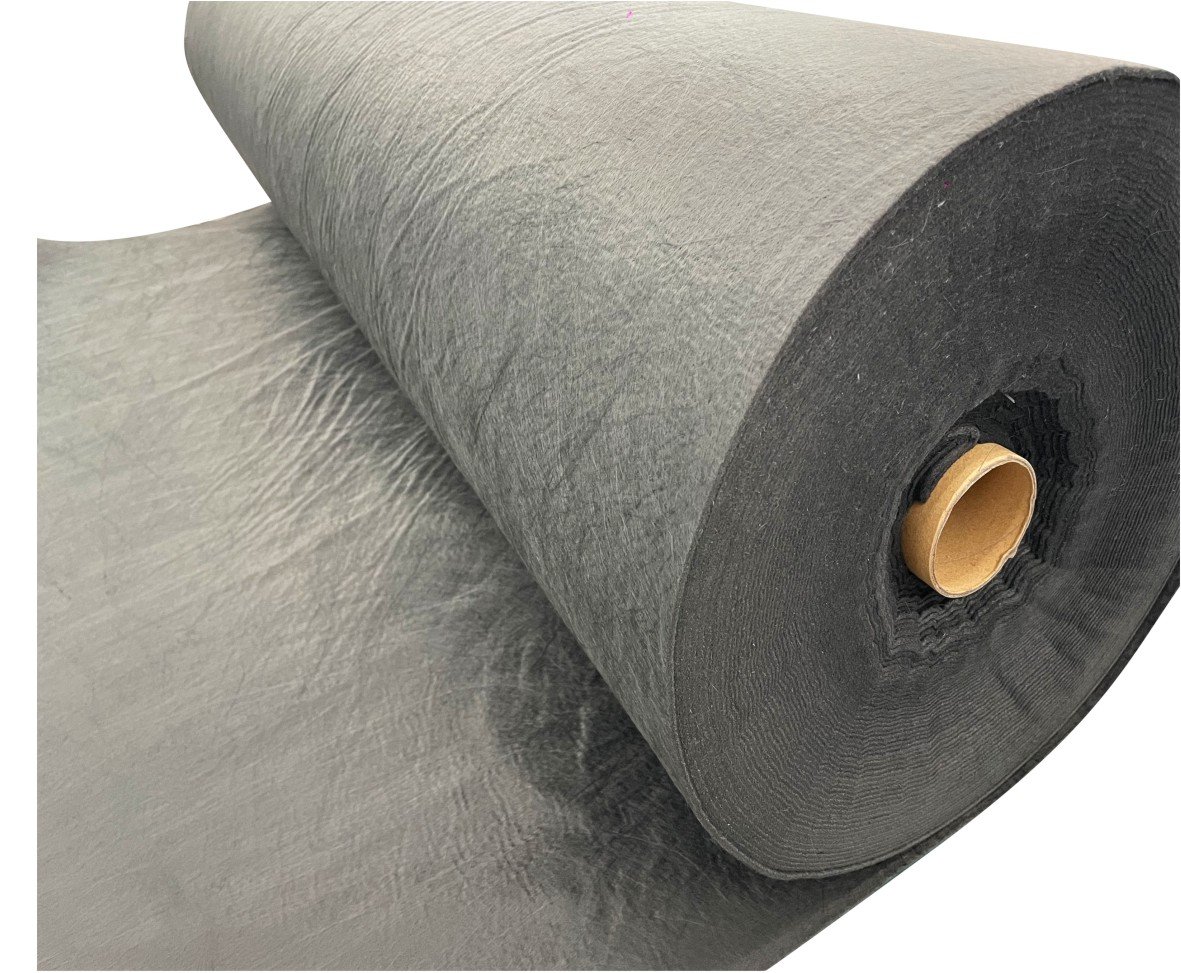
When selecting geotextiles for retaining walls, focus should be placed on weight (≥200–400g/m²), tensile strength (≥8–15kN/m), and water permeability (permeability coefficient ≥10⁻³ cm/s). For general gravel backfill, needle-punched non-woven fabric is recommended, as it effectively isolates soil, prevents loss, and provides drainage. During construction, a lap width of ≥20–30cm must be ensured to avoid leakage and structural instability, thereby enhancing the lifespan and safety of the retaining wall.
Weight and Thickness
For geotextiles used in retaining walls, first check whether the weight and thickness match the backfill material, wall height, and drainage method. Common non-woven geotextiles for residential projects are mostly between 4–8 oz/yd² (approx. 135–270 g/m²); when there are more gravel edges, heavier compaction, or higher walls, one usually looks toward higher specifications. If it is too light, it is more easily punctured during construction; if it is too thick but the pore size and water permeability do not match, drainage may also slow down.
Select by Usage
Geotextile behind a retaining wall is not bought by the “thickest roll,” but by first looking at the wall height, backfill particle size, compaction method, and drainage layout. Common heights for garden low walls are about 0.6–1.0 m, while residential retaining walls are mostly 1.0–1.8 m; beyond that, the soil pressure behind the wall, backfill volume, and construction disturbance will all increase, and the friction and local point pressure sustained by the geotextile will increase accordingly.
Even with the same backfill stone, the material state varies greatly. Smooth pea gravel has lighter friction against the fabric surface, with common particle sizes around 6–10 mm; whereas crushed stone common specs are around 19 mm (3/4 in), with more obvious edges, making it easier to form point-like stress during backfilling and compaction. If a clean gravel drainage layer is placed behind the wall, the geotextile is more like being in long-term contact with the gravel, not just laying a separation surface.
Breaking down the scenarios first makes selection easier. The table below is more suitable for general users to reference:
| Scenario | Common Wall Height | Backfill Situation | Common Geotextile Range |
|---|---|---|---|
| Flower beds, walkways, small terraces | 0.6–1.0 m | Fine gravel, small-scale manual construction | 4–6 oz/yd² (approx. 135–200 g/m²) |
| Residential backyard retaining walls | 1.0–1.8 m | 19 mm crushed stone + drainage pipe + layered compaction | 6–8 oz/yd² (approx. 200–270 g/m²) |
| Higher walls or slope remediation | 1.8 m+ | Coarser crushed stone, higher construction loads | 8 oz/yd²+ (approx. 270 g/m² or above) |
If the wall is just a garden edge, the soil thickness behind it is limited, backfilling mostly relies on manual spreading, and construction disturbance is small, common 4–6 oz/yd² non-woven fabric can cover most needs. The issue here is usually not excessive soil pressure, but whether the fabric surface can avoid being scratched when laying stones and whether it can keep fine soil out of the drainage layer.
When the wall height reaches about 1.2 m, the situation begins to change. There is generally a drainage stone zone of about 300 mm behind the wall, with a 100 mm (4 in) perforated drainage pipe often equipped at the bottom, and backfill must be compacted in layers, with common single-layer compaction thickness around 150–200 mm. If the geotextile is too light, the locations where problems first occur are often not the whole surface, but the corners, overlaps, and around the drainage pipe.
Going further up, scenario judgment cannot look only at height. Even if both are 1.5 m residential retaining walls, Project A uses smooth gravel while Project B uses more angular crushed stone; the latter usually has higher requirements for the geotextile. Additionally, when small rammers, plate compactors, or loaders are involved in backfilling, the fabric surface sustains not a single static pressure, but local squeezing after repeated disturbance.
When the wall height approaches 1.8 m, the backfill material is crushed stone, and there is mechanical layered compaction, the selection usually moves toward 6–8 oz/yd² or even higher specifications, rather than staying at the gardening landscape fabric level.
Many users view “landscape fabric,” “weed barrier,” and “geotextile” as the same category of material. Actual uses vary greatly. Light-duty garden fabric has common lower weights, suitable for weed suppression, covering soil surfaces, and laying under mulch; placed on the outside of a retaining wall drainage layer, facing 19 mm crushed stone and multiple rounds of compaction, the usage environment is on a completely different level.
When selecting by scenario, you can use this set of questions to filter first:
- Is the wall height below 1 m, or 1–2 m
- Is the backfill material smooth gravel, or crushed stone around 3/4 in
- Is construction mainly manual, or will there be mechanical compaction
- Is there a 4 in perforated drainage pipe behind the wall
- Is the drainage stone zone width about 200 mm, or 300 mm+
- Is the geotextile laid on a flat surface, or is it to wrap the outside of the drainage stone layer
In common residential projects, the most common and safest range is usually 6–8 oz/yd² (approx. 200–270 g/m²) needle-punched non-woven geotextile.
Different Problems Solved
When selecting retaining wall geotextile, weight and thickness are often written in the same row of parameters, but they do not answer the same question. Weight looks at how much material is used per unit area, with common notations being 4 oz/yd², 6 oz/yd², 8 oz/yd², converting to approximately 135, 200, 270 g/m². Thickness is commonly written as values like 1.5 mm, 2.2 mm, 3.0 mm, reflecting the loftiness of the fabric body itself and the buffer layer space.
Look at weight first. Clean crushed stone of about 19 mm (3/4 in) is often placed behind retaining walls; during laying, there will be pushing, pulling, stepping, and pressing, and the geotextile sustains many small-range concentrated stresses, not uniform pressure. Higher weight usually means more total fibers, and the fabric surface is less likely to have holes poked by gravel edges during the construction phase, and can better withstand pulling at repeated friction, folding, turning, and overlapping parts.
Looking at common residential scenarios makes it clearer:
| Weight Grade | Approx. Conversion | Common Usage Environment | Construction Tolerance Performance |
|---|---|---|---|
| 4 oz/yd² | Approx. 135 g/m² | Light landscape, fine gravel, manual laying | More sensitive to coarse crushed stone and strong compaction |
| 6 oz/yd² | Approx. 200 g/m² | Residential retaining walls, drainage stone layer, layered compaction | Balances filtration and construction tolerance |
| 8 oz/yd² | Approx. 270 g/m² | Higher walls, coarser crushed stone, higher disturbance | More stable against local point pressure and friction |
Even for the same non-woven fabric, the difference between 135 g/m² and 270 g/m² is not just reflected in “feeling thicker,” but in how much construction disturbance the fabric surface can withstand. When backfilling the first layer of stone material, edges will first press onto a few contact points; if the mechanical compaction layer thickness is 150–200 mm, the stress on the fabric surface will superimpose continuously.
Two materials have similar weights, one with a thickness of 1.8 mm and the other 2.7 mm; the latter usually provides a larger buffer when in contact with crushed stone and can better adapt to uneven base layers. Especially in practices with a drainage stone zone of about 300 mm behind the wall and a 100 mm (4 in) perforated drainage pipe laid at the bottom, the thickness is closer to whether the filtration structure is stable, rather than simply “looking thick.”
But thickness cannot be looked at alone. Actual selection also requires checking AOS / O95 and water permittivity together. AOS reflects the apparent opening size, with common values possibly in the 0.15–0.60 mm range; if the opening size is too large, fine material enters the gravel layer more easily; if the opening size is too small, combined with soil containing high fines, the drainage speed may slow down.
Putting the two parameters together looks closer to actual working conditions:
| Phenomenon You See | More Relevant Parameter | Common Consequence |
|---|---|---|
| Punctured by gravel during backfill | Weight, Puncture resistance | Local damage to fabric, fine soil subsequently enters drainage layer |
| Pulled apart at corners or overlaps | Weight, Tear resistance | Instability at corner positions first |
| Fine particles slowly mixing into gravel | Thickness, AOS | Drainage layer gradually filled with fine material |
| Slow water dispersal after rain | Thickness, Permittivity, Opening size | Water content behind the wall maintained longer |
Weight is more like “can it hold up during the construction phase,” while thickness is more like “can the filter layer be maintained during the service phase.” For example, if a fabric is made 3.0 mm thick, if the weight is low and puncture resistance is insufficient, it may still be damaged during the backfilling phase when laid behind coarse crushed stone; conversely, if a fabric is made 270 g/m², if the thickness and opening size configuration are inappropriate, the fine material control and drainage performance may not be ideal.
When actually looking at product pages, you can prioritize checking the following 4 items before deciding whether it is suitable to be placed behind a retaining wall:
- Weight: At least clarify if it is g/m² or oz/yd²
- Thickness: Common range is 1.5–3.0 mm
- CBR puncture: Look at local puncture capability
- AOS / O95: Look at whether the match between fine material and drainage layer is appropriate
For common residential retaining walls, in cases equipped with 3/4 in drainage gravel, 4 in perforated drainage pipe, and layered compaction, most projects will fall within the 6–8 oz/yd² (approx. 200–270 g/m²) range of needle-punched non-woven fabric, while also checking thickness and opening size.
Installation Angle
When laying on the excavation surface, the fabric needs to be tight against the native soil, with the bottom maintaining a 0° horizontal extension past the wall base for at least 12 inches. Spreading upward along the back of the wall needs to follow the excavation slope (45° to 90°). At joining seams, a roof-shingle style lap is used, with the upper layer covering the lower layer; the overlap amount in hydrostatic pressure areas must not be less than 18 inches. The top seal needs a 90° horizontal fold, completely wrapping the #57 clean stone, covered above by a 12-inch thick low-permeability topsoil layer to stop surface water from vertically pouring into the aggregate layer.
Bottom 0° Flat Laying
When excavating the retaining wall base trench, the bottom must reach an absolute horizontal state, with the allowable error range controlled to not exceed 1/4 inch per 10 feet. Use a laser level or leveling rod for precise leveling, and clear all sharp rocks or tree roots exceeding 1 inch in diameter. The subsoil layer needs to be treated with mechanical compaction equipment to reach at least 95% of standard Proctor dry density (ASTM D698).
After completing base preparation, unfold 4 to 8 oz non-woven needle-punched geotextile for flat laying operations. The fabric must maintain a 0° extension at the bottom of the trench, completely covering the trench base surface. Outside the heel of the retaining wall, the fabric needs to extend an additional at least 12 to 18 inches outward. Trench base width: standard size is 1/3 to 1/2 of the total wall height
- Fabric base width: trench width plus height of both side elevations plus 24 inches of overlap amount
- Compaction equipment: recommended to use a plate compactor with vibration force of 3000 to 5000 lbs
- Flatness re-measurement: perform an elevation check every 20 feet of laying
At the 90° intersection of the native soil excavation surface and the 0° horizontal trench bottom, geotextile is strictly forbidden from being tight-fitting. Construction personnel need to manually create 2 to 3 inch wide fabric pleats in this right-angle area. The extra fabric folded out is like a spring, providing necessary deformation buffer space when sustaining heavy pressure from above. The weight of #57 clean stone per cubic yard is approximately 2500 lbs, which creates a huge instantaneous impact force when dumped.
When heavy gravel falls from a height and hits the bottom of the fabric, the reserved pleats will be pulled flat. If the geotextile is in a tight state when laid, the 50% ultimate elongation (Elongation at break) of the non-woven fabric will be instantaneously pierced. Microscopic fibers will undergo irreversible fracture, tearing open gaps several inches long. Once the opening size (AOS) is destroyed, silt particles <0.075mm in the surrounding soil will surge in with the water flow.
To reduce the impact damage from falling gravel, regulations require that the dumping drop of aggregate must not exceed 3 feet. Use a small chute or mechanical arm to slowly lay the first batch of #57 clean stone on the geotextile.
After completing the bottom gravel laying and light leveling, place the 4-inch outer diameter perforated PVC drainage blind pipe. The placement position of the pipe must be close to the excavation surface at the back of the trench, about 2 to 4 inches from the geotextile edge.
- Blind pipe material: Schedule 40 PVC perforated pipe has better compressive strength
- Opening orientation: water inlet holes must be placed facing down, located at the 4 o’clock and 8 o’clock positions
- Drainage slope: the pipe needs to maintain a 1% water-following slope, i.e., dropping 1/8 inch per foot
- Outlet setting: an outlet (Weep hole) draining toward the outside of the wall needs to be set every 50 feet
After the blind pipe is in place, continue dumping gravel onto the upper outside of the pipe, covering at least 8 inches above the pipe. During the dumping process, heavy machinery is strictly forbidden from pressing above the trench that is not filled with gravel; tracks or tires need to maintain a safety setback distance of at least 2 feet from the trench edge. During the process of filling gravel, the fabric slowly stretches after being pressed, and the original 2-inch pleats are consumed, allowing the geotextile to perfectly fit the right-angle contour of the trench bottom.
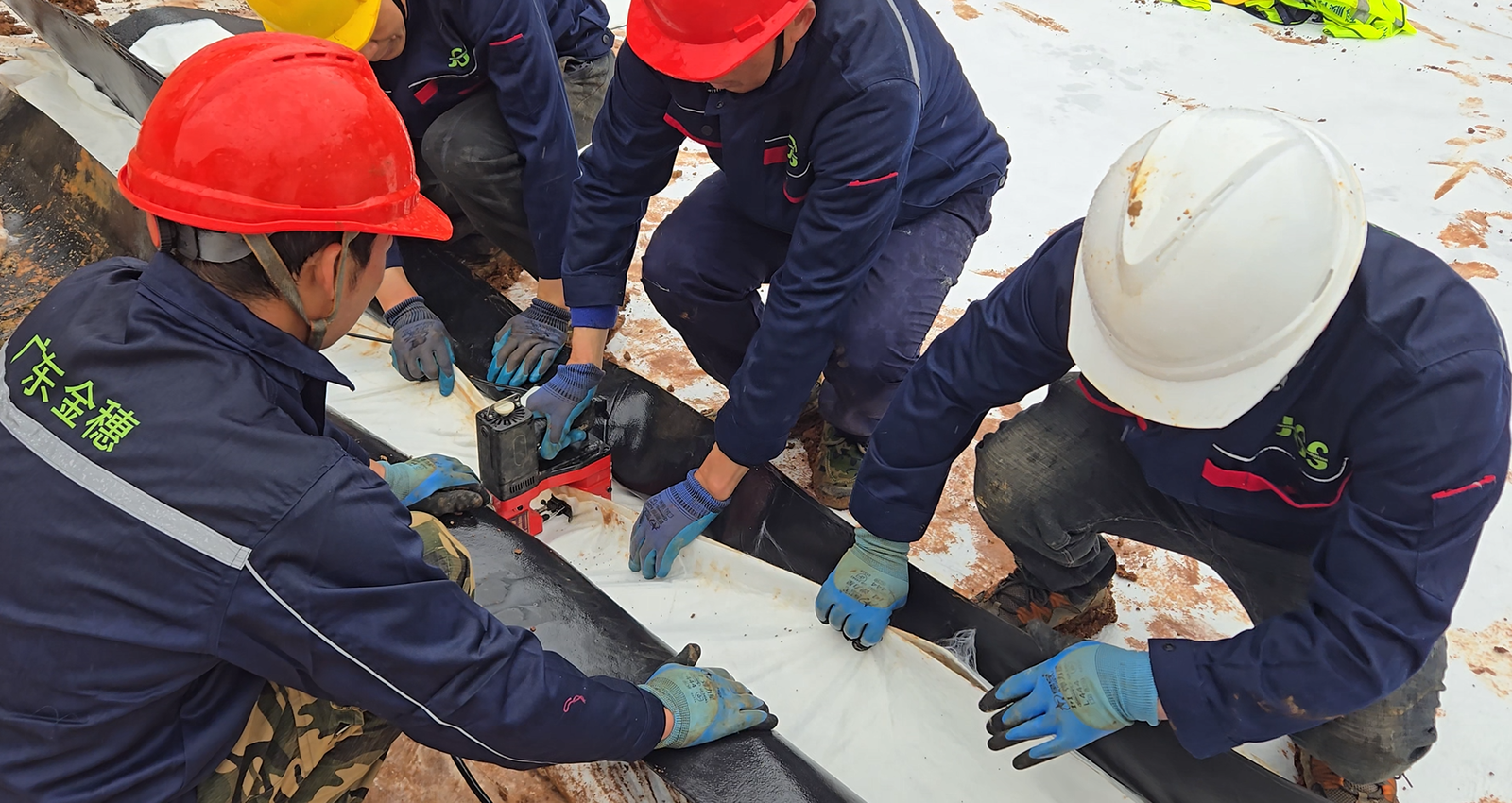
After completing bottom gravel filling, fold the 12 to 18 inch geotextile edge originally left outside the trench upward. The folded fabric is tight against the back of the retaining wall block material, overlapping with the geotextile hanging down along the excavation surface from above. The overlapping part must use the shingle-style lap method with the upper layer pressing the lower layer.
- Lap width: the bottom overlap area must not be less than 18 inches
- Fixing method: use specialized double-sided tape for temporary fixing to prevent sliding off
- Gravel filling: immediately pour the next layer of gravel to compact the seam after overlapping is completed
- Tension control: keep the fabric flat during backfilling to prevent the generation of invalid pleats
The closure of the bottom filtration cavity marks the completion of the 0° flat laying operation. The #57 clean stone and perforated pipe wrapped inside the geotextile form an independent underground water storage and drainage zone. Water flow enters the cavity through fabric pores with an equivalent opening size of 70 to 100 U.S. Sieve, and sediment is completely blocked outside. Under the action of gravity, water flow collects into the PVC pipe at the 0° bottom and drains toward the designated outlet along the 1% slope.
In a state where sufficient stress release space is reserved, the geotextile at the bottom always maintains its Grab Tensile Strength below the warning line of 120 lbs while sustaining the static load of 10 to 15 feet high backfill soil and gravel from above. The fabric structure remains stable, and the filtration Permittivity is maintained within the test interval of 1.0 to 2.0 sec⁻¹, ensuring continuous and efficient drainage.
Excavation Inclination
OSHA regulations divide native soil into three categories: A, B, and C; the native soil excavation surface behind the retaining wall presents a geometric inclination span from 1H:1V (45°) to 90° vertical. When laying 4 to 8 oz non-woven needle-punched geotextile, the fabric needs to 100% adhere to the concave and convex surface of the native soil. For every 10 square feet on the excavation surface where a pit deeper than 2 inches appears, construction personnel must fill it with clean soil and compact it to 90% standard Proctor dry density.
Fixing the fabric uniformly uses 11-gauge 6-inch U-shaped steel staples. Encountering Class A clay or weathered rock areas with extremely high density, where the penetration resistance of 6-inch steel staples breaks the 50 lb limit, the site needs to replace them with 8-inch heavy-duty steel plate nails. The direction of nail driving is kept perpendicular to the geotextile surface, with the top crossbar pressing tight against the fabric fibers but not destroying the calibrated equivalent opening size structure.
The slope surface fixing interval is controlled by the physical inclination parameters of the native soil. On a 90° vertical rock surface, gravity exerts a constant downward pulling force on the fabric, and the nail driving interval needs to be narrowed to one every 3 feet horizontally. Where the excavation surface transitions to a 45° gentle slope of loose sandy loam soil, drive one steel nail every 1.5 feet to prevent the fabric from sliding down before backfilling heavy aggregate.
- Select 11-gauge 6 to 8 inch U-shaped metal ground nails for fixing
- Fixing point interval on vertical rock surfaces is kept at once every 3 feet horizontally
- Shorten fixing point interval to 1.5 feet in gentle slope loose soil areas
- The top of the steel nail laterally compacts fabric fibers to prevent local penetration and tearing
Commercially available standard single roll geotextile width is 12.5 feet or 15 feet, so a large number of horizontal and vertical splice seams will inevitably be generated behind large retaining wall structures. The lower edge of the fabric laid above covers the upper surface of the fabric below, with the physical form simulating roof shingle overlapping.
Under the ASTM D4491 test standard, the hydraulic conductivity of non-woven fabric is 110 to 150 gallons per minute per square foot. The fabric thickness in the overlap area doubles, and the local water permeability correspondingly drops by about 40%. To compensate for the physical loss of hydraulic conductivity, regulations require that in any area where hydrostatic pressure may potentially accumulate, the overlap amount of horizontal seams is set with a lower limit of 18 inches.
| Native Soil Slope | OSHA Soil Physical Classification | Minimum Lap Length (inches) | Steel Nail Fixing Interval at Seams (inches) |
|---|---|---|---|
| 1H:1V (45°) | Class C loose sandy soil | 24 | 12 |
| 0.5H:1V (63°) | Class B silty loam | 18 | 18 |
| Vertical (90°) | Class A dense hard clay | 12 | 24 |
For vertical splice seam treatment, the fabric overlap size is uniformly relaxed to 24 inches to resist the lateral shear squeezing force caused by backfill machinery. Adjacent vertical seam positions are mandatory to be staggered by at least a 3-foot distance. Longitudinally concentrated seams form structural weak zones; under the lateral pressure of 2500 lbs of #57 clean stone per cubic yard, the probability of non-staggered seams being torn open surges by 60%.
In 90° wall corner terrain that is convex or concave, the physical extensibility of large-size fabric cannot meet the requirement of dead-angle-free fitting. The construction party cuts the 15-foot wide full roll of fabric into 3-foot wide long strips specifically to cover the corner areas. The splice overlap amount in irregular areas is mandatory to be increased to 24 inches, with a U-shaped ground nail driven every 6 inches along the seam to build a high-density physical defense line.
- Horizontal splicing mandatory uses shingle-style overlapping with the upper layer covering the lower layer
- Vertical splice seam staggered distance is greater than the 3 feet in the horizontal direction
- In corner irregular areas, cut the fabric into 3-foot wide independent patches
- Nail driving interval at seams in high-pressure stress zones is reduced to 6 inches
Geotextile in the overlap area is exposed to the outdoors during the construction period, and the ASTM D4355 standard limits its UV degradation safety period. Polypropylene fibers receiving 500 hours of direct sunlight, the calibrated 120 lb grab tensile strength decays by 30%. Dump #57 clean stone to cover within 24 hours of completing shingle-style overlapping to block the continuous destruction of polymer molecular chains by UV wavelengths.
When gust wind speed reaches 15 miles per hour, wide-width geotextile not pressed by gravel generates an extremely strong sail effect. The upward pulling force generated by 12.5-foot wide fabric under wind pressure easily pulls out 11-gauge steel nails. Place smooth river pebbles weighing 10 lbs every 5 feet at the seams to act as temporary weights, preventing wind from tearing open the preset 18 to 24 inch overlap amount.
Dumping #57 clean stone to compact seams, the maximum drop is strictly limited to within 3 feet. Sharp gravel with a diameter of 1.5 inches falling from a height, instantaneous kinetic energy is concentrated on the seam edge with an overlap thickness of only 0.15 inches. An excessive drop will knock the upper geotextile edge toward the bottom, causing displacement sliding, and the preset 24-inch overlap amount will instantaneously shrink to less than 10 inches, destroying the hydraulic seal defense line.
Engineers calculate procurement material volume in the early stage, reserving a 10% to 15% area loss rate for high-standard shingle-style overlapping. A roll of non-woven geotextile with a total length of 100 feet, after undergoing horizontal splicing every 12.5 feet, 24 inches of vertical overlap loss, and corner cut-off waste, the actual effective excavation area covered drops to 85% of the nominal total area.
Horizontal Closure
The #57 clean stone backfilling operation at the back of the retaining wall must absolutely stop at 12 inches below the highest layer of the wall (Cap block). The reserved 1-foot vertical space is specifically used to construct a water-blocking layer to intercept vertical infiltration of surface rainwater.
After stopping backfill, the non-woven needle-punched geotextile extending upward along the native excavation needs to be folded 90° horizontally toward the retaining wall. The fabric is laid flat against the top surface of the gravel layer, spanning the entire width of the drainage aggregate row and producing close contact with the blocks on the back of the wall.
The wrapping step forming a closed system is called a “Burrito Wrap” in engineering terms. The horizontal fabric overlap size at the top must not be less than 18 inches, blocking soil particles from above from leaking into the pores below through the seams. To prevent downward shear force of backfill soil, the fabric must meet the puncture strength of at least 300 lbs under the ASTM D6241 standard.
- Precise 90° horizontal angle fits the entire aggregate surface
- Fabric edges need to reach the back of the wall without leaving gaps
- Length of upper layer covering lower layer at seams reaches 18 inches
- Polypropylene material outdoor exposure time is below 14 days
The geotextile after horizontal folding is completed forms an isolation membrane, with 8 to 12 inches thick low-permeability topsoil filled above. In the Unified Soil Classification System (USCS), clayey loam of category C or D is preferred. Surface layers with high clay content can reduce the surface runoff infiltration rate by 70% to 80%, forcing water flow to drain horizontally along the surface.
It is strictly forbidden to use sandy soil or topsoil with organic matter content higher than 5% above the horizontal seal. Porous soil will absorb rainwater like a sponge, applying static pressure to the 90° folded geotextile surface. The weight of saturated water-containing soil per cubic foot reaches 120 lbs, and long-term heavy pressure will cause deformation of the equivalent opening size (AOS) of the fabric.
When covering topsoil, use the layered backfill (Lifts) method for compaction. Each layer of fill thickness is controlled at 4 inches, operated using a heavy hand tamper or a small mechanical compactor weighing less than 150 lbs. The final compaction degree must reach 95% standard Proctor dry density (ASTM D698) to eliminate water storage voids inside the soil.
- Use USCS classified Grade C or D clayey loam
- Soil organic matter volume ratio is controlled below 5%
- Perform an independent compaction operation every 4 inches of thickness
- Compaction degree reaches 95% standard Proctor dry density
Heavy rollers or plate compactors with a calibrated vibration force exceeding 2000 lbs are forbidden from entering within 3 feet of the back of the wall. Excessive mechanical vibration waves will pass downward through the 12-inch soil layer, causing the geotextile seams at the horizontal seal to slide off. Strong lateral soil pressure can easily push the top retaining wall blocks outward by 1 to 2 inches, destroying the overall vertical line of the wall face.
The surface of the topsoil layer after completing compaction needs to construct a clear water-following slope (Positive grading). Starting from the top surface of the retaining wall, in the area extending 3 to 5 feet behind the excavation surface, the ground maintains a drainage inclination of 2% to 5%. Converted to height drop, for every 1 foot extended backward, the surface height drops by 1/4 to 5/8 inches.
A standard positive grading can use gravity to guide more than 85% of surface runoff away from the back of the retaining wall. If the catchment area of the native slope exceeds 1000 square feet, the topsoil slope alone cannot drain storm runoff. At a position 3 to 4 feet from the back of the wall, a shallow intercepting ditch (Swale) 6 inches deep and 12 inches wide needs to be excavated.
- Maintain an inclination of 2% to 5% draining toward the back of the wall
- For every 1 foot extended backward, the surface drops 1/4 to 5/8 inches
- Slope needs to extend at least 3 to 5 feet backward from the top of the wall
- Catchment area exceeding 1000 square feet requires digging an intercepting ditch
The installation steps for the top block (Cap block) affect the watertightness of the seal system. During construction, apply a 1/2 inch wide bead of polyurethane construction adhesive on the top layer of wall bricks.
Turf or shallow-root plants can be planted above the 12-inch thick topsoil layer, with root depth controlled within 6 inches. Deep-root shrubs must be planted outside the area at least 3 feet from the back of the wall. If plant roots penetrate the topsoil layer and pierce the geotextile below with 300 lbs puncture resistance, moisture will pour vertically into the #57 clean stone layer along the root channels.
Regular settlement observation of the 3 to 5 foot wide slope area at the surface is extremely necessary. Within the first 6 months of new completion, backfill soil layers usually undergo a natural settlement of about 1/2 inch. When low-lying water accumulation areas are found in the topsoil layer, immediately supplement with the same grade of C/D clay and re-compact to 95% density.
Longevity and UV Resistance
The service life of qualified retaining wall geotextile needs to reach 50 to 75 years. The American Association of State Highway and Transportation Officials (AASHTO) M288 standard stipulates that after undergoing 500 hours of xenon arc lamp UV accelerated aging test (ASTM D4355 test method), the tensile strength retention rate of geotextile must be greater than or equal to 70%. For polypropylene (PP) materials without 2% to 3% high-density Carbon Black or UV stabilizers added, the tensile strength will drop by more than 50% within 14 to 30 days of exposure to sunlight.
Test Indicators
The ASTM D4355 test established by the American Society for Testing and Materials uses xenon arc lamp equipment equipped with daylight filters. The inside of the equipment simulates full-spectrum solar radiation, precisely controlling the irradiance of UV light with a wavelength of 340 nm at 0.35 W/m².
After standing for 24 hours in a standard air-conditioned room at 21 degrees Celsius and 65% relative humidity to eliminate internal stress, technicians will fix the specimen to a stainless steel test fixture. The fixture applies an initial pre-tension of 10 Newtons to a rectangular strip 50 mm wide and 200 mm long.
- Specimen edge sealing: edges where warp and weft yarns interweave are cut using ultrasonic thermal melting to prevent mechanical fraying during testing from causing tension reading failure.
- Fixture contact surface protection: the surface is covered with a layer of Teflon film to avoid high-temperature metal from melting the polymer fibers.
The loaded specimen fixture is sent into the rotating turntable of the instrument to execute a strict 120-minute light-dark alternating cycle program. For the first 90 minutes, the xenon arc lamp illuminates continuously, with the chamber temperature monitored by a black panel thermometer set at 65 degrees Celsius. For the last 30 minutes, the light source is turned off, and the relative humidity in the chamber is increased from 50% to 95%.
A spray system matching the humidity increase uses deionized water to simulate outdoor rainfall.
- Water quality purity parameters: silica content of deionized water is strictly limited to below 0.1 ppm to prevent scale from forming a reflective layer on the fiber surface.
- Deionized water conductivity: the reading needs to be less than 5.0 microsiemens/cm to avoid metal ions catalyzing the hydrolysis reaction of polyester materials.
- Water temperature control: the sprayed simulation rainfall water temperature is stable in the 20 to 25 degrees Celsius range, applying a sudden cold thermal expansion and contraction physical impact to the heated fibers.
The borosilicate glass inner and outer filters equipped in the test equipment block short-wave UV light with wavelengths below 290 nm. Dust accumulation on the filter surface will cause the transmittance in the 340 nm band to drop by 1.5% every 100 hours.
The continuous loss of transmittance requires laboratory technicians to use a multi-channel spectroradiometer to calibrate the test chamber every 400 hours of operation. The tolerance of the black panel temperature sensor probe is limited to within plus or minus 3 degrees Celsius. A temperature deviation of 5 degrees from the standard set value will cause a quantitative error of 25% in the photo-oxidation degradation reaction speed of polymer fibers.
In an extremely stable experimental chamber environment, operators will take out specimens at three fixed time nodes: when the program runs to 150 hours, 300 hours, and 500 hours. An exposure of 150 hours is equivalent to being placed outdoors without cover for 14 days in mid-latitude regions of North America. An exposure of 500 hours is equivalent to approximately 45 days of cumulative UV radiation dose in the summer in Denver, Colorado.
Material thickness data seriously affects the reading of test tension values. For non-woven fabric specimens with a weight of 8.0 oz/yd² and thickness reaching 2.5 mm, the bottom fibers can avoid the UV radiation absorbed by the surface layer.
Polymer test data from Georgia Institute of Technology in Atlanta show that for same-material specimens with weight halved to 4.0 oz/yd², the retention rate in the 500-hour test will drop significantly to 62%.
Fibers in the top 0.1 mm under the thickness parameter sustain 90% of the photon bombardment. The peak tension value after UV destruction measured by the instrument, divided by the baseline tension value of the unexposed original specimen, the calculated percentage is the tensile strength retention rate.
| Engineering Usage Grade (AASHTO) | Total Xenon Arc Irradiation Duration | Allowable Tension Drop | Applicable Retaining Wall Environment |
|---|---|---|---|
| Class 3 (Light load) | 150 hours | 50% | Temporary protection at slope top |
| Class 2 (Medium load) | 500 hours | 30% | Regular walls below 10 feet |
| Class 1 (Heavy load) | 500 hours | 20% | Load-bearing grade highway subgrade |
The anti-aging evaluation curve submitted by the retention rate test report contains two separate sets of data: Machine Direction and Cross Machine Direction. Woven geotextile has differences in warp and weft tension sustained during the weaving process. After 300 hours of exposure, the strength drop of transverse narrow flat yarns is often 12% higher than that in the longitudinal direction.
When processing the two separate sets of data, the relative standard deviation (RSD) of the test process is controlled within 7%. Two independent laboratories performing the ASTM D4355 test on the same batch of roll material, the allowable upper limit for inter-laboratory deviation is 15%. Data sets exceeding the 15% tolerance band will be voided, and fresh material must be cut to restart the 500-hour process.
Final data passing all tolerance audits are organized into an Engineering Bill of Materials (BOM) provided to buyers. The exact irradiance joules at the end of each 150-hour cycle are detailed on the chart.
Anti-aging Additive Proportioning
Retaining wall geotextile raw materials are mainly polypropylene (PP) or polyester (PET). Polypropylene is composed of carbon-hydrogen bonds (C-H); under UV irradiation with wavelengths of 290 to 315 nm, hydrogen on tertiary carbon atoms is easily detached to form free radicals. Fracture of PP filaments with molecular weights between 100,000 and 500,000 g/mol will cause material elongation to drop by 15% within 72 hours.
Federal Highway Administration (FHWA) data show that in soil with pH values between 3 and 9, high molecular weight PP material can maintain structural stability for up to 100 years.
Polyester (PET) molecular main chains contain benzene rings and ester bonds, possessing a natural absorption capacity for UV light with wavelengths of 315 to 380 nm. In environments with relative humidity below 60%, the tensile strength of pure PET fiber only decays by 8% after 14 days of outdoor exposure. Strongly alkaline soil will trigger hydrolysis of PET ester bonds.
When the pH value of backfill soil is greater than 9, the rate of PET hydrolysis reaction doubles, and the design life of 50 years will shrink to less than 25 years.
The industrial standard practice for blocking polymer photo-oxidation reaction is incorporating high-density Carbon Black. The particle size of Carbon Black used for geotextile must be controlled between 15 to 25 nm. Coarse Carbon Black with particle sizes exceeding 30 nm cannot be uniformly dispersed in the polymer matrix. Pure black woven or non-woven fabric needs to incorporate 2% to 3% weight percentage of fine-particle Carbon Black. A proportion less than 2% will allow UV light to penetrate the surface 0.05 mm protective net, triggering internal fiber embrittlement.
Excessive addition exceeding 3% will destroy the crystallinity of the polymer. According to a material tensile test report from Texas A&M University, PP geotextile with a Carbon Black content reaching 4%, its initial Grab Tensile Strength will abnormally drop from a standard 120 lbs to 95 lbs.
- Dispersion rating: Carbon Black aggregate size under a microscope must be less than 50 microns, reaching Grade 3 or better of the ASTM D5596 standard.
- Oil absorption value: the oil absorption value of high-quality Carbon Black needs to be maintained at 80 to 120 ml/100g, ensuring perfect fusion with PP resin.
- Heat conduction: heat energy converted from absorbed photons will make the surface temperature of black fabric 15 degrees Celsius higher than air temperature.
HALS does not absorb UV light; the chemical mechanism is capturing free radicals generated by photodegradation. HALS agents added in amounts of 0.5% to 1.0% can extend the outdoor exposure safety period of white geotextile from 3 days to 21 days.
Long-term aging tests from the University of Florida show that HALS will lose activity in acidic environments (pH below 5), being inactivated by protonation from acidic ions.
For light-colored fabric in high-acidity environments, manufacturers will compositely add 0.2% UV absorbers (UVA), such as benzotriazole compounds. UVA can absorb light energy in the 300 to 400 nm band and convert it into harmless low-frequency heat energy for release. The mixed additive formula pushes production costs up by about 12%.
- Primary antioxidant: 0.1% hindered phenol is used to consume oxygen free radicals during processing, protecting the initial molecular weight of the polymer.
- Secondary antioxidant: 0.15% phosphite is responsible for decomposing hydroperoxides, preventing material yellowing during extrusion at high temperatures of 200 degrees.
- Wash-out resistance: high molecular weight HALS (greater than 2000 g/mol) can resist migration loss caused by long-term flushing by groundwater.
After being buried in soil, oxygen concentration drops sharply from 21% in the air to less than 5%. Extremely low-oxygen environments reduce the thermal oxidation reaction rate by 90%. In a constant-temperature underground environment at 20 degrees Celsius, the half-life of antioxidants is up to 35 years.
In retaining wall projects in the hot-dry desert regions of Arizona, summer soil temperature at 1 foot below the surface can reach 45 degrees Celsius.
To deal with extreme attenuation in geothermal areas, specialty geotextiles will increase the initial concentration of antioxidants to above 0.5%. After undergoing 500 hours of xenon arc lamp accelerated aging test, the tensile retention rate of high-proportion materials can still be maintained above 85%. For high-crystallinity PP material, as crystallinity increases from 40% to 55%, the time span for the material to resist chemical degradation can increase by at least 20 years.
Exposure Safety Window Period
In the Federal Highway Administration (FHWA) engineering manual, the basic exposure limit for polypropylene (PP) material without 2.5% Carbon Black added is 14 days. UV radiation amount is the absolute variable leading to high-molecular-chain fracture. in Phoenix, Arizona at lower latitudes (average summer UV index 10+), the photodegradation reaction rate of material is 2.5 times that of Seattle, Washington (UV index 4).
Within the first 48 hours, the consumption rate of hindered amine light stabilizers (HALS) on the material surface is 15%, and the grab tensile strength (ASTM D4632 standard) is maintained above 98% of the factory rated value. From day 3 to day 14, UV photons penetrate the material surface to a depth of 0.05 mm, destroying polymer carbon-hydrogen bonds. The original 120 lb grab tensile strength drops to about 85 lbs on day 14, touching the Class 3 level bottom line stipulated by the AASHTO M288 standard.
According to outdoor exposure experiment data from the Civil Engineering Department of the University of Florida, there are significant differences in physical indicator decay nodes for standard 4.0 oz/yd² non-woven geotextile in a coverless environment:
- Day 7: elongation indicator hardens and shrinks from a nominal 50% to 42%.
- Day 14: puncture strength (ASTM D6241) decreases by 20%.
- Day 21: microscopic 0.01 mm cracks become visible on polypropylene fibers.
- Day 30: surface undergoes serious powdering, and load-bearing capacity falls off a cliff by 45%.
After the exposure period breaks the 30-day threshold, fiber structures on friction stress surfaces will shed white or gray fine powder, and polypropylene molecular chains completely break and degrade. When laying gravel bases, 10-ton heavy smooth-wheel rollers
When standard 12.5-foot wide geotextile rolls are stacked in the open at the construction site, the two exposed edges sustain more than 8 hours of oblique light daily. For every 10 degree Celsius increase in ambient temperature, the photo-oxidation chemical reaction speed doubles. Under 40 degrees Celsius high heat in Texas in July, the outer three layers of uncovered roll material (representing about 5% of a 300-foot total length roll) will lose 30% of tensile strength within 7 days.
The construction specification manual of the U.S. Army Corps of Engineers (USACE) requires contractors to adopt quantitative physical cutting and disposal standards for geotextiles exceeding exposure limits:
- Edge whitening: cut off the damaged area at both ends of the roll for 0.5 feet to 1 foot each.
- Local lack of cover: direct sunlight areas need to have a 2-foot safety buffer zone cut and extended outward.
- Over-exposed laying surface: a layer of brand-new geotextile must be covered on top of the old fabric.
- Lap overlap correction: the overlap width of material in the decay period needs to be increased from the standard 18 inches to 36 inches.
Morning dew or rainfall adhering to the surface of polyester (PET) geotextile, water molecules accelerate the hydrolysis of material ester bonds under UV catalysis. When relative humidity jumps from 50% to 90%, the tensile modulus of PET material within the 14-day window period drops an additional 12%. Cumulative received radiation reaching 500 MJ/m² is the ultimate survival threshold for most commercial polyolefin geotextiles. Encountering truck dispatch delays or thunderstorms resulting in backfill work stagnation, already laid rolls exceeding the 500 MJ/m² threshold will be forcibly stripped by forklifts.
Differences in molecular bond energy of different base materials lead to completely different safety window periods and exposure decay curve slopes:
- Virgin Polypropylene: no additives, window period only 48 to 72 hours, extremely easy to photodegrade.
- High Anti-UV Polypropylene: with fine Carbon Black particles added, window period reaches over 30 days, decay curve is flat.
- Polyester (PET): benzene ring structure has inherent light resistance, window period is about 14 to 20 days without stabilizers.
- Woven Slit Film: flat structure has a large light-receiving area, decay speed is 15% faster than non-woven fabric of the same weight.
Structural engineers inclusion a photodegradation reduction factor (RFid) in the calculation formula for design tensile strength when drawing retaining wall blueprints. In an ultimate exposure environment of 14 days allowed by regulations, the RFid value is set between 1.15 to 1.20.

Leave a reply