Underground structures / Membrane protection

Nonwoven Geotextile for Tunnel Waterproofing Protection

Give the waterproofing membrane a suitable protective layer. Compare Jinseed PET nonwoven geotextile against your tunnel’s specified polymer, puncture performance, substrate and exposure conditions.

PET continuous filamentNeedle-punched fabric
100–830 g/m²Published product range
Up to 6 mPublished roll width
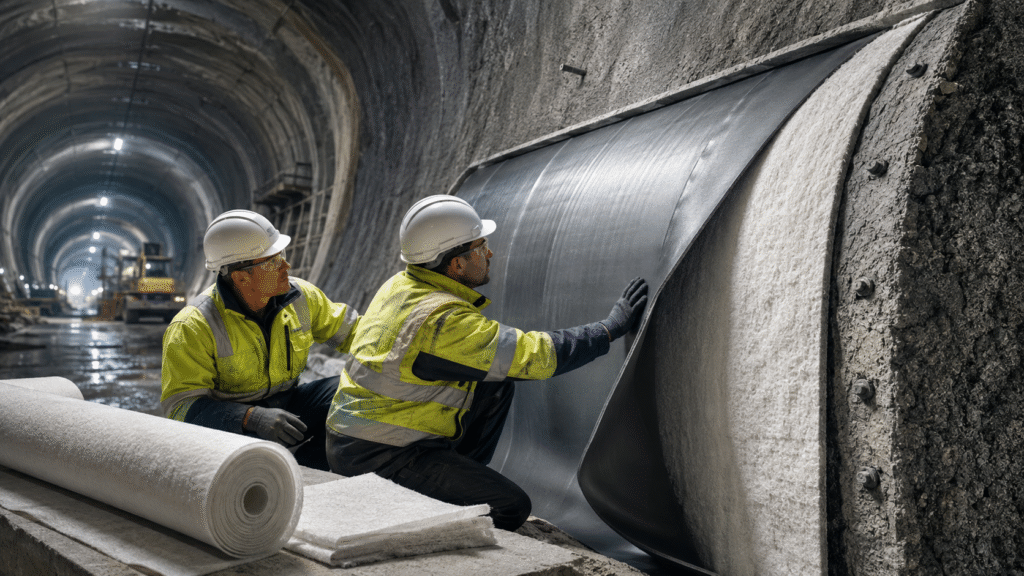
Illustration of nonwoven geotextile between a tunnel substrate and waterproofing membrane
Application illustration from the media library. It shows the protection-layer concept, not a verified Jinseed tunnel project.
Protection, not waterproofing.

A nonwoven geotextile cushions and separates the waterproofing membrane from the receiving surface. The membrane provides the water barrier. Fabric selection depends on the actual substrate, loads, membrane and durability requirements; mass per unit area alone does not establish puncture protection or drainage capacity.

A small layer.
A critical interface.

In a conventional sheet-membrane tunnel lining, the geotextile sits against the prepared initial lining and behind the membrane. The detailed arrangement changes with the waterproofing system, drainage strategy and final lining.

  • 01

    Cushion local contact

    The fabric helps distribute contact from the substrate. Remove protruding steel, sharp points and unacceptable surface irregularities first; geotextile is not a substitute for preparing the receiving surface.

  • 02

    Keep layers appropriately separated

    Specify compatible materials and fixings so the protection layer remains continuous without placing hard points or tension against the membrane.

  • 03

    Define the water-management role

    If the design relies on in-plane flow, check transmissivity under the specified normal stress and boundary conditions. Normal-to-plane permeability does not prove that the fabric can replace a designed drainage composite.

Conceptual tunnel liningGround → interior
Rock / ground supportInitial support system
Prepared shotcreteAccepted receiving surface
Nonwoven geotextileProtection layer
Waterproofing membraneContinuous sealed barrier
Final liningProject-specific structure

Concept only, not to scale. Waterstops, drainage outlets, compartments, fixings and joints must follow the selected system design.

Specify performance beyond “500 gsm”.

A weight designation is useful for identifying a grade, but two fabrics with the same mass can behave differently. Request test methods, directions, conditioning and acceptance values—not only a nominal weight.

Property / decisionWhat the submittal should showSelection implication
Polymer & manufacturePET or PP, filament construction and traceable grade.Match the specified system. Do not substitute PET for a PP requirement without approval.
Mass per unit areaNominal value, tolerance and test method such as ASTM D5261.Useful for QC; not a stand-alone protection rating.
Thickness / compressionTest pressure, thickness and relevant compression behavior.Compare at the stated conditions rather than an unspecified “thickness”.
Index punctureMethod and result, such as ASTM D6241; required minimum.An index test supports comparison. It is not an allowable point load for the installed membrane.
Tensile & elongationTest method and machine/transverse direction results.Review handling, continuity and installation requirements together.
Hydraulic functionPermittivity or transmissivity as required, with conditions.Through-thickness flow and in-plane flow are different functions.
DurabilityExposure, temperature, design life and relevant evidence.Check groundwater chemistry and contact with cementitious materials.
System protectionApproved trial or performance assessment, where specified.Use representative roughness, membrane and loading; not GSM alone.
Unit check: 1 oz/yd² ≈ 33.906 g/m². A 500 g/m² fabric is about 14.75 oz/yd². This is a unit conversion, not proof that two products or specifications are equivalent.

PET or PP?
Start with the approved system.

Jinseed’s published nonwoven product is needle-punched PET continuous-filament geotextile. PET can be a candidate where the project accepts it and the exposure is suitable. It must not be presented as a universal replacement for polypropylene.

  • Check the membrane supplier’s specified protection layer.
  • Identify sustained alkalinity, moisture and temperature; PET hydrolysis needs consideration.
  • Request the project’s durability evidence rather than relying on a generic pH claim.
  • If PP is mandatory, retain that requirement and clarify procurement before quoting an alternative.

For example, Sika’s Sarnafelt NWP-HD is a PP leveling layer listed at 710 g/m². This illustrates a system-specific specification, not a Jinseed equivalence or a universal tunnel minimum. [3]

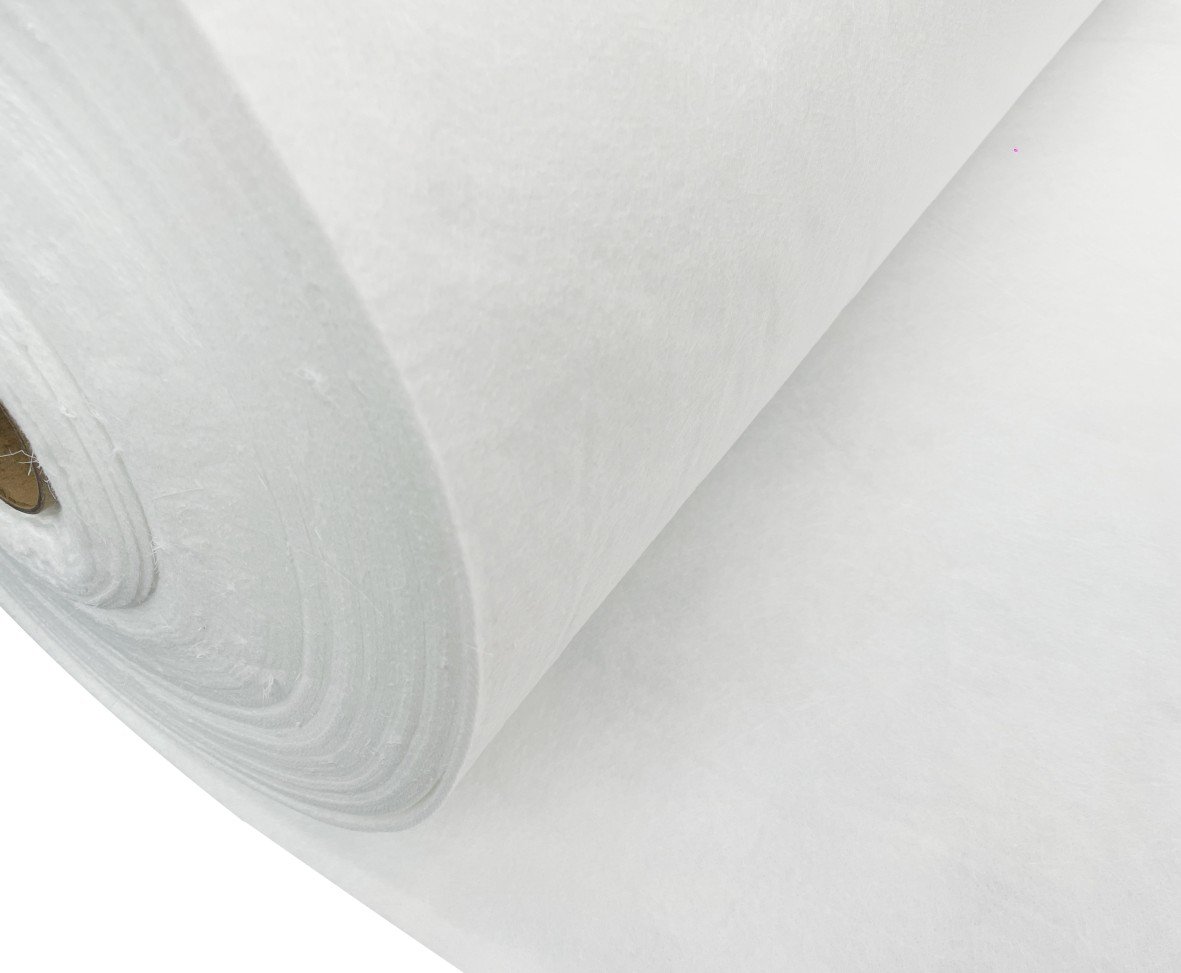
Close view of Jinseed white PET nonwoven geotextile material
Jinseed PET nonwoven material. Confirm the proposed grade against the tunnel waterproofing specification.

Know what the test report actually covers.

The report below concerns one submitted PET sample. Use it to understand the available evidence, then agree grade-specific and supplied-lot documentation for your project.

TRI Suzhou / SCH22214

PET nonwoven, nominal 400 g/m²

Reported
9 December 2022
Control no.
10774
Measured mass
410.7 g/m²
Wide-width tensile
MD 27 / TD 26 kN/m
Permittivity
0.78 s⁻¹

Read the full TRI report ↗

Values shown are the report’s specimen averages: mass by ASTM D5261, wide-width tensile strength by ASTM D4595, and permittivity by ASTM D4491. MD means machine direction; TD means transverse direction. These sample results are not guaranteed minima for every batch or approval of a complete tunnel system.

Build a useful submittal package

  • Proposed polymer, grade, mass and roll dimensions.
  • Data sheet with the correct test methods and directions.
  • Supplied-lot identification and agreed QC records.
  • Required durability and system-protection evidence.
  • Declared differences from the project specification.

See the product range and current management-system certificates. Management certification does not replace tunnel material acceptance.

Accept the surface.
Then protect the membrane.

FHWA tunnel guidance emphasizes a suitable, inspected receiving surface for the waterproofing system. The project documents and membrane supplier define the specific smoothness, fixing and installation details. [1]

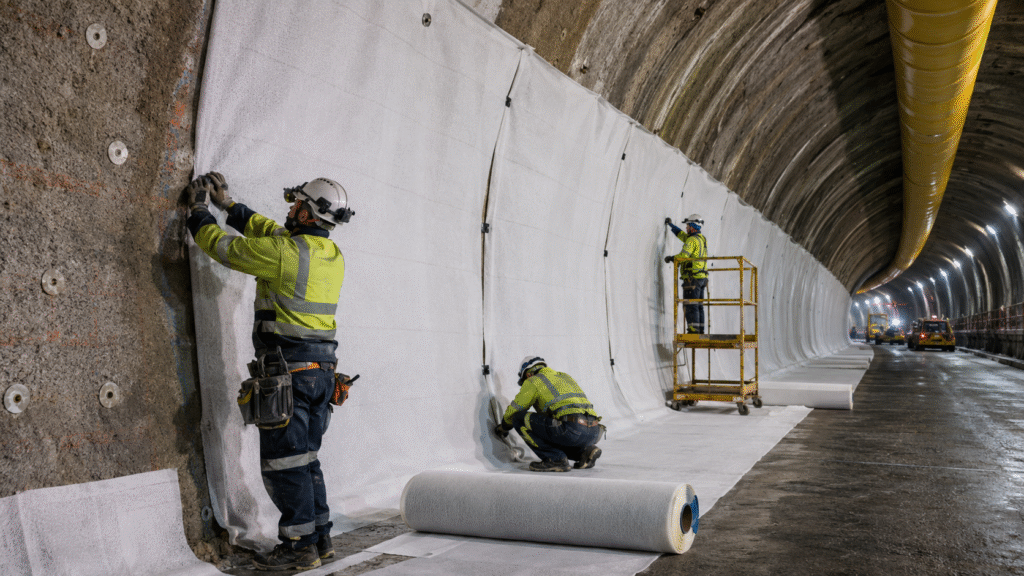
Illustration of geotextile being fixed along a tunnel wall
Installation illustration. Fixing pattern, access equipment and overlap dimensions must follow the approved method statement.
  1. 01

    Inspect the substrate

    Record unacceptable projections, exposed steel, loose material and abrupt transitions. Close repairs before the protection layer hides the receiving surface.

  2. 02

    Maintain continuous protection

    Use specified overlaps and fixings. Keep the fabric supported around corners and details without gaps, excessive tension or bunched layers.

  3. 03

    Release before concealment

    Inspect fabric condition and membrane installation. Record seam tests and repairs separately. Protect accepted work during reinforcement and final lining construction.

Order by coverage.
Check the roll plan.

Use the developed waterproofed perimeter, not the excavation width. Add portals, cross-passages, niches, overlaps and cutting requirements from the actual layout.

  • Confirm roll width against access and installation direction.
  • Compare usable coverage after overlaps, not gross roll area alone.
  • Check roll length, mass and handling limits at the workface.
  • Keep materials clean and protected before installation.

Detailed tunnel quantity guide ↗

Worked example / Coverage before allowances

100 m reach × 20 m lined perimeter

2,000 m²

Fabric mass = area × g/m² ÷ 1,000

At an illustrative 500 g/m², this equals 1,000 kg of fabric before overlaps, cutting and packaging.

The example is a quantity calculation, not a recommended tunnel grade or a shipping weight. Confirm the selected grade, roll schedule and final loading plan.

Answers before the submittal

Is nonwoven geotextile itself waterproof?

No. Its role here is to protect and separate layers. The waterproofing membrane, seams and connection details form the barrier. Any drainage function must be explicitly designed and supported by appropriate hydraulic data.

Is 400 or 500 g/m² enough for a tunnel?

Weight alone cannot answer that. Compare puncture and compression behavior, substrate roughness, loads, membrane type and exposure with the required acceptance criteria. The published 400 g/m² sample report does not establish suitability for every tunnel.

Can Jinseed PET fabric replace a specified PP geotextile?

Only with the responsible designer’s and system supplier’s acceptance of the proposed alternative. Check durability under the actual conditions and the required mechanical and hydraulic properties. A similar weight is not evidence of equivalence.

Does a high ASTM D6241 result guarantee membrane protection?

No. It is an index puncture result for the tested fabric. Protection of the actual membrane depends on the supporting surface, loading, contact geometry and installation. Use system-level assessment or testing where the specification requires it.

Can the fabric replace a drainage composite?

Not automatically. Drainage capacity in the plane of the material must be checked under the specified loading and boundary conditions. Permittivity through the fabric is a different property and cannot be used as a direct substitute.

What do you need to quote tunnel protection geotextile?

Send the project specification, required polymer, membrane system, test methods and acceptance values, roll requirements, quantity, destination and delivery schedule. Identify whether alternatives are permitted and which approvals are required.

From specification to supply

Send the requirements.
Make the comparison clear.

Request a proposed PET grade with the documents needed to review it. Keep required criteria and permitted alternatives visible from the first quotation.

  • Required PET/PP polymer and membrane system.
  • Mass, puncture, tensile, hydraulic and durability criteria.
  • Roll dimensions, quantity and delivery schedule.
  • Destination and required independent testing.

Start your message with “Tunnel protection geotextile”. Send drawings and specifications to info@jinseed-geo.com.

Request a material quotation

联系我们表单

Your inquiry starts a material review. Any substitution, project acceptance and final order remain subject to the agreed specification.

Technical references

Content reviewed 23 October 2026. Follow the selected waterproofing system and project specification for acceptance.

Language »