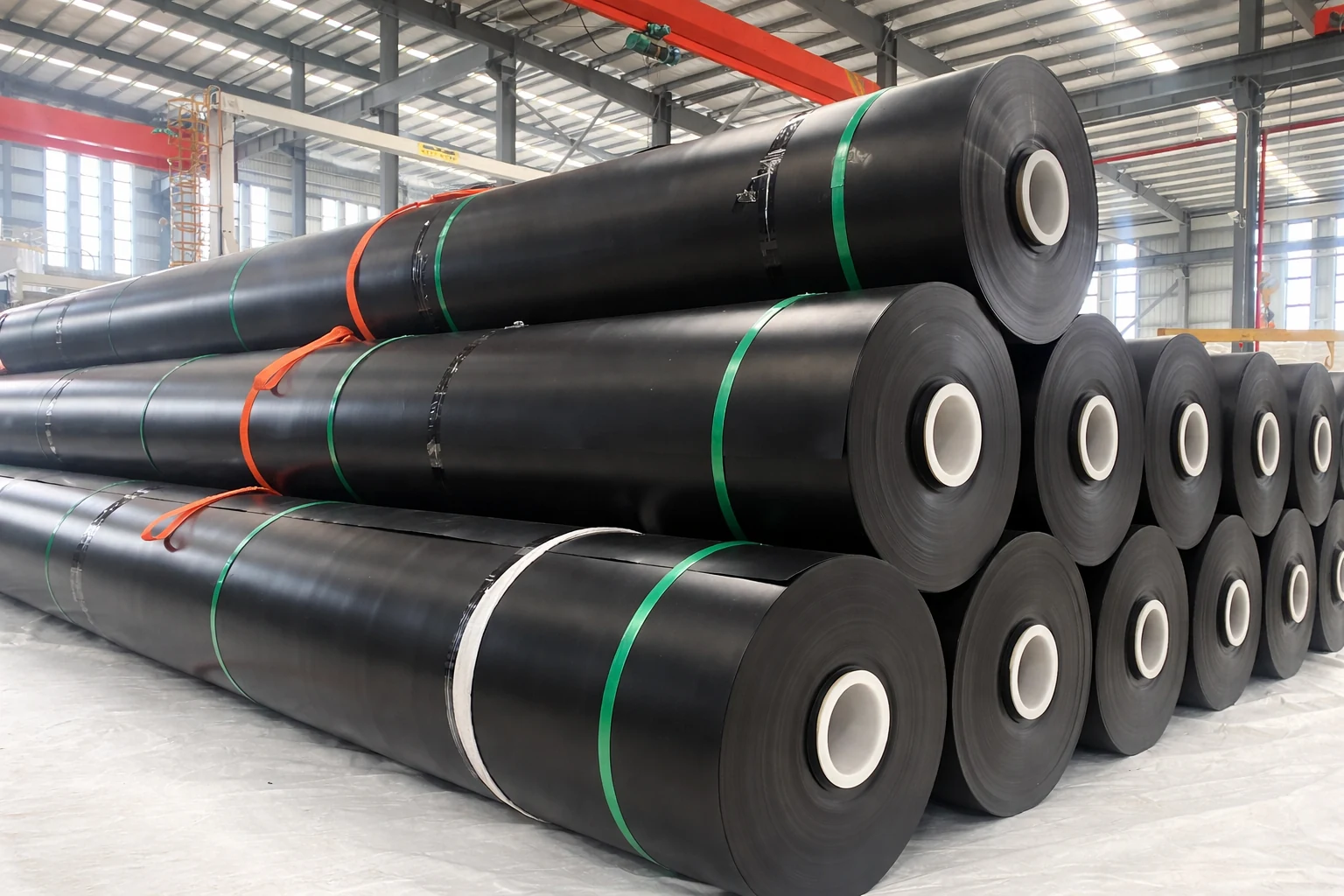
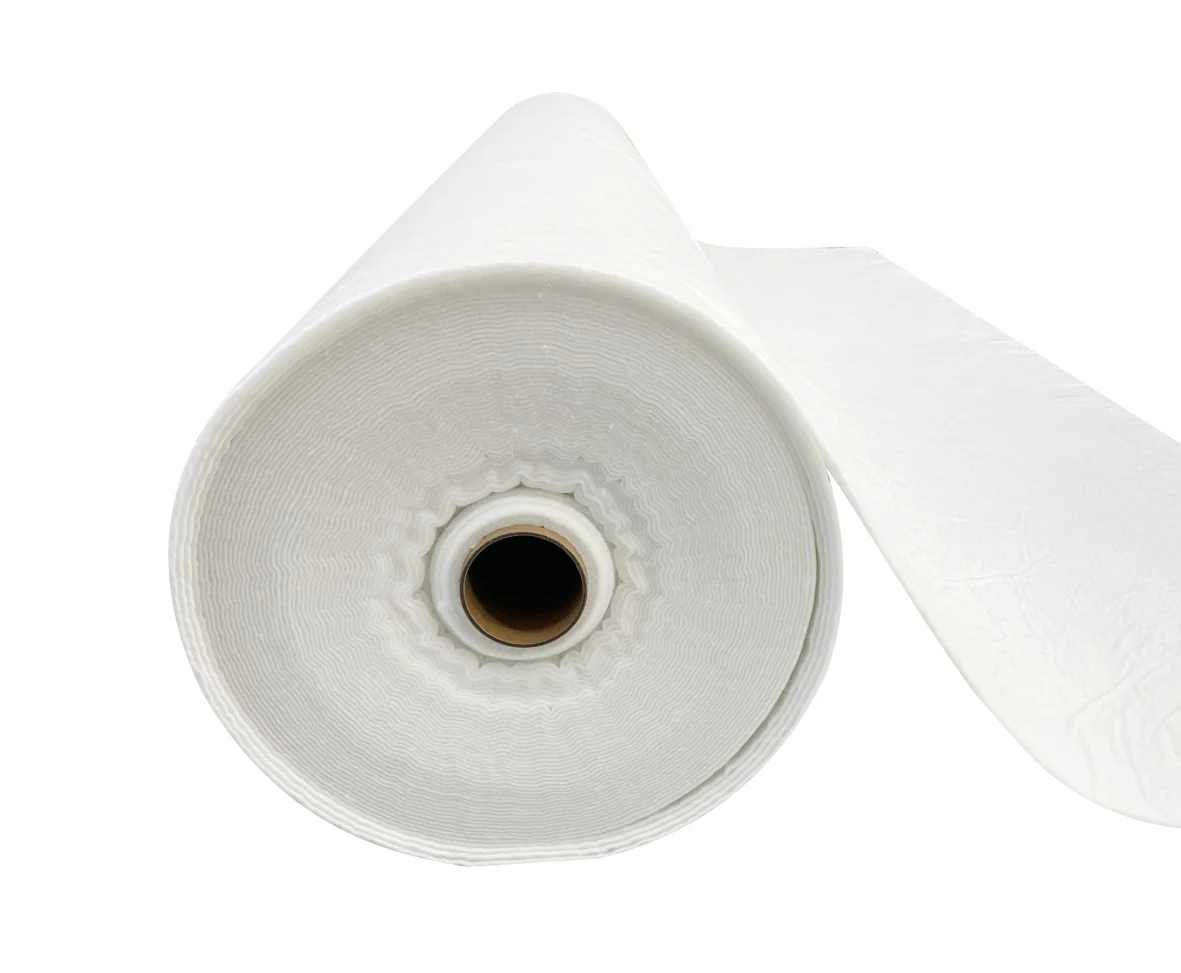

HDPE geomembrane yield tensile strength reaches 18 MPa with break elongation of 700%-800%, while the friction angle difference between smooth and rough surface types reaches 10-15 degrees — a landfill used smooth membrane on an 18-degree slope, and the entire liner slipped after heavy rain, stabilizing only after switching to rough surface.
Slope Stability
Steep Slope Limits
The friction angle between smooth HDPE geomembrane and compacted clay is approximately 20-25 degrees, corresponding to a limiting slope angle of about 18-20 degrees. When slope gradients exceed 18 degrees, the friction between smooth membrane and clay is no longer sufficient to resist the self-weight component parallel to the slope face, requiring rough-surface membrane or additional geotextile reinforcement. The 18-degree limiting angle assumes uniform contact along the entire slope, which is rarely achieved in practice due to subgrade variability and membrane flexibility. I typically apply the 18-degree limit only for slopes with good subgrade preparation and specify rough surface for any slope exceeding 14 degrees if construction quality assurance is uncertain. During my review of a steep-slope landfill with a 25-degree gradient, I found the original design used smooth membrane throughout, requiring anchor trench length to increase by over 60% to achieve adequate safety factors — switching to rough membrane reduced the required anchor length by approximately 40% and eliminated the need for the extended trench.
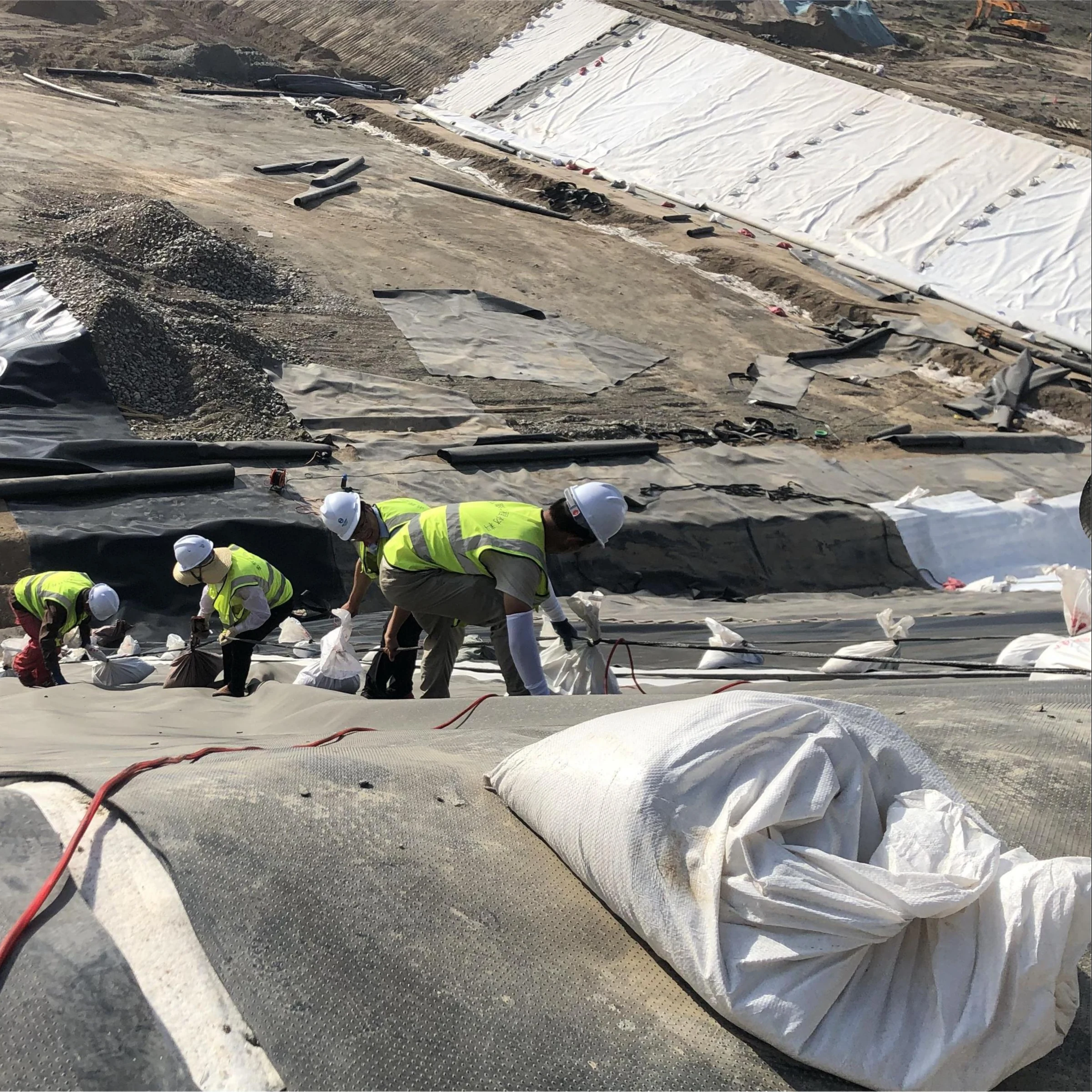
The construction sequence on steep slopes must account for the fact that membrane placement itself creates temporary instability before cover soil is placed. I require that membrane deployment proceed from the toe upward in staged sections no longer than 20 meters along the slope, with each section covered with initial cover soil within the same working day to prevent wind damage or membrane uplift from negative pressure. This staged construction approach adds approximately 15-20% to construction time but eliminates the risk of membrane damage from construction equipment operating on unprotected steep slopes.
GRI GM13 requires that HDPE geomembrane nominal thickness deviation be controlled within plus or minus 10% to ensure the specified friction angle performance, with rough surface height at least 0.25mm.
Safety Basis
Slope stability analysis must verify three conditions simultaneously: the membrane body must have adequate tensile strength to resist imposed loads without rupturing; the anchorage trench must provide sufficient uplift resistance to prevent the membrane from being pulled out of the ground; and the membrane-soil interface must develop adequate shear strength to transfer imposed forces safely into the surrounding soil mass. Among these three conditions, the interface friction angle is the core parameter that determines the overall safety factor because it controls both the anchorage trench capacity and the interface shear resistance. The peak friction angle between smooth HDPE and clay is approximately 22 degrees, while rough surfaces using column-textured or nitrogen-roughened processes can increase this to 30-36 degrees. During a tailings reservoir project I worked on, laboratory testing of field samples showed the rough surface friction angle reached 34 degrees — far exceeding the design value of 28 degrees — giving the slope a calculated stability safety factor of 2.4 under operating conditions.
The selection of friction angle parameters for slope stability analysis must distinguish between peak conditions and fully softened long-term conditions. I always apply a strength reduction factor of 0.75 to the peak friction angle when analyzing long-term behavior because cyclic loading and environmental exposure gradually degrade the interface roughness over the project design life. For the design life calculation, I use the fully softened friction angle as the baseline value and then verify that the required anchor length at this reduced value still fits within the available slope geometry — if it does not, I specify rough-surface geomembrane from the outset rather than relying on post-construction monitoring to identify inadequate design.

Sliding Prevention
Slope anti-slip design follows a 2.0 safety factor principle: the resisting forces from friction must exceed the driving forces from self-weight by a factor of 2.0 under extreme conditions, ensuring that extreme loads cause the membrane to fail in localized stretching before the entire system slides. This principle means the membrane itself should reach its yield strength before the interface reaches its shear strength. The friction angle between smooth HDPE and clay is approximately 20-25 degrees, while rough surfaces can reach 30-36 degrees — meaning on an 18-degree slope, the anti-slip capacity of rough surfaces is nearly double that of smooth surfaces under identical conditions. I have observed a case where smooth membrane on a 20-degree slope experienced complete sliding failure during heavy rainfall, with all displacement readings dropping to zero suddenly at the moment of failure; after switching to rough surface, the monitoring data stabilized and no further movement was detected over the following two years of observation.
- Slopes 18-25 degrees: rough HDPE membrane recommended
- Slopes 25-35 degrees: rough membrane plus anchorage trench combined
- Slopes exceeding 35 degrees: buffer platform or double rough membrane required
I encountered a case on a 32-degree waste residue landfill where rough membrane combined with a properly designed anchorage trench still experienced sliding — investigation revealed the anchorage trench was only 0.4 meters deep with backfill compaction at approximately 82% of standard Proctor density, making the anchor zone itself the weak link in the system rather than the membrane interface. This case illustrates that anchorage trench design must be verified independently from membrane selection, and that backfill compaction quality is as critical as trench geometry.
Friction Angle
Friction Comparison
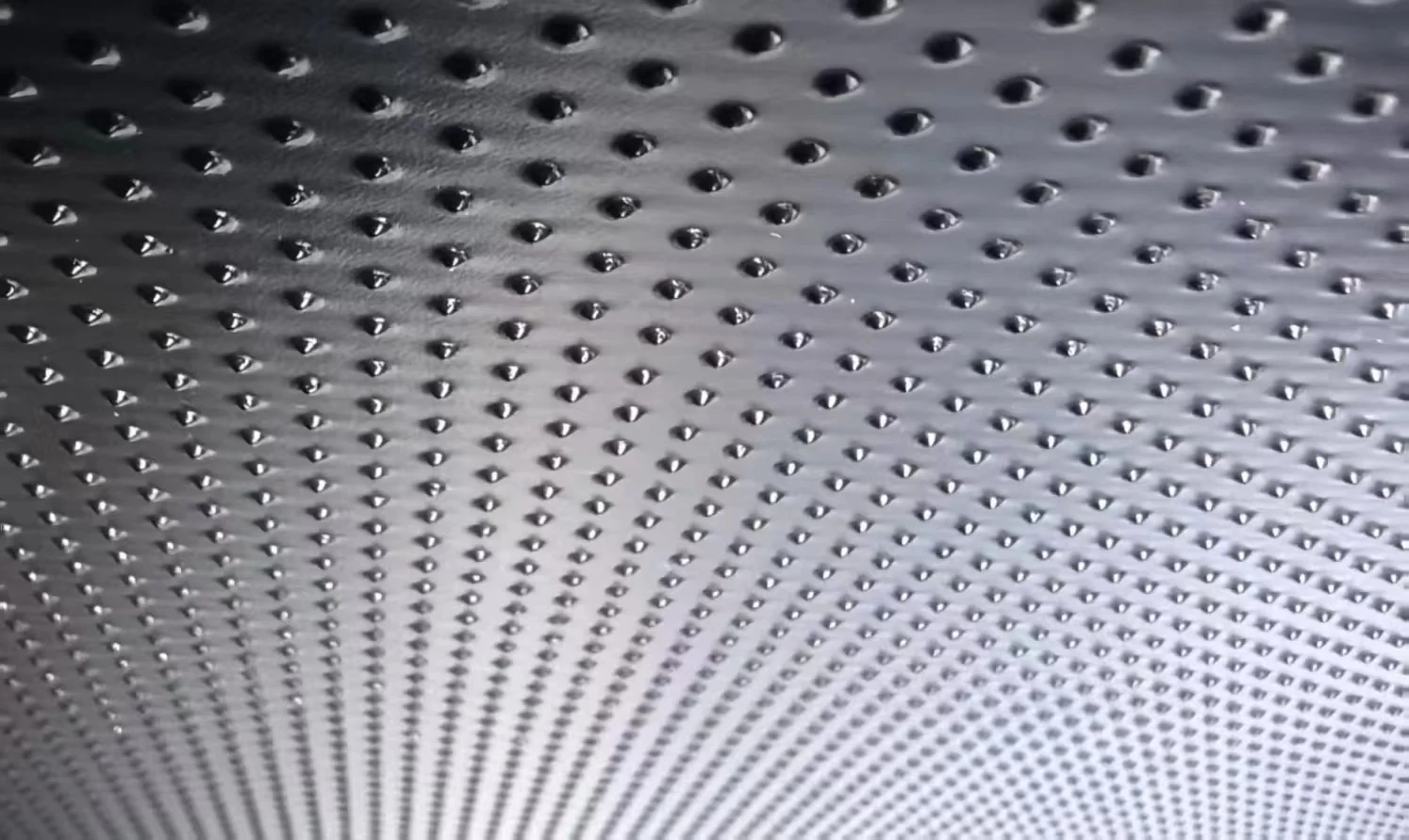
The friction angle difference between smooth and rough HDPE membrane derives primarily from surface roughness. Smooth membrane has a surface roughness Ra value of less than 0.8 micrometers, producing a friction coefficient of only 0.2-0.3 against compacted clay. Rough membrane forms a granular surface texture through column-textured, nitrogen-roughened, or spray-roughened manufacturing processes, raising the effective friction coefficient to 0.4-0.6 — this difference of approximately 0.2-0.3 in friction coefficient is the decisive factor in slope anti-slip design. The surface roughness of HDPE geomembrane is quantified using the Ra parameter measured by profilometry, but the friction coefficient depends more critically on the Rsm (mean spacing of roughness profile peaks) than on Ra alone. A surface with high Ra but widely spaced peaks provides less mechanical interlock with soil particles than a surface with moderate Ra but closely spaced peaks. I require that roughness specifications include both Ra and Rsm data from the manufacturer to verify that the specified surface geometry will achieve the design friction coefficient under actual field conditions.
ASTM D5321 specifies the test method for shear testing of geosynthetic-soil and geosynthetic-geosynthetic interfaces, requiring reporting of both peak shear strength and residual shear strength parameters to characterize the full interface behavior from peak through post-peak softening.
Soil Interaction
The interface friction mechanism between HDPE geomembrane and soil differs fundamentally from soil particle-to-particle friction. The soil-membrane interface friction angle depends on three interacting factors: membrane surface roughness, soil particle shape and angularity, and the magnitude of normal stress acting perpendicular to the interface. I conducted direct shear tests on different sand types against smooth HDPE: angular gravel sand with sharp edges achieved a peak friction angle of approximately 28 degrees, while rounded gravel sand with smooth particles reached only 22 degrees — a 6-degree difference attributable to particle angularity. Angular particles with sharp edges penetrate the soft HDPE surface slightly, creating mechanical interlock in addition to pure friction, while rounded particles rely primarily on surface friction alone.
The magnitude of the friction coefficient between geomembrane and soil is not a material constant but depends significantly on the normal stress level. At low normal stress below 50kPa (typical of shallow cover conditions), the friction coefficient is higher because soil particles interlock more effectively with membrane surface texture. At high normal stress above 200kPa from thick cover layers, the friction coefficient decreases as soil particles are pressed flat against the membrane, reducing the effective roughness contribution. When geomembrane is used in combination with geotextile, the interface shear characteristics exhibit strain-softening behavior. Research from Zhejiang University’s Geotechnical Institute demonstrates that rough geomembrane-geotextile interfaces are strain-softening type, with strength loss coming from geotextile fiber damage and rough surface abrasion during shearing — this is a time-dependent degradation process that is more pronounced in high-temperature or chemically aggressive environments.
Lin Weian, Zhan Liangtong, and Chen Yunmin’s research on HDPE Geomembrane/Geotextile Interface Shear Characteristics found that rough HDPE-geotextile interface peak strength exceeds smooth, but the post-peak strength loss rate is also approximately 15%-20% higher than smooth interfaces, requiring additional safety margins in design.
Laboratory Testing
On-site direct shear testing is the most reliable method to determine the actual interface friction angle for a specific project. I typically require at least 3 parallel test groups per project, tested at optimal moisture content and at plus or minus 2% moisture deviation conditions to cover the likely range of field moisture fluctuations during construction and operation. Normal stress in testing should simulate the pressure corresponding to actual cover layer thickness at the location of interest on the slope. The testing protocol requires careful attention to shear displacement rate, which determines whether drained or undrained conditions prevail during the test. For low-permeability clay subgrades, I specify a shear displacement rate not exceeding 1mm per minute to ensure excess pore pressures dissipate during testing, producing drained shear strength parameters appropriate for long-term design conditions.
The difference between peak friction angle and residual friction angle is another critical design indicator. Larger differences indicate greater interface degradation during shearing, meaning the interface loses more strength after peak. During a project test, I measured smooth HDPE versus clay at a peak friction angle of 22 degrees with residual friction angle at only 16 degrees — a 6-degree difference of approximately 27% reduction from peak, meaning long-term strength under repeated loading may be only 70%-80% of the peak laboratory value. The interpretation of direct shear test results requires attention to post-peak behavior, not just the peak value. I specify that test reports include both peak and residual values with explicit notation of the displacement at which each occurs, and I use the smaller of peak minus one standard deviation or residual plus 2 degrees as my design friction angle — a conservative approach that accounts for both statistical variation and strength degradation over the project lifetime.
Interface Shear Strength
Contact Area
Interface shear strength relates not only to friction angle but also directly and critically to contact area between the membrane and subgrade soil. The effective contact area between HDPE membrane and soil depends on membrane laying flatness, subgrade surface uniformity, and the presence of any voids or debonded zones. I once used infrared thermal imaging to check membrane laying quality on site during construction — this revealed membrane debonding areas where effective contact area was only approximately 75% of the total surface area, causing actual shear strength to fall more than 20% below laboratory values. The reduction in effective contact area due to membrane debonding or subgrade irregularity is not uniformly distributed across the slope. I have observed during construction inspections that debonding typically concentrates in areas where the subgrade was not properly compacted — around soft spots, near drainage channels, or where construction traffic created wheel ruts before membrane installation.
I specify a minimum subgrade compaction of 95% of standard Proctor maximum dry density within 300mm of the membrane interface, and I require nuclear density gauge verification at grid intervals not exceeding 5 meters across the entire slope surface before membrane deployment begins. The nuclear density gauge provides rapid in-situ density measurements but requires calibration against actual soil samples at each project location because gauge readings are sensitive to soil chemistry and mineral composition. I require a minimum of one calibration check per 500 square meters of subgrade, with additional checks whenever soil source changes or whenever gauge readings in adjacent areas differ by more than 2%. Without proper calibration, the reported compaction percentage may deviate by 3-5% from actual conditions — a gap that becomes significant when the target is 95% of maximum Proctor density.
Per GRI GM13, HDPE geomembrane density must be at least 0.94 g/cm3 with melt index within specified ranges to ensure material uniformity and long-term performance stability across the entire membrane roll.
Water Effects
Water has a significant negative impact on the geomembrane-clay interface strength through two mechanisms: reduced effective normal stress from pore water pressure and lubrication of the membrane-soil interface. Leachate or rainwater infiltrating beneath the membrane reduces the effective normal stress acting at the interface while simultaneously lubricating the contact surface between membrane and soil. During a landfill project I participated in, field measurements showed that after water ingress, interface cohesion dropped by approximately 30%-40% and friction angle decreased by approximately 3-5 degrees. Under wastewater immersion conditions simulating actual leachate exposure, the rough HDPE friction coefficient decreased to levels approaching those of smooth HDPE — effectively eliminating the rough surface advantage in wet or contaminated environments.
High water table or leakage-risk areas cannot rely solely on rough surface selection for slope stability — a properly designed drainage system must work in conjunction with membrane selection. Drainage cushion layers or geotextile drainage layers must be included to quickly drain water trapped beneath the membrane, preventing pore pressure buildup that would reduce effective stress across the interface. In my designs, I reduce the wet-state friction angle by at least 20% as a conservative safety margin against moisture effects, and I specify additional drainage capacity for areas where leakage is anticipated based on waste characteristics or operational history. The chemical composition of leachates in landfill applications can worsen interface strength degradation beyond what pure water infiltration would suggest. I increase the safety factor from 2.0 to 2.5 for applications with chemically aggressive leachates to account for the additional uncertainty about long-term chemical effects on interface strength.
Material Selection
The choice between smooth and rough HDPE geomembrane depends on slope gradient, loading conditions, and service environment — there is no universal best option. For flat surfaces or gentle slopes less than 18 degrees in standard lining projects, smooth membrane is sufficient and offers more stable welding quality with higher seam strength under field conditions. For slopes or vertical walls exceeding 18 degrees, rough membrane is the preferred choice because the friction angle advantage translates directly to reduced anchorage requirements and improved safety factors. Rough surface types vary in their mechanical properties: column-textured surfaces offer high elongation at break but slightly lower friction coefficients; nitrogen-roughened surfaces offer high friction coefficients but lower elongation; new spray-roughened surfaces offer optimal all-around performance but at higher material cost.
- Thickness selection: 1.0-1.5mm for simple cover projects, 2.0mm for areas with stones, roots, or complex foundation conditions
- Rough surface types: column-textured has high elongation but slightly lower friction; nitrogen-roughened has high friction but lower elongation; spray-roughened offers optimal all-around performance at higher cost
- Price reference: smooth membrane approximately USD 8-15 per square meter, rough approximately USD 12-25 per square meter (for 1.5mm thickness)
| Parameter | Smooth HDPE | Rough HDPE | Remarks |
|---|---|---|---|
| Surface roughness Ra | <0.8 micrometers | 0.8-3.0 micrometers | Affects friction coefficient |
| Friction angle (vs clay) | 20-25 degrees | 30-36 degrees | Peak friction angle |
| Friction coefficient | 0.2-0.3 | 0.4-0.6 | At 100kPa normal stress |
| Recommended slope limit | <18 degrees | >18 degrees | With anchorage trench design |
| Yield tensile strength | 18 MPa | 18 MPa | Same specification |
| Break elongation | 700-800% | Varies by process | Column/nitrogen/spray differs |
Material selection logic follows three steps: slope gradient determines whether rough surface is needed, soil conditions set the safety factor value, and leakage risk dictates whether additional drainage configuration is required. A tailings reservoir return visit in the eighth year of operation showed that choosing the higher-priced spray-roughened geomembrane (USD 25 per square meter versus USD 12 for smooth) cost approximately USD 400,000 more upfront but avoided 3 slope repair projects over 8 years, saving USD 2 million in repair costs — the long-term comprehensive benefit makes rough surface selection often the more economical choice on steep slope projects despite the higher initial material cost.