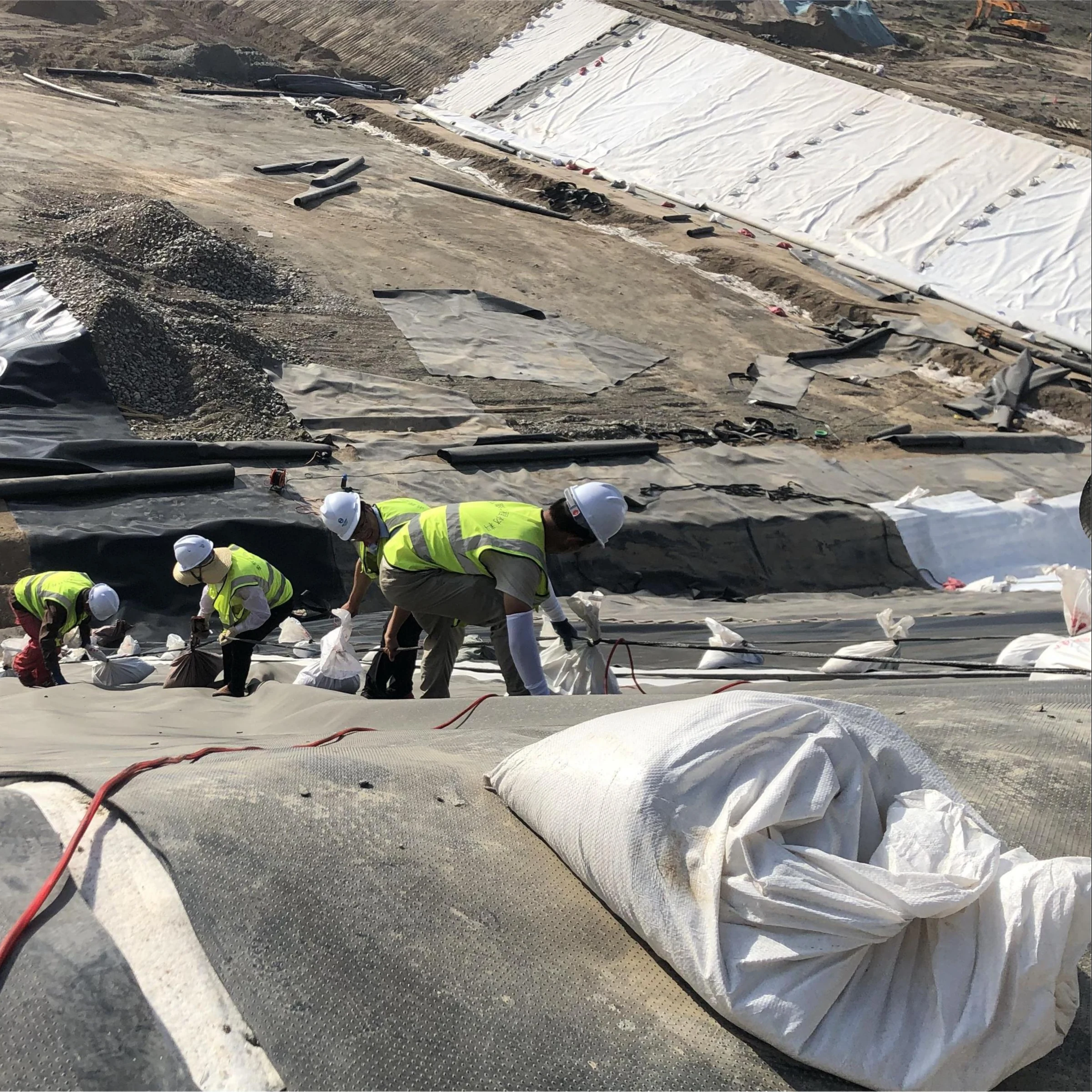

Industry data from 58 completed projects (cumulative area 1,409,500 m2) shows an average leak density of 6 leaks per hectare, with 11 of those 58 projects exceeding 20 leaks per hectare (source: Alphard Leak Location, 2025). Undetected leaks mean contaminants reaching soil and groundwater — remediation costs run 3 to 5 times higher than prevention costs. Conducting a professional ELL survey after geomembrane installation and before geomembrane cover is therefore a mandatory quality gate for project acceptance.
Spark Testing
Working Principle
Spark testing applies a high-voltage pulse of 15,000V to 35,000V between the geomembrane and the conductive sublayer beneath it. The technician moves the detection probe slowly across the membrane surface, keeping the probe tip 1 to 10mm from the sheet. When a breach of 1mm or larger exists at a point, current passes through that point to complete the electrical circuit, producing a visible spark and triggering simultaneous audio-visual alarms — the operator records the leak location at that moment. Standard ASTM D7240 governs the capacitive leak location method, and ASTM D6365 governs spark testing of field seams; both require the tested membrane surface to be flat, dry, exposed, free of debris, and in an insulating condition.
I worked on a landfill project where the 3mm HDPE liner had surface condensation from early morning dew — five consecutive alerts appeared before we wiped the surface dry and confirmed they were false positives from moisture interference, not actual leaks. That incident taught me to always check surface humidity with a hygrometer before beginning formal detection each day.
Pulse frequency and waveform are core equipment parameters that vary by manufacturer: some units use DC pulses (fast response, suitable for rapid scanning) while others use low-frequency AC pulses (more stable signal, better for complex sites). Before testing, the operator should consult the equipment manual to confirm the appropriate pulse mode for the current site conditions — for example, when metallic pipelines exist underground, AC mode typically offers better anti-interference performance than DC mode.
Calibration verification frequency is governed by the specific equipment manufacturer’s recommended schedule and the applicable standard. For ASTM-compliant operations, the probe ground reference electrode must maintain firm contact with the conductive sublayer throughout the entire detection pass — any loss of ground contact interrupts the electrical circuit and produces invalid readings. Technicians should verify ground continuity at the start of each new grid row before commencing scanning.
Dry Surface Detection Specifications
Dryness is the first prerequisite for spark testing. Surface moisture causes current to disperse across the water film, producing false positive signals. On-site calibration is mandatory: first create an artificial hole roughly 1mm in diameter using a metal needle, power on the unit, and verify that the equipment correctly detects the spark from that known hole — only then may formal detection begin. During scanning, probe travel speed should be controlled at approximately 0.5m/s; too fast risks missing leaks, too slow reduces efficiency.
Grid division also requires care: typically scan row by row on a 1m by 1m or 1m by 2m grid, then after completing each pass move half a grid width and scan back, ensuring probe coverage with no blind spots. Maintain the probe-to-membrane distance of 1 to 10mm throughout; excessive distance reduces sensitivity while insufficient distance risks scoring the membrane surface. When encountering surface irregularities or weld seam ridges, lift the probe slightly to avoid mechanical damage while logging the anomaly for recheck.
Recalibration is required at the start of each day, after any lunch break, after every 2-hour work interruption, when ambient temperature shifts more than 5 degrees C, and whenever the operator changes. One project case illustrates why these checkpoints matter: after a lunch break, the team skipped recalibration and missed 3 consecutive leaks of 1 to 2mm each — the omissions were only caught during the client’s third-party reinspection, requiring a full rework of the repair batch at an additional cost of approximately $22,000.
The 1mm diameter artificial calibration hole must be created using the same membrane material as the project geomembrane, not cardboard or other surrogate materials. Different geomembrane materials (HDPE versus PVC versus LLDPE) have different electrical resistivity, and a calibration hole in the wrong material produces misleading sensitivity settings. Some operators pre-cut several calibration holes at the project start, store them in a labeled bag, and reuse them for daily recalibrations to ensure consistency.
Precise Detection of Tiny Holes
The detection sensitivity ceiling for spark testing is 1mm — the universally recognized threshold in the industry. In actual projects, 1mm-scale pinholes are nearly invisible on the membrane surface and cannot be judged by eye, yet the spark method can precisely locate them. During a landfill cover project, the detector found a 1.2mm pinhole that the site engineer initially dismissed as a surface color variation rather than a genuine breach — laboratory analysis of the excised sample confirmed it was a puncture from a sharp stone. This case illustrates that no visual abnormality does not equal membrane integrity; spark testing provides numerical verification that is more reliable than visual inspection.
Precise location determination has two dimensions: first, identifying the approximate leak zone (accuracy approximately 0.5m radius), then conducting detailed scanning within that zone for exact pinpointing. When the initial alert fires, mark the location and then scan spirally outward from that mark at a slower rate (0.2 to 0.3m/s) within a 1m2 area — the point of strongest spark intensity is the leak’s precise location. Experienced operators can control location accuracy within a 50mm radius.
It is important to note that the “precision” of spark testing refers to hole-size resolution, not coordinate precision. If a project requires coordinate-level positioning (such as for GIS system integration), RTK GPS must be used to synchronously record coordinates at each alert, achieving accuracy of plus or minus 20mm. In environmentally sensitive projects such as hazardous waste landfills, coordinate-level positioning is commonly mandated by regulators.
Coordinate-level positioning requires the RTK GPS antenna to be physically attached to the spark tester handle or probe frame, so that each alert automatically records the GPS coordinates at that exact moment — no manual waypoint entry is required. For projects using GIS-based asset management systems, coordinate data should be submitted in ESRI Shapefile or GeoJSON format to enable direct integration with the client’s spatial database, eliminating manual digitizing steps that introduce positional errors.
Arc Testing
Large-Area Detection
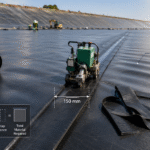
Arc Testing is a mobile leak location technique suitable for large-area exposed geomembranes, with the core equipment being a portable arc tester (such as the SENSOR DDS MIT Arc Tester). Its principle uses a moving electrode array on the membrane surface to generate a low-voltage electric field grid (typically arranged in a 1m by 5m pattern); when the electrodes pass over a damaged zone, the local electric field distorts, and the instrument captures this signal variation and records the location. ASTM D7953-20(2024) is the primary standard for arc testing, applicable to pre-cover landfill caps, reservoirs, and tank basins.
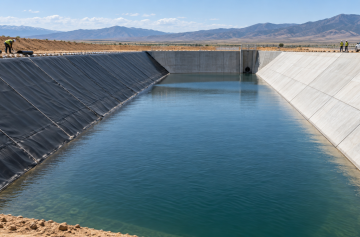
The primary advantage of arc testing is that it requires no water or conductive liquid beneath the membrane, the equipment is portable, and it handles rough terrain. In an abandoned mine acid-water reservoir project where membrane surface elevation changes exceeded 3m, the traditional water puddle method was inoperable — switching to arc testing completed 18,000 m2 of detection within two days, finding and repairing 7 leaks before geomembrane cover was applied. For comparison, the same project using traditional point-by-point vacuum testing would have required at least 5 days.
Arc testing efficiency ranges from 2,000 to 5,000 m2/h, far exceeding spark testing’s 500 to 800 m2/h, making it the preferred method for large-area projects. Its drawback is lower location precision than spark testing — arc testing typically localizes leaks within a 0.5 to 1m radius rather than to exact coordinates. For projects requiring precise coordinates, a secondary spark testing pass within suspicious zones must follow the arc scan for accurate pin-pointing.
Arc testing electrode array configurations vary by manufacturer and project scale. The 1m by 5m rectangular array is standard for flat, even terrain; for irregularly shaped basins or areas with protrusions, a circular or triangular array may provide better coverage at corners and edges. Some operators pre-survey the site geometry before selecting the array configuration, which can reduce total scan time by 15 to 20 percent on complex-shaped projects.
Wet Surface Detection Applications
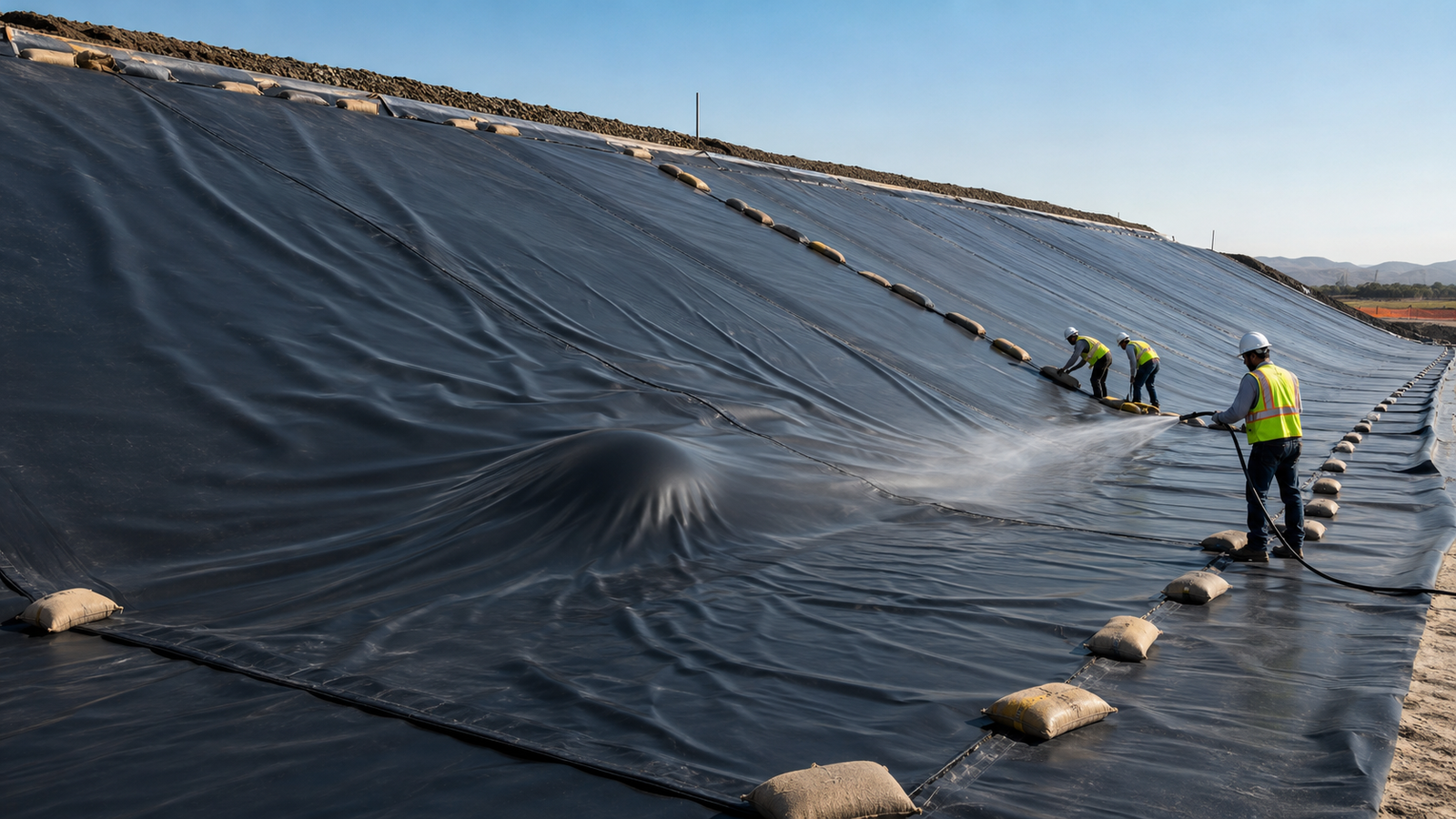
When the geomembrane surface has standing water or wet conditions, the Water Puddle Method takes priority. ASTM D7002 governs this method: when 2 to 3cm of water exists on the membrane surface, immerse electrodes in the water to apply current; the current conducts downward through the water layer, and if a breach exists in the membrane, current passes through the breach into the conductive sublayer, completing the circuit. By measuring the electric field gradient change in the water, the leak point is located. The water puddle method does not require the membrane surface to be completely dry, giving it a unique advantage in post-rain inspection scenarios.
During a tailings dam project, after heavy rainfall the dam crest water level exceeded design elevation and the geomembrane cover work was delayed — the client asked us to perform inspection under standing water using the water puddle method, locating 3 leaks within one hour and enabling timely repairs to resume construction. Waiting for the water to fully drain would have required an additional 2 to 3 days of delay, costing approximately $18,000 in avoided schedule losses.
Limitations of the water puddle method include water layer thickness requirements: below 2cm depth, electrical resistance is too high and the signal becomes weak or undetectable; above 10cm depth, the electric field disperses excessively, reducing location precision. Additionally, suspended particles in the water (such as fine sand or clay) affect conductivity — conductivity should be measured with a probe before testing, and if too low, the water should be replaced before proceeding.
The water puddle method requires that the water layer be electrically continuous — standing water isolated in separate puddles separated by dry geomembrane ridges will not form a continuous conductive path. Before commencing the survey, the operator should walk the entire flooded area and verify that all standing water pools are connected. In practice, this means ensuring the water depth is sufficient to overflow any geomembrane crests between pools, maintaining electrical connectivity across the entire flooded zone.
Detecting Concealed Seam Defects
Seams are the weak points of geomembrane systems — hot wedge or extrusion weld lap zones with incomplete fusion create concealed leak pathways that are invisible from the membrane surface. Arc testing identifies these defects through localized electric field anomaly signals. When electrodes pass over an incompletely fused zone, the local electric field distribution differs subtly from the normal area, and the instrument records this anomaly.
Important: arc testing detects defect zones rather than precise coordinates. Once an anomaly is found, secondary detailed scanning (such as point-by-point spark probing within that zone) is required to pinpoint the actual hole. In a petrochemical tank bottom project, the initial arc scan flagged a suspected defect zone; subsequent spark probing on a 0.5m by 0.5m grid within that area finally located an 0.8mm seam microcrack, which was repaired and passed retest.
Incomplete fusion in hot wedge weld lap zones typically occurs in two forms: weld filler not fully filling the lap gap (slag inclusion), or local non-fusion due to insufficient welding temperature. The former typically produces a continuous linear anomaly signal during arc scanning, while the latter produces discrete point anomalies. When analyzing scan data, operators should cross-reference construction logs with seam numbers and timestamps to help determine anomaly type for more efficient repair planning.
Arc testing data interpretation requires operator experience — the signal anomaly produced by a slag inclusion differs from that of a genuine hole, and both differ from anomalies caused by surface moisture or subsurface geological features. Experienced technicians build pattern recognition over dozens of projects, which is why some inspection companies assign senior operators to seam scans specifically, while junior technicians handle open-area scanning where signal interpretation is more straightforward.
Third-party reinspection should always follow seam repairs, particularly for microcracks in extrusion welds, which are the most difficult seam defect type to fully repair due to limited access for re-welding tools. ASTM D7747 provides guidance on minimum reinspection extent following seam repairs, generally requiring a 5m radius retest around each repair location.
Post-Installation Integrity Testing
Quality Verification
Post-installation integrity testing is a critical step in geomembrane project acceptance. Verification covers: cross-checking the installed membrane against as-built drawings to confirm coverage completeness, overlap width, and penetration details; compiling all ELL test results into a report; cross-referencing with construction logs and seam inspection records to verify the overall integrity of the containment system.
A complete ELL report must include: total inspected area, detection method used, instrument model and calibration records, on-site environmental conditions at time of testing (temperature, humidity), coordinates and estimated aperture for every detected leak, repair recommendations, conclusions, and the inspecting organization’s credentials.
One hidden risk in the verification process is that some contractors perform repairs without reinspection afterward, potentially leading to repeated damage at the same location. A thorough ELL report should document every repair’s timestamp, method, operator, and reinspection result, forming a complete closed-loop record. When accepting the project, clients should require the inspection firm to provide the full repair-reinspection trace, not just the initial survey results.
The ELL report sign-off process should involve three parties: the installing contractor (confirming they received the report and reviewed repair recommendations), the independent ELL inspector (certifying the accuracy of detection results), and the project owner or their representative (formally accepting the report as part of project closeout). A report without three-party sign-off may not satisfy regulatory audit requirements, even if the technical content is complete and accurate.
Digital submission of ELL reports is increasingly required by regulatory agencies, with data delivered in standardized formats such as PDF/A for document preservation and CSV or SHP for spatial leak data. Projects bid under US federal regulations (such as RCRA Subtitle D) have specific data format requirements that must be verified before the inspection contract is signed, as post-inspection format conversion can introduce data integrity risks if not handled carefully.
Preventing Future Leaks
The ELL report provides the project owner with baseline as-built data. If abnormal settlement or structural deformation occurs on-site in the future, comparing a new inspection against the baseline enables rapid determination of whether new damage has occurred. Some projects employ a dual-verification strategy: initial acceptance uses arc testing for a comprehensive scan, while periodic follow-up during operations uses the water puddle method — the two methods cross-verify each other, minimizing miss rates to the greatest extent possible.
ELL detection data combined with construction process photographs, seam logs, and concealed-work records together form a complete quality archive. With this archive, the project owner can demonstrate containment system engineering quality to regulatory agencies and can continuously track membrane surface condition throughout the operational period, reducing long-term environmental liability exposure.
From an environmental liability perspective, the true value of the ELL baseline archive is its timestamp function: if a leak event occurs, the owner can demonstrate that the contamination was caused by post-construction external factors (such as heavy equipment crushing or structural settlement) rather than construction-period defects, thereby distinguishing liability attribution. Projects lacking baseline data face near-impossible burden of proof efforts once contamination occurs, and owners typically bear full responsibility.
The baseline ELL archive also serves as an operational risk management tool — if a geomembrane is damaged by a specific operational event (such as a vehicle collision or dropped equipment), the post-event ELL survey can be directly compared to the baseline to quantify the new damage extent, supporting insurance claims and incident reporting. Without a baseline, it is impossible to distinguish new damage from pre-existing conditions, complicating both insurance settlements and regulatory notifications.
Operational ELL monitoring frequency should be risk-based: high-traffic areas adjacent to containment zones warrant annual reinspection, while low-activity zones may only require reinspection every 3 to 5 years or after significant operational changes. Risk-based scheduling reduces long-term monitoring cost while maintaining adequate environmental protection for the highest-risk areas of the facility.
Simple Report Preparation Guide
The core of an ELL report is data — leak count, location, estimated aperture, and repair status, each with clear documentation. Recommended report structure: Executive Summary (inspected area, method used, total leak count — summarized within one page); Leak List (coordinates, aperture, type — hole / seam defect / mechanical damage — and whether repaired, with on-site photos); Calibration Records (instrument model, calibration date, calibration aperture parameters); On-site Conditions (inspection date, temperature, humidity, membrane surface condition description); Conclusions and Recommendations (whether this inspection passes, repair list, and follow-up schedule).
- Executive Summary: inspected area, detection method, total leak count — within one page
- Leak List: coordinates, aperture, type, repair status, with on-site photos
- Calibration Records: instrument model, calibration date, calibration aperture parameters
- On-site Conditions: inspection date, temperature, humidity, membrane surface condition description
- Conclusions and Recommendations: whether this inspection passes, repair list, and follow-up schedule
The report submission timeline is equally important: the initial survey report should be submitted before repairs are finalized, giving the client adequate time to evaluate the repair approach; the final report (including all reinspection results) should be submitted before geomembrane cover, serving as a mandatory acceptance document. Some regulatory agencies require ELL reports to be electronically archived within 30 days of cover — late submission may result in significant compliance penalties and project delays.
For a typical 10-hectare landfill, ELL inspection services cost approximately $15,000 to $25,000. If leaks are missed and contaminants reach groundwater, remediation starts at $500,000 or more. A single professional ELL survey is the highest ROI engineering quality insurance available for any containment system project, delivering quantifiable risk reduction that far outweighs the upfront inspection cost.
| Method | Application Scenario | Detection Area Efficiency | Minimum Detectable Aperture | Standard Reference |
|---|---|---|---|---|
| Spark Testing | Dry, exposed geomembrane | 500-800 m2/h | 1mm | ASTM D7240, ASTM D6365 |
| Arc Testing | Large-area exposed geomembrane, dry or wet | 2,000-5,000 m2/h | 1-2mm | ASTM D7953-20(2024) |
| Water Puddle | Membrane with standing water, post-rain inspection | 1,000-2,000 m2/h | 1mm | ASTM D7002 |
| Dipole Method | Dry or wet geomembrane, complex terrain | 1,500-3,000 m2/h | 1mm | ASTM D7007 |
Per ASTM D7240 and ASTM D6365, spark testing requires the tested membrane surface to be flat, dry, exposed, free of debris, and in an insulating condition throughout the entire process. Any moisture or debris residue causes signal dispersion or false positives, so surface cleaning and dryness confirmation must be completed before testing begins.
Data from Alphard Leak Location across 58 completed projects (cumulative area 1,409,500 m2) shows average leak density of 6 per hectare for HDPE, PVC, and bituminous geomembranes, with 11 of those 58 projects exceeding 20 leaks per hectare — demonstrating that even experienced construction teams cannot ignore inspection requirements.
ASTM D7953-20(2024) requires arc testing to be completed before geomembrane cover is applied, with the membrane surface in an exposed state. Once covered, the contact conditions between geomembrane and conductive sublayer change, the electric field distribution becomes irregular, and detection accuracy drops substantially or becomes invalid.
Groundwater remediation costs for geomembrane leak incidents typically run 3 to 5 times the cost of prevention. For a typical 10-hectare landfill, ELL inspection fees range from $15,000 to $25,000, while groundwater remediation for a contaminated site commonly starts at $500,000 or above.