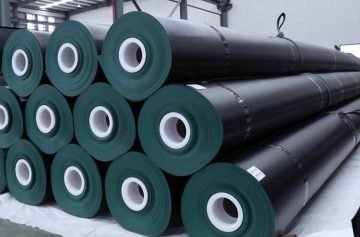
Choose landscape geotextile by its job first, then use GSM to compare suitable grades. GSM means grams per square metre: it describes mass, not drainage capacity, weed resistance, or vehicle load capacity. Two fabrics of the same weight can perform differently because their fibre type, structure, thickness, and manufacturing process differ.
For a gravel path, the main job may be separating stone from soil. For a French drain, it is filtering the surrounding soil while passing water. For a planted bed, consider whether a permanent fabric is needed at all. Those decisions require different evidence.
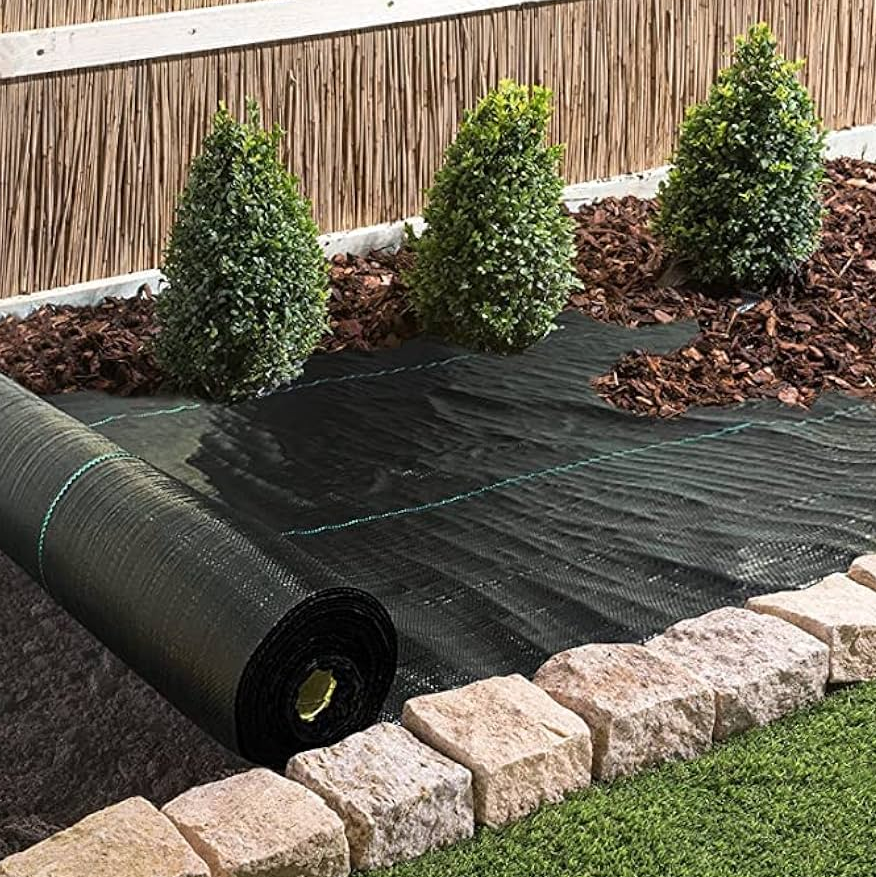
What GSM tells you—and what it cannot tell you
A 200 GSM fabric has a nominal mass of 200 g for each square metre. A 4 m × 50 m roll contains 200 m², so its theoretical fabric mass is 40 kg. Packaging, the core, moisture, and manufacturing tolerances affect the shipping weight. A roll’s mass alone cannot confirm its tensile strength or filtration performance.
| Nominal mass | Approximate oz/yd² | Theoretical fabric mass per 100 m² |
|---|---|---|
| 100 g/m² | 2.95 | 10 kg |
| 150 g/m² | 4.42 | 15 kg |
| 200 g/m² | 5.90 | 20 kg |
| 300 g/m² | 8.85 | 30 kg |
| 400 g/m² | 11.80 | 40 kg |
Conversion: 1 oz/yd² ≈ 33.906 g/m². These are unit conversions, not recommended grades for particular loads. A label such as “315” can be a product designation rather than GSM; confirm the units on the datasheet.
Match the specification to the landscape application
| Application | Primary function | Selection checks beyond weight |
|---|---|---|
| Planted beds with organic mulch | Manage weeds and maintain planting access | Whether fabric is appropriate, weed species, maintenance, and water movement |
| Decorative gravel or pedestrian paths | Separate aggregate from soil | Soil retention, permeability, puncture resistance, and installation damage |
| French drains and drainage trenches | Filter soil around drainage aggregate | Opening size matched to soil, cross-plane water flow, clogging risk, and a working outlet |
| Driveways and access routes | Separation, with stabilization or reinforcement if designed | Subgrade strength, wheel loads, aggregate thickness, survivability, and relevant tensile properties |
| Retaining walls and riprap | Filtration and installation protection | Engineered drainage, soil compatibility, interface stability, and stone placement procedure |
| Geomembrane underlay or protection | Reduce local damage to the liner | Actual aggregate, pressure, liner thickness, and system protection testing |
For early comparison, you can ask suppliers for several available weights—such as 150, 200, 300, and 400 g/m²—together with their test results. Select the grade that meets the application requirements. Do not approve “300 GSM for every driveway” or “400 GSM for every retaining wall” without those checks.
Weed control is not a GSM guarantee
Landscape fabric can help suppress some existing weeds, but new weeds can germinate in material that accumulates above it. Oregon State University Extension’s guide to mulching woody ornamentals explains why fabric beneath mulch is not a permanent solution. Keep maintenance and future planting access in the decision.
A claim such as “140 GSM blocks 99.7% of light” needs a test for that product. GSM does not specify optical transmission, and a CBR puncture number does not establish resistance to every weed or rhizome. Likewise, an oxygen-poor root zone should not be treated as a desirable weed-control mechanism.
Where a fabric is selected, prepare the area, address persistent weeds, protect joints and edges, and provide space for plant growth. Follow the product’s installation instructions for overlaps, fixing, and cover. Do not assume one pin spacing or overlap works on every slope and soil.
Read drainage data with the correct units
ASTM D4491 evaluates water flow normal to the geotextile using permittivity. Under the reported test conditions, cross-plane permeability is related to permittivity and thickness. This is distinct from in-plane transmissivity, which describes flow along the fabric or drainage product.
| Property | Typical units | What it describes |
|---|---|---|
| Permittivity, ψ | s⁻¹ | Cross-plane flow normalized for water head |
| Permeability coefficient, k | m/s or cm/s | Hydraulic conductivity using the relevant thickness and test conditions |
| Water flow per unit area | L/(m²·s) | Flow at a stated head; the head must be included |
| In-plane transmissivity, θ | m²/s | Flow along the plane under specified stress and gradient |
| Opening size | mm or stated sieve designation | Method-specific filtration index; it is not a flow rate |
Rainfall calculation: 50 mm/hour equals 50 L/(m²·hour), or approximately 0.0139 L/(m²·s). Across 100 m², that is 5,000 L/hour, about 1.39 L/s before allowing for runoff or storage. This conversion does not prove that a drainage system will work: the underlying soil, available head, clogged condition, aggregate, pipe, and outlet can control performance.
For comparison, a flow result measured at a 50 mm laboratory head is not a promise that the same rate occurs in a nearly flat garden. Nor can a thin filter fabric replace a designed drainage aggregate layer or drainage composite behind a wall.
Match opening size to soil, not to weight alone
Ask for soil particle-size information and the appropriate filter criteria. A smaller opening is not automatically better: retaining soil and avoiding excessive clogging must both be considered. ASTM apparent opening size and ISO O90 are results from different methods; do not swap their labels or treat them as interchangeable numbers.
For fine, unstable, or difficult soils, request a project-specific soil–geotextile compatibility assessment. There is no universal “135 GSM is optimal” rule, and adding an arbitrary sand layer does not by itself establish a compatible filter system.
A documented PET example from Jinseed
The TRI Suzhou report SCH22214, dated 9 December 2022, covers a submitted 400 g/m² PET nonwoven sample, control 10774. Its reported average mass was 410.7 g/m², permittivity 0.78 s⁻¹, and flow 40 L/(m²·s) at 50 mm head. Apparent opening size was 0.090 mm. Wide-width tensile results were 27 kN/m in the machine direction and 26 kN/m across it.
The report supports those sample results. It does not establish a universal landscape weight recommendation, UV exposure limit, CBR puncture rating, or performance for other Jinseed grades. Obtain the current datasheet and the relevant lot records for the PET nonwoven geotextile being considered.
Strength, installation damage, and long-term exposure
ASTM D6241 measures index puncture resistance using a 50 mm probe. The reported force is useful for specification and product comparison; it is not a vehicle load rating. A 3,500 N result does not mean that a fabric is automatically suitable for a particular truck, rock size, or wall height.
Similarly, grab tensile force in newtons and wide-width tensile strength in kN/m are different measurements. Compare products using the same method, direction, and reporting basis. For structural reinforcement, the designer also needs behaviour at relevant strain, durability, installation damage, and long-term loading—not just ultimate strength.
Both woven and nonwoven products can have useful engineering functions. Woven fabric is not automatically impermeable, and nonwoven fabric is not automatically adequate for every drain. Select a tested product for the soil and installation rather than choosing by appearance.
ASTM lists D4355/D4355M for xenon-arc exposure and D5970/D5970M for outdoor exposure. Laboratory exposure hours should not be converted directly into a permitted number of days in the sun. Follow the product’s documented storage and covering limits, and investigate damaged or overexposed rolls before installation.
Calculate quantity from the layout
Illustrative path calculation: a 20 m × 5 m path needs 100 m² of net coverage. If two 3 m-wide strips run its full length with a 0.30 m overlap, their net combined width is 5.70 m. Buying two 20 m lengths uses 120 m²: 6 m² is in the overlap and 14 m² lies beyond the 5 m path width before trimming. There is no automatic 10% or 15% allowance here. The stated overlap is only a calculation assumption; use the approved installation detail.
At 200 g/m², the theoretical fabric mass for that 120 m² is 24 kg, excluding packaging. Check available roll lengths and handling arrangements before ordering. Add separate allowances for returns, joints, irregular edges, and repairs where the layout requires them.
A practical purchasing checklist
- Identify the primary function: weed management, separation, filtration, protection, or engineered reinforcement.
- Provide soil conditions, drainage route, cover material, loading, and installation method.
- Compare grade-specific hydraulic and mechanical data with units and methods.
- Check sample identity, production traceability, and whether values are typical, average, or contractual minimums.
- Confirm the panel layout, storage conditions, covering requirements, and inspection procedure.
Send Jinseed the application and specification when requesting a quotation. A list of candidate weights plus the required performance is more useful than a request for the “heaviest” fabric.
Sources
- Oregon State University Extension: Mulching woody ornamentals with organic materials.
- ASTM D4491: water permeability by permittivity.
- ASTM D6241: static puncture testing with a 50 mm probe.
- ASTM geotechnical standards: laboratory and outdoor exposure methods.
- TRI Suzhou report SCH22214: 400 g/m² PET sample.