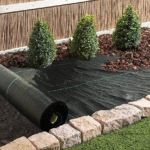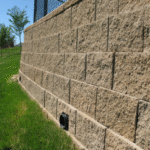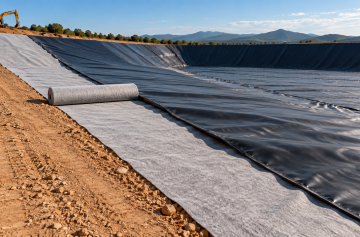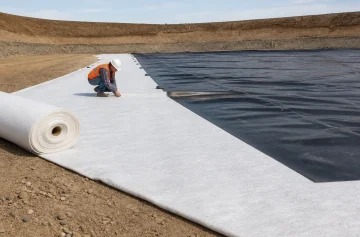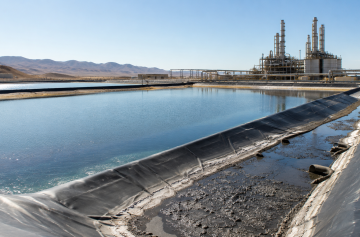
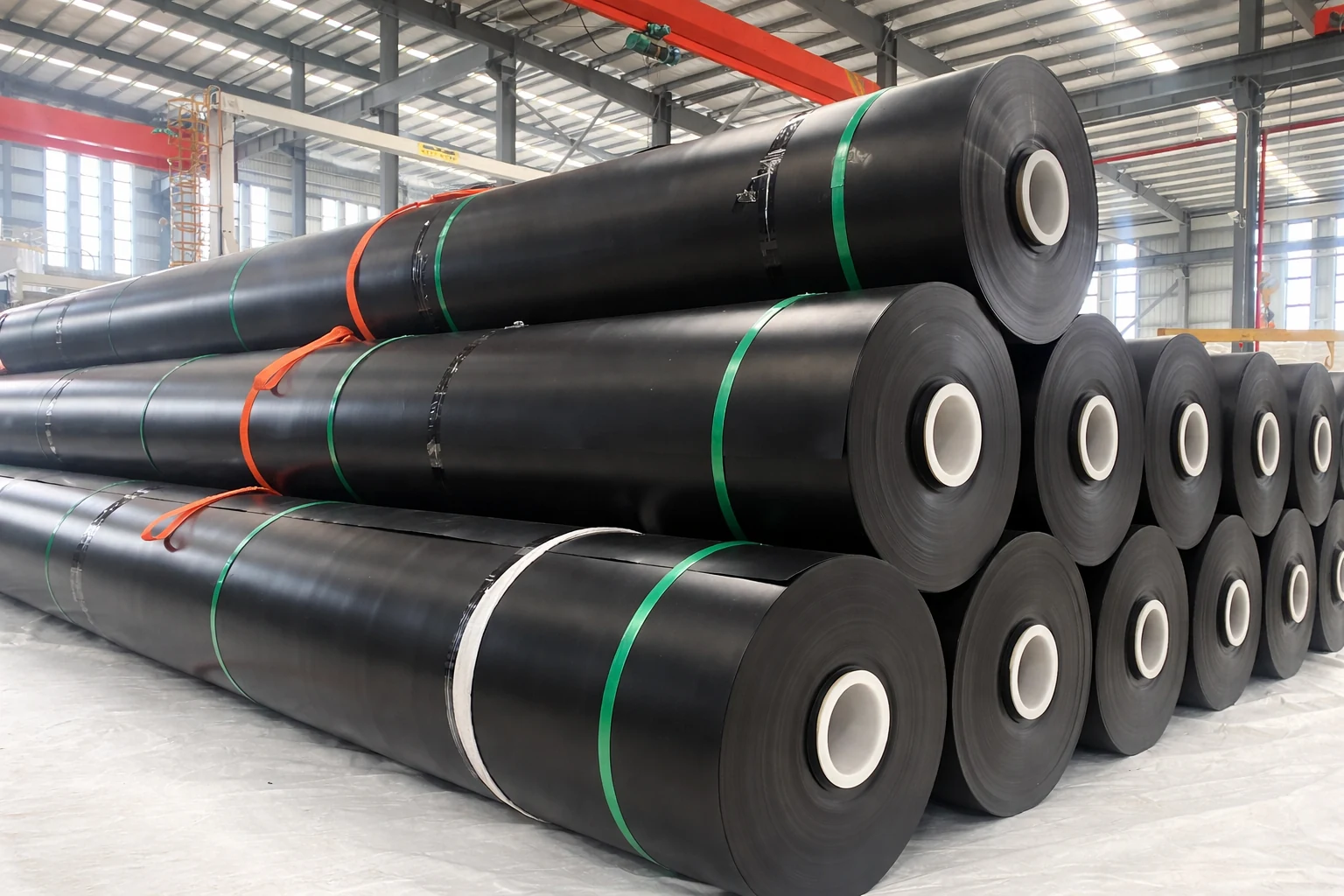
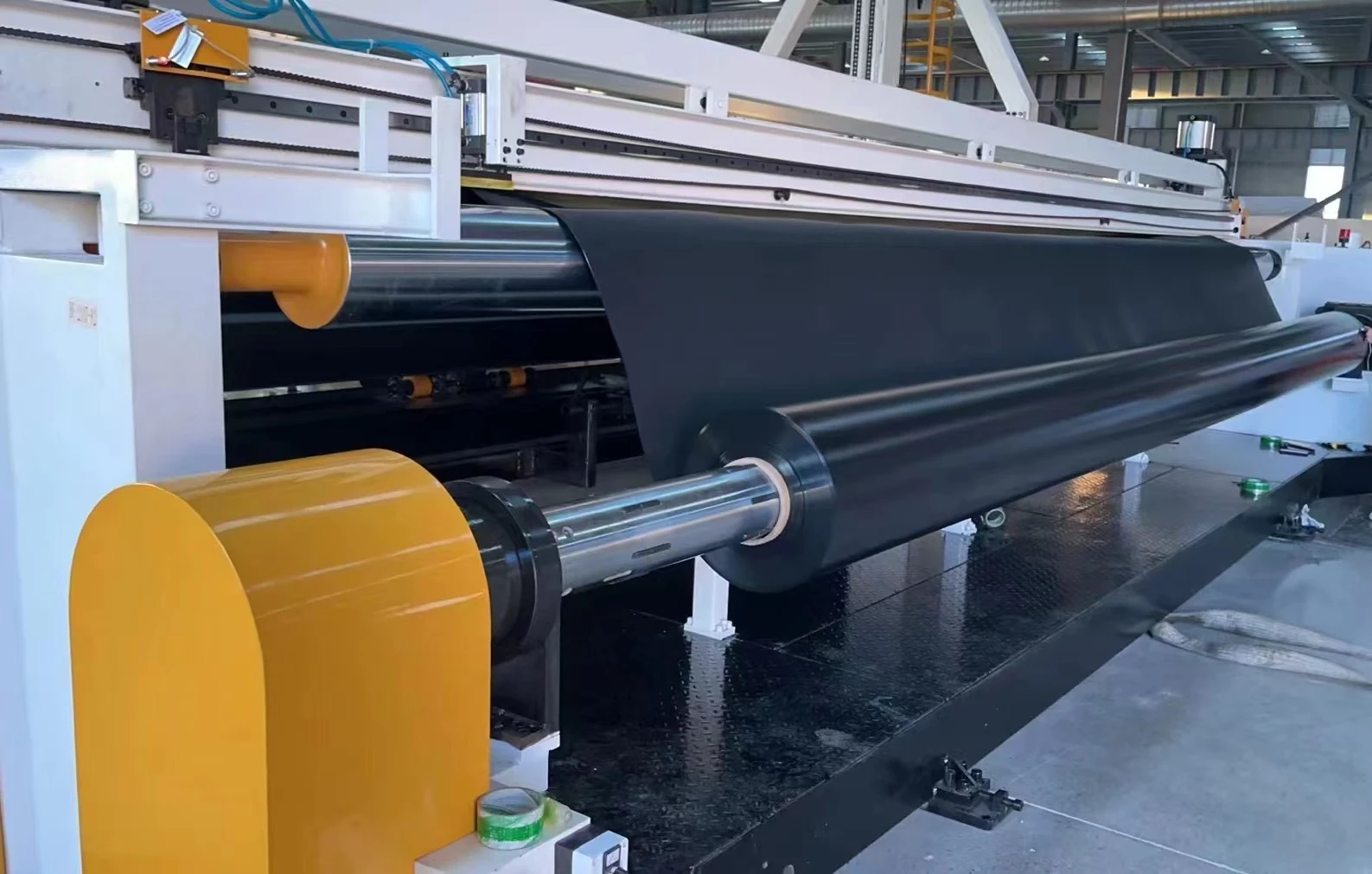
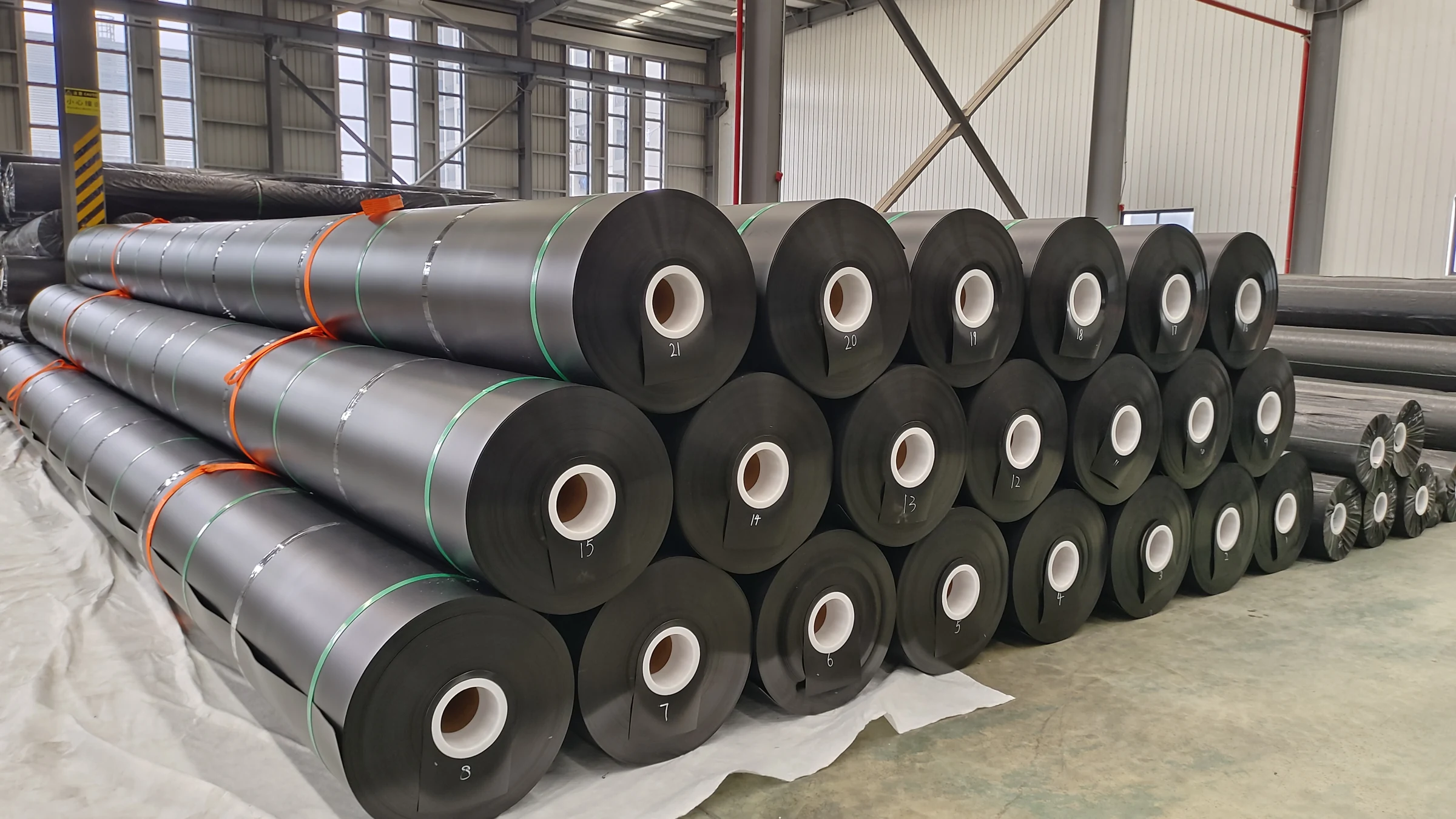
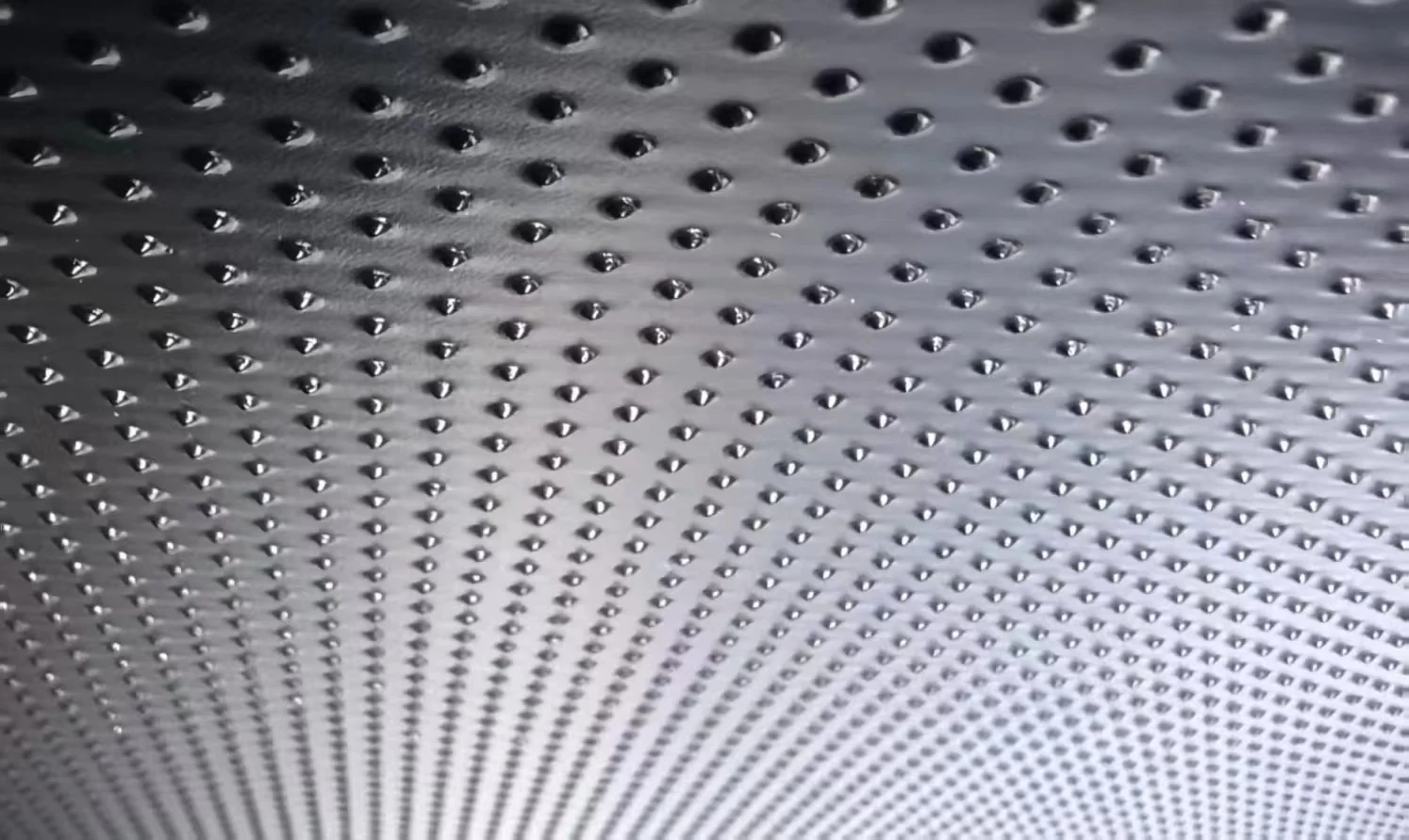
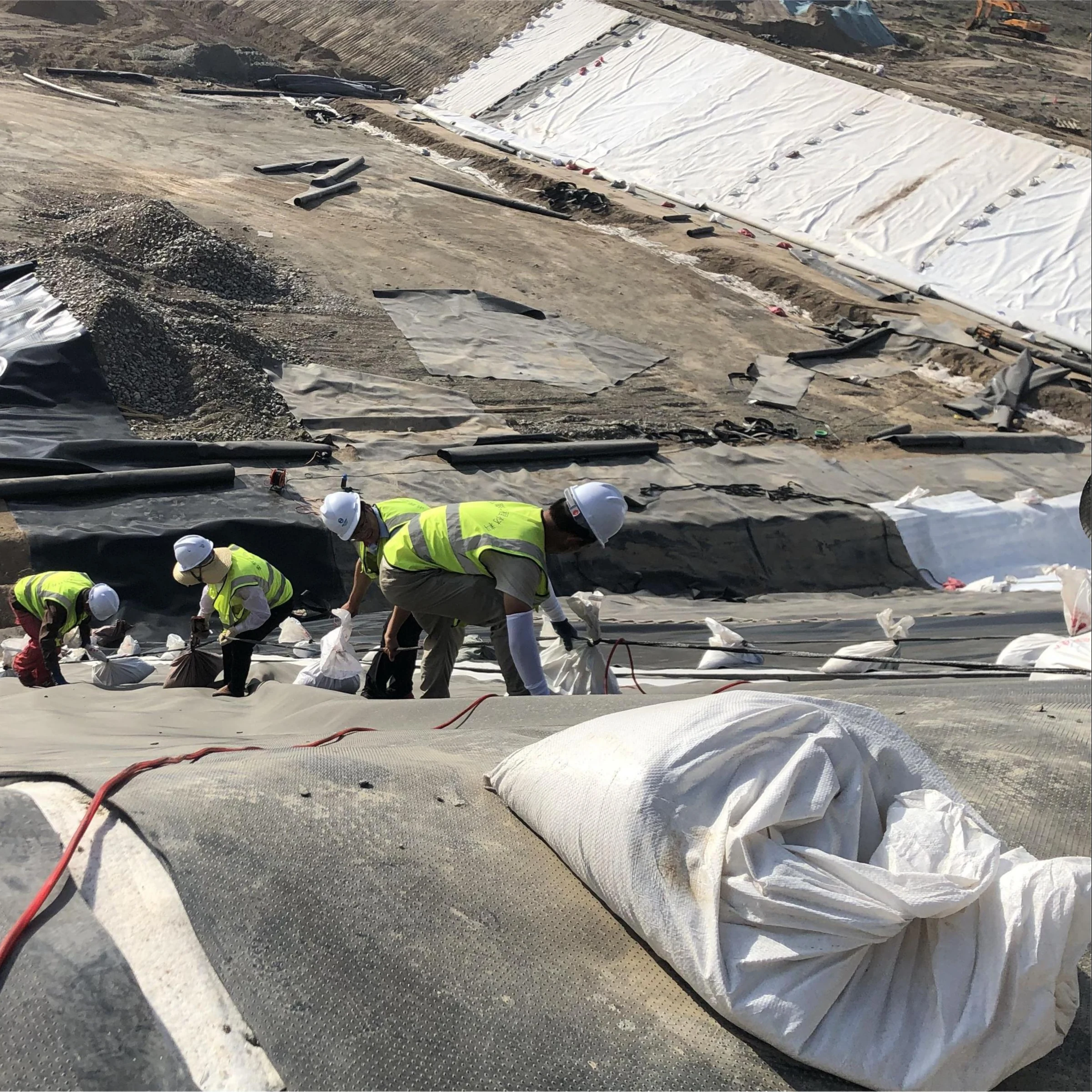
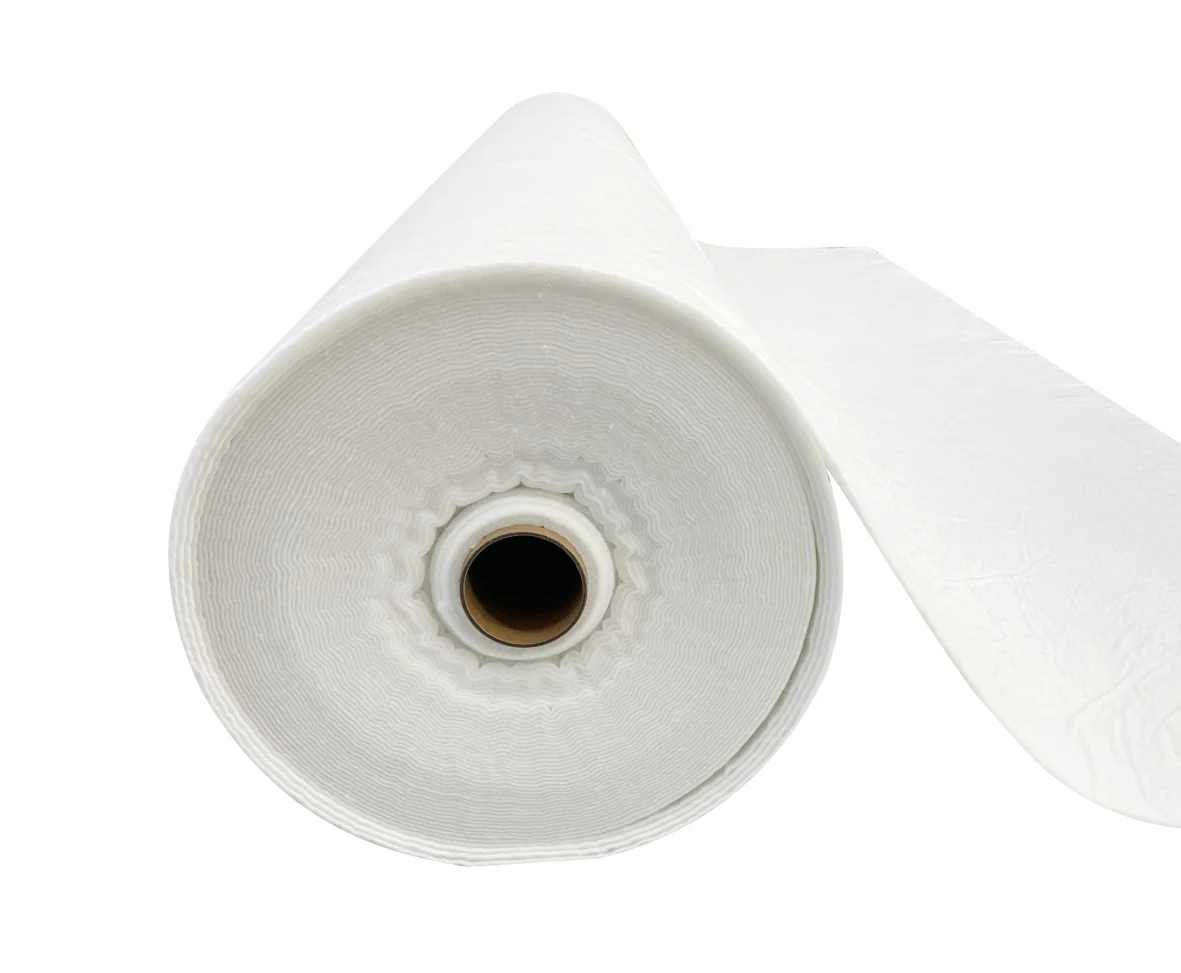

For drainage, use 150 g+ nonwoven fabric (to resist clogging and collapse); for reinforcement, use 50 kN+ woven fabric (for base stabilization and tensile strength). For drainage behind small retaining walls, nonwoven geotextile is the first choice.
Filtration
Woven vs. Nonwoven
On the shelves of a building supply store, woven geotextile rolls feel a lot like the plastic woven sacks used for fertilizer. The surface is smooth and slightly glossy. This material is made by interlacing 2 to 3 mm wide polypropylene slit-film tapes on large looms.
If a 200 lb adult stands on a suspended single layer of woven fabric, the deflection is usually less than 3 inches. Its elongation is tightly controlled below 15%, giving it a stiff feel and very high tensile capacity.
The flat tapes overlap tightly, leaving almost no visible gaps for light to pass through, and porosity generally stays in the 4% to 8% range. Pour water onto woven fabric, and it will pool on the surface much like it does on a sheet of plastic.
Test data show a permittivity of only 0.05 sec⁻¹. Per square foot, it can slowly pass only 4 to 5 gallons of water per minute.
Retaining wall backfill often contains about 20% clay and fine silt. Because woven fabric has a smooth surface and very low porosity, slurry particles just a few microns in diameter quickly stick to the flat tapes under rainfall infiltration.
In less than two weeks, the original 4% void space can be sealed shut by a visibly hard crust of dried mud. Drainage effectively stops, and the moisture content in the soil behind the wall can quickly rise past the 40% danger threshold.
To handle the tons of hydrostatic pressure that can build up behind a retaining wall, you need a nonwoven material that looks and feels like thick gray felt. In manufacturing, polypropylene is melted into fine filaments tens of microns in diameter, then laid randomly onto a conveyor and punched repeatedly with steel needles.
The needles move up and down at more than 1,000 strokes per minute. A 4 oz fabric, after being compressed and entangled by needle punching, expands to a physical thickness of about 1.8 mm, or roughly 70 mils in industrial specifications.
The randomly arranged fibers create a dense network of microscopic voids in three dimensions. This needle-punch process gives the fabric an overall porosity of 75% to 85%, and when you pull both ends by hand, elongation can easily exceed 50%.
Water poured onto nonwoven fabric disappears almost instantly. Test instruments record permittivity values of 1.5 sec⁻¹ to 2.2 sec⁻¹, which is equivalent to draining more than 110 gallons of rainwater per minute per square foot.
| Performance Comparison | Woven Fabric (Polypropylene Slit Film) | Nonwoven Needle-Punched Fabric (4 oz) |
|---|---|---|
| Physical Thickness | 15 mils (very thin) | 70 mils (lofty, three-dimensional) |
| Flow Rate per Minute | 4 – 5 gpm/ft² | 110 – 130 gpm/ft² |
| Fiber Porosity | About 5% | About 80% |
| Slurry Clogging Rate | Over 90% (crusts very easily) | Less than 15% (deep filtration) |
| Ultimate Elongation | Less than 15% (stiff feel) | More than 50% (soft and conformable) |
If you press stiff woven fabric into a trench filled with 3/4 inch crushed stone, it cannot conform to the uneven edges and voids between the rocks. When a wheelbarrow dumps 300 lb of backfill on top, the suspended flat tapes can snap where sharp stone points press up underneath.
With 50% elongation, nonwoven fabric acts like a cushion. When it meets sharp-edged #57 clean stone, the fibers stretch and wrap around the high points of the aggregate, preventing large-scale damage during installation.
This increases the contact area between the fabric and the stone by about 40%. That flexibility spreads out localized pressure as high as 80 psi per square inch, helping the filtration layer stay structurally intact during backfilling.
- 70 mil thickness provides three-dimensional cushioning space
- 50% elongation adapts to irregular stone shapes
- Drainage remains steady at over 100 gallons per minute
- Intercepts particles larger than 0.15 mm without caking
After eight months underground, excavated woven fabric is often sealed over with a 1 mm thick crust of hard dried mud. Peel away the crust and the plastic tapes underneath may still look glossy and intact, but the stone layer behind it is already completely dry.
This kind of blockage can push soil moisture content 30% beyond the safe range. When water cannot drain out, the lateral hydrostatic pressure behind a 6 ft wall can rise above 1,100 psf.
Excavate nonwoven fabric that has also been buried for eight months, and the original gray fiber layer may have turned reddish brown. Cut through the 1.8 mm cross-section and you will find tiny 0.05 mm particles embedded in the middle fiber layer.
Because the fabric still retains internal three-dimensional flow paths, water can continue to bypass partially occupied fibers. The stone layer behind it stays at a steady 10% moisture content, and clean water continues to flow through the 4 inch perforated pipe.
When purchasing, check the Grab Tensile Strength listed on the packaging. Woven fabrics commonly used for roadway applications are often rated at 200 lbs, while retaining wall filtration layers should use needle-punched rolls rated at 120 lbs.
A full roll of nonwoven fabric measuring 4 ft by 100 ft typically weighs about 12 to 15 lbs. This 4 oz product can still retain 70% of its mechanical strength after 500 hours of UV exposure testing.
- Equivalent opening size (AOS) corresponds to U.S. Sieve #70-100
- Grab tensile strength exceeds 100 lbs
- Complies with ASTM D4491 permittivity testing
- Physical service life exceeds 50 years
Cutting nonwoven fabric with a standard utility knife leaves a clean, smooth edge without fiber unraveling. By contrast, woven fabric tends to shed loose plastic strands at the cut, making the jobsite messy. During installation, adjacent sheets must overlap by at least 18 inches (45 cm). Secure the edges with 6 inch U-shaped metal pins driven into the soil every 3 feet to prevent the fabric from shifting during backfilling.
Each 8 inch lift of backfill should be compacted once with a vibratory tamper. Under 1,000 lbs of vibration force, the geotextile bonds tightly to the stone layer and forms a stable barrier between the soil and the drainage pipe.
Opening Size & Permeability
Angular 3/4 inch (about 19 mm) crushed stone is as sharp as broken glass. Under the weight of several tons of soil, 4 oz/yd² nonwoven fabric gets pressed tightly against the stone edges. The microscopic openings that are invisible to the naked eye are distorted under load.
Choosing geotextile is a bit like choosing a strainer for soy milk in the kitchen. If the openings are larger than 0.212 mm, the red clay and silt behind the retaining wall, with particle sizes from 0.05 to 0.002 mm, will wash right through with the water. The slurry then quickly fills the 40% natural void space in the crushed stone layer.
- Stone voids fill up within 3 months
- 1/4 inch drain holes become completely blocked
- A 6 ft wall ends up carrying 1,100 lbs of water pressure
Switch to a dense fabric with openings smaller than 0.150 mm, and the water can no longer escape fast enough. In a storm with 2 inches of rain per hour, a film of water will immediately build up on the fabric surface. The groundwater level behind the wall then rises rapidly.
For every 1 foot of water that accumulates in the soil, lateral pressure at the bottom increases by 62.4 psf. A concrete retaining wall weighing several thousand pounds can be pushed outward by that water pressure, and the top often ends up more than 2 inches out of plumb.
A polypropylene fiber matrix with openings between 150 and 212 microns can reliably hold back more than 85% of suspended sediment. Very fine silt enters the first fiber layer, then gets trapped within the internal three-dimensional voids across the roughly 2 mm fabric thickness.
Once this internal soil filter forms, the water can still pass through at a permittivity of 1.5 sec⁻¹. Each square foot of fabric can consistently discharge 90 to 130 gallons of clean rainwater per minute.
After passing through the geotextile, clear water drops through the large voids between #57 clean stone at a velocity of 0.5 ft per second. A 50 ft long, 4 inch diameter perforated corrugated pipe can smoothly drain about 100 gallons of water per minute.
Once the water pressure is relieved, the saturated slurry behind the wall, whose moisture content had risen from 15% to 45%, begins to dry out again. Under 1,000 lbs of vibratory compaction force, the backfill maintains a friction angle of 40 degrees and stays firmly seated against the back of the wall.
- Use fabric rated to U.S. Sieve #70 to #100
- Maintain permittivity above 1.5 sec⁻¹ year-round
- Ensure a flow rate of at least 90 gpm/ft²
- Grab tensile strength should exceed 100 lbs
Fabric Weight
Categories & Applications
For a small backyard planter under 60 cm high, a light fabric in the 3.1 to 4.5 oz (100-150 g/m²) range is usually enough. It typically feels about 0.8 to 1.2 mm thick and drains very quickly, passing about 140 gallons of water per minute per square foot. With 1/2 inch washed round gravel over it, the permittivity can still stay above 1.5 sec⁻¹.
It is a good match for wrapping a 4 inch corrugated drain pipe. With an opening size of 0.212 mm, it can keep about 85% of the sediment in the soil out of the pipe. But in machine tensile testing, this fabric does not hold much beyond 100 lbs, so it should never be paired with large, angular crushed stone that can puncture it under compaction.
| Weight (oz/yd²) | Grab Tensile (lbs) | Puncture Strength (lbs) | Flow Rate (gpm/ft²) | Recommended Wall Height (ft) |
|---|---|---|---|---|
| 3.5 oz | 90 | 240 | 150 | < 2 |
| 4.5 oz | 120 | 310 | 135 | 2 – 3 |
| 6.0 oz | 160 | 410 | 110 | 3 – 6 |
| 8.0 oz | 205 | 535 | 90 | 6 – 10 |
| 10.0 oz | 250 | 700 | 75 | > 10 |
For a standard residential retaining wall 1 to 2 meters high, 6.0 oz (200 g/m²) is the safest choice. When backfilled with sharp 3/4 inch crushed stone, it can withstand 410 lbs of puncture force, leaving surface indentations of less than 2 mm. At that point, permittivity still remains around 1.2 sec⁻¹.
As wall height increases, the soil pressure behind it can reach 150 psf. 6 oz fabric has about 50% elongation capacity, so if the foundation settles by 15 mm, it can stretch with it without tearing. Replace it with thin 4 oz fabric, and the impact of dumped stone can drive the damage rate up by 40%.
If vehicles will park or drive above the wall, it is better to step up to 8.0 oz (270 g/m²). With a tensile rating of 205 lbs, it can handle repeated vibration from a 100 to 200 kg light compactor. Its openings are as fine as 0.18 mm, and even in fine silty soil soaked for 500 hours, it is not easily clogged.
For commercial retaining walls taller than 3 meters, you need a heavier fabric in the 10 to 16 oz (340-540 g/m²) range. These fabrics are over 2.5 mm thick and still retain 80% of their strength after 500 hours of sun exposure. Heavier fabric drains more slowly, typically passing only 50 to 70 gallons per minute per square foot.
In rainy areas, using heavy fabric means that every 1 foot rise in water behind the wall adds 62.4 psf of pressure. In these cases, weep holes should be placed every 4 feet and used together with a 12 oz composite drainage net to move water out quickly.
- 10 oz: placed over weak, muddy subgrades, it can support 3 inch coarse stone without punching through, saving about 30% in soil replacement costs.
- 12 oz: used in coastal revetment work, it can resist 500 lbs of wave-induced tensile force without tearing.
- 16 oz: thick like carpet, used specifically as underlayment beneath landfill liners.
Each step up in fabric weight generally increases material cost by about 15% to 25%. In strongly alkaline soils with a pH above 8, heavier fabric is also more durable. The fiber structure of 300 g/m² fabric is denser, so alkaline degradation proceeds 3.5 times more slowly than in 150 g/m² fabric, making a buried service life of 60 years entirely feasible.
Do not use woven fabric under 120 g/m² for drainage. It may look strong enough at 150 lbs tensile capacity, but it lacks the three-dimensional void structure and its flow rate is less than 10 gpm/ft². Behind a retaining wall, repeated freeze-thaw cycles can increase the chance of outward wall movement by 50%.
Thin 4.5 oz fabric wrinkles easily, so adjacent sheets should overlap by 18 inches to be safe. A heavy 10 oz roll weighing 80 kg is stable enough under its own weight that a 12 inch overlap with U-shaped steel pins is generally sufficient.
Selection Advice
When you go to a building supply yard, bring along a 300-lumen flashlight and press it against the back of the fabric. If a roll labeled 8 oz shows bright spots the size of coins shining through, it likely contains more than 20% short recycled fibers. High-density 270 g/m² nonwoven geotextile typically has a light transmission rate under 5%. If you use a highly translucent product to wrap a 6 inch corrugated drain pipe and then backfill it with 3/4 inch crushed stone, an excavator track can easily crush a 5 cm tear into it.
Contractors often keep a caliper in the pickup. A new 6 oz fabric should have a natural uncompressed thickness of about 1.8 mm when unrolled flat. Put a 50 lb bag of Portland cement on a sample for 24 hours, then remove it and measure again. If the thickness rebounds to less than 1.2 mm, the fabric is likely made from cheap, low-grade polyester. A compliant high-polymer polypropylene (PP) fiber should recover about 85% of its thickness after heavy loading.
When checking the plastic packaging on a full roll, focus closely on the factory test data:
- AOS equivalent to U.S. Sieve #70 (0.212 mm)
- Grab Tensile rating of 160 lbs
- CBR puncture value above 410 lbs
- 70% strength retained after 500 hours of UV exposure
- Flow rate rated around 110 gpm/ft²
The moment a loader dumps 2 tons of wet soil behind a retaining wall, a 4 oz lightweight cushion layer can undergo severe physical stretching. Its original 0.2 mm filtration openings may be pulled open to 0.8 mm. Once heavy rain arrives, the silt behind the wall washes through those enlarged openings into the blind drain at the bottom. In less than two weeks, the carefully finished lawn at the top of the wall may collapse into a sinkhole 3 inches deep.
On slope projects with a very high groundwater table, winter night temperatures may fall below -5°C. Water that has seeped into the soil freezes and expands, generating frost heave pressure of 1,500 lbs per square foot pushing outward. An 8 oz fabric has about 2.5 mm of three-dimensional cushion space inside, enough to absorb the volume expansion of ice crystals. A thin 3 oz product, by contrast, is like a brittle sheet of paper stretched across stone edges; when temperatures drop suddenly, frozen soil can rip the fibers apart across the middle.
After 25 cycles of extreme freeze-thaw simulation in the lab, 8 oz fabric retains 35% more void space than 4 oz fabric. That microscopic elastic space is the physical safeguard against seasonal movement in retaining walls built in cold climates. Under loaded frozen conditions, fiber breaking load in overly thin fabrics can drop to less than 40% of the original value.
When crews roll out the fabric in the field, a few rules must be followed:
- Keep overlap between adjacent sheets at 18 inches
- Use 6 inch steel U-pins for anchorage
- Drive one pin every 3 feet along the slope
- Increase overlap to 36 inches on soft muddy subgrades
- The upper sheet must always lap over the lower sheet edge
- Lay the rolls straight in the natural direction of water flow
Some contractors use a hot-air torch to fuse the seams. Polypropylene begins to melt at about 160°C. Go even slightly too hot, and the 5 cm overlap zone at the joint turns into a stiff plastic sheet with no permeability.
Installation
Full Installation Process
After excavation, the trench bottom and sidewalls must be trimmed smooth. Remove all stones and roots larger than 25 mm in diameter. Compact the native soil with a plate compactor for 3 to 4 passes. A soil moisture content of 10% to 15% is ideal for stable compaction.
Select nonwoven geotextile in the 140 to 200 g/m² range. During installation, run the fabric from the trench bottom up the side and extend it all the way to the top of the cut slope. On slopes steeper than 26 degrees, install one 150 mm steel ground anchor every 0.9 m.
Do not pull the fabric too tight. Leave about 2% slack so it will not tear when stone is placed. Adjacent sheets must never be left with gaps. On dry, firm ground, a 300 mm overlap is sufficient. On wet, soft mud, the overlap must be increased to 900 mm.
Pin through the seams with 11-gauge U-shaped steel staples. Fasten one point every 1.5 meters. Alignment tolerance at the seams must be kept within 50 mm. The fabric should be lapped in the direction of drainage or backfill placement so water and soil cannot force their way into the joint.
- The gravel layer should be at least 300 mm wide.
- Use clean crushed stone 12.5 mm to 25 mm in size, equivalent to ASTM No. 57.
- Place a 100 mm diameter perforated pipe at the bottom of the stone layer.
- The gravel bedding beneath the pipe should be 50 mm thick.
- The drain pipe should slope downward 10 mm to 20 mm per meter.
- The perforations in the pipe must face downward.
Use the nonwoven fabric’s 0.15 mm to 0.21 mm equivalent opening size to filter fine particles. At the end of the pipe, install a 45 degree elbow to discharge water. Do not let the stone drop from a height greater than 300 mm. Place backfill in lifts, keeping each layer between 150 mm and 200 mm thick.
Within 1 meter behind the wall, only walk-behind compactors under 500 kg may be used. Large bulldozers must never drive directly over exposed fabric before it is covered. The first soil cover layer must be at least 150 mm thick before light equipment is allowed on it.
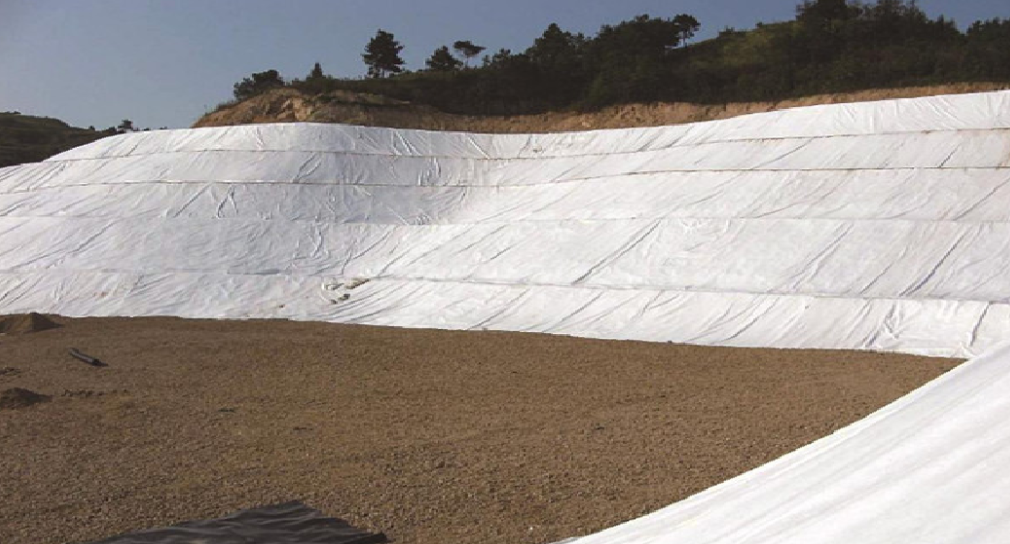
Polypropylene fabric is vulnerable to sunlight. Test data show that after 500 hours in the sun, tensile strength can be cut in half. Once the fabric is placed, it must be covered with soil within 72 hours. Use material with a flow rate of at least 50 liters per square meter per second.
- Any damaged area larger than 100 mm must be patched.
- Patches must extend 300 mm beyond the damaged area on all sides.
- Leave a 300 mm flap at the top for folding back.
- Cover with a 150 mm clay cap and compact it to 95%.
- Cut the fabric with a utility knife and keep the cut straight.
Once the gravel is in place, fold the reserved fabric flap back over the top. Use the cap layer to direct rainwater away toward the front of the wall. Do not let water pour directly into the gravel, or the drainage system will fail. If the retaining wall is higher than 1.2 meters, geogrid reinforcement should also be used.
The geogrid embedment depth is generally 0.7 times the wall height. The geotextile should be placed outside the grid to prevent clogging. Leave a 150 mm separation layer between them. In winds above Force 4, weigh down the fabric edges with sandbags to keep the rolls from shifting.
For silty soils, use fabric with a smaller AOS (apparent opening size). Check the outlet regularly. If the discharge water carries fine sand, that usually means either the fabric selection or the overlap installation is wrong. Do not cut with a dull blade, because pulled fibers weaken the edge.
Elevation tolerance after compaction of each lift should be controlled to about 10 mm. Do not use solvent-based chemical cleaners on the fabric surface. The fineness modulus of the backfill also affects permeability. Keep the drain outlet clear of debris and accumulated soil.
- Keep soil moisture content at about 12%.
- Use 150 mm carbon steel anchors.
- Maintain a drainage slope of at least 1%.
- Single dump loads of backfill should not exceed 200 kg.
- Maintain a 150 mm safety clearance above the fabric during machine operation.
This kind of work cannot be rushed. Geotextile is not just a liner; it is the skin of the entire drainage system. If that skin tears or is joined poorly, the soil behind the wall will eventually be washed out by rain. Pay attention to the surface grain direction of the fabric during installation.
High-performance woven fabrics have a specific load-bearing orientation. They must be laid according to the tensile strength direction indicated in the product data. In cold regions, choose materials with strong freeze-thaw resistance. Keep the site well drained throughout construction so rainwater does not erode already installed sections.
If the subgrade is too soft and the CBR value is below 3, then the cushion layer must be thickened or the overlap increased. Wrapping gravel in geotextile in this way is known as a French drain. It balances hydrostatic pressure behind the wall. Once the pressure is controlled, the wall will not bulge outward.
The fabric must be laid flat, with no ridges or bulges. During backfilling, spread material from the center outward to both sides. Keep the work continuous and minimize atmospheric exposure time for the fabric. Measure every step carefully.
Precautions
Do not leave geotextile rolls exposed on the jobsite for more than 14 days. Even UV-stabilized polypropylene fibers will lose 15% to 20% of their tensile strength after 168 hours under 500 W/㎡ sunlight. If stone backfill cannot be placed the same day, cover the fabric completely with black opaque film at least 0.1 mm thick.
Do not reduce seam overlap at roll joints. On dry, firm soil, keep 300 mm of overlap. On muddy ground with moisture content above 20%, at least 900 mm is required. Use 11-gauge, 150 mm long steel U-staples every 1.2 meters to keep 20 mm crushed stone from knocking the seam out of alignment during placement.
| Risk Item | Monitoring Indicator / Data | Field Remedy |
|---|---|---|
| UV Degradation | Exposure time > 336 hours | Replace the top 50 mm depth of damaged fabric |
| Stone Impact Damage | Stone drop height > 300 mm | Add a 100 mm sand cushion layer for protection |
| Drain Hole Blockage | Fine content > 15% | Use fabric with AOS < 0.15 mm |
| Mechanical Traffic | Soil cover thickness < 150 mm | No equipment over 2 tons allowed to enter |
Control stone drop height during placement. A stone heavier than 50 kg dropped from 0.5 m can generate enough impact to tear fabric lighter than 200 g/m². Under ASTM D4833 puncture strength requirements, the selected fabric should withstand at least 300 N. Keep each backfill lift around 150 mm thick.
The wrong opening size will cause water to build up behind the wall. If the backfill contains a lot of fine sand, choose fabric with an AOS between 0.15 mm and 0.21 mm. Openings that are too large will let sand escape and undermine the soil mass; openings that are too small will clog with particles finer than 0.075 mm. Maintain a flow rate above 50 liters per square meter per second.
The perforations in the drain pipe must face downward. If they face upward, muddy water will run directly into the pipe and, in less than six months, the bottom of the pipe may accumulate 20 mm of silt. Maintain a slope of 1% to 2% per meter. Place the pipe on a 50 mm bed of clean 25 mm stone so the fabric does not seal tightly against the perforations.
- Use nonwoven fabric weighing 140 g – 200 g per square meter as the filter layer.
- For walls higher than 1.2 meters, use geogrid with an embedment length equal to 0.7 times the wall height.
- Keep compaction equipment 1 meter away from the back of the wall.
- Use compactors under 500 kg and control vibration frequency at 30 Hz.
- Do not allow wheeled equipment to turn on fabric that is not yet covered by at least 200 mm of soil.
A roller heavier than 2 tons driving over a 200 mm cover layer can generate more than 80 kPa of lateral squeezing force, enough to distort installed geotextile. Cut edges must be clean and free of burrs. Use a sharp utility knife and replace the blade every 10 meters. The turned-up edge of the fabric should extend at least 300 mm above the top of the gravel layer.
Cap the top with 150 mm of clay compacted to more than 95% to keep surface water from entering the drainage structure through gaps. Any tear larger than 50 mm must be repaired. The patch must extend 300 mm beyond the damaged edge and be fixed with dedicated geotextile adhesive or ground anchors.
Place a 100 mm sand layer between the geogrid and the geotextile to prevent the sharp edges of the grid from puncturing the filter layer. After rain, check whether air or water pockets have formed beneath the fabric. Uplift can create voids of 20 mm to 40 mm. Before backfilling, temporarily secure the fabric with sandbags weighing about 20 kg.
- Avoid contact between the fabric and chemical herbicides containing bleach or strong acids or alkalis.
- Stone larger than 75 mm in diameter must not exceed 10% of the fill.
- Install one 50 mm diameter weep hole every 2.5 meters along the retaining wall.
- The inside face of each weep hole must be wrapped with two layers of geotextile filter fabric.
- In winter construction below -5°C, increase overlap by 10%.
Fabric becomes more brittle in winter, and impact resistance drops by 10%, so stone drop height should be reduced to 150 mm. The fabric surface must never be contaminated with paint or solvents, which can alter the local opening size. During backfilling, spread material from the center outward. Keep elevation tolerance after each compacted lift to about 10 mm.
Geotextile is not just a liner; it is the skin of the entire drainage system. If that skin tears or is not joined properly, the soil behind the wall will eventually be washed out by rain. Pay attention to the surface grain direction during installation. High-performance woven fabrics have a defined load-bearing direction and should be laid perpendicular to the wall face according to the tensile strength data.
Keep subgrade moisture content at about 12%. If the foundation soil is too soft and the CBR value is below 3, then the cushion layer must be thickened or the overlap increased. Using geotextile to wrap the gravel in this way helps balance hydrostatic pressure behind the wall. Once the pressure is balanced, the wall will not bulge outward.
Keep drainage flowing freely on site so rainwater does not scour installed sections. Limit each single dump of backfill to no more than 200 kg. Clean debris from the outlet regularly. If the discharge water carries fine sand, that means there is a problem with either the fabric selection or the seam overlap. Do not install large sheets of fabric in strong winds.
- When wind exceeds Force 4, edge weighting of 10 kg/m is required.
- Install 600 mm wide reinforced fabric beneath the first course at the wall base.
- Use dedicated clamps at pipe connections; never wrap geotextile around the joint as a substitute connector.
- The surveyor should check horizontal displacement of the fabric after every three lifts of backfill.
- If displacement exceeds 30 mm, reset anchor tension.
All fill gradation must be matched to the geotextile’s O95 index (equivalent opening size). If the fill is too fine, place a 50 mm layer of medium-coarse sand between the geotextile and the fill. This prevents very fine particles from sealing directly onto the fibers and helps maintain a long-term permeability coefficient of 10-3 cm/s.
Keep construction continuous and minimize the amount of time the fabric is exposed to the atmosphere.