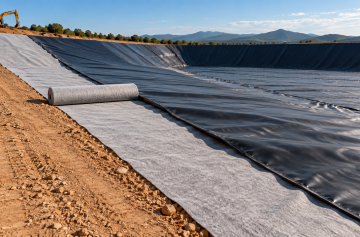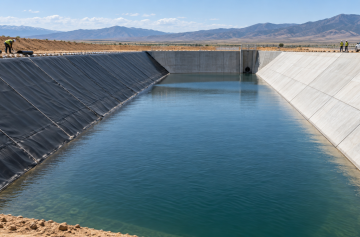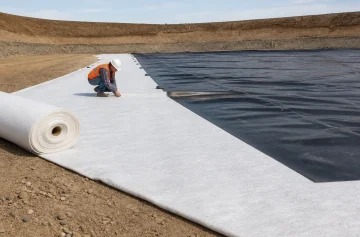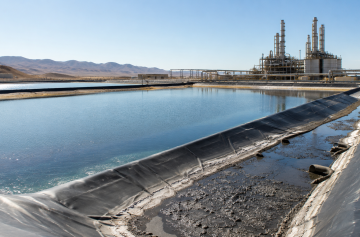
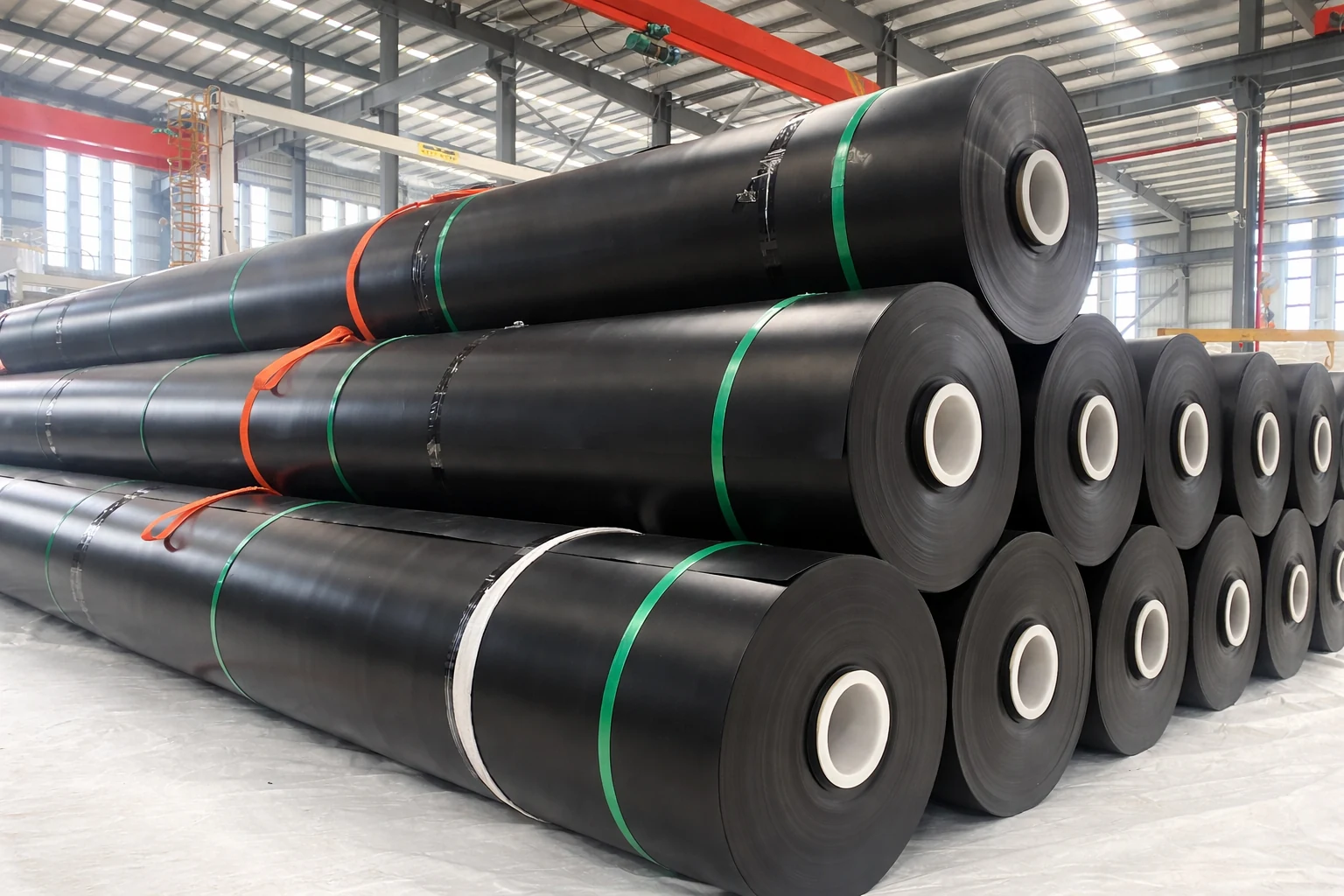



| Specification | GRI-GM13 is a widely recognized standard specification for smooth and textured HDPE geomembranes in the geosynthetics industry. It is published by the Geosynthetic Research Institute (GRI). |
|---|---|
| Project Experience | Over the past three years, we have supplied GRI-GM13-compliant HDPE geomembranes to more than 20 mining and landfill projects worldwide. |
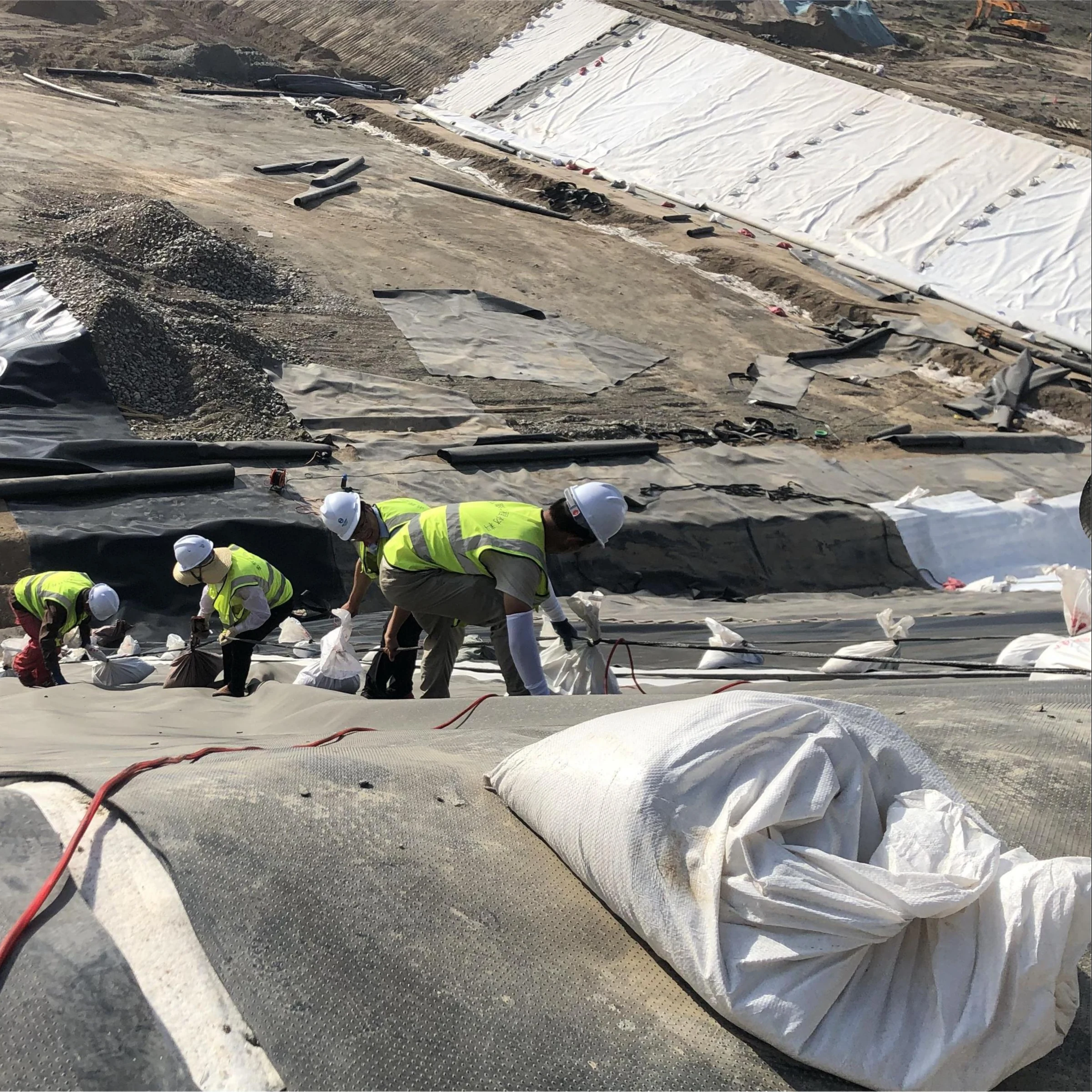
| Practical Value | Our field experience shows that specifying GM13-compliant liners can reduce the risk of receiving nonconforming material. Leakage control still depends on correct design, installation, seaming, protection, and construction quality assurance.[1] |
Performance
Density
Density is a fundamental parameter related to the chemical resistance and mechanical behavior of HDPE geomembranes.
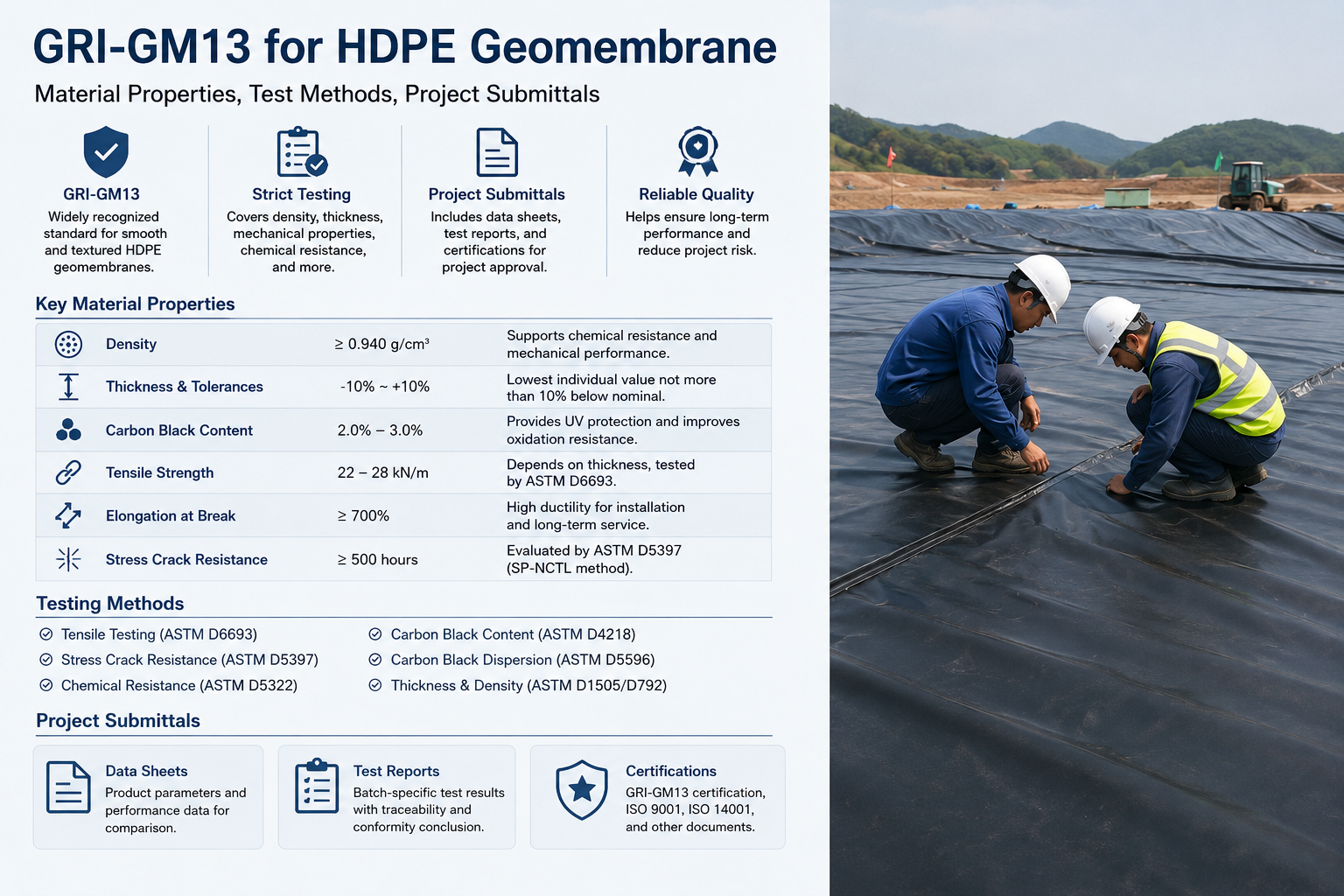
GRI-GM13 requires a minimum formulated sheet density of 0.940 g/cm³. This requirement supports consistent long-term performance in acidic, alkaline, and saline environments.
During a phosphorus mine tailings storage facility project in Hubei, we performed density sampling on 12 incoming batches.
- All measured values were between 0.940 and 0.947 g/cm³.
- The results met the minimum density requirement.[2]
- Based on our experience supplying mining seepage control projects, material below the specified density can have less predictable chemical and mechanical performance. The actual aging rate depends on the resin, additives, temperature, stress, and exposure medium.[3]
Higher formulated density generally reflects a greater crystalline fraction in HDPE. However, density alone does not prove puncture resistance, stress-crack resistance, or service life.
HDPE geomembranes are used as very low-permeability barriers, but GRI-GM13 does not set a universal hydraulic conductivity acceptance value.
Our quality laboratory verifies density with an applicable density test such as ASTM D1505 or ASTM D792. Carbon black dispersion is evaluated separately rather than using the Methylene Blue Method.[4]
During on-site re-inspection, we found several trader-supplied products described as imported brands with actual densities of only 0.932–0.938 g/cm³.
These values were below the GRI-GM13 minimum and indicated a higher risk of inconsistent long-term performance. Buyers relying only on supplier certificates may not identify this problem.
Project specifications should clearly state the minimum density requirement and the accepted ASTM D1505 or ASTM D792 test method.[5]
Further reading: Landfill Project Reference
Thickness and Tolerances
GRI-GM13 sets thickness-control requirements for HDPE geomembranes because localized thin areas can become weak points during installation and service.
| Control Point | Requirement or Review Method |
|---|---|
| Nominal Thickness | State the required nominal thickness in the project specification. |
| Individual Measurements | The lowest individual value in the specified measurement set must not be more than 10% below nominal thickness. |
| Testing Frequency | Thickness is checked by roll under the applicable GRI-GM13 method and project quality plan. |
In an Inner Mongolian coal-chemical evaporation pond project, we identified a local area that was 0.5 mm below the specified thickness.
The affected material was replaced within 48 hours, avoiding the use of a visibly nonconforming area.[6]
Detailed thickness-control considerations are available in our aquaculture seepage control lining selection guide.[7]
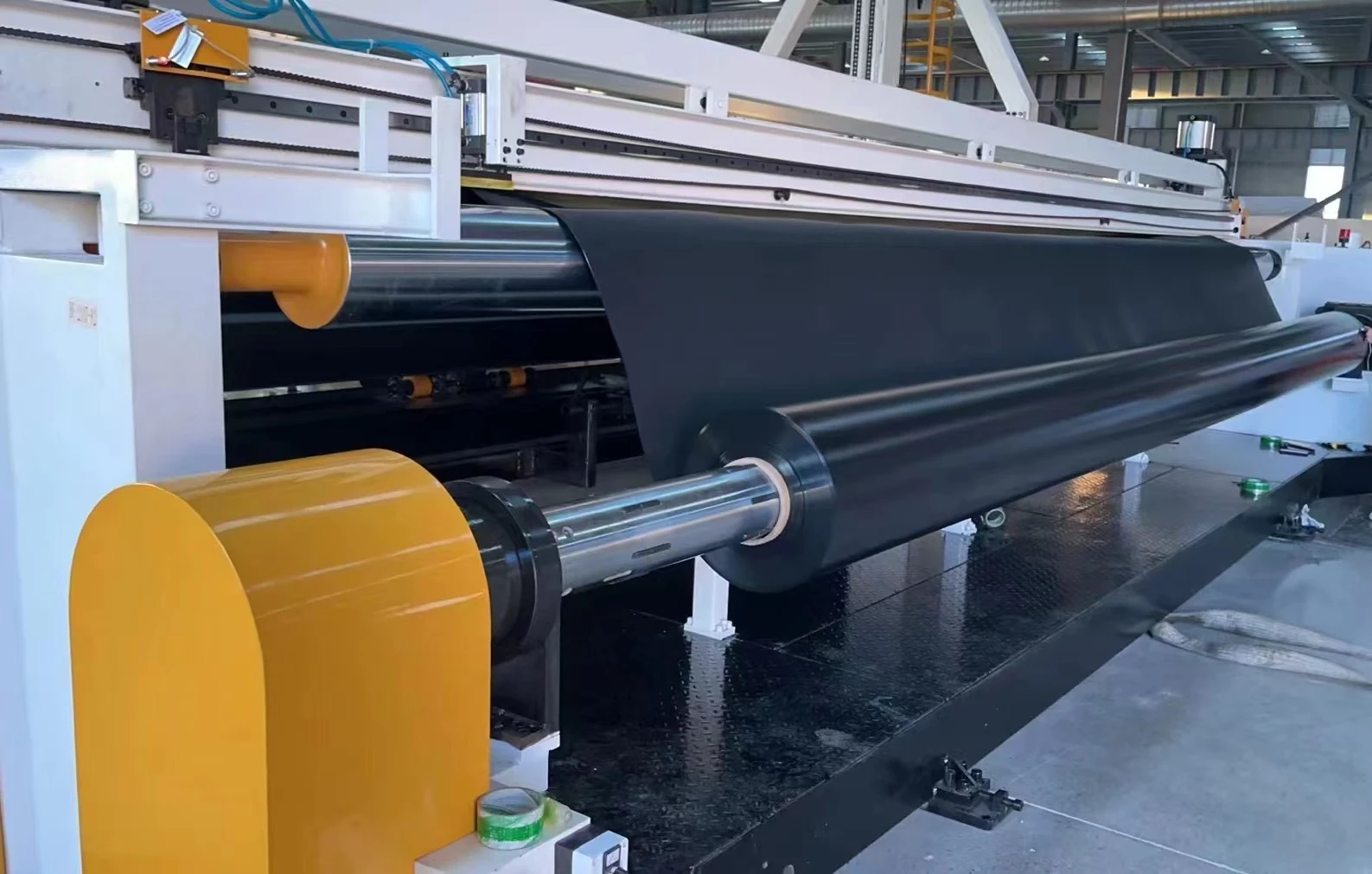
Thickness uniformity depends on extrusion-die control, line stability, cooling, resin flow, and online measurement. A production method alone does not guarantee compliance.
Jinseed’s production lines use 24-point online thickness monitoring with real-time feedback and automatic gap adjustment.
The system is designed to keep monitored thickness variation within ±5% of nominal. Final product acceptance still follows the GRI-GM13 thickness criteria and the project specification.[8]
For industrial wastewater evaporation ponds, this monitoring provides additional production-control data for project review.[9]
In practice, supervisory engineers should request thickness-distribution records for each roll instead of reviewing only a general compliance certificate.
During a Southeast Asian aquaculture project, we identified a batch with abnormal thickness variation from its distribution records. The batch was replaced before installation, reducing the risk of a later seepage dispute.
Sampling frequency should be defined by roll identification, manufacturing lot, project risk, and the construction quality assurance plan. A universal ratio of one sample per 5,000 m² is not a GRI-GM13 requirement.[10]
Further reading: Aquaculture Lining Reference
Carbon Black Content
Carbon black content is an important parameter for the UV resistance of black HDPE geomembranes.
GRI-GM13 specifies a carbon black content of 2.0%–3.0% by mass. Material outside this range does not meet the specification, and performance also depends on dispersion quality and the antioxidant package.
During a Xinjiang saline-alkali photovoltaic support-foundation seepage-control project, incoming material was sampled and tested.
- Measured carbon black content was between 2.3% and 2.8%.
- The results met the specified 2.0%–3.0% range.[11]
- Carbon black content was reviewed together with dispersion rather than as a stand-alone result.
Carbon black absorbs and scatters ultraviolet radiation across the relevant solar UV range, helping limit photo-oxidative degradation.
Carbon black content testing follows ASTM D4218. GRI-GM13 evaluates carbon black dispersion separately under ASTM D5596 and does not require a D50 particle-size value of 20–30 μm.[12]
For LLDPE geomembrane options in high-UV environments, the carbon black formulation and dispersion should be reviewed together with the applicable LLDPE specification.[13]
Some low-price suppliers use inconsistent carbon black masterbatch or poorly dispersed fillers, which can reduce UV and oxidation resistance.
We assisted an environmental engineering company in identifying a clearance-stock batch with only 1.2% carbon black content. The batch was nonconforming and could not support a reliable service-life claim without exposure-specific aging data.
Quality control is both an environmental responsibility and a necessary part of total lifecycle cost management.[14]
Further reading: LLDPE Quality Reference
Testing Methods
Strength Testing
Mechanical testing evaluates whether an HDPE geomembrane can resist damage during installation and service.
| Property | GRI-GM13 Basis | Test Method |
|---|---|---|
| Tensile Strength | Minimum yield and break strengths depend on nominal geomembrane thickness. | ASTM D6693, Type IV |
| Break Elongation | Minimum 700% for smooth HDPE geomembrane. | ASTM D6693, Type IV |
| Stress Crack Resistance | Evaluated against the current SP-NCTL acceptance criteria, commonly reported as a minimum of 500 hours. | ASTM D5397, Appendix |
Our laboratory conducted eight batch-comparison tensile tests for a hazardous-waste landfill project in Jiangsu in 2024.
- Tensile strength results were between 22 and 28 kN/m.
- Break elongation exceeded 700%.
- The results were evaluated against the GRI-GM13 requirement for the supplied nominal thickness.[15]
Based on our experience with biogas digester projects, stress-crack resistance is an important durability indicator.
However, a service life of more than 25 years cannot be predicted from ESCR alone. Temperature, chemical exposure, stress, UV exposure, installation quality, and whether the liner is covered must also be considered.[16]
Tensile testing for GRI-GM13 follows ASTM D6693 using Type IV specimens. ASTM D638 is not the specified tensile test method for GM13 geomembrane acceptance.
Stress-crack resistance testing follows ASTM D5397 Appendix using the single-point notched constant tensile load procedure. ASTM D1693 is not the GM13 acceptance method.[17]
These tests are often missed during rapid site acceptance, but they are important for evaluating mechanical consistency and long-term stress-crack resistance.
In a Southeast Asian tailings storage facility project, material had acceptable tensile strength at delivery but failed the specified stress-crack resistance criterion at 400 hours.
The investigation identified prolonged direct sunlight during storage as a possible contributor to degradation. The case shows why site storage records and project-specific retesting may be necessary; factory certificates alone do not cover every transport and storage risk.[18]
Further reading: GRI Standards Reference
Chemical Resistance Testing
Chemical resistance is important for HDPE geomembranes used in mining acid drainage, wastewater evaporation ponds, and sludge-storage applications.
GRI-GM13 does not require immersion in fixed concentrations of sulfuric acid, hydrochloric acid, nitric acid, sodium hydroxide, or sodium chloride. Chemical compatibility must be evaluated separately for the actual service liquid.
A project-specific test program may use solutions such as 30% sulfuric acid, 15% hydrochloric acid, 10% nitric acid, 50% sodium hydroxide, or saturated sodium chloride when those concentrations represent the intended service conditions.
These concentrations are not universal GM13 acceptance requirements.
In a sulfur-containing tailings seepage-control system, we conducted a 60-day composite acid immersion test on supplier-provided HDPE membranes.
Tensile-strength retention exceeded 95% after immersion.[19]
For environmental engineering projects with complex chemical media, compatibility should be verified before material selection.[20]
Laboratory immersion procedures for geosynthetics can follow ASTM D5322, with geomembrane property evaluation performed under the applicable chemical-resistance practice. Field immersion may follow ASTM D5496.
Project test periods may include 30-, 60-, and 120-day review points, depending on the chemical, concentration, temperature, and design life.
- Check changes in mass and dimensions.
- Retest relevant tensile and elongation properties.
- Inspect for cracking, swelling, softening, or delamination.
- Compare results with project-specific retention criteria.
For highly aggressive liquids, including concentrated acids or hydrofluoric-acid-containing media, standard HDPE should not be accepted only from a general chemical-resistance statement.
The correct material may require a specially formulated HDPE or another compatible lining system selected from media-specific test data.[21]
Technical agreements should require compatibility data for the actual service medium rather than only pure water or a standard salt solution.
In a coal-chemical wastewater evaporation pond project, the supplier submitted a general-purpose HDPE report, while the actual liquid contained a high fluoride concentration.
The original report was not sufficient to prove suitability. A fluoride-resistant formulation was accepted only after supplementary compatibility testing.[22]
Further reading: GRI Specification Reference
Quality Inspection
Geomembrane quality inspection covers raw-material intake, production control, finished-roll inspection, delivery documentation, and project conformance testing.
Jinseed performs visual inspection on each roll before shipment for pinholes, impurities, scratches, folds, and other visible defects. Physical-property sampling is completed according to the applicable GRI-GM13 frequency and the project specification.
Our laboratory is equipped with universal testing machines, stress-crack resistance instruments, thickness gauges, and density-testing equipment. These instruments support the standard physical, mechanical, and endurance tests.[23]
For detailed Jinseed quality inspection procedures, our online documentation provides the test-item checklist.[24]
Key inspection points include:
- Roll weight: compare actual and theoretical weight using the tolerance stated in the contract or manufacturer specification, such as ±5% where that limit is expressly agreed.
- Width: verify that the delivered roll is not below the specified nominal width.
- Length: confirm the measured or traceable roll length for each roll.
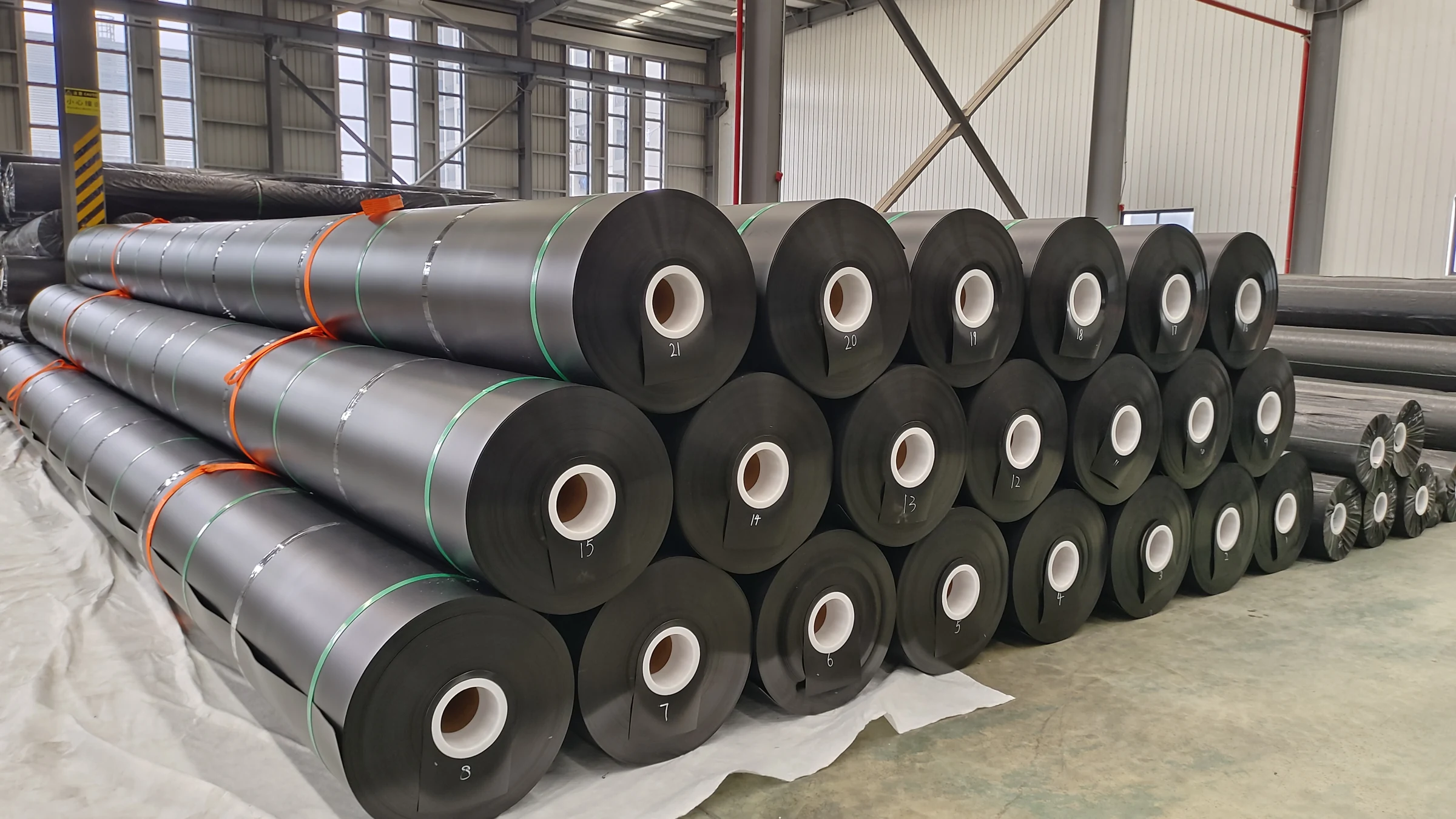
- Roll identification: match the roll number, production lot, resin batch, and test report.
- Field seams: evaluate peel and shear performance under the project specification and the applicable GRI-GM19a criteria. A universal rule of 80% of parent-sheet strength should not be used without the governing seam specification.
During a storage-reservoir seepage-control project, on-site peel testing identified incorrect hot-wedge welding temperature settings.
The welding parameters were adjusted, and the seams were retested against the project acceptance criteria.[25]
Independent inspection can improve the credibility of material acceptance.
- Define witness-sampling responsibilities in the contract.
- Select a laboratory accepted by both parties.
- Use traceable roll and lot numbers on samples and reports.
- State who pays for initial testing, retesting, and dispute testing.
For projects in China, a CMA-marked report may be required by the contract, regulator, or acceptance procedure.
There is no universal rule that every environmental project above CNY 50 million must use a CMA-accredited report solely because of the investment amount.[26]
Further reading: GRI Certification Reference
Project Submittals
Data Sheets
A geomembrane data sheet is a baseline document used by purchasers to compare the product with the technical specification.
| Data-Sheet Item | Review Point |
|---|---|
| Nominal Thickness | Match the specified thickness and applicable smooth or textured test method. |
| Density | Confirm the minimum formulated sheet density and test method. |
| Tensile Properties | Review yield strength, break strength, yield elongation, and break elongation for the stated thickness. |
| Tear and Puncture Resistance | Compare minimum values with the applicable GRI-GM13 table. |
| Stress Crack Resistance | Confirm the ASTM D5397 SP-NCTL result. |
| Carbon Black | Review content and dispersion separately. |
| Oxidative Induction Time and Aging | Review standard or high-pressure OIT, oven-aging retention, and UV-resistance retention as applicable. |
| Project-Specific Data | Permeability, chemical compatibility, and operating-temperature information may be requested by the project, but they are not universal GRI-GM13 data-sheet fields. |
When preparing specifications for a uranium-mine project, we required the supplier’s data sheet to show each parameter beside the applicable GRI-GM13 Table 1 limit.
This allowed supervisory engineers to verify compliance more efficiently.[27]
Key data-sheet review points include:
- Whether all applicable GRI-GM13 properties are included.
- Whether values are minimum values, typical values, ranges, or actual test results.
- Whether units are consistent and clearly stated.
- Whether the product name, surface type, thickness, revision number, and issue date match the offered material.
- Whether the document is current for the product being purchased.
A requirement that the data sheet be issued within six months may be added by a purchaser, but it is not a universal GRI-GM13 rule.
Project parties should request batch-specific test reports instead of relying only on a generic product data sheet.[28]
For geomembranes outside the project’s normal product range, additional design and installation information may be needed.
GRI-GM13 includes HDPE thicknesses up to 3.0 mm, so material above 2.0 mm is not automatically outside the specification. LLDPE geomembranes should be reviewed under the applicable LLDPE specification rather than treated as low-density HDPE under GM13.
During an artificial-lake seepage-control project, brittle behavior occurred during a cold wave because the submitted data did not include adequate low-temperature performance information.
Supplementary testing was used to establish the applicable lower service and installation temperature for the supplied material.[29]
Further reading: GRI Data Sheet Standard
Test Reports
A test report is a traceable document used to show whether a material lot meets the specified performance requirements. It may be issued by the manufacturer’s laboratory or an independent laboratory.
GRI-GM13 defines minimum manufacturing quality-control test frequencies. Manufacturers should maintain records that connect the reported results to the relevant production lot and roll identification.
Test reports should include:
- Manufacturer and product identification.
- Batch, lot, and roll numbers.
- Production date and test date.
- Nominal thickness and surface type.
- Test methods and standard versions.
- Sample or specimen quantity.
- Individual and average results where required.
- Applicable acceptance limits and a clear conformity conclusion.
In a municipal sludge-disposal-center project, the procurement contract required each delivery batch to include a test report issued within three months.
On-site witnessed sampling was supervised by the project engineer.[30]
Jinseed’s test report templates are available online for reference.[31]
Key test-report review points include:
- Report-number uniqueness and traceability.
- Laboratory accreditation appropriate to the jurisdiction, such as CMA in China or ISO/IEC 17025 accreditation where required.
- Use of the standard version specified by the contract.
- Correct test conditions, specimen preparation, and loading rate.
- Reasonable rounding and consistent units.
- Separate machine-direction and cross-machine-direction tensile results.
- Clear identification of the ASTM D5397 SP-NCTL procedure for stress-crack resistance.[32]
Export and foreign-invested projects may require additional documents under the destination country’s regulations or the owner’s specification.
AS/NZS 4602.1 should not be cited as a geomembrane requirement because it applies to high-visibility safety garments. Australian geomembrane requirements should be confirmed from the relevant project specification and regulator.
For the European market, CE marking depends on the product’s intended use and the applicable harmonized geosynthetics standard under the Construction Products Regulation. It is not a single universal GM13 approval.
We assisted a Southeast Asia-bound geomembrane manufacturer in comparing GRI-GM13 with destination-market and project requirements so that one production batch could be documented for multiple acceptance systems.[33]
Further reading: GRI Test Report Format
Certifications
Certificates and supporting documents help purchasers review product conformity, manufacturing systems, and supplier identity. They do not all prove the same thing.
| Document | What It Shows |
|---|---|
| GCI Product Certification to GRI-GM13 | Shows that listed HDPE geomembrane products are covered by the Geosynthetic Certification Institute product-certification program. |
| ISO 9001:2015 | Shows certification of the manufacturer’s quality-management system within the stated scope. |
| ISO 14001 | Shows certification of the organization’s environmental-management system within the stated scope. |
| IGS Membership | Shows membership in the International Geosynthetics Society. It is not product certification. |
| CE Documentation | Applies where the intended use is covered by a relevant harmonized European standard and regulatory route. |
During supplier qualification, we first request a valid ISO 9001 certificate and current evidence of GRI-GM13 product conformity or certification for the offered geomembrane.
These documents are treated as an initial screening threshold rather than a substitute for batch-specific test data.[34]
GRI-GM13 product certification is administered through the Geosynthetic Certification Institute product-certification program. Independent testing is performed by an appropriate accredited laboratory as part of that program.
The program uses plant audits and product testing, with audits conducted approximately every six months. It should not be described as a generic one-year certificate issued directly by a testing laboratory.
Purchasers should verify the current manufacturer and product listing through the official GSI or GCI certification information and confirm that the plant, formulation, surface type, process, and thickness match the offered material.
During due diligence, we identified expired documents and incorrect certificate numbers. Direct verification prevented the documents from being accepted without confirmation.[35]
Jinseed’s GRI-related certificate can be downloaded from our About Us page for project review and archiving.[36]
ISO 9001 certificate review points include:
- The manufacturer name and address should match the contractual supplier and production site.
- The certificate should be within its validity period.
- The certification scope should include geomembrane or geosynthetics production.
- The certification body and accreditation should be independently verifiable.
- The normal three-year certification cycle should not be confused with the annual surveillance process.
For large infrastructure projects, contract terms may require original certificates, certified copies, or independently verifiable electronic records.
Certificate validity should be monitored throughout production and delivery rather than checked only during initial supplier approval.[37]
Further reading: Contact Us for Certificate Originals