

Non-woven geotextiles for drainage, with their three-dimensional pore structure, can effectively balance drainage and anti-clogging under the conditions of a vertical permeability coefficient $k$ reaching $10^{-1} \sim 10^{-3}$ cm/s (flow rate 50-150 L/(m²·s)) and an Apparent Opening Size (AOS) of 0.07-0.212mm.
Selection should follow the criterion $O_{95} < 2 \times d_{85}$.
In applications such as retaining walls, blind drains, and landfills, ensure a flat ground overlap of $\ge 300$mm.
To prevent UV aging, the first layer of backfill ($> 300$mm) must be completed within 48 hours after laying, and mechanical rolling directly on the fabric surface is strictly prohibited.
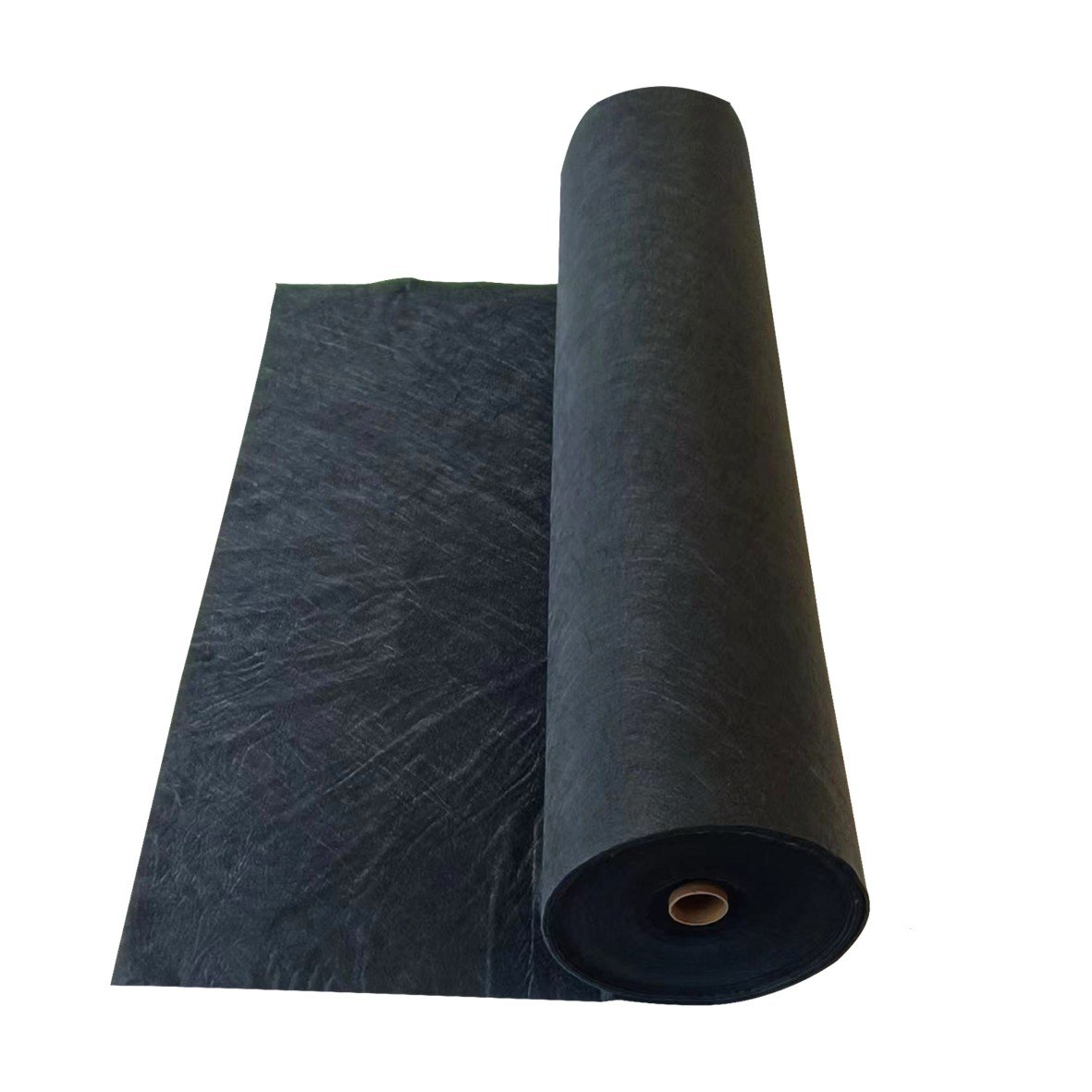
Permeability
According to the ASTM D4491 standard, the permittivity of needle-punched non-woven fabrics specifically for drainage is typically maintained between 1.2 to 2.2 sec⁻¹.
Under a constant head of 50mm, each square meter of material can discharge 3500 to 5800 liters of water per minute.
Due to the material’s porosity of over 85%, the fine channels between fibers allow high-speed fluid transfer in low-pressure differential environments, preventing water accumulation behind structures.
Stability
In-plane and cross-plane transmissivity tests conducted according to ASTM D4716 show that when the normal stress applied to the material surface gradually increases from 20 kPa to over 200 kPa, the non-woven fiber structure undergoes physical compression, leading to changes in internal porosity and permeation paths.
In simulated laboratory environments, high-quality polypropylene (PP) filament non-woven fabrics typically maintain a water permeability retention rate between 70% to 85% of the initial value under 100 kPa pressure, depending on the fiber linear density and needle-punching frequency.
For a needle-punched non-woven fabric with a mass of 300g/m², the thickness is usually compressed to about 60% of its initial state when the vertical pressure reaches 50 kPa. At this point, the Apparent Opening Size (AOS) shifts slightly, but the permeability coefficient (k) often remains above 0.25 cm/s, sufficient to meet the technical requirements of most soil filtration and drainage applications.
In high-pressure environments, polymer materials undergo slow plastic deformation under sustained loads, a phenomenon that must be quantified for projects with a design life exceeding 50 years.
When calculating long-term drainage capacity, engineers introduce reduction factors.
The reduction factor for compressive creep, $RF_{cr}$, is typically between 1.1 and 1.5 for polyester (PET) fibers, while it is between 1.5 and 2.5 for polypropylene fibers.
Through these quantitative indicators, it is possible to predict whether the pore structure will still support the intended drainage flow after 100,000 hours of service.
According to constant head method testing under the ISO 11058 standard, the flow regime of water through non-woven fabrics shifts from turbulent to laminar under pressure. In low hydraulic gradient (i=0.1) environments, the negative impact of pressure on permeability is smaller than in high-gradient environments. Experimental data shows that when pressure doubles from 50 kPa to 100 kPa, the drop in permittivity is approximately 12% – 18%.
Compared to the regular structure of woven geotextiles, the three-dimensional pore network of non-woven fabrics does not cause the entire drainage channel to close due to the displacement of a single fiber when compressed.
The vertically connected fibers formed by the needle-punching process act like support columns, resisting pore closure caused by pressure within a certain range.
If the initial Void Ratio of the material is set at 0.85, this value may drop to 0.60 under extreme high pressure (such as the 500 kPa load of a landfill).
In filtration simulation tests for sandy soils, non-woven geotextiles under 150 kPa pressure demonstrated excellent anti-clogging stability. Although pressure brings fibers closer together, it also shortens the path length for fine particles to pass through the fabric, allowing materials meeting the AOS < 2.0d₈₅ criterion to maintain a long-term Gradient Ratio below 3.0.
In specific engineering scenarios containing chemical leachate, pressure accelerates the deposition of minerals within the compressed fiber gaps.
Design corrections use $RF_{cc}$ (chemical clogging reduction factor) and $RF_{bc}$ (biological clogging reduction factor).
Typically, the final design flow rate after these combined reductions must still maintain a safety margin 10 times higher than the maximum predicted seepage flow.
Actual field monitoring data records show that at the bottom of a highway subgrade deeper than 10 meters, the laid non-woven geotextile still maintains a cross-plane flow rate of over 100 gpm/ft² after 5 years of natural settlement and repeated vehicle loads. This proves the physical advantage of the needle-punching process in maintaining three-dimensional drainage plane stability, effectively preventing subgrade softening caused by upward seepage of groundwater.
In elevated temperature environments, such as drainage systems with thermal effects like mining heap leach pads, it is necessary to refer to ASTM D6243 to obtain interface shear strength while evaluating porosity retention under thermo-mechanical coupling.
For standard environmental applications, conventional needle-punched non-woven fabrics, with a needle-punching point density exceeding 50,000 holes/m², ensure a uniform distribution of permeability across the pressure surface, avoiding fluid stagnation caused by excessive local pressure.
Standards and Testing
ASTM D4491 specifies both constant head and falling head test procedures for the drainage efficiency of non-woven geotextiles.
In the constant head method, the sample is placed at the bottom of a permeameter with an internal diameter of 50mm, maintaining a 50mm hydrostatic pressure head difference above it.
The test must be conducted at a controlled water temperature of 21 ± 2°C to eliminate the impact of fluid viscosity changes on the permeability coefficient (k).
For drainage-grade needle-punched non-woven fabrics, a single test requires continuous recording of the fluid volume passing through the material until the time deviation between three consecutive measurements is less than 5%.
The calculated Permittivity is measured in sec⁻¹, reflecting the rate at which water penetrates the fabric under a unit head.
In actual tests for high-performance polypropylene non-woven fabrics, materials with a mass of 200g/m² typically exhibit a permittivity of 1.5 sec⁻¹ to 2.0 sec⁻¹. Converted to this standard, the flow rate per square meter per second can exceed 100 liters. Test protocols require the use of deaired water to prevent air bubbles from blocking fiber pores, ensuring data reflects the true physical flow limits of the material.
- 50mm Constant Pressure Head: Establishes a standardized hydraulic driving force, simulating the initial state of surface runoff infiltrating a drainage layer.
- Deaired Water Treatment: Removes dissolved air from the fluid to prevent bubbles from attaching to fiber intersection points, which would cause a false decrease in porosity.
- Temperature Correction Factor ($R_t$): Standardizes all test results to a reference environment of 20°C, ensuring comparability of data between different laboratories.
- Multi-sample Averaging: Based on ASTM D4354 sampling standards, at least 5 samples from different locations of the roll are selected for parallel testing, with the average taken as the technical parameter for the batch.
The determination of Apparent Opening Size (AOS) is based on the ASTM D4751 standard.
A weight of 50g of specific-grade glass beads is placed on the sample and sieved for 10 minutes on a vibrator with a frequency of 50Hz and an amplitude of 1.5mm.
By weighing the glass beads that penetrate the fabric, the O₉₅ value is determined, meaning 95% of particles of a specific size cannot pass through the material.
This parameter ensures that while the geotextile rapidly discharges water, it effectively blocks fine sand with a diameter greater than 0.15mm, preventing siltation in downstream drainage pipes.
In tests for a particle size of 0.212mm (No. 70 sieve), if the penetration rate is lower than 5%, the material’s AOS is marked as 0.212mm. In actual engineering design, this value must be matched with the soil’s effective particle size (d₈₅), meeting filtration criteria to prevent piping phenomena.
- Glass Bead Size Gradation: Covers a standard range from 0.600mm to 0.075mm, providing a fine pore size distribution curve.
- 10-Minute Standard Sieving: Standardized mechanical vibration time ensures particles fully seek penetration paths within the three-dimensional fiber network.
- Limitations of Dry Sieving: Although dry sieving is easy to operate, wet sieving according to ISO 12956 is often used as a supplementary reference when dealing with extremely fine fibers or materials with electrostatic effects.
- Pore Size Uniformity Index: Evaluates the consistency of the needle-punching process across the width of the material by analyzing the passage rate of glass beads of different sizes.
ISO 11058 introduces the Velocity Index (vₕ₅₀) to quantify hydraulic conductivity performance.
Unlike single-head tests, this procedure requires measuring flow rates at five different pressure head gradients:
10mm, 20mm, 30mm, 40mm, and 50mm.
For heavy-duty protective non-woven fabrics, the typical range of vₕ₀₅₀ is between 30mm/s to 110mm/s.
- Five-level Pressure Gradient Regression: Predicts the overload capacity of the material under extreme flood pressure through linear or non-linear fitting.
- Perforated Plate Support System: The test apparatus is equipped with a high-flux support grid at the bottom to avoid secondary resistance to water flow from the testing equipment itself.
- Flow Regime Identification: Analyzes whether the water flow remains within the laminar range while passing through materials with a thickness of 3mm to 6mm.
- Darcy’s Law Applicability Check: Verifies if the flow velocity is proportional to the hydraulic gradient within this pressure range, thereby providing parameters for hydraulic modeling.
Assessment for long-term service performance typically cites the Gradient Ratio test of ASTM D5101.
This test combines the geotextile with site-specific soil samples in a constant-head permeameter.
Pressure distribution changes are monitored as water flows through the interface by setting pressure sensors (piezometers) inside the soil and at the geotextile interface.
If the pressure loss at the interface is much higher than inside the soil, the gradient ratio value will exceed 3.0, indicating serious particle migration or clogging.
- Pressure Sensor Array: Multiple monitoring points are arranged along the flow direction to capture real-time hydraulic gradient changes at the interface layer.
- 24-168 Hour Long-term Operation: Observes whether the “natural filter layer” formed on the geotextile surface stabilizes as fine particles migrate.
- System Permeability Calculation: Comprehensively evaluates the overall discharge efficiency of the soil-geotextile combination.
- Clogging Sensitivity Identification: Determines the application boundaries of the material by comparing gradient ratios under different soil types (e.g., silt vs. sand).
For drainage systems needing to handle chemically active fluids (such as mining heap leach or industrial filtrate), the test protocol adds a chemical compatibility immersion procedure according to ASTM D5322.
After samples are immersed in specific chemical solutions for 120 days, the ISO 11058 permeability test is repeated to evaluate whether the pore structure has collapsed due to oxidation, hydrolysis, or swelling of the polymer fibers.
For high-quality polypropylene fibers, the drop in permittivity is typically controlled within 10% in environments with a pH value of 2 to 13.
AOS (Pore Size)
AOS stands for Apparent Opening Size, defined as O₉₅ under the ASTM D4751 standard, which is the smallest size at which a geotextile can retain 95% of glass beads of a specific diameter.
In drainage engineering, the AOS of non-woven geotextiles typically ranges between 0.15mm (100 mesh) to 0.60mm (30 mesh).
This indicator determines whether the material can maintain a water flux of over 200L to 500L per minute per square meter while intercepting soil particles of D₈₅ grain size under normal pressure, preventing foundation instability caused by fine particle loss.
Standards and Parameters
In the design and material acceptance stage of drainage engineering, the Apparent Opening Size test for non-woven geotextiles is primarily executed according to the ASTM D4751 standard, a method known as dry sieving in North America and most international general specifications.
During the experiment, technicians place 50 grams of quasi-spherical glass beads on the surface of a 200mm diameter geotextile specimen, which is then installed on a mechanical vibratory shaker vibrating at a frequency of 285 cycles per minute for 10 minutes.
The glass beads selected for the test cover multiple levels from 0.850mm (#20) to 0.075mm (#200).
When the vibration ends, the retention rate is calculated by weighing the beads remaining on the fabric surface.
The final value for Apparent Opening Size (AOS) is defined as the particle size at which 95% of glass beads of a specific diameter are retained, usually marked as $O_{95}$ in technical data sheets.
If 95% of glass beads with a diameter of 0.212mm cannot pass through, the product’s AOS corresponds to US Standard Sieve #70.
The laboratory environment has specific requirements for the accuracy of test results; the relative air humidity must be controlled between 50% to 70%, and the temperature maintained at 21°C ± 2°C. This is to prevent static electricity during dry sieving, which could cause fine glass beads to adsorb to the synthetic fiber surface instead of settling normally, resulting in a measurement error where the AOS value appears smaller than it is.
| US Standard Sieve | Millimeters (mm) | Micrometers ($\mu m$) | Nominal Tolerance (mm) |
|---|---|---|---|
| #20 | 0.850 | 850 | ± 0.025 |
| #30 | 0.600 | 600 | ± 0.018 |
| #40 | 0.425 | 425 | ± 0.015 |
| #50 | 0.300 | 300 | ± 0.012 |
| #60 | 0.250 | 250 | ± 0.010 |
| #70 | 0.212 | 212 | ± 0.009 |
| #80 | 0.180 | 180 | ± 0.007 |
| #100 | 0.150 | 150 | ± 0.007 |
| #120 | 0.125 | 125 | ± 0.005 |
| #140 | 0.106 | 106 | ± 0.005 |
| #170 | 0.090 | 90 | ± 0.004 |
| #200 | 0.075 | 75 | ± 0.004 |
Unlike the ASTM dry sieving method, the European standard ISO 12956 uses wet sieving to determine the characteristic pore size.
Wet sieving simulates actual working conditions where water flow carries soil particles, using specific graded stone powder or spherical media as test material, and continuously spraying water onto the fabric surface at a flow rate usually set to 0.5 liters per second.
The result measured by wet sieving is usually called $O_{90}$, which is the pore size value at which 90% of particles are retained.
In parameter conversion for international engineering, it is generally considered that the $O_{90}$ (ISO) for the same material is approximately 0.8 to 0.9 times the $O_{95}$ (ASTM). The specific conversion ratio depends on the non-woven fabric production process, such as needle-punching density and fiber fineness (denier).
For needle-punched non-woven fabrics, as the mass increases from 150g/m² to 400g/m², the fiber interlacing network becomes tighter, and the water flow path becomes more tortuous.
The AOS of a 150g/m² geotextile is typically distributed around 0.212mm (#70), while when the mass increases to over 500g/m², the AOS often drops to 0.150mm (#100) or lower.
Fiber thickness also changes pore size distribution;
geotextiles made from 6 denier (6D) staple fibers have more micro-pores than products made from 15 denier (15D) fibers, even if both have the same mass.
The $O_{95}$ value of fine fiber products will appear more refined.
Filtration and Selection
When choosing non-woven geotextiles for drainage, refer to the Apparent Opening Size $O_{95}$ tested according to ASTM D4751.
When the weight proportion of particles passing through a 0.075mm (#200 sieve) in the soil is lower than 50%, selection guidelines suggest that $O_{95}$ should be less than or equal to 0.60mm (#30 sieve).
If the soil is finer, with fine particle content exceeding 50%, $O_{95}$ must be reduced to 0.212mm (#70 sieve) or lower.
In Federal Highway Administration (FHWA) engineering specifications, soil retention is measured by calculating the ratio $O_{95} / D_{85}$. For engineering environments with non-steady flow or affected by vibration, this ratio is usually strictly limited to within 1.0 to prevent serious internal erosion.
The permeability criterion requires that the permeability coefficient $k_g$ of the non-woven geotextile must be much higher than the permeability coefficient $k_s$ of the protected soil.
A commonly used relationship is $k_g \geq 10 \times k_s$.
Considering the compressive deformation caused by soil pressure in field construction, the nominal thickness of non-woven geotextiles will change.
Therefore, the engineering community prefers to use Permittivity to describe hydraulic performance.
The unit of permittivity $\psi$ is $s^{-1}$, representing the flow rate through a unit area of geotextile under a unit head difference.
For most subgrade blind drains and retaining wall drainage systems, the geotextile is required to reach a flow velocity between 200L/min/m² and 500L/min/m² under a 50mm head.
If permittivity is insufficient, excess pore water pressure will accumulate at the geotextile interface, leading to instability of retaining walls or subgrade pumping.
Permittivity testing is based on the ASTM D4491 standard, determined through constant head or falling head tests. it reflects not only the gap size between fibers but also the fiber arrangement density per unit volume.
Non-woven geotextiles rely on their randomly interlaced three-dimensional pore structure to provide multiple drainage channels.
Selection logic suggests that the porosity of non-woven geotextiles should be maintained between 80% and 90%.
When the soil is poorly graded silty sand or contains a large number of colloidal particles, traditional $O_{95}$ indicators are no longer sufficient for safety assessment.
In such cases, the Gradient Ratio Test (ASTM D5101) must be introduced, judged by measuring the hydraulic gradient ratio of the geotextile and the soil within 25mm above it.
If the ratio exceeds 3.0, it indicates serious particle siltation on the fabric surface.
Because fine particles are embedded deep into the fibers, drainage capacity is greatly attenuated.
AASHTO M288 classifies non-woven geotextiles into Class 1, Class 2, and Class 3.
In cases where gravel particle size is large, the drop height is high, or foundation bearing capacity is extremely low, Class 1 needle-punched non-woven fabrics must be prioritized.
These materials typically require a grab strength of over 1100N.
Under good backfill conditions, Class 2 (grab strength over 700N) can meet the requirements.
Application Scenarios
Non-woven geotextiles provide a permeability coefficient of $10^{-1}$ to $10^{-3}$ cm/s through their three-dimensional pore structure in drainage engineering, effectively intercepting particles from $0.05$ to $0.21$ mm.
In highway drainage systems, laying needle-punched geotextiles with a mass of $200$ to $400$ g/m² can reduce subgrade moisture content by over $15%$.
For retaining walls, vertical permeability must be greater than $0.5$ cm/s at a hydraulic head gradient of $1.0$ to maintain structural stability and ensure a design life of over $50$ years.
Highways and Railways
In modern highway pavement structure design, materials are classified into three grades based on the AASHTO M288 standard for different construction environment pressures.
In a high-stress Class 1 environment, the mass per unit area typically needs to be above 270 g/m², and its Grab tensile strength must be no less than 900 N.
If silt from the subgrade soil enters the drainage layer, it will cause the internal friction angle of the graded gravel to decrease, reducing the bearing capacity of the pavement structure by 30% to 50%.
By laying non-woven geotextile at the interface, the physical independence of each material layer can be maintained.
This isolation can extend the design life of the pavement by more than 10 years.
| Technical Parameter | Class 1 Standard | Class 2 Standard | Class 3 Standard | Common Test Standard |
|---|---|---|---|---|
| Grab Tensile Strength (N) | $\ge 900$ | $\ge 700$ | $\ge 500$ | ASTM D4632 |
| CBR Puncture Strength (N) | $\ge 2225$ | $\ge 1625$ | $\ge 1025$ | ASTM D6241 |
| Trapezoidal Tear Strength (N) | $\ge 350$ | $\ge 250$ | $\ge 180$ | ASTM D4533 |
| Apparent Opening Size AOS (mm) | $\le 0.25$ | $\le 0.25$ | $\le 0.25$ | ASTM D4751 |
Railway track systems have even stricter performance requirements for non-woven geotextiles.
Beneath the ballast layer, the geotextile acts as a protective layer to prevent “pumping” and subgrade fouling.
When trains run at high speeds and pass through tracks, the resulting dynamic cyclic loads create high pore water pressure on the subgrade surface, forcing lower fine particles upward under pressure.
Needle-punched non-woven geotextile, through its three-dimensional voids in the thickness direction, can maintain horizontal permeability of over $1.0 \times 10^{-2}$ cm/s while bearing axial loads of over 30 tons.
For heavy rail systems, polypropylene (PP) geotextiles of 400 g/m² to 800 g/m² are typically selected to ensure that fiber structures do not suffer fatigue fracture under high-frequency vibration of gravel.
| Application Site | Typical Mass (g/m²) | Permittivity ($sec^{-1}$) | Elongation (%) | UV Resistance (500h) |
|---|---|---|---|---|
| HSR Subgrade | $500 – 800$ | $\ge 0.8$ | $\ge 50$ | $\ge 70%$ Strength retention |
| Highway Shoulder Drain | $150 – 250$ | $\ge 1.5$ | $\ge 50$ | $\ge 70%$ Strength retention |
| Soft Soil Reinforcement | $300 – 500$ | $\ge 1.0$ | $\ge 50$ | $\ge 70%$ Strength retention |
| Temporary Access Road | $200 – 300$ | $\ge 1.2$ | $\ge 50$ | Not mandatory |
French Drains typically use non-woven geotextile to wrap gravel or perforated drainage pipes.
Their filtration logic follows the D15/d85 criterion, meaning the geotextile’s pore size must match the particle size distribution of the surrounding soil.
In areas with high rainfall, the permittivity of non-woven fabric is usually required to be above 1.0 $sec^{-1}$.
This ensures that under saturated conditions, water flow can enter the collection system without obstacles, while soil particles larger than 0.075 mm are blocked outside the fabric.
In subgrades after adopting qualified filter layers, the groundwater level can be stably maintained at 60 cm below the pavement structure layer, greatly reducing frost heave damage in seasonal frozen soil areas.
Soil mechanics research indicates that the application of non-woven geotextile in subgrade engineering can reduce pavement surface deflection by about 15%. On unstable soft foundations, laying needle-punched geotextile with high elongation (usually $>50%$) can absorb some of the shear stress caused by uneven settlement. The material’s polyester (PET) or polypropylene (PP) fibers exhibit excellent inertia in buried environments, showing good corrosion resistance to acidic soils (pH 4.0) or alkaline lime-modified soils (pH 12.0), ensuring structural integrity of infrastructure during a service cycle of 50 to 75 years.
Highway specifications typically require that the first layer of fill must be covered within 48 hours after laying the geotextile to avoid polymer photo-degradation caused by sun exposure.
For working conditions using large mechanical compaction, the CBR puncture strength of the geotextile must be able to withstand the impact of angular gravel with particle sizes over 50 mm.
In railway slope protection projects with steep slopes, the setting of overlap width affects the system’s sealing.
A 300 mm overlap is typically used on level subgrades, while on soft soil foundations, it must be increased to 600 to 1000 mm, or a sewing process should be used to ensure the interface does not open when the soil mass undergoes large lateral displacement.
Retaining Walls
In retaining wall engineering design, when rainfall or groundwater infiltrates backfill, water accumulates in soil pores.
If not discharged, lateral pressure will increase by over 40%.
Non-woven geotextile forms a continuous filtration interface between the wall back and the gravel drainage layer, with its vertical permeability coefficient typically maintained between $1.0 \times 10^{-1}$ to $5.0 \times 10^{-3}$ cm/s.
For gravity retaining walls or reinforced soil retaining walls over 6 meters high, using needle-punched geotextile with a mass of 300 to 500 g/m² ensures that the drainage system’s water-passing capacity is more than 10 times higher than the soil inflow rate, effectively preventing the soil from significantly reducing shear strength due to saturation.
According to ASTM D4491 standard testing, qualified drainage non-woven geotextile needs a permittivity of 0.5 to 2.0 $sec^{-1}$. On the back of a typical 10-meter-high retaining wall, this material can handle infiltration flows of dozens of liters per minute per square meter of interface, eliminating the overturning moment on the wall toe caused by head height accumulation.
In cases where retaining wall backfill has a fine grain size, the Apparent Opening Size of the geotextile must be precisely controlled within the range of 0.15 to 0.25 mm (corresponding to 60# to 100# sieve openings under the ASTM D4751 standard).
The needle-punched fiber arrangement of non-woven fabrics simulates the filtration logic of natural graded sand and gravel, inducing the soil to form a “natural filter layer” at the contact surface—a skeleton composed of coarse particles.
In this way, after dust particles smaller than 0.075 mm are discharged at the initial stage of pressure, the remaining soil structure tends to stabilize.
Over a 15-year operational cycle, the permeability loss rate of such drainage interfaces is typically lower than 20%, far superior to traditional single-layer graded sand and gravel solutions.
In terms of mechanical performance, the squeezing stress behind retaining walls requires the geotextile to have extremely high puncture resistance. When tested with the ASTM D6241 standard, 300g/m² polyester non-woven fabric should have a puncture strength of no less than 1800 N to resist sharp mechanical damage generated by backfill gravel during compaction.
In environments as deep as 10 meters underground, lateral soil pressure may reach 50 to 100 kPa.
Non-woven fabric must maintain porosity even under pressure.
Polypropylene (PP) non-woven fabric has excellent chemical stability in environments with pH values from 2 to 13, resisting erosion of the fiber structure by acidic substances or alkaline building materials in groundwater.
Geotextile filter wrapping layers laid around foundation bases can extend the maintenance cycle of French Drains from 5 years to over 30 years, preventing silt deposition in drainage stratification.
In cases of instantaneous high water levels caused by extreme weather, thick needle-punched geotextiles with a thickness of 3 to 5 mm can provide lateral buffer channels, avoiding pressure from forming local puncture points on waterproofing membranes.
For multi-story buildings including basements, non-woven fabrics with a mass of over 400 g/m² are typically used beneath foundations for isolation and drainage.
This can increase the Safety Factor of foundation bearing capacity by approximately 15% to 20%.
By dispersing soil pressure and efficiently guiding moisture, structural differential settlement is limited to within 15 mm, reducing the risk of structural cracks caused by uneven moisture content.
In permanent underground engineering with a design life of over 50 years, the Creep Resistance of materials is crucial. Research data points out that for high-quality polyester non-woven fabrics under a constant load of 20 kPa, the thickness compression rate will stabilize after 10,000 hours, retaining over 70% of the original drainage capacity, ensuring a long-term dry operational environment for underground structures.
The anchorage length of non-woven geotextile at the top of a retaining wall should be no less than 300 mm, using overlapping joints.
Overlap width is typically set between 450 to 600 mm depending on soil stiffness.
At the junction of the basement floor slab and side walls, the geotextile must wrap the entire drainage conduit to ensure fine sand cannot enter through joints.
When using mechanical fixation (such as nails or specialized gaskets) to attach fabric to a wall surface, avoid over-stretching fibers to prevent unpredictable expansion of the effective pore size.
Landfills
In multi-layer liner systems at the bottom of landfills, static pressure can reach 400 to 800 kPa in modern controlled landfills deeper than 40 meters.
Needle-punched polypropylene (PP) non-woven geotextiles with a mass between 800 g/m² to 1600 g/m² are laid above 2.0 mm thick HDPE geomembranes.
With its initial thickness exceeding 6 mm and the buffer space formed by interlaced needle-punched fibers, the material absorbs local concentrated stress generated by backfilled gravel drainage material, distributing point loads transmitted to the anti-seepage membrane and preventing sharp stones from physically puncturing the membrane during compaction.
- Physical Protection Indicators: When tested with the ASTM D6241 standard, the CBR puncture strength of 1200 g/m² high-strength non-woven geotextile usually exceeds 8000 N.
- Hydraulic Permeability Parameters: Permittivity must be maintained between 0.5 to 1.2 $sec^{-1}$, ensuring leachate smoothly enters the collection pipe network under a 0.1 head gradient.
- Pore Size Control Range: Apparent Opening Size (AOS) must be maintained at 0.075 to 0.15 mm per ASTM D4751, balancing the interception of fine waste particles with maintaining long-term water flow capacity.
- Chemical Resistance Grade: After samples are immersed in strong acid-alkali leachate with pH values from 2 to 13 for 120 days, the tensile strength retention rate must be higher than 90%.
Leachate in landfills contains complex organic acids, heavy metals, and microorganisms, which requires non-woven geotextile to have extremely high biological stability. Polypropylene fibers, due to the chemical inertia of their carbon chain structure, do not undergo hydrolysis reactions like some polyester materials when in long-term contact with landfill degradation byproducts. Accelerated laboratory aging data shows that in a 50°C leachate environment, the estimated physical life of high-quality polypropylene needle-punched fabric can exceed 100 years, meeting monitoring and maintenance requirements for up to 30 years after closure.
When organic moisture passes through the geotextile interface, microorganisms attach to fiber surfaces and form biofilms.
Non-woven geotextiles, having a porosity of over 80%, provide more overflow paths internally than single-layer woven materials.
Even if some pores are occupied by biofilms or fine dust particles, water can still seek other outlets by moving laterally into the gravel drainage layer.
This three-dimensional permeability characteristic is less prone to interface failure than traditional graded sand and gravel filter layers when handling initial leachate with high Total Suspended Solids (TSS) content.
Under high-pressure conditions, the compressive creep behavior of non-woven geotextile changes its initial pore structure. Data indicates that when a constant load of 500 kPa is applied, the thickness loss of thick needle-punched geotextile after 10,000 hours is between 20% to 35%. Designers must use the corrected permeability coefficient under pressure when calculating drainage flow, usually taking 0.1 to 0.5 times the initial value, to ensure sufficient discharge capacity in the later stages of landfill operation and prevent leachate head from exceeding the legal limit of 30 cm.
During the laying process, the overlap width of two fabric pieces is typically set at 150 to 300 mm, and they are connected using hot air welding or hand-held sewing machines to prevent fabric misalignment during gravel dumping, which could expose the anti-seepage membrane.
For slope areas with a gradient greater than 1:3, textured HDPE membranes must be used in conjunction with needle-punched fabric having a higher friction coefficient to increase interface shear strength and prevent overall landslides of the landfill material.
Since landfills are permanent engineering projects, sampling frequency for geotextiles is typically conducted every 5,000 square meters for a full indicator re-check, including thickness, mass, tensile strength, and trapezoidal tear strength, ensuring every roll of material arriving at the site meets the rigid requirements of the technical specification.

Leave a reply