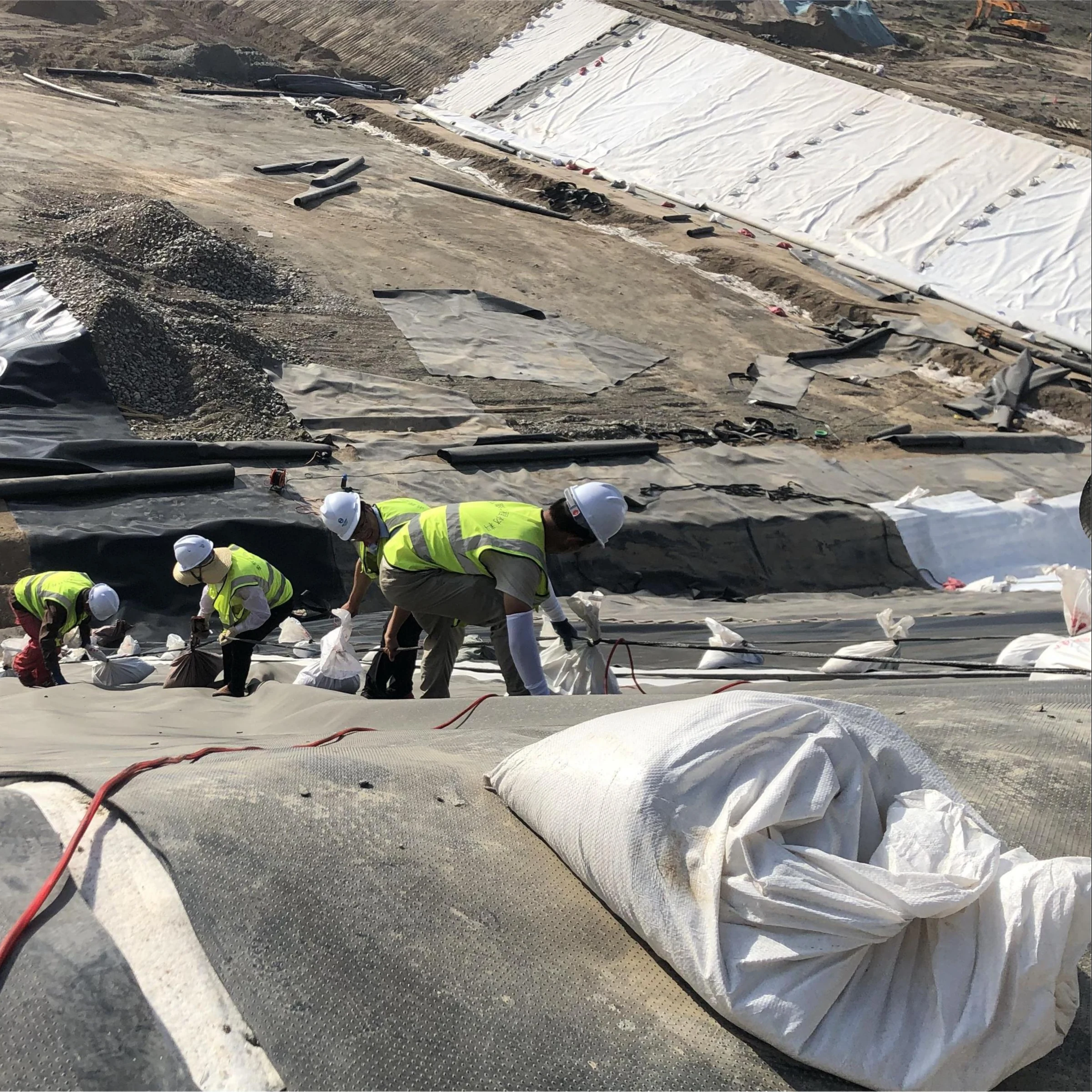
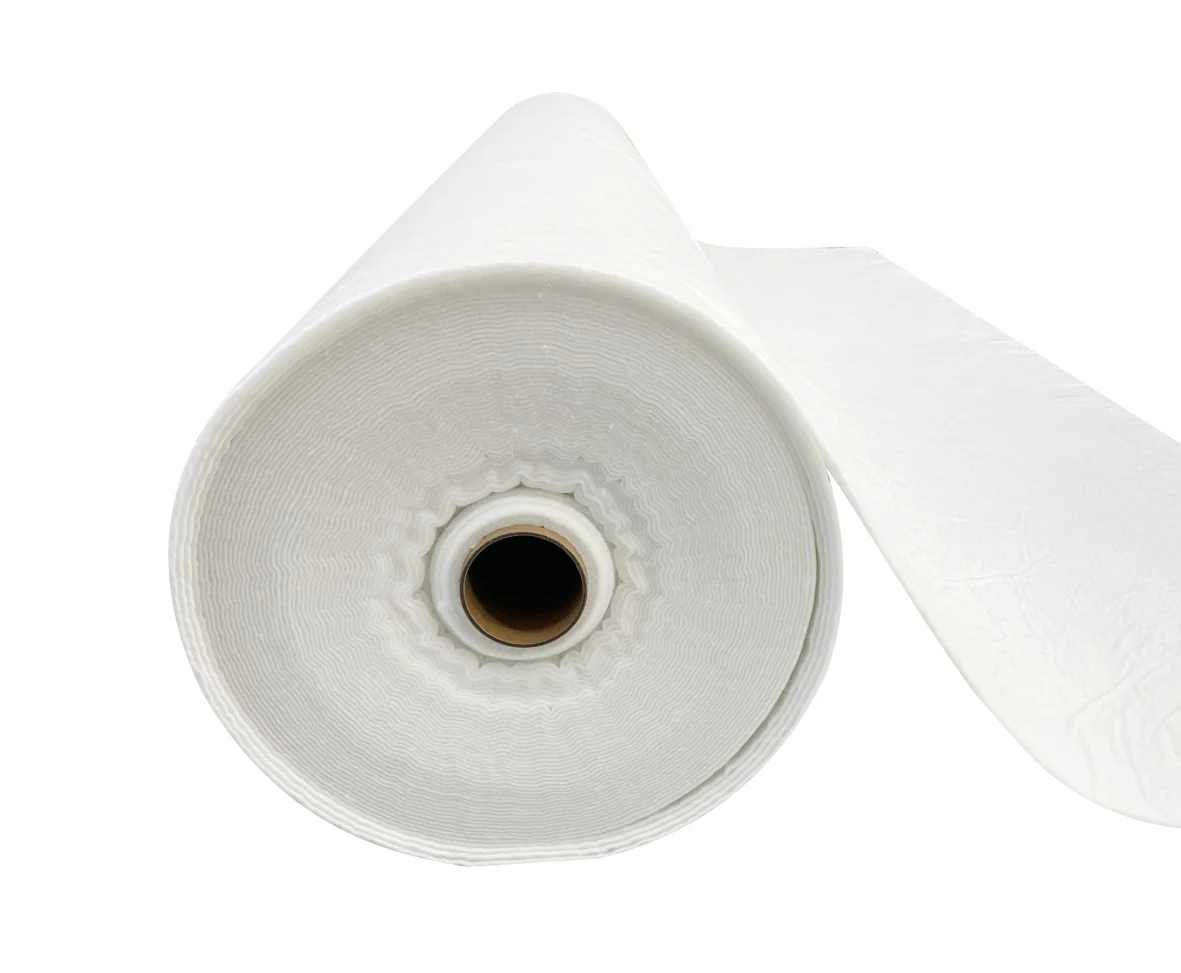

Choose geotextile by GSM: 100–150g/m² for weed control, 150–300g/m² for landscape drainage, and ≥300g/m² for load-bearing areas. A water permeability rate of ≥80% and tensile strength of ≥8kN/m will give you better durability.
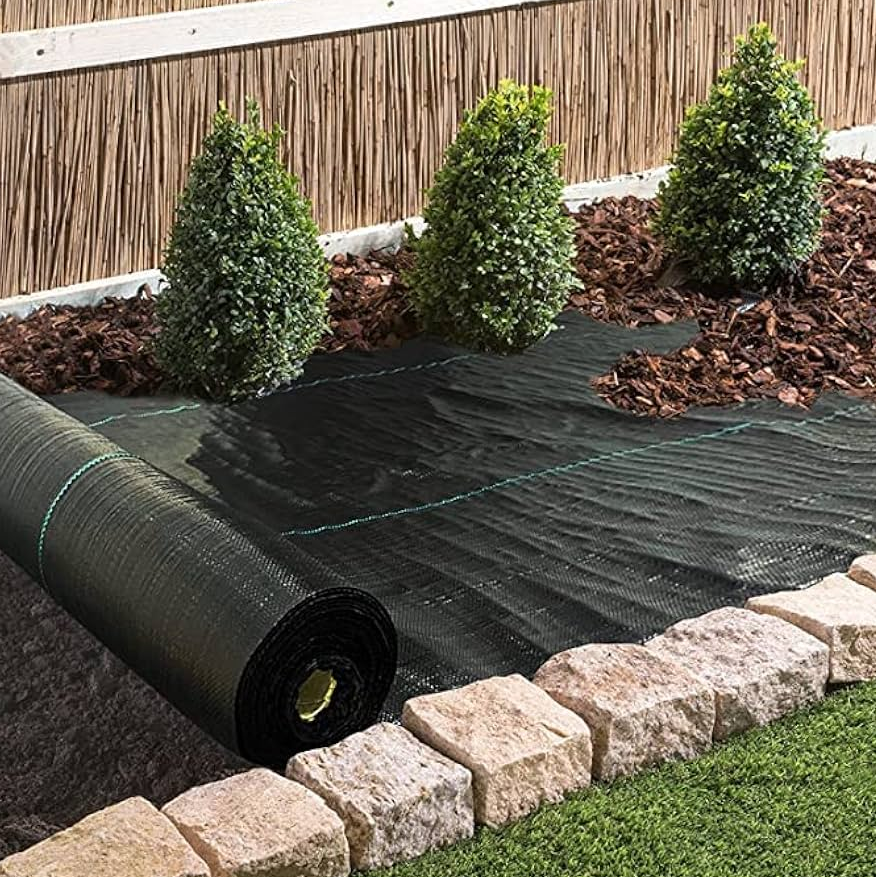
Weed Prevention vs. Water Permeability
Water Permeability & Aperture Size
One square meter of needle-punched nonwoven fabric contains roughly 120,000 microscopic flow channels. In the 100 GSM grade, the equivalent opening size typically falls between 0.15 mm and 0.18 mm. That size allows very fine silt particles smaller than 0.075 mm to pass through with the water. If the opening size shrinks to 0.08 mm, soil particles begin to accumulate upstream of the fabric and form a dense sludge layer about 3 mm thick.
Vertical permeability drops nonlinearly as GSM increases. Under a constant 50 mm head, 100 GSM fabric delivers a flow rate of 155 L/m²/s. At 150 GSM, that falls to 95 L/m²/s. Industrial-grade 250 GSM fabric drops further to just 35 L/m²/s. When rainfall exceeds 40 mm per hour, heavy-weight materials can cause surface water to build up at a rate of 1.5 cm per minute.
| Weight (GSM) | Equivalent Opening Size (mm) | Vertical Permeability Coefficient | Flow Rate (L/m 2 cdot s) | Fiber Layers (Approx.) |
|---|---|---|---|---|
| 90 – 110 | 0.16 – 0.20 | 2.2 – 2.5 | 140 – 170 | 2 – 3 layers |
| 120 – 140 | 0.12 – 0.15 | 1.6 – 1.9 | 90 – 120 | 4 – 5 layers |
| 150 – 180 | 0.10 – 0.12 | 1.1 – 1.4 | 60 – 85 | 6 – 8 layers |
| 200 – 250 | 0.07 – 0.09 | 0.5 – 0.8 | 30 – 50 | More than 10 layers |
Internal porosity typically stays between 75% and 82%. In 135 GSM fabric, the average fiber diameter generally ranges from 18 to 22 microns. High-density needle punching repeatedly entangles these fibers, creating a complex maze-like path. As water passes through 1.2 mm-thick 150 GSM fabric, its actual travel path is about 4.5 times the fabric thickness. That longer path increases friction between water molecules and the fiber surface, producing a head loss of about 12 mm.
The Gradient Ratio (GR) is used to measure long-term drainage stability. When GR stays between 1.2 and 1.8, the fabric remains in a stable flow condition. In clay soils, 120 GSM fabric still shows stable GR values after 240 hours of continuous flow testing. Under the same conditions, 200 GSM fabric can exceed a GR of 3.0 within 72 hours as its internal micropores begin to clog.
- Porosity: around 78% provides a good balance of strength and drainage
- Fiber diameter: around 20 microns gives the best surface area
- Head loss: 150 GSM should stay below 15 mm
- Clogging threshold: O should be greater than 1.5 times the soil’s
- Wetting angle: virgin polypropylene fibers should have a contact angle below 90°
Surface cover compacts the fabric and squeezes the voids between fibers. A 5 cm gravel layer applies a static pressure of about 0.8 kPa. Under that load, the porosity of 100 GSM fabric can shrink from 80% to 55%. A 155 GSM fabric has greater structural rigidity and can still maintain porosity above 72%. That stable physical structure keeps the vertical drainage channels from collapsing under long-term load.
On slopes steeper than 15 degrees, surface water creates lateral shear forces. A 130 GSM rough-surface geotextile can reach a static friction coefficient of 0.68. That rough texture captures fast-moving rainwater and forces surface runoff to shift into vertical infiltration. Water retention time on the fabric surface increases by 0.8 seconds, and total infiltration rises by 25%.
- Friction coefficient: above 0.65 helps prevent cover material from shifting
- Permeability retention under load: > 60% at 10 kPa
- Transmissivity: 150 GSM should reach 0.03 cm/s
- Air permeability: 120 GSM should allow 55 L/m^2 cdot s airflow
- Thermal stability: pore deformation rate < 2% at 60°C
Soil pH affects how water moves between the fibers. In acidic soil with a pH of 5.0, the charge distribution on the fiber surface attracts more fine mineral particles. This electrostatic attraction can cause calcification in 100 GSM fabric over five years, reducing permeability by 60%. A 140 GSM fabric made from virgin material and treated with an antistatic additive can keep that decline below 15%.
Freeze-thaw cycles in colder regions can damage the pore structure. As water freezes and expands inside the fibers, a single cycle can generate expansion pressure as high as 200 MPa. In tests at -15°C, 135 GSM fabric maintains a rebound rate above 92%. That toughness prevents ice crystals from snapping the fibers and keeps the shift below 5% after winter.
- pH resistance: performance loss < 10% from pH 4.5 to 9.0
- Freeze-thaw recovery: strength retention > 95% after 50 cycles at -20°C
- Ash content: premium virgin material should stay below 0.5%
- Material density: polypropylene is typically around 0.91 g/cm^3
- Carbon black particle size: 25 nm gives the most even distribution
In high water table areas, the fabric needs to move water laterally as well as vertically. Under 20 kPa of lateral pressure, 145 GSM needle-punched fabric maintains an in-plane transmissivity of 0.025 cm/s. Standing water can then migrate slowly through the fabric layer toward lower ground. This drainage blanket effect is more effective than vertical permeability alone at reducing moisture around plant roots.
For sandy soils, should be kept around 0.12 mm. That size blocks more than 95% of fine sand from entering the drainage layer while still maintaining a flow rate of 85 liters per square meter. A 200 GSM fabric may raise the retention rate to 99%, but the flow rate becomes too low for heavy showers. Based on current lab data, 135 GSM offers the best balance between clog resistance and high flow capacity.
- In-plane transmissivity: 0.02 – 0.04 cm/s
- Effective flow area: micropores should make up > 35% of the surface area
- Particle retention: > 98% blockage for 0.1 mm particles
- Wetting saturation point: 150 GSM should require 0.8 L/m² of water volume
- Service life: 15 – 20 years underground away from light
During installation, surface level variation should stay under 3 cm to prevent washout cavities from forming under the fabric. On cohesive soils, adding a 2 cm coarse sand transition layer above the soil will trap 0.01 mm particles before they reach the fabric. This combined structure can extend the permeability life of 140 GSM geotextile by 1.8 times.
Fabric in the 135 GSM to 155 GSM range offers the best balance between light blocking for weed control and a 90 L/s flow rate. Grades above 200 GSM are typically meant for heavy-duty driveway bases; used directly in flower beds, they can reduce the total soil microbial population by 35%. The right permeability choice allows a garden to drain surface water within 45 minutes after a heavy downpour stops.
- Sand cushion thickness: recommended 20 – 40 mm
- Soil flatness: within a tolerance of ±30 mm
- Microbial activity retention: 120 GSM performs above 85%
- Drainage recovery time: < 60 minutes after heavy rain
- Puncture resistance: CBR strength should reach at least 1.6 kN
Weed Control Performance
One square meter of disturbed topsoil can contain around 35,000 dormant seeds. Light is the physical trigger that activates them. The fiber pores in 90 GSM fabric allow about 18% of visible light to pass through, which gives shallow-rooted weeds like purslane enough energy to germinate. A 140 GSM fabric blocks more than 99.7% of light, and without the energy needed for photosynthesis, weed seeds exhaust their internal reserves within 14 days.
Rhizomatous weeds such as nutsedge, with hard pointed tips, can pierce low-density barrier layers. A 100 GSM geotextile has a puncture strength of about 1.1 kN. At 150 GSM, that rises to 2.2 kN. High-pressure needle punching creates more than 300 entanglement points per square centimeter, and that dense fiber structure prevents emerging shoots from finding gaps to break through.
Weed growth depends on oxygen exchange near the soil surface. A 180 GSM fabric limits air permeability to 38 L/m²/s. In this low-oxygen environment, carbon dioxide concentrations near the soil surface stay around 1.2%. That suppresses the vegetative reproduction rate of more than 85% of weed species and prevents rhizomes from spreading laterally beneath the fabric.
- Light blocking: 140 GSM should reach 99.7%
- Puncture strength: 1.5 kN is the safety threshold for weed control
- Fiber entanglement points: at least 280 per square centimeter
- Oxygen permeability: keep below 40 L/m²/s
- Seed survival time: less than 20 days without light
Fluctuations in soil pH can affect the structural integrity of the weed barrier. In soils with a pH between 4.5 and 8.5, virgin polypropylene can maintain tensile strength for 15 years. Fabrics made from low-quality recycled material can become brittle underground within 24 months and develop cracks wider than 2 mm. Weed seedlings quickly exploit those cracks and take over the surface.
A 135 GSM fabric containing 2.5% carbon black can retain over 80% of its strength after 500 hours of simulated intense UV exposure. Exposed edges without carbon black protection can suffer polymer chain breakdown within 90 days. High-density fabric not only blocks UV light but also reduces unnecessary evaporation of soil moisture.
A 5 cm gravel cover layer creates a downward pressure of about 75 kg/m². That pressure compresses 90 GSM lightweight material by 40%, deforming the fiber pores. A 150 GSM fabric still retains 65% of its original thickness under the same load. That stable physical structure ensures weed-control performance is not compromised by the weight of landscape cover materials.
- Carbon black content: 2% – 3%
- Soil compatibility: suitable for pH 4.0 – 9.0
- UV retention: > 75% after 500 hours
- Load resistance: withstands 80 kg/m² without deformation
- Crack control: fiber break elongation < 60%
Overlap details during installation determine how long the weed barrier lasts. A 25 cm overlap prevents lateral weeds from emerging through the seams. Fix the fabric with 15 cm ground pins at a rate of two pins per meter to stop soil settlement from pulling the fabric apart and creating gaps. When cutting an “X”-shaped opening around a plant stem, the cut radius should be 30 mm wider than the trunk diameter.
On slopes steeper than 20 degrees, the cover layer can slide and expose the geotextile. A rough-surface 120 GSM fabric increases friction with the ground, typically to above 0.65. That textured surface grips mulch or soil on top and helps prevent barrier failure caused by physical displacement.
In areas with a high water table, the fabric must also provide lateral drainage. A 140 GSM needle-punched fabric can still maintain a lateral transmissivity of 0.02 cm/s under pressure. This prevents water from building up under the mat and creating root rot conditions. A healthy soil micro-ecosystem further helps suppress moisture-loving weeds.
- Overlap width: keep at 25 – 30 cm
- Pin spacing: one pin every 0.5 m along the edges
- Friction coefficient: above 0.6 to prevent sliding
- Transmissivity: 0.01 – 0.03 cm/s
- Cut allowance: 1.2 times the trunk diameter
Polypropylene fibers show less than 1% shrinkage under temperature cycling from -20°C to 60°C. That thermal stability ensures the fabric will not tear when frozen ground heaves in northern winters. A 135 GSM fabric delivers tensile strength of 800 N/5 cm in both machine and cross directions, enough to resist seasonal soil movement.
Long-term weed control depends on the fibers’ resistance to biodegradation. Pure polymer chips contain no plant proteins, so fungi and bacteria cannot colonize the surface. In laboratory burial tests, 150 GSM fabric loses less than 3% of its mass after 120 months. That means its physical barrier function remains effective for at least ten years without being eaten away by microbes.
If the soil contains a large amount of gravel, sharp objects larger than 30 mm should be removed before installation. Instantaneous pressure at a single contact point can reach 500 psi. A reinforced 160 GSM fabric can absorb this concentrated pressure and prevent stones from punching through the weed barrier when stepped on.
Fabric in the 135 GSM to 150 GSM range offers the best balance between light blocking and water permeability. Going too heavy can trigger anaerobic conditions and reduce soil fertility. This weight range blocks more than 98% of common weeds while still allowing 80 liters of rainwater per minute to infiltrate evenly into the ground.
- Temperature tolerance: -25°C to 70°C
- Thermal shrinkage: < 1.2%
- Tensile strength: 800 N / 5cm
- Mass loss: < 5% over 10 years
- Point-load resistance: > 400 psi
Drainage Performance
When you lay geotextile in a garden, the speed of water movement is determined by the tiny pores on the fabric surface. Under a 5 cm water head, 100 GSM fabric can pass 140 liters of water per second. Switch to a thicker 200 GSM grade, and that number drops to about 45 liters. As water moves through the forest of fibers, it encounters resistance known as the vertical permeability coefficient, typically ranging from 1.5 to 2.2 s.
The average pore size between fibers is referred to as . In a 125 GSM fabric, it is about 0.12 mm—smaller than fine sand. Silt particles smaller than 0.04 mm can pass through with the water. If particle size happens to match the pore openings, the fabric’s permeability can decline by more than 40% within three years.
- Vertical drainage flow rate: 80 – 150 L/m²/s
- Fiber void ratio: 70% – 85% by volume
- Equivalent opening size range: 0.08 – 0.16 mm
- Permeability coefficient: no lower than 1.2 s
- Gradient Ratio (GR): should remain below 3.0 long term
Plant roots need soil oxygen levels to stay around 12%. A 120 GSM geotextile allows air to pass through at 50 liters per second. If drainage is too slow and standing water remains on the surface for more than 24 hours, carbon dioxide levels in the soil can spike. In that oxygen-poor environment, the total microbial population can be cut in half within two weeks, causing roots to turn black.
During rainfall, the impact energy of raindrops is absorbed by the fabric. A 150 GSM fabric can handle intense rainfall of 50 mm per hour without generating surface runoff. Before entering the soil, water forms a thin film a few millimeters deep above the fabric. This film balances gravitational pressure and allows water to infiltrate vertically in a more even pattern, preventing localized washout and subgrade collapse.
Gravel cover creates continuous pressure. A 5 cm layer of pebbles weighs roughly 80 kg/m², compressing the geotextile fiber layer. A lightweight 100 GSM fabric can lose 35% of its thickness under that load, narrowing drainage pores. Industrial-grade 155 GSM fabric can preserve 68% of its original void space, ensuring water molecules still have a pathway under pressure.
- Permeability retention under load: > 65%
- Fiber tensile strength: at least 700 N in the machine direction
- Lateral transmissivity: 0.02 – 0.04 cm/s
- Wetting saturation time: less than 1.2 seconds
- Biofilm attachment index: below 0.1
The hydrophobicity of the polypropylene fiber surface determines whether water droplets can penetrate quickly. Fabric made from virgin plastic chips wets instantly on contact with water. Recycled material containing impurities causes droplets to bead up and roll off like water on a lotus leaf. That water-repellent effect forces rainwater to flow laterally toward the edges of the flower bed, leaving those edge zones muddy from excess moisture.
On slopes steeper than 20 degrees, water moves faster. A rough-surface 135 GSM geotextile offers stronger friction, with a coefficient around 0.65. That textured surface helps hold water in place and slow it down, giving it enough time to move from the surface into the soil instead of carrying mulch straight into the drain.
In areas with a high water table, the fabric also needs lateral drainage capacity. A 140 GSM needle-punched fabric contains capillary-like pathways. Once the subsoil becomes saturated, excess water can move horizontally through the fabric at about 0.03 cm/s. This “subsurface drainage blanket” effect can carry water to a drainage point 3 meters away and keep plant roots from sitting in water for long periods.
- Slope friction coefficient: 0.65 – 0.75
- Head loss: less than 12 mm
- Long-term clogging coefficient: around 0.08
- Carbon black stabilizer content: no less than 2.2%
- Freeze-thaw loss: strength reduction < 5% at -20°C
Soil pH can quietly alter the fabric’s permeability over time. In environments with a pH between 4.5 and 9.0, polypropylene fabric can maintain structural integrity for 15 years without collapse. If the fabric begins to chemically degrade underground, broken fibers can fill the pore space. High-purity 150 GSM fabric still retains more than 80% of its initial permeability after a laboratory simulation of 10 years.
Freezing winter conditions in northern regions put the fabric’s toughness to the test. About 20% air volume is reserved between the fibers, leaving room for ice crystals to expand. Landscape fabric in the 135 GSM range shows less than 1% shrinkage at -15°C. This thermal stability ensures the drainage channels do not close when the ground thaws in spring.
Overlap width during installation is critical for continuous water flow. A 25 cm overlap ensures water will not jet upward at the seams. In sites with high clay content, spread a 3 cm layer of coarse sand before installation. This sand cushion pre-filters ultrafine particles around 0.02 mm and keeps them from clogging the fabric’s fiber network.
- Seam overlap width: 25 – 30 cm
- Pin spacing: every 0.5 m
- Edge turn-up height: at least 5 cm
- Sand cushion thickness: 2.5 – 4 cm
- UV retention: > 70% after 500 hours of exposure
Mulch thickness also affects breathability. A 10 cm layer of organic wood mulch blocks 99% of UV light and extends the life of the fabric. But if the mulch is too thick, it can intercept light rain and leave the fabric below dry for long periods. A 125 GSM fabric creates slight capillary pull, drawing moisture from the mulch into the soil and improving the garden’s ability to make use of light rainfall.
The 135 GSM grade hits the physical sweet spot between weed control and drainage. It can block tiny 0.1 mm seeds while still delivering drainage at 80 liters per minute. It is heavy enough not to be easily punctured by stones, yet not so heavy that it cuts off air exchange at the surface, allowing the soil micro-ecosystem to remain active.
When clearing the site, sharp stones larger than 2.5 cm in diameter must be removed. The instantaneous pressure from a person stepping on a stone can reach 450 psi. A 160 GSM fabric offers greater puncture toughness and can spread that point load across a 10 cm area. That protection keeps the drainage layer intact even after years of foot traffic.
- Static puncture resistance: at least 1.4 kN
- Elongation at break: 50% – 80%
- Carbon black particle size: 20 – 35 nm distribution
- Soil cover depth: recommended 7 – 10 cm
- Expected service life: 12 to 20 years
Matching Thickness to the Top Cover Material
Wood Chips, Bark, and Pine Needles
Nonwoven geotextile in the 90g/m² to 110g/m² range is the standard choice under organic covers such as pine bark mulch and dyed softwood chips. At this weight, the material thickness stays close to 0.75 mm, with millions of needle-punched micropores distributed across every square meter. In 100g fabric, the equivalent opening size (O90) is typically around 0.11 mm, which helps keep fine humus particles from decomposing mulch out of the soil profile.
Wood-based mulch is usually installed at a depth of 5 cm to 10 cm, producing a static load of roughly 25 kg to 45 kg per square meter. Under compression, lightweight geotextile should provide grab tensile strength above 400 N so it can withstand wheelbarrow traffic or shovel work during installation without tearing.
Before laying pine needles or bark, confirm that the geotextile has a permeability rate of 2.2 L/m²/s. Once wet, wood mulch can gain more than 30% in bulk density. The hydrophobic structure of 100g fabric directs rainwater into the root zone within 0.5 seconds, helping prevent long-term moisture buildup beneath the mulch that can encourage fungal growth.
- Cover thickness: 7.5 cm gives the best weed control
- Overlap distance: 300 mm at the edges helps prevent lateral mulch movement
- Anchoring frequency: drive one 150 mm steel pin every 1.2 m
- Edge trench depth: trench 10 cm along flower bed edges for edge anchoring
Fine wood fibers shrink dramatically during wet-dry cycles. The needle-punched structure of 100g/m² fabric allows around 30% elongation within the fiber matrix, and that flexibility helps absorb the pull caused by thermal expansion and contraction in the mulch layer. Using fabric above 150g lowers porosity by 15%, which can create oxygen deficiency for soil microbes.
When rainfall intensity reaches 30 mm/h, hydrostatic pressure beneath the mulch increases. The vertical permeability coefficient of 110g geotextile remains stable between 1.0 times 10 m/s and 5.0 times 10 m/s. That ensures stormwater can drain through the bed without creating runoff that displaces the mulch layer.
Pine needle mulch contains resin, which changes the surface tension of water. High-quality lightweight geotextile is hydrophilically treated so oily moisture can spread and penetrate on contact. Water no longer beads and slides across the fabric surface, allowing plant roots to benefit from more than 95% of effective rainfall.
Organic mulch typically decomposes over 18 to 24 months. During that period, the geotextile must carry the increasing weight of decaying material. Test data show that after two years of biodegradation pressure, 100g fabric still retains more than 85% of its tensile strength. This barrier also blocks 99% of sunlight, preventing weed seeds from photosynthesizing.
- Vertical permeability: at least 120 L/m²/min
- Puncture strength: CBR value should exceed 1100 N
- Fiber material: use 100% virgin polypropylene filament or staple fiber
- UV protection: strength retention should remain above 70% after 500 hours of sun exposure
For heavier wood chips from broadleaf species, the weight can be increased to 120g/m². This slight adjustment improves tear resistance and helps prevent large chip edges from cutting through the fibers under foot traffic. In colder regions where frost heave exceeds 30 cm, the 115g grade provides better lateral drainage.
Long-term monitoring shows that areas using 90g-110g geotextile maintain soil moisture levels 22% higher than bare ground. This weight range strikes a physical balance between blocking light (light transmission <1%) and maintaining gas exchange (oxygen diffusion rate). It is a cost-effective foundation for stable landscape performance.
Avoid installation on windy days, as lightweight fabric can easily lift when rolled out over large areas. For cutting, an 18 mm utility knife blade is recommended. A thin blade reduces fiber pullout and keeps cuts clean. On slopes steeper than 30 degrees, anchor density should be doubled to 4 to 6 anchors per square meter.
Polypropylene remains chemically stable in both acidic and alkaline soils. A 100g geotextile can tolerate environments with pH values from 2 to 13. The weak acids released as wood chips decompose will not damage the polymer structure. That ensures the weed barrier remains intact and effective until the mulch has fully broken down into compost.
For every 100 square meters of coverage, allow an extra 5% of geotextile for folds and overlaps. Installation temperatures should stay between -10°C and 45°C. In hot weather, the fabric softens slightly, so avoid overstretching it during installation to prevent fiber shrinkage from pulling out the anchors as temperatures drop.
- Cutting tool: 18 mm high-carbon steel utility knife
- Edge allowance: leave 150 mm around the perimeter of the flower bed
- Installation speed: a two-person crew can complete 50 m² per hour
- Inspection frequency: check for holes every 10 m² before covering
When wood chip particle size falls between 10 mm and 30 mm, 100g geotextile provides the most effective support.
Crushed Stone, Slag, and Road Base Aggregate
Needle-punched nonwoven geotextile in the 200g/m² to 250g/m² range is the standard choice for angular materials such as crushed stone and slag. These aggregates are mechanically crushed, leaving them with sharp edges that create high point-load pressure on the layer below when compacted. A weight of 200g or more provides the cushioning needed to handle that stress.
The nominal thickness of 200g geotextile usually falls between 1.8 mm and 2.2 mm. Its measured CBR puncture strength should exceed 2200 N to prevent penetration during the placement and compaction of 20 mm to 40 mm crushed stone. Below 150g, stone edges can punch through the fabric instantly under roller or vehicle loading.
No. 1 or No. 2 crushed aggregate used in road base shifts under gravity, so the geotextile should offer grab tensile strength of no less than 900 N. At this grade, elongation at break in both directions generally ranges from 50% to 80%. That elasticity allows the material to deform moderately as the stone settles, absorbing localized stress.
- CBR puncture strength: measured value for 250g grade should be geq 2500N
- Tear strength: maintain 380N to 480N to resist pulling during installation
- Equivalent opening size (O90): control within 0.07mm to 0.12mm to prevent subgrade fines loss
- Permeability coefficient: vertical permeability should reach 2.5 times 10 cm/s
- Peel strength: interlayer bonding should be no less than 1.2kN/m
- Grab tensile balance: strength difference between machine and cross directions should stay within 15%
Slag and construction rubble typically have a surface friction coefficient above 0.45 and generate strong interlock. The three-dimensional needle-punched fiber structure on high-GSM geotextile helps lock angular stone in place and reduce lateral movement within the aggregate layer. This mechanical interlock allows the stone base to remain structurally stable even under loads above 20 tons.
In rainy seasons or high water table conditions, 200g geotextile maintains vertical permeability of about 2500 L/m²/min. That confirms that even in extreme rainfall over 50 mm, water trapped inside the crushed stone base can discharge downward within 3 seconds. If the material is too thin, fine sediment will quickly clog the pores.
For paved areas that need to carry loaded pickups or small trucks, moving up to 250g is recommended. When tire pressure reaches 600 kPa, ultrathin materials can develop fatigue cracks from the cutting action of crushed stone. The denser fiber layering in 250g needle-punched fabric helps protect the subgrade from being pressed into the stone voids.
- Overlap width: on unstable soft subgrades, overlap should reach 500 mm
- Installation direction: lay the fabric in the direction of aggregate spreading equipment
- Drop height: the first stone layer should never be dumped from above 30 cm
- Anchoring: use 200 mm long, 8 mm diameter steel U-pins
- Edge treatment: turn up 20 cm along the road base edge for wrapping
In terms of durability, filament polyester geotextile in the 200g range shows strong aging resistance. After 150,000 cycles of vehicle loading, it still retains more than 90% of its structural integrity. That physical strength keeps the stone separated from the soil over a 10-year service life and helps preserve the level surface of landscape driveways and paths.
In high-fill road sections, crushed stone backfill must accommodate uneven settlement in the soil. Under 20 kPa of lateral pressure, the in-plane transmissivity of 250g fabric should remain no lower than 4.5 times 10m²/s. In this role, the geotextile acts not only as a separator but also as a horizontal drainage layer, carrying pore water out to the sides of the subgrade.
- Thickness measurement accuracy: use a thickness gauge with 0.1 mm graduations for five-point random checks
- Appearance quality: no roll should contain continuous holes longer than 15 mm
- Raw material purity: virgin polypropylene or polyester content should exceed 98%
- Low-temperature flexibility: repeated folding at -15°C should not cause cracking
- Roll length tolerance: standard roll length is 50 m, with error controlled within pm 0.5 m
- Standard widths: typically 4 m or 6 m to reduce seam count
Construction slag is often mildly alkaline, usually with a pH between 8.0 and 11.0. Polypropylene (PP) geotextile in the 200g range is chemically inert and retains more than 95% of its strength after 30 days of soaking in a strongly alkaline solution. That chemical stability ensures the material will not degrade in recycled industrial aggregate applications.
Aggregate size distribution determines how aggressively the fabric will be stressed. When using stone larger than 50 mm, localized tensile stress in the fabric can rise by 35%. At that point, 200g material is already near its load limit. If the stone is a high-hardness type such as crushed granite, upgrading to 300g is recommended to improve impact resistance within the fiber layers.
A 22 mm heavy-duty high-carbon steel utility blade is recommended for cutting. The fabric should be laid flat under tension, but not overstretched—leave about 3% slack. During mechanical spreading, aggregate leveling speed should be limited to 5 km/h. Before covering, perform a visual pinhole scan every 5 meters.
- Cutting tool: 22 mm high-carbon steel utility knife
- Edge allowance: leave 150 mm around the perimeter of the flower bed
- Installation speed: a two-person crew can complete 50 m² per hour
- Inspection frequency: scan every 5 meters before covering
- Anchor distribution: use 3 to 5 anchors per square meter
Field data show that crushed stone surfaces separated with 200g-250g geotextile have a subgrade modulus about 30% higher than directly placed aggregate. This reinforcing effect becomes especially obvious after 24 months of natural settlement. It blocks fine soil particles (<0.075mm) from migrating up into the stone voids, allowing the pavement structure to maintain strong mechanical support over time.
For every 100 square meters of coverage, allow an extra 5% of geotextile for folds and overlaps. Installation temperatures should stay between -10°C and 45°C. In hot weather, the fabric softens slightly, so avoid overstretching it during installation to prevent fiber shrinkage from pulling out the anchors as temperatures drop.
When crushed stone particle size falls between 10 mm and 30 mm, 200g geotextile provides the most effective support.
Retaining Wall Bases, Driveways, and Large Riprap
Heavy-duty needle-punched nonwoven geotextile in the 300g/m² to 400g/m² range is the minimum standard for driveways, retaining walls, and large riprap projects. When a surface must handle repeated traffic from SUVs or light trucks weighing over 3.5 tons, the instantaneous ground pressure can exceed 500 kPa. A 300g fabric with an initial thickness of 3.0 mm creates a strong cushioning layer between the stone base and the soil.
At this weight, CBR puncture strength should typically exceed 3500 N to prevent a 15 cm crushed stone layer from punching through the filter layer under dynamic vehicle loading. Below 250g, the fiber layer can deform permanently under heavy traffic. Once the fabric is cut by stone edges, mud from below can rise through the cracks, leading to localized pavement failure within 12 months.
For landscape driveways on slopes steeper than 15 degrees, filament polyester (PET) is recommended. At 400g, this material can deliver tensile strength up to 25kN/m, allowing it to resist the shear stress created as stone shifts downslope under gravity.
- Maximum tensile load: both machine and cross directions should be geq 20kN/m
- Elongation at break: keep within 50% to 80% to absorb uneven subgrade settlement
- Thickness standard: measured value under 2kPa pressure should be geq 2.8mm
- Equivalent opening size (O90): precisely control between 0.05mm and 0.08mm
- Grab tensile strength: measured value should fall between 1300N and 1500N
- Peel strength: interlayer bonding should reach 1.5kN/m
The stability of a retaining wall base depends on the geotextile’s in-plane drainage capacity. Under a static pressure of 200 kPa, 400g fabric can still maintain an in-plane transmissivity on the order of 5 times 10m²/s. That ensures accumulated water behind the wall can drain along the plane of the fabric into the outlet pipe, preventing hydrostatic pressure buildup that could cause the wall to lean.
When wall height exceeds 2.5 meters, lateral earth pressure at the base can compress the material to less than 30% of its original thickness. Choosing 400g ensures the filtration channels remain open under load and that soil particles stay dynamically stable. Testing shows this grade can block more than 98% of fine sand particles, helping prevent piping and subgrade loss.
In permanently wet environments, resistance to acidic and alkaline conditions determines service life. Virgin 400g polypropylene (PP) geotextile can still retain more than 70% of its original strength after 50 years underground across a pH range of 2 to 13.
- Installation width: extend at least 600 mm beyond the base to spread vertical loads
- Overlap standard: adjacent sheets should overlap by 500 mm and physical stitching is recommended
- Anchor density: install 2.5 to 4 steel anchors with 10 mm diameter per square meter
- Placement limit: riprap over 50 kg must not be dropped from more than 0.3 m
- Edge treatment: turn up 20 cm along the road base edge to prevent lateral seepage washout
In large riprap slope protection projects, individual stones often weigh more than 30 kg and have highly irregular edges. The needle-punched structure in 400g fabric allows the fibers to shift under impact, dissipating the kinetic energy of falling stone through fiber friction. Measured grab tensile strength should exceed 1300 N to prevent damage during equipment traffic.
The junction between driveway edges and drainage ditches experiences especially complex stresses. In these areas, two layers of 300g geotextile are typically installed in a staggered layout to increase lateral drainage flow. According to current landscape engineering data, permeability in heavy-load zones should not fall below 0.1 cm/s to handle extreme storm runoff exceeding 60 mm per hour.
- UV protection: after 500 hours of accelerated aging, strength retention should be geq 70%
- Vertical permeability: flow should exceed 1800 L/m²/min
- Mold resistance: in buried conditions, biodegradation rate should stay below 3%
- Roll weight: at 400g/m², a standard 100 m² roll weighs about 42 kg
- Machine-to-cross strength ratio: keep between 1.0 and 1.2 for even slope protection performance
If the crushed stone base contains a large percentage of fines smaller than 5 mm, it must be paired with a 400g fabric that has a smaller O90 value. When fines exceed 20%, lightweight materials can become sealed with dust very quickly, causing drainage failure in the base layer. The three-dimensional structure of 400g fabric provides deeper filtration space, allowing it to hold more fine particles without compromising primary drainage.
Construction traffic can create severe track-tearing forces during installation. On soft subgrades (CBR < 3%), the geotextile must also serve as a reinforcement layer. In this case, the modulus of 300g material can improve subgrade bearing capacity by about 40% and reduce crushed stone fill demand by around 25%. Over long landscape road projects, that can translate into substantial material cost savings.
Retaining wall foundations in frost-prone regions must withstand cyclical volume expansion. The flexibility of high-GSM geotextile can absorb about 10 cm of soil movement and help prevent structural cracking in the wall.
- Cutting tool: high-power electric shears or a 22 mm heavy-duty industrial utility knife is recommended
- Installation temperature: -20°C to 55°C; large-area rollout should never be done in high winds
- Covering time: stone cover should be placed within 48 hours after rollout to reduce photodegradation risk
- Inspection frequency: for heavy structures, perform 3 full visual checks per 100 m²
- Anchor material: hot-dip galvanized steel is preferred to resist corrosion in acidic soils
When riprap exceeds 300 mm in diameter, the instantaneous static pressure on the fabric can exceed 15 kN. Heavy-duty 400g material deforms by about 1.5 mm at the contact point, increasing the contact area and lowering pressure. If lightweight 100g-200g fabric is used instead, sharp stone edges can cut straight through it, allowing soil to wash out under flowing water and eventually causing riprap layer collapse.
Woven vs. Non-Woven
Woven Geotextile
Woven geotextile has a rough feel, a lot like a plastic woven sack, and in engineering it is mainly used for the heavy-duty work. It is tightly woven on industrial looms from polypropylene (PP) filaments or slit film yarns, and its tensile strength in the warp and weft directions often determines how long a pavement system will last.
A common 315 grade typically delivers a grab tensile strength of around 315. Under ASTM D4632 testing, elongation is usually kept below 15%, which means the subgrade will not undergo significant plastic deformation when heavy vehicles pass over it.
If you are building a temporary construction access road over weak soil for 15trucks, this type of fabric needs to be installed under the base layer. It creates a physical barrier between the mud below and a 6 8 thick crushed stone layer, typically 57 stone, preventing the aggregate from sinking into the subgrade.
| Physical Property (ASTM Test) | 200 Standard | 315 Reinforced |
|---|---|---|
| Grab Tensile Strength (D4632) | 200 | 315 |
| Trapezoidal Tear Strength (D4533) | 75 | 120 |
| CBR Puncture Strength (D6241) | 700 | 900 |
| Permittivity (D4491) | 0.05 | 0.05 |
| Apparent Opening Size (D4751) | 40 | 40 |
This material has a very low flow rate, usually only 4 10 . In regions with heavy rainfall, if water trapped in the base cannot drain quickly enough, the low permeability can cause water to build up above the fabric and destabilize the stone layer.
Poor drainage performance is why it does badly in French drains. Fine clay particles at the micron scale can quickly clog the woven openings and form an impermeable “mud cake.” Field investigations show that in drainage failures caused by selecting the wrong material, about 60% involved woven fabric being installed where high permeability was required.
Its soil stabilization performance comes from the tensioned membrane effect. When the aggregate layer is loaded vertically, woven geotextile absorbs lateral tensile stresses. In very soft soils with a CBR below 3, that reinforcement can reduce aggregate fill requirements by about 30% 50%, directly lowering project costs.
Required overlap width depends on soil stability. On firm, dry ground, an overlap of 12 18 is usually enough. But in muddy areas with a CBR below 1, the overlap should be increased to 3 or even sewn onsite.
- 12.5 times 300 standard roll size, covering about 416 text
- 15 wide rolls are better for large parking lots and can reduce overlap waste by more than 10%
- After 500 of UV exposure testing (ASTM D4355), a compliant product should retain more than 70% of its strength
In retaining wall construction, woven geotextile is often used as soil reinforcement. It can withstand the shear stress created by earth pressure behind the wall. Trapezoidal tear strength becomes especially important here, and a 315 grade provides tear resistance up to 120 text, helping prevent dropped stone during installation from puncturing the fabric.
Because it absorbs very little water, its physical structure remains stable even at -20 and is not altered by freeze-thaw cycling. This is especially important for driveway bases in colder climates, where it helps prevent frost-related pumping and upheaval.
If the goal is weed control, the dense weave blocks more than 90% of light. But it should be used with caution in shrub beds or flower beds, because its low permeability can suffocate roots in oxygen-poor conditions, especially when soil moisture remains above 80% for extended periods.
| Application | Recommended Grade | Core Reason |
|---|---|---|
| Temporary construction access road | 200 | Lower cost, suitable for short-term heavy-load separation |
| Permanent asphalt pavement | 315 | High modulus reduces reflective cracking and supports long-term loads |
| Container yard | 4 4 High Strength | Handles extremely high point loads; CBR puncture should exceed 1000 text |
| Sediment pond fence | Silt Fence Fabric | Special monofilament weave that captures sediment while allowing limited overflow |
During installation, the fabric must be laid completely flat with no wrinkles. Wrinkles create weak points under load and lead to localized stress concentration. Use 6 long, 11 steel U-shaped pins for anchoring, typically spaced at 3 5
When estimating quantity, always add 10% 15% for waste, including overlaps and trimming along irregular edges. For a site totaling 1000, you would typically need about 1150 of material.
Long-term UV exposure is the biggest enemy of woven polypropylene. On a job site, if rolls are left in direct sunlight for more than 14 without soil cover, tensile strength will begin to degrade irreversibly. Laboratory data show that after 30 of exposure, some low-quality products can lose more than 50% of their strength.
Although woven fabric is usually 15% 20% cheaper than nonwoven fabric of a similar weight, it is not worth saving that money in drainage filtration layers. Used behind a retaining wall, it can allow hydrostatic pressure to build up and may ultimately cause the wall to lean outward or fail after a single storm with rainfall over 50 } per hour.
Non-Woven Geotextile
Needle-punched nonwoven geotextile feels like thick wool felt. Instead of using a woven warp-and-weft structure, it is made by repeatedly punching layers of polypropylene fibers with tens of thousands of barbed needles. This process physically locks the fibers together into a dense three-dimensional filtration and drainage network.
A 4.0 oz/yd² fabric can pass 140 gallons of water per minute through each square foot. In extreme weather with rainfall reaching 50 mm per hour, that flow rate helps prevent water buildup inside the subgrade. Under ASTM D4491 testing, its permittivity typically falls between 1.5 and 2.0 sec⁻¹.
French drains usually rely on lightweight 4.0 oz nonwoven fabric. Wrapped around 57 stone, it provides an apparent opening size (AOS) of 70 US Sieve, which means it blocks sediment particles larger than 0.212 mm. Without this protective layer, the drain pipe can be more than half filled with silt within 24 months.
| Physical Property (ASTM Test) | 4.0 oz (Common Grade) | 6.0 oz (Reinforced Grade) | 8.0 oz (Heavy-Duty Grade) |
|---|---|---|---|
| Grab Tensile Strength (D4632) | 100 lbs | 160 lbs | 205 lbs |
| Trapezoidal Tear Strength (D4533) | 50 lbs | 65 lbs | 85 lbs |
| CBR Puncture Strength (D6241) | 300 lbs | 410 lbs | 535 lbs |
| Flow Rate (D4491) | 140 gpm/ft² | 110 gpm/ft² | 90 gpm/ft² |
| Nominal Thickness (D5199) | 40 mils | 60 mils | 80 mils |
Under pressure, this type of fabric can easily stretch more than 50%. When it encounters sharp protruding stone in the subgrade, it deforms and wraps around the stone instead of being punctured directly. That high elongation helps protect waterproofing membranes or geomembranes above it from concentrated damage.
For backfill zones behind retaining walls, 6.0 oz medium-weight nonwoven fabric is recommended. Even while carrying 160 lbs of tensile load, it can still maintain a flow rate of 110 gpm/ft². Hydrostatic pressure behind the wall can then drain downward along the fabric face into a 4-inch outlet pipe, reducing the risk of wall movement during rainy seasons.
- Pond liner underlayment protection: 8.0 oz fabric can resist 535 lbs of puncture force and helps prevent stone from damaging EPDM liner.
- Root zone separation: 3.5 oz fabric blocks weeds while still allowing more than 90% of liquid fertilizer and oxygen to pass through.
- Slope erosion control: used with riprap to prevent river flow from washing fine soil out from between the stones.
- Driveway soft subgrade transition: separates road base aggregate larger than 2 inches from the clay layer below so the stone does not sink into the mud.
Its polypropylene composition keeps it chemically stable in highly acidic or alkaline soils with pH values from 2 to 13. But UV exposure is its weak point. According to ASTM D4355 data, fabric strength drops by 30% after 500 hours of direct sun exposure. Once installed onsite, it must be covered with soil or stone within one week.
Overlap in drainage projects is typically kept at 12 inches. On slopes steeper than 3:1, overlap should be increased to at least 18 inches. Reinforce the installation with 6-inch U-shaped anchors made from 11-gauge steel wire, spacing them every 3 feet.
| Field Installation Recommendation | Recommended Value / Allowance | Key Detail |
|---|---|---|
| Overlap | 12 – 18 inches | Avoid open seams in low spots to prevent mud intrusion |
| Staple Spacing | 2 – 4 ft | Use tighter spacing on uneven ground to reduce shifting |
| Wastage Allowance | 12% – 15% | Include overlap, edge trimming, and terrain variation |
| Exposure Limit | < 14 days | Reduce UV-driven degradation of polypropylene molecular chains |
For special subgrades containing more than 15% fine particles, the thickness of the nonwoven fabric determines its long-term permeability. Ultra-thick 120 mil fabric provides a longer, more tortuous pore path. Sediment gets trapped at different depths within the fiber matrix instead of forming a sealed crust on the surface.
Standard rolls are often 15 feet wide and up to 360 feet long. A single roll of 8.0 oz heavy-duty fabric weighs about 250 lbs, so handling usually requires a small excavator or forklift. When pulling by hand at the edges, the fibers should not pull out in large fuzzy sections.
For weed control in landscape beds, 3.0 oz to 4.0 oz nonwoven fabric is the common choice. Its needle-punch density provides more than 90% light blocking while still maintaining a 140 gpm/ft² infiltration rate. That keeps soil moisture around shrub roots in a healthy range below 60% and helps prevent root rot.
For driveway bases intended for 15-ton vehicle parking, nonwoven geotextile should be 8.0 oz or heavier. While its grab tensile strength is only 205 lbs, its flexibility and CBR puncture resistance allow it to absorb the concentrated force from a 6-inch crushed stone layer under load.
Checking edge quality is one of the quickest ways to judge fabric quality. Good fabric has clean-cut edges and tightly entangled fibers. If long filaments can be pulled out easily with one hand, the needle punch density is inadequate. Under long-term water flow, that loose structure is more likely to suffer fiber migration.
When estimating quantity, add 10% to 15% on top of the net coverage area. For example, for a 1000 square yard retaining wall backdrain system, it is advisable to prepare 1150 square yards. That extra 15% covers 12-inch overlaps and cutting waste at corners.