







Support and groundwater relief
Map soft zones, persistent seepage and seasonal groundwater. Specify any drainage or pressure-relief measures before deployment. Reinspect the receiving surface after rain, traffic or earthwork repairs.
Specify a canal liner around the ground, the water and the way you maintain it. Source HDPE geomembrane and compatible protection geotextile from Jinseed, with the documentation your project requires.
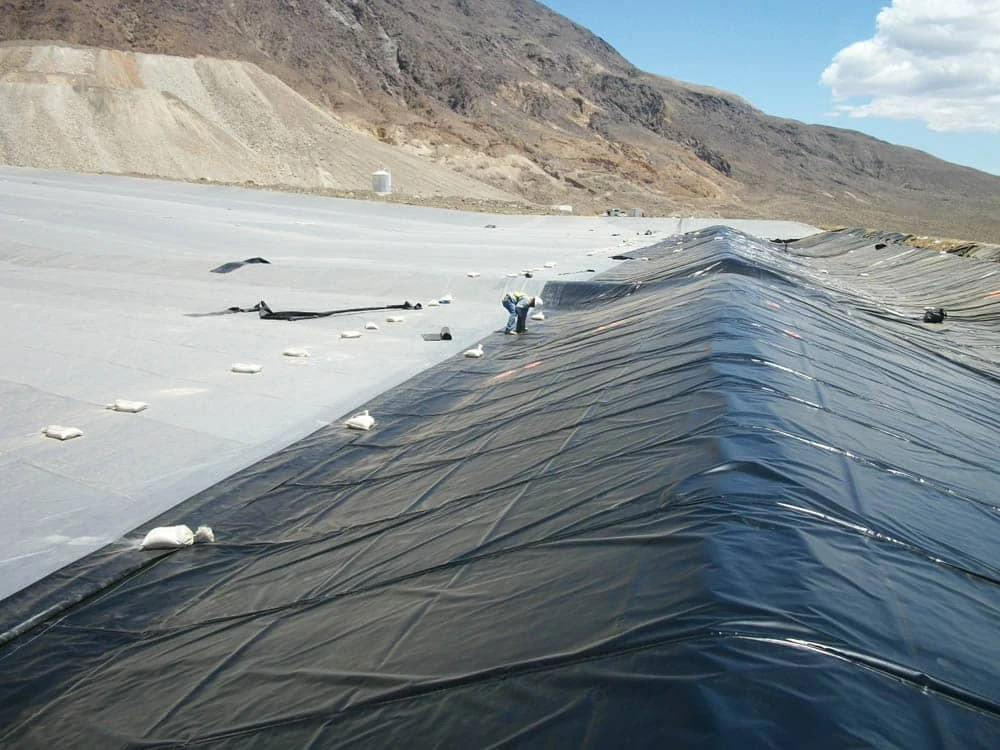
An HDPE geomembrane forms a low-permeability barrier that reduces seepage through a prepared canal bed and side slopes. Performance depends on the complete lining system: support beneath the sheet, welded seams, anchorage, penetrations, groundwater control and protection during operation. The liner does not eliminate evaporation or replace hydraulic design.
Decide whether the membrane will remain exposed or sit beneath a protective cover before comparing roll prices. That decision changes surface protection, hydraulic roughness, inspection access and repair methods.
Additional protection above the liner, drainage and transition details depend on the approved cross-section.
The barrier remains accessible for inspection and repair. Address UV exposure, debris, wind before filling, livestock access and cleaning equipment. Flow velocity limits must suit the selected system.
A designed cover can protect the barrier from operational contact. It adds loads, changes channel capacity and makes repairs less accessible. Cover placement must avoid punctures and unapproved traffic on the liner.
The July 2026 NRCS Code 428 addresses both arrangements. For U.S. projects, use the applicable local Field Office Technical Guide and project design—not the national document alone. [1]
Jinseed’s published HDPE range is 1.0–3.0 mm with widths up to 8.0 m. Confirm the offered grade, actual dimensions, tolerances and production availability in the quotation. View the HDPE product range ↗
| RFQ item | What to state | Why it matters |
|---|---|---|
| Nominal thickness | Specified mm or mil, tolerance and measurement method. | 1.5 mm ≈ 59.1 mil; 60 mil = 1.524 mm. Do not substitute rounded labels without approval. |
| Smooth or textured | Surface finish on each face and required interface tests. | Texture changes interface behavior. It does not establish a safe slope without analysis. |
| Subgrade protection | Soil condition, protrusions, bearing support and geotextile criteria. | A heavier fabric cannot correct a soft spot, void or sharp projection that requires removal. |
| Roll layout | Width, length, handling limits and proposed panel direction. | Wider rolls may reduce seam count but can complicate deployment in narrow corridors. |
| Material verification | GRI-GM13 edition if specified, acceptance values and batch records. | Material QC supports procurement; it does not replace installed-system acceptance. |
| Site exposure | Exposed/covered condition, temperature, water chemistry and cleaning method. | These conditions affect durability, protective measures and maintenance planning. |
Seepage control must work through filling, irrigation shutdowns and maintenance. A thicker sheet alone cannot resolve pressure beneath the liner or an inadequately supported connection.
Map soft zones, persistent seepage and seasonal groundwater. Specify any drainage or pressure-relief measures before deployment. Reinspect the receiving surface after rain, traffic or earthwork repairs.
Show anchor trenches, end cutoffs, transitions to concrete and pipe boots on the drawings. Define independent pipe supports, movement allowances and access for connection testing.
Identify sediment-removal equipment, crossing points and livestock access. Specify approved access and protective measures. Inspect exposed areas after storms, debris impacts and canal drawdown.
Review available material evidence before ordering, then agree the documents required for the supplied lot. Keep mill QC, third-party sample testing and field seam acceptance as separate records.
The downloadable report is sample evidence, not a certification of every thickness, batch or completed canal.
Canal plan area misses the slopes. Start with the lined cross-section, then add the measured allowances for anchors, seams, structures and cutting. Separate membrane supply from earthworks, protection, welding, testing and freight.
A = L × [b + 2h√(1 + z²)]
Geometric lining area only. Lined height must include the specified freeboard. The example excludes overlaps, anchors, ends, structures and waste; it is not a roll order or hydraulic design.
Plan inspection and testing before the first panel is deployed. The approved quality plan determines responsibilities, sampling and acceptance values.
Confirm subgrade, drainage, materials and roll identification. Mark boundaries of the accepted area and hold unresolved defects. Establish trial-weld procedures for actual conditions.
Record panel and seam IDs. Complete applicable nondestructive and destructive tests, inspect details and retest repairs. A tested seam with a failed result is not accepted.
Deliver as-built drawings, seam logs, reports and open-item status. Agree controlled filling, inspections and maintenance responsibilities with the owner.
There is no single thickness for every canal. Compare the specified minimum with subgrade, cover, maintenance loads, climate and installation risk. Jinseed publishes 1.0–3.0 mm HDPE grades; the designer must approve the proposed thickness and tolerance.
Yes, where the engineered system uses it as a barrier beneath the cover. Define support, protection during concrete placement, joint and structure details, drainage and interface stability. The membrane does not replace the concrete or hydraulic design.
No. Reduced seepage must be assessed against a measured baseline and operating conditions. A liner does not remove evaporation, distribution losses or leakage at unsealed structures. Any claimed savings need a documented water balance.
Choose by the intended exposed surface and the interfaces beneath any cover. Smoothness, debris behavior, construction access and interface shear requirements all matter. Specify texture by face and confirm the actual system rather than assuming textured material is always better.
Send a cross-section, reach length, specified thickness and finish, exposed or covered condition, protection-layer requirements, test specification and destination. Include required delivery dates and identify any items still awaiting design approval.
Tell us what is specified and what still needs comparison. Request a quotation that identifies the proposed grade, roll plan, documents, delivery terms and any exceptions.
In the message field, start with “Irrigation canal liner”. For drawings and specifications, email info@jinseed-geo.com.
Submitting an inquiry does not place an order. Material availability, compliance and delivery are confirmed in the quotation.
Content reviewed 23 October 2026. Examples support specification discussions and do not replace project engineering.