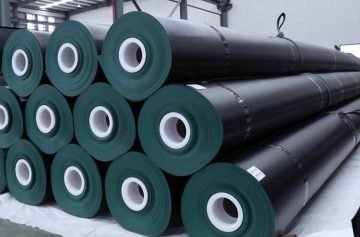
Choose geotextile cloth when water needs to pass through a layer while soil and aggregate remain separated. Choose a purpose-designed membrane when the job is to restrict water or water-vapor movement. For a lined pond or canal, both may be needed: the membrane provides the barrier and a suitable nonwoven geotextile helps protect it from contact damage.
“Plastic sheeting” covers very different products, from temporary polyethylene film to engineered geomembranes and underslab vapor retarders. Comparing them only by thickness, price, or the word “waterproof” can lead to the wrong purchase. This guide compares their functions, limitations, installation needs, and the information to request before ordering.

Geotextile cloth vs. plastic sheeting: a practical comparison
| Decision | Permeable geotextile | Plastic film or engineered membrane |
|---|---|---|
| Water movement | Water passes through interconnected openings; capacity depends on the product and surrounding soil. | Designed to restrict liquid or vapor movement, depending on the product. Seams, penetrations, and damage affect installed performance. |
| Soil filtration | Opening size and hydraulic properties must suit the protected soil. | A continuous barrier is not a substitute for a soil filter. |
| Typical role | Separation, filtration, and cushioning; other functions require appropriate design. | Containment, vapor control, or temporary weather protection, according to the specification. |
| First documents to compare | Opening size, permittivity, strength and puncture test results, polymer, and installation requirements. | Application-specific specification, thickness, mechanical properties, durability evidence, and joint details. |
| Common purchasing mistake | Buying by weight alone or assuming the fabric will waterproof a structure. | Using general-purpose film where a certified vapor retarder or engineered liner is required. |
Breathability and moisture permeation
In drainage work, “breathable” is too vague to be a useful specification. Ask whether the design needs liquid water to cross the layer, vapor transmission to be limited, or water to travel along a drainage layer. These are different performance requirements.
Water through geotextile
ASTM D4491/D4491M addresses geotextile water permeability by permittivity. Permittivity is reported in s−1; it is not the same unit as hydraulic conductivity, which is reported in m/s or cm/s. A clean-material test does not by itself establish the capacity of a buried soil–fabric–aggregate system.
A fabric can be highly permeable and still be the wrong filter if its openings allow unacceptable soil migration or if the soil–fabric interface clogs. For drainage selection, use the nonwoven drainage guide to compare opening size, water-flow direction, and the surrounding soil.
Water and vapor through plastic
A low-permeability membrane is selected to resist water movement, but “zero leakage” is not a reliable description of an installed liner. A sheet can have low material permeability while a damaged seam, puncture, or poorly detailed pipe penetration allows leakage. Vapor permeance and liquid-water containment also require different evidence.
For a membrane below a concrete slab, ASTM E1745 covers plastic water-vapor retarders in contact with soil or granular fill. Its performance classification considers more than nominal thickness. A generic 6-mil film should not be assumed to meet a specified vapor-retarder class simply because it is polyethylene.
Useful unit conversion: 1 mil is 0.001 inch, or 0.0254 mm. Therefore 6 mil is approximately 0.152 mm, 20 mil is 0.508 mm, and 60 mil is 1.524 mm. These conversions help compare quotations; they do not make films with different formulations and test results equivalent.
Temperature and planting conditions
Neither product provides a universal soil-temperature or oxygen level. Color, mulch cover, soil moisture, weather, irrigation, and ventilation all influence the result. In planting areas, consider the water path and maintenance plan before covering soil. A continuous sheet may redirect water toward edges or low points; a permeable fabric still needs a permeable receiving layer beneath it.
Which material fits your application?
French drains and drainage trenches
Where a filter is required around drainage aggregate, use a geotextile selected for the adjacent soil. Water must enter the drain while unacceptable migration of soil is controlled. Wrapping that same aggregate in continuous plastic can block the intended inflow. The trench still needs correctly graded aggregate, a suitable pipe arrangement where specified, and an accessible discharge route.
Road bases, parking areas, and construction access
A suitable geotextile can help keep aggregate and subgrade from mixing. FHWA’s pavement guidance distinguishes separation, filtration, stabilization, and reinforcement. This distinction matters: a drainage fabric is not automatically a structural reinforcement product, and installing fabric does not justify a fixed percentage reduction in aggregate thickness.
For traffic-bearing work, identify subgrade strength, aggregate grading, cover thickness, equipment loading, and acceptable rutting before selecting the geosynthetic. Any structural credit belongs in the pavement or working-platform design. Plastic film chosen for moisture control does not replace that design.
Ponds, reservoirs, and irrigation canals
A geotextile alone will not retain pond water. A specified HDPE geomembrane liner can provide the barrier component, with protection layers selected for the subgrade, cover material, and loading. The irrigation canal liner guide explains the system-level questions to resolve.
For freshwater, hydrostatic pressure increases by approximately 9.81 kPa for each meter of depth. Thus a 2 m water depth produces about 19.6 kPa at the bottom, before other loads are considered. This is a pressure calculation, not a liner-thickness recommendation. Sharp subgrade particles, differential settlement, and installation damage may govern protection requirements.
Concrete slabs and crawl spaces
Select a vapor-control product specified for the particular assembly. Detail joints, edges, services, and connections to other moisture-control components. Geotextile may have a separate protective role but does not replace the vapor retarder. A crawl-space ground membrane also does not by itself resolve bulk-water entry, inadequate drainage, or indoor humidity.
Landscaping and weed suppression
Separate planting-bed decisions from engineering filtration. A landscaping fabric needs an appropriate water path and a plan for mulch replacement and weed removal; weeds can establish in material deposited above it. Continuous plastic may be appropriate for a defined temporary horticultural use, but should not be presented as a universal permanent alternative to permeable fabric around plants.
Stability, puncture resistance, and service life
Do not assign a friction angle from the material name
The relevant interface might be soil–fabric, fabric–membrane, or membrane–cover material. Its behavior changes with the actual materials, normal stress, moisture, and displacement. ASTM D5321/D5321M describes direct shear testing of these interfaces. Use the edition specified for the project and test representative combinations; a generic “safe up to 10 degrees” claim is not a slope-stability assessment.
Compare the same strength test
A grab tensile result in N cannot be directly compared with wide-width tensile strength in kN/m. Similarly, ASTM D6241 uses a 50 mm probe for a puncture index test; it does not reproduce every sharp stone, cover pressure, or field impact. Product qualification should distinguish index tests from protection testing of the actual liner and cover arrangement.
There is no single service life for “geotextile” or “plastic.” Polymer formulation, exposure, temperature, chemical conditions, stress, workmanship, and maintenance all matter. Accelerated UV hours must not be converted directly into years outdoors. Request durability evidence for the proposed product and the relevant environment rather than accepting a lifespan inferred from mass or thickness.
Compare installed cost, not just roll price
Compare offers against the same design and delivery scope. Include roll coverage, laps or welds, offcuts, protection layers, freight, installation labor, testing, and access for repairs. A lower-price sheet may cost more if its width creates additional seams or if it cannot meet the required application specification.
For example, a 4 m-wide roll used with an assumed 0.30 m side lap provides about 3.70 m of repeated-panel coverage. For a large rectangular area, that represents roughly 8.1% more roll area than the net area before end laps, edges, and offcuts. This is a quantity-planning example, not a recommended overlap: the approved installation detail determines the actual lap.
What to send with a material inquiry
- Application, location, drawings, and the function of each layer.
- Soil information and intended water-flow direction.
- Required test methods, acceptance values, and applicable specification editions.
- Load, temperature, chemical exposure, and planned cover or outdoor exposure.
- Net area, dimensions, access constraints, and delivery destination.
Review Jinseed’s nonwoven geotextile options for filtration or protection and the HDPE liner range for containment. Send the project requirements to info@jinseed-geo.com so the proposed material and supporting documents can be compared with the specification.
Frequently asked questions
Can plastic sheeting replace geotextile under gravel?
Not where water must cross a filter or where the specification requires separation with hydraulic compatibility. A barrier layer can change the water path. Confirm the purpose of the layer before substituting materials.
Can geotextile replace a pond liner?
No. A permeable geotextile can protect a liner or filter soil, but it is not the containment membrane.
Is thicker always better?
No. A thicker product may improve some properties while changing hydraulic behavior, handling, or cost. Compare the required performance tests and complete assembly.
Can both materials be used together?
Yes. A designed system may combine a barrier membrane with geotextile protection and a separate drainage component. Their positions, interfaces, and outlet details must work together.
Content reviewed: 19 October 2026. This comparison is material-selection guidance; project drawings, specifications, and engineering design govern installation. Linked standard pages identify test scopes, not certification of every Jinseed product.