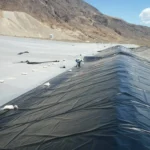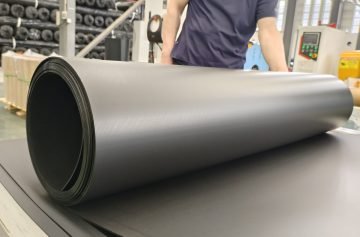
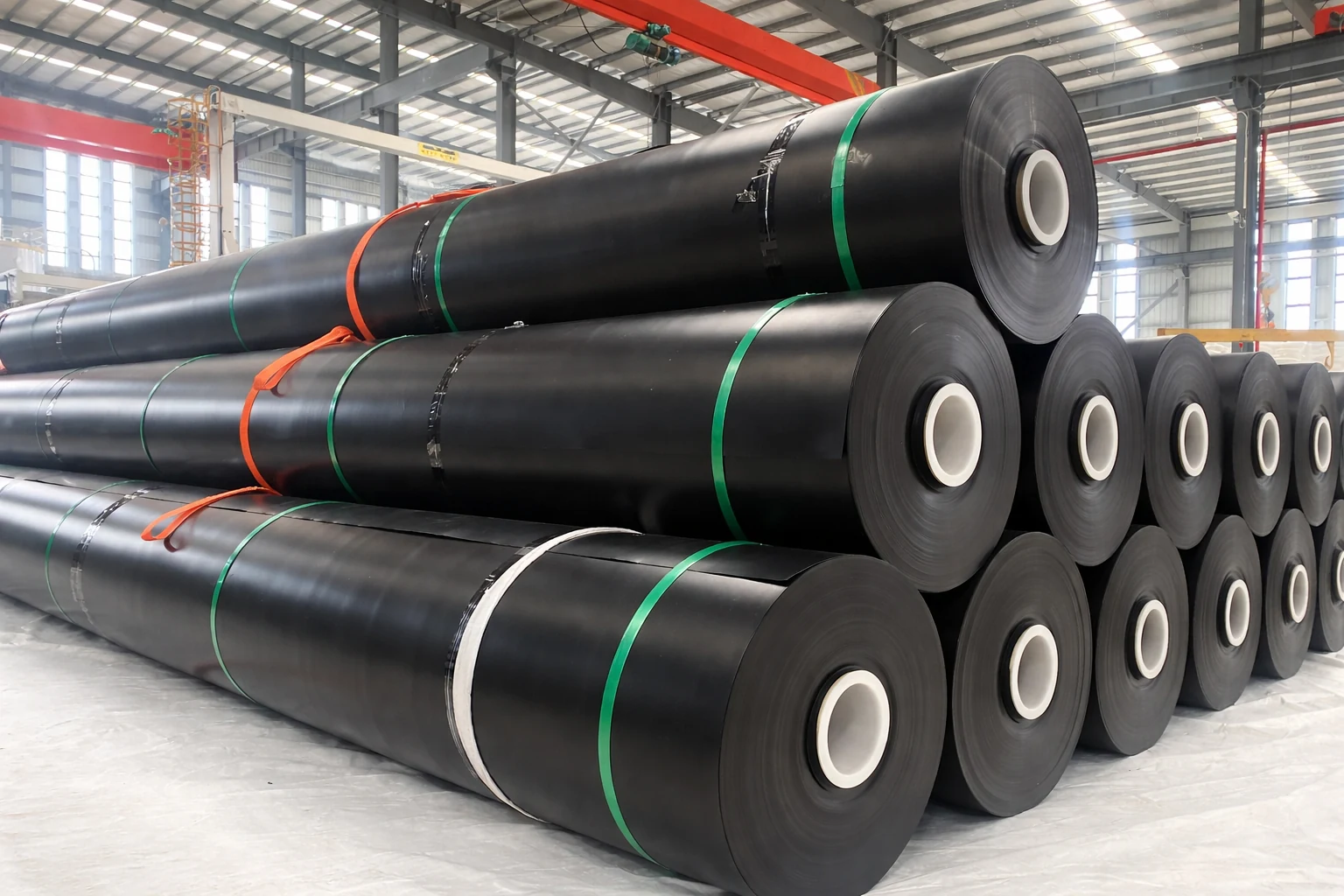
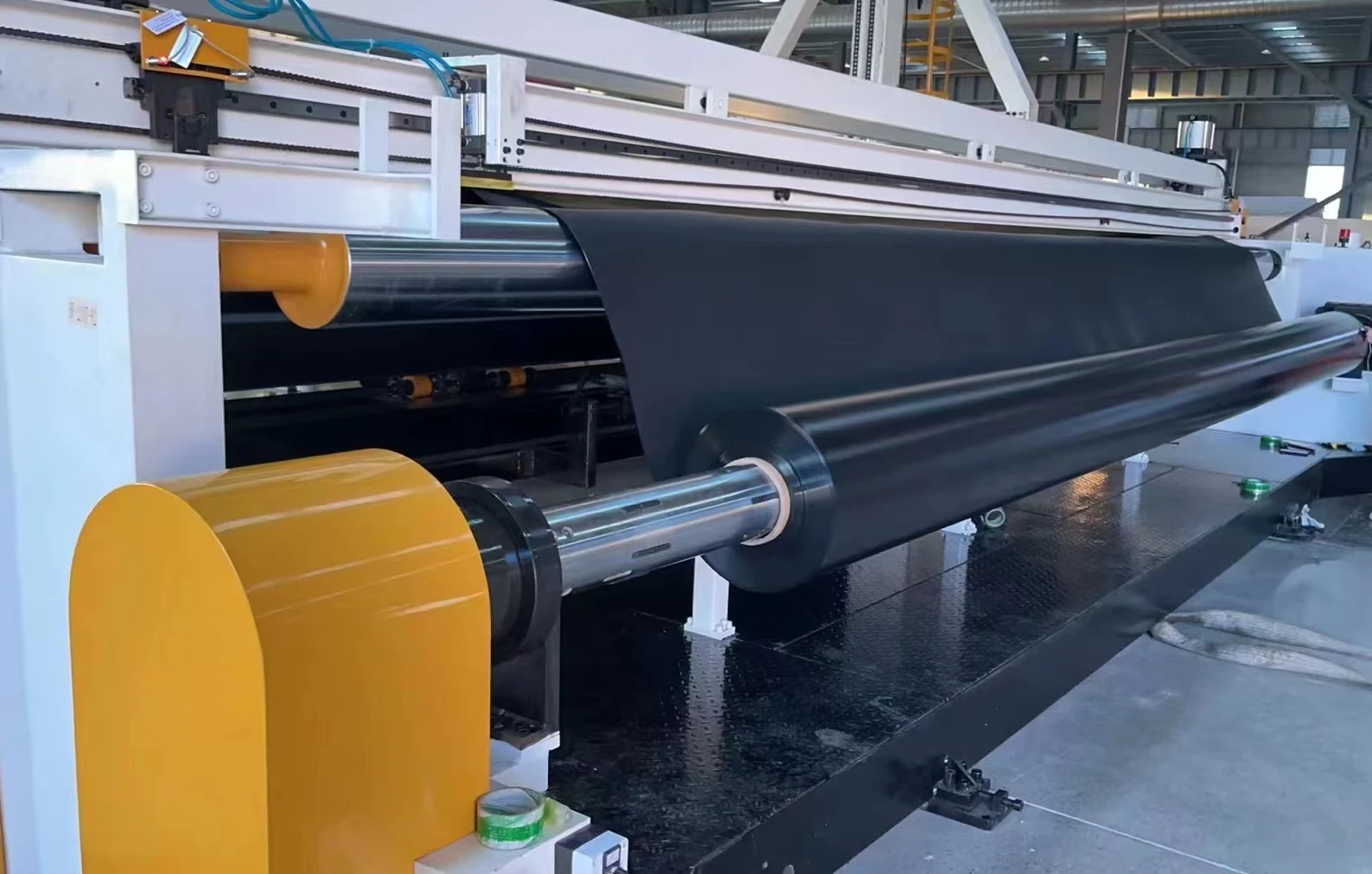
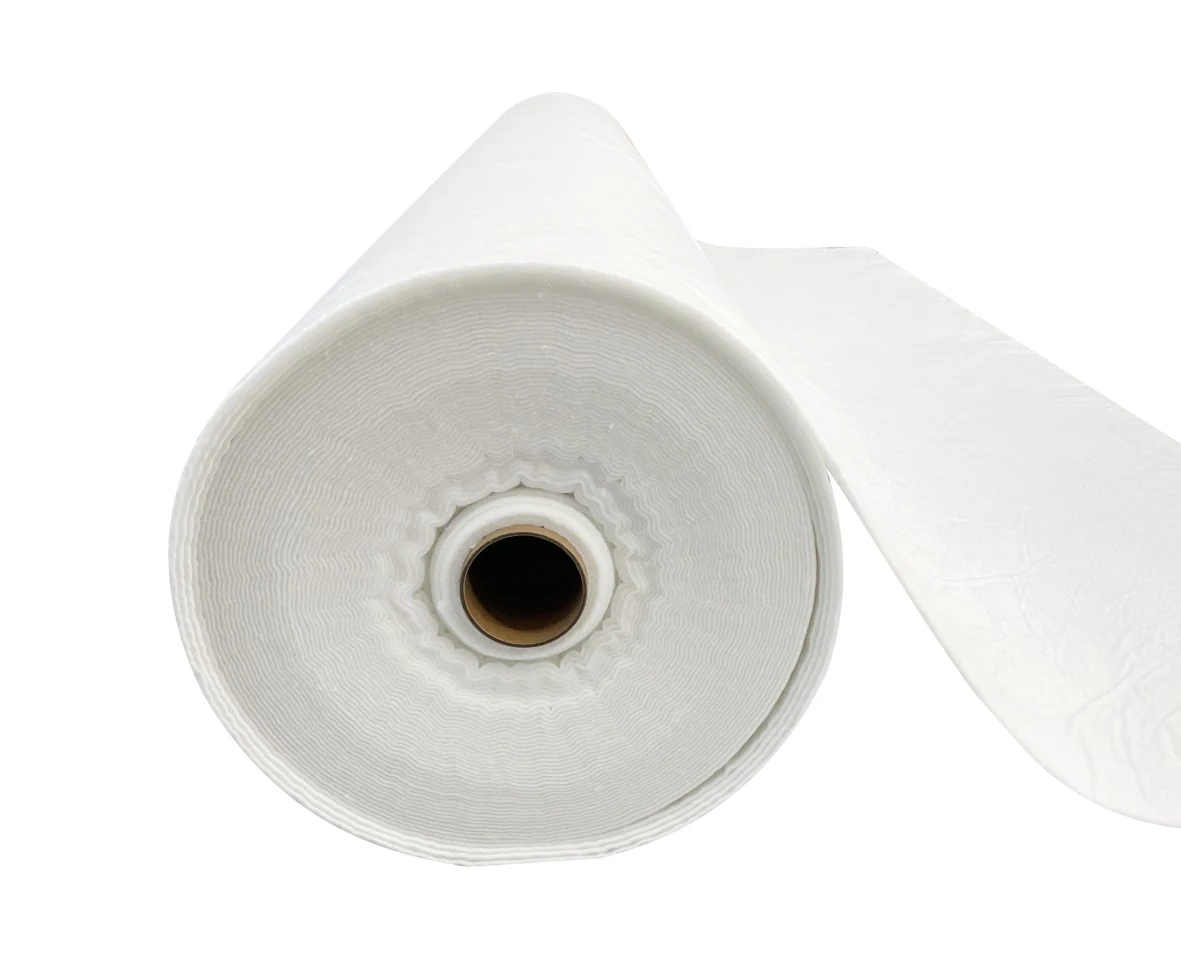

A green roof filter fabric keeps growing-medium particles out of the drainage layer while allowing water to pass through. Select it for the actual growing medium, hydraulic demand, installation loads and approved roof assembly. Polyester (PET) and polypropylene (PP) nonwoven geotextiles are possible options; neither polymer nor fabric weight alone establishes suitability.
This guide separates filtration from waterproofing, drainage and root resistance. It also gives a worked roll-quantity example: a nominal 6 m × 50 m roll contains 300 m², but overlaps and cutting reduce usable coverage. Product performance must come from the proposed grade’s test report, rather than being inferred from its mass per unit area.
Position in the roof build-up
The filter normally separates the growing medium from the drainage layer. Some drainage composites include a bonded filter, so an additional loose fabric is not automatically required. Protection, root resistance, insulation and waterproofing follow the roof-system designer’s assembly details. The Whole Building Design Guide’s extensive vegetative roof guidance explains these separate functions and the need for compatible components.
Blocked outlets or an incompatible filter can increase water retention beyond the design allowance. A 100 mm depth of free-standing water adds approximately 100 kg/m², or 0.98 kPa, using a water density of 1,000 kg/m³. This is additional ponded water, not a substitute for calculating the saturated growing-medium load. For media, ASTM E2399/E2399M addresses maximum density for dead-load analysis. Multiply the applicable tested density by the installed depth and include the other roof loads; the standard does not assign one universal load to every extensive or intensive roof.
Non-woven fabric comes first—but check compatibility
Nonwoven PET and PP fabrics are used in green roof assemblies, but woven fabrics are not inherently incapable of retaining fines. Construction, pore distribution, media gradation and clogging behavior determine performance. The WBDG guidance specifically discusses woven filters for media with high clay content. A selected product should be assessed with the proposed medium rather than rejected or approved solely by the words “woven” or “nonwoven.”
A continuous filament structure also does not guarantee that one grade is stronger than every short-fiber product of equal mass. Compare the same test method, specimen direction and reporting basis. Use the current nonwoven geotextile product information to identify a candidate, then request its grade-specific data and the roof supplier’s acceptance.
Weight by roof type
Mass per unit area is useful for identification, handling and quantity calculations. It is not a stand-alone filtration specification. For reference, 200, 250 and 300 g/m² correspond to approximately 5.90, 7.37 and 8.85 oz/yd². These conversions do not mean that each weight is approved for a particular growing-medium depth.
| Roof condition | Filter selection evidence | Separate assembly check |
|---|---|---|
| Shallow, extensive planting | Opening size, through-plane flow and compatibility with the specified lightweight medium | Saturated load, outlet capacity and installation damage |
| Deeper, intensive planting | Performance under the actual overburden pressure and medium composition | Structural load, protection layer and planting/root details |
| Sloping roof | Filter continuity and approved lap or joint arrangement | System restraint, erosion and interface stability |
| High-fines or unfamiliar medium | Media-specific filtration assessment; investigate particle loss and clogging | Long-term drainage and maintenance access |
Increasing fabric weight does not by itself stabilize a sloping roof. Do not adopt a universal 15° cutoff, overlap or grade increase without the selected system’s details.
Pore size governs retention
ASTM D4751 measures apparent opening size (AOS). An O90 value reported under another method is not interchangeable with an ASTM AOS/O95 value. Ask for the test method and the result in millimetres; do not substitute a nominal mesh label or an unsupported conversion.
There is no universally safe opening-size interval of 0.06–0.11 mm for all roof media. Openings must retain the relevant particles without causing unacceptable blockage. The previous blanket rule O95 ≤ 2d50 is not a complete specification for an engineered roof medium; a criterion needs its design source, soil applicability and hydraulic conditions.
A numerical check illustrates why mixing criteria fails: if a design criterion requires an opening of at least 3 × 0.15 mm, the limit is 0.45 mm. A measured value of 0.09 mm would not meet that criterion. Higher clean-water flow cannot make the opening-size comparison pass, and an O90 result cannot simply be substituted for O95. Resolve the applicability of the criterion and test the medium–fabric combination.
Drainage and clogging
Distinguish three properties: flow through the filter, flow along the drainage layer, and the behavior of the combined medium/filter system. Thickness ratios do not predict hydraulic capacity. A fabric 2.6 mm thick is 8.7% of the thickness of a 30 mm drainage board, but that arithmetic says nothing about their relative flow capacities.
ASTM D4491/D4491M measures uncompressed geotextile permittivity. Its laboratory result is not a long-term roof discharge guarantee. Where load is important, use a suitable under-load assessment and the drainage product’s capacity at the actual gradient and pressure.
ASTM D5101-23 evaluates specific saturated soil–geotextile combinations under unidirectional flow. It is a design investigation, not a generic manufacturer’s acceptance certificate. Its scope recommends ASTM D5567 for soils with a plasticity index of 5 or more; the laboratory should confirm applicability to the proposed roof medium.
| Requested information | What must accompany the value | Why it matters |
|---|---|---|
| Polymer and mass per unit area | Product/grade identification, tolerances and report date | Traceability and quantity calculations |
| Opening size | Test method, designation and result in mm | Retention comparison without mixing O90 and AOS |
| Through-plane flow or permittivity | Head, loading condition and units | Comparable hydraulic data |
| Tensile, tear and puncture properties | Method, direction and reporting basis | Installation survivability; values cannot be inferred from weight |
| Medium–filter compatibility | Actual medium description and applicable laboratory/design assessment | Particle retention and clogging risk |
| Drainage-layer capacity | Gradient, normal pressure and long-term design allowances | Conveyance to outlets |
For a calculation example only, rainfall of 100 mm/hour equals 0.0278 L/s/m². If a project designer selects a factor of five, the corresponding comparison flow is 0.139 L/s/m². Neither the rainfall nor that factor is a universal requirement. Clean-water capacity at 50 mm head must not be treated as capacity at a lower roof head or after long-term clogging.
Protection layer and root barrier
A protection fabric cushions the waterproofing against mechanical damage. An ordinary filter or cushioning geotextile is not proof of root resistance. Use the specified root-resistant waterproofing or a separate approved root barrier. WBDG discusses tested root resistance and protection as distinct requirements.
Specify protection for the actual substrate, drainage components, overburden and construction traffic. A 300–600 g/m² candidate range may be discussed with the system supplier, but no puncture rating or suitability follows automatically from that range. Sharp components, planted trees and concentrated loads require their own details. Sloping assemblies also need interface and restraint assessment; thicker fabric alone is not a solution.
Quantity and rolls
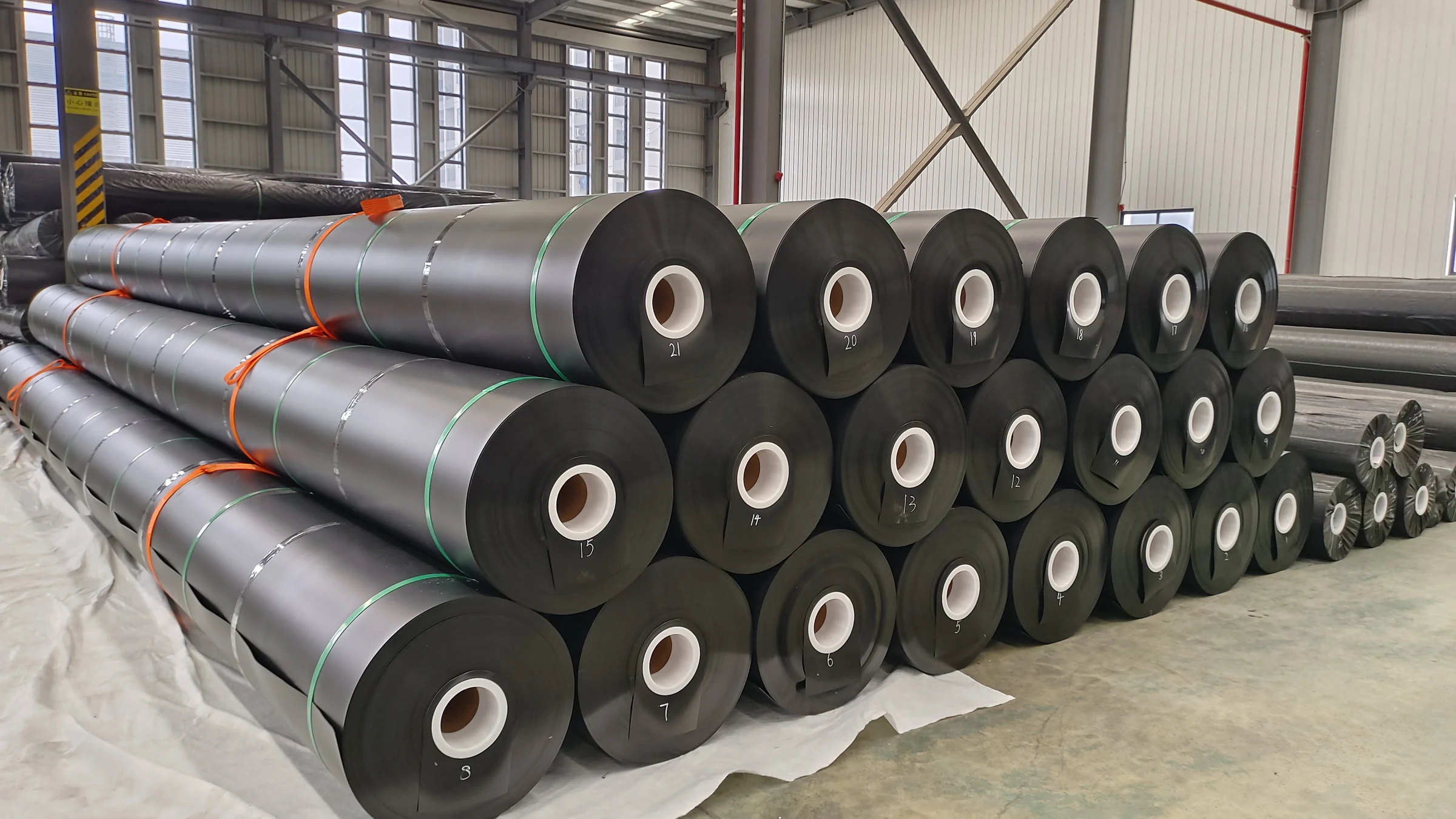
The following is a worked purchasing example, not a confirmed Jinseed stock format or a final roof take-off. Assume 6 m × 50 m rolls, a 200 g/m² filter and a separately approved 300 g/m² protection fabric. Each roll has 300 m² gross area. The calculated unwrapped masses are 60 kg and 90 kg respectively.
With 150 mm side laps only, effective strip width is 6 − 0.15 = 5.85 m, giving 292.5 m² per 50 m strip. The continuous-area approximation is 10,000 ÷ 0.975 = 10,256.4 m² of purchased fabric, before end laps, boundaries, penetrations, upstands, damage allowances and cutting. Dividing by 300 and rounding up gives 35 rolls. Adding 2.5% to the net roof area is only an approximation; it is not the exact overlap calculation.
| Illustrative item | Nominal mass | Mass per 300 m² roll | Example rolls | Fabric mass |
|---|---|---|---|---|
| Filter | 200 g/m² | 60 kg | 35 | 2.10 t |
| Protection | 300 g/m² | 90 kg | 35 | 3.15 t |
| Combined | 0.50 kg/m² for two layers before lap allowance | 150 kg per pair | 70 total | 5.25 t |
The 35-roll figure is an area estimate, not a guarantee that a particular roof layout can be covered. Prepare a panel layout before ordering. Packaging and cores add shipping mass. If a container has an allowable payload of 26 t, 5.25 t is 20.2% of that assumed payload; verify the actual container, route limits and loading plan. Rolled fabric dimensions, door opening and stowage determine volume utilization, so dividing nominal container volume by roll volume does not guarantee a roll count.
Send the growing-medium specification, approved roof build-up, roof plan, proposed grades, roll-size preference and destination with a quotation request. Confirm minimum quantity, manufacturing time and shipment separately.
Laying and laps
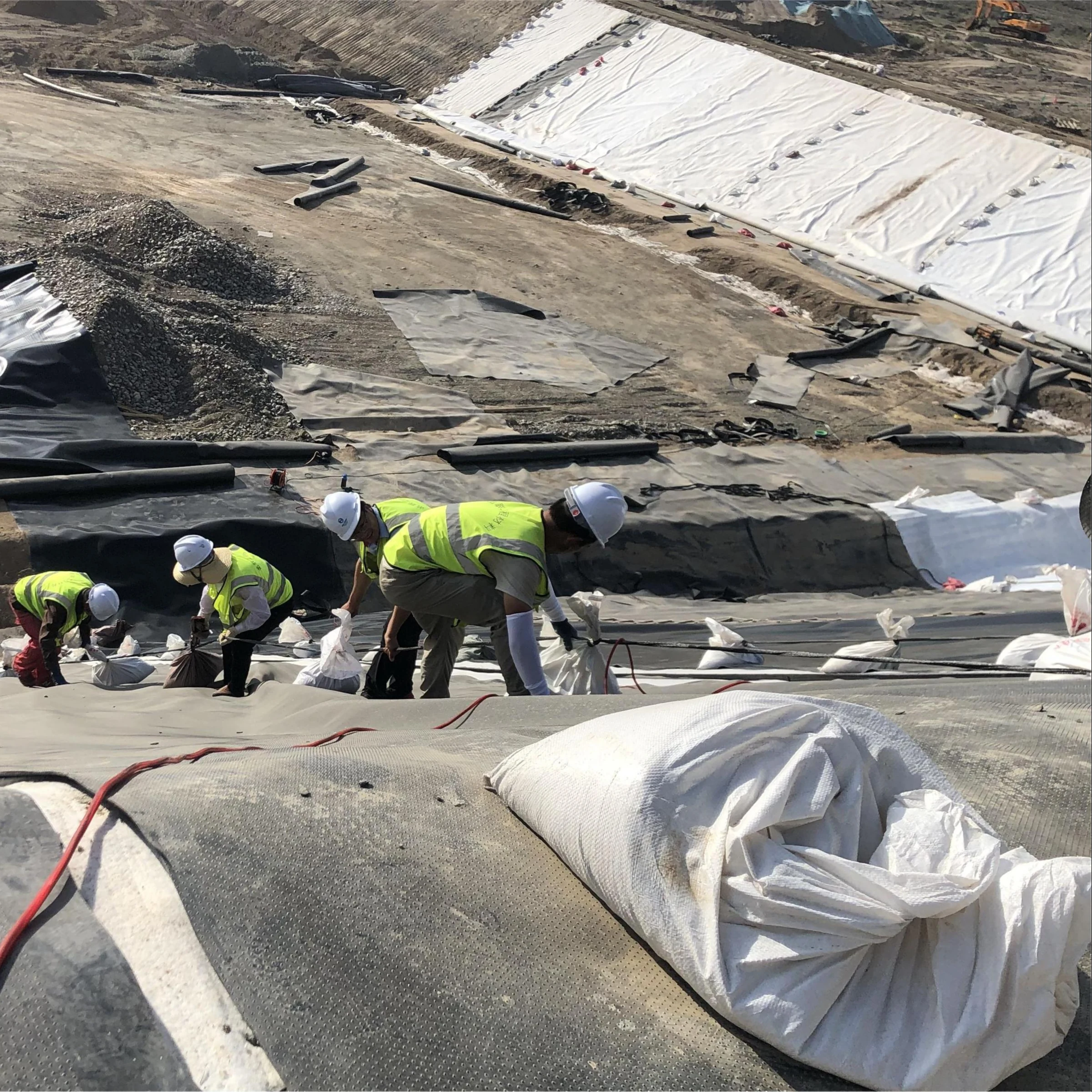
Use the roof supplier’s installation details for overlap, upstands, outlets and temporary restraint. The 150 mm overlap above is a calculation assumption, not a universal instruction. Keep the filter continuous, prevent media from bypassing joints and preserve access to drainage outlets. Do not drive fixings through the waterproofing unless the approved detail specifically allows them.
Inspect roll labels, substrate cleanliness and fabric damage before covering. Keep the material protected from wind displacement and construction traffic. Check the manufacturer’s handling limits in cold or wet conditions; PET does not have a universal 5°C fold-cracking threshold. Crew productivity depends on roof geometry, access, weather and detailing, so establish a project rate from a trial area rather than promising a fixed daily output.
Common selection errors
- Choosing by weight alone: a heavier product is neither automatically a better filter nor automatically unsuitable. Require measured hydraulic and mechanical properties.
- Replacing filter fabric with an impermeable liner: that changes the intended water path and can obstruct drainage unless specifically designed as part of a water-storage assembly.
- Treating a filter as a root barrier or drainage board: specify each function and check the complete assembly.
- Using unrelated tests as proof: a clean-water index test does not establish compatibility with every growing medium, a lifetime, or a warranty.
- Assuming recycled or short-fiber material must fail: assess the actual grade’s consistency, traceability and test evidence instead of an unsupported percentage variation.
Service life and replacement
Burial reduces direct UV exposure, but service life also depends on the polymer, chemical conditions, temperature, load, installation damage and compatibility with the medium. Neither a temperature below 40°C nor the term “PET” establishes a service life equal to the waterproofing.
A waterproofing warranty does not automatically cover filter fabric. Read the written system warranty for covered components, installation requirements, exclusions and responsibility for removing overburden. For repair, identify the failure cause, follow the system supplier’s patch or replacement detail, and restore filtration continuity without blocking drainage. Price and schedule access, media removal and reinstatement separately.
Data basis and sources
The numerical examples above use stated assumptions and unit conversions, not claimed field trials or certified product test results. Useful conversions are 1 oz/yd² ≈ 33.906 g/m², 1 mil = 0.0254 mm, and 1 kN/m ≈ 5.710 lb/in. The cited standards describe assessment methods; they do not certify Jinseed products or prescribe one grade for every roof. Confirm the edition required by the project and obtain the complete applicable documents.
- WBDG: Extensive Vegetative Roofs — assembly functions, filtration, root resistance and warranty considerations.
- ASTM E2399/E2399M-19 — maximum media density for vegetative-roof dead-load analysis.
- ASTM D4751-20 — apparent opening-size test-method description; check the edition specified for the project.
- ASTM D4491/D4491M-22 — geotextile permittivity in the uncompressed state.
- ASTM D5101-23 — site-specific soil–geotextile filtration compatibility and method limitations.