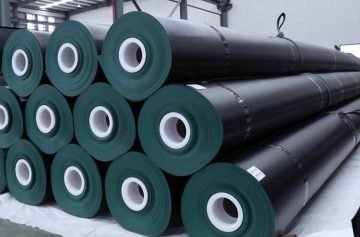
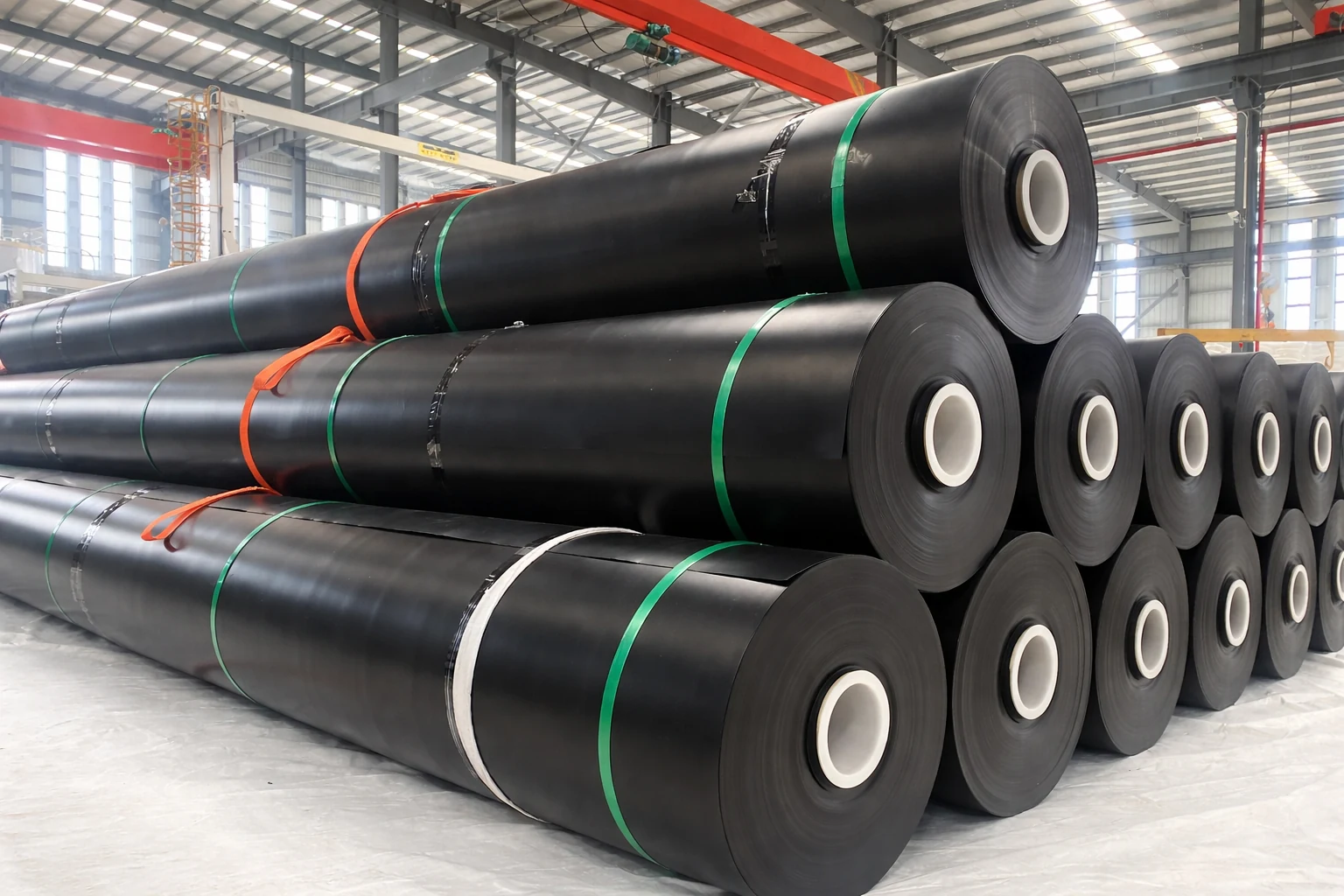
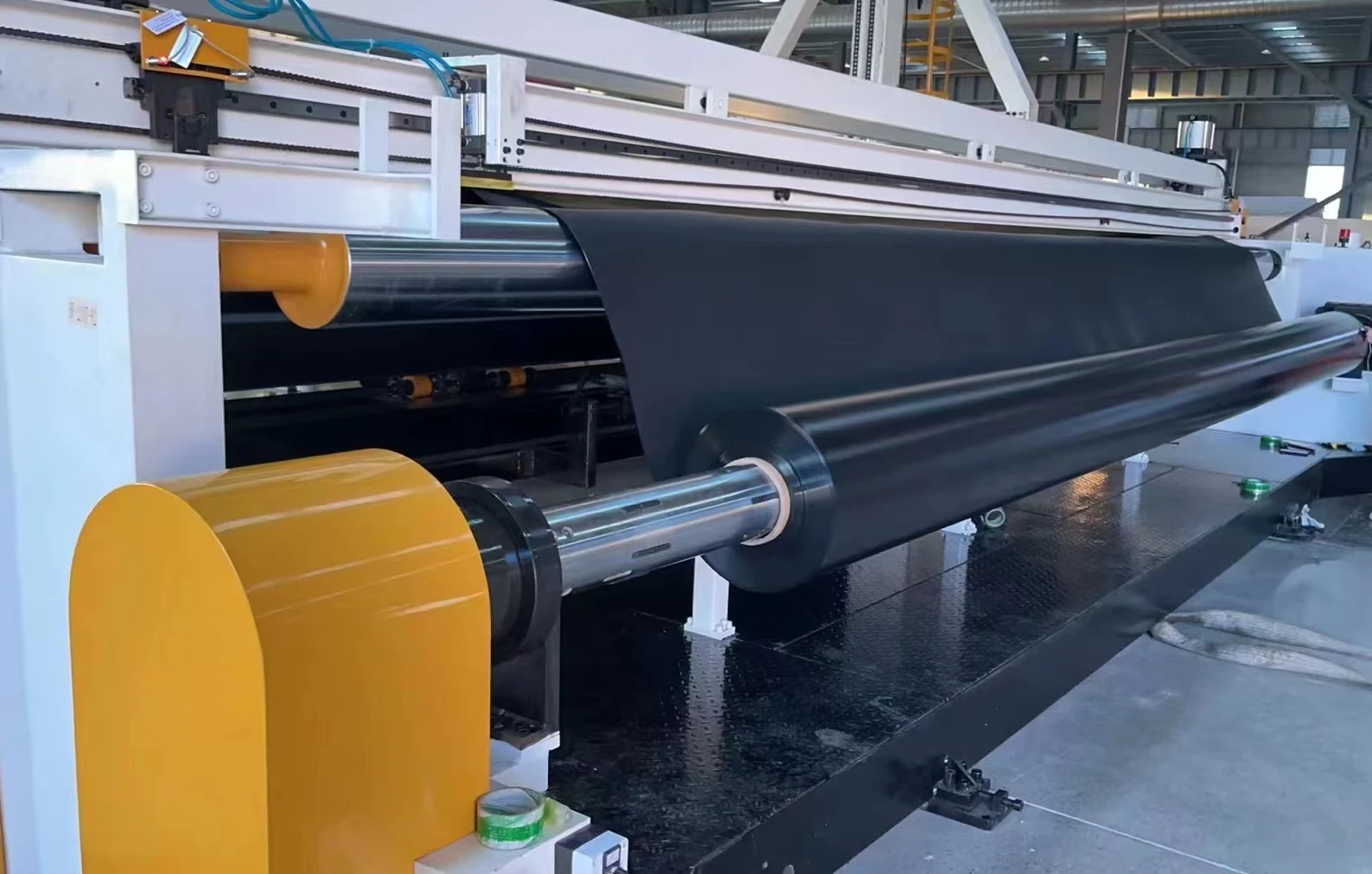
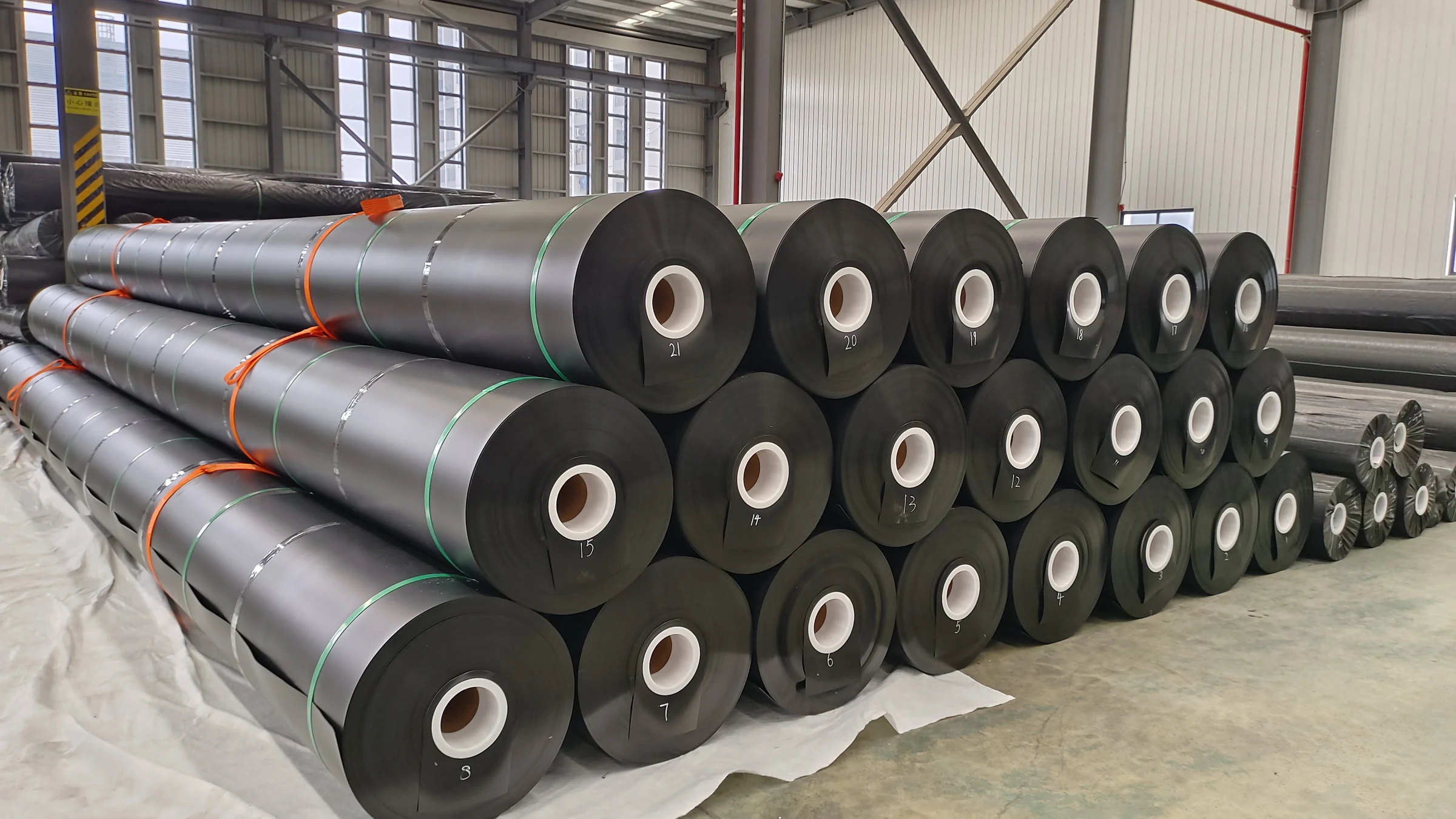

Select HDPE or PVC geomembrane for industrial containment from the actual liquid, temperature, deformation and construction conditions—not a universal material ranking. HDPE is widely specified for containment, while flexible PVC can suit concealed systems and prefabricated layouts. Neither polymer name proves compatibility with an unknown chemical mixture, allowable settlement or service life.
This guide supports industrial material approval and quotation comparison. For water ponds where shape, access and maintenance dominate the decision, see the HDPE versus PVC pond-liner guide.

Material differences that matter in a specification
HDPE is a semi-crystalline thermoplastic. Flexible PVC uses a formulation that makes the sheet more pliable than rigid PVC pipe. The resin, additives, processing and finished thickness influence performance; a generic recipe is not a substitute for the offered grade’s declaration.
GRI-GM13 Revision 19, June 11, 2025, addresses manufacturing quality control for smooth and textured HDPE. Its sheet density classification must not be confused with base-resin density. ASTM D7176-22 covers nonreinforced PVC sheeting for buried applications. Its scope does not establish suitability for permanent exposed service.
| Decision | HDPE review | PVC review |
|---|---|---|
| Chemical exposure | Evaluate the actual mixture and formulation; hydrocarbons and oxidizers cannot be approved by pH alone. | Evaluate the actual formulation, including plasticizer retention and changes after exposure. |
| Deformation | Review settlement geometry, stresses, temperature and seams. | Flexibility can help conformability, but large laboratory elongation is not allowable field strain. |
| Exposure | Obtain evidence for the proposed UV, temperature and chemical conditions. | Confirm whether the specific grade requires cover and the permitted exposure before covering. |
| Fabrication | Compare roll layout, field welding, access and repair details. | Consider prefabricated panels where available, including panel mass, transport and remaining field joints. |
| Approval | Match sheet reports, surface and thickness to the project specification. | Match the specified PVC formulation, thickness, fabrication and application conditions. |
Chemical compatibility: identify more than pH
A liquid at pH 2 is not chemically equivalent to every other liquid at pH 2. Record constituent concentrations, temperature range, oxidizing agents, solvents, suspended solids, cleaning chemicals and whether contact is continuous or intermittent. Include credible upset conditions rather than only normal operation.
EPA Method 9090A provides a membrane-liner compatibility evaluation approach. Agree the test liquid, exposure and relevant changes with the responsible laboratory and project reviewer. Assess sheet and joint performance where relevant; a favorable visual appearance after immersion is not sufficient on its own.
Do not interpret “no visible dissolution” as zero transport of organic constituents. Nor does a low permeability reported in m/s constitute a whole-system leakage rate. Installed leakage depends on defects, seams, penetrations, hydraulic head, support and the other components of the containment system.
Settlement, slopes and protection layers
Flexible PVC can be easier to conform around some details, but neither material repairs an unstable foundation. Address voids, unsupported corners, sharp projections, differential settlement and groundwater uplift through the design. A rupture elongation is measured on a particular specimen; it cannot justify a blanket 5%, 15% or 30% allowable settlement.
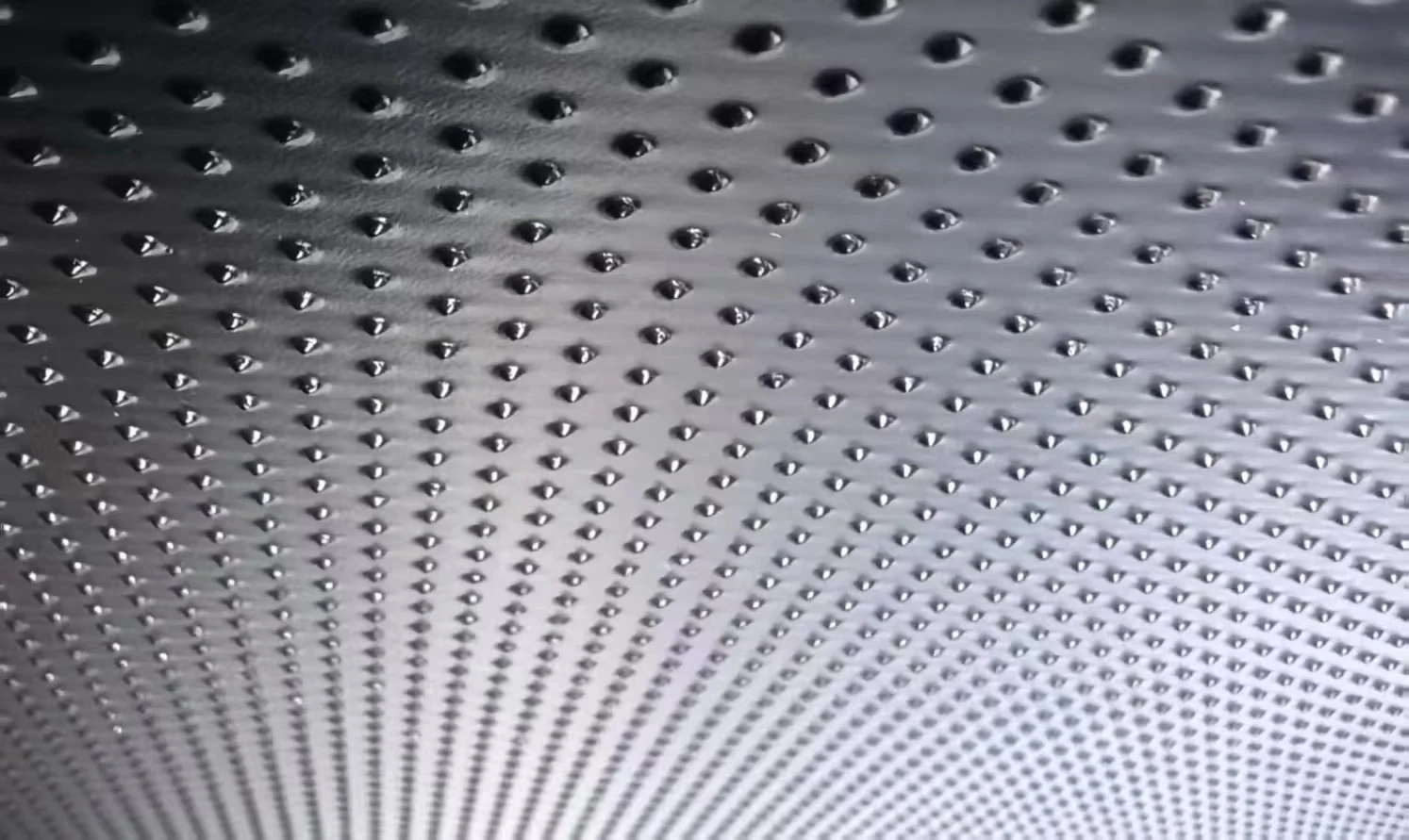
Specify interface shear testing using the actual contact materials and relevant loading conditions when slope stability depends on those interfaces. ASTM D5321/D5321M addresses direct-shear evaluation of soil–geosynthetic and geosynthetic–geosynthetic interfaces. “Smooth,” “textured” or “PVC” does not assign a safe friction angle or slope. See the textured geomembrane product information for the offered surface, then request project-specific interface evidence.
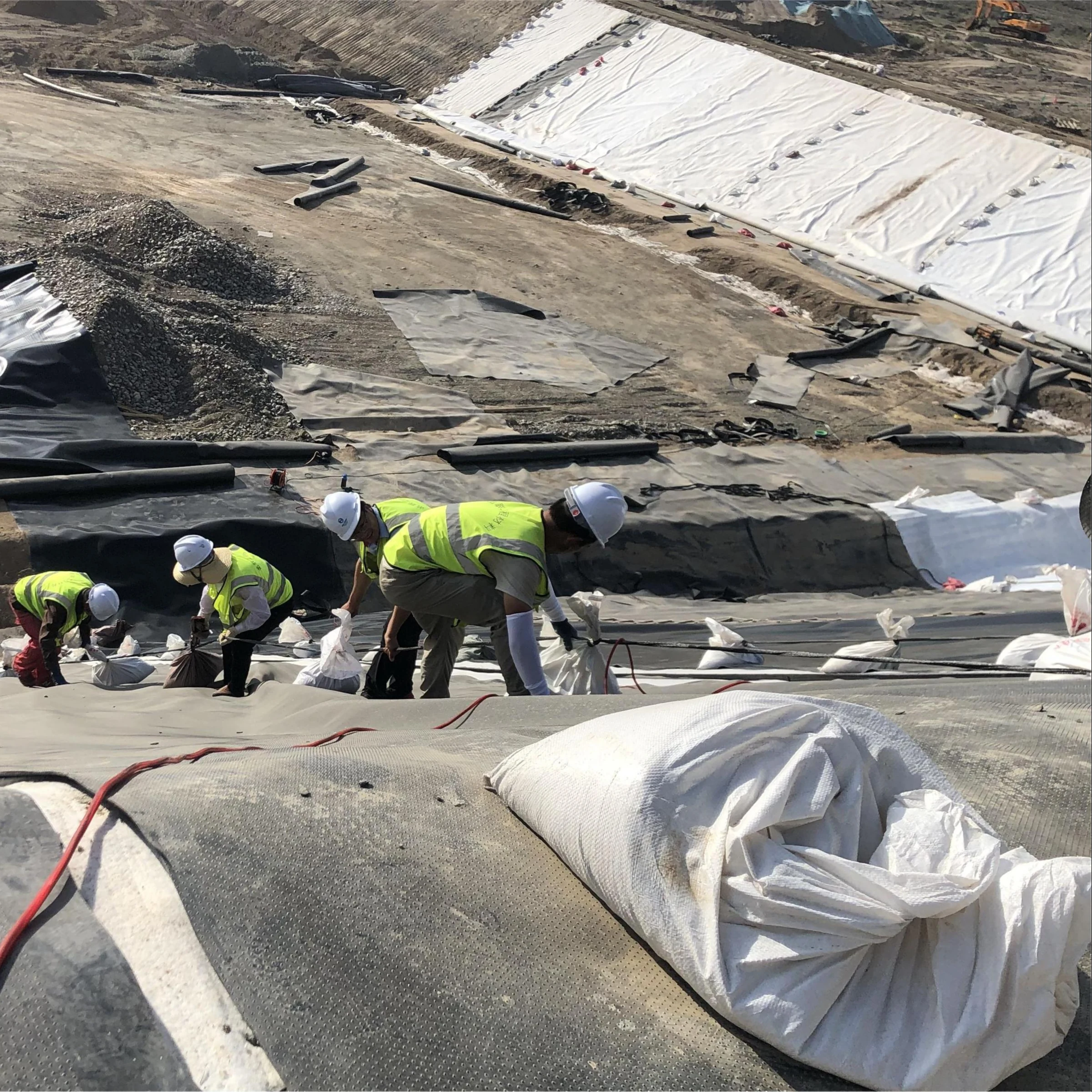
Protect the sheet against the specified aggregate and construction loads. Define cover placement, equipment access and temporary loading; a nominal 12-inch soil cover is not automatic permission for a bulldozer to operate above either liner.
Seaming and quality assurance
HDPE commonly uses hot-wedge seams for suitable panel joints and extrusion welding for appropriate details and repairs. PVC joining may use thermal, dielectric or approved chemical-fusion methods depending on the product and fabrication procedure. Factory prefabrication can reduce field seam length, but the reduction must come from the proposed panel plan; it is not invariably 80–95%.
| Stage | Evidence to require |
|---|---|
| Procedure qualification | Approved method and equipment, trial seams, sheet condition and weather limits. |
| Continuity testing | Appropriate air-channel, vacuum or other approved test, with coverage, limitations and repair records. |
| Strength testing | Peel/shear method, material-specific acceptance criteria, sample locations and disposition of failures. |
| Installed integrity | Project-required leak survey compatible with the liner and surrounding layers; not a replacement for seam strength tests. |
A test interval of 500 ft equals 152.4 m. It may be specified on a project, but it is not an automatic sampling rule for every material and site. Similarly, a welding-machine set point is not the sheet-interface temperature. Use the qualified procedure rather than copying one temperature, speed or test pressure into every contract.
Compare quantities and total installed cost
Separate material, freight, handling, prepared subgrade, protection, field seams, QA, details, cover and maintenance. Different cover requirements or access constraints can outweigh a difference in sheet price. Obtain current quotations with the same currency, delivery basis, thickness and scope; historical dollar-per-square-meter ranges are not current offers.
Thickness conversion: 1 mil = 0.0254 mm; therefore 60 mil = 1.524 mm, while 1.5 mm is approximately 59.1 mil. Commercial labels can use rounded conversions, but acceptance must follow the contract’s units and limits.
Illustrative shipping-mass comparison: at 1.5 mm thickness, assumed sheet densities of 940 and 1,200 kg/m³ give 1.41 and 1.80 kg/m² respectively, using mass/area = density × thickness in meters. The second is about 27.7% heavier. These assumed densities are calculation inputs, not guaranteed Jinseed product values; use actual sheet density and add packaging.
Illustrative thermal movement: with an assumed expansion coefficient of 1.2 × 10⁻⁴/°C, a free 100 m length and a 30°C temperature change give ΔL = αLΔT = 0.36 m. Restraint and geometry change field behavior. This calculation does not prescribe a universal slack percentage, and PVC also requires temperature-aware placement.
Check regulatory and service-life claims
The US municipal-solid-waste landfill design provisions in 40 CFR 258.40 include a composite-liner route and an approved performance-design route. The composite route specifies at least 30 mil for the flexible membrane component, or at least 60 mil when it is HDPE, with additional soil-layer and leachate-control requirements. This is not a requirement that every industrial liner be HDPE. The applicable permit and project design govern.
A puncture test does not prove a 50-year life. OIT is an indicator of stabilization, not a service-life clock; ASTM D8117 cautions against inferring field life directly from OIT. Assess durability against formulation, temperature, exposure and stress rather than assigning HDPE and PVC fixed lifetime ranges.
Prepare the material approval request
- Provide the liquid composition, temperature envelope, design life and exposure arrangement.
- Supply sections, settlement and uplift assessments, contact materials, loading and penetrations.
- State the adopted specification edition, units, surface and required thickness.
- Request traceable reports, the fabrication plan, field QA plan and exclusions from each offer.
- Resolve compatibility or design gaps before approving substitution.
For an HDPE option, review Jinseed’s HDPE liner information and send the project specification for a quotation. Identify any unverified requirements explicitly; a commercial offer does not replace engineering approval.