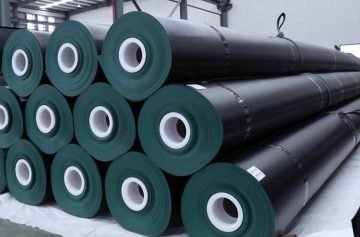
HDPE and LLDPE geomembranes are both polyethylene barriers, but they solve different design problems. HDPE is generally stiffer and widely used in containment systems where chemical exposure, puncture protection and construction quality are central. LLDPE is more flexible and is often considered for covers, complex details and foundations expected to deform. Neither material is automatically suitable because a project is a landfill, mine or cold-region reservoir.
Compare the proposed resin formulation, thickness, surface, supporting layers, service temperature and seam qualification. This guide separates material specifications from engineering design values, with numerical examples that can be checked rather than assumed performance guarantees.
HDPE vs. LLDPE: the practical comparison
| Selection factor | HDPE | LLDPE | What to verify |
|---|---|---|---|
| Flexibility and deformation | Relatively stiff; manage strain concentrations and bridging | More conformable; often considered where differential movement matters | Settlement geometry, strains at seams, anchors and penetrations |
| Material specification | GRI-GM13 for the specified HDPE sheet | GRI-GM17 for the specified nonreinforced LLDPE sheet | Revision, surface type, thickness and lot-specific results |
| Chemical exposure | Common candidate for waste and process containment | Also used for containment where the formulation is compatible | Actual liquid mixture, concentration, temperature and duration |
| Slopes | Smooth or textured options | Smooth or textured options | Shear testing of the actual adjacent materials |
| Installation and repair | Qualified thermal seams and repair procedures | Qualified thermal seams and repair procedures | Trial welds, compatible materials, access and inspection |
| Temperature | Check handling, welding and continuous service separately | Check the same conditions; flexibility alone is insufficient | Manufacturer limits supported by relevant testing |
The Fabricated Geomembrane Institute’s material guide describes these general differences and common applications. They are useful for shortlisting materials, not for approving a design or promising that every formulation behaves identically.
Compare specification values on the same basis
The following is a limited comparison of 2.00 mm smooth sheet requirements in GRI-GM13, Revision 19, June 11, 2025 and GRI-GM17, Revision 17, June 11, 2025. These are specified index properties, not Jinseed batch test results or allowable installed loads. Read the complete specifications and their sampling provisions for acceptance.
| Property | HDPE / GM13 | LLDPE / GM17 | Interpretation |
|---|---|---|---|
| Break strength, minimum average | 53 N/mm | 53 N/mm | Equal listed break strength does not mean equal stiffness |
| Break elongation, minimum average | 700% | 800% | Laboratory extension at break; not allowable field strain |
| Index puncture resistance, minimum average | 640 N | 500 N | Standard probe test; not a gravel protection design |
| Tear resistance, minimum average | 249 N | 200 N | Compare the specified test method, not arbitrary field cuts |
Do not reuse the smooth-sheet values for textured products. Texture can change the reported properties. GM17 also lists a 30% minimum axi-symmetric break resistance strain under ASTM D5617; this is a specific test result, not permission for a cap to settle by 30% of its height.
Choose for the complete containment scenario
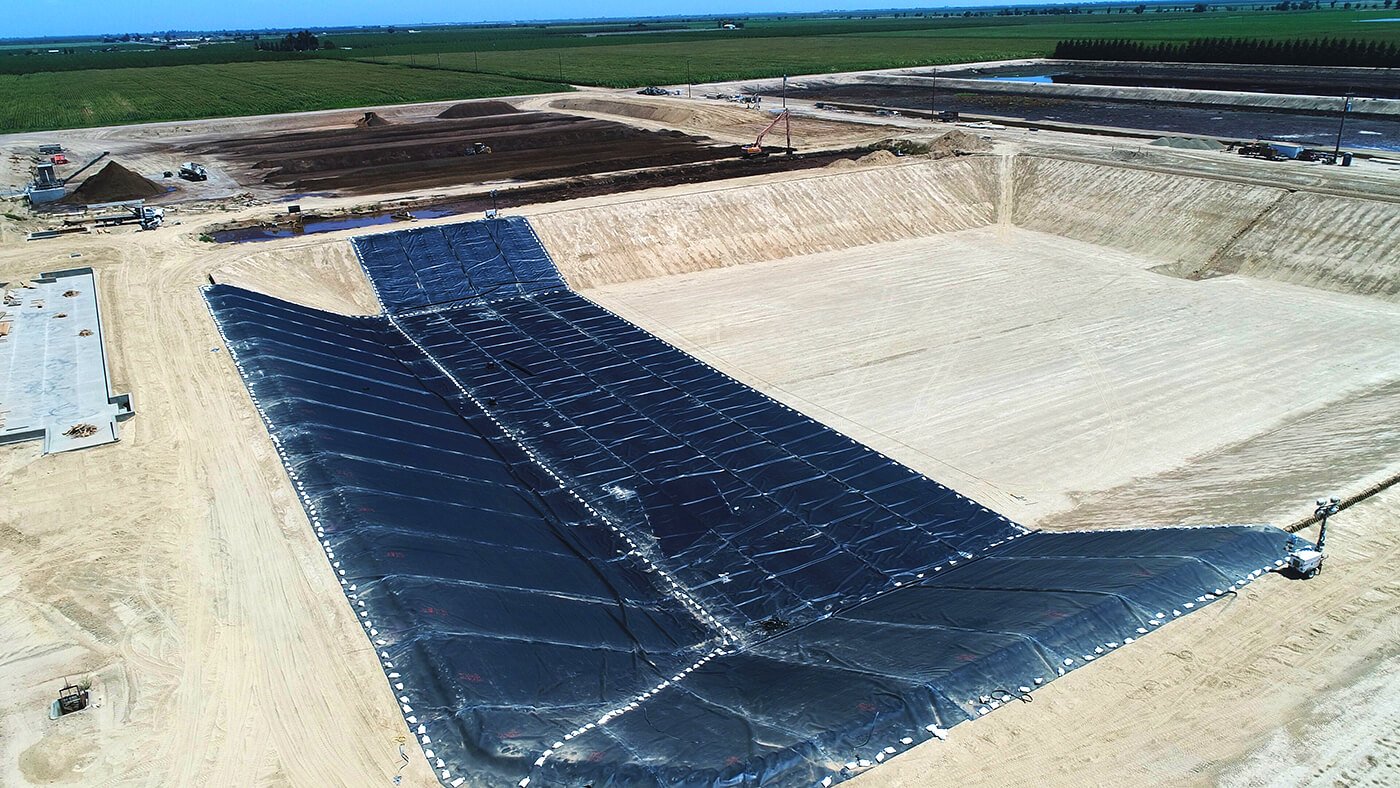
Landfill bottom liners and chemical containment
HDPE is a common starting point for these applications. The selection still needs a compatible formulation, protective layers, drainage, acceptable subgrade and a construction quality assurance plan. A higher puncture index alone does not show that angular aggregate can be placed directly on the sheet.
Chemical compatibility is also different from permeation. A polymer may retain useful mechanical properties while some dissolved compounds diffuse through it. A universal water-permeability number cannot predict the transport of every organic contaminant. Avoid treating either material as an absolute barrier to all solvents.
EPA Method 9090A addresses the effects of chemical exposure on flexible membrane liner properties. Where relevant, use a representative liquid and an appropriate testing program. An oven-aging OIT result does not substitute for chemical immersion evidence, and a stated pH does not fully describe a process liquid.
Landfill caps and differential settlement
LLDPE’s flexibility can be valuable for a cover expected to move, but displacement must be translated into strain in the proposed geometry. Seams, anchor trenches, penetrations and local subgrade defects may govern before a large sheet reaches its laboratory break elongation.
Illustrative geometry: a 2 m horizontal span drawn into a symmetrical V with a 0.2 m central drop has a new straight-segment length of 2 × √(1² + 0.2²) = 2.040 m, or approximately 2.0% geometric extension. A 0.5 m drop gives 2.236 m, or approximately 11.8%. These are simplified, initially taut line calculations. Slack, contact, three-dimensional deformation and stress redistribution are excluded; neither result is an allowable strain.
Gas and liquid drainage remain necessary. A flexible liner should not be selected to intentionally contain uncontrolled gas balloons or accommodate unresolved uplift. Investigate the pressure source and the drainage system.
Heap leach pads and heavily loaded liners
Assess the liner together with the bedding, protection layer, drainage aggregate and load history. HDPE’s stiffness can be useful, while settlement requirements may change the preferred design. It is not defensible to declare that all LLDPE is unsuitable for mining or that textured HDPE alone prevents a heap failure.
Illustrative load: using an assumed bulk unit weight of 18 kN/m³, 30 m and 100 m of material give nominal vertical overburden stresses of 540 kPa and 1,800 kPa. This simple γH estimate excludes slope effects, arching and construction equipment. It demonstrates why a small-probe puncture result cannot by itself approve a full liner stack under heavy loading.
Surface texture does not determine slope stability by itself
Neither polymer has a fixed interface friction angle. The result depends on the other material, normal stress, wetting, displacement and specimen preparation. A texture height is a manufacturing measurement, not a substitute for shear testing or a long-term guarantee that asperities remain unchanged.
ASTM D5321/D5321M provides a direct-shear test framework for soil–geosynthetic and geosynthetic–geosynthetic interfaces. Specify representative interfaces and loading conditions, and have the designer select the appropriate strength parameters. A generic 28–34° range cannot establish a factor of safety for a particular slope.
For the separate surface-selection question, see smooth versus textured HDPE geomembrane. That decision should follow the system assessment rather than be inferred from the material name.
Temperature adaptability: define which temperature matters
Separate ambient temperature, sheet surface temperature, liquid temperature and welding-machine settings. A black exposed liner can be warmer than the surrounding air; a heated process pond can impose a different long-term exposure from short-term sunlight. A low laboratory brittleness temperature is not a qualified cold-weather welding limit.
| Condition | Evidence to request | Practical action |
|---|---|---|
| Cold handling | Product-specific handling limits and relevant low-temperature data | Control folds, impact, frost and unstable subgrade |
| Cold or windy welding | Qualified procedure and passing trial seams under actual conditions | Adjust within the approved procedure; stop when conditions cannot be controlled |
| Warm chemical service | Compatibility and aging evaluation at representative exposure | Review the complete liquid mixture and continuous temperature |
| Day-to-night cycling | Panel layout, anchorage and covering plan | Check wrinkles and bridging before loading or covering |
Both HDPE and LLDPE undergo thermal movement. Covering a sheet while it is taut or bridging a depression can lock in a poor condition. Schedule inspection and cover placement for the actual sheet condition, rather than adopting a universal instruction to cover at the coldest hour. See the guide to geomembrane wrinkles, bridging and ballast.
Maintainability and repair qualification
Both materials can be thermally repaired when the existing sheet is suitable and the repair procedure is qualified. Age alone does not establish weldability. Inspect contamination, oxidation, cracking, thickness and the sound area available for the patch; confirm compatibility of the patch and extrudate. Damaged material may require replacement beyond a small surface patch.
Do not automatically grind away 10% of the parent sheet, prescribe a universal grinding depth, or assume that surface fuzzing improves fusion. Excessive preparation can thin or notch the liner. Follow the qualified preparation procedure and verify that the remaining substrate is acceptable before welding.
GRI-GM19a addresses seam strength and related acceptance properties. ASTM D6392 covers destructive seam-integrity testing. These are not universal welder temperature or travel-speed recipes. Equipment, sheet thickness, formulation and weather influence the working settings.
Use trial seams and specified destructive tests to qualify the process. Apply the appropriate nondestructive method to completed seams and repairs, document defects and retest repaired areas. Passing an air-channel or vacuum test does not by itself demonstrate adequate peel and shear strength.
Adhesive or tape repairs should not be assumed to provide a permanent equivalent to an accepted thermal seam. A special repair system needs explicit manufacturer support and approval for the material, exposure and required performance. LLDPE flexibility does not make an arbitrary adhesive repair acceptable.
How to compare installed cost without invented savings
Compare delivered material, seams, details, protective layers, testing, access and downtime. A lower roll price can be offset by difficult installation or maintenance access. There is no reliable universal rule that LLDPE repairs cost 20–30% less than HDPE repairs.
Budget example, not a quotation: for 10,000 m² of installed liner, a verified difference of US$0.20/m² in a comparable installed package changes the initial cost by US$2,000. Include identical assumptions for overlaps, wastage, testing and protection in both offers. Evaluate later repair costs separately using actual access and shutdown requirements.
Questions to settle before ordering
- What liquid or waste will contact the liner, at what concentrations and temperatures?
- What foundation movements, slopes and normal stresses must the design accommodate?
- Which sheet specification, revision, thickness and surface are required?
- What test reports identify the offered formulation and production lot?
- How will seams, penetrations, protective layers and repairs be accepted?
- What inspection access and operating records will remain available after commissioning?
Use these answers to compare products and quotations. Ask Jinseed for the proposed sheet’s specification and available test documentation, then evaluate it against the project’s requirements. The examples above are calculations and published specification comparisons; they are not verified project case studies or service-life warranties.