
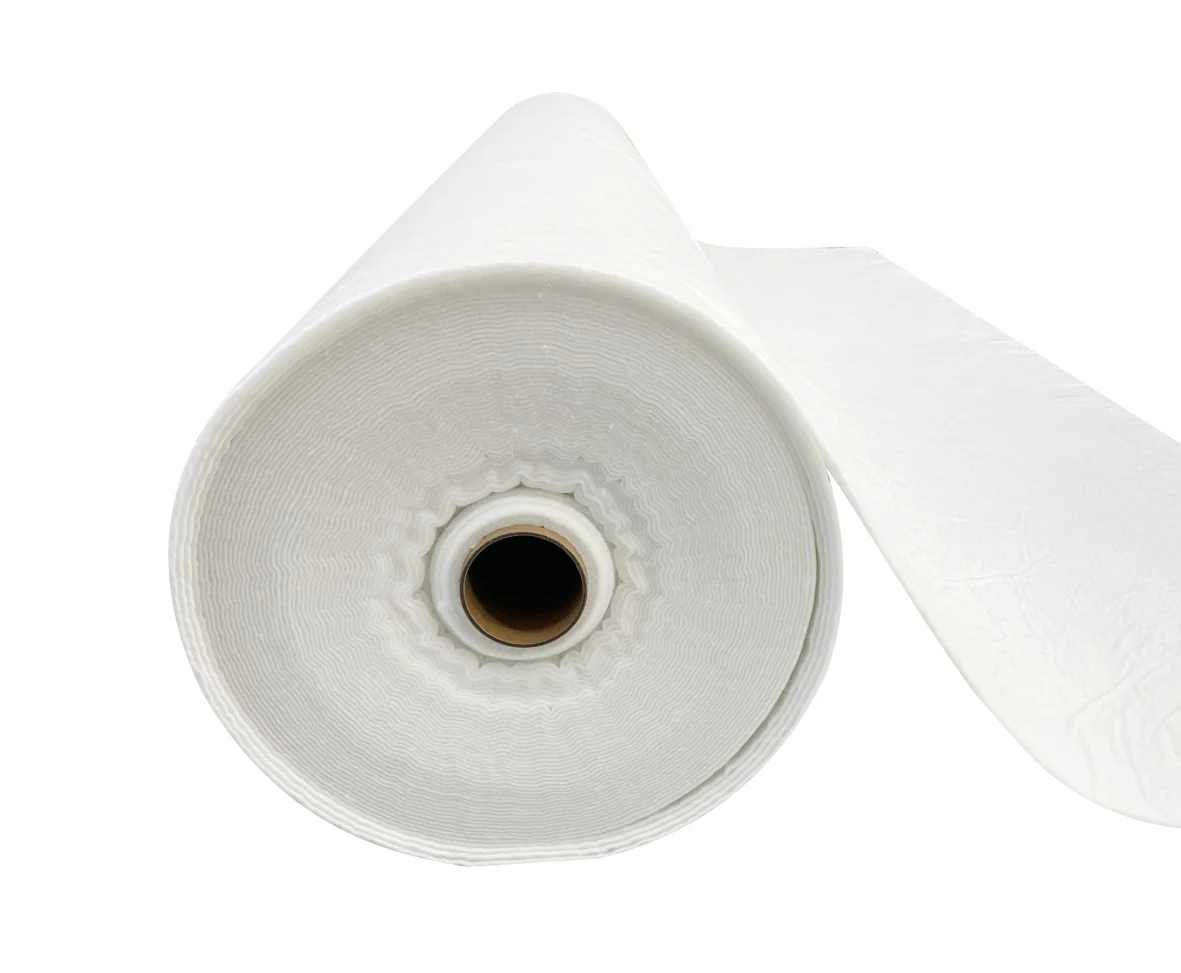

GSM tells you how heavy the fabric is. Tensile strength shows how it performs when pulled under a stated test. Puncture strength looks at resistance to a concentrated load. AOS helps you judge whether the fabric opening is suitable for the soil, while permittivity shows how easily water passes through the fabric. When comparing two nonwoven geotextiles, make sure the product construction, test method, unit, MD/CD direction and reporting basis match. If one sheet reports ASTM D4632 grab strength and another reports ASTM D4595 wide-width strength, the numbers are not directly comparable.
| Data Sheet Item | Read It As | Check Before Comparing |
|---|---|---|
| GSM | Mass per unit area | Nominal/typical basis and product construction |
| Grab tensile | Pulling resistance under ASTM D4632 | MD/CD, N or lbf, reporting basis |
| Puncture | Resistance to concentrated penetration | Test method; D6241 and older D4833 values are not interchangeable |
| AOS | Filtration opening-size index | Soil gradation, mm or sieve number |
| Permittivity | Water flow through the fabric thickness | Test method and condition |
| MARV | Specification value, not the same as “typical” | Whether the project requires MARV, minimum or maximum |
Start by making sure the products themselves are comparable. A 300 GSM continuous-filament PET nonwoven geotextile and a 300 GSM staple-fiber PP product can carry the same weight figure on the data sheet and still behave differently in strength, puncture and water-flow tests.
GSM
On a geotextile data sheet, GSM means grams per square meter. ASTM D5261-10(2024) measures mass per unit area of geotextiles and is used for specification and quality-control checks.[1]
1 oz/yd² ≈ 33.9 g/m²
| Metric Grade | Approx. U.S. Weight |
|---|---|
| 150 GSM | 4.42 oz/yd² |
| 200 GSM | 5.90 oz/yd² |
| 250 GSM | 7.37 oz/yd² |
| 300 GSM | 8.85 oz/yd² |
| 400 GSM | 11.80 oz/yd² |
| 500 GSM | 14.75 oz/yd² |
| U.S. Grade | Approx. Metric Weight |
|---|---|
| 4 oz/yd² | 136 GSM |
| 6 oz/yd² | 203 GSM |
| 8 oz/yd² | 271 GSM |
| 10 oz/yd² | 339 GSM |
| 12 oz/yd² | 407 GSM |
| 16 oz/yd² | 542 GSM |
An 8 oz fabric is about 271 GSM, not exactly 300 GSM. A 300 GSM product contains about 29 g/m² more mass. That tells you the difference in weight, but it does not tell you how much stronger either product will be.
The table below is an illustrative comparison, not a fixed industry specification:
| Property | 300 GSM Fabric A | 300 GSM Fabric B |
|---|---|---|
| Grab strength | 1,050 N | 1,200 N |
| Static puncture | 2,500 N | 2,900 N |
| AOS | 0.18 mm | 0.15 mm |
| Permittivity | 1.5 s-1 | 1.1 s-1 |
Here, both fabrics are 300 GSM, yet Fabric B has about 14.3% more grab strength and 16% more puncture strength. Fabric A, meanwhile, has the higher permittivity. In a real purchase, that means matching GSM is only the first check, not the final decision.
Use GSM to compare weight classes. Use tensile, puncture, AOS and permittivity to compare performance. The same point applies when comparing 4 oz and 8 oz nonwoven geotextiles.
Tensile Strength
When a data sheet says “tensile strength,” look at the test method before looking at the number. ASTM D4632/D4632M measures grab breaking load and grab elongation of geotextiles.[2]
A data sheet may show:
Grab strength: 1,100 N
Elongation: 55%
In this test, the machine grips only part of the specimen width. So the 1,100 N figure is a laboratory grab-test result, not a safe design load for one meter of installed geotextile.
Direction matters as well. MD is machine direction; CD or XD is cross-machine direction.
| Direction | Measured Grab Strength | Project Minimum | Difference | Result |
|---|---|---|---|---|
| MD | 1,050 N | 1,000 N | +5% | Pass |
| CD | 980 N | 1,000 N | -2% | Fail |
If these values use the required reporting basis and the specification requires 1,000 N in both directions, CD at 980 N does not meet that numerical limit. For a lot-acceptance decision, apply the specified sampling and conformity procedure rather than treating one specimen as the entire lot. Averaging 1,050 N and 980 N does not fix that shortfall unless the specification specifically allows averaging.
Elongation needs the same kind of care. A value of 60% tells you how much the specimen stretched in that test. It does not mean the installed fabric should be allowed to stretch 60%, and it does not make the product automatically better than one with 40% elongation.
The physical difference between tensile and puncture testing is shown in more detail in this geotextile grab tensile and puncture test guide.
ASTM D4595/D4595M uses a wide-width specimen and normally reports tensile strength in kN/m.[3]
| Product | Value | Method | Direct Comparison? |
|---|---|---|---|
| A | 1,100 N | ASTM D4632 grab | No |
| B | 14 kN/m | ASTM D4595 wide-width | No |
N can be converted to lbf. A D4632 grab result cannot simply be converted into a D4595 wide-width result because the test itself is different.
Puncture & Tear
For sites with crushed stone, rough subgrade or large aggregate, puncture is one of the numbers worth checking closely. ASTM D6241 measures static puncture strength using a 50 mm probe.[4]
A product may report:
Static puncture: 2,700 N
That result shows how the specimen performed in the laboratory test. On site, damage can still be affected by aggregate shape, maximum particle size, drop height, subgrade support and construction traffic.
If a project requires 2,400 N minimum, the difference between two products is easy to see:
| Product | Puncture | Margin Above 2,400 N |
|---|---|---|
| A | 2,500 N | 4.2% |
| B | 2,900 N | 20.8% |
Both values are numerically above 2,400 N if the required test method and reporting basis match. Product B simply has a larger margin.
Tear is a different failure mode. ASTM D4533/D4533M measures trapezoid tearing strength.[5]
| Property | What Is Happening to the Fabric? |
|---|---|
| Puncture | A concentrated load penetrates an initially intact specimen |
| Tear | An existing cut or tear continues to grow |
If a specification asks for puncture, a tear value cannot be used in its place.
Older data sheets may contain ASTM D4833 puncture results. The current ASTM D4833/D4833M scope applies to geomembranes and related products and points geotextile puncture testing to D6241.[6] D4833 and D6241 numbers should not be compared as though they came from the same test.
AOS
AOS stands for Apparent Opening Size. ASTM D4751-21a describes it as an indication of the approximate largest opening available for soil to pass through a geotextile. The standard includes dry-sieving glass-bead methods and a capillary-porometer method. Method B requires product-specific prequalification against Method A; do not assume the two methods are interchangeable simply because both results are labelled AOS.[7]
AOS may be reported in millimeters or as a U.S. sieve number:
| U.S. Sieve | Approx. Opening |
|---|---|
| No. 30 | 0.600 mm |
| No. 40 | 0.425 mm |
| No. 50 | 0.300 mm |
| No. 70 | 0.212 mm |
| No. 100 | 0.150 mm |
| No. 140 | 0.106 mm |
| No. 200 | 0.075 mm |
No. 100 is smaller than No. 70. The change from 0.212 mm to 0.150 mm is about a 29% reduction in opening size.
Do not picture AOS as thousands of identical holes in the fabric. A needle-punched nonwoven has a three-dimensional fiber structure with many different flow paths. AOS is a standardized index used for filtration checks.
Once soil retention matters, look at the soil data as well:
- D85: 85% of the soil by mass is finer than this size.
- D15: 15% of the soil by mass is finer than this size.
- Passing No. 200: percentage of soil finer than approximately 0.075 mm.
FHWA pavement guidance uses D85, D15 and percent passing No. 200 when checking geotextile filtration compatibility. The geocomposite pavement drainage procedure in FHWA NHI-05-037, Section 7.2.15, gives AOS ≤ 1.8 × D85 of the subgrade for nonwoven geotextiles, together with kgeotextile ≥ kbase/subbase and permittivity ≥ 0.1 s-1.[8]
If:
D85 = 0.20 mm
then the AOS limit in that particular FHWA procedure is:
1.8 × 0.20 = 0.36 mm
The 0.36 mm result belongs to that FHWA pavement drainage procedure, using the subgrade D85. It is not a universal AOS limit for every drain, road or retaining wall, nor a replacement for the current contract specification.
FHWA also treats highly pumping-susceptible noncohesive silts more cautiously because a reliable soil filter bridge may not form. In those conditions, a smaller opening or laboratory filtration test may be needed.
The practical relationship between soil gradation, opening size and water flow is covered in more detail in the site’s AOS and soil-retention guide.
Where the soil is difficult, AOS alone may not be enough. ASTM D5101 is a site-specific soil-geotextile filtration compatibility test; it is not intended as a routine manufacturer acceptance test. The current method applies D5101 to soils with a plasticity index below 5 and recommends D5567 when the plasticity index is 5 or more.[9] ASTM D5567 measures the hydraulic conductivity ratio of soil/geotextile systems under its stated conditions.[10]
Permittivity
Permittivity is the number to check when you want to know how easily water moves through the thickness of the geotextile. It is reported in s-1. ASTM D4491/D4491M measures geotextile water permeability in terms of permittivity under standard, uncompressed conditions.[11]
The relationship is:
ψ = k / t
or:
k = ψ × t
- ψ = permittivity
- k = nominal hydraulic conductivity
- t = nominal thickness
| Example | Permittivity | Thickness | Nominal k |
|---|---|---|---|
| A | 1.5 s-1 | 2.0 mm = 0.002 m | 0.003 m/s |
| B | 1.0 s-1 | 3.0 mm = 0.003 m | 0.003 m/s |
Both examples give the same nominal hydraulic conductivity even though the permittivity values are different. In other words, permittivity and permeability are related, but they are not the same number.
If two comparable products tested under the same method have permittivities of 0.8 s-1 and 1.6 s-1, the second laboratory permittivity value is twice the first. That still does not mean installed field flow will be exactly twice as high.
Pressure can change the result because a nonwoven geotextile can compress. ASTM D5493 measures permittivity when geotextile void structure changes under applied compressive stress.[12]
Some data sheets give water flow in L/m²/s or gpm/ft² instead of relying only on permittivity. Those figures are useful only when the test conditions match.
| Fabric | Water Flow | Test Conditions | Useful Comparison? |
|---|---|---|---|
| A | 90 L/m²/s | Same method/head as B | Yes |
| B | 120 L/m²/s | Same method/head as A | Yes |
| C | 150 L/m²/s | Unknown | No |
Under the same test conditions, 120 L/m²/s is about 33% higher than 90 L/m²/s. Fabric C shows 150 L/m²/s, but that number cannot be ranked until the test condition is known.
This matters in nonwoven geotextiles used for drainage, where the fabric has to pass water without losing the required soil-retention function.
Permittivity also should not be confused with transmissivity. Permittivity is flow through the fabric thickness; transmissivity is flow along the plane of a geosynthetic. ASTM D4716/D4716M measures in-plane flow rate and hydraulic transmissivity.[13]
| Property | Flow Direction |
|---|---|
| Permittivity | Through the fabric |
| Transmissivity | Along the fabric/geosynthetic plane |
Thickness
ASTM D5199-25 measures nominal thickness of geosynthetics and notes that thickness can change with normal load.[14]
A data sheet may list:
Nominal thickness: 3.5 mm
That is the thickness under the stated test condition. Once the fabric is covered by soil or aggregate, it may become thinner.
| Use | Why Thickness Matters |
|---|---|
| Geomembrane protection | Part of the cushioning/protection system |
| Hydraulic calculation | Used with permittivity to calculate nominal hydraulic conductivity |
| Product comparison | Useful only when the test condition is comparable |
Thickness is worth checking where cushioning or hydraulic calculations matter. It should not be used by itself to rank filter performance.
MARV & Value Basis
Two data sheets can use the same test and still be difficult to compare if one shows a typical value and the other shows MARV.
| Term | What to Do With It |
|---|---|
| Typical | Treat as representative performance, not automatically as an acceptance limit |
| Nominal | Treat as a stated grade or product value |
| Minimum | Check that the product meets or exceeds the lower limit |
| Maximum | Check that the product does not exceed the upper limit |
| MARV | Compare with a specification requiring Minimum Average Roll Value |
FHWA describes MARV as commonly corresponding to a value two standard deviations below the mean tensile strength. This is a statistical product-control basis, not a guarantee that every individual specimen exceeds the published value. For example, a mean of 1,300 N and standard deviation of 75 N give a calculated MARV of 1,150 N. A single certificate result cannot establish that production distribution.[15]
| Product | Published Value | Can You Rank the Specification Directly? |
|---|---|---|
| A | 1,250 N typical | No |
| B | 1,150 N MARV | No |
Product A has the larger printed number, but the two figures are not reported on the same basis. That is enough to stop a direct specification comparison.
Pay attention to whether the project sets a minimum or a maximum:
| Requirement | Product Value | Result |
|---|---|---|
| Grab ≥ 1,000 N | 1,100 N | Pass if method/basis match |
| AOS ≤ 0.20 mm | 0.18 mm | Pass if method/basis match |
| AOS ≤ 0.20 mm | 0.25 mm | Fail |
ASTM D4759 provides a practice for determining whether geosynthetic properties conform to a specification.[16]
The document type matters too. A TDS normally describes a product grade. A Certificate of Compliance addresses stated compliance. A COA or lot test report may contain results tied to a particular lot or sample. If the project asks for lot-specific results, a generic website table does not meet that need.
This distinction is important when checking a manufacturer’s production control and test documentation.
Data Sheet Comparison
The following is an illustrative example. All three products are assumed to use the same test methods and reporting basis.
| Property | 250 GSM | 300 GSM | 400 GSM |
|---|---|---|---|
| Grab strength | 950 N | 1,100 N | 1,350 N |
| Static puncture | 2,200 N | 2,650 N | 3,150 N |
| AOS | 0.18 mm | 0.15 mm | 0.13 mm |
| Permittivity | 1.8 s-1 | 1.4 s-1 | 1.0 s-1 |
| Nominal thickness | 2.2 mm | 2.8 mm | 3.6 mm |
If a project requires:
| Property | Requirement |
|---|---|
| Grab strength | ≥ 1,000 N MARV |
| Static puncture | ≥ 2,400 N MARV |
| AOS | ≤ 0.20 mm |
| Permittivity | ≥ 1.0 s-1 |
the numerical check is:
| Product | Grab | Puncture | AOS | Permittivity | Numerical Result |
|---|---|---|---|---|---|
| 250 GSM | Fail | Fail | Pass | Pass | Fail |
| 300 GSM | Pass | Pass | Pass | Pass | Pass* |
| 400 GSM | Pass | Pass | Pass | At minimum | Pass* |
*Only if the stated test methods and MARV/reporting basis match the project specification.
The useful difference shows up here: the 400 GSM product has the higher mechanical values, but its permittivity sits exactly at the 1.0 s-1 minimum. The 300 GSM product also passes every numerical requirement. Paying for the heavier grade only makes sense if the project actually benefits from the extra mechanical margin.
Application Priorities
| Application | Check First | Do Not Select By |
|---|---|---|
| Road separation | Puncture, tensile, tear, AOS, soil compatibility | GSM alone |
| Under gravel | Installation resistance, separation, AOS, water flow | Thickness alone |
| French drain | Soil gradation, AOS, permittivity, clogging risk | Highest tensile strength |
| Riprap | Filtration plus puncture/installation survivability | AOS alone |
| Geomembrane protection | Thickness, mass, puncture and cushioning performance | Permittivity alone |
Finally
An 8 oz/yd² fabric is about 271 GSM, while 300 GSM is about 8.85 oz/yd². No. 70 AOS is approximately 0.212 mm and No. 100 is 0.150 mm, a 29% smaller opening. A 2,500 N puncture result is 4.2% above a 2,400 N minimum, while 2,900 N is 20.8% above it. Those numbers only become useful when the test methods and reporting basis match. For an actual purchase, use GSM to compare weight, D4632 for grab strength, D6241 for puncture, D4751 for AOS and D4491 for permittivity, then check the project limits before deciding which product fits.