

The primary causes of geomembrane damage include UV aging (5-10 years), pH levels (<4 or >11) corrosion, and mechanical scratching.
For repairing membranes with a thickness >1.5mm, extrusion welding is recommended, with a weld width of $\ge$ 20mm;
hot air welding overlaps should be $\ge$ 10cm;
Repair patches should have rounded corners and an extension $\ge$ 15cm.
Maintenance requires quarterly inspections;
if the daily water level drop exceeds >10%, leak detection is required;
Regularly clear gravel monthly and cover the membrane with a 30cm protective soil layer, which can extend the service life by more than 30%.
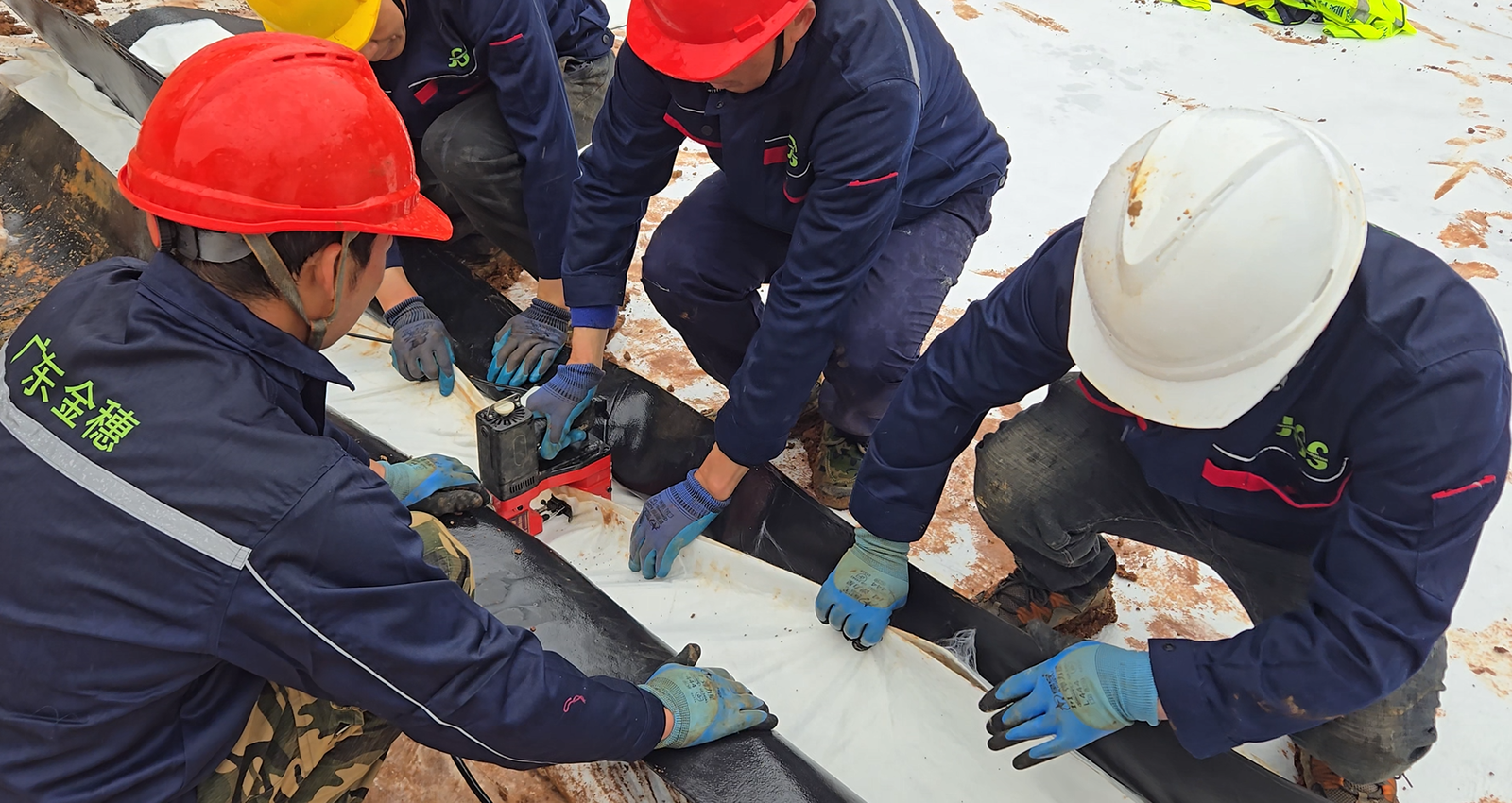
Causes of Damage
According to statistics, over 80% of geomembrane damage occurs during construction and the initial filling phase.
When a 1.5mm thick HDPE membrane withstands a static puncture force exceeding 480N or comes into contact with sharp gravel with a diameter greater than 10mm, irreversible deformation of the physical structure will occur.
For membrane materials exposed long-term, their OIT (Oxidative Induction Time) decreases by approximately 12% per year.
When the leakage rate exceeds the industry standard threshold of 500 liters/hectare/day, it usually indicates that multiple physical holes with diameters greater than 1mm have appeared in the impervious layer.
Environmental Exposure
Exposed geomembranes endure ultraviolet radiation with wavelengths of 290nm to 400nm in the solar spectrum.
The molecular structure of High-Density Polyethylene (HDPE) consists of long-chain carbon atoms.
The energy carried by UV rays is sufficient to break these chemical bonds, inducing photo-oxidation reactions.
To delay this process, industrial standards require the addition of 2.0% to 3.0% carbon black to the resin.
The role of carbon black is to absorb UV rays and convert them into heat energy.
According to the GRI-GM13 standard, after 1600 hours of UV irradiation testing at 85°C, the retention rate of the Oxidative Induction Time (OIT) for the membrane material must exceed 50%.
If the carbon black content is below 2% or unevenly distributed (poor dispersion grade), UV rays will penetrate the surface layer of the membrane, leading to the degradation of polymer chains.
Material that originally reached an elongation of 700% can become fragile within a few years, with elongation potentially falling below 50%.
“In high UV radiation regions such as Nevada or Arizona, the oxidation reaction rate on the surface of unprotected HDPE membranes is more than 10x faster than that of membranes buried under soil. For every 10°C increase in ambient temperature, the consumption rate of antioxidants doubles, which shortens the theoretical service life of the impervious system.” —— Excerpt from a technical report by an international geosynthetics association.
| Exposure Time (Years) | OIT Retention Rate (Estimated) | Physical Appearance | Risk Level |
|---|---|---|---|
| 0-5 | 90% – 100% | Smooth surface, good flexibility | Low Risk |
| 5-15 | 60% – 85% | Slight discoloration, hardening at edges | Medium Risk |
| 15-30 | 30% – 50% | Surface micro-cracks, decrease in tensile strength | High Risk |
| 30+ | <20% | Structural fragmentation, loss of anti-seepage function | Extremely High Risk |
The linear thermal expansion coefficient of HDPE is approximately 2.0 x 10⁻⁴ /°C.
In an exposed water pond 100 meters long, if the temperature difference rises from 10°C in the early morning to 50°C in the afternoon, the physical length of the membrane material will theoretically change by 80 cm.
If sufficient wave-like margins are not reserved during installation, or if the anchor trench design is too rigid, the membrane material will develop Stress Cracking in stress-concentrated areas (such as weld edges or corners).
ASTM D5397 Notched Constant Tensile Load tests show that low-quality membrane materials under sustained stress will undergo brittle fracture within 200 hours, even without physical puncture.
In contrast, membrane materials meeting high-performance requirements should be able to withstand more than 500 hours of testing without developing cracks.
- Standard OIT Test (ASTM D3895): Measured at 200°C and under normal pressure oxygen environment.
- High Pressure OIT Test (ASTM D5885): Measured at 150°C and under high pressure oxygen environment of 3.5 MPa.
- Antioxidant Consumption: At the beginning of service, antioxidants sacrifice themselves to neutralize free radicals. Once these chemicals are exhausted, the polymer enters an auto-catalytic oxidation stage, and the aging rate of the material grows exponentially.
Ozone in the air attacks unsaturated bonds in the polymer chains, leading to changes in the cross-linking density on the material surface.
This makes the membrane material harder and more brittle, reducing its ability to resist multi-axial tension.
In some industrial wastewater reservoirs, Volatile Organic Compounds (VOCs) on the liquid surface undergo photochemical reactions with sunlight to form higher concentrations of oxidizing environments.
In environments with long-term exposure to high concentrations of ozone, the tensile yield strength of the geomembrane decreases by 1.5% to 2.2% annually.
Thermal degradation usually occurs in dark-colored areas of the membrane, as dark surfaces can reach temperatures exceeding 75°C under direct sunlight.
This high temperature not only accelerates the volatilization and consumption of antioxidants but also changes the crystallinity of the polymer.
The crystallinity of HDPE is typically between 40% and 60%.
Long-term heat exposure leads to increased crystallinity, which may improve tensile strength in the short term but sacrifices flexibility and impact resistance.
As the crystalline regions expand, the amorphous regions (responsible for providing toughness) are compressed.
When facing slight foundation settlement, the material no longer absorbs deformation through elongation but instead undergoes mechanical fracture.
When evaluating material aging, focus on changes in the following physical parameters:
- Density Increase: As oxidation products are formed, the density of HDPE slowly rises from 0.941 g/cm³, which is usually a signal that the material is becoming brittle.
- Melt Flow Rate (MFR) Change: If the MFR decreases significantly, it indicates molecular chain cross-linking has occurred; if the MFR rises, it indicates a large amount of molecular chain scission.
- Bending Cold Crack Temperature: Severely aged membranes will shatter like glass when stressed in low-temperature environments (e.g., below -10°C), rather than undergoing plastic deformation.
To counter these irreversible natural processes, products with higher initial HP-OIT values and more advanced stabilizer formulations must be selected during the design phase based on the project location (e.g., arid regions near the equator).
Keeping the membrane surface covered with water or adding a soil cover layer can reduce the material aging rate by more than 90%.
Internal Pressure
During the operation cycle of an anti-seepage system, if organic matter beneath the geomembrane decomposes in an anaerobic environment, or if fluctuating groundwater levels squeeze air in the soil pores, gas pressure will accumulate rapidly if an effective venting layer is not set at the base.
According to fluid dynamics calculations, when the gas pressure under the membrane exceeds 0.5% to 1.0% of the liquid column pressure above, the geomembrane will begin to detach from the base layer and bulge upward.
This bulge, known as the “Whales” phenomenon, is usually circular or elliptical, with diameters extending from 1 meter to 15 meters and heights sometimes reaching over 2 meters.
For a 1.5mm thick HDPE membrane, localized bulging creates multi-axial tensile stress, thinning the membrane at the apex.
If this stress persists and exceeds the material’s yield point (usually 12% to 15% yield elongation), the membrane material undergoes irreversible plastic deformation, finally bursting at the weakest welding edges or stress points.
- Gas Generation Rate Reference: In landfill environments, the underlying soil may produce 0.05 to 0.2 cubic meters of gas per square meter per day.
- Buoyancy Imbalance: The specific gravity of HDPE is approximately 0.94, which is less than that of water. Without ballast or a cover layer, even a minimal head difference can cause the membrane to float.
- Venting System Failure: If the spacing of vent pipes exceeds 50 meters, or if gas venting trenches are blocked by fine sand, the rate of local gas pressure accumulation will exceed the discharge rate by more than 3x.
According to specifications, the compaction of the base layer must reach 95% of the Standard Proctor Density.
If the foundation soil contains undiscovered weak zones or voids, the foundation will undergo localized collapse under the hydrostatic pressure of tens of thousands of tons of water above.
A localized settlement pit with a diameter of 0.5 meters will cause significant suspended tension in the geomembrane spanning that area.
When the ratio of the suspended span to the settlement depth is less than 2:1, the tensile stress within the membrane material will multiply.
At this point, the geomembrane no longer functions merely as an anti-seepage layer but is forced to act as a load-bearing structure.
Despite HDPE possessing a break elongation exceeding 700%, the material will undergo Creep under long-term high-load tension, leading to molecular chain breakage.
- Hydrostatic Pressure Load: In a pond 10 meters deep, the static pressure on the bottom membrane is approximately 100 kPa.
- Shear Force Damage: Lateral shear forces generated by foundation displacement act on the welds, leading to peel failure of extrusion or fusion welds.
- Void Threshold: For a 2.0mm thick membrane, the risk of failure increases by 60% when an unsupported void of more than 300mm appears underneath.
During the rainy season or river flood periods, the groundwater level may rise above the geomembrane elevation.
If the system is not designed with pressure relief wells or one-way drainage valves, the upward osmotic pressure will lift the anti-seepage layer like a jack.
In some saline-alkali lands or areas with highly mineralized groundwater, salt crystals remaining after water evaporation can also form hard lumps at the bottom of the membrane.
When these crystals are squeezed by the pressure from above, they pierce the membrane body from the bottom like sharp stones.
Membrane tearing caused by groundwater pressure usually results in a single damaged area exceeding 5 square meters, and large-scale dewatering operations must be conducted before repair, increasing maintenance complexity and cost.
On slopes with an inclination greater than 1:3, if the cover soil layer gains weight after rain or undergoes overall sliding, it will drag the geomembrane downward via friction.
At this point, the membrane material located within the Anchor Trench at the top of the slope will endure enormous pull-out force.
If the anchor design is improper, the membrane material will be pulled straight out of the anchor trench;
Or if the anchoring is too firm, the membrane material will undergo transverse fracture at the top corner due to stress concentration.
- Friction Coefficient Comparison: The friction angle between textured membranes and soil is usually between 26° to 32°, while smooth membranes are only 12° to 18°.
- Load Transfer: On a 20-meter long slope, if the cover layer produces a 10mm displacement, the unit tensile force acting on the membrane may exceed 30 kN/m.
- Stress Concentration Point: The junction between the bottom of the slope and the floor is the area with the most concentrated stress; approximately 40% of geological cracks occur here.
To monitor these internal pressures, modern advanced anti-seepage projects often install pressure sensors and vacuum monitoring systems.
Once the pressure under the membrane is monitored to abnormally exceed 5 kPa, emergency venting procedures must be initiated.
Construction Damage
According to statistics from the Geosynthetic Institute (GRI), over 75% of geomembrane leaks stem from mechanical operation errors during installation or improper base layer treatment.
The static puncture strength of a 1.5mm thick HDPE membrane under the ASTM D4833 standard is typically between 480N and 600N.
At construction sites, the ground contact pressure of crawler bulldozers or dump trucks is usually between 35kPa and 550kPa.
If there is no controlled backfill protective layer with a thickness of at least 300mm above the membrane material, the reciprocating movement of heavy equipment will generate shear forces through aggregate squeezing, causing the membrane thickness to decrease by more than 20% in compressive performance within minutes due to stretching and thinning.
This physical damage is not limited to visible holes; it more often manifests as micron-level scratches difficult to find with the naked eye.
These scratches evolve into starting points for stress concentration under hydrostatic pressure after subsequent water storage.
| Equipment Type | Typical Ground Pressure (kPa) | Impact on 1.5mm Membrane | Recommended Minimum Protective Layer Thickness (mm) |
|---|---|---|---|
| Light Crawler Tractor | 30 – 45 | Causes plastic deformation of uncovered membrane | 150 – 200 |
| Low-Pressure Tire Loader | 150 – 250 | Causes particle embedding and point punctures | 300 – 400 |
| Standard Dump Truck | 500 – 700 | Instantly tears unprotected welds and parent material | 500 – 600 |
| Vibratory Roller | Extremely high dynamic load | Forces gravel through the bottom layer, destroying structural integrity | 600+ (Limited to upper layer compaction) |
According to the screening standard of ASTM D422, the content of sharp-angled stones with a particle size greater than 12.5mm in the base soil used for geomembrane support must be limited to 0%.
If the bottom layer contains unfiltered quarry debris, localized pressure exceeding 50N/mm² will be generated by the sharp edges of the stones when liquid is added above, creating static pressure over 100kPa.
This pressure overcomes the tensile yield strength of the polymer, leading to the “Cold Flow” phenomenon in the membrane material, where molecular chains move to the periphery of the pressurized area, causing the center point thickness to decay to below 10% of the original thickness, forming a potential leak point.
Using non-woven geotextiles with a weight of 10oz/yd² (340g/m²) or more as a buffer layer can reduce the impact of this localized point pressure by 60% to 80%, but it cannot completely offset mechanical stretching caused by an uneven base layer.
During the laying and unfolding phases, operators using rough metal tools or dragging the membrane material on ground with gravel will lead to linear scratches exceeding 0.15mm in depth.
According to material properties, scratches with a depth exceeding 10% of the total thickness are considered structural defects in engineering evaluations and must be repaired with patches.
During the welding preparation phase, to remove the oxidation layer, technicians use 80-mesh grinding discs for cleaning.
If the grinding depth exceeds 0.1mm and the subsequent extrusion welding fails to completely cover the ground area, the long-term Environmental Stress Cracking Resistance (ESCR) of that area will decrease by approximately 40%.
In actual tests, welds damaged by grinding often fracture in the heat-affected zone of the parent material rather than the weld itself during ASTM D6392 peel testing.
| Damage Type | Physical Parameter/Data Density | Cause | Repair Threshold |
|---|---|---|---|
| Surface Scratch | Depth >10% Membrane Thickness | Steel rope dragging, hard soles trampling, tool drops | Must be covered with a circular patch of diameter +150mm |
| Over-grinding | Depth >0.15mm | Improper weld preparation, excessive grinder pressure | Must be re-welded with extrusion to cover |
| Crease Damage | Whitening caused by 180-degree folding | Improper transport/storage, forced stretching for alignment | Considered failure if whitening zone appears at crease |
| Particle Embedding | Embedding depth >0.5mm | Backfill soil carrying stones, heavy vehicle pressure | Must cut out the affected area and replace with new membrane |
During backfill operations, when an operator dumps coarse aggregate from a height exceeding 1 meter, the impact kinetic energy generated by the free-falling stones is enough to penetrate HDPE membranes with a thickness of 1.0mm or 1.5mm.
Industrial standards recommend using the “Pushing Method” for backfilling, where equipment always travels on the already laid protective layer and maintains at least 300mm of loose soil in front as a buffer.
Additionally, the leveling speed of backfill soil should be controlled below 5 km/h to prevent horizontal shear stress generated by mechanical track rotation from stretching and deforming the underlying membrane.
During maintenance after the anti-seepage system is put into operation, such as when cleaning industrial sedimentation tanks, using scrapers with metal edges or excavator buckets for desilting can instantly tear openings longer than 500mm if the operational depth control error exceeds 50mm.
In some hydraulic engineering projects, if floating crash barriers are not installed, lateral impact forces generated by floating timber or ice driven by wind can also cause tearing of the membrane near the slope top anchor zone.
In areas without concrete slope protection, the damage rate of membrane material due to external object impacts is 35% higher than in protected areas.
For membrane materials used for liners, if high-pressure water guns with pressures exceeding 20 MPa are used for washing, and the nozzle is less than 300mm from the membrane surface, the localized scouring force generated by the water flow will lead to the loss of carbon black particles on the surface of the aged membrane, and may even peel the edges of the welding zone.
Repair Methods
Repairing geomembranes must execute the ASTM D6392 standard.
The patch overlap width for HDPE membranes (thickness 1.0mm-3.0mm) must be maintained between 75mm and 150mm.
Extrusion welding temperature must be controlled at 230°C-260°C, and the grinding depth for surface oxidation layer removal must not exceed 10% of the membrane thickness.
According to GRI-GM specifications, the peel strength at the repair site must reach more than 90% of the original material strength and must maintain no leakage under a vacuum pressure test of 35-50 kPa for 15 seconds.
Extrusion Welding
Extrusion welding is the standard process for handling physical damage to geomembranes, encapsulation of complex penetrations, and repair of long-distance cracks.
Its physical essence is to inject molten resin welding rods into a preheated damaged area, causing the repair material and parent material to re-fuse at the molecular level.
According to technical guidance from ASTM D4437, executing this process must use a handheld extrusion welder equipped with a preheating blower and electronic constant temperature control system.
Before official operation, the equipment must be preheated for at least 10 minutes until the resin temperature in the extrusion chamber reaches the preset range (usually between 220°C and 260°C).
Before welding the first patch, operators need to discharge old material that may have degraded due to long-term heating in the extrusion chamber, continuously extruding about 150mm to 300mm of welding rod and discarding it.
All overlap areas to be welded must be mechanically ground using 60-mesh to 80-mesh grinding wheels to remove the surface oxidation layer in the damaged area and its surrounding area with a width of at least 20mm.
According to international engineering specifications, it is strictly forbidden for the grinding depth to exceed 10% of the original thickness of the geomembrane.
If a 1.5mm thick HDPE membrane has more than 0.15mm ground off, that location is highly susceptible to stress cracking when subsequently subjected to foundation settlement tension.
The ground area must be welded within 1 hour; if this interval is exceeded or the area is exposed to heavy dust, minor grinding must be repeated to remove the newly formed oxidation film.
At the same time, the welding interface must remain absolutely dry.
Any residual condensation or soil moisture will instantly vaporize upon injection of 250°C solder, forming bubbles with diameters over 0.5mm inside the weld, leading to vacuum test failure.
| Technical Parameter | HDPE (1.5mm – 2.5mm) | LLDPE (1.0mm – 2.0mm) | Execution Reference Standard |
|---|---|---|---|
| Extrusion Melt Temp | 240°C – 260°C | 220°C – 240°C | ASTM D6392 |
| Preheat Air Temp | 260°C – 290°C | 240°C – 270°C | GRI GM19 |
| Welding Rod Diameter | 4.0mm / 5.0mm | 3.0mm / 4.0mm | Original Factory Match |
| Effective Weld Width | 30mm – 40mm | 25mm – 35mm | Field Test Requirement |
| Grinding Overlap Margin | Weld extension 10mm – 15mm | Weld extension 10mm – 15mm | NDT Redundancy |
| Welding Movement Speed | 0.3 – 0.6 m/min | 0.4 – 0.8 m/min | Fine-tune based on Temp |
In the actual walking welding process, the front end of the welding shoe preheats the parent material through a hot air nozzle, making its surface temperature reach the melting midpoint an instant before solder coverage.
If the movement speed is too fast, the preheating depth of the parent material surface is insufficient, and the solder will only “pile up” on top of the parent material, forming a “cold weld” without structural strength;
If the speed is too slow, excessive thermal energy will cause excessive thermal deformation of the parent material, causing thickness thinning or forming obvious wrinkles.
The operator needs to observe slight overflow at the weld edges; a standard weld edge should have a tiny continuous melt flow of 1mm to 3mm.
For thick membranes greater than 2.0mm, the angle of the welding shoe needs to be adjusted based on field trial welding results to ensure the thickness at the center of the weld bead is at least 1.5 times the patch thickness to compensate for dimensional reduction brought by thermal shrinkage.
For “T”-shaped joints encountered during repair (i.e., intersection of three or more layers of geomembrane), special geometric trimming procedures must be executed.
Operators need to use a scraper or grinder to reduce the edges of the bottom weld into a 45-degree slope; this step is called “edge beveling”.
If edge beveling is not performed, the extrusion welding shoe will jump when passing the step location of existing welds, leading to an air gap or unbonded zone about 10mm to 30mm long at that transition point, which is a high-probability location for leaks in the anti-seepage system.
After completing T-joint welding, it is recommended to add an extra section of extrusion solder about 50mm long at the center of the intersection for reinforcement.
The resin composition of all welding rods used must be completely consistent with the parent material.
It is strictly forbidden to use polypropylene (PP) welding rods on HDPE membranes, as poor compatibility between different polymers prevents the formation of physical entanglement of long-chain molecules, and the weld will be easily torn like tape after cooling.
| Quality Inspection Item | Qualified Standard Indicator | Testing Frequency | Test Method |
|---|---|---|---|
| Visual Inspection | No scorching, bubbles, missing welds, wrinkles | 100% Full Coverage | Visual/Thickness Gauge |
| Peel Strength (Peel) | ≥ 60% to 90% Parent Material Strength | Sample every 150m of weld | ASTM D6392 |
| Shear Strength (Shear) | ≥ 90% to 95% Parent Material Strength | Sample every 150m of weld | ASTM D6392 |
| Airtightness Test | Maintain 35-50 kPa for 15s without bubbles | 100% of Repair Sites | Vacuum Box Method |
| Destructive Test Mode | Must show FTB (Film Tearing Bond) | Each trial weld and sampling | Field Tensiometer |
When the ambient wind speed exceeds 20 km/h, the efficiency of the hot air nozzle decreases by more than 30%, preventing the preheated area from reaching melting temperature.
At this time, windproof barriers must be erected or higher-power preheating devices used.
When the ambient temperature is below 5°C, the initial heat capacity of the membrane material is extremely low.
Before welding, the patch and parent material must be processed for overall temperature recovery using a heat gun.
If this temperature difference compensation is ignored, the weld bead will produce severe internal shrinkage stress during the cooling process, which may lead to micro-cracks at the weld edges within 48 hours.
Hot Air Fusion
Hot air fusion primarily relies on a handheld hot air welding gun (usually with power between 1600W and 2000W) to generate controlled hot air flow, combined with a silicone pressure roller to repair damaged parts of the geomembrane.
The equipment heats inhaled air to a designated temperature between 20°C and 600°C through internal ceramic heating elements, with air volume maintained at 200 to 300 liters per minute.
When actually repairing HDPE (High Density Polyethylene) or LLDPE (Linear Low Density Polyethylene) membrane materials, the nozzle temperature for air outflow is usually set between 350°C and 420°C.
The hot air nozzle is inserted into the overlapping part of the two membrane layers, making the contact surface reach a thermal melting state within 0.5 seconds, followed by the pressure roller applying about 15kg to 20kg of vertical pressure.
The repair process has clear restrictions on ambient temperature, usually requiring it to be above 5°C.
If wind speed exceeds 20 km/h, windbreaks must be used to prevent heat loss from the nozzle, otherwise welds are prone to cold welds or insufficient strength.
Before repair begins, patch cutting for the damaged location needs to follow specific dimensions.
The edge of the patch must exceed the edge of the damaged area by at least 100mm to 150mm.
For a 1.5mm thick HDPE geomembrane, the overlap width must not be less than 75mm.
Operators should use isopropyl alcohol or specialized cleaners to remove dust, moisture, and surface oxidation layers within the overlap area.
- The width of the welding nozzle is usually selected as a 40mm flat nozzle to ensure sufficient effective fusion width.
- The distance between the pressure roller and the nozzle outlet should be kept between 10mm and 15mm to ensure compaction is completed before heat loss.
- The feeding speed needs to be maintained at 1.5 to 2.5 meters per minute. Speed too slow will cause scorching and carbonization of the membrane material, while speed too fast will fail to form a continuous melt pool.
- Before official repair, a trial weld at least 1 meter long must be conducted on fragments of the same material.
- Trial weld samples must be cooled for 20 minutes before performing shear and peel tests using a field tensiometer.
According to the ASTM D6392 standard, for a 1.5mm thick HDPE membrane in a peel test, the weld strength should reach above 12kN/m, and a FTB (Film Tearing Bond) failure mode must occur, meaning the tear happens on the parent material rather than the welding surface.
If the test shows welding surface separation, the temperature setting of the welding gun needs to be readjusted or the movement speed decreased.
When repairing parts with complex shapes, such as corners or pipe penetrations, a 20mm narrow nozzle can be substituted to improve heat concentration precision.
During operation, the angle between the welding gun nozzle and the membrane surface should be maintained at about 45 degrees.
The weld edge after welding should have a tiny melt glue overflow (about 1mm to 2mm wide).
For the four corners of the patch, they must be trimmed into arc shapes with a radius not less than 25mm.
| Parameter Type | HDPE Repair Standard Value (1.5mm) | LLDPE Repair Standard Value (1.5mm) |
|---|---|---|
| Recommended Gun Temp | 380°C – 410°C | 330°C – 360°C |
| Min Overlap Width | 100 mm | 100 mm |
| Welding Speed | 1.8 – 2.2 m/min | 2.0 – 2.5 m/min |
| Vacuum Test Pressure | 35 kPa | 30 kPa |
| Hold Time | 15 seconds | 15 seconds |
If ambient humidity exceeds 80%, preheating and dehydration treatment of the overlap area using a hot air gun is required before welding to ensure the interface is completely dry.
For large-area repairs, operators should re-conduct trial weld calibration every 4 hours or when the temperature change exceeds 5°C.
Patch Cutting
All geomembrane repair patches must be cut into circular or elliptical shapes, and must absolutely not have any sharp right angles or corners smaller than 90 degrees.
When the damaged area of the geomembrane has a 90-degree sharp corner, the stress concentration factor at that location will be several times higher than the surrounding area, leading to the crack continuing to extend along the original damage path after welding is completed.
According to research data from the International Geosynthetics Society (GRI), the edge stress distribution uniformity of circular patches is more than 40% higher than that of rectangular patches.
When cutting HDPE (High Density Polyethylene) patches, the radius of each corner should be maintained at least between 25mm and 50mm.
If the damage is a long and narrow crack, the patch should be cut into a long strip with circular arcs at both ends, and the long axis direction of the patch should as much as possible align with the direction of maximum stress of the geomembrane during laying.
The patch edge must exceed the edge of the damaged area by at least 150mm. If the diameter of the damaged hole is 10mm, then the diameter of the cut circular patch should be no less than 310mm. This value is calculated based on the redundancy of effective welding width in peel strength testing, ensuring that under extreme shear force, the weld itself will not become the weak link of the anti-seepage system.
In complex field construction environments, multiple damage points often appear concentrated in a small area.
In this case, the principle of “combined coverage” should be followed, i.e., if the interval between two adjacent repair sites is less than 200mm, they cannot be handled with two small patches separately, but must use one complete large patch to cover both damaged locations entirely.
Increasing the area of a single patch will consume more membrane material but can effectively reduce the total length of welds and the number of weld intersections (T-joints).
When handling geomembranes with a thickness of 2.0mm or more, this merging strategy is particularly important because thick membranes are more difficult to extrusion weld at intersections, making them prone to tiny pores.
The material of the patch must completely match the original anti-seepage layer, including resin grade, thickness, and carbon black content. It is usually recommended to use scraps from the same batch of coiled material for repair. According to the ASTM D5199 standard, the thickness deviation between the patch and the parent material should be controlled within plus or minus 10%. If materials of different thicknesses are used, inconsistent heat conduction rates during the welding process will lead to degradation of the thinner side due to overheating, while the thicker side may produce cold welds due to insufficient heating.
The patch after welding should undergo visual inspection to confirm the weld bead width is uniformly distributed between 30mm and 40mm.
The weld edge should have minor and uniform overflow, proving sufficient internal pressure.
Finally, the patch number, construction date, operator code, and test pressure value should be marked next to each patch with an indelible marker.
Maintenance & Prevention Checklist
According to statistics, executing standardized inspection processes quarterly can extend the service life of geomembranes from the expected 15 years to more than 30 years.
For a 1.5mm thick HDPE membrane, for every 10℃ increase in ambient temperature, its antioxidant consumption rate doubles.
A qualified checklist must cover from 0.1mm pinhole detection to monitoring the 25% shear strength decay of welds.
Based on ASTM D5820 and GRI-GM13 standards, establishing a quantified prevention mechanism is an effective means to reduce the liner leakage rate (usually controlled at less than 10 liters per hectare per day).
Inspection Schedule
According to industrial operation data, daily visual inspections should cover all exposed membrane surfaces, focusing on looking for physical damage with a diameter exceeding 2mm or scratches caused by wildlife activity.
For a 1.5mm (60 mil) thick HDPE liner, if the surface scratch depth exceeds 10% of the membrane thickness, it must be marked and reinforced with a patch according to repair guidelines.
Flow records of the Leak Detection System (LDS) sump need to be taken weekly; if the Allowable Leakage Rate (ALR) per hectare per day is found to suddenly exceed 500 liters, electrical leak location detection must be initiated immediately.
In monthly routine inspections, technicians should use a vacuum box to perform negative pressure testing on 5% of field welds selected at random.
The test pressure needs to be stable between -35kPa and -50kPa, and the maintenance time must not be less than 15 seconds.
| Inspection Frequency | Monitoring Object | Quantified Standard & Detection Method | Judgment Pass/Intervention Limit |
|---|---|---|---|
| Daily | Exposed Liner Surface | Visual inspection for physical damage, animal tracks, and debris accumulation | Scratch depth < 0.15mm (1.5mm membrane) |
| Weekly | Leak Detection System (LDS) | Measure collection pipe output flow (LPH) | Flow fluctuation < 15% of last week’s average |
| Monthly | Extrusion & Fusion Welds | Vacuum box test (ASTM D4437) or Air channel test | Pressure drop < 28kPa (4 psi) / 5 mins |
| Quarterly | Anchor System & Slopes | GPS coordinate displacement monitoring; measure liner tension wrinkles | Total displacement < 50mm; wrinkle height < 100mm |
| Semi-Annually | Pipe Penetrations & Seals | Check stainless steel band tightening torque; sealant aging check | Torque meets specs; no cracking in sealant |
| Annually | Liner Material Property | Lab sampling for Oxidative Induction Time (OIT) | OIT retention > 100 mins (ASTM D3895) |
Inspection for slope areas requires displacement monitoring combined with a total station or high-precision GPS.
Due to the thermal expansion and contraction properties of geomembranes, in cases where temperature changes exceed 20°C, the membrane material will produce obvious stress fluctuations.
Quarterly inspections should record soil stability around the anchor trench, observing whether cracks or subsidence exceeding 30mm exist.
At the connection between the liner and concrete structures, the stress state of mechanical anchors needs to be checked to ensure no deformation of stainless steel batten strips and that the compression of the sealing gasket is maintained at 20% to 30% of its initial thickness.
If discoloration of the membrane material at the top of the slope is observed (turning from black to dark gray), it may suggest excessive antioxidant consumption; in this case, a high-pressure oxidative induction time test must be conducted according to the ASTM D5885 standard.
For facilities in an empty pond state, wind load monitoring is equally important.
When the instantaneous wind speed on site exceeds 15m/s, the integrity of ballast sandbags must be checked to ensure at least one effective ballast object of 15kg is distributed every 25 square meters to prevent the uplift phenomenon from destroying the liner’s subgrade contact.
For processes using dual-track fusion welding, the air channel test is the preferred choice for verifying long-distance joints.
During the inspection process, insert an air needle into the sealed channel, inflate to 250kPa to 300kPa, and observe the pressure gauge reading.
If the pressure drop within 5 minutes is less than 28kPa, the section of the weld is judged to be qualified.
For complex geometric parts (such as corners or pipe boots), because air testing cannot be performed, they must be covered with a vacuum box throughout.
The soap solution ratio of the vacuum box should be strictly executed according to industrial standards to ensure that even tiny pinholes can produce clear continuous bubbles under a pressure of -35kPa.
For systems that have been in service for more than 5 years, annual sampling should include testing the shear strength and peel strength of joints.
The sampling frequency is usually one sample block for every 150 meters of weld.
According to the GRI-GM19 standard, the peel strength of 1.5mm HDPE membrane should be no less than 13 kN/m, and the failure form must be a ductile failure (FTB), meaning the failure occurs in the parent material rather than the welding surface.
Sample and analyze the liquid in the pond monthly, focusing on monitoring concentration changes of surfactants, strong oxidants, or solvents.
If the liquid contains specific chemical substances, their erosion of polymer chains will lead to a decrease in Environmental Stress Cracking Resistance (ESCR) performance.
In inspection records, the range of liquid level fluctuations should be registered in detail, as geomembranes in areas with frequent liquid level changes will be subjected to the dual effects of cyclic stress and UV rays, making them very prone to fatigue damage.
Technicians should use a durometer to measure the hardness (Shore D) of the membrane material in the alternating liquid level zone.
If the hardness value increases by more than 10% compared to the original data, it indicates that the material has undergone significant embrittlement.
Raw data generated by each inspection, including real-time ambient temperature, humidity, wind speed, and specific detection pressure values, should be entered into the site Geographic Information System (GIS).
When an area shows data fluctuations in three consecutive inspections (such as an accelerating decrease in vacuum degree, even if it is still within the qualified range), it should be marked as a risk monitoring zone.
When performing Electrical Leak Location (ELL), ensure there is enough electrolyte (such as water or moist soil) above the liner.
The applied voltage is usually 12V to 24V.
Detection equipment identifies holes by capturing abrupt changes in current across the liner.
Under the guidance of the ASTM D7007 standard, this method can locate leak points with diameters smaller than 1mm.
Preventive Measures
During the operation of the geomembrane, according to common industrial standards, any light equipment (such as ATVs or small sampling vehicles) entering the work area must have tire contact pressure controlled below 35kPa (5 psi).
For situations where heavy trucks or excavators are required for soil covering, clean filler with a thickness of no less than 300mm to 600mm must be laid first as a buffer layer, and the filler must not contain sharp stones or construction debris with a diameter exceeding 12mm.
The filler should be laid using the “Pushing Method,” where machinery always travels on the already laid protective layer; any in-place steering operations on the membrane surface are prohibited.
To monitor potential physical displacement, displacement observation points should be set every 20 meters in the slope area.
If the stretch of the geomembrane at the anchor trench is observed to exceed 50mm, the sliding risk of the slope must be checked immediately.
- Equipment Entry Parameters: Wheel pressure < 35kPa; ground pressure for crawler equipment < 40kPa; vehicle speed on the protective layer limited to within 10km/h.
- Filler Specification Requirements: The proportion passing through a 0.5-inch (12.5mm) sieve must be 100%; fine powder content (passing through No. 200 sieve) should be less than 15% to ensure drainage and reduce stress concentration.
- Walkway Setup: On high-frequency inspection paths, double layers of 400g/m² non-woven geotextile should be laid as artificial corridors to prevent gravel carried by soles from wearing down the 1.5mm thick HDPE membrane.
The thermal expansion coefficient of High-Density Polyethylene (HDPE) is typically 2.0 x 10^-4 /°C.
When exposed to sun at noon in summer, the membrane surface temperature can rise above 70°C, leading to obvious wave-like wrinkles in the membrane material.
Standard operating guidelines require that the height of wrinkles should not exceed 10% of their width.
For UV protection, exposed geomembranes must comply with the ASTM D1603 standard, and their carbon black content should be stable between 2.0% and 3.0% to ensure a service life of more than 20 years in strong UV environments.
Wind loads can easily cause the “uplift” phenomenon in an empty pond state.
When the sustained wind speed exceeds 50km/h, the negative pressure beneath the membrane material will lift the liner.
At this time, stability must be maintained by increasing ballast or using a vacuum drainage system.
- Thermal Deformation Control Indicators: When the temperature difference span > 30°C, soil covering operations should be conducted during the low-temperature period in the early morning; parts with wrinkle heights exceeding 100mm are strictly prohibited from being covered and require manual leveling or readjustment.
- UV Performance Indicators: High-pressure oxidative induction time (OIT) must meet ASTM D3895 and be greater than 100 minutes; after 2000 hours of fluorescent UV exposure testing (ASTM D7238), its OIT retention rate must be greater than 50%.
- Wind Load Prevention Strategy: Place a sandbag weighing 10kg to 15kg every 2 to 5 meters on the slope; the anchor trench depth should be at least 600mm and filled with concrete with a compressive strength of no less than 20MPa or compacted soil.
Plant roots can penetrate along geomembrane seams or minute damages in the process of seeking water sources, triggering leaks.
To address such issues, before liner laying, the subgrade cleaning standard should reach the smoothness specified by ASTM D4439, removing all roots and organic matter with a diameter exceeding 5mm.
In areas with a lot of wildlife, such as agricultural reservoirs in North America or Europe, a metal wire mesh with a 500-micron pore size needs to be buried at the base of the fence to prevent rodents such as woodchucks from burrowing and establishing nests beneath the liner.

Leave a reply