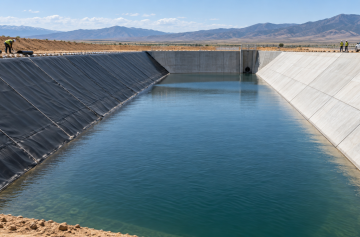
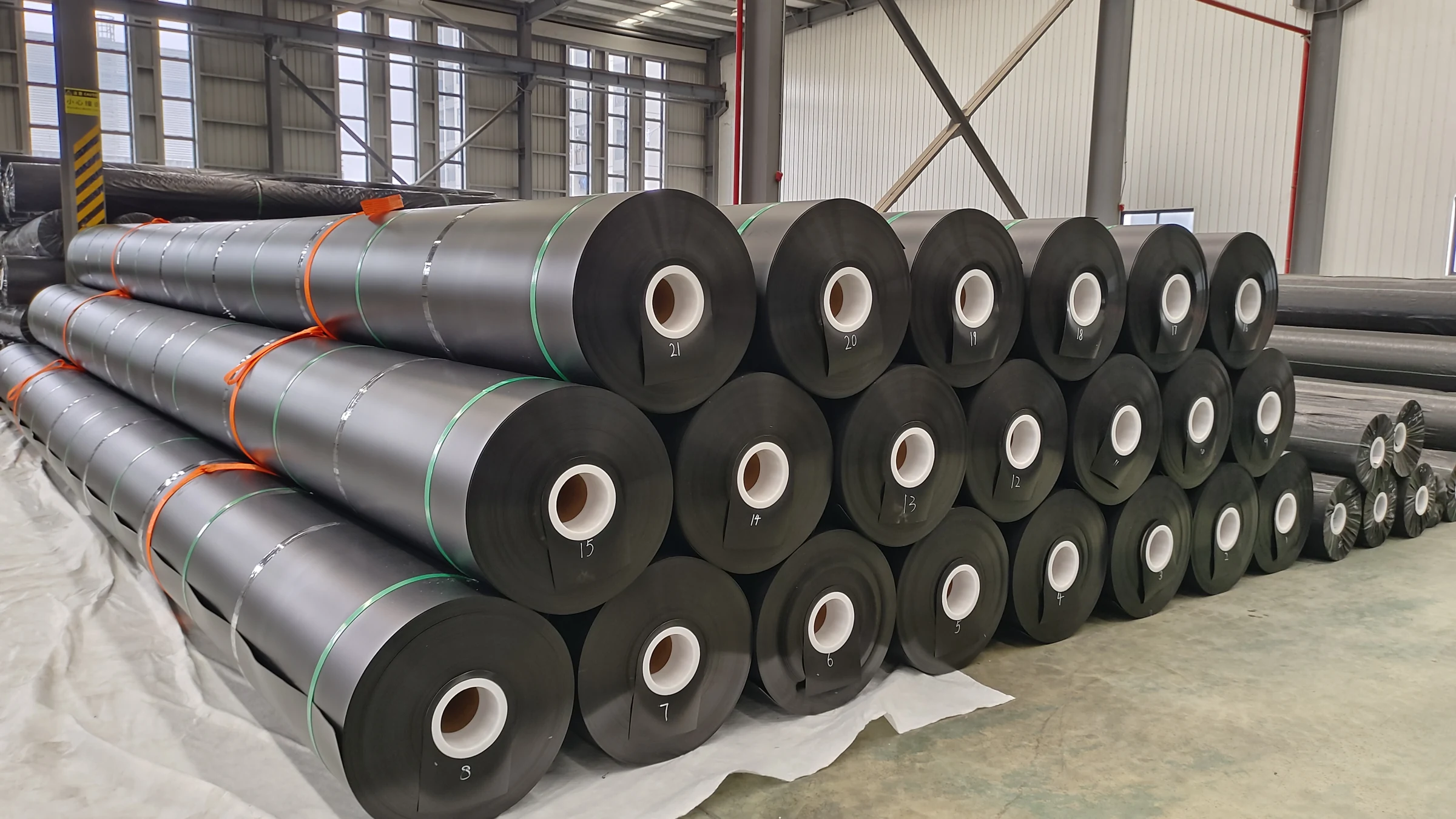

This article covers HDPE geomembrane liners used in dams, reservoirs and similar water-containment projects. LLDPE, PVC and EPDM use different formulations and should be checked against the standards that apply to those materials.
UV Resistance
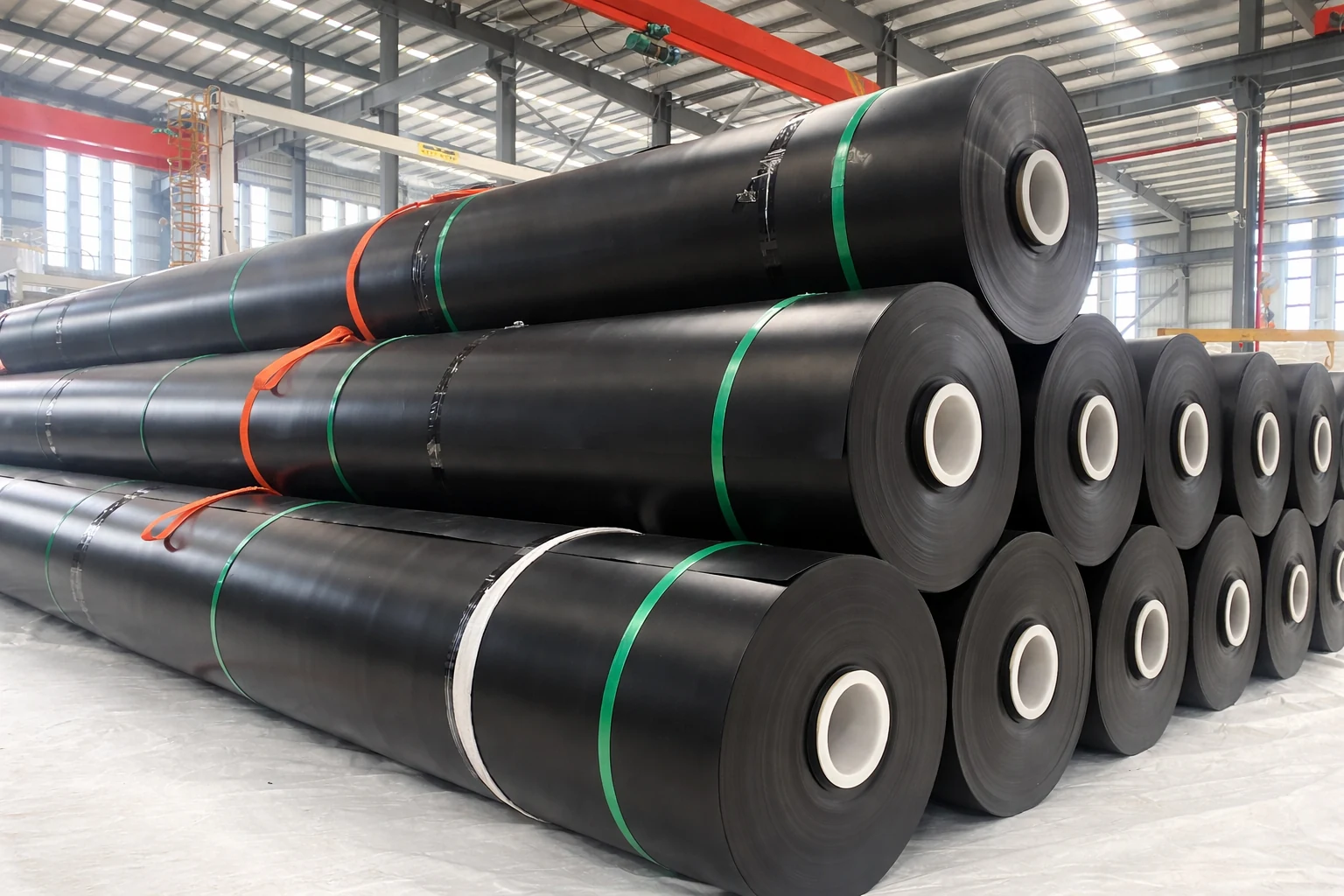
Most HDPE dam liners are black because carbon black is mixed into the polyethylene. It absorbs UV radiation and slows damage to the polymer. The percentage matters, but poor dispersion can still leave weak areas in the sheet.

GRI-GM13 specifies 2.0–3.0% carbon black for HDPE geomembrane. It also covers carbon black dispersion, oxidative induction time (OIT), heat aging, UV aging and stress-crack resistance. GM13 is a manufacturing quality-control specification, not a complete dam or reservoir design standard.[1]
Current GM13 OIT requirements include:
- Standard OIT: minimum 100 minutes;
- High Pressure OIT: minimum 400 minutes;
- High Pressure OIT retained after 1,600 hours of accelerated UV exposure: minimum 50%.
Standard OIT and High Pressure OIT use different test methods, so the numbers cannot be compared as if they were the same measurement. A 400-minute High Pressure OIT result does not mean four times the service life of a 100-minute Standard OIT result.
The 1,600-hour UV test also cannot be turned into a fixed outdoor-life figure. It does not mean that 1,600 test hours equal a set number of years in the field. Sunlight, liner temperature, climate, slope direction and the time spent above the waterline all change the exposure.
When you compare two liners, look at the actual carbon black, dispersion, OIT and UV-aging results for the material being supplied. The words “UV stabilized” by themselves tell you very little.
Thickness
Thickness mainly affects mechanical strength. More thickness gives the sheet more resistance to puncture, tearing, handling damage and local deformation.
The table below shows GM13 minimum average tear and puncture values for smooth HDPE geomembrane. Textured HDPE has different specified puncture values.[2]
| Thickness | Approx. mil | Tear resistance | Puncture resistance |
|---|---|---|---|
| 0.75 mm | 30 mil | 21 lb | 54 lb |
| 1.0 mm | 40 mil | 28 lb | 72 lb |
| 1.5 mm | 60 mil | 42 lb | 108 lb |
| 2.0 mm | 80 mil | 56 lb | 144 lb |
| 2.5 mm | 100 mil | 70 lb | 180 lb |
These are laboratory values. A puncture result of 144 lb does not mean a 2.0 mm liner can sit safely on a 144 lb sharp stone. A narrow rock point puts far more stress on the sheet than a broad contact area. Soil support, water pressure and any protection layer also change the risk.
Thickness also affects transport and handling. Using an HDPE density of about 0.94 g/cm³, the estimated sheet mass is:
| Thickness | Approx. mass per m² | Approx. mass for 10,000 m² |
|---|---|---|
| 0.75 mm | 0.71 kg/m² | 7.1 tonnes |
| 1.0 mm | 0.94 kg/m² | 9.4 tonnes |
| 1.5 mm | 1.41 kg/m² | 14.1 tonnes |
| 2.0 mm | 1.88 kg/m² | 18.8 tonnes |
| 2.5 mm | 2.35 kg/m² | 23.5 tonnes |
The figures above are for smooth sheet and do not include packaging, manufacturing tolerance or surface texture.
For a 20,000 m² project, 1.5 mm HDPE weighs about 28.2 tonnes. The same area in 2.0 mm material weighs about 37.6 tonnes. That extra 0.5 mm adds roughly 9.4 tonnes of geomembrane before packaging is counted.
Extra thickness makes sense when the site has a real mechanical risk, such as:
- angular stone in the foundation;
- construction traffic;
- soil or aggregate placed over the liner;
- long or difficult slopes;
- many pipe or concrete details;
- expected settlement;
- a high cost if leakage occurs.
USDA NRCS Conservation Practice Standard 521 gives one reference for agricultural impoundments. Within that standard, minimum HDPE thickness is 30 mil for clear water and 60 mil for wastewater.[3]
Those figures apply to the projects covered by that standard. A commercial reservoir, mine pond or large dam may need a different thickness based on foundation condition, slope design, cover material and expected loading.
Water Pressure
Fresh water creates about 9.8 kPa of static pressure for every metre of depth.
| Water depth | Approx. pressure at that depth |
|---|---|
| 1 m | 9.8 kPa |
| 5 m | 49 kPa |
| 10 m | 98 kPa |
| 15 m | 147 kPa |
At 10 m depth, pressure is close to 98 kN per square metre. The liner is supported by the subgrade, so it is not carrying that pressure like a sheet hanging in the air. Trouble starts where the support is uneven.
If one sharp stone sticks out of the foundation, water pressure pushes the HDPE onto that point as the reservoir fills. In that situation, removing the stone or adding proper cushioning can do more than simply changing the liner from 1.5 to 2.0 mm.
Subgrade Protection
Walk the prepared subgrade before the liner is deployed. Remove anything that can press into the HDPE after filling.

Check for:
- sharp stones;
- roots;
- metal;
- broken concrete;
- construction waste;
- hard soil lumps;
- sharp trench edges;
- abrupt changes in grade.
The finished surface should be firm and smooth, without isolated hard points under the liner.
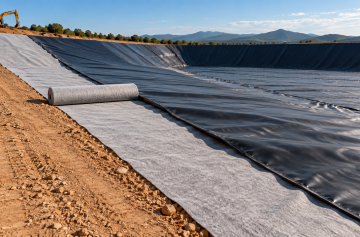
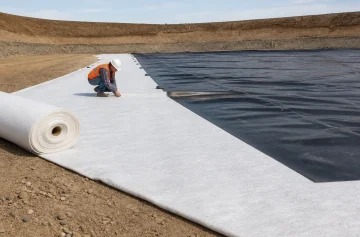
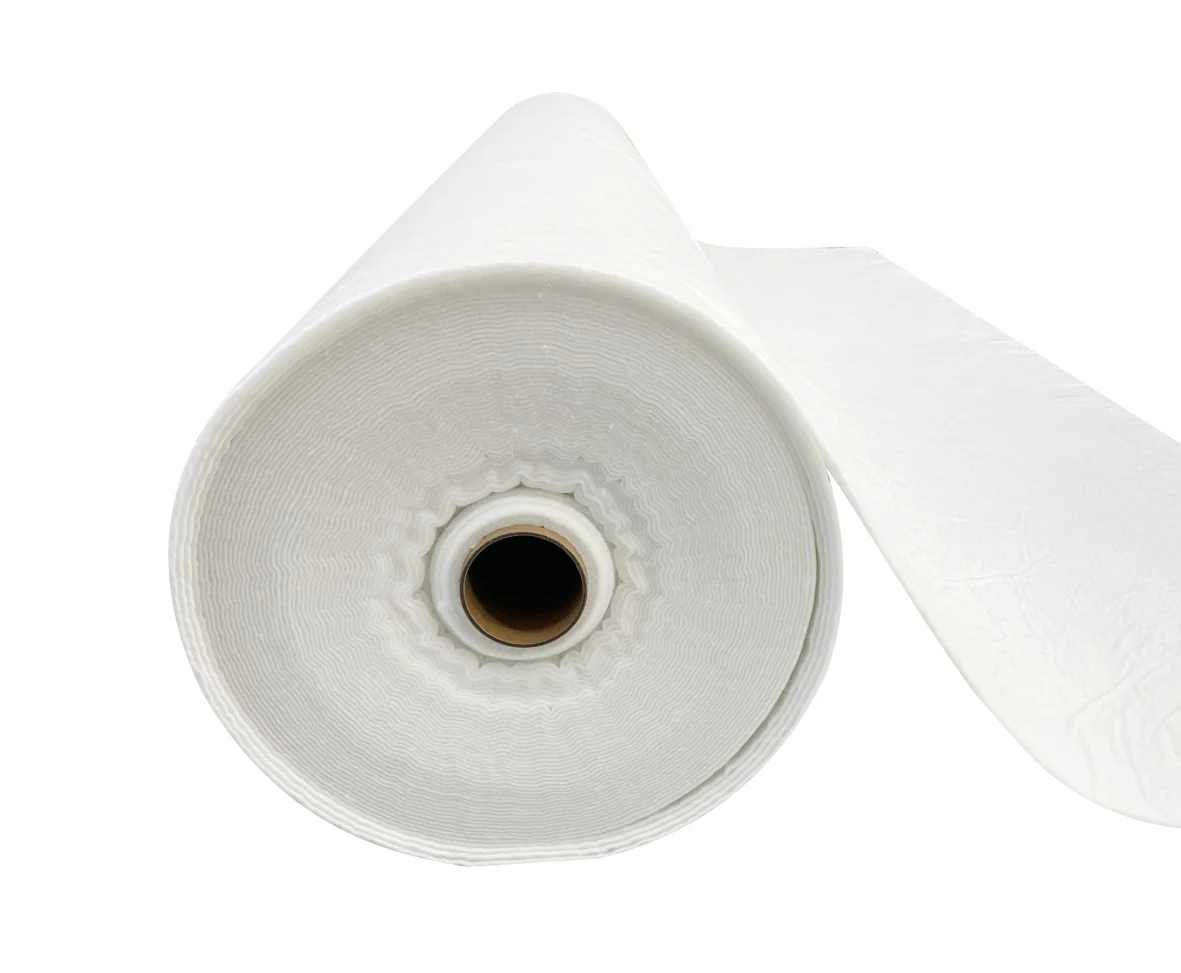
If sharp material cannot be removed completely, a nonwoven geotextile is often placed under the geomembrane as cushioning.
NRCS 521 requires cushioning within its scope where damaging angular particles or concretions larger than 3/8 inch remain. Listed options include nonwoven geotextile of at least 10 oz/yd² or at least 6 inches of suitable soil.[4]
Ten ounces per square yard is about 339 g/m².
Do not choose cushioning by GSM alone. A 500 g/m² geotextile over rounded gravel may face less puncture risk than the same fabric placed over one sharp rock. Stone shape and contact pressure matter.
More examples are covered in the guide to geotextile cushioning under HDPE geomembrane.
Slopes
Extra membrane thickness cannot fix poor slope stability. Check the whole interface, including:
- slope angle;
- slope length;
- soil condition;
- whether the liner is exposed or covered;
- materials touching each side of the liner;
- water-level changes;
- anchor details;
- expected settlement.
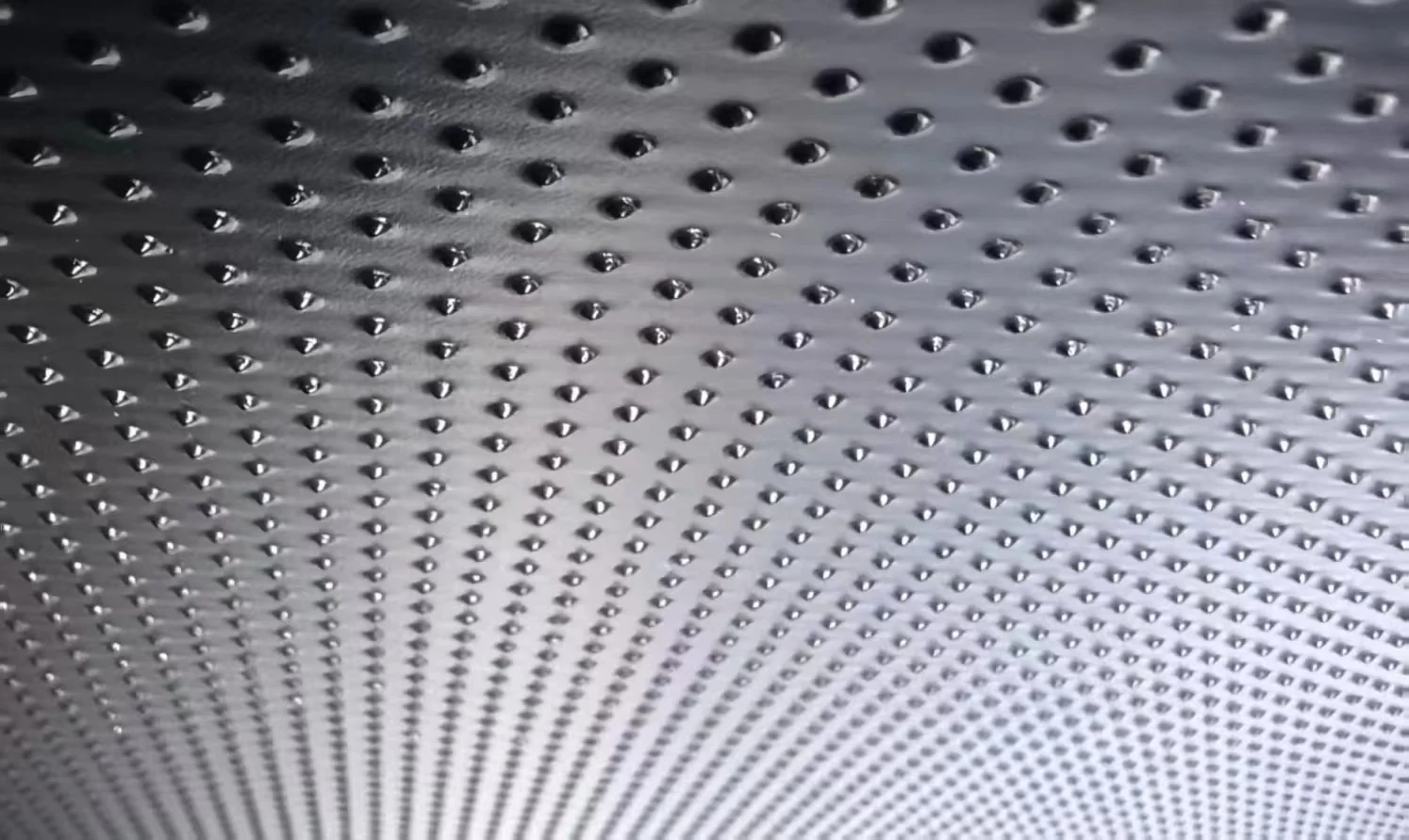
A textured HDPE liner usually provides more surface friction than smooth HDPE, but the important value is the friction at the actual interface.
These interfaces are not the same:
- HDPE against compacted soil;
- HDPE against nonwoven geotextile;
- HDPE against sand;
- HDPE against another geosynthetic.
The same textured liner can behave differently against each material.
ASTM D5321/D5321M measures shear strength between soil and geosynthetics or between two geosynthetics. Results change with the materials tested, normal load, moisture and other test conditions.[5]
On a covered slope where stability matters, testing the actual project materials is more useful than relying on one friction-angle figure from a product catalog.
Thermal Movement
HDPE gets longer as it heats and shorter as it cools. On a large exposed reservoir, the movement can be substantial.
A common engineering range for the linear thermal expansion coefficient of HDPE is about 0.12–0.20 mm per metre per °C. The exact value varies by material and test condition, so use this range to understand the scale of movement rather than to design an anchor detail.
For a free 100 m length of HDPE with a 20°C temperature rise:
- at 0.12 mm/m/°C, the calculated change is about 240 mm;
- at 0.20 mm/m/°C, the calculated change is about 400 mm.
That is about 24–40 cm over 100 m.
An installed liner cannot usually move freely because seams, slopes, anchors and contact with the ground restrain it. Some of that movement then shows up as wrinkles. A sheet that looks flat early in the morning may have visible waves after several hours in the sun.
Wrinkles
Thermal wrinkles are common on exposed HDPE. What matters is where the wrinkle goes and what happens when the liner is loaded or covered.

Pay closer attention when a wrinkle:
- turns into a sharp fold;
- bridges over a hollow area;
- runs into a pipe detail;
- is trapped against concrete;
- is buried under soil or aggregate;
- is crushed by construction equipment.
Do not pull a hot liner extremely tight just to make the surface look flat. When the sheet cools, contraction can increase stress around seams, anchors and rigid details.
Cover placement also needs care. If large hot wrinkles are buried under aggregate, those shapes can become trapped in the finished liner system.
Waterline Exposure
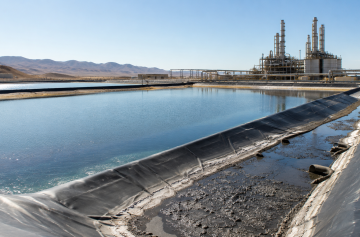
UV exposure is not equal across the whole reservoir. The bottom may stay underwater for most of the year, while upper slopes remain exposed. The area around a changing waterline moves between both conditions.

If the reservoir level falls 8–10 m in the dry season, a large section of liner that was underwater can sit in direct sun for months.
For this reason, check exposure at the lowest normal operating water level, not only when the reservoir is full.
The exposed part of an agricultural water reservoir liner may also face waves, sediment, maintenance work and repeated wetting and drying.
Welding
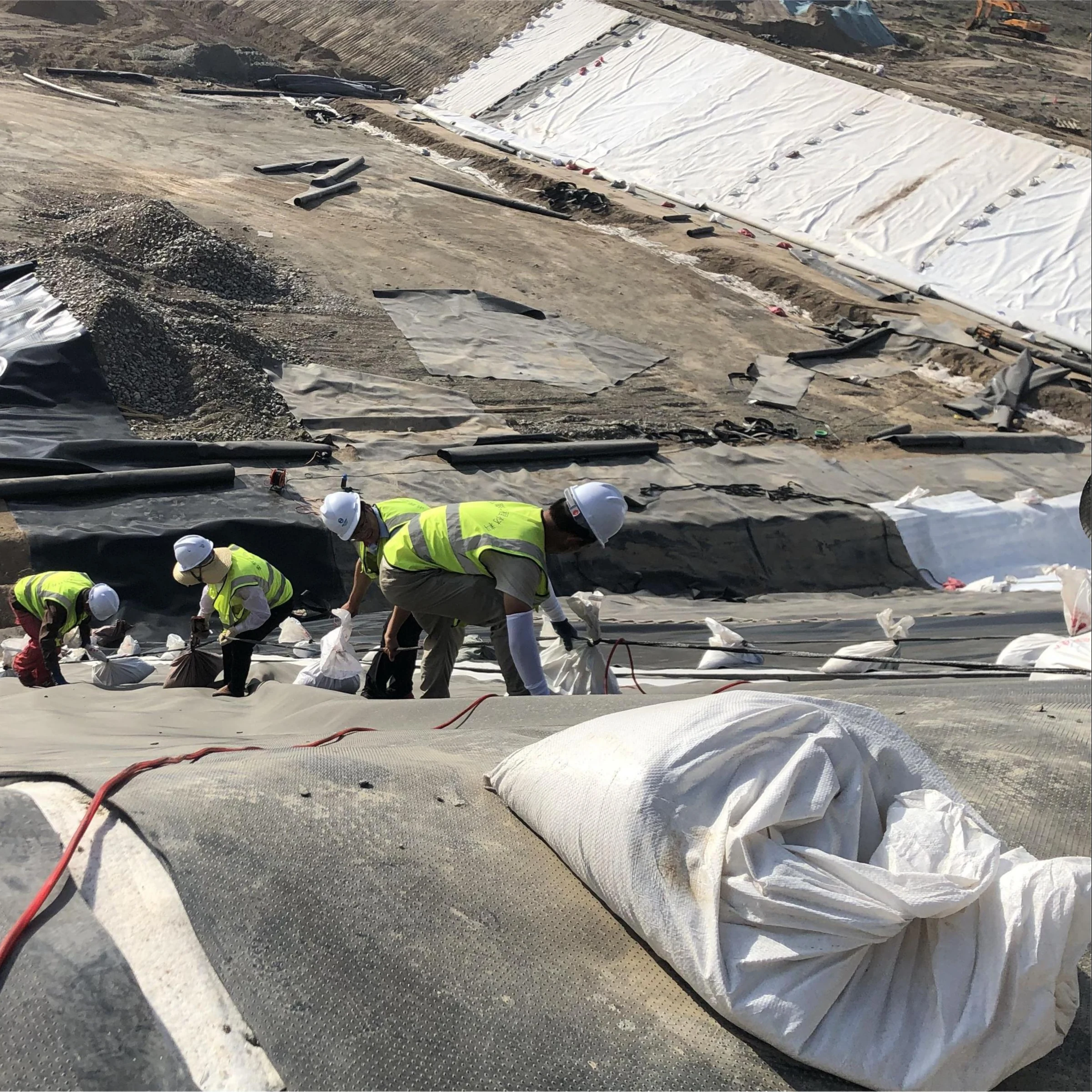
HDPE rolls are welded together on site. Poor seams can leak even when the liner itself meets the material specification.

The two main welding methods are:
- hot-wedge welding for long production seams;
- extrusion welding for patches, pipe details, corners and short seams.
A dual-track hot-wedge weld forms two parallel seams with an air channel between them. The channel can be pressure tested after welding.
Extrusion welding places molten polyethylene along a prepared joint. It is commonly used where a wedge welder cannot fit or follow the detail.
See the geomembrane welding and seaming guide for more detail on the two methods.
Do not copy a welding temperature or travel speed from another job. Settings change with liner formulation, thickness, welding machine, sheet temperature, wind and surface condition.
Weld Conditions
The seam area needs to be clean and dry. Dust, soil, oil or water can interfere with fusion and become trapped inside the weld.
Sheet temperature can change a lot through the day. Black HDPE sitting in direct sunlight may be far hotter than the surrounding air.
Too little heat or excessive travel speed can leave a weak weld. Too much heat or very slow travel can overheat the seam.
Make a trial seam before production welding. Repeat the trial when conditions change enough to affect the welding process, such as:
- a large temperature change;
- a different welding machine;
- a different operator;
- a long work stoppage;
- a different membrane thickness;
- a major weather change.
The wider HDPE geomembrane installation process should also control panel handling, foundation acceptance and traffic over exposed sheet.
How Much Seam Can a Project Have?
A medium-size reservoir can contain several kilometres of welds.
Take a lined area of 20,000 m², measuring 200 m by 100 m. If the panels have an effective width of about 7 m and run across the 100 m direction, the job needs about 29 strips.
That layout creates about 28 long seams × 100 m = 2.8 km of longitudinal seam. Short seams, slope seams, repairs and penetrations add more.
With that much welding, test records need to show where each test was taken. A folder of general welding certificates is not enough to trace a problem back to one seam.
Seam Testing
Appearance alone cannot confirm weld quality. Production seams are normally checked in several ways:
- Trial seams show whether the current welding setup can produce an acceptable joint.
- Nondestructive tests check installed seam continuity without cutting samples from the seam.
- Destructive tests measure the physical performance of selected production samples.
Air-channel testing: ASTM D5820 covers pressurized evaluation of the channel between dual seams. It checks continuity and watertightness but does not measure seam strength.[6]
Vacuum testing: ASTM D5641/D5641M covers vacuum-chamber testing of seams, patches and defects. Uneven surfaces, tight corners and curved areas can make it harder to seal the chamber properly.[7]
Peel and shear testing: ASTM D6392 covers destructive testing of thermally fused, nonreinforced geomembrane seams. It measures seam behavior in peel and shear.[8]
Each result should be tied to a seam location. Record:
- panel number;
- seam number;
- date;
- operator;
- welding machine;
- machine settings;
- sheet temperature where recorded;
- trial-seam result;
- nondestructive result;
- destructive result;
- repair number.
Repairs
Small areas of damage can often be repaired without replacing a whole panel.
Common repairs include:
- patches over punctures;
- cap strips over defective seam sections;
- extrusion repairs;
- replacement of a damaged local area.
Test every repair after welding and mark it on the repair map.
A few tested repairs on a large job are not unusual. A repeated pattern is more concerning. If ten punctures appear along the same equipment route, patching the holes is only half the job. The traffic route or sharp material underneath also needs to be corrected.
Pipe Penetrations
Pipes and concrete details need careful design because rigid structures and HDPE do not move in the same way.
The liner expands and contracts with temperature. Soil may settle, while concrete and steel move differently. If the HDPE is pulled too tight around a rigid pipe, movement can concentrate around the boot or weld.
ASTM D6497/D6497M gives guidance for mechanical attachment of geomembranes to pipes and structures.[9]
Check:
- pipe and boot shape;
- concrete edges;
- mechanical attachment;
- welding access;
- expected settlement;
- pipe buoyancy where relevant;
- inspection access;
- future repair access.
Put these details on the drawings before the liner is deployed. They are much harder to solve properly once the crew is standing at the pipe with the sheet already in place.
Groundwater and Gas
Pressure can build underneath a geomembrane as well as above it.
Possible sources include:
- high groundwater;
- water trapped below the HDPE;
- soil gas;
- gas produced by organic material.
If that pressure becomes high enough, the liner can lift and form large bubbles. The movement can pull on anchors and penetrations and create new wrinkles.
NRCS 521 contains specific requirements for projects within its scope. It calls for vents at the crest of geomembrane-lined pond slopes at intervals no greater than 50 ft. It also requires underliner drainage where the pond invert is within 2 ft of seasonal high groundwater or where groundwater uplift is a risk.[10]
Do not copy those dimensions into an unrelated dam design without checking the project conditions. A thicker liner may resist puncture better, but it will not stop groundwater pressure from building underneath it.
Service Life
There is no fixed outdoor life for every UV-stabilized HDPE liner. Service life changes with:
- the polyethylene formulation;
- carbon black and antioxidant system;
- surface temperature;
- hours of direct exposure;
- water chemistry;
- mechanical stress;
- weld quality;
- punctures and installation damage.
OIT gives information about the antioxidant reserve in the material. It does not directly tell you how many years the liner will remain usable.
ASTM D5721, which covers air-oven aging of polyolefin geomembranes, states that the link between accelerated aging and service life has to be established for the actual application. It also notes that the test does not predict every case where stress, environment, temperature and time act together.[11]
If a supplier quotes a “30-year” or “50-year” life, ask what sits behind the number:
- Was the material exposed or covered?
- What temperature was assumed?
- Which formulation was tested?
- What UV exposure was assumed?
- Was the number based on field data or accelerated testing?
- Is it a predicted life or a warranty?
A long material-life estimate also cannot compensate for a badly made field weld.
Existing Liners
Do not judge an existing liner by age alone. A 15-year-old sheet in moderate conditions may still perform well, while a newer liner can fail early after overheating, installation damage or excessive stress.
Inspect:
- visible cracking;
- deep scratches;
- sharp folds;
- seam condition;
- repairs;
- pipe details;
- anchor areas;
- areas that remain exposed to high temperatures.
If the material looks deteriorated, representative samples can be tested for tensile behavior, OIT and stress-crack resistance.
Quality Records
Manufacturing records should match the rolls that actually arrive on site.
Check:
- production batch;
- roll number;
- roll dimensions;
- thickness;
- density;
- tensile properties;
- tear resistance;
- puncture resistance;
- stress-crack resistance;
- carbon black content;
- carbon black dispersion;
- OIT;
- applicable aging results.
GRI-GM13 describes these requirements as manufacturing quality control and notes that a project specification may ask for more.[12]
When reviewing an HDPE geomembrane manufacturer’s paperwork, make sure the certificate can be matched to the roll label.
production batch → roll number → installed panel → seam number → test result → repair record
This traceability becomes especially useful on a large site. If the job has 100 or more rolls and several kilometres of seams, a certificate with no link to a specific roll is of little help when a problem has to be investigated later.
Material Quantity
Do not calculate liner quantity from the flat reservoir floor alone. Side slopes and construction details can add a large amount of material.
The quantity may need to include:
- side slopes;
- anchor trenches;
- pipe and concrete details;
- panel overlaps;
- layout allowances;
- approved construction waste or spare material.
If the floor and slope surfaces together measure 16,000 m², buying only 10,000 m² because the plan view shows a 100 m × 100 m bottom leaves the project short before welding starts.
Use the actual three-dimensional liner layout for the final quantity instead of adding one fixed percentage to the horizontal water area.
Final Inspection
Inspect the liner before filling the reservoir or covering the HDPE with soil.
Pay close attention to:
- pipe penetrations;
- concrete structures;
- slope toes;
- anchor areas;
- T-joints;
- repairs;
- access routes;
- equipment work areas.
Look for cuts, punctures, deep scratches, open seams, overheated welds, damaged patches, folds and areas under excessive tension.
Seam tests only check seams. They cannot find a puncture made in the middle of a panel.
ASTM D7002 covers electrical leak location on exposed geomembranes using the water-puddle method.[13]
ASTM D7007 covers electrical methods where geomembranes are covered with water or earthen material.[14]
Electrical leak-location testing needs the right site and electrical conditions. It can find breaches away from the seams, but it does not replace normal seam quality control.
After Filling
Keep checking exposed liner after the reservoir enters service, especially after:
- very low water levels;
- storms;
- maintenance work;
- equipment access;
- unusual heat;
- slope movement.
Watch for new holes, cracking, liner movement, stressed pipe details, anchor movement, uplift and unusual water loss.
A falling water level does not always point to a liner leak. Evaporation, valves, pipes and other structures can also change the reservoir level.
Keep a normal operating baseline for the site. If known evaporation and operating withdrawal usually lower the water level by about 20 mm per day, an unexplained drop of 60 mm per day is worth checking. The normal figure should come from the real reservoir rather than a general industry estimate.
Buying Checklist
Before placing an order, confirm the following information.
Material
- HDPE grade and formulation requirements;
- smooth or textured surface;
- nominal thickness;
- thickness tolerance;
- applicable GRI or project specification.
UV and aging
- 2.0–3.0% carbon black where GM13 applies;
- carbon black dispersion;
- Standard OIT or High Pressure OIT;
- oven-aging result;
- UV-aging result;
- stress-crack resistance.
Mechanical risk
- foundation condition;
- expected water depth;
- puncture protection;
- construction traffic;
- cover placement;
- future maintenance access.
Slopes and structures
- slope geometry;
- interface friction;
- anchor design;
- groundwater condition;
- gas venting where required;
- pipe penetrations;
- concrete attachments.
Installation
- panel layout;
- welding procedure;
- trial seams;
- nondestructive seam tests;
- destructive seam tests;
- repair testing.
Records
- production batches;
- roll numbers;
- material test records;
- panel map;
- seam map;
- test results;
- repair map;
- as-built records.
A purchase description such as “2 mm black UV-resistant HDPE” is not enough for a serious dam or reservoir project.
FAQ
Can new HDPE be welded to an old liner?
Sometimes. First inspect the old surface for dirt, oxidation, scratches and aging. Clean and prepare it using the approved repair method, then make trial welds before starting the repair. Welding settings that work on a new roll may not work the same way on an older sheet.
What if a roll label does not match the test certificate?
Keep that roll separate until the identification issue is resolved. The roll number is what links the physical material to the manufacturer’s test records. Once an unidentified roll has been cut into several panels and installed, traceability becomes much harder to restore.
Can HDPE geomembrane be installed next to concrete?
Yes. Remove or cover rough edges, bolts, projections and unfinished joints that could damage the sheet. Mechanical terminations and pipe details also need enough room for welding and inspection. Put these details on the drawings before deployment.
How should HDPE rolls be handled before installation?
Keep rolls away from sharp objects and do not drag them across the ground. Prevent uncontrolled rolling and keep every label readable. After transport, inspect the roll edges and exposed surfaces. Good factory material can still be damaged during unloading or storage.
Does 2.0 mm HDPE last longer than 1.5 mm HDPE?
Not necessarily. A 2.0 mm sheet is about 33% thicker than a 1.5 mm sheet and contains about 33% more material per square metre when density is the same. That gives more mechanical protection. UV life depends much more on formulation, carbon black, antioxidants, temperature and exposure. A good 1.5 mm liner can outperform a poorly formulated 2.0 mm liner.
How much does 2.0 mm HDPE weigh?
At a density of about 0.94 g/cm³, 2.0 mm smooth HDPE weighs roughly 1.88 kg/m² before manufacturing tolerance or texture is included. A 10,000 m² quantity is therefore about 18.8 tonnes. Cores, wrapping and other packaging add to the final shipping weight.
When is electrical leak-location testing useful?
Use it when the project needs a check for punctures or other breaches outside the welded seams. It works alongside seam testing rather than replacing it. The test method depends on whether the liner is exposed or already covered, and the site needs suitable electrical conditions for the method to work properly.
Finally
For an exposed HDPE dam liner, the specification and the installation records matter more than a simple “UV resistant” or “50-year life” claim. Under GM13, check 2.0–3.0% carbon black, the required OIT values, at least 50% retained High Pressure OIT after 1,600 hours of UV exposure and the required stress-crack performance. A 10 m water depth creates about 98 kPa of pressure, while 10,000 m² of 2.0 mm HDPE weighs about 18.8 tonnes. Keep the foundation clean, control wrinkles and welding, test the seams and make sure every roll, panel and repair can be traced.