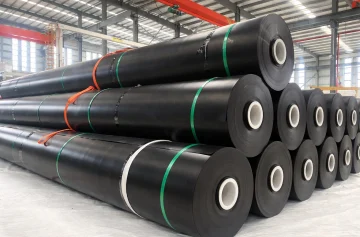
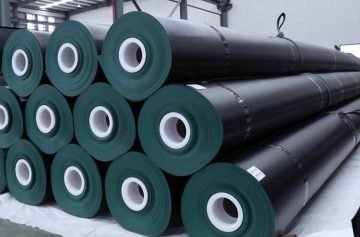
Non-woven geotextile for drainage is selected as part of a soil–filter–drain system. It must admit water, control soil migration, and survive installation. The right choice depends on soil grading, water-flow direction, hydraulic demand, loading, and the drain outlet—not simply fabric weight or the highest advertised flow rate.
This guide explains how to read hydraulic data, match apparent opening size to the soil, and prepare an installation and purchasing checklist. For broader material comparisons, see geotextile cloth versus plastic sheeting.
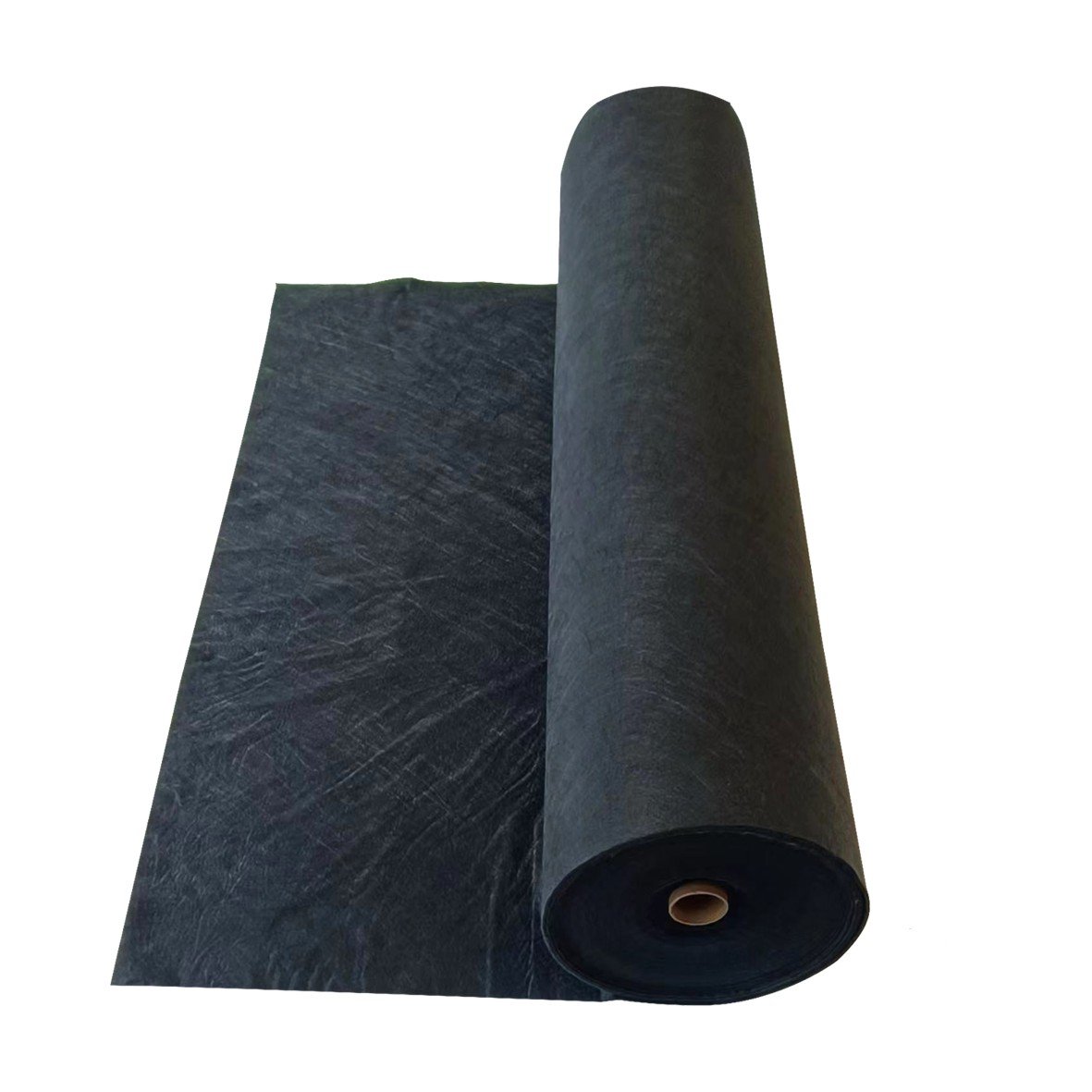
Permeability: identify the direction of water flow
A drain detail should show arrows from the water source to the discharge point. Water crossing a geotextile into clean aggregate is a different design problem from water traveling along the geosynthetic to an outlet. The same word, “drainage,” is often used for both.
| Property | Units | What it describes |
|---|---|---|
| Permittivity, ψ | s−1 | Water flow normal to the fabric under a given head; see ASTM D4491/D4491M. |
| Hydraulic conductivity, k | m/s or cm/s | Flow behavior expressed with a hydraulic gradient; thickness and test conditions matter. |
| Flow per unit area | L/(m²·s), L/(m²·min), or gpm/ft² | Discharge divided by area at the reported head and conditions. |
| In-plane transmissivity, θ | m²/s | Flow along the layer at a stated gradient and normal stress; see ASTM D4716/D4716M. |
ASTM D4491/D4491M concerns permittivity in the uncompressed condition. ASTM D4716/D4716M concerns in-plane flow and transmissivity under specified loading and boundary conditions. D4716 is not a cross-plane permittivity test. Report the test conditions alongside the number.
A worked flow-rate conversion
For a simple clean-water calculation, flow per area is q/A = ψ × Δh. If an assumed permittivity is 1.2–2.2 s−1 and the head difference is 50 mm (0.05 m), the calculated flow is 0.06–0.11 m/s, equivalent to 60–110 L/(m²·s), or 3,600–6,600 L/(m²·min).
These are illustrative inputs and arithmetic, not a guaranteed Jinseed product range or a field design capacity. The surrounding soil, contact area, compression, clogging, drainage aggregate, pipe capacity, and outlet can all limit the installed system. A high laboratory flow rate cannot compensate for a blocked discharge point.
Compression and long-term performance
Specify the stress and contact conditions that the drainage component will actually experience. A thick nonwoven may compress under cover loads; a drainage composite also needs assessment of its core and filter interaction. Do not assume a fixed percentage of retained capacity at 50, 100, or 500 kPa without the corresponding test evidence.
Where long-term in-plane drainage is required, use relevant performance testing and design reductions for the actual system. Product-specific creep and clogging evidence is more useful than assigning the same reduction factor to every PET or PP fabric. Avoid counting the filter fabric as a drainage core unless its verified capacity supports that function.
AOS: match the filter to the soil
Apparent opening size (AOS) characterizes geotextile openings. ASTM D4751 provides the relevant test methods. AOS is an index property, not a promise that the installed fabric retains every soil particle above a particular diameter. Filtration develops through interaction between the soil and the fabric.
Obtain the soil grading curve, percentage passing the No. 200 sieve, and relevant soil classification and plasticity information. D85 is the particle size at which 85% of the soil mass is finer. A criterion involving O95/D85 only becomes meaningful when the designer also identifies the soil type, flow conditions, and applicable design method.
Why a universal O95 < 2 × D85 rule is inadequate
FHWA’s pavement drainage guidance treats retention, permeability, and clogging resistance together. The appropriate criterion varies with soil and application. Noncohesive silt, pumping, or pulsating flow can require more conservative selection and laboratory compatibility testing. This historical manual is useful design background; use the specification edition adopted by the project for acceptance values.
A smaller opening is not automatically better. A fabric that restricts soil movement but blinds at the interface can reduce inflow. Conversely, excessive soil loss can damage the surrounding ground even if the drain initially flows freely. For difficult soils or consequential applications, consider soil–geotextile compatibility testing such as ASTM D5101 with representative soil and agreed test conditions.
Read pore-size data consistently
Specify opening size in millimeters together with the method and acceptance basis. Do not substitute an ISO wet-sieving result for an ASTM AOS result by applying a universal conversion factor. Different procedures measure different characteristics, so the comparison needs supporting evidence for the proposed product.
Likewise, do not infer AOS from fabric mass. Two fabrics both labeled 200 g/m² can differ in fiber type, fiber size, bonding process, thickness, and opening distribution. The datasheet and test report must describe the actual grade being supplied.
Application scenarios
French drains and road-edge drains
The filter must suit the soil touching the drainage aggregate, not just the pipe diameter. Identify whether the approved detail wraps the aggregate envelope, the pipe, or another component. A pipe sock is not automatically equivalent to filtering the full trench interface. Maintain the specified aggregate grading, pipe slope, connections, and outlet protection.
Retaining walls
Check how water enters the drainage layer and how it leaves the wall system. A geotextile can separate fine backfill from drainage aggregate, while a drainage composite may convey water along the wall. Neither should be described as waterproofing. Wall waterproofing, structural stability, and surface-water management remain separate requirements.
Landfills and chemically active drainage
Identify whether the fabric is acting as a filter, a geomembrane protection layer, or both. These functions need different checks. Evaluate actual leachate chemistry, temperature, confinement, and biological or mineral clogging risks; a generic pH range does not demonstrate compatibility with every chemical mixture.
Do not assume that a protection fabric suitable above an HDPE liner will also work as the filter elsewhere in the drainage system. Similarly, a filter selected for soil retention may not provide enough protection against the intended aggregate and load. Each layer needs its own acceptance criteria.
Installation checks that protect drainage performance
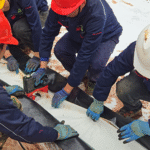
- Before delivery: approve the product designation, report references, roll dimensions, and acceptance criteria.
- Prepare the surface: remove protrusions and debris, resolve soft spots, and confirm the drain geometry.
- Place without tension: keep the fabric in contact with the receiving surface; avoid bridging hollows or stretching it tight.
- Join to the approved detail: specify overlaps or seams, orientation, repairs, and anchorage. A single overlap value does not fit every trench, soft subgrade, or slope.
- Control cover placement: prevent equipment from trafficking exposed fabric; use approved cover thickness, drop height, and placement methods.
- Inspect before burial: record damage and repairs, verify laps, and keep the drainage aggregate free from soil contamination.
- Complete the outlet: confirm continuity, discharge arrangements, and access for maintenance.
Cover the fabric promptly according to the product and project requirements. “Cover within 48 hours” is not a universal rule for every geotextile use. For example, NRCS Construction Specification 95 gives defined joining methods and application-specific provisions. Adopt the relevant detail rather than mixing dimensions from unrelated specifications.
What to include in a drainage geotextile inquiry
| Provide | Request in the response |
|---|---|
| Soil grading and water-flow sketch | AOS and hydraulic data for the proposed grade, with methods and conditions |
| Loads, aggregate size, and construction method | Survivability and puncture data appropriate to the specification |
| Water chemistry, temperature, and service environment | Relevant compatibility and durability evidence |
| Approved specification and acceptance limits | A compliance comparison distinguishing typical values from contractual limits |
| Area, trench dimensions, and destination | Roll layout, estimated quantities, and delivery scope |
See Jinseed’s nonwoven geotextile range. Send the drainage detail and specification to info@jinseed-geo.com to request product documents for comparison. The construction selection checklist covers broader procurement and receiving checks.
Frequently asked questions
Is heavier fabric better for drainage?
Not automatically. Greater mass can improve some mechanical properties, but hydraulic performance and soil compatibility must still be checked for the actual product.
Will nonwoven geotextile stop all fines?
No. The objective is a stable filter system with acceptable soil retention and sustained flow, not an absolute barrier to every fine particle.
Can a high flow-rate fabric fix a slow drain?
Only if the fabric is the limiting component. Investigate soil inflow, aggregate contamination, pipe blockage, grade, and outlet conditions before replacing material.
Is nonwoven geotextile waterproof?
No. It is permeable. A waterproofing or containment membrane performs a different function, although both products may appear in the same designed system.
Content reviewed: 19 October 2026. Calculation inputs are illustrative unless identified as a product test result. Final material selection and installation follow the project design and adopted specifications.