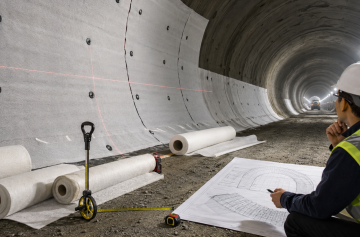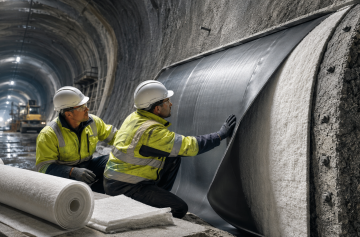
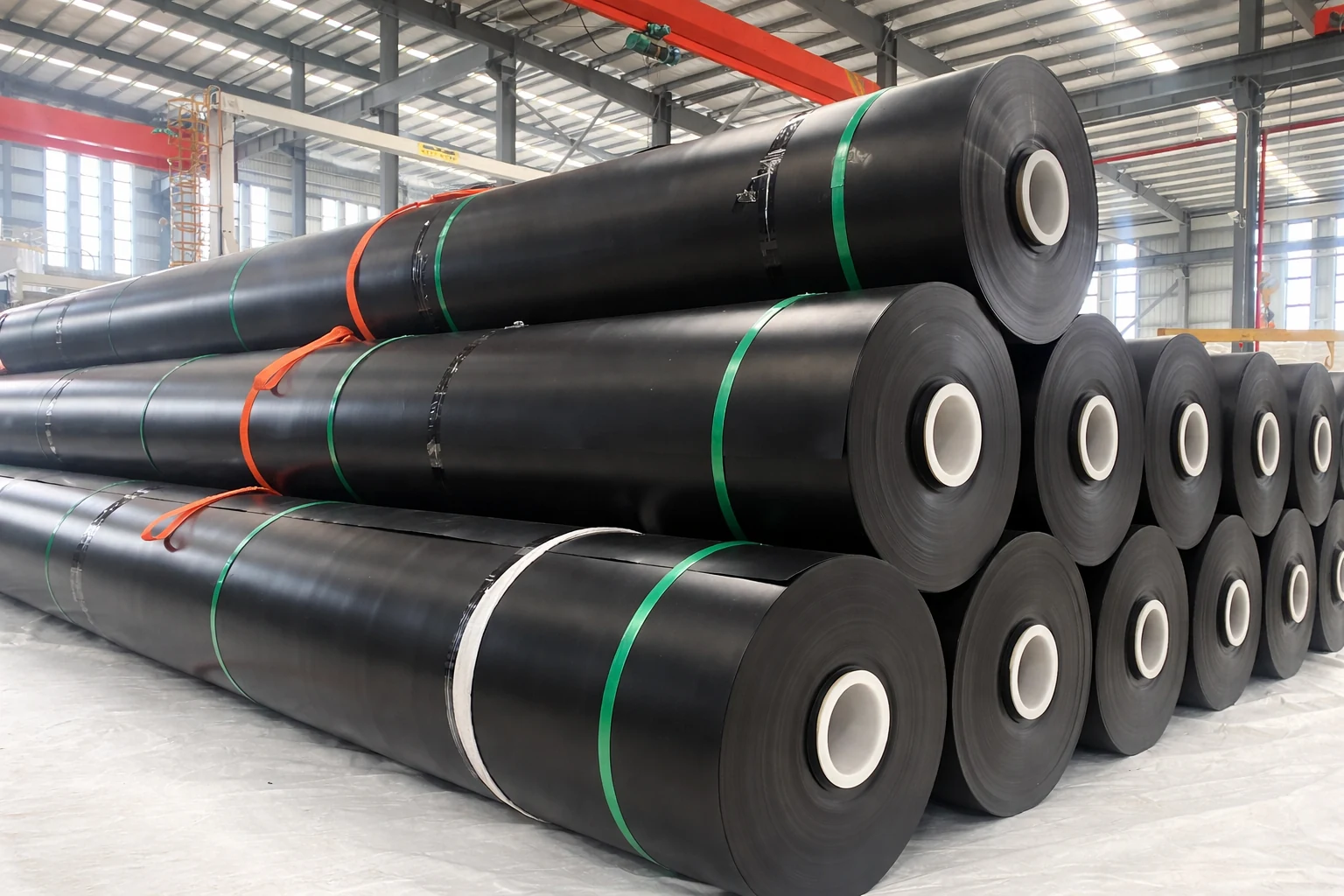
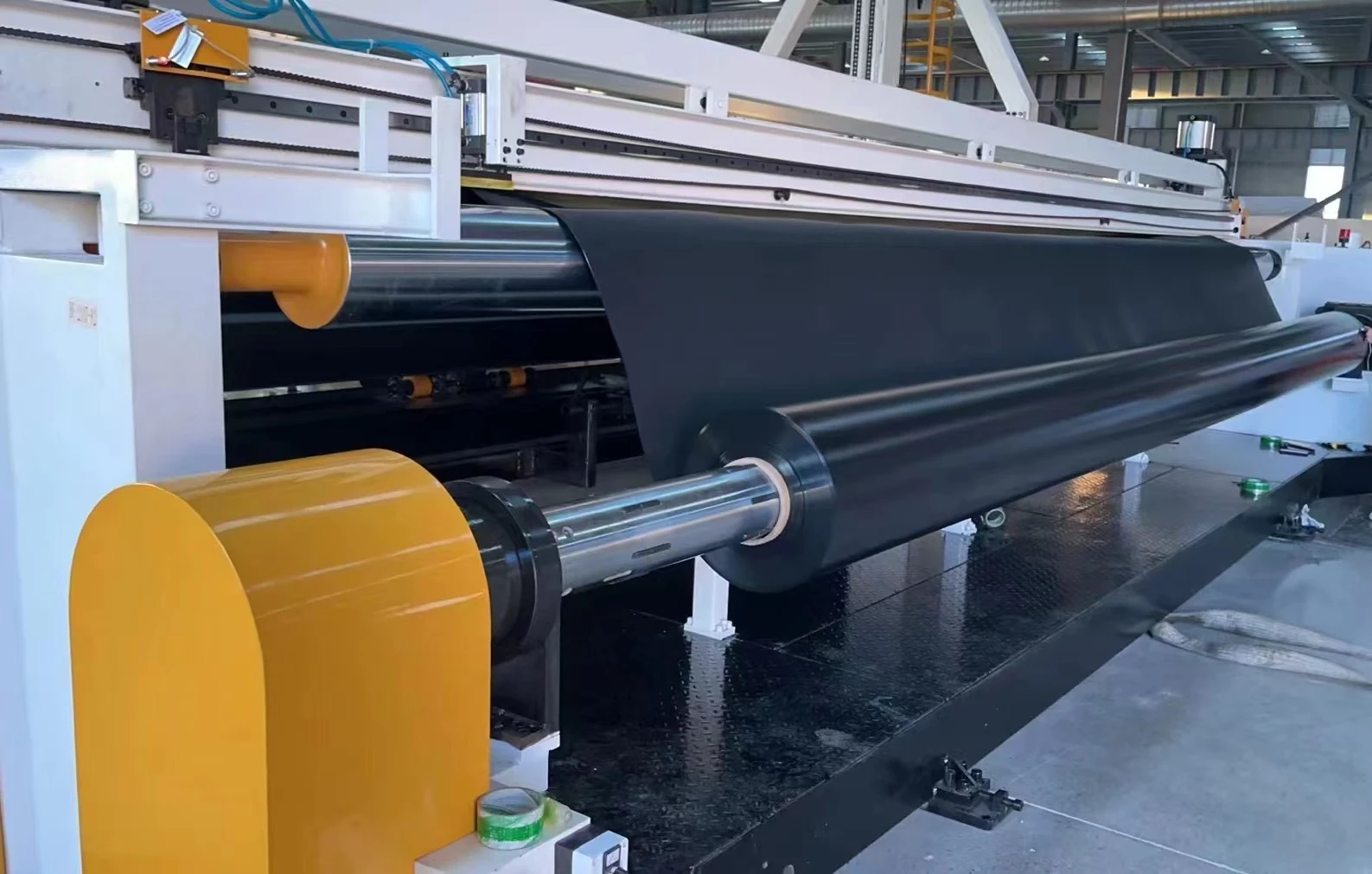
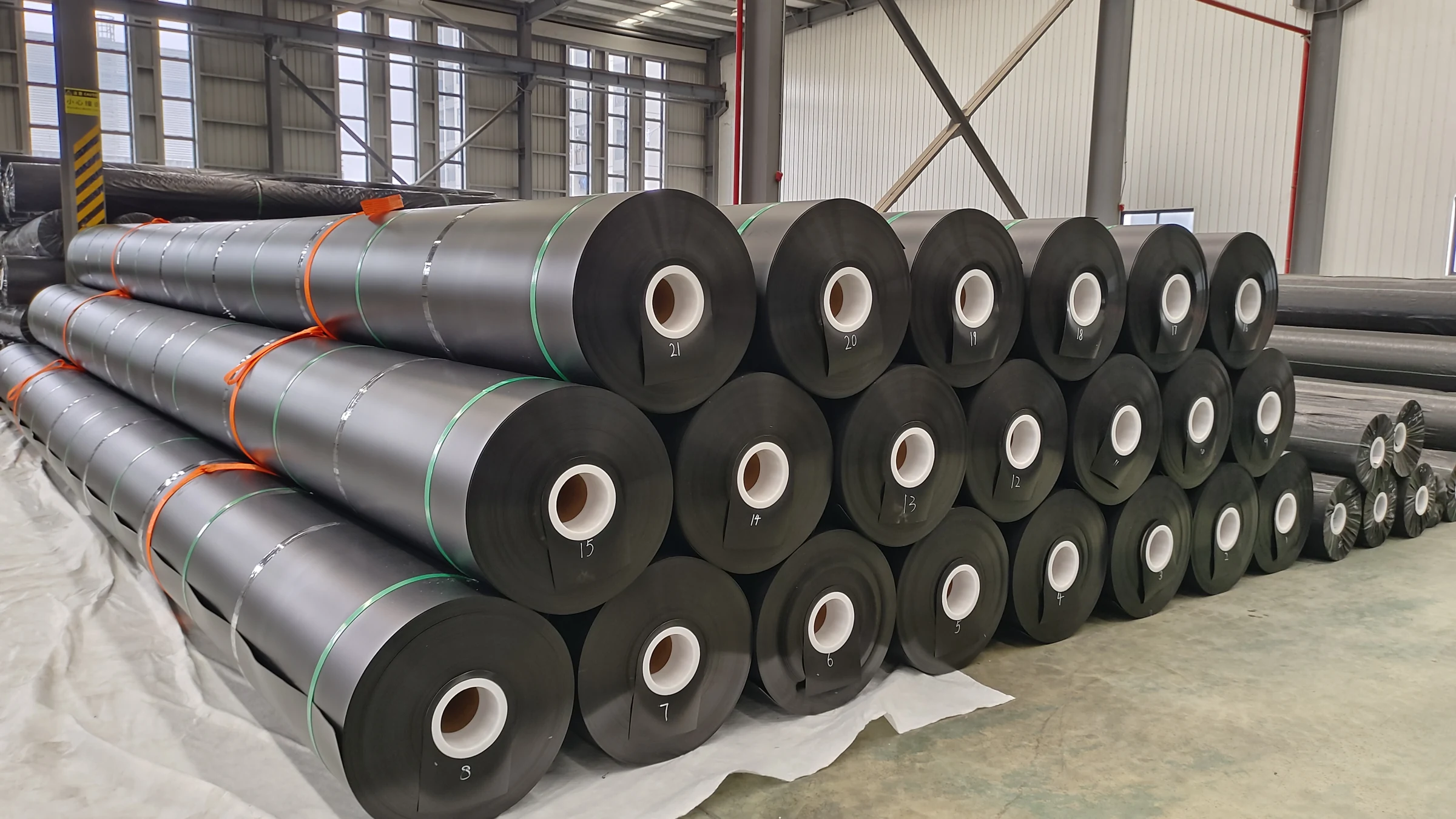
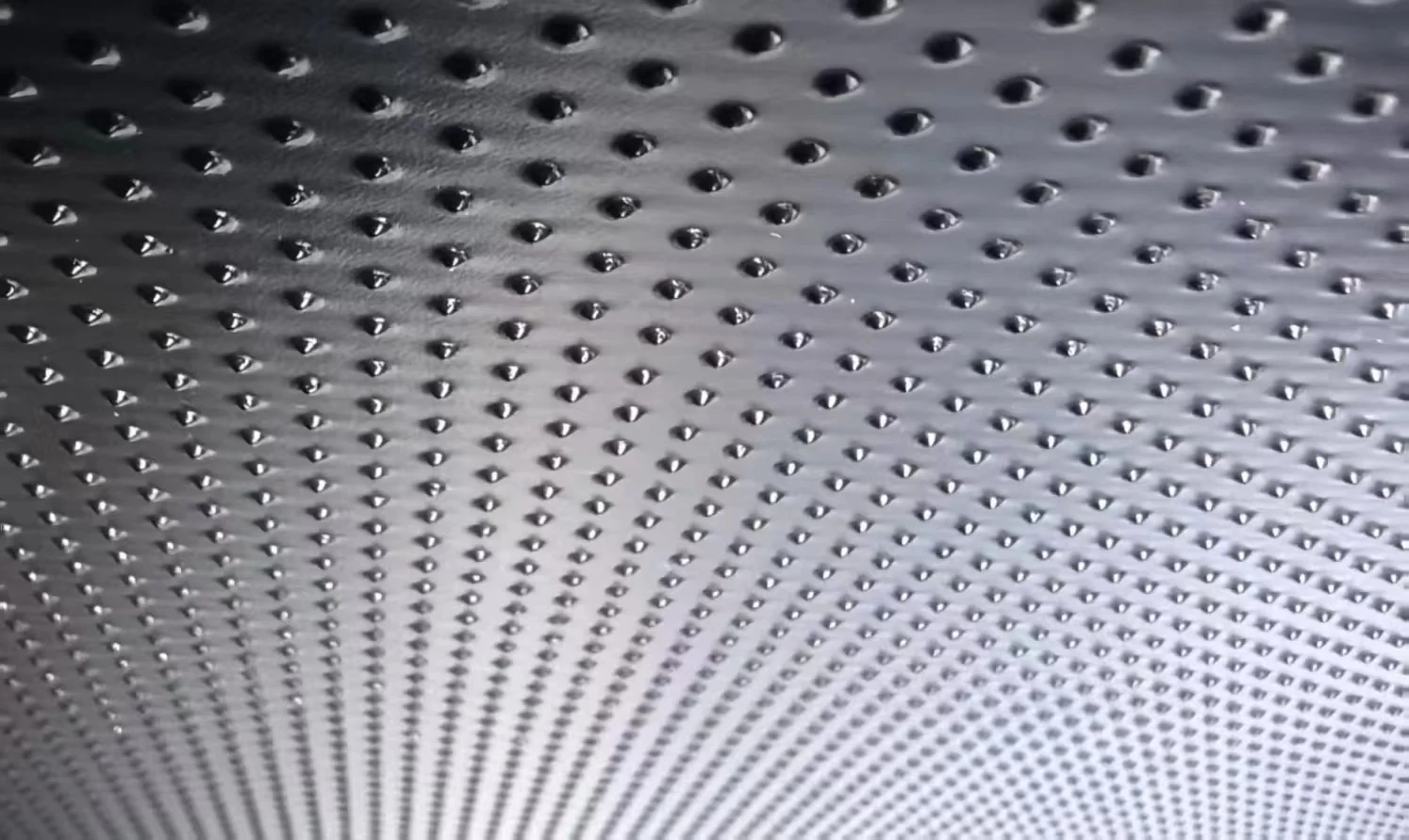
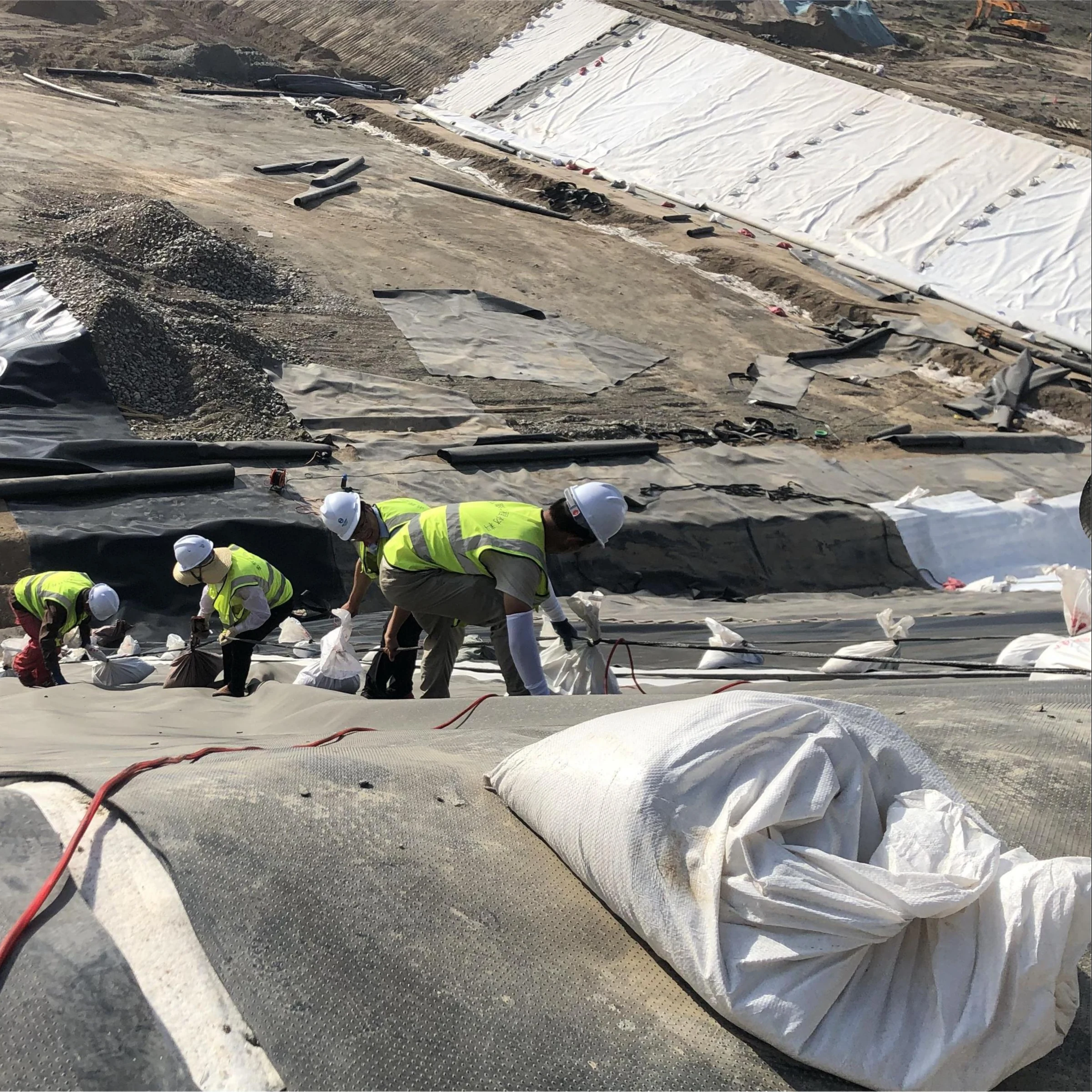

A supplier can only give you a useful secondary containment liner quote when the RFQ describes the job clearly. That means the chemical name and concentration, maximum spill temperature, exposure time, specific gravity, required containment volume, rainfall allowance, maximum liquid depth, subgrade, tank foundations, penetrations, and terminations all need to be known. The supplier’s quote should then show the exact liner product and thickness, protection layer, construction details, testing scope, assumptions, exclusions, deviations, unit rates, and final records.
Exact Chemical, Concentration and Exposure

“Acid,” “oil,” or “industrial wastewater” is too broad for liner selection. The supplier needs to know what may actually touch the liner and under what conditions.
| RFQ field | Example |
|---|---|
| Chemical | Sulfuric acid |
| Normal concentration | 93 wt% |
| Maximum concentration | 93 wt% |
| Normal temperature | 20–30°C |
| Maximum spill temperature | 45°C |
| Specific gravity | Use actual product value at design temperature |
| Exposure | Emergency spill containment |
| Maximum contact time | 72 hours before removal |
| Repeated exposure | Possible |
| Other liquids | 10% sodium hydroxide wash solution |
| SDS | Attached |
RFQ example only: the concentrations, temperatures and 72-hour duration above illustrate information to supply. They do not confirm compatibility or approval of HDPE, LLDPE or any Jinseed product for sulfuric acid.
For process wastewater or mixed liquids, pH by itself does not tell the supplier enough. If solvents, hydrocarbons, oxidizers, acids, alkalis, salts, oils, metals, process additives, or cleaning chemicals may be present, put them in the RFQ.
Use the worst condition that can realistically occur. If the normal sodium hydroxide concentration is 25% but an upset can produce 50%, the supplier needs to see the 50% condition. The same applies to mixtures: if two chemicals can meet inside the containment area after a spill, that possible mixture belongs in the RFQ.
Specific gravity is also useful because two liquids at the same depth can place very different loads on the containment system. A quick estimate is:
Pressure, kPa ≈ 9.81 × specific gravity × liquid depth in meters
| Specific gravity | 0.5 m depth | 1.0 m depth | 1.5 m depth |
|---|---|---|---|
| 1.00 | 4.9 kPa | 9.8 kPa | 14.7 kPa |
| 1.20 | 5.9 kPa | 11.8 kPa | 17.7 kPa |
| 1.50 | 7.4 kPa | 14.7 kPa | 22.1 kPa |
| 1.84 | 9.0 kPa | 18.1 kPa | 27.1 kPa |
At 1.0 m depth, a liquid with a specific gravity of 1.84 puts about 18.1 kPa on the bottom of the containment area. Water at the same depth is about 9.8 kPa. That difference matters when looking at the subgrade, liner protection, walls, penetrations, and other details.
The supplier also needs to confirm compatibility for the exact proposed liner product. A statement such as “HDPE is chemical resistant” leaves too much unanswered. The review should name the chemical, concentration, temperature, exposure time, product, thickness, and any limits.
Three separate checks are involved:
- Material change: swelling, shrinkage, softening, cracking, brittleness, or loss of strength.
- Permeation: movement of chemical through the polymer even when no visible hole exists.
- Properties after exposure: whether required tensile, elongation, puncture, and other properties remain acceptable.
ASTM D5322 provides laboratory immersion procedures for evaluating geosynthetics exposed to liquids. ASTM states that the procedure alone does not establish field suitability; the chemical, exposure conditions, test methods, and evaluation criteria must still be defined.[1]
ASTM D5747/D5747M covers tests used to evaluate geomembranes after chemical exposure. Interpretation of the results remains outside the scope of the practice, so a test report still needs project-specific acceptance criteria.[2]
Required Spill Capacity
The RFQ should already contain the required containment volume. If checking the volume calculation is part of the bidder’s work, say so clearly instead of leaving that responsibility open.
The volume calculation starts with the release case being designed for. Depending on the project, that may include:
- largest tank;
- process vessel;
- connected tank or equipment volume;
- liquid held in connected piping;
- rainfall;
- firewater, where required;
- other project-specific releases.
“110% of the largest tank” should not be copied into every RFQ as a default. The required volume depends on the jurisdiction, stored material, permit, owner standard, and design basis.
For U.S. facilities covered by EPA SPCC requirements, applicable bulk oil storage containment must hold the entire capacity of the largest single container plus sufficient freeboard for precipitation. EPA considers a 25-year, 24-hour storm a reasonable basis for many facilities, but it is not a fixed requirement for every SPCC facility.[3]
That SPCC requirement applies to qualifying U.S. oil facilities. It should not be copied automatically into an acid, alkali, wastewater, or non-U.S. chemical project.
A simple starting point for the capacity check is:
Available containment volume = geometric basin volume − physical displacement below the design liquid level
Physical displacement can come from parts of:
- tank shells;
- concrete ringwalls and pads;
- columns;
- large piping;
- equipment bases;
- other permanent objects below the design liquid level.
Use the space those objects physically occupy below the liquid level. The tank’s rated storage capacity is not its displacement.
| Volume conversion | Value |
|---|---|
| 1 ft³ | 7.48052 US gal |
| 1 m³ | 1,000 L |
| 1 m³ | 264.2 US gal |
| 1 US gal | 3.785 L |
Rainfall, Displacement and Freeboard
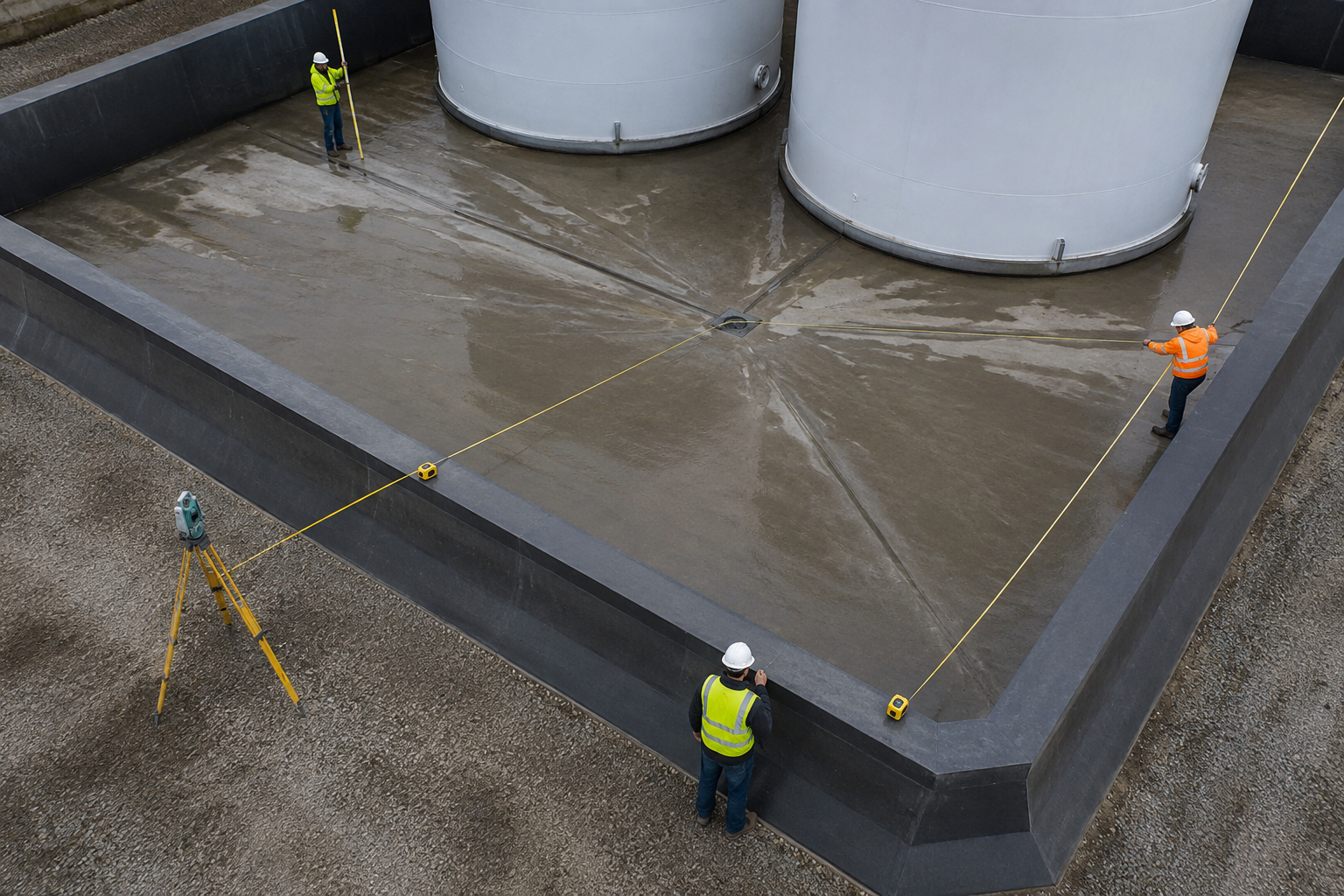
Rainfall can add more volume than many buyers expect. Over 1,000 ft² of contributing area, the numbers are:
| Rainfall | Water volume |
|---|---|
| 1 in | 623 gal |
| 2 in | 1,247 gal |
| 4 in | 2,494 gal |
| 6 in | 3,740 gal |
A 6-inch rainfall event over 10,000 ft² therefore adds about 37,400 gallons.
The area used in that calculation is the area that actually drains into the containment. It is not automatically the same as the liner area. Tank roofs, canopies, pavement, berms, roof drains, and nearby drainage can all change the amount of water entering the basin.
Example:
- Largest design spill: 50,000 gal
- Rainfall collection area: 4,000 ft²
- Design rainfall: 4 in
- Structural displacement: 3,500 gal
Rainfall:
4,000 × (4 ÷ 12) × 7.48052 ≈ 9,974 gal
Required geometric capacity before any additional project margin:
50,000 + 9,974 + 3,500 = 63,474 gal
Freeboard should be shown as a real elevation or vertical distance, not left as a vague note.
| Elevation item | Example |
|---|---|
| Containment floor | 100.00 m |
| Design liquid level | 100.80 m |
| Top of wall | 101.00 m |
| Available freeboard | 0.20 m |
Low points can control the real capacity. If a doorway or road crossing is at elevation 100.90 m, the basin cannot simply be treated as though the full wall height reaches 101.00 m unless another barrier closes that opening.
Basin Dimensions and Liner Quantity
The supplier needs dimensions that can actually be measured and priced:
- floor length and width;
- wall or berm height;
- maximum liquid elevation;
- floor slope;
- side slopes;
- tank locations;
- tank foundations;
- sumps;
- trenches;
- internal walls and pads;
- anchor trenches and perimeter returns.
A containment volume does not tell you how much liner to buy. The actual membrane quantity also includes side slopes, vertical surfaces, trenches, returns, overlaps, details, and fabrication allowance.
Area alone can also give a false picture of installation cost:
| Item | Example A | Example B |
|---|---|---|
| Liner area | 10,000 ft² | 6,000 ft² |
| Pipe penetrations | 2 | 18 |
| Concrete termination | 0 ft | 220 ft |
| Sumps | 0 | 2 |
| Tank ringwalls | 0 | 3 |
| Tight corners | 4 | 14 |
Example B contains 40% less liner area, yet the installer has far more pipe boots, concrete work, sumps, ringwalls, and corners to deal with. A simple $/ft² or $/m² comparison would miss that difference.
Subgrade and Cushion Layer
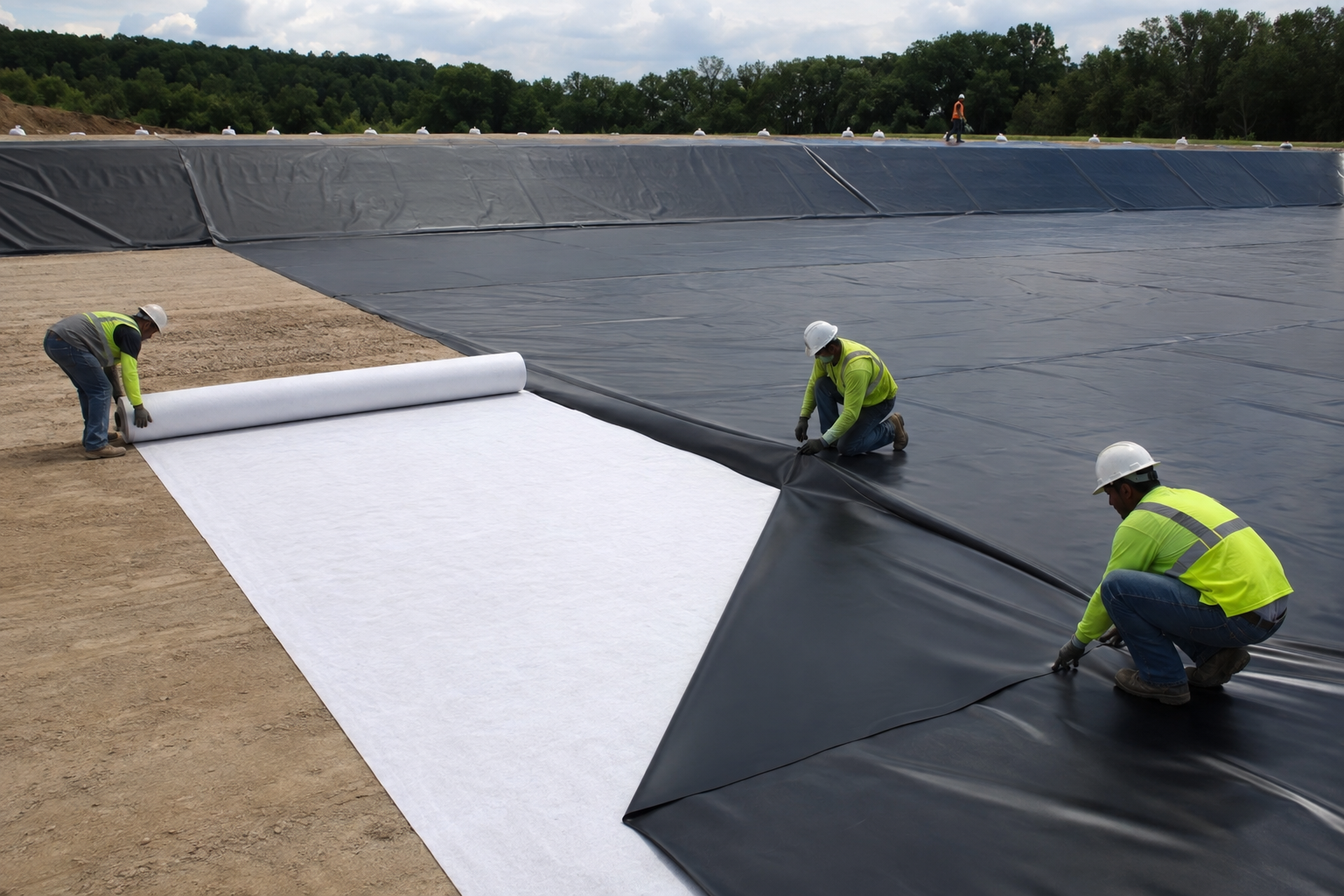
The RFQ should show what the membrane will actually sit on:
- compacted soil;
- sand;
- crushed aggregate;
- concrete;
- asphalt;
- existing geomembrane;
- geotextile;
- another engineered layer.
For soil subgrades, the practical information is:
- soil or fill type;
- compaction requirement and test basis;
- maximum permitted particle or protrusion;
- whether angular crushed rock is present;
- surface tolerance;
- soft or pumping areas;
- expected settlement;
- groundwater condition.
Stone size by itself is not enough. A rounded 20 mm stone and a sharp 10 mm stone do not put the liner under the same type of stress. Shape, protrusion, liquid pressure, liner thickness, and cushion properties all matter.
A nonwoven geotextile may be used for cushioning where the design calls for it, but a higher g/m² or oz/yd² number is not proof by itself that the liner is adequately protected.
ASTM D6241 uses a 50 mm probe to measure the index puncture strength of geotextiles and related products. It is a product-comparison test; it does not reproduce every field combination of rock shape, geomembrane, cushion, and liquid pressure.[4]
A 1.5 mm geomembrane under 1.0 m of water is loaded by about 9.8 kPa. At the same depth, a liquid with SG 1.5 produces about 14.7 kPa. That is why cushion selection should be checked against the real liquid load and the actual supporting surface, not chosen from geotextile weight alone.
The geotextile cushion installation guide shows typical subgrade, cushion, fold, debris, and traffic problems that should be resolved before the membrane is covered.
Concrete, Tank Foundations and Groundwater
Existing concrete often needs more work than the drawing suggests. The bid package should show or photograph:
- exposed reinforcing steel;
- sharp form-tie remains;
- broken edges;
- cracks;
- construction joints;
- expansion joints;
- old coatings;
- oil or chemical contamination;
- rough repairs.
The RFQ should also say who is paying for repairs and surface preparation.
For each tank, identify the foundation:
- concrete ringwall;
- full concrete slab;
- pedestal;
- compacted tank pad;
- other foundation.
The drawings or scope should make clear whether the liner:
- passes under the foundation;
- stops at the foundation;
- turns up against concrete;
- ties into an existing barrier;
- must be installed around an existing tank.
On retrofit jobs, the liner-to-ringwall or liner-to-slab connection can be one of the most important details in the whole containment system. “Seal around tank” does not give the installer enough information to price or fabricate that work.
Groundwater belongs in the RFQ as well. An empty basin can still see pressure from below if water rises under the membrane.
If the groundwater piezometric level is 0.5 m above the liner underside while the basin is empty, the water pressure beneath the liner is about 4.9 kPa; a 1.0 m positive head corresponds to about 9.8 kPa. A water level 0.5 m below the liner does not create that positive hydrostatic uplift. Evaluate the net uplift against the actual liquid level, cover or ballast, drainage and other resisting loads.
If trapped water, air, or vapor is also possible, note it. Depending on the site, drainage, venting, ballast, or other measures may be needed to deal with uplift.
Slope and Anchor Details
A slope ratio should be given as a real dimension, because it changes both liner quantity and installation conditions.
For a 3H:1V berm with 1.0 m vertical height:
- horizontal run = 3.0 m;
- vertical rise = 1.0 m;
- slope length = √(3² + 1²);
- slope length ≈ 3.16 m.
For every 1 m of berm length, that slope uses about 3.16 m² of membrane before anchor trench, overlap, or termination allowance is added.
Where several materials sit on the slope together, more than one sliding surface is possible:
soil → geotextile → geomembrane → cover material
ASTM D5321/D5321M measures interface shear resistance for the materials and normal stresses used in the test. The result is a design value for the tested conditions, not a universal friction coefficient.[5]
A textured geomembrane gives a different interface condition from a smooth liner, but texture does not remove the need to check slope stability.
The bid package should also show:
- anchor trench location;
- trench dimensions if already designed;
- concrete termination where applicable;
- top-of-slope access;
- changes in slope direction.
Pipe Penetration Schedule
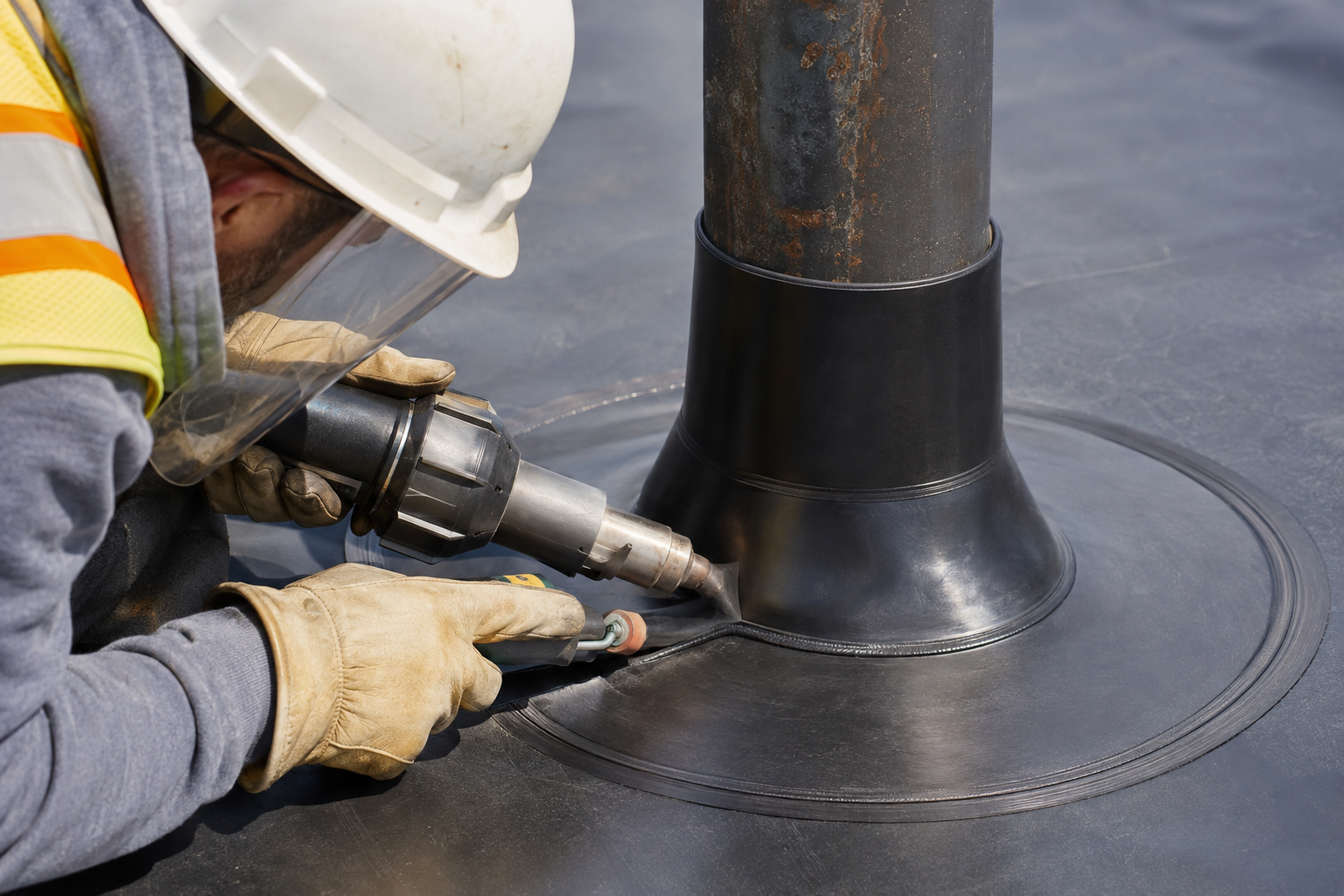
Every pipe, conduit, drain, sleeve, column, and structural member that breaks the liner should appear on a penetration schedule.
For common steel pipe sizes, the outside diameter is:
| Nominal pipe size | Outside diameter |
|---|---|
| 2 in | 60.3 mm |
| 4 in | 114.3 mm |
| 6 in | 168.3 mm |
| 8 in | 219.1 mm |
Use the actual outside diameter in the RFQ. A boot or collar has to fit the real pipe, not the nominal pipe name.
| Penetration field | Example |
|---|---|
| Pipe ID | P-101 |
| Outside diameter | 114.3 mm |
| Pipe material | Carbon steel |
| Orientation | Horizontal |
| Centerline above floor | 450 mm |
| Maximum temperature | 60°C |
| Expected movement | ±10 mm axial |
| Wall clearance | 300 mm |
| Nearest flange clearance | 150 mm |
| Insulation | No |
| Existing/new | Existing |
Retrofit photographs should show more than the pipe itself. Flanges, valves, elbows, supports, insulation, walls, and nearby lines all affect whether the installer can physically make the detail.
A pipe with 500 mm of open working space is not the same job as the same pipe located 100 mm above the floor with a flange 75 mm from the proposed boot.
Movement needs a number where one is available. A flexible pipe boot should not be assumed to absorb unlimited thermal movement, vibration, or structural settlement.
Terminations and Drains
Terminations should be measured just like liner area and pipe boots.
| Termination | Example quantity |
|---|---|
| Concrete wall termination | 96 m |
| Tank ringwall termination | 2 tanks |
| Steel termination | 18 m |
| Anchor trench | 145 m |
For each one, include:
- substrate;
- length;
- elevation;
- existing or new construction;
- expected movement;
- chemical exposure.
If the proposed detail uses mechanical bars, fasteners, embedded strips, or sealants, ask to see that detail with the bid.
Drains need the same level of detail because they are also openings through the containment barrier:
- location;
- pipe outside diameter;
- drain body;
- flange or connection detail;
- sump dimensions;
- floor slope;
- valve arrangement;
- normal valve position.
The drain arrangement should match how the facility actually handles collected liquid, whether it is inspected before discharge, pumped to treatment, transferred to another tank, or removed by vacuum truck.
Liner Product and Thickness
“60 mil liner” is not a complete material specification.
| Thickness | Metric equivalent |
|---|---|
| 30 mil | 0.762 mm |
| 40 mil | 1.016 mm |
| 60 mil | 1.524 mm |
| 80 mil | 2.032 mm |
| 100 mil | 2.540 mm |
| 120 mil | 3.048 mm |
A 60 mil liner and a 1.5 mm liner are close in thickness, but that does not make them the same product.
The material submission should identify:
- manufacturer;
- exact product designation;
- polymer type;
- nominal thickness;
- smooth or textured surface;
- reinforced or nonreinforced construction;
- chemical compatibility basis;
- UV exposure condition;
- required material specification.
Common project options include HDPE geomembrane, LLDPE liner, reinforced systems, PVC, and other specialty barriers. The first filter is chemical suitability for the required liquid and temperature. After that, compare the practical differences between products.
For HDPE, GRI-GM13 Revision 19 covers smooth and textured HDPE geomembranes with formulated sheet density of at least 0.940 g/cc and nominal thicknesses from 0.75 mm through 3.0 mm. The specification covers product properties and testing frequency; it is not a chemical-compatibility approval.[6]
A GM13 submission should be read as a group of properties, not reduced to thickness alone. Density, tensile properties, tear, puncture, stress-crack resistance, carbon black, and oxidative-induction properties all belong in that review. The GRI-GM13 data-sheet review gives a property-by-property check for HDPE submissions.
Seams and Test Requirements
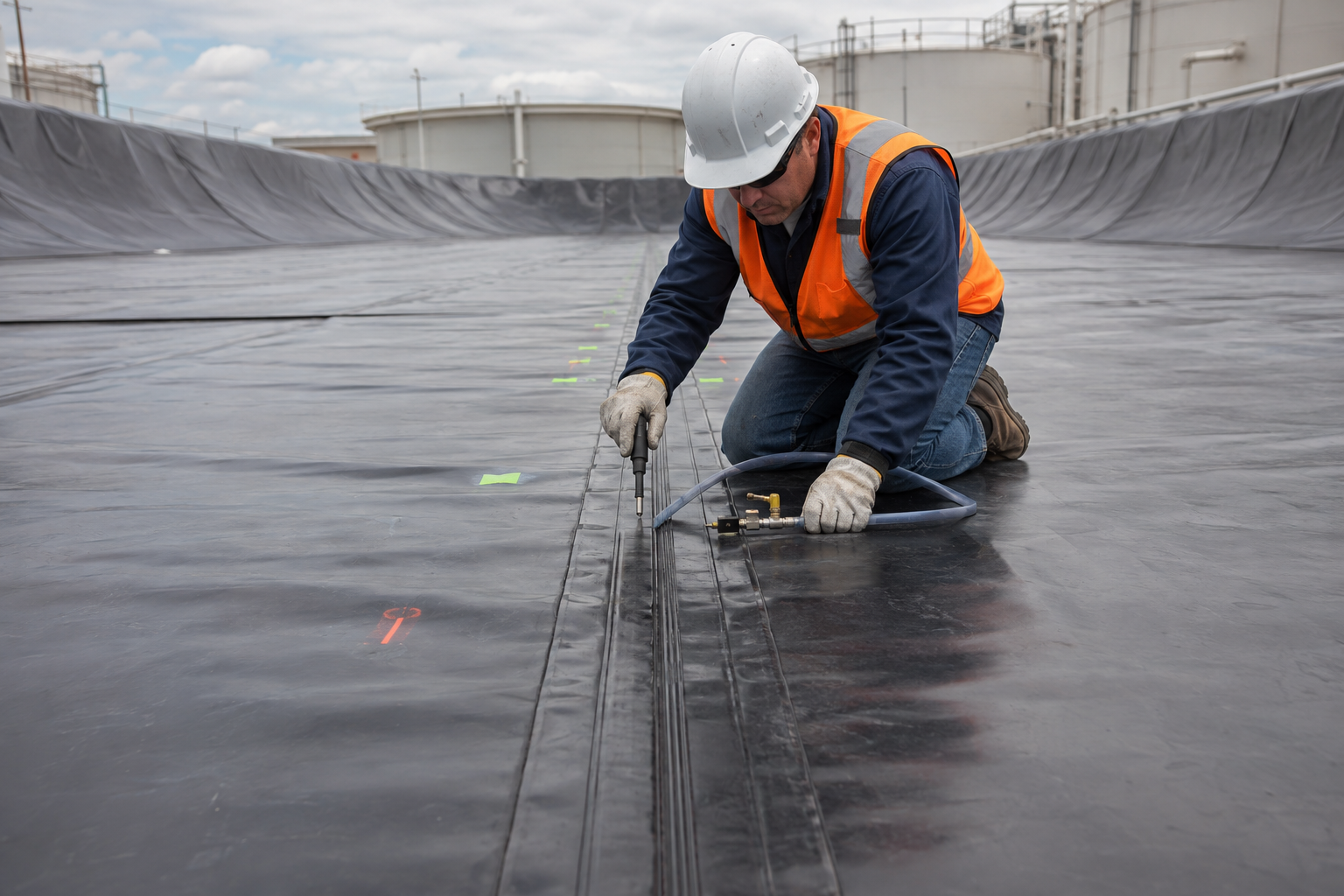
Seaming and testing should be priced from an actual requirement rather than a line that only says “all seams tested.”
| RFQ item | Required entry |
|---|---|
| Production seam method | Bidder to state |
| Detail/repair method | Bidder to state |
| Trial seams | Required / project specification |
| Nondestructive testing | Method by seam type |
| Destructive testing | Where required by specification |
| Acceptance criteria | Project specification / approved standard |
| Repair testing | Required |
| Final records | Required |
Thermoplastic geomembranes may use hot-wedge, hot-air, extrusion, or other approved joining methods depending on the material and detail. Long production seams and small penetration repairs do not always use the same method.
ASTM D4437/D4437M covers nondestructive methods used to evaluate flexible geomembrane seam integrity.[7]
ASTM D6392 covers destructive peel and shear evaluation of thermo-fusion seams for nonreinforced geomembranes within its scope.[8]
The repair log should include:
- repair number;
- location;
- reason for repair;
- repair method;
- test method;
- result.
The geomembrane welding and seam-testing guide provides additional examples of production seams, extrusion details, and field quality checks.
QC, Protection and Handover
The RFQ should show who checks what, especially when more than one contractor is working in the same area.
| Task | Example responsibility |
|---|---|
| Subgrade preparation | Civil contractor |
| Subgrade acceptance | As defined by project |
| Installer QC | Liner contractor |
| Independent CQA | If required |
| Repair verification | As defined by project |
| Final acceptance | Owner / Engineer / designated party |
QC covers the installer’s own seam checks, trial seams, inspections, and repairs. CQA is a separate verification role where the project requires one. EPA technical guidance for waste-containment construction also distinguishes contractor quality control from construction quality assurance.[9]
Responsibility for the liner after installation should also be written down. Damage often happens after the membrane crew has finished.
Check whether the liner will be exposed to:
- workers;
- forklifts or vehicles;
- scaffolding;
- pipe installation;
- welding sparks;
- gravel;
- concrete;
- equipment supports.
Where cover is part of the project, put the real project requirement in the scope. For example:
Example only: nonwoven protection geotextile plus 300 mm soil cover.
The 300 mm value is an example quantity, not a universal minimum.
Bid Quantities and Price Breakdown
Measurable quantities make bids easier to compare and easier to adjust later.
| Item | Illustrative RFQ quantity |
|---|---|
| Geomembrane | 1,850 m² |
| Protection geotextile | 1,900 m² |
| Main field seams | Approx. 620 m |
| Pipe penetrations | 14 |
| Concrete terminations | 96 m |
| Tank ringwalls | 2 |
| Sumps | 1 |
| Maximum liquid depth | 0.85 m |
The price breakdown should separate:
- liner;
- geotextile or protection layer;
- prefabrication;
- pipe boots;
- terminations;
- freight;
- mobilization;
- installation;
- testing;
- equipment;
- travel;
- optional work.
Unit rates are especially useful where field measurements may change.
Example:
| Item | RFQ quantity | Field quantity | Change |
|---|---|---|---|
| Pipe penetrations | 8 | 17 | +9 |
| Concrete termination | 120 ft | 185 ft | +65 ft / +54% |
With agreed unit rates, those changes can be priced from measured quantities instead of reopening the whole commercial discussion.
The bid should separate:
- Assumptions: conditions used to calculate the price;
- Exclusions: work not included;
- Deviations: technical requirements changed by the bidder.
If the RFQ specifies 2.0 mm HDPE and a bidder offers 1.5 mm LLDPE, that difference should appear clearly as an alternative or deviation rather than being buried in the product data sheet.
Required Bid Documents
A complete bid package should contain:
- manufacturer and exact product name;
- product data sheet;
- chemical-compatibility basis;
- applicable material specification;
- liner thickness and surface type;
- protection-layer specification;
- typical pipe-penetration detail;
- typical foundation detail;
- typical termination detail;
- seaming method;
- testing method;
- QC procedure;
- assumptions;
- exclusions;
- technical deviations;
- alternative products;
- lead time;
- price breakdown;
- unit rates;
- warranty terms.
Where traceability is required, final records should include:
- roll numbers;
- lot or batch numbers;
- material certificates;
- panel layout;
- seam map;
- trial seam records;
- nondestructive test records;
- destructive test records where applicable;
- repair log;
- final inspection record;
- as-built drawings.
Keep the warranty items separate:
- material warranty;
- installation/workmanship warranty;
- chemical-suitability statement, where provided.
A 20-year material warranty does not by itself prove that a liner is suitable for a specific acid concentration at 60°C.
RFQ Template
Project
- Project:
- Location:
- New construction / Retrofit:
- Quotation due:
- Installation date:
- Applicable regulation/design basis:
Chemical
- Chemical name:
- CAS number, if available:
- Normal concentration:
- Maximum concentration:
- Specific gravity/density:
- Normal temperature:
- Maximum spill temperature:
- Maximum contact time:
- Repeated exposure: Yes / No
- Other possible chemicals:
- Cleaning chemicals:
- Possible mixtures:
- SDS attached: Yes / No
Containment
- Design release case:
- Largest applicable container:
- Required containment volume:
- Maximum liquid depth:
- Design rainfall:
- Rainfall collection area:
- Firewater allowance, if applicable:
- Displacement:
- Required freeboard:
- Bidder required to verify calculation: Yes / No
Geometry
- Floor length:
- Floor width:
- Wall/berm height:
- Side slope:
- Floor slope:
- Sumps:
- Anchor trench:
- Internal structures:
- Drawings attached: Yes / No
- Field dimensions verified: Yes / No
Subgrade
- Surface: Soil / Concrete / Other
- Soil/fill type:
- Compaction requirement:
- Maximum particle/protrusion:
- Angular rock: Yes / No / Unknown
- Expected settlement:
- Groundwater elevation:
- Sub-liner water/gas risk:
- Protection geotextile: Yes / No
- Subgrade prepared by:
- Subgrade accepted by:
Tank Foundations
- Foundation type:
- Existing / New:
- Liner under foundation: Yes / No
- Liner terminates at foundation: Yes / No
- Transition detail required: Yes / No
- Expected movement:
Penetrations
- Total penetrations:
- Floor penetrations:
- Wall penetrations:
- Outside diameters:
- Pipe materials:
- Maximum temperatures:
- Expected movement:
- Heat tracing:
- Insulation:
- Flange/valve clearances:
- Photographs attached: Yes / No
Terminations
- Concrete termination length:
- Steel termination length:
- Ringwall terminations:
- Anchor trench length:
- Typical details required with bid: Yes / No
Liner
- Specified polymer, if any:
- Specified product, if any:
- Specified thickness:
- Smooth / Textured:
- Reinforced / Nonreinforced:
- UV exposed: Yes / No
- Alternative products allowed: Yes / No
Testing
- Trial seams:
- Nondestructive testing:
- Destructive testing:
- Acceptance criteria:
- Independent CQA required: Yes / No
- Repair log required: Yes / No
Commercial Scope
- Material only / Supply and install:
- Subgrade preparation included: Yes / No
- Geotextile included: Yes / No
- Pipe boots included: Yes / No
- Terminations included: Yes / No
- Freight included: Yes / No
- Unloading included: Yes / No
- Mobilization included: Yes / No
- Power supplied by:
- Equipment supplied by:
Bidder Deliverables
- Product data sheet
- Chemical-compatibility basis
- Penetration details
- Foundation details
- Termination details
- Installation method
- QA/QC procedure
- Assumptions
- Exclusions
- Deviations
- Alternatives
- Lead time
- Warranty
- Price breakdown
- Unit rates
Finally
A quote is ready to compare when another supplier can price the same job from the same information. For the example in this article, a 50,000-gallon spill plus 9,974 gallons of rainfall and 3,500 gallons of displacement gives 63,474 gallons before extra freeboard. A 3H:1V berm rising 1 m needs about 3.16 m of liner across the slope, while a nominal 4-inch pipe needs a detail based on its actual 114.3 mm outside diameter. The same level of detail should be carried through the chemical condition, subgrade, foundations, penetration count, termination length, liner product, seam tests, unit rates, exclusions, and deviations. When those items are measurable, the bids are much easier to compare and later scope changes are easier to price.