
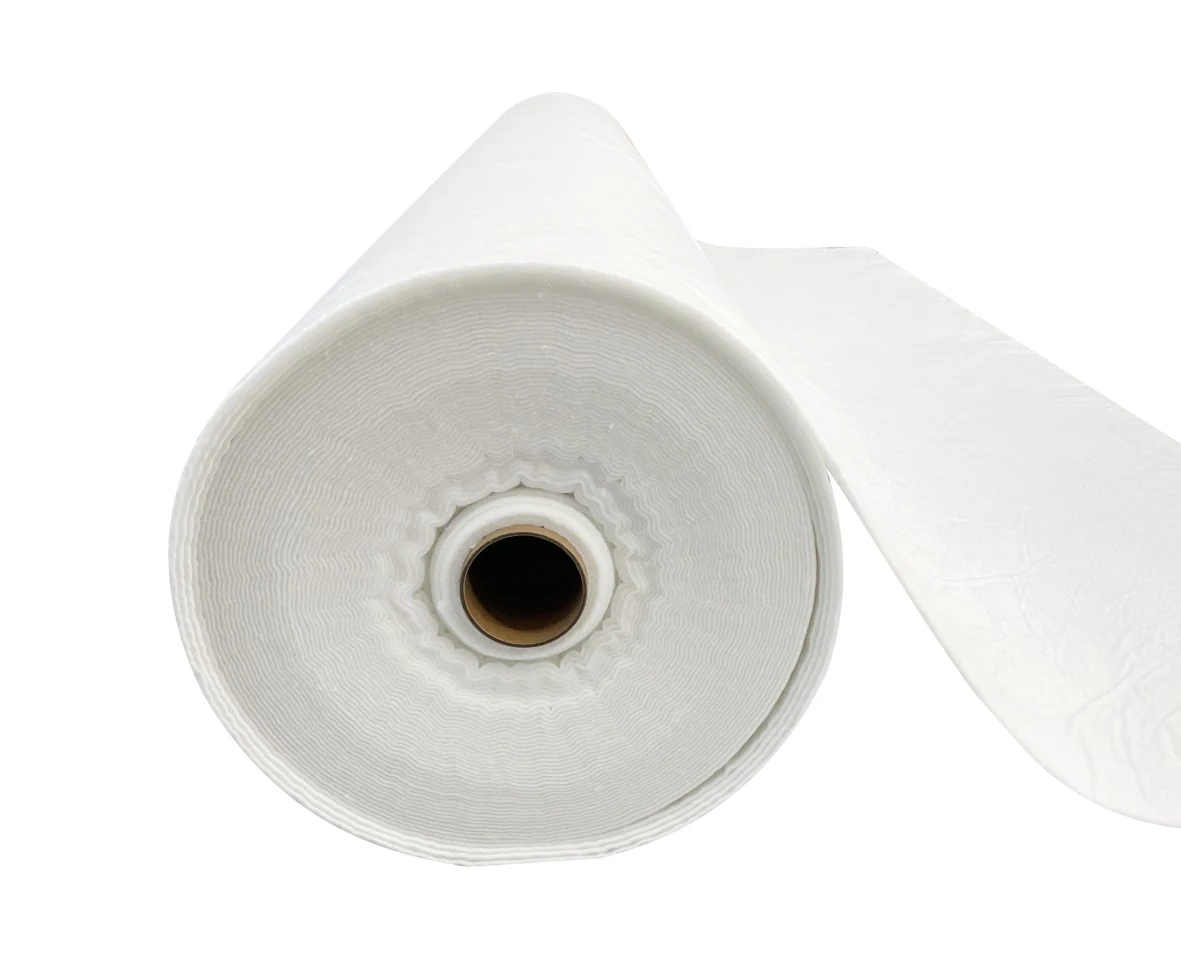

Geotextile clogging is a loss of flow capacity caused by material accumulating at the soil–fabric interface or within the fabric’s pore network. Soil fines, mineral deposits and biological growth can contribute. Prevention requires a compatible soil–filter–drainage system, suitable installation and maintainable outlets; higher GSM or smaller openings alone are not reliable solutions.
Before replacing a filter, locate the hydraulic restriction. A blocked pipe, collapsed drain, compressed drainage core or inadequate outlet can produce symptoms similar to a clogged geotextile.
Distinguish the mechanisms before choosing a remedy
| Mechanism or alternative cause | What to investigate | Implication |
|---|---|---|
| Surface blinding | A concentrated fine-soil layer at the upstream fabric surface | Assess soil migration, contact and filter compatibility. |
| Internal particle clogging | Fine particles retained within the pore network | Assess soil gradation, flow conditions and fabric structure together. |
| Chemical deposition | Mineral scale or precipitates associated with actual water chemistry | Identify deposits and reactions before selecting treatment. |
| Biological accumulation | Biofilm or biomass in biologically active liquids | Consider representative biological performance testing. |
| Restricted drainage path | Obstructed outlet, sedimented pipe, compressed core or inadequate slope | Correct the actual drainage problem rather than assuming fabric failure. |
A flow change is a warning, not a diagnosis. Record water levels, discharge and rainfall or operational changes together. Where feasible, compare head on either side of the suspected restriction. Samples and photographs should retain location and upstream/downstream orientation.
Why tighter openings or heavier fabric are not automatic improvements
A filter must retain the required soil while transmitting water. An opening selected only to stop every fine particle may concentrate particles at the interface. An overly open filter may permit unacceptable soil loss. The balance depends on soil gradation, particle stability, hydraulic conditions and the drainage assembly.
FHWA foundation guidance treats soil retention and hydraulic suitability as linked filter-design considerations. Apply project-specific criteria, especially for critical or unusual soils and flow regimes.
GSM measures mass per unit area, not long-term clogging resistance. Equal-mass fabrics can have different opening distributions and flow behavior. For initial selection, see AOS, soil retention and flow capacity; for substitutions, see why equal GSM does not prove equivalence.
Choose tests that answer the failure question
| Investigation or test | Useful information | Limit |
|---|---|---|
| Soil grading, plasticity and water chemistry | Defines the soil and liquid presented to the filter | A generic soil description cannot replace representative samples. |
| ASTM D4751: apparent opening size | Index measure supporting opening-size comparison | Does not independently prove long-term soil–filter compatibility. |
| ASTM D4491/D4491M: permittivity | Through-thickness water flow under the test conditions | An isolated, uncompressed fabric is not the complete buried system. |
| ASTM D5101: filtration compatibility | Gradient-ratio assessment of a soil–geotextile system | Select applicable soil and flow conditions. |
| ASTM D5567: hydraulic conductivity ratio | Performance/comparative assessment of saturated soil–geotextile systems | Confirm specimen and apparatus suitability with the laboratory. |
| ASTM D1987: biological clogging | Performance where biologically active liquids are relevant | Does not replace physical or chemical investigations. |
The official ASTM D5101-23 scope describes water-saturated soil under unidirectional flow and distinguishes this performance test from manufacturer certification or geotextile acceptance testing. It recommends D5101 for soils with plasticity index below 5 and D5567 for a plasticity index of 5 or more; near that boundary, agree suitability with the laboratory before testing.
ASTM D5567-24 covers saturated soil–geotextile systems and has its own hydraulic-conductivity applicability limits. Test selection must satisfy those limits as well as the project’s soil and hydraulic conditions. Do not select solely by the number on a brochure.
Read a gradient ratio without inventing a universal pass limit
A hydraulic gradient is head loss divided by the distance over which it is measured. A gradient ratio compares the gradient in the soil–geotextile region with the reference soil gradient defined by the procedure.
Gradient ratio = isoil–geotextile region / ireference soil region
Illustrative arithmetic: 4 / 2 = 2.0
This example is not an acceptance criterion. Different measurement spacings mean that dividing head losses directly may give the wrong ratio. Review test duration, flow trends, soil loss, imposed gradients and specimen conditions together. A stable result in one arrangement does not guarantee field life or cover another soil, liquid or cyclic flow regime.
Prevent clogging across the project lifecycle
Design the complete drainage assembly
Provide representative soil and liquid data. Select the filter and granular transition layers together, consider flow and confinement, and verify that collectors and outlets can remove the water. For critical or severe conditions, specify appropriate system-performance evidence and agree criteria before testing.
Keep construction contamination out
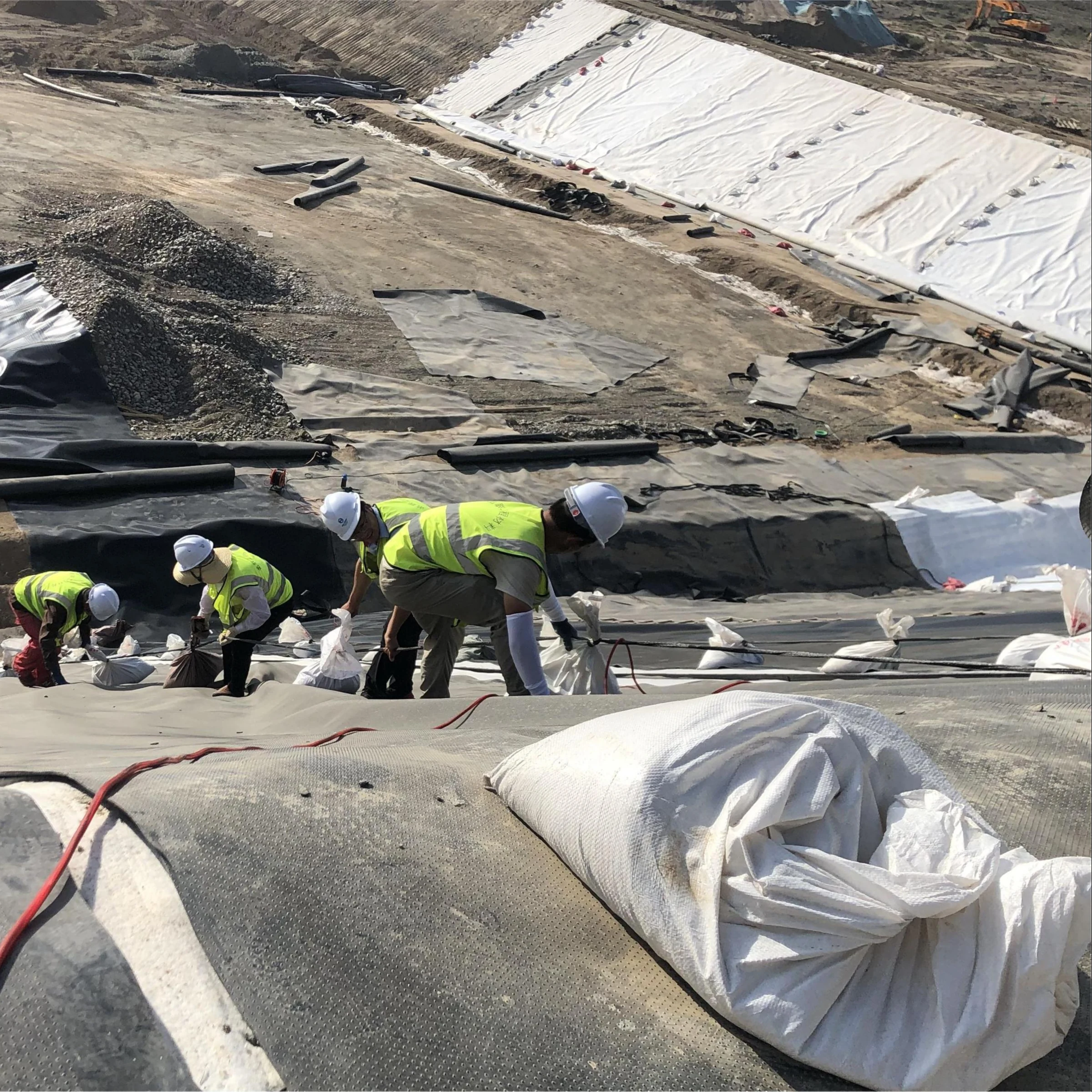
Store rolls protected from contamination and damage. Prepare the receiving surface, avoid dragging fabric through mud and prevent dirty runoff entering exposed drainage layers. Place specified adjacent material without mixing unsuitable fines into it. Follow project overlap, joining and placement requirements; an arbitrary overlap cannot remedy incompatible filter selection.
Make inspection and maintenance possible
Provide accessible outlets and inspection points where the design permits. Establish baseline discharge and water-level observations under recorded conditions. Investigate sustained changes before drainage becomes inaccessible or hydraulic pressure rises.
Investigate an installed filter before prescribing treatment
- Check safe access, outlet condition, pipe continuity and downstream water levels.
- Locate the restriction using appropriate inspection and head/flow measurements.
- Where authorized, sample deposits, water and affected material with location records.
- Ask the designer and laboratory to distinguish physical, chemical and biological mechanisms.
- Assess cleaning, local repair, drainage modification or replacement against access, compatibility and soil stability.
Do not prescribe high-pressure flushing, acids or disinfectants from a photograph. An unsuitable treatment can damage the assembly, mobilize soil or affect receiving water. A proposed treatment needs a project-specific assessment and controlled method.
Practical questions
Can nonwoven geotextile become clogged?
Yes. Suitability depends on soil, liquid and installed conditions. Neither “nonwoven” nor a high initial flow value guarantees resistance to every mechanism.
Does brown staining prove clogging?
No. Establish whether flow or head loss changed, and identify the deposit before attributing a hydraulic problem to it.
Should a clogged filter be replaced with a heavier grade?
Not without diagnosing the cause. The replacement must satisfy retention, hydraulic performance, durability and installation requirements. Mass alone cannot resolve incompatibility.
Test references
- ASTM D4751 publisher record: apparent opening size; use the project-specified edition and method, not an assumption that this older edition is current.
- ASTM D4491/D4491M publisher record: water permeability by permittivity; confirm the required edition.
- ASTM D1987-22(2026): biological clogging of geotextile or soil/geotextile filters.
Request geotextile against a filter specification
Send soil grading and plasticity, liquid and temperature, expected flow, adjacent materials and required tests. For existing problems, add water-level, discharge and deposit observations.