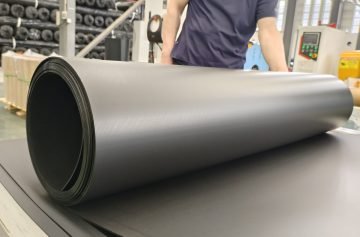
A pond liner’s cost per m2 depends on whether the quote covers the sheet alone, delivered material, or a completed installation. For a weight-based sheet quote, use price per m2 = price per kg × sheet mass in kg/m2. A nominal 1.5 mm smooth HDPE liner calculated at 0.940 g/cm3 weighs about 1.41 kg/m2, so its sheet-only price is 1.41 times the quoted price per kg. That density is the minimum-average formulated density in GRI-GM13, not a measured value for every roll [1].
For a pond budget, multiply the sheet price by the area you must purchase, then add delivery, any protective underlay, ground preparation, anchorage, installation, and testing. There is no single price that represents all these scopes. A usable quotation needs a currency, date, specification, quantity, and delivery location.
Have qualified personnel determine the lining design, material suitability, installation procedures, and acceptance requirements under local rules and the project specification.
What does the quoted price per m2 include?
| Price basis | What to confirm |
|---|---|
| Sheet only | Material, nominal thickness, surface, specification, roll dimensions, quantity, currency, and quotation validity. |
| Delivered material | Sheet price plus agreed freight, unloading, duties, and taxes; list any exclusions. |
| Installed lining | The agreed material and site-work scope, including any underlay, deployment, welding, testing, anchor work, and supervision; define the payable area. |
Ask the supplier to write the price basis on the quotation. “Installed per m2” still needs a denominator: purchased liner area, accepted installed area, and pond water-surface area are different measurements.
For a project comparison, divide the same total-cost scope by the same reference area. If you use water-surface area to compare budgets, label it explicitly; do not present that result as the sheet’s selling price.
How thickness changes the sheet cost
For a smooth sheet, the theoretical mass calculation is mass in kg/m2 = thickness in mm × density in g/cm3. Using nominal thickness and a density of 0.940 g/cm3 gives the following estimates. GRI-GM13 covers smooth and textured HDPE geomembranes from 0.75 to 3.0 mm [1].
| Nominal thickness | Mass calculation | Approximate smooth-sheet mass |
|---|---|---|
| 0.75 mm | 0.75 × 0.940 | 0.71 kg/m2 |
| 1.00 mm | 1.00 × 0.940 | 0.94 kg/m2 |
| 1.50 mm | 1.50 × 0.940 | 1.41 kg/m2 |
| 2.00 mm | 2.00 × 0.940 | 1.88 kg/m2 |
These are calculated estimates, not guaranteed roll weights. Confirm actual mass and dimensional tolerances with the supplier. For textured material, request the relevant product mass rather than assuming the smooth-sheet estimate applies.
Overlaps, anchorage, and offcuts increase the area purchased; they do not increase the sheet’s mass per m2. At the same quoted price per kg and density, doubling nominal thickness doubles the calculated sheet-only cost per m2. It does not establish how the delivered or installed total will change.
Choose the required performance before comparing prices
Have the designer specify thickness and protection for the ground conditions, puncture risks, loading, exposure, and intended service. Ask installers to price that specification rather than assuming a thinner offer is an equivalent substitute. Handling, equipment, access, and detailing belong in the installation quote, not in an assumed universal thickness surcharge.
Check whether a low-priced sheet meets the specification
GRI-GM13 Rev. 19 Table 1(a), in U.S. customary units, gives these smooth-HDPE acceptance values. The millimeter labels below are approximate nominal counterparts, not exact conversions or a replacement for the standard’s separate SI table. Tensile, tear, and puncture entries are minimum-average values; the stress-crack requirement is 500 hours [1].
| Property and test method | 40 mil, approximately 1.0 mm | 60 mil, approximately 1.5 mm | 80 mil, approximately 2.0 mm |
|---|---|---|---|
| Tensile yield strength, ASTM D6693 Type IV | 84 lb/in. | 126 lb/in. | 168 lb/in. |
| Tensile break strength, ASTM D6693 Type IV | 152 lb/in. | 228 lb/in. | 304 lb/in. |
| Tear resistance, ASTM D1004 | 28 lb | 42 lb | 56 lb |
| Puncture resistance, ASTM D4833 | 72 lb | 108 lb | 144 lb |
| Stress-crack resistance, ASTM D5397 Appendix | 500 hr | 500 hr | 500 hr |
For tensile properties, Table 1(a) specifies averages based on five specimens in each of the machine and cross-machine directions. Compare reports using the correct thickness, surface, unit system, sampling basis, and test conditions. A single specimen result is not the same as a minimum-average acceptance result [1].
The same standard specifies a carbon-black content range of 2.0–3.0% under ASTM D4218, with permitted alternative methods subject to correlation. Its ASTM D5596 dispersion criterion concerns near-spherical agglomerates in ten views: nine in Categories 1 or 2 and one in Category 3. Initial minimum-average OIT is either 100 minutes under ASTM D8117 or 400 minutes under ASTM D5885; the manufacturer may select the listed OIT method [1].
After ASTM D5721 oven aging for 90 days at 85°C, minimum-average OIT retention is 55% for standard OIT or 80% for high-pressure OIT. The UV criterion is at least 50% high-pressure OIT retention after 1,600 hours under ASTM D7238, using a 20-hour UV cycle at 75°C followed by four hours of condensation at 60°C. These are specified laboratory acceptance conditions, not a prediction of years of pond service [1].
Request the applicable batch or roll reports alongside the quotation and discuss traceability with the HDPE geomembrane manufacturer. A declaration of compliance should identify the specification and revision being offered.
How material and surface affect the comparison
- Smooth HDPE. Jinseed’s HDPE liner range is relevant to pond projects, including water storage and irrigation applications. Confirm suitability for the specific contents and design.
- Textured HDPE. When interface friction is a design consideration, ask about single- or double-sided textured liner. Do not treat texture alone as proof of slope stability; the designer must establish the required interface performance.
- LLDPE. Include Jinseed’s LLDPE liner as an option for evaluation where deformation or detailing is a concern. Request the applicable LLDPE specification and reports rather than applying the HDPE acceptance table.
- EPDM and PVC. These are comparison alternatives, not products claimed here as part of Jinseed’s supply range. Compare their proposed specifications and installation scopes separately.
For an aquaculture pond, state the species, water depth, operating temperatures, water treatment, and cleaning method. For an industrial containment pond, provide the stored-fluid composition and operating conditions. Have qualified personnel assess chemical compatibility; greater thickness does not by itself establish compatibility.
What to budget beyond the liner sheet
- Ground preparation. Include the specified grading, removal of unsuitable material, and preparation of a suitable support surface. FAO pond guidance identifies topography, water supply, and soil properties as site-selection factors and connects pond construction to earthwork requirements [2].
- Protective underlay. If the design calls for a cushion, price the PET continuous-filament nonwoven geotextile separately. Specify its required performance and coverage; a geomembrane protection layer is not interchangeable with the waterproof liner.
- Anchorage and penetrations. Ask for the material and labor associated with the approved anchor details, pipe boots, outlets, joints, and other connections.
- Deployment, welding, and testing. Require a priced installation and quality plan. ASTM D6392-25 covers destructive peel and shear testing of sampled thermo-fusion seams in nonreinforced geomembranes. It is not a method for nondestructively checking every seam along its full length. Have the project’s qualified quality personnel define sampling, acceptance, any separate continuity testing, repairs, and retesting [3].
- Delivery and site logistics. Confirm shipping terms, unloading, storage, access, taxes, and responsibility for each item.
Do not transfer landfill liner requirements directly to an ordinary pond. A landfill liner system is a separate design context; use the requirements that actually apply to the proposed facility.
How much liner area should you purchase?
Water-surface area is not a purchase quantity. The order must account for the pond profile, the approved anchorage detail, panel layout, overlaps, and cutting waste. Establish which dimensions describe the waterline, pond crest, or excavation before calculating.
Illustrative geometry: take a rectangular pond with a 30 × 20 m water surface, 2 m depth, uniform 3H:1V sides, a level bottom, and no shelves. The horizontal side run is 6 m, making the bottom 18 × 8 m. Each sloping side measures √(6² + 2²), or about 6.325 m.
Assuming an additional 1 m of sheet length beyond each waterline edge for anchorage, with no extra freeboard, the developed rectangular sheet dimensions are approximately:
- Length: 18 + (2 × 6.325) + (2 × 1) = 32.65 m.
- Width: 8 + (2 × 6.325) + (2 × 1) = 22.65 m.
- Rectangular sheet envelope: about 739.5 m2, or approximately 740 m2.
That envelope is about 1.23 times the 600 m2 water surface, before seam overlaps and cutting waste. It is not the exact developed surface area or a final panel order. The 1 m allowance is an arithmetic assumption, not an anchor-trench design recommendation; the approved detail must determine the real allowance. Jinseed’s pond liner coverage guide addresses the quantities to include.
A practical quote-comparison scenario
Suppose one offer covers only the 600 m2 water surface while another covers the approximately 740 m2 rectangular envelope above. Even with identical material and unit prices, they are not quoting the same quantity. The latter contains about 23% more sheet before the remaining allowances.
If the sheet price is P per m2, the envelope’s sheet subtotal is approximately 740 × P in the quoted currency. Dividing that subtotal by the water-surface area gives about 1.23 × P per m2 of water surface. Freight and site work remain additional. This is a calculation scenario, not a market price or a completed-project case study.
Before accepting either offer, ask for the drawing dimensions, roll or panel layout, allowance calculation, and list of exclusions. Those documents make the comparison reproducible without relying on an unsupported claim that one quote is “cheaper.”
What to send for a comparable pond-liner quote
- Dimensions, water depth, freeboard, side slopes, and a drawing identifying the waterline and crest.
- Intended contents and operating conditions, including relevant chemistry and cleaning practices.
- Specified material, thickness, surface, and acceptance standard, or a request for qualified design input.
- Any required protection layer and its specified performance; confirm the geotextile grade separately.
- Purchase quantity and allowance breakdown, or a request for the proposed panel layout.
- Delivery address, unloading arrangements, currency, taxes, and quotation validity.
- Installation, testing, repair, and acceptance responsibilities, with a clearly defined payable-area rule.
Use Jinseed’s HDPE geomembrane cost-per-m2 guide for the related sheet-pricing discussion. For the pond itself, compare the resulting total scope and quantities—not just the unit-price headline.
Request pond-liner pricing for your project
Send your pond drawing, material requirements, estimated quantity, and delivery address. Ask for itemized inclusions, exclusions, and available product documentation.
References
- Geosynthetic Institute, GRI-GM13, Revision 19, June 11, 2025. HDPE smooth and textured geomembrane specification; Table 1(a) and associated notes. Accessed November 4, 2026.
- FAO, Fish Culture in Undrainable Ponds: Site Selection and Pond Construction. Site conditions, soil, and pond construction considerations. Accessed November 4, 2026.
- ASTM International, ASTM D6392-25. Standard Test Method for Determining the Integrity of Nonreinforced Geomembrane Seams Produced Using Thermo-Fusion Methods; public Scope and Significance and Use. Accessed November 4, 2026.