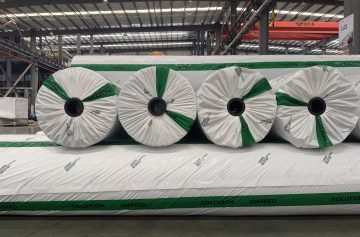
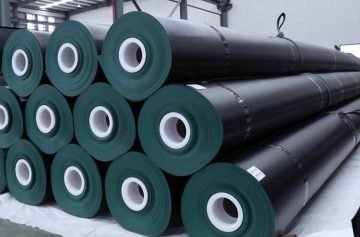
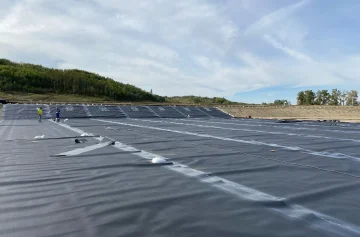
Yes. GRI-GM13 is a specification for smooth and textured HDPE geomembranes. It provides a manufacturing-quality baseline, but a statement of conformity does not by itself establish suitability for a particular chemical, slope, installation or design life. Buyers should distinguish material conformity, an independent test report and a product-certification claim.
The reference checked for this article is GRI-GM13, Revision 19, dated June 11, 2025. Confirm the revision required by the project and check the GSI specification directory before procurement.
What the specification covers
The scope includes formulated HDPE sheet density of at least 0.940 g/cm³ and thicknesses from 0.75 to 3.0 mm. Separate smooth and textured tables apply. Do not use the smooth-sheet table to accept a textured product without reviewing the differences.
| Selected check | Revision 19 reference |
|---|---|
| Formulated density | Minimum average 0.940 g/cm³; D1505/D792 |
| Carbon black content | 2.0–3.0%; dispersion assessed separately |
| Stress-crack resistance | 500 hours; D5397 Appendix, with specimen conditions |
| Initial OIT alternatives | Standard OIT: 100 minutes, or high-pressure OIT: 400 minutes |
| Break elongation | Smooth: 700%; textured: 100%, under the specified tensile procedure |
This selection is not a complete acceptance specification. Read the relevant table, frequencies and footnotes together. Thickness-control rules differ by surface, and textured welding margins have separate requirements. Revision 19 also contains seam-property requirements in an appendix.
Read the units and the type of reported value
A data sheet may state a nominal value, a minimum average, a typical value or an actual test result. Those are not interchangeable. A typical result above a limit does not demonstrate that every delivered lot satisfies the specified acceptance basis.
Check units before comparing competing offers. Tensile force per unit width in kN/m is not tensile stress in MPa. Thickness in millimetres is not mils: 1 mil = 0.0254 mm, so 60 mil = 1.524 mm. If a project specifies one unit system and a particular nominal grade, do not silently substitute a nearby rounded value from another table.
Density is not a stand-alone chemical-resistance or lifetime rating. Carbon black content is not a complete UV assessment. Likewise, an OIT result or a stress-crack result is not a number of service years. Review the complete proposed grade and the intended exposure.
GM13 conformity is different from product certification
A supplier can submit evidence that a particular material meets specified GM13 requirements. That is a conformity claim, which must be supported by appropriately identified test results and manufacturing records. It does not automatically mean GSI has certified the product or manufacturer.
GSI’s official product-certification notice states that the GCI Product Certification Program was discontinued on July 10, 2006. Historical descriptions of that program should not be presented as a currently operating GM13 product-certification route.
If a document is described as a certificate, identify its issuer and exact scheme. Determine whether it is a manufacturer declaration, test report, management-system certificate or independent product certificate. Verify the issuer, scope, product, factory and validity directly rather than relying on the word “certified” in a quotation.
A quality-management certificate addresses a different question from a liner test report. ISO’s information on ISO 9001 identifies it as a quality-management-system standard. Check the certificate’s edition and transition arrangements with the issuing certification body; do not infer that a standard revision immediately invalidates every existing certificate.
Build a traceable project submittal
A useful submittal lets the reviewer follow the material from the offered grade to the delivered rolls. Use the following procurement checklist alongside the project quality plan.
| Document | What to check | What it cannot establish alone |
|---|---|---|
| Product data sheet | Product code, polymer, surface, nominal thickness, units and revision | Conformity of a particular shipment |
| Manufacturing test report | Roll or lot IDs, methods, results, applicable limits and test dates | Site installation quality |
| Independent report | Sample identity, sampling responsibility, laboratory scope and tested properties | Untested properties or all future production |
| Conformity statement | Exact specification revision, scope and supporting evidence | Automatic third-party product certification |
| Installation records | Panel map, seam identification, trial welds, tests, repairs and acceptance | Unmeasured long-term performance |
Ask the supplier to disclose missing tests or exceptions instead of accepting a blank “pass” column. The independent laboratory’s relevant accreditation scope matters more than an unrelated accreditation logo. Record who selected and sealed the samples and how they relate to production batches.
Do not invent a universal report expiry of three or six months. The purchaser can set recency and retesting requirements, but the chosen interval should relate to production traceability, changes in formulation, storage conditions, contract requirements and project risk.
Chemical compatibility needs separate evidence
A claim that an HDPE liner conforms to GM13 does not prove it is suitable for every acid, alkali, solvent or mixed leachate. Define the actual liquids, concentrations, temperatures, exposure duration, mechanical stresses and credible upset conditions before requesting compatibility information.
US EPA Method 9090A addresses the effects of waste chemicals on membrane-liner properties. It is a reference for a compatibility evaluation, not a universal prediction of decades of service. A report should identify the tested material, exposure medium and conditions, and explain which property changes were evaluated.
Do not present a generic list of acid concentrations as required GM13 immersion tests. Nor should an unsupported claim of “95% strength retention after 60 days” be used without the report, test conditions and acceptance basis. A qualified result is useful precisely because the reader can understand its limits.
Material acceptance and field acceptance are separate steps
Before shipment, confirm that the offered product matches the approved submittal. At delivery, reconcile roll labels and reports, inspect packaging and visible damage, and document storage. During installation, use the approved seam procedures and construction quality-assurance plan.
The accepted sheet still needs a prepared subgrade, appropriate protection, qualified seams and suitable drainage and anchorage. A successful factory test cannot establish that the lining remained undamaged during placement or covering.
For a quotation, identify the required HDPE geomembrane grade, the governing GM13 revision and additional project requirements. Request the corresponding documents through Jinseed’s contact page. Review the grade-specific evidence before approving the material for installation.