

Key Specifications
BS EN 13256:2016 covers geotextiles and related products used in tunnels and underground structures. In this application, the main job is protecting a geosynthetic barrier. If the material also drains or filters water, those functions need their own performance requirements.[1]
| Property | What It Tells You | Typical Test |
|---|---|---|
| Static puncture | Resistance to concentrated penetration | ISO 12236 |
| Dynamic perforation | Damage caused by a standard impact | ISO 13433 |
| Protection performance | Ability to protect a membrane from a local hard point | EN 14574 / EN 13719 where applicable |
| Tensile behavior | Strength and stretch during handling and installation | ISO 10319 |
| Mass per unit area | Product grade and production consistency | ISO 9864 |
| Thickness | Fabric thickness at a stated pressure | ISO 9863-1 |
| Cross-plane permeability | Water moving through the fabric | ISO 11058 |
| In-plane flow | Water moving along the layer | ISO 12958-1 / ISO 12958-2 |
| Opening size | Filtration opening where particle retention is required | ISO 12956 |
| Durability | Long-term property retention | ISO/TS 13434 and relevant durability tests |
Mass and thickness are useful for product control, but they do not tell you on their own how well the material will protect a waterproofing membrane.
Protection or Drainage
A typical tunnel waterproofing build-up may look like this:
shotcrete → protection geotextile → waterproofing membrane → secondary lining
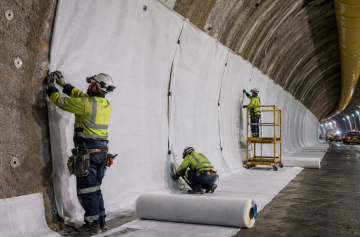
Here, the geotextile sits between a hard, uneven surface and the membrane. Its job is to soften contact with exposed aggregate, rough concrete and other local hard points. Needle-punched nonwoven geotextile is one product type used where cushioning and conformability are needed.
| Function | Main Checks |
|---|---|
| Protection only | Puncture, protection performance, mechanical behavior and durability |
| Protection + drainage | Protection properties plus the required water-flow capacity |
| Protection + filtration | Protection properties plus permeability, opening size and soil compatibility |
A supplier may list many hydraulic properties on the data sheet. That does not mean all of them belong in the tunnel specification. If water does not need to pass through or travel along the geotextile, those values may have little effect on product selection.
Static Puncture
Puncture damage usually starts at a small contact point. Exposed aggregate, a rough repair edge, a fixing detail or reinforcement left too close to the surface can put concentrated pressure on the membrane.
ISO 12236:2026 measures static puncture resistance by pushing a flat-ended plunger through the geosynthetic and recording the required force. The 2026 edition replaced ISO 12236:2006.[2]
Results are normally shown in N or kN:
- 3,000 N = 3.0 kN;
- 5,500 N = 5.5 kN;
- 9,000 N = 9.0 kN.
For this test, a higher value normally means greater resistance to the standard plunger.
A measurable project clause can be written as:
Static puncture resistance: ≥ project requirement, ISO 12236.
“High puncture strength” sounds useful, but it gives the supplier and laboratory no clear pass/fail point. A number and test method are much more useful.
Dynamic Perforation
Not every puncture happens under slow pressure. A hard object can also hit the material during construction. ISO 13433:2025 checks this type of response by dropping a steel cone from a fixed height. The 2025 edition replaced ISO 13433:2006.[3]
| Test | Better Result |
|---|---|
| Static puncture force | Higher |
| Dynamic perforation opening | Lower |
If the result is reported as an opening diameter, the limit should normally control the maximum opening:
Dynamic perforation: opening ≤ project limit, ISO 13433.
This detail is easy to get wrong in a tender. For static puncture, a higher result is better. For cone-drop opening size, a lower result is better.
Membrane Protection Tests
ISO 12236 and ISO 13433 are useful for comparing products, but the actual tunnel membrane is supported by a much more complex surface.
EN 14574:2015 measures pyramid puncture resistance with the geosynthetic supported on a rigid surface. It is useful when the concern is short-term damage from a hard, sharp point behind the protection layer.[4]
EN 13719:2016 looks at long-term protection efficiency when a geosynthetic is in contact with a geosynthetic barrier and exposed to static point loading.[5]
| Test | What It Checks |
|---|---|
| ISO 12236 | Standard static CBR puncture resistance |
| ISO 13433 | Standard cone-drop perforation response |
| EN 14574 | Short-term protection against a hard supported point |
| EN 13719 | Long-term protection under static point loading |
These are different tests, so their numbers cannot be converted into each other. A 5.5 kN ISO 12236 result does not tell you what result the same material will produce under EN 14574 or EN 13719.
Published Tunnel Specification Example
The British Tunnelling Society’s Specification for Tunnelling, Fourth edition gives a useful real-world example of how several geotextile properties can be specified together. The figures below are a published project-style reference, not a fixed rule for every tunnel.[6]
| Property | 500 g/m² Class | 800 g/m² Class |
|---|---|---|
| Example location | Elsewhere around tunnel | Invert |
| Mass per unit area | ≥ 500 g/m² | ≥ 800 g/m² |
| Thickness at 200 kPa | ≥ 1.7 mm | ≥ 3.4 mm |
| Static puncture | ≥ 5,500 N | ≥ 9,000 N |
The same specification gives an in-plane water-flow requirement of at least 0.003 L/(m·s) at 200 kPa and hydraulic gradient 1 for the geotextile fleece.[6]
The useful part of this example is not simply the difference between 500 g/m² and 800 g/m². The heavier class also comes with different requirements for thickness under pressure and static puncture resistance.
Those figures should not be copied into another project without checking the membrane, substrate, drainage design, construction sequence and contract requirements.
Index Values and Real Tunnel Loads
A laboratory index value gives you a common basis for comparing products. It does not tell you the safe point load of the finished waterproofing system.
For example:
ISO 12236 = 5.5 kN
does not mean:
a sharp object may safely apply 5.5 kN directly to the waterproofing membrane.
What happens on site also depends on:
- the contact area and shape of the projection;
- shotcrete roughness;
- geotextile thickness after compression;
- membrane material and thickness;
- normal pressure;
- installation damage;
- long-term loading.
The same issue applies to a geotextile cushion below a geomembrane. One GSM value or one puncture result cannot describe the safe load of the whole liner system.
For higher-risk tunnel sections, it can make sense to test the selected geotextile together with representative substrate roughness and the actual membrane.
Mass per Unit Area
Mass per unit area is normally shown in g/m² or GSM.
ISO 9864:2005 defines the measurement method and identifies mass per unit area as a value used for product identification and technical data sheets.[7]
The conversion is simple:
| Geotextile Grade | Mass per m² | Mass over 100 m² |
|---|---|---|
| 300 g/m² | 0.30 kg | 30 kg |
| 500 g/m² | 0.50 kg | 50 kg |
| 800 g/m² | 0.80 kg | 80 kg |
| 1,000 g/m² | 1.00 kg | 100 kg |
A roll measuring 4 m × 100 m contains 400 m² of material. On that basis:
- 500 g/m² × 400 m² = approximately 200 kg;
- 800 g/m² × 400 m² = approximately 320 kg.
These are fabric-mass calculations only. Shipping weight will also include the roll core, wrapping and packaging.
GSM is useful when checking product grade and consistency. It does not directly measure puncture resistance, membrane protection, drainage capacity or retained thickness.
That is why two 500 g/m² products can still perform differently. Fibre structure, needling and thickness may not be the same. When reviewing a nonwoven geotextile data sheet, compare the properties that matter to the project instead of choosing by GSM alone.
The way the number is reported also matters:
- typical value — a representative result;
- mean value — an average result;
- declared value — formally declared manufacturer performance;
- minimum requirement — the contractual acceptance limit;
- tolerance — permitted production variation.
For example, a purely illustrative tolerance of 500 g/m² ±10% would represent a range of 450–550 g/m². This is only a calculation example; it does not mean ±10% is the correct tolerance for every project.
Thickness Under Pressure
A nonwoven geotextile may look thick when it is unloaded, but that is not the condition it will see after the tunnel lining is built.
ISO 9863-1:2016 measures geosynthetic thickness at specified pressures.[8]
A requirement such as:
Thickness ≥ 5 mm
is incomplete if it does not say at what pressure the 5 mm is measured.
The BTS/ICE example makes this easy to see. At 200 kPa, its 500 g/m² fleece has a minimum thickness of 1.7 mm, while the 800 g/m² fleece has a minimum of 3.4 mm.[6]
For scale:
| Pressure | Equivalent Unit |
|---|---|
| 100 kPa | 0.10 MPa ≈ 1 bar |
| 200 kPa | 0.20 MPa ≈ 2 bar |
| 500 kPa | 0.50 MPa ≈ 5 bar |
Freshwater pressure increases by about 9.8 kPa for every metre of water depth. So 10 m of water head is roughly 98 kPa and 20 m is roughly 196 kPa.
This comparison is only there to show the scale of the pressure. A 200 kPa thickness test is not automatically the same as a tunnel design condition under 20 m of groundwater. Structural loading, groundwater pressure and compression still need to be checked separately.
Cross-Plane Water Flow
If water needs to pass through the fabric, cross-plane flow becomes relevant.
ISO 11058:2019 covers water permeability normal to the plane of a single geotextile or related product without load and includes constant-head and falling-head test methods.[9]
This is the value to look at when groundwater must pass through the geotextile into another drainage layer or collector.
Supplier data can be misleading if two values use different methods or units. For example, ASTM D4491/D4491M-22 reports water permeability of geotextiles in terms of permittivity.[10]
An ASTM permittivity result and an ISO 11058 value should not be compared simply by looking at which number is larger.
In-Plane Water Flow
When water needs to move along the drainage layer rather than through it, in-plane flow is the more useful property.
ISO 12958-1:2020 is an index test for constant-head water-flow capacity within the plane of a factory-assembled product.[11]
ISO 12958-2:2020 is a performance test that can use defined boundary materials and conditions such as normal load and hydraulic gradient.[12]
For a tunnel drainage layer, the number only makes sense when the test conditions are also known:
- normal pressure;
- hydraulic gradient;
- flow direction;
- boundary materials;
- required flow capacity.
The BTS/ICE specification example requires at least 0.003 L/(m·s) in-plane flow for the geotextile fleece at 200 kPa and hydraulic gradient 1.[6]
If the specification only says:
In-plane flow ≥ 0.003 L/(m·s)
the requirement is missing the pressure and hydraulic gradient that go with that value.
A nonwoven geotextile used for drainage should therefore be judged against the actual flow path and test conditions, not a general claim that the material is “highly permeable.”
Opening Size
Opening size matters when the geotextile also acts as a filter.
ISO 12956:2019 determines characteristic opening size using wet sieving.[13]
The filter needs to do three jobs at the same time:
- allow enough water through;
- retain the particles that need to stay in place;
- limit clogging.
A larger opening may let too many fines move through the fabric. A smaller opening can reduce flow or increase clogging risk.
There is no single O90 value that works for every tunnel. If the geotextile only cushions a membrane against prepared shotcrete, opening size may not control the specification. If it also filters soil-bearing groundwater, it becomes much more important.
Tensile Behavior
ISO 10319:2024 is the current wide-width tensile test for geosynthetics. It measures tensile force and elongation characteristics.[14]
In a tunnel, tensile performance matters most while the material is being installed. The fleece may need to be lifted overhead, pulled around a curved surface or stretched around local details and fixings.
Where the project calls for directional values, check both machine direction and cross-machine direction.
The highest tensile number is not automatically the best choice. A protection fleece also needs enough stretch to sit against an uneven surface without creating unnecessary local stress.
Tensile strength and/or static puncture resistance should be specified where they actually help control the product. Adding every available mechanical test only makes the specification harder to use.
Special Conditions
Seams and joints: If sheets are sewn or mechanically joined and the joint must carry tensile load, ISO 10321:2008 can be used for seam or joint tensile testing.[15]
Interface friction: ISO 12957-1:2018 gives a direct shear index test for geosynthetics in contact with standard sand and can also be applied with a specified soil or another geosynthetic under defined conditions.[16] If the real concern is sliding against concrete or shotcrete, the project should define a suitable interface test instead of assuming the standard sand condition represents the tunnel.
Installation damage: ISO 10722:2019 evaluates mechanical damage caused by granular material under repeated loading.[17] It does not directly reproduce every tunnel problem, such as exposed reinforcement, a tool drop or a sharp concrete edge.
Polymer and Durability
Both polypropylene and polyester are used in nonwoven geotextiles. The practical question is not which polymer is “best,” but whether the selected product suits the tunnel environment and design life.
| Condition | What to Check |
|---|---|
| Exposure before covering | UV resistance and permitted exposure period |
| Groundwater | Chemical compatibility |
| Elevated temperature | Polymer stability |
| Long design life | Ageing and property-retention evidence |
| Drainage under pressure | Retention of required hydraulic performance |
ISO/TS 13434:2020 provides guidance for assessing geosynthetic durability. ISO confirmed the document in 2024, so the 2020 edition remains current.[18]
A supplier may state “100-year service life”, but that figure only has value if the assumptions are clear. Check which polymer and product were assessed, what temperature and chemical environment were used, and what ageing evidence supports the claim.
Set the Specification Values
A workable specification starts with the tunnel conditions, not with whichever GSM happens to be available from the supplier.
| Step | What to Decide |
|---|---|
| Function | Protection only, protection + drainage, or protection + filtration |
| Membrane | Material, thickness and sensitivity to local loading |
| Substrate | Shotcrete roughness, joints, aggregate exposure and hard projections |
| Protection | Relevant puncture, protection and/or tensile tests |
| Product control | Mass per unit area and thickness at stated pressure |
| Hydraulics | Add only the water-flow and filtration properties required by the design |
| Durability | Match polymer evidence to groundwater, temperature and service life |
| Acceptance | State method, unit, limit, tolerance and sampling rules |
In practice, this means you should not start with “we can buy 500 GSM” and then try to make the design fit that product. Work from the membrane, surface condition, water path and expected loading, then check which available grade meets the requirement.
Supplier Comparison
The following is an illustrative tender example only. The numbers show how a bid comparison works; they are not universal tunnel requirements.
| Property | Illustrative Requirement | Supplier A | Supplier B |
|---|---|---|---|
| Mass per unit area | ≥ 500 g/m² | 520 g/m² | 545 g/m² |
| Thickness at 200 kPa | ≥ 1.7 mm | 1.9 mm | 1.4 mm |
| Static puncture | ≥ 5.5 kN | 5.8 kN | 6.1 kN |
| Overall result | All limits must be met | Pass | Fail thickness |
Supplier B has the higher GSM and higher puncture value, yet it still fails this example because its thickness at 200 kPa is below the stated requirement.
This is exactly why one large number should not decide the purchase. The product has to meet the full set of limits that matter to the project.
Test methods also need to match. Two data sheets may both use the words “puncture strength” while relying on different standards, specimens or equipment.
Specification Example
A project clause can use the following format:
Product: Nonwoven geotextile suitable for protection of the specified tunnel waterproofing system.
Function: Membrane protection, with drainage or filtration requirements added only where shown in the project design.
Polymer: Project-approved polymer suitable for the stated environment and design life.
Mass per unit area: Project requirement according to ISO 9864, including the required declared-value or tolerance basis.
Thickness: Project requirement at a stated pressure according to ISO 9863-1.
Mechanical performance: Applicable tensile and/or static puncture requirement using the stated test method.
Dynamic perforation: Maximum permitted result according to ISO 13433 where required.
Protection performance: EN 14574, EN 13719 or another approved protection test where applicable.
Hydraulic performance: ISO 11058, ISO 12958-1, ISO 12958-2 and/or ISO 12956 only where the product has the corresponding drainage or filtration function.
Durability: Evidence appropriate to the polymer, groundwater, temperature and required service life.
Traceability: Each delivered roll must be linked to the approved product grade and production batch.
Site Acceptance
The geotextile should be checked while defects can still be seen and corrected.
At delivery, record:
- manufacturer and exact product grade;
- roll and batch number;
- roll width and length;
- technical data sheet revision;
- required test certificates;
- visible transport or storage damage.
ISO 9862:2023 gives general principles for sampling geosynthetics delivered to construction sites and preparing test specimens.[19]
The project quality plan should state how many rolls or production lots are sampled, which tests are repeated and what happens when a result falls outside the acceptance limit.
ISO 10320:2019 covers information used to identify geosynthetics on site. ISO also makes clear that identification does not replace the technical data sheet and does not prove technical conformity by itself.[20]
Before the membrane covers the geotextile, inspect for:
- tears and holes;
- open overlaps;
- missing coverage;
- large wrinkles;
- damaging fixings;
- remaining sharp substrate projections;
- blocked drainage areas;
- construction damage around the invert.
A heavier fleece is not a fix for exposed steel or a severe concrete projection. Those defects should be corrected before the protection layer is covered.
Common Specification Errors
| Error | Why It Is a Problem |
|---|---|
| Specifying only GSM | Weight does not prove membrane protection |
| No test method | Supplier values cannot be compared correctly |
| Typical value treated as minimum | The contractual acceptance basis becomes unclear |
| CBR result treated as safe site load | An index test does not represent the complete waterproofing system |
| Hydraulic tests added automatically | The property may have no role in the actual tunnel design |
| Thickness compared at different pressures | The values are not on the same test basis |
| Cross-plane and in-plane flow mixed together | They describe different water paths |
| Different standards compared by raw numbers | The test procedures may be different |
| Sharp substrate covered with heavier geotextile | Fabric does not replace proper surface preparation |
| Roll label treated as proof of compliance | Product identity and technical conformity are different checks |
Finally
A tunnel geotextile specification works best when several measurable properties are checked together. In the published BTS/ICE example, 500 and 800 g/m² grades are paired with minimum static puncture values of 5.5 and 9.0 kN and thicknesses of 1.7 and 3.4 mm at 200 kPa. Those numbers are examples, not universal limits. For an actual project, match the protection, thickness and hydraulic requirements to the membrane, shotcrete and water conditions, use the correct test method, keep the delivered rolls traceable to their batches, and inspect the material before it is covered.