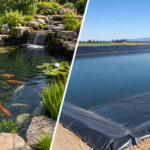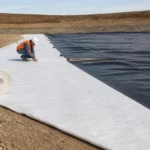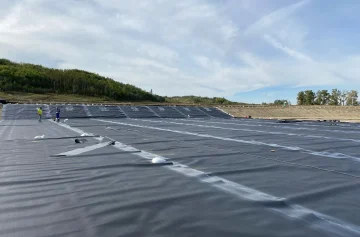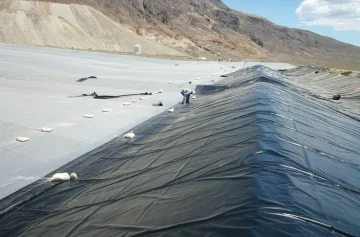
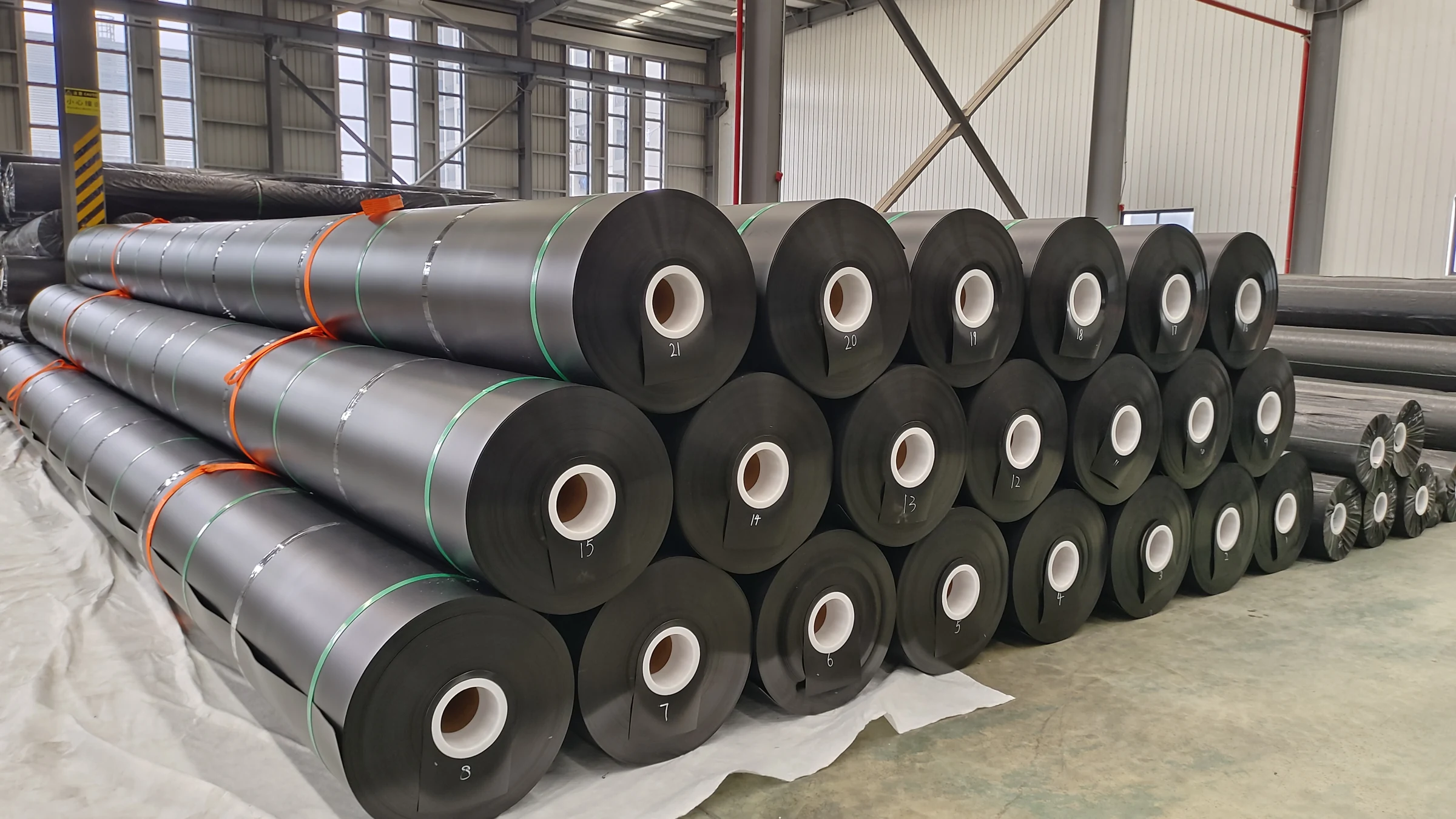
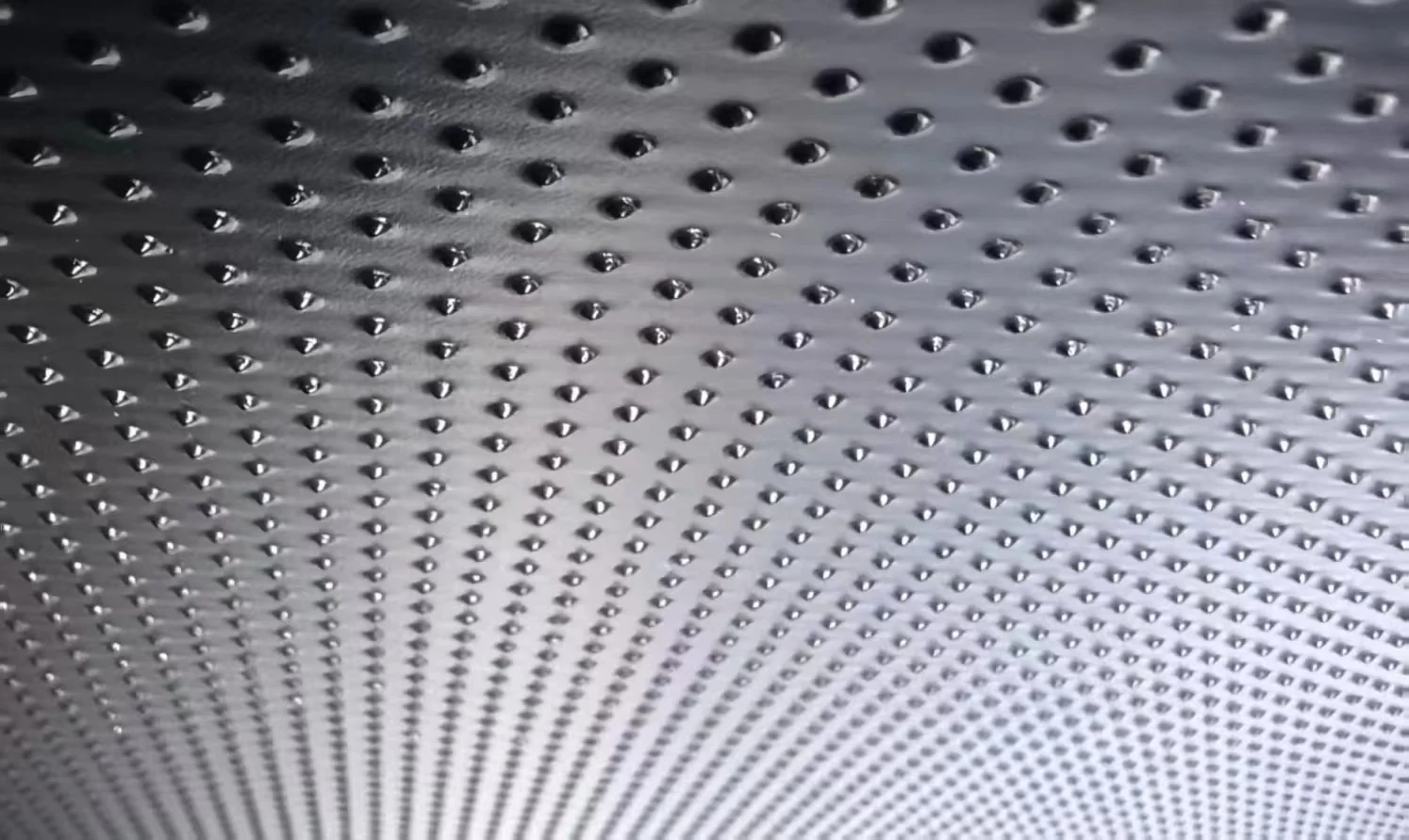
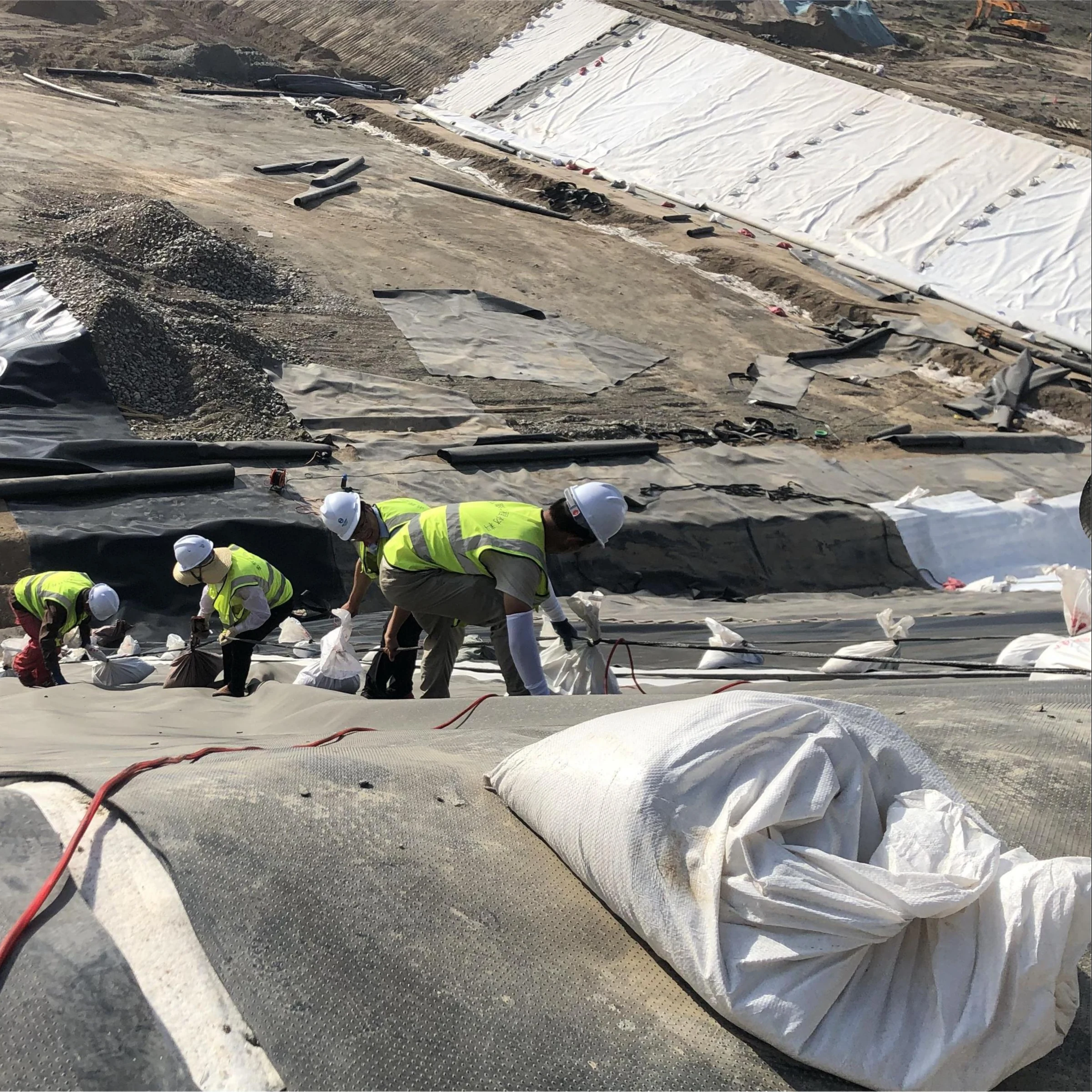
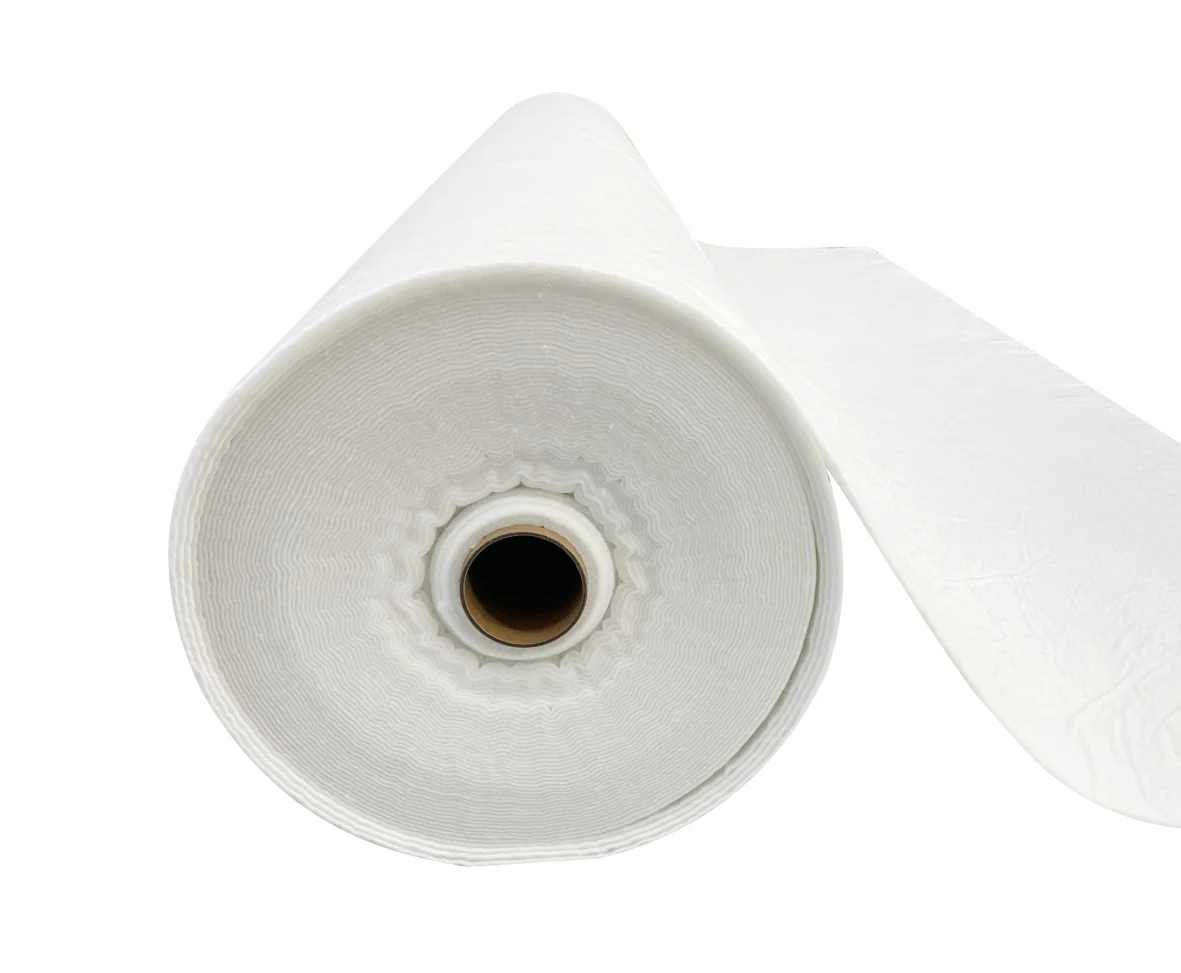

Bentonite-amended soil, geosynthetic clay liner (GCL) and HDPE geomembrane are three different pond-lining systems. Bentonite is incorporated into compacted soil or supplied within a manufactured GCL; HDPE is a welded polymer sheet. Choose between them using the permitted seepage, liquid chemistry, foundation, protective layers and installation quality—not a universal pond-size or water-loss cutoff.
This comparison explains how to assess seepage control, installation quantities, cost and durability. The numerical examples below are calculations with stated assumptions, not Jinseed project results or guaranteed performance.
Bentonite clay vs. geomembrane: what is being compared?
| System | How it controls seepage | What the buyer must establish |
|---|---|---|
| Bentonite-amended compacted soil | A tested soil–bentonite mixture forms a relatively thick, low-permeability layer. | Soil suitability, amendment dosage, moisture, compaction, finished thickness and protection against erosion or drying. |
| Geosynthetic clay liner | A manufactured bentonite layer provides hydraulic resistance after suitable hydration and confinement. | Product construction, compatibility, overlaps, hydration conditions, cover and stability. Bentonite mass and total product mass are different quantities. |
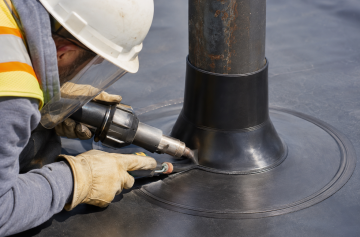
| HDPE geomembrane | The sheet forms a barrier; field seams, penetrations and damage determine much of the installed leakage risk. | Thickness, material specification, subgrade protection, weld qualification, seam testing, repairs and any required leak survey. |
| Composite liner | A geomembrane works with a compatible low-permeability component. | The specified layer contact, interface stability, drainage arrangement and regulatory acceptance. Adding layers does not automatically create an approved design. |
A GCL is not simply loose bentonite spread over the ground. Likewise, a nonwoven geotextile cushion is not itself a waterproof liner. For the distinction between filtration, cushioning and containment, see our geotextile and geomembrane comparison.
Compare seepage under the same hydraulic conditions
For an ideal saturated, homogeneous clay layer, Darcy’s law gives Q = k × i × A, where Q is flow, k is hydraulic conductivity, i is hydraulic gradient and A is flow area. Thickness and head matter: comparing k alone cannot establish that a thin GCL will perform exactly like a thick soil liner.
Consider a flat 10,000 m² liner, 0.3048 m thick, with 2.7432 m of water above it. Assume a freely drained underside at atmospheric pressure, steady one-dimensional flow and no defects. Including the elevation drop through the liner, i = (2.7432 + 0.3048) / 0.3048 = 10. This gives:
| Assumed k | Calculated flux | Flow over 10,000 m² | Equivalent US gallons/acre/day |
|---|---|---|---|
| 1 × 10⁻⁶ cm/s = 1 × 10⁻⁸ m/s | 8.64 mm/day | 86.4 m³/day | About 9,237 |
| 1 × 10⁻⁷ cm/s = 1 × 10⁻⁹ m/s | 0.864 mm/day | 8.64 m³/day | About 924 |
| 1 × 10⁻⁸ cm/s = 1 × 10⁻¹⁰ m/s | 0.0864 mm/day | 0.864 m³/day | About 92 |
These are hypothetical soil-layer calculations, not measured values for any supplied product. Backpressure, unsaturated conditions, cracks and actual material behaviour change the result. A thin GCL also requires its hydrated thickness and suitable test conditions; do not insert the soil thickness from this example into a GCL calculation.
For water-budget conversion, 500 US gallons/acre/day equals approximately 0.468 mm/day, or 4.68 m³/day over 10,000 m². That conversion is useful, but 500 gallons is not a universal threshold that forces every pond to use HDPE. The acceptable loss must come from the project purpose and applicable requirements.
Measure pond leakage separately from evaporation, rainfall, inflows and withdrawals. For example, 1 mm/day of evaporation across 10,000 m² removes 10 m³/day even with an intact liner. A falling water level alone does not identify a seam failure.
Why a hole calculation is not an installed leakage prediction
A free-discharge orifice equation assumes an opening discharging without resistance beneath it. A geomembrane hole against soil or a GCL has a different flow boundary. Hole size, head, contact quality, wrinkles and the supporting layer all matter. A reported tear length does not establish its open area, and hole counts from another site cannot prove a particular installation will leak at that rate.
Check US project requirements before choosing thickness
The NRCS national Code 521, August 2023R, lists HDPE minima of 30 mil for clear water and 60 mil for wastewater. It requires at least 12 inches of soil cover for GCLs, measured perpendicular to the surface. It also addresses GCL compatibility and requires a geofilm/geomembrane for waste-storage GCLs. Consult the applicable local Field Office Technical Guide and approved design; these national values are not universal permission for every pond.
30 mil = 0.762 mm; 60 mil = 1.524 mm. A nominal 1.5 mm sheet should not automatically be described as satisfying a 60 mil minimum. Ask how thickness is specified, measured and accepted, including any minimum and average requirements.
For amended soil, NRCS Code 520, May 2016, gives a 12-inch minimum liner for water depths up to 16 feet; greater thickness may follow from seepage design or local requirements. Its 6-inch maximum lift for bentonite-treated soil is a compaction-layer limit, not permission for a 6-inch total liner. Dosage and construction requirements depend on soil and intended use.
Landfills have different requirements. The prescriptive composite option in 40 CFR §258.40 includes an HDPE minimum of 60 mil and a compacted-soil component at least two feet thick, with specified hydraulic conductivity and direct, uniform contact. This provision concerns covered municipal solid waste landfill units; it is not a general irrigation-pond specification or automatic approval to replace soil with a GCL.
Liquid chemistry: test compatibility instead of applying one cutoff
For a GCL, assess the retained liquid and the contacting soils. Calcium, magnesium, salts and other constituents can affect bentonite behaviour, but one calcium concentration does not establish a universal failure boundary or a fixed tenfold increase in hydraulic conductivity.
For example, 0.0125 mol/L calcium chloride corresponds to approximately 501 mg/L calcium and 1,387 mg/L anhydrous CaCl₂ equivalent. These describe the same example solution on different mass bases. They are not a product acceptance limit, and they should not be confused with hardness expressed as CaCO₃ or total dissolved solids.
ASTM D6766-25 measures GCL flux and hydraulic conductivity using potentially incompatible solutions. It distinguishes prehydration with water from hydration directly with the test liquid. Its stated scope covers geotextile-backed GCLs and excludes products with geomembrane, geofilm or polymer-coating backing. Select a suitable test programme for the actual product construction rather than applying this method indiscriminately.
Request the test liquid composition, temperature, confinement, hydration sequence and acceptance criterion alongside the result. HDPE also needs compatibility evaluation for the actual liquid and temperature; “chemical resistant” does not mean resistant to every mixture at every concentration.
Installation quantities: developed area, seams and cover
Use the developed floor-and-slope area, then add the documented anchorage, seams, penetrations, trimming and repair allowance. Water-surface area is not necessarily the lining area. The following flat-square example shows why a single percentage allowance can be misleading.
Panel-width example for a 100 m × 100 m flat area
Assume straight 100 m strips, 0.15 m longitudinal overlap, no transverse joints and no anchorage. For N panels of width w, covered width = Nw − (N − 1) × 0.15 m. The overlap is an arithmetic assumption, not a recommended detail for all products.
| Panel width | Strips required | Covered width before trimming | Longitudinal seam length | Gross sheet area |
|---|---|---|---|---|
| 8 m | 13 | 102.2 m | 12 × 100 = 1,200 m | 10,400 m² |
| 7 m | 15 | 102.9 m | 14 × 100 = 1,400 m | 10,500 m² |
| 5 m | 21 | 102.0 m | 20 × 100 = 2,000 m | 10,500 m² |
The 8 m layout has 800 m less longitudinal joint length than the 5 m layout under these assumptions. Dividing area by roll width gives only an approximation; it misses the finite panel count and boundary edges. Real GCL and geomembrane overlaps, roll lengths and joint types differ, so compare actual installation drawings.
Freight and earthwork examples
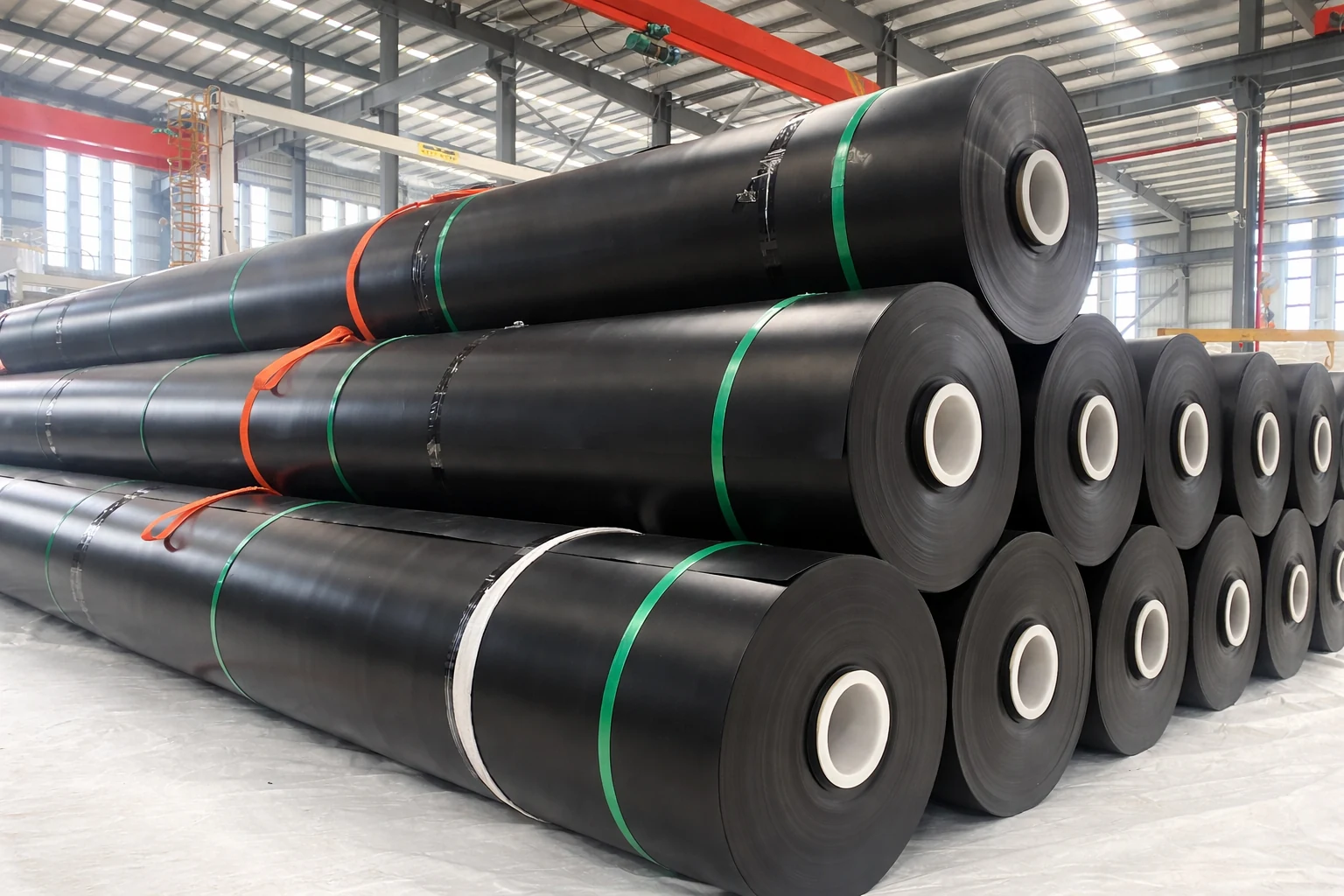
- HDPE: at an assumed 940 kg/m³ density, 1.5 mm smooth sheet weighs 1.41 kg/m². Net 10,000 m² weighs 14.1 tonnes; the illustrative 10,400 m² gross layout weighs 14.664 tonnes before packaging. This thickness example is not a claim of 60 mil compliance.
- GCL: if the selected product’s total mass is 4.8 kg/m², 10,000 m² weighs 48 tonnes before overlaps and packaging. Confirm whether a quoted mass refers to total product or bentonite alone, and its moisture basis.
- Cover: 300 mm across a flat 10,000 m² area requires 3,000 m³ of finished cover. Twelve inches is 304.8 mm and requires 3,048 m³. These are finished geometric volumes; source-material purchase and truck counts require density, compaction and handling factors.
Neither total weight nor nominal roll count alone establishes a safe container-loading plan. Confirm roll dimensions, payload, axle limits and unloading arrangements. Soil-cover placement also needs a method that protects the liner and maintains slope stability.
Installed cost: retain useful evidence without misdating it
A public NRCS New Jersey FY2015 bentonite-sealant cost scenario, compiled in November 2014, priced one acre at $74,626.04 without cover and $81,711.50 with a one-foot cover. Dividing by 4,046.856 m² gives approximately $18.44/m² and $20.19/m². These are historical planning scenarios—not current quotations, national price ranges or evidence that bentonite is always more expensive than HDPE.
Do not compare those installed historical figures with a current factory price for bare membrane. Obtain quotations with the same site area, access assumptions, earthwork, taxes, freight and acceptance scope.
| Cost item | Bentonite-amended soil or GCL | HDPE geomembrane |
|---|---|---|
| Materials and quantities | Tested amendment dose or specified GCL, overlaps and cover. | Specified sheet, seams, cushions and other designed layers. |
| Earthwork | Mixing/compaction or prepared foundation and GCL cover. | Prepared foundation, anchorage, protection and any designed drainage. |
| Installation and verification | Mix uniformity and density/thickness checks, or GCL layout and overlap inspection. | Welding, seam testing, repair records and specified leak-location testing. |
| Operation | Access to inspect and repair erosion, loss of cover or damaged areas. | Access to inspect and repair exposed sheet, penetrations and damage. |
For quotation sensitivity, every $1/m² change in an item applied to 10,000 m² changes that subtotal by $10,000. A $5/m³ change in the rate for 3,048 m³ of cover changes it by $15,240. These calculations help identify which local prices deserve firm quotes without inventing a current market range.
Durability: distinguish a model, a design period and a warranty
HDPE ageing depends on formulation, temperature, exposure and stress. GCL and amended-soil performance depends on chemical compatibility, confinement, hydration, wet–dry conditions and physical protection. Long service is possible only if the selected system suits its environment and remains intact.
The Geosynthetic Institute’s paper on geosynthetic lifetime prediction discusses accelerated testing and extrapolation. Such estimates are conditional models, not proof that every pond liner will last 70 or 150 years. A manufacturer’s warranty is a separate written commitment with its own conditions and exclusions.
Specify the intended service period, operating temperature, exposure, inspection access and repair strategy. Require the supplier to identify supporting data for the proposed grade. Laboratory ageing results cannot compensate for an untested weld or a damaged pipe penetration.
Which pond liner should you shortlist?
- Consider amended soil when suitable soil and earthwork resources are available, and a tested mixture and constructible thickness can meet the seepage requirement.
- Consider GCL when the product can be hydrated, confined and protected appropriately, compatibility is demonstrated, and overlap and slope details are practical.
- Consider HDPE when a welded-sheet barrier meets the project needs and qualified installation, protection and verification can be provided.
- Evaluate a composite system when the risk assessment or specification calls for combined barriers. Confirm the design and regulatory route rather than treating the second material as an automatic upgrade.
Frequently asked questions
Can bentonite be added to a leaking pond without draining it?
That depends on the leak mechanism and the proposed treatment. Adding loose material does not prove it reaches the leak or forms a uniform compacted barrier. Diagnose the leak and obtain a suitable repair method; do not assume a broadcast application reproduces a designed soil–bentonite liner.
Does a GCL automatically self-seal every puncture?
No. Bentonite swelling can help with limited local discontinuities under favourable conditions, but major damage, poor confinement, incompatible liquid or failed overlaps require assessment and repair. Use the product’s documented repair procedure.
Is HDPE always the cheapest option?
No. Compare delivered and installed systems with identical scope. Local soil availability, cover earthwork, specialist labour, geometry and verification can outweigh the difference in sheet price.
What should I send for a Jinseed quotation?
Send the pond use and location, liquid composition and temperature, maximum depth, developed lining area, slopes, subgrade and groundwater information, specified thickness, protective layers, acceptance tests and delivery destination. Include the installation drawing when available. Request a material and shipping quotation with clearly separated inclusions and exclusions.
Sources are linked beside the relevant statements. Calculations are illustrative; no project performance, current-price guarantee or professional review is implied.