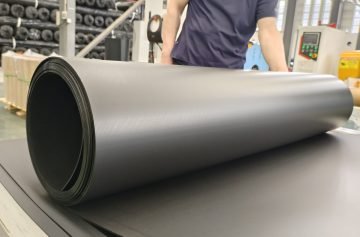
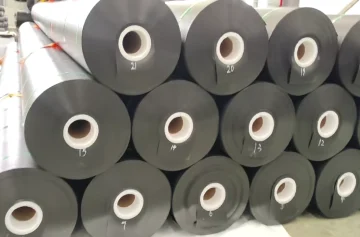
A secondary containment liner budget starts with purchase area × quoted sheet price per m², then adds freight, installation, protection layers, and quality assurance where these are not already included. For the rectangular bund calculated below, allow about 300 m² of sheet, so the material subtotal is 300 × your quoted price per m². That is not the installed project total.
There is no verified, dated supplier quotation behind this example, so it does not give a dollar-per-m² range. A useful price needs a material specification, delivery location, currency, validity date, and installation scope. The calculation below shows how to turn that quote into a budget without confusing sheet cost with the cost of a working containment system.
What should a secondary containment liner quote include?
| Price basis | Included scope to confirm | How to compare it |
|---|---|---|
| Sheet price per m² | Specified polymer, thickness, surface, roll dimensions, and manufacturing standard; state whether freight is included | Multiply by purchase area, including the agreed cutting and overlap allowance |
| Installed liner package | Sheet, delivery, deployment, seams, penetration details, protection layers, testing, and supervision as expressly listed | Compare the package total and exclusions; if expressed per m², use the same net lined area |
| Whole containment project | Liner package plus earthworks or concrete construction, drainage, engineering, permits, and contingency where applicable | Compare the complete project scope, not the sheet rate alone |
Add only items excluded from the quoted package. A delivered sheet price already includes the stated freight leg; a lump-sum installation offer may already include mobilisation and testing. Ask for those boundaries in writing before adding separate allowances.
How does thickness affect material cost?
At the same density, a thicker sheet contains more material per square metre. GRI-GM13 Revision 16 covers HDPE geomembranes with a formulated sheet density of at least 0.940 g/cm³ and thicknesses from 0.75 to 3.0 mm. It is a manufacturing quality-control specification, not a complete design specification for every chemical-containment application. [1]
| Nominal thickness | Rounded mil equivalent | Calculated mass at 0.940 g/cm³ |
|---|---|---|
| 0.75 mm | 30 mil | 0.71 kg/m² |
| 1.00 mm | 39 mil | 0.94 kg/m² |
| 1.50 mm | 59 mil | 1.41 kg/m² |
| 2.00 mm | 79 mil | 1.88 kg/m² |
| 2.50 mm | 98 mil | 2.35 kg/m² |
| 3.00 mm | 118 mil | 2.82 kg/m² |
The mass calculation is density in g/cm³ multiplied by thickness in mm, illustrated for uniform smooth sheet. These are calculated values, not measured roll weights or guaranteed textured-sheet masses. One mil is 0.001 inch; the conversions use 25.4 mm per inch and are rounded to the nearest mil. Specify the contractual thickness and unit rather than treating metric and customary nominal sizes as exact equivalents.
Changing from 1.5 to 2.0 mm adds 0.47 kg/m² at the assumed density, about 33% more material. Across the illustrative 300 m² order, that is 141 kg extra. It does not establish a 33% increase in sheet price or installed cost: conversion costs, order quantity, freight, and site work still need quoting.
A quote for HDPE liner to GM13 is not interchangeable with one for LLDPE liner to GM17. GM17 is the corresponding manufacturing specification for LLDPE; material selection still needs project-specific compatibility and design review. [2]
For comparable offers, identify the specification revision and required test reports. GM13 distinguishes smooth-sheet thickness under ASTM D5199 from textured-sheet core thickness under ASTM D5994. Its tables use D4218 for carbon black, with D1603 permitted where an appropriate correlation is established, and D8117 for standard OIT or D5885 for high-pressure OIT. These are not interchangeable test conditions or a guarantee of chemical resistance. [1]
How much sheet does a tank bund need?
For a rectangular basin with a flat floor and vertical walls, the simplified lined area is length × width + 2 × (length + width) × lined wall height. This example assumes an unobstructed 20 m × 10 m internal floor, 1.2 m lined walls, and no separately measured anchor trenches or penetrations.
| Quantity | Calculation | Result |
|---|---|---|
| Floor | 20 × 10 | 200 m² |
| Walls | 2 × (20 + 10) × 1.2 | 72 m² |
| Net lined area | 200 + 72 | 272 m² |
| Illustrative purchase allowance | 272 × 10% | 27.2 m² |
| Estimated purchase area | 272 + 27.2 | 299.2 m², rounded to about 300 m² |
The 10% allowance is an estimating assumption, not a standard wastage factor. A panel layout must check roll widths, seam overlaps, cuts, terminations, and anchorage. Anchor-trench dimensions, sumps, plinths, and pipe details require a drawing-based takeoff; they are not automatically covered by this percentage. Any minimum full-roll purchase can also change the quantity billed.
Sloped walls need their actual slope lengths, not vertical heights, in the area calculation. If textured liner is specified, have the designer establish the interface shear requirements; surface texture alone does not prove slope stability.
What does the worked estimate reveal?
Using only the 200 m² floor would omit 72 m² of wall lining. The walls add 36% to the floor-only quantity before any purchase allowance. With the rounded 300 m² order, the sheet budget is 1.5 times a floor-only estimate at the same quoted rate.
If the quoted sheet price is P per m², the material subtotal is approximately 300P. Dividing that subtotal by the 272 m² net lined area gives about 1.103P per net lined m², before freight and site work. This explains why a purchase-area rate and a finished-area rate can differ even when both quotations use the same sheet price.
This is a transparent estimating scenario, not a completed Jinseed project, field test, or customer saving. It demonstrates the quantity checks a buyer can reproduce; actual installation experience must be supported by project records rather than inferred from this calculation.
How do capacity and rainfall affect the budget?
The empty example basin has a gross geometric volume of 20 × 10 × 1.2 = 240 m³, about 63,400 US gallons. That is not its usable oil-storage allowance: rainfall freeboard and relevant tank, foundation, or equipment displacement must be accounted for. EPA’s worked examples calculate net dike capacity by subtracting displacement from gross capacity. [3]
For bulk storage installations covered by 40 CFR 112.8(c)(2), subject to its stated exceptions, secondary containment must accommodate the entire capacity of the largest single container plus sufficient freeboard for precipitation. Diked areas must be sufficiently impervious to contain discharged oil. This U.S. provision is not a universal sizing rule for every chemical, wastewater, or production facility. [4]
The capacity check is gross containment volume − relevant displacement ≥ required spill volume + precipitation allowance. Displacement reduces available space; it must not be subtracted from the required spill allowance. The site’s designer must determine which occupied volumes count for the failure scenario. [3]
For arithmetic only, 100 mm of rain over a 200 m² horizontal catchment contributes 20 m³, about 5,280 US gallons. It is not a prescribed design storm. Actual catchment, rainfall basis, drainage arrangements, and local requirements must be established before fixing the bund geometry and liner takeoff. A secondary containment design for oil and gas ponds needs its own applicable regulatory scope.
Which installation items need separate pricing?
Provide the stored liquid, concentration, temperature, and expected contact duration so the designer can assess compatibility of the sheet and details. Neither pH alone nor a GM13 or GM17 designation establishes suitability for a particular chemical. A secondary containment liner RFQ should connect that exposure information to the drawings and acceptance requirements.
| Cost item | What the quotation should define |
|---|---|
| Subgrade and protection | Surface preparation, acceptance criteria, and any geomembrane protection geotextile or cover system required by the design |
| Anchors and terminations | Excavation, backfill, compaction, mechanical fixings, and interfaces with existing concrete |
| Penetrations and repairs | Number, diameter, location, approved sealing detail, and access for each pipe or obstruction |
| Welding and testing | Mobilisation, trial seams, production seams, applicable nondestructive and destructive tests, repairs, and retests |
| Construction quality assurance | Inspection responsibility, roll traceability, seam records, test reports, and handover documents |
| Drainage and leak detection | Valves, sumps, any detection layer or second liner, and their interfaces with the containment system |
| Commercial exclusions | Freight endpoint, unloading, taxes, standby time, extra-work rates, and contingency responsibility |
Do not assume every penetration uses the same boot or that every seam receives all possible test methods. The approved detail and construction quality-assurance plan should define the applicable welding and seam-testing work. Installation, inspection, and testing must be performed by suitably qualified personnel under applicable local codes and project specifications.
Where §112.8(b)(2) applies, diked-area drainage valves must be of manual, open-and-closed design, not flapper type. The rainwater bypass provisions also require inspection, supervised drainage, resealing, and records. These drainage obligations are separate from geomembrane seam acceptance. [4]
How can you compare offers without buying a lower specification?
Give bidders one material schedule, panel takeoff, penetration schedule, and testing scope. Compare the complete included total in the same currency and delivery terms, not whichever sheet rate looks lowest. Small or phased jobs may carry a larger mobilisation cost per m²; ask bidders to state the number of visits and any minimum charges rather than assuming a universal rate.
Check net lined area against purchase area, confirm whether rolls are billed by m² or by mass, and match the thickness and surface before comparing prices. If a supplier quotes by mass, use its stated roll mass and area to reconcile the offer. The calculation above is not a substitute for a textured product’s actual commercial weight basis.
Before reducing thickness to lower cost, have the designer approve the change. The useful saving may instead come from a revised panel layout or fewer site visits, but neither should remove necessary anchorage, compatible details, protection, or testing.
What should you send for a project quotation?
- The liquid’s safety data sheet, concentration, temperature, and expected contact duration.
- Approved bund geometry, capacity basis, rainfall allowance, and a drawing-based liner takeoff.
- Subgrade condition, protection requirements, access constraints, and the penetration and termination schedules.
- Material specification, thickness, surface, quality-assurance scope, delivery destination, currency, and required quotation validity.
For a Jinseed material enquiry, identify whether the design calls for HDPE, LLDPE, single- or double-sided textured HDPE, or PET nonwoven geotextile. Ask the supplier to state which materials and services its offer actually includes; a sheet quotation is not evidence of a turnkey installation contract.
Need a material quotation for your containment design?
Send the drawings, stored-liquid details, material specification, and delivery destination. Ask Jinseed to identify the included quantities, delivery terms, and exclusions.
References
- Geosynthetic Research Institute, GRI-GM13, Revision 16, March 17, 2021. Scope and smooth/textured HDPE manufacturing test tables. Consulted November 10, 2026.
- Geosynthetic Research Institute, GRI-GM17, Revision 14, March 17, 2021. LLDPE smooth and textured geomembrane manufacturing specification. Consulted November 10, 2026.
- U.S. EPA, SPCC Guidance for Regional Inspectors, Chapter 4. December 16, 2013; Figure 4-6 illustrates gross capacity, tank displacement, net capacity, and precipitation freeboard. Consulted November 10, 2026.
- 40 CFR 112.8. Bulk storage containment under paragraph (c)(2), drainage valves under (b)(2), and rainwater bypass provisions under (c)(3). Text checked for November 6, 2026, through the eCFR API on November 10, 2026.