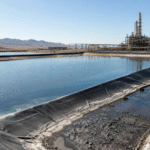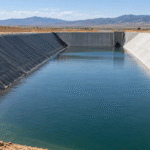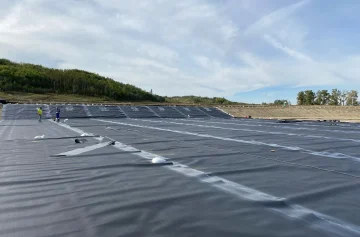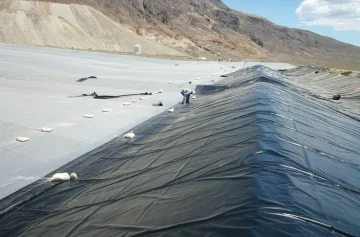
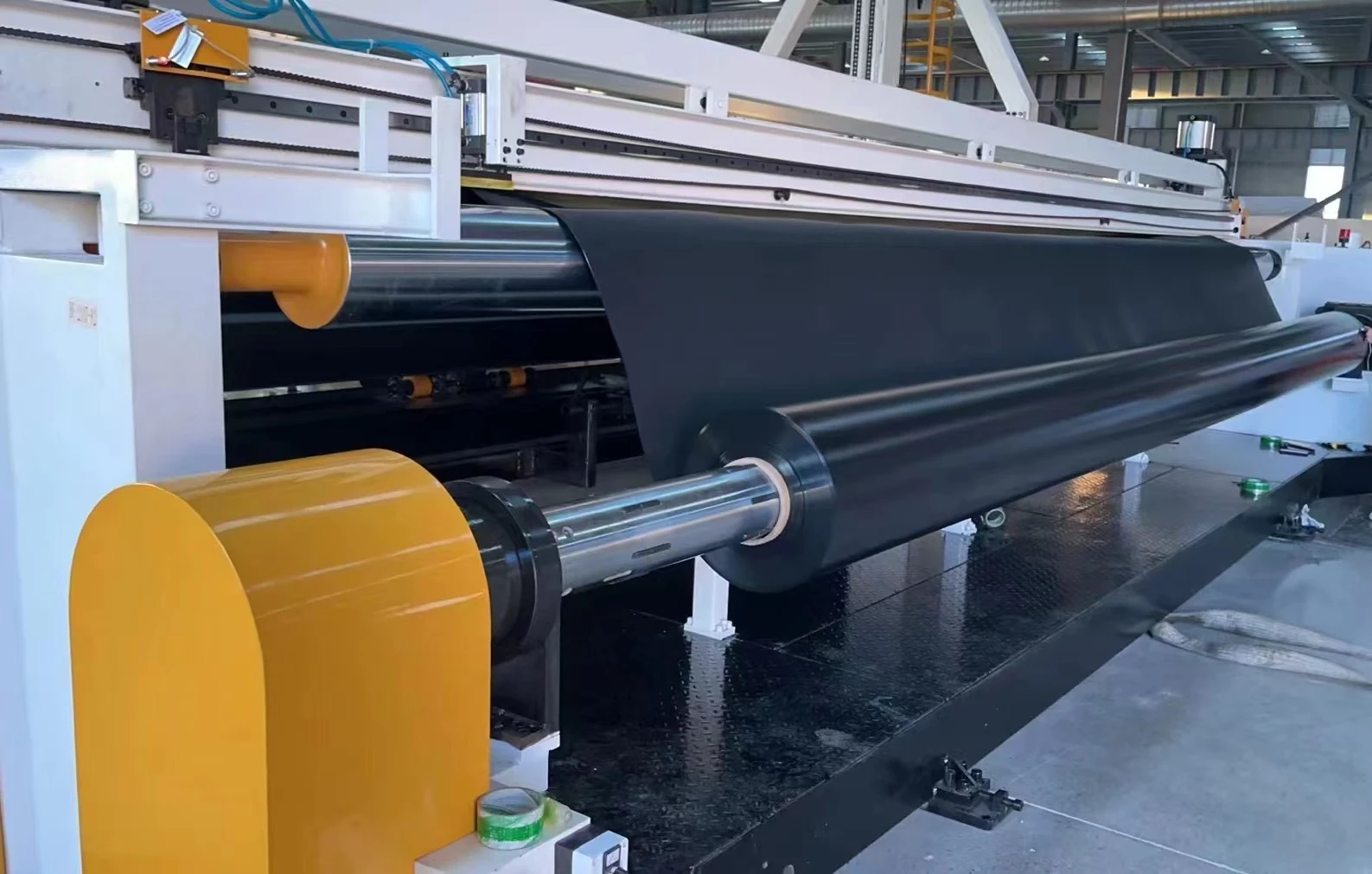
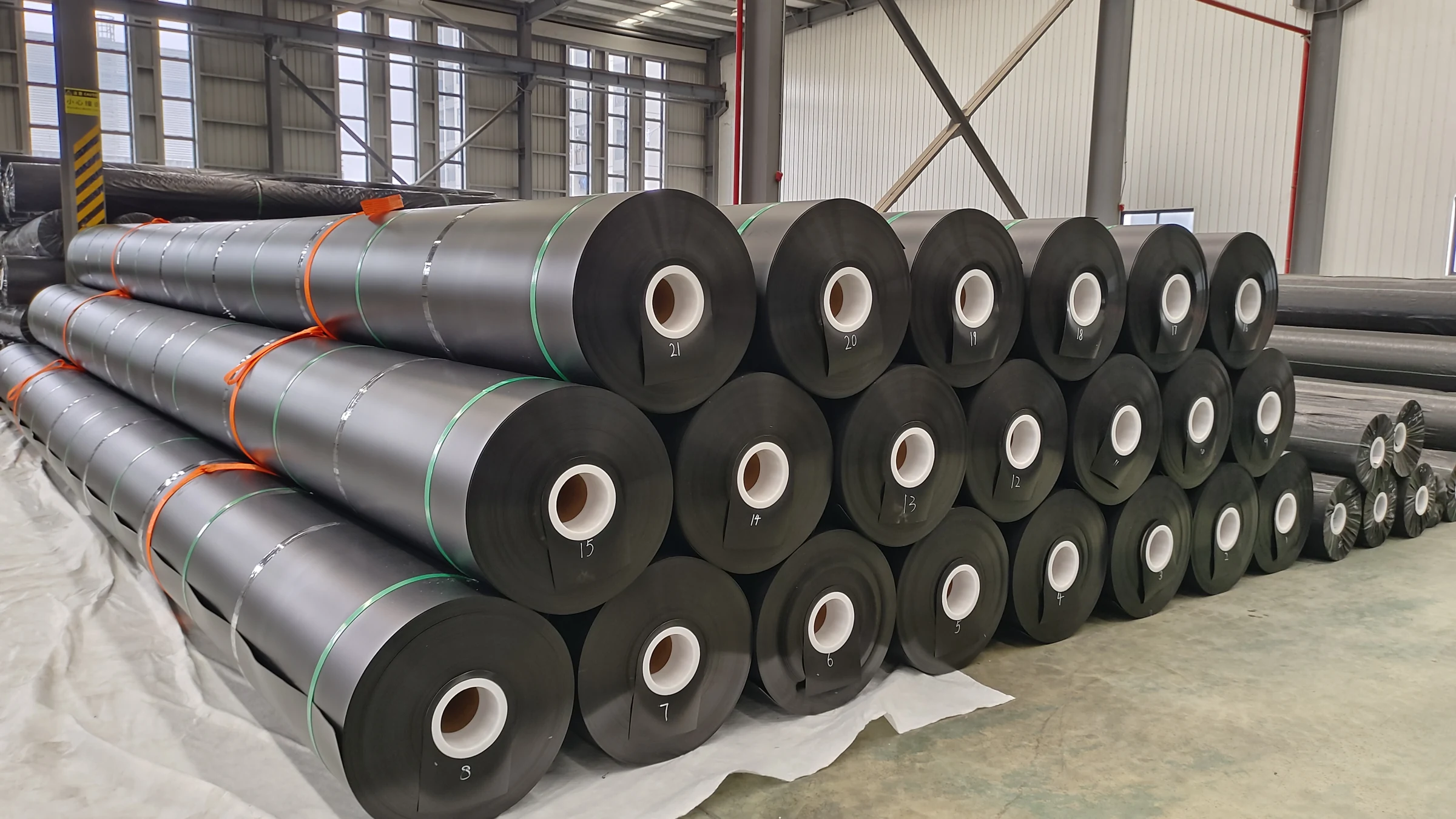
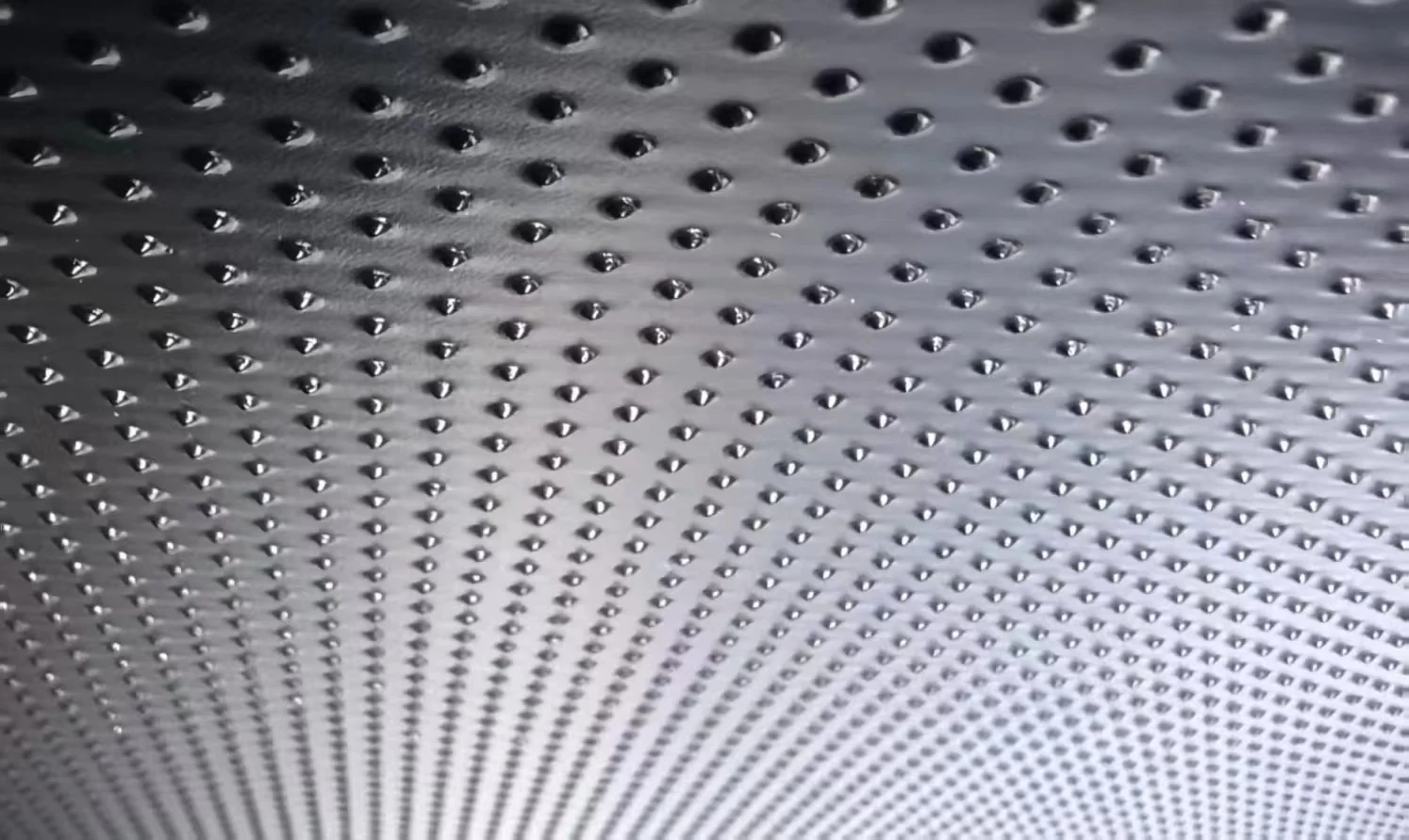
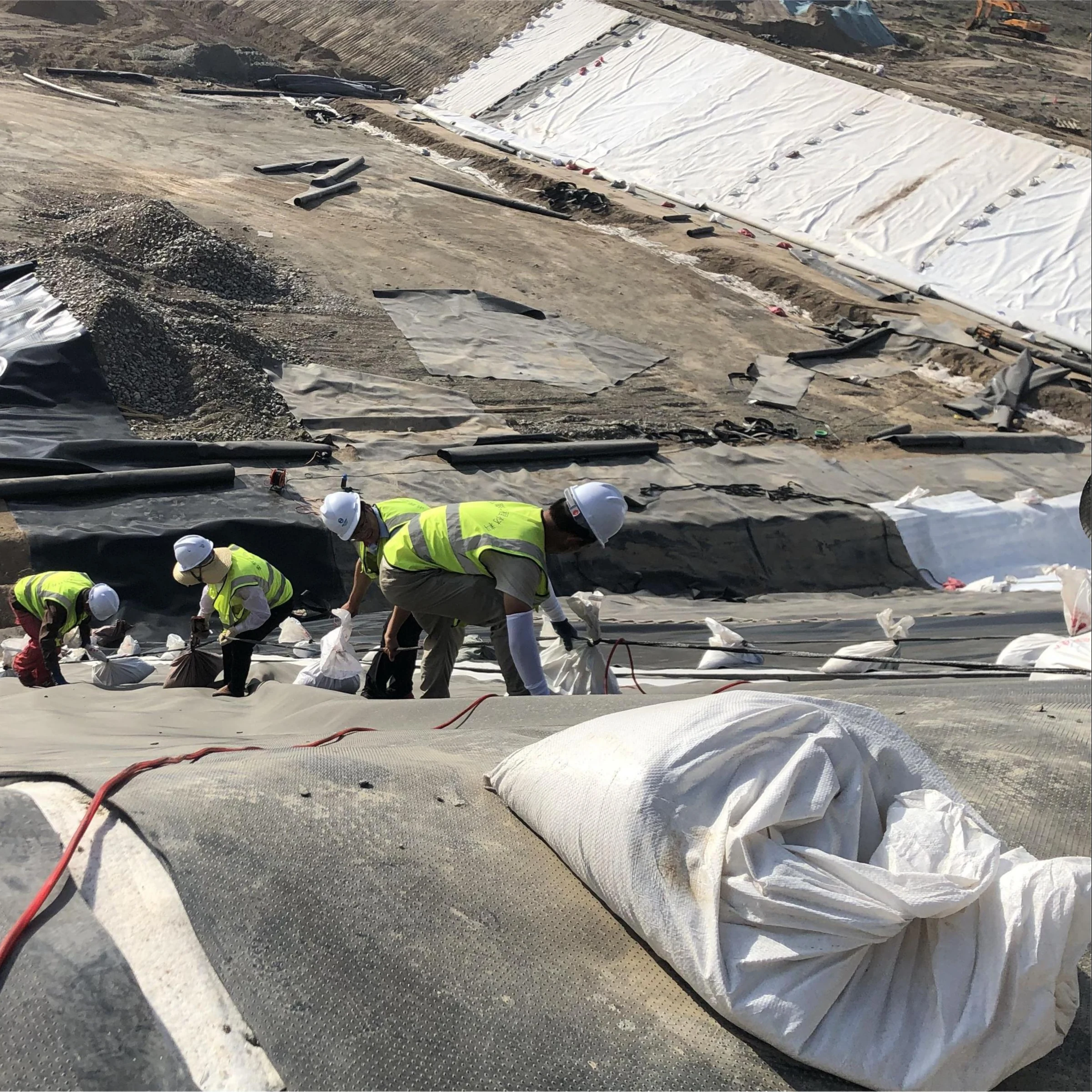
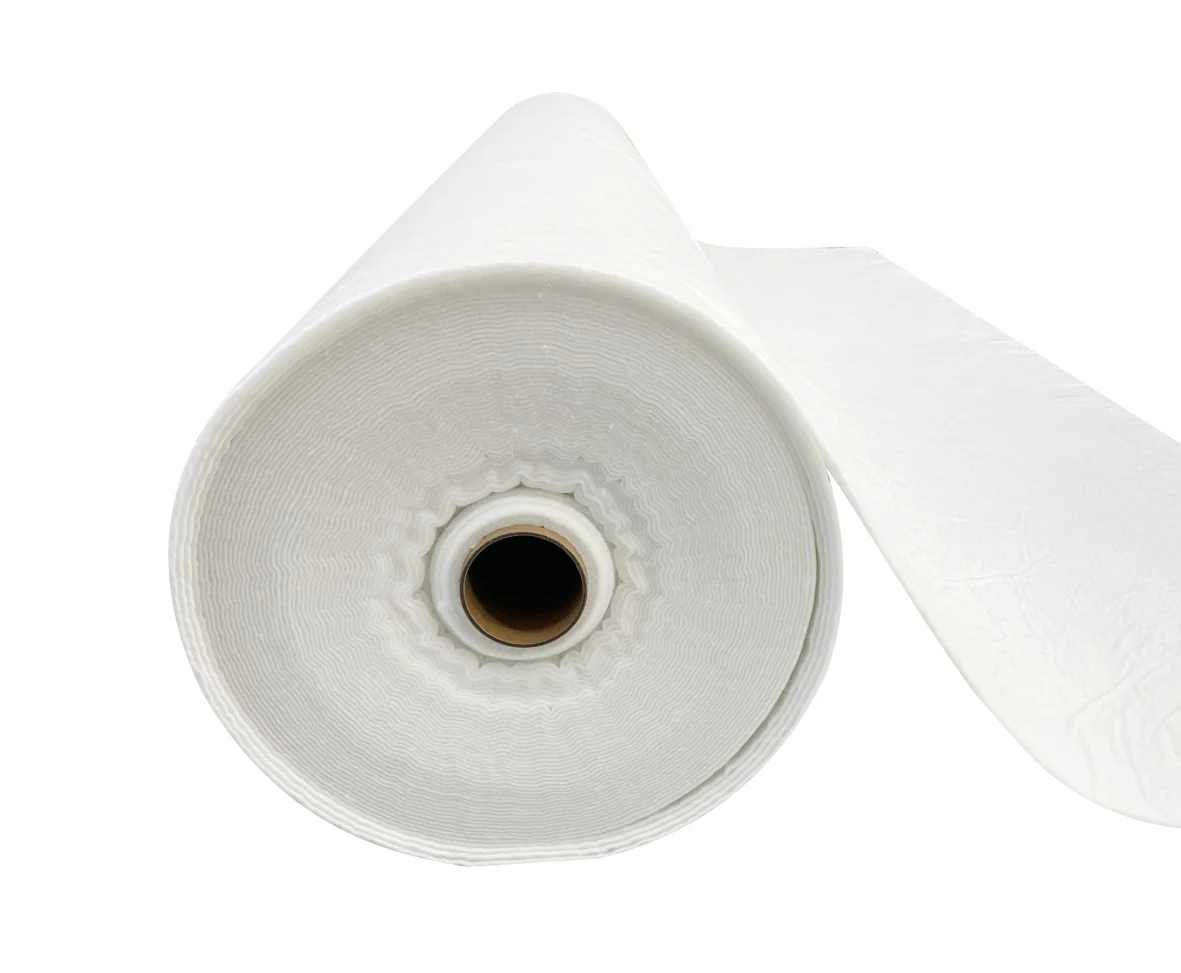

A geotextile is a permeable fabric; a geomembrane is a low-permeability barrier. A geotextile can separate soils, filter water or protect a liner from local damage. A geomembrane limits liquid or gas migration when the sheet, seams, penetrations and supporting system are properly specified and installed. They often work together, but one does not replace the other.
For a pond or containment project, start with the required function and layer arrangement. Then select the fabric properties and membrane properties separately. “600 g/m² fabric plus 1.5 mm HDPE” is a possible combination to evaluate, not a design that is automatically suitable for every reservoir, landfill or mine.
What each material does
Geotextiles include woven and nonwoven products made from different polymers. Jinseed’s PET non-woven geotextile is one product family, not the definition of all geotextiles. Filtration requires water to pass through while retaining the relevant soil particles. Separation keeps adjacent materials from mixing. Protection reduces local stress on a geomembrane; reinforcement requires a separately designed tensile function.
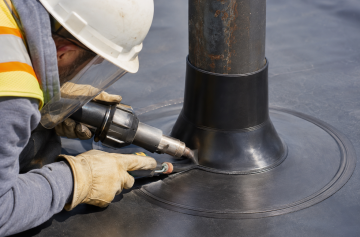
An HDPE geomembrane is a continuous polymer sheet. It does not have a filter opening size to select. Its material formulation, thickness, chemical compatibility and seam system matter, as do construction damage and the details around pipes and anchors. A thicker sheet is not a substitute for sound subgrade preparation or seam inspection.
| Question | Geotextile | Geomembrane |
|---|---|---|
| Should water cross the material? | Yes, when performing filtration; check soil retention and flow together. | The containment objective is to limit migration; evaluate the complete barrier system. |
| What does the nominal size describe? | Mass per unit area, such as 300 or 600 g/m², identifies weight rather than all performance properties. | Thickness, such as 1.5 or 2.0 mm, identifies one physical property rather than chemical or installation suitability. |
| Can it protect a liner? | A suitable protection geotextile may reduce local damage; verify it with the proposed aggregate and load. | The liner itself must withstand the designed stresses and installation conditions. |
| Can it drain laterally? | Check in-plane flow under load; through-plane flow alone does not establish drainage capacity. | A separate drainage layer is normally needed where lateral water collection is required. |
| What can go wrong? | Clogging, soil loss, installation damage, unsuitable joins or inadequate protection. | Holes, defective seams, unsuitable chemical exposure, movement, uplift or poorly detailed penetrations. |
Water flow: distinguish filtration from drainage
A geotextile’s through-plane flow describes water crossing its thickness. ASTM D4491 reports water permeability by permittivity; ASTM D4716 addresses in-plane flow and transmissivity. These are different measurements. A fabric with a high clean-water flow result may still clog against a particular soil, and a compressible fabric may lose lateral flow capacity under load. See the D4491 scope and D4716 scope.
For a calculation example, assume a measured flow of 30 L/s per m² at a 50 mm head. That is a flow velocity of 0.030 m/s and an approximate permittivity of 0.030 ÷ 0.050 = 0.60 s⁻¹. If the corresponding specimen thickness is 4.4 mm, the equivalent normal hydraulic conductivity is approximately 0.60 × 0.0044 = 0.00264 m/s, or 0.264 cm/s. These are illustrative inputs, not a guaranteed result for every 600 g/m² fabric. Thickness, conditioning, head and test procedure must match the report.
This calculation does not establish a geomembrane’s leakage rate. Nor should the compacted-soil conductivity limit in a landfill regulation be copied into a membrane data sheet. Polymer permeation and leakage through defects require different evaluation.
Test methods stay separate
A geotextile tensile result and a geomembrane tensile result can both be written in kN/m without being interchangeable. Specimen geometry, loading procedure and reported endpoint matter. For membranes, distinguish yield from break where applicable. For textiles, distinguish wide-width tensile strength from a grab breaking load.
| Property | Geotextile checks | Geomembrane checks |
|---|---|---|
| Tensile behavior | ASTM D4595 wide-width or D4632 grab, as specified; preserve the method’s units. | ASTM D6693 for relevant nonreinforced polymer sheets; distinguish yield and break. |
| Puncture | ASTM D6241 uses a 50 mm probe for an index result. | ASTM D4833 is an index puncture test. Do not equate its force directly with a D6241 value or a field stone load. |
| Opening size | ASTM D4751 apparent opening size and ISO 12956 characteristic opening size use different procedures; identify the method with the result. | A filter opening-size specification does not apply to an intact geomembrane sheet. |
| Hydraulic behavior | Through-plane permittivity and in-plane transmissivity are different properties. | Evaluate material compatibility, permeation where relevant, and installed barrier integrity. |
| Thickness | Identify the measuring pressure and method because nonwoven fabrics compress. | Use the appropriate smooth-sheet or textured-sheet procedure and the acceptance criteria in the order. |
| Interface shear | Test the actual material pair and relevant normal stresses and moisture conditions. Neither product has a universal interface friction angle. | |
| Oxidation resistance | Requirements depend on polymer, exposure and the product specification. | Where specified, distinguish standard OIT from high-pressure OIT. They do not directly report service life. |
Do not label every opening-size result “O90.” Use the terminology and method stated in the laboratory report. Relevant primary references are ASTM D4751 and ISO 12956. ASTM D8117 measures oxidative induction time by differential scanning calorimetry, not thermogravimetric analysis; see its official description.
GRI-GM13 provides manufacturing quality-control requirements for HDPE geomembranes. Its thickness criteria are not a blanket “±10%” allowance, and ASTM D5199 does not itself grant a universal ±3% product tolerance. Ask for the applicable revision, nominal thickness, minimum average and individual acceptance limits. A claimed 2,000-hour stress-crack result or tighter thickness tolerance needs a matching product specification and report. See the GRI-GM13 specification.
Where the layers belong in a composite liner
A protection fabric does not belong under every geomembrane by default. In the prescriptive composite-liner option for applicable new U.S. municipal solid-waste landfill units and lateral expansions, 40 CFR 258.40 specifies direct, uniform contact between the membrane and compacted soil. Putting an unapproved fabric between those components changes that detail.
That option specifies a membrane of at least 30 mil, or at least 60 mil for HDPE, over at least 2 ft of compacted soil with hydraulic conductivity no greater than 1 × 10⁻⁷ cm/s. The section also provides an approved alternative design route. These requirements are not universal rules for ponds or mines. Read 40 CFR 258.40 alongside the applicable permit.
One mil is exactly 0.0254 mm. Therefore, 60 mil is 1.524 mm; 1.5 mm is about 59.06 mil. Rounding does not demonstrate compliance with a specified minimum. Put the required nominal grade and acceptance criteria in the purchase order.
| Application | Possible geotextile role | Key system check |
|---|---|---|
| Pond or reservoir | Protection between approved subgrade and membrane, or above the liner beneath cover. | Subgrade damage, water head, groundwater uplift, exposed conditions and protection details. |
| Landfill base | Protection above the membrane, or filtration associated with a drainage layer where designed. | Approved composite-liner contact, leachate drainage, loading and construction quality assurance. |
| Double-liner containment | Protection or filtration in specified positions. | Separate primary barrier, leak detection and secondary barrier functions; no universal seven-layer arrangement. |
| Heap leach pad | Protection where testing establishes its suitability. | Chemical compatibility, ore and drainage loads, interface shear and solution collection. |
| Canal or tunnel | Protection, separation or a drainage-related function. | Actual concrete/substrate condition, seams, joints, water path and required flow under load. |
| Road or French drain | Separation or filtration, often without a geomembrane. | Do not add a barrier where the intended function is to let water drain. |
Choosing fabric weight and membrane thickness
Use product mass as a procurement descriptor, then check the performance requirements. A 300, 600 or 800 g/m² protection fabric cannot be selected solely from the largest stone size. Aggregate angularity, contact geometry, sustained load, liner thickness and installation methods influence the result. A system-specific protection assessment or test section is more useful than comparing two index puncture forces.
Hydrostatic pressure remains a useful first calculation. For fresh water at an assumed density of 1,000 kg/m³, p = ρgh gives approximately 49 kPa at 5 m and 98 kPa at 10 m. These pressures do not convert directly into a required liner thickness: support, local voids, penetrations, uplift and applied cover loads also matter.
A 2:1 horizontal-to-vertical slope has an angle of about 26.6°. Selecting a textured liner does not establish a 30° interface friction angle or prove stability. ASTM D5321 interface testing produces results for the tested material pair and conditions. The design must consider the relevant resistance, drainage and required safety margin.
For further specification checks, see our guides to soil retention and filter openings and geotextile protection beneath geomembranes.
Quantity and shipping: keep the assumptions visible
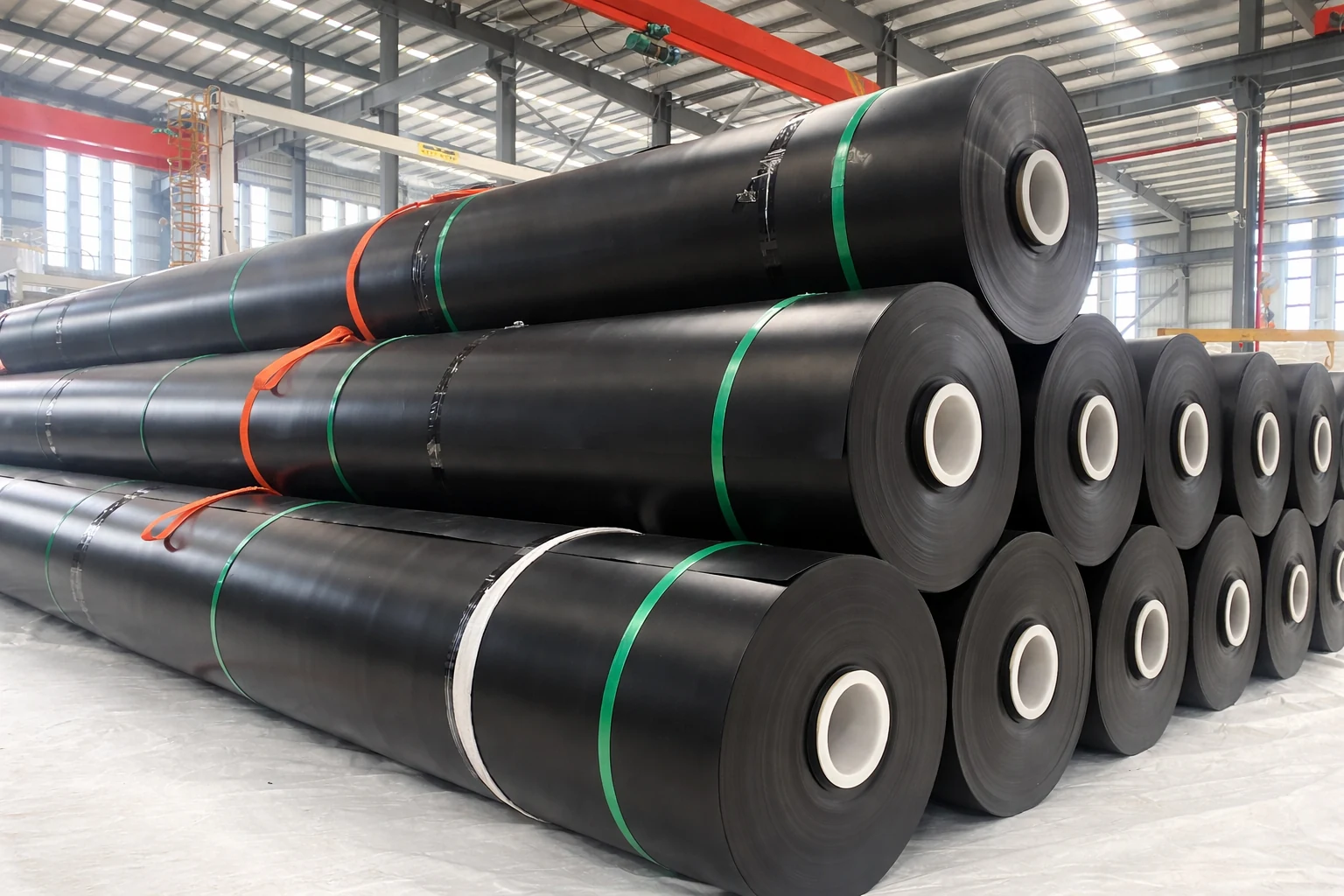
For an illustrative 1.5 mm sheet, using an assumed density of 940 kg/m³ gives 0.0015 × 940 = 1.41 kg/m². This is a planning assumption, not a declaration that the formulation meets GM13 density requirements. An 8 m × 140 m roll contains 1,120 m² and about 1,579 kg of sheet, before the core, wrapping and dimensional variation.
A flat net area of 15 hectares is 150,000 m². Dividing by 1,120 m² gives 133.93, rounded up to 134 rolls only before overlaps, slopes, anchors, penetrations and trimming. Those 134 full rolls contain 150,080 m² and approximately 211.61 tonnes of sheet under the stated assumption. They are not a final procurement quantity.
At 600 g/m², one protection layer over the net 150,000 m² adds 90 tonnes, again before allowances. Per 1,000 m², fabric masses are 0.3 tonnes at 300 g/m², 0.6 tonnes at 600 g/m² and 0.8 tonnes at 800 g/m². Two protection layers double the net fabric area before their individual allowances.
Container count cannot be calculated from area alone. If a loading plan accommodates 15–17 of the illustrative membrane rolls, 134 rolls would need 8–9 loads by roll count. At 17 rolls, sheet mass alone is about 26.85 tonnes per load. Packaging, payload limits, roll arrangement, lifting clearance and destination transport rules can change the result. An 8 m roll cannot fit across the width of a conventional container; orientation and loading method must be confirmed.
A 50-year assumed service period must not become a product-life claim. Dividing 1.41 kg/m² by 50 yields 0.0282 kg/m² per year mathematically, but that ratio does not demonstrate durability, replacement frequency or environmental impact. Keep life-cycle assumptions separate from verified test results.
Installation and delivery checks
- Check the approved layer drawing. Confirm which layer filters, which drains, which protects and which contains. Avoid inserting a textile where direct barrier-to-soil contact is required.
- Prepare and accept the subgrade. Specify the compaction method, target and moisture condition; “above 90%” without a reference test is incomplete.
- Follow the joining and deployment procedure. Fabric overlaps and membrane overlaps serve different purposes. A single 150 mm value, or a fixed thermal slack percentage, is not suitable for all materials and conditions.
- Qualify seams and inspect the installation. Set welding and testing parameters for the material, thickness, machine and conditions. Air-channel testing applies to suitable dual-track seams; it does not test every seam type or every area of sheet.
- Match supplied rolls to the order. Record product, batch, dimensions and relevant test results. Confirm test frequencies rather than assuming every roll was subjected to every long-duration laboratory test.
- Protect materials during storage and covering. Follow the handling instructions and inspect for damage. Accelerated UV or oxidation results do not translate directly into a guaranteed number of outdoor service years.
What to send with an enquiry
Send the application, layer drawing, retained liquid and temperature, maximum head, subgrade/aggregate details, slope, specified material and acceptance requirements, developed area, roll-size restrictions and destination. If the drawing calls for 1.5 mm sheet and 600 g/m² fabric, include those values and identify whether they are fixed requirements or options under review.
Jinseed can then identify candidate products and prepare the quantity and loading proposal for the project team’s review. Confirm minimum order, lead time, test documentation and any special compatibility or certification requirements in the written quotation. Send your specification for a product and shipping quotation.
Technical references are linked beside the relevant discussion. Calculated examples state their inputs and do not constitute a project design, a batch test report or a service-life warranty.