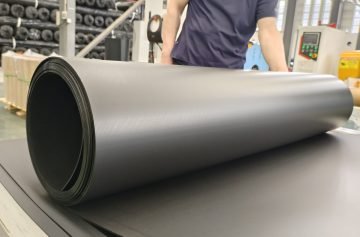
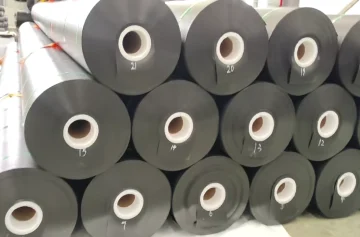
Geotextile cost per m2 depends on the specified fabric, order quantity, and delivery terms. To check a quotation, divide the roll price by its gross area. To budget the installed cost per covered m2, divide the material bill plus any separately charged freight, installation, testing, and taxes by the net area covered.
For example, a 6 m by 50 m roll contains 300 m2. Its material price per purchased m2 is the roll price divided by 300. If you must buy that entire roll for a 200 m2 job, the material cost per covered m2 is the roll price divided by 200: 1.5 times the quoted material rate, before other charges.
This is a quotation and budgeting guide, not a dated market-price survey. It does not provide a verified currency-per-m2 range. An actual price requires a quotation for the grade, quantity, destination, currency, and validity date you need.
Material price versus installed cost
| Price basis | Calculation | What to check |
|---|---|---|
| Material price per purchased m2 | Quoted material charge ÷ gross area supplied | Polymer, construction, grade, roll dimensions, minimum order, and whether freight or taxes are included |
| Installed geotextile cost per covered m2 | Total geotextile work cost ÷ net area covered | Purchased fabric, freight, laying, specified seams or overlaps, cutting, edge details, testing, and applicable taxes |
| Whole-project budget | Geotextile work plus the other specified works | Earthworks, aggregate, drainage, geomembrane where required, engineering, and permits are separate scope items |
A delivered fabric quotation already includes the stated delivery scope; do not add it again. Likewise, overlap and cutting waste increase the material quantity. They are not a second material charge on top of a bill that already covers that quantity.
A geotextile and a geomembrane are not interchangeable purchases. A permeable geotextile may separate, filter, drain, or protect, while a geomembrane provides a barrier. Compare prices for the layer the design actually specifies.
What changes the fabric price
The useful comparison is between equivalent specifications, not simply matching GSM. State the polymer, fibre structure, manufacturing process, mass per unit area, required performance, and reporting basis. If UV exposure, chemical compatibility, or sustained loading matters to the design, request the relevant product evidence rather than inferring suitability from PET or PP alone.
Continuous-filament and short-fibre construction should be identified separately from the bonding process. In a woven versus nonwoven comparison, match the specified strength and hydraulic requirements before comparing price.
Ask whether cutting, packing, minimum-order charges, and freight are included. Roll dimensions and shipping scope also feature in HDPE liner cost calculations and geomembrane wholesale pricing, but those products’ rates are not evidence of a geotextile price.
Comparing GSM and published grades
GSM means grams per square metre. ASTM D5261 measures geotextile mass per unit area using specimens of known area; it is a mass measurement, not a performance rating. [1]
For quotations using US fabric weights, 1 oz/yd2 is approximately 33.9 g/m2. An 8 oz/yd2 fabric is therefore about 271 g/m2, not 300 g/m2. The conversion uses the avoirdupois ounce and square yard. [2]
| Metric mass | Approximate oz/yd2 | US mass | Approximate g/m2 |
|---|---|---|---|
| 150 g/m2 | 4.42 | 4 oz/yd2 | 136 |
| 200 g/m2 | 5.90 | 6 oz/yd2 | 203 |
| 300 g/m2 | 8.85 | 8 oz/yd2 | 271 |
| 400 g/m2 | 11.80 | 12 oz/yd2 | 407 |
Jinseed’s PET continuous-filament nonwoven geotextile page, checked on November 11, 2026, lists needle-punched fabric from 100 to 830 g/m2, widths up to 6 m, and roll lengths up to 340 m. The following values are manufacturer-published grade data, not independently verified batch results or guaranteed acceptance values.
| Fabric mass | Published tensile strength MD (kN/m) | Published CBR puncture (N) | Published flow at 50 mm head (L/s/m2) |
|---|---|---|---|
| 150 g/m2 | 11 ± 0.5 | 1,850 | 90 |
| 200 g/m2 | 15 ± 0.5 | 2,500 | 70 |
| 300 g/m2 | 23 ± 0.5 | 3,800 | 50 |
| 400 g/m2 | 27 ± 0.5 | 4,600 | 40 |
| 600 g/m2 | 39 ± 0.5 | 7,500 | 30 |
The 600 g/m2 grade contains four times the mass per unit area of the 150 g/m2 grade, but this does not establish a fourfold price. Nor does its index puncture value establish an allowable site load. Confirm the test methods, MD and cross-machine-direction requirements, conditioning, and contractual acceptance basis in the current data sheet and quotation.
Grab breaking load, wide-width tensile strength, static puncture, apparent opening size, and permittivity are different measurements. ASTM provides separate methods for them: D4632/D4632M, D4595/D4595M, D6241, D4751, and D4491/D4491M. Do not substitute one test result for another or treat a laboratory hydraulic result as a field-performance guarantee. [3]
One documentation detail needs particular care: Jinseed’s product page notes that its original PDF labels the opening-size row “O90” while citing ASTM D4751. Do not assume that this is an ISO O90 result. Ask for the required opening-size method and supporting report before accepting a filter grade. The nonwoven data-sheet guide explains the properties to compare.
Price the specified function
The International Geosynthetics Society distinguishes functions including separation, filtration, drainage, reinforcement, and protection. These are functions across the geosynthetics family, not a claim that every fabric performs all of them. [4] ISO 10318-1:2026 provides vocabulary for geosynthetic functions, products, and properties. [5]
A separator beneath aggregate in civil engineering, a soil filter in hydraulic works, and protection geotextile beside an HDPE liner need different design checks. For protection in mining or landfill applications, the actual liner, aggregate, and loading matter; a higher GSM alone does not demonstrate suitability.
For US municipal solid waste landfills, EPA describes composite liners and leachate collection and removal systems. That is system-level regulatory context, not a universal geotextile grade or an installation rule for every pond. [6] EPA’s separate geosynthetic clay liner fact sheet concerns bentonite-based liner products; a geotextile component is not, by itself, the complete clay liner. [7]
A worked quantity check
Consider an illustrative flat area 20 m long and 10 m wide. Two 20 m strips, each cut from a 6 m wide roll, provide 240 m2 of gross fabric. With one assumed 0.3 m longitudinal overlap, the combined width before trimming is 6 + 6 − 0.3 = 11.7 m, so it covers the 10 m width. The overlap consumes 6 m2; the remaining 34 m2 is outside the net rectangle before any reuse or edge detailing.
For this layout, cut fabric is 240 m2, not the 200 m2 net area. If the supplier sells exactly those cuts at a uniform rate of P per m2, the material bill is 240P and the material cost per covered m2 is 1.20P. If the minimum purchase is one 6 m by 50 m roll, the bill is 300P and the material cost per covered m2 is 1.50P. The uncut 10 m roll length represents another 60 m2 of inventory; it is not installed coverage.
The assumed 0.3 m overlap demonstrates the arithmetic only. It is not an installation recommendation. Different widths, reusable offcuts, sewn seams, trenches, slopes, and penetrations change the takeoff. A theoretical 6 m by 340 m roll contains 2,040 m2, but availability at those dimensions must be confirmed for the selected grade.
Selection, layout, installation, and verification must be performed by qualified personnel to the approved design and applicable local codes. A road, reservoir, or aquaculture pond needs its own design and regulatory assessment.
Costs to confirm separately
| Item | Quotation question |
|---|---|
| Material and minimum order | Are you paying for full rolls, custom cuts, or a minimum quantity? Who keeps usable offcuts? |
| Freight and handling | What delivery point, unloading responsibility, packing, duties, and taxes does the price include? |
| Laying and joints | Does the installer include the specified overlap or sewn seam, edge details, penetrations, and repairs? |
| Preparation and covering | Who provides subgrade preparation and cover placement, and are those costs inside or outside the geotextile rate? |
| Acceptance documentation | Which tests, sampling frequencies, reports, and retest responsibilities does the project require? |
| Price validity | What currency, validity date, payment terms, and scope exclusions apply? |
Include the testing and records required by the project rather than assuming that every job has the same inspection scope. For environmental engineering work, resolve acceptance requirements with the responsible designer and approving authority before comparing installed rates.
Getting a comparable quotation
Send suppliers one schedule covering the fabric specification, net drawing area, proposed roll or cut quantities, delivery destination, and installation scope. Attach the approved drawings and state whether each required property is a nominal value, minimum average roll value, or another contractual acceptance basis. Require the same test methods and units from every bidder.
For example, “300 g/m2 PET, 200 m2 net area” leaves the purchase quantity and delivery scope unresolved. “300 g/m2 PET needle-punched continuous-filament fabric to the attached specification; 200 m2 net area; quote two 6 m by 20 m cuts and one 6 m by 50 m roll as alternatives; deliver to the stated address; identify freight, taxes, and testing separately” makes those alternatives visible. This is an illustrative inquiry, not a customer case or a promise of one-round quoting.
Jinseed’s nonwoven geotextile manufacturing information and quality-control information describe its supply and inspection processes. Request documentation for the offered grade and batch rather than treating a general factory statement as the acceptance record for your order.
If the project also includes LLDPE liner, textured HDPE liner, or a landfill liner system, keep those layers as separate quotation lines. The HDPE geomembrane supply scope should not be folded into a geotextile material rate.
Get an exact per-m2 price for your spec
Send Jinseed the function, GSM, test basis, drawing sizes, and delivery point, and the team will price the same scope back in writing.
The cost calculation to keep
Material bill = purchased m2 × quoted material rate per m2. Installed cost per covered m2 = (material bill + separately charged delivery, installation, testing, and applicable taxes) ÷ net covered m2. Count every cost once, and keep the purchased area distinct from the area the fabric actually covers.
References
- ASTM International. D5261-10(2024), Measuring Mass per Unit Area of Geotextiles.
- NIST. Guide to the SI, Appendix B.8: conversion factors.
- ASTM International. D4632/D4632M, grab breaking load; D4595/D4595M, wide-width tensile properties; D6241, static puncture using a 50 mm probe; D4751, apparent opening size; D4491/D4491M, water permeability by permittivity. Use the editions required by the project.
- International Geosynthetics Society. Geosynthetic Functions.
- ISO. ISO 10318-1:2026, Geosynthetics — Part 1: Vocabulary.
- US EPA. Municipal Solid Waste Landfills.
- US EPA. Geosynthetic Clay Liners Used in Municipal Solid Waste Landfills.