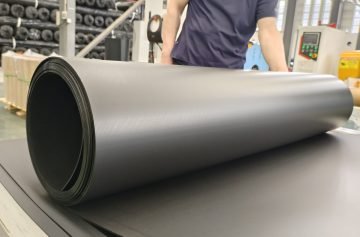
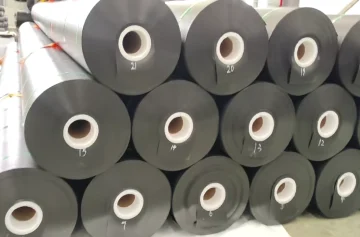
A geotextile roll costs its width multiplied by its length and the quoted price per square metre, plus any charges not already included. For a 6 m × 50 m roll, that means 300 × your quoted rate per m² before separately charged packing, cutting, freight or taxes.
There is no verified current currency-price range in this guide. A useful price needs a specified fabric, roll size, quantity and delivery destination; an unsupported “typical roll price” would hide those differences. The examples below show how to turn a supplier’s rate into a roll budget and check how much usable coverage it buys.
What is included in the roll price?
| Price basis | What to check | Best use |
|---|---|---|
| Fabric price per m² | The specified fabric and whether packing or delivery is included | Comparing rates for equivalent material |
| Price per roll | Gross roll area × fabric rate, with any minimum-order, cutting or packing charges identified | Calculating the purchasing total and roll count |
| Delivered order total | All purchased rolls plus freight, unloading, duties and taxes where applicable | Budgeting material at the agreed delivery point |
| Installed cost per net m² | Material, delivery and specified installation, preparation, testing and cover work, divided by the area actually covered | Comparing complete project scopes |
Count each charge once. If the fabric rate is already delivered, do not add the same freight again. Likewise, a material-only quote does not include sewing, installation or testing unless those items are expressly included.
A geotextile and a geomembrane serve different functions: the textile is permeable, while a geomembrane provides a low-permeability barrier. Their prices are not interchangeable.
What changes the price of a geotextile roll?
The main quotation variables are polymer, fabric construction, mass per unit area, required performance, roll dimensions and order quantity. Freight and delivery terms then determine what it costs to get the order to your site.
Specify PET or PP rather than asking for “geotextile” alone. Do not infer chemical compatibility, creep performance or outdoor service life from the polymer name. Where exposure matters, request the relevant product evidence and test conditions. ASTM D4355/D4355M addresses deterioration under laboratory exposure to light, moisture and heat; its method designation is not a service-life guarantee. [1]
Also distinguish woven and nonwoven construction, and continuous-filament and short-fibre products. Equal GSM does not establish equivalent mechanical or hydraulic performance.
A heavier fabric contains more fibre per square metre, but a fourfold increase in fabric mass does not establish a fourfold price increase. Manufacturing, order size, packaging and freight also affect the offer. Ask whether a small order attracts a minimum charge or a cut-roll fee.
How much fabric is in one roll?
Roll area = width × length. Nominal fabric mass in kilograms = roll area × GSM ÷ 1,000. GSM means grams per square metre; ASTM D5261 is the test method for measuring geotextile mass per unit area. [2]
Jinseed’s PET continuous-filament nonwoven geotextile page, checked on November 11, 2026, lists 100–830 g/m² fabric and dimensions up to 6 m wide and 340 m long. These are published product limits, not confirmation that every grade and size combination is available. The following dimensions are arithmetic examples, not a stock list.
| Illustrative dimensions | Gross area | At 150 g/m² | At 300 g/m² | At 600 g/m² |
|---|---|---|---|---|
| 6 m × 50 m | 300 m² | 45 kg | 90 kg | 180 kg |
| 6 m × 100 m | 600 m² | 90 kg | 180 kg | 360 kg |
| 6 m × 340 m | 2,040 m² | 306 kg | 612 kg | 1,224 kg |
These are calculated nominal fabric masses, excluding the core, wrapping and added moisture; they are not measured shipping weights. A 300 m² roll at 600 GSM contains 180 kg of fabric before packaging. Use the supplier’s actual gross weight and package dimensions to plan unloading, storage and handling, rather than choosing equipment from GSM alone.
Check units when comparing imported offers. NIST’s conversion factors give approximately 33.9 g/m² for 1 oz/yd², making an 8 oz/yd² fabric about 271 g/m², not 300 g/m². A quotation saying only “8 oz” needs its area unit confirmed. [3]
Which grade should you price?
Start with the required function, then the design’s acceptance criteria. Separation, filtration, drainage and protection are distinct geosynthetic functions; one property or weight cannot define suitability for all of them. [4]
- Separation: for aggregate over subgrade in civil engineering, price the specified survivability and separation requirements, not just the lightest available roll.
- Filtration: for retaining walls, drains or hydraulic works, request the opening-size and hydraulic criteria selected for the soil and flow conditions.
- Protection: around an HDPE liner, price the protection geotextile required for the actual loading and adjacent materials. An index puncture value alone does not establish system protection.
A driveway separator and a geomembrane cushion may have different specifications. A product can serve more than one function, but only if it meets each applicable requirement. Do not approve a same-GSM substitution without checking those requirements.
For a landfill liner system or a mining containment application, use the approved system specification and permit conditions. An aquaculture application may have a different acceptance scope; application names alone neither prove nor rule out material equivalence.
Before comparing technical values, confirm the test method and edition, machine and cross-machine directions where applicable, conditioning, thickness pressure, hydraulic head and reporting basis. Opening-size values from different methods are not automatically interchangeable. A nonwoven geotextile data sheet should identify the basis for each value; a published typical value is not a batch acceptance result.
How many rolls will the job need?
Gross purchased area and net covered area are different quantities. Allowances depend on panel layout, specified overlaps or seams, anchorage, cuts and whether offcuts can actually be reused.
Consider a flat 20 m × 10 m rectangle with no trenches or penetrations. Two 6 m × 20 m strips use 240 m² of fabric. Assuming a 0.3 m overlap along their 20 m edges, the combined width is 6 + 6 − 0.3 = 11.7 m. The overlap uses 6 m², and 34 m² lies outside the 200 m² rectangle before trimming.
If a supplier sells those exact cuts at a uniform rate of P per m², the fabric subtotal is 240P. If the minimum purchase is a complete 6 m × 50 m roll, the subtotal is 300P, leaving 60 m² uncut after the two strips. Both calculations exclude separate charges and assume the same grade and unit rate.
That makes the fabric-only cost per net covered m² 1.2P for the cut purchase, or 1.5P for the full-roll purchase if its remainder is charged entirely to this job. Reusable stock may be accounted for differently. This is a quantity and budgeting example, not a quoted price or an installation design.
The 0.3 m overlap is an assumption for arithmetic, not a recommended overlap. Confirm the approved takeoff and panel layout before ordering. For specified sewn or bonded seams, ASTM D4884/D4884M measures seam strength; it does not prescribe a universal seam detail or overlap width. [5]
Wider panels may reduce joint count but can change access and handling needs. Qualified personnel must carry out design, installation and acceptance according to the approved design and applicable local codes. The FHWA’s 1998 geosynthetic design and construction manual provides general background, not a substitute for current project requirements. [6]
Which extra costs belong in the budget?
| Budget item | Quotation detail to establish |
|---|---|
| Cutting and minimum purchase | Full-roll or cut-length supply, minimum order and cutting charges |
| Freight and unloading | Delivery point, gross package weights, vehicle access, unloading responsibility, duties and taxes |
| Layout and joints | Purchased quantity, overlaps, seam type, thread, labour, testing and edge details |
| Preparation and cover work | Subgrade acceptance, cover-placement restrictions, equipment access and the responsible contractor |
| Penetrations and repairs | Detail quantities, extra fabric, repair procedures and agreed rates |
| Acceptance and records | Sampling frequency, test methods, reporting basis, retest responsibility and traceability |
| Commercial terms | Currency, validity period, payment terms, exclusions and spare-roll allowance |
Keep material-only offers separate from installed-work offers. For environmental engineering and other controlled works, obtain acceptance requirements from the designer and approving authority before asking bidders to price testing.
How can you check two quotes and the delivered rolls?
Put both quotations on one basis: identical specification, confirmed dimensions, purchase quantity, delivery point and included services. A lower material rate is not necessarily a lower delivered or installed total.
For example, if two offers cover the same number of identical rolls, compare each order’s fabric subtotal plus its excluded charges. An offer with freight included and one with freight excluded cannot be ranked by the fabric subtotal alone. This is a comparison scenario, not a claim about a completed purchase.
At receipt, use a roll-label and packaging check to connect the delivery to the order:
- Match the product code, polymer, construction, grade and stated dimensions against the purchase order.
- Record roll or batch identifiers and match them to the supplied certificates or test reports.
- Record visible packaging damage and discrepancies under the agreed receiving procedure.
- Compare any declared shipping weight with its stated basis. Gross weight includes packaging; it does not independently verify fabric GSM or strength.
- Refer substitutions or nonconformities to the responsible quality representative before installation.
These checks support traceability. They do not replace contractual sampling, laboratory testing or engineering acceptance.
What should an inquiry for a roll price include?
- Required function, project specification and relevant soil, aggregate or flow conditions
- Polymer, construction, GSM and required mechanical and hydraulic properties
- Test methods, reporting basis and acceptance criteria, including minimum average roll values where specified
- Drawing dimensions, panel layout, overlaps, trenches, slopes and penetrations
- Requested roll width, length, quantity and whether cut rolls are acceptable
- Responsibility for installation, seams, testing, unloading and records
- Delivery destination, currency, required delivery date and quotation validity
Jinseed’s product pages checked on November 11, 2026 list PET continuous-filament nonwoven geotextile, HDPE and LLDPE geomembranes, and single- and double-textured HDPE geomembranes. Woven PP and other comparison fabrics discussed here are not presented as Jinseed products.
The number to compare is the total for the specified rolls at the agreed delivery scope. For a project budget, also divide the relevant total by net usable coverage—not simply by the area printed on the roll label.
Price your geotextile roll on the right grade
Send Jinseed your specification, roll size, quantity and delivery destination for a quotation with clearly defined inclusions and exclusions.
References
- ASTM D4355/D4355M-21: Deterioration of Geotextiles by Exposure to Light, Moisture, and Heat in a Xenon Arc-Type Apparatus.
- ASTM D5261-10(2024): Measuring Mass per Unit Area of Geotextiles.
- NIST Guide to the SI, Appendix B.8: Conversion Factors.
- International Geosynthetics Society: Geosynthetic Functions.
- ASTM D4884/D4884M-22: Strength of Sewn or Bonded Seams of Geotextiles.
- Federal Highway Administration: Geosynthetic Design and Construction Guidelines, 1998 reference manual, National Transportation Library record.