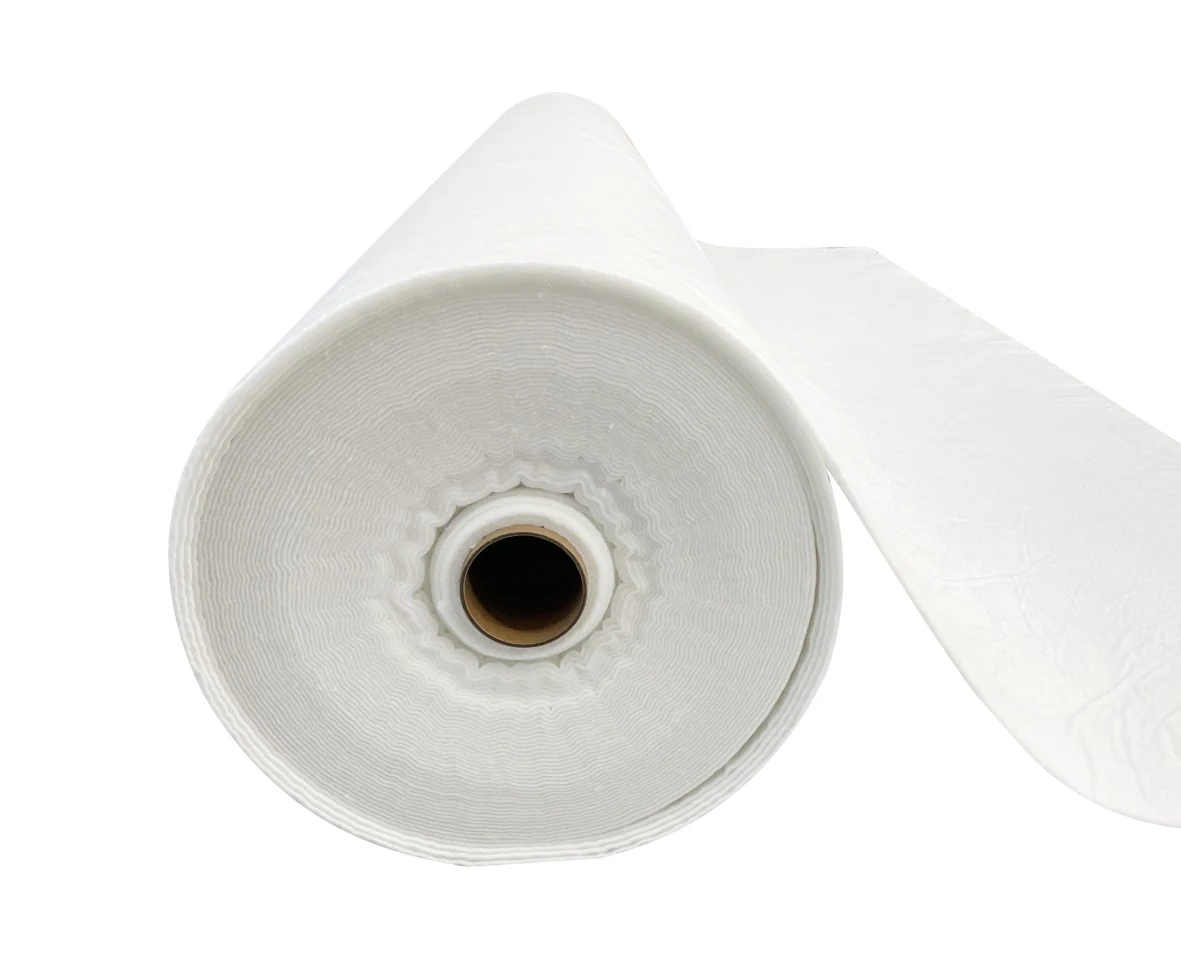

For drainage, select a geotextile by soil retention, water passage, clogging resistance and installation survivability—not by “woven” or “nonwoven” alone. Needle-punched nonwoven fabrics are common filters, but suitable woven monofilament fabrics can also perform filtration. A slit-film road separator should not be substituted for a specified drainage filter without checking its properties and obtaining approval.
This comparison concerns filters around aggregate drains, underdrains and drainage layers. For traffic-bearing aggregate surfaces, see the separate gravel-road selection guide. A drainage filter keeps the soil and drainage aggregate compatible; it does not replace a pipe, drainage core or usable outlet.
Compare fabric construction without assuming performance
Nonwoven geotextiles can use staple or continuous fibers and different bonding processes. Woven products can use monofilament, multifilament or tape constructions. PET and PP identify polymers, while woven and nonwoven identify fabric construction. Neither classification supplies a complete hydraulic or durability specification. The Iowa DOT geosynthetic design guide describes these material families and distinguishes their functions.
| Candidate | Potential drainage role | What must be checked |
|---|---|---|
| Needle-punched nonwoven | Filter between soil and aggregate or drainage core | Opening size, permittivity, clogging compatibility and resistance to placement damage |
| Woven monofilament | Filter where the selected construction meets the soil and hydraulic criteria | Opening characteristics, water passage and project-specific filtration evidence |
| Woven slit-film separator | Separation where accepted by the specification | Do not infer suitability for an underdrain from road-strength ratings |
| Drainage geocomposite | In-plane flow in a core with suitable filter faces | Loaded flow capacity, filter compatibility, outlets, joints and long-term reductions |
Match the filter opening to the actual soil
Obtain the soil grading, fines content, plasticity and information about unstable or dispersive soils. Check the specified retention and permeability criteria together. Making every opening smaller may increase clogging; making it larger may allow unacceptable soil loss. A single GSM or a universal 0.075–0.2 mm opening range cannot settle this balance.
ASTM D4751 addresses apparent opening size, using specified test procedures. The reported AOS is not a promise to capture 95% of every site’s soil. Record the method and units, and do not treat a sieve number as a particle diameter. For demanding or uncertain soils, request a soil–geotextile filtration assessment using representative materials and hydraulic conditions.
Drainage design should consider physical clogging, chemical precipitation and biological growth. Polymer resistance to degradation does not mean the filter cannot clog. A claim that PP prevents biofilm, or that a fabric guarantees a 50-year unclogged drain, needs evidence beyond the polymer name.
Keep hydraulic conductivity, permittivity and transmissivity separate
| Quantity | Typical units | Meaning |
|---|---|---|
| Hydraulic conductivity, k | m/s or cm/s | Flow response incorporating thickness and hydraulic gradient |
| Permittivity, ψ | s⁻¹ | Through-thickness flow per unit area per unit head difference |
| Transmissivity, θ | m²/s | In-plane flow per unit width per unit hydraulic gradient |
ASTM D4491/D4491M measures permittivity in an isolated test condition and cautions against equating that result with field performance. A value in cm/s is not permittivity. ASTM D4716/D4716M addresses in-plane flow; comparisons need matching normal stress, gradient, contact surfaces and conditioning.
A transparent flow calculation
For a simplified through-flow calculation, Q/A = ψ × Δh. If ψ = 1.0 s⁻¹ and the head difference Δh = 0.05 m, Q/A = 0.05 m/s = 3,000 L/min/m². These are assumed test conditions, not a product rating or a prediction of trench discharge. Soil resistance, contact, loading, clogging, pipe capacity and the outlet can control the installed system.
For unit comparison, 140 US gpm/ft² ≈ 5,704 L/min/m², while 50 US gpm/ft² ≈ 2,037 L/min/m². State US gallons and the test head. Comparing either number directly with rainfall over an unspecified catchment ignores the collection area and the rest of the drainage path.
Choose survivability and durability after hydraulic suitability
Specify strength, tear and static puncture requirements for the aggregate, placement method and cover conditions. A laboratory puncture force is not an allowable field pressure or permission to dump sharp rock onto exposed fabric. Greater mass can change mechanical and hydraulic properties, but “heavier is always the better filter” is not a valid rule.
4, 6, 8 and 10 oz/yd² correspond approximately to 136, 203, 271 and 339 g/m². These are mass conversions only, not recommended drainage grades. Compare reports for the actual grade. For PET or PP, assess the chemistry, temperature, oxidation or hydrolysis exposure relevant to the site; a broad pH range alone does not establish design life.
Check the installed drainage path
- Confirm soil preparation and remove damaging projections without leaving unsupported voids.
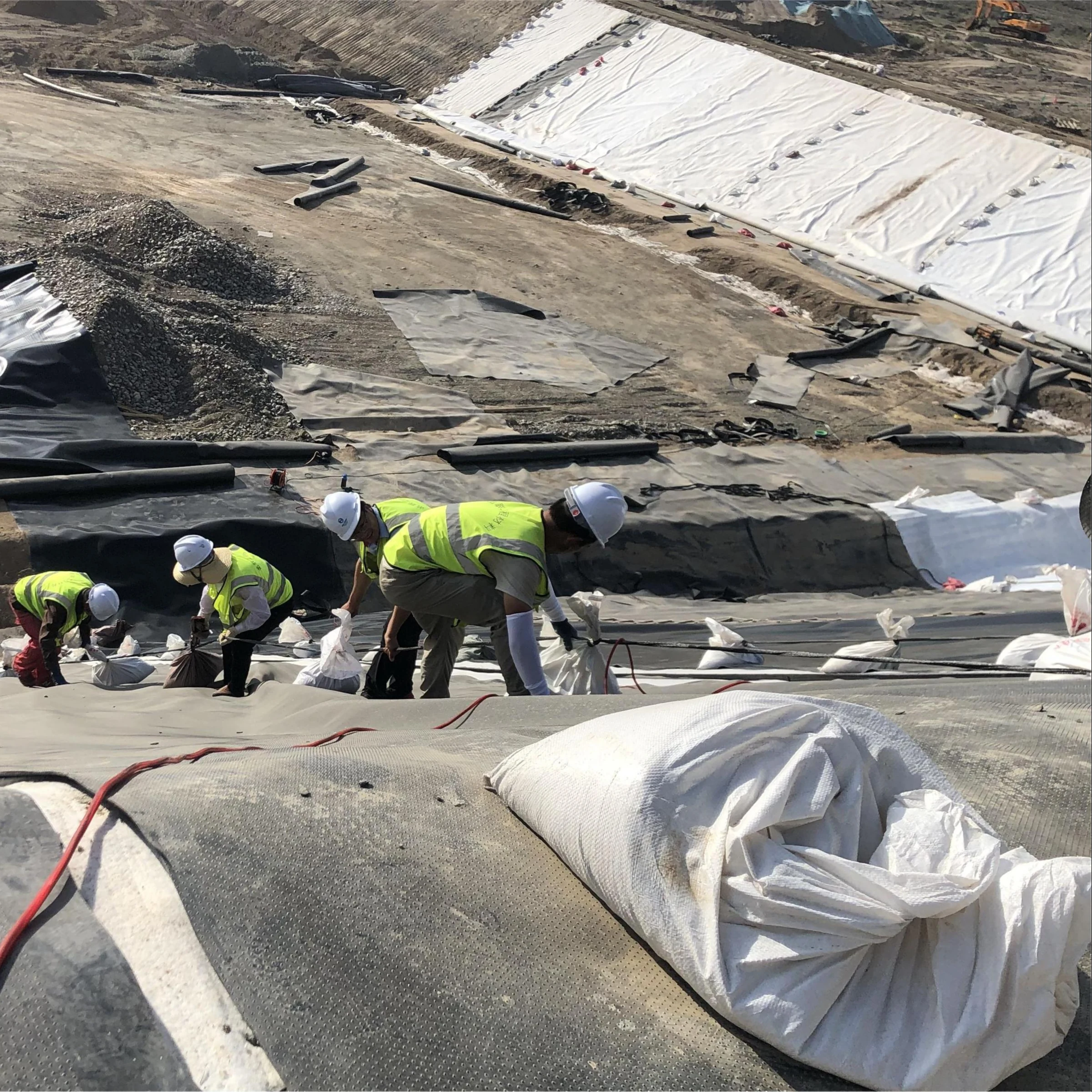
- Place the approved filter continuously at the soil/drainage-material interface, following the specified laps and details.
- Use the specified clean drainage aggregate and protect the fabric during placement.
- Keep construction traffic off exposed fabric and inspect damage before covering.
- Connect the drainage layer or pipe to an approved, maintainable outlet; check elevations and discharge restrictions.
- Record the fabric grade, roll identification, repairs and inspection results.
In retaining walls, distinguish the filter from the waterproofing and structural systems. In roof drainage, verify the drainage core and outlet capacity separately. In infiltration systems, confirm that the soil can accept the design flow and that the chosen filter detail will not unnecessarily restrict infiltration.
What to send with a drainage-fabric enquiry
Provide the soil report, application section, hydraulic conditions, aggregate, loading, required test methods and acceptance values. Identify the governing specification edition and approval authority. Review Jinseed’s nonwoven geotextile range against those requirements, then request the matching grade and supporting reports. Unverified properties should remain open items in the submittal, not be assumed from a nominal fabric weight.