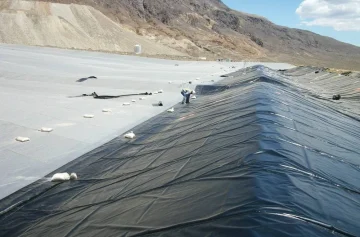
Geotextile fabric supports a landfill liner system by protecting the geomembrane, separating materials and, where specified, filtering liquid into drainage layers. It is permeable: it does not replace the geomembrane or treat dissolved contaminants. Choosing the right fabric requires the actual aggregate, loading, soil and leachate conditions—not a universal fabric weight or a promised service life.
This guide focuses on the geotextile components of a landfill lining system. For the barrier itself, see our guide to landfill geomembrane benefits and quality checks.

Where geotextile belongs in a landfill liner system
A protection geotextile directly above a geomembrane and a filter above a drainage layer perform different jobs. A single fabric should not be assumed to satisfy both positions. Identify its location on the approved section drawing before requesting a quotation.
| Location or function | Purpose | Key selection question |
|---|---|---|
| Protection above the geomembrane | Cushion contact with aggregate and reduce local damage | Does the complete assembly protect the liner under installation and long-term loads? |
| Filter at a soil/drainage interface | Limit soil migration while allowing liquid passage | Is the fabric compatible with the soil, flow and clogging environment? |
| Separator between unlike granular materials | Limit intermixing | Can it survive placement and maintain separation? |
| Geocomposite drainage component | Filter or protect a drainage core | Does the assembled product retain adequate flow under confinement? |
Do not add fabric to an interface without checking the design. Under the composite-liner option in 40 CFR §258.40(b), the flexible membrane must contact the compacted soil component directly and uniformly. An extra geotextile between those components would change that specified arrangement.
Protecting the primary geomembrane
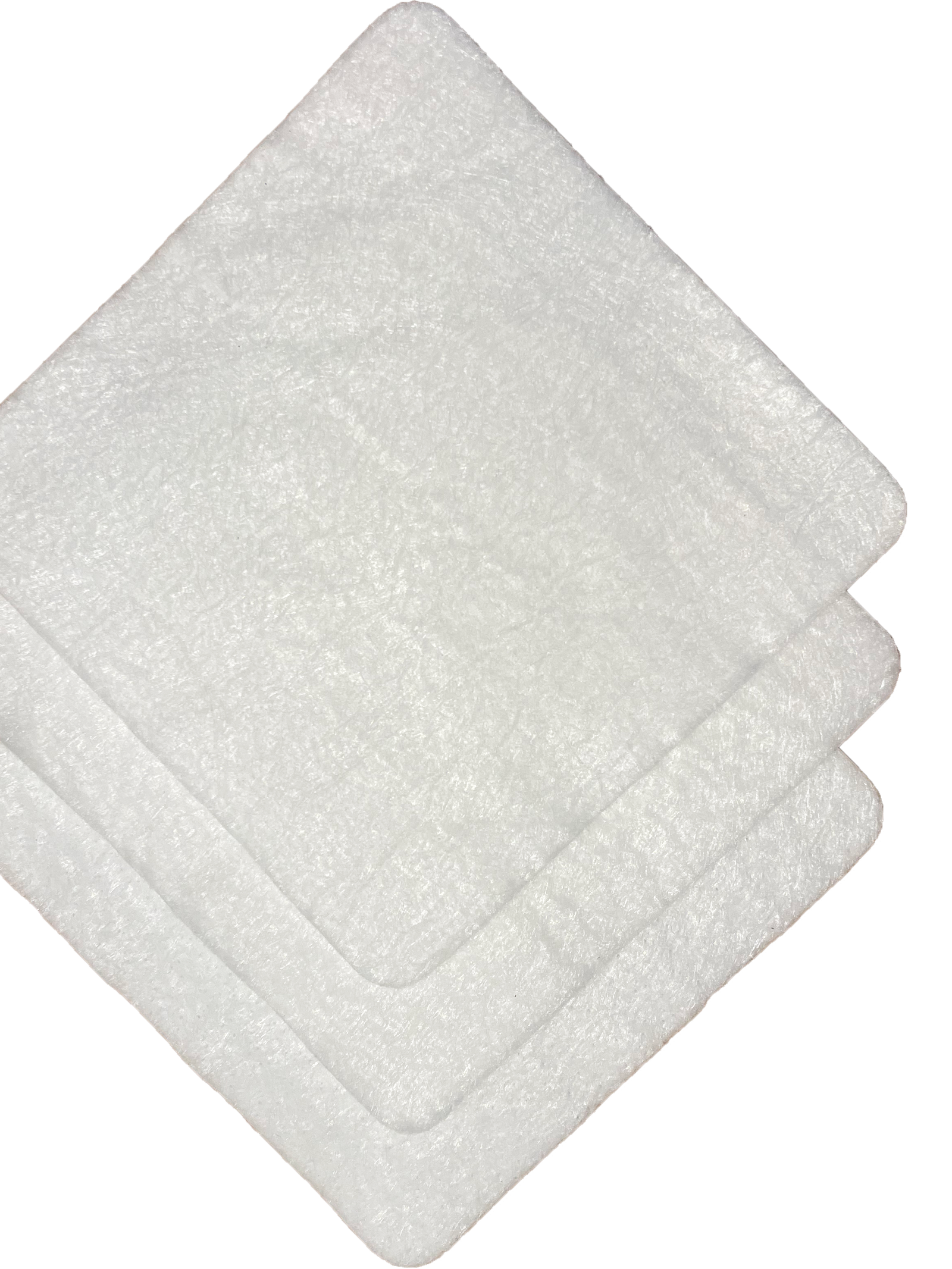
Needle-punched nonwoven geotextiles are used as cushioning layers because their fibrous structure can redistribute contact stresses. Their effectiveness depends on more than mass per unit area. Angular stone, a thin cover lift, construction traffic and sustained waste loading can create very different demands on the same fabric.
The GRI-GT12(a) specification addresses manufacturing quality control for nonwoven geomembrane protection materials. It is a useful procurement reference, but meeting its material requirements does not establish that a particular liner/stone/fabric combination is safe for a particular landfill.
- Specify the geomembrane polymer, thickness, surface texture and underlying support.
- Document aggregate grading, maximum size, angularity and placement method.
- Estimate both construction loading and final sustained loading.
- Check geotextile thickness and behavior under pressure, not just its unconfined appearance.
- Evaluate the actual combination through the project’s protection assessment and acceptance criteria.
GRI-GS11 describes field test pads for assessing geomembrane protection. A representative trial can help reveal damage from the proposed materials and placement process. Record the trial arrangement, equipment, cover thickness and inspection findings so its relevance to construction is clear.
A laboratory puncture index is not a direct allowable stone load. Likewise, a heavier fabric is not automatically a substitute for a properly prepared subgrade or controlled aggregate placement. Do not convert a catalog puncture value into a guaranteed waste height or liner lifespan.
Illustrative load calculation
For an initial screening calculation, assume a uniform 30 m waste depth and an average bulk unit weight of 10 kN/m³. The vertical overburden stress is approximately 30 × 10 = 300 kPa. This is an assumed example, not a landfill design value. It excludes construction equipment effects, concentrated stone contacts, geometry and other load cases. Its purpose is to show why an assembly test at light pressure may not represent the completed landfill.
Filtration and leachate drainage
A geotextile filter helps retain the soil structure while passing liquid. It is not a membrane that admits only water molecules, and it cannot be credited with removing dissolved metals or organic compounds. Do not use a generic suspended-solids removal percentage to size a leachate treatment plant.
Ask for soil particle-size distribution, fines content and relevant soil behavior before choosing an opening size. Very small openings can increase clogging risk; very large openings can permit excessive particle migration. The appropriate balance also depends on hydraulic conditions and the stability of the soil-filter interface.
- ASTM D4751 addresses apparent opening size (AOS). AOS is an index for comparison, not a complete field filtration guarantee.
- ASTM D4491/D4491M addresses water permeability through the fabric by permittivity under the specified test conditions.
- ASTM D5101 evaluates soil-geotextile filtration compatibility. Use representative soil and the procedure required by the project.
D5101 is a site-specific design investigation, not routine shipment acceptance testing. Its stated scope uses the method for soils with plasticity index below 5 and recommends D5567 for soils with plasticity index of 5 or more; the project team should select the applicable procedure. These linked editions identify the test families; the contract should specify its adopted edition. A clean-water index test alone does not reproduce biological growth, chemical precipitation or long-term leachate exposure. Critical drainage designs need a project-specific allowance for these mechanisms and a maintainable collection system.
Also distinguish cross-plane permittivity, in s⁻¹, from in-plane transmissivity, in m²/s. A high cross-plane flow result does not prove that fabric alone can convey liquid laterally to a pipe. Drainage aggregate or a designed drainage geocomposite, slope, outlet capacity and maintenance access all matter.
Separation, slopes and installation
Separation helps prevent adjacent materials from mixing during construction and service. It does not authorize removal of a specified drainage or protection layer. Where a thinner alternative is proposed, compare the complete sections for hydraulic capacity, protection, stability and regulatory acceptance.
On slopes, the weakest interface can govern performance. Test the proposed material contacts at relevant stress and moisture conditions, and use the design’s required peak or large-displacement parameters. Do not assign a universal friction angle to “textured HDPE plus nonwoven fabric.”
- Accept the supporting surface. Remove debris and address soft areas or protrusions in accordance with the liner installation plan.
- Confirm roll identity. Match roll labels and certificates to the approved material and retain traceability.
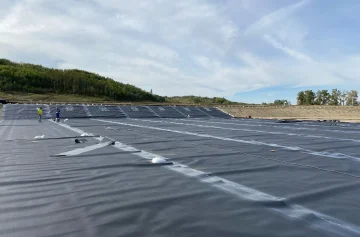
- Lay the fabric without damaging the liner. Avoid dragging contaminated rolls, excessive tension and unapproved attachment methods.
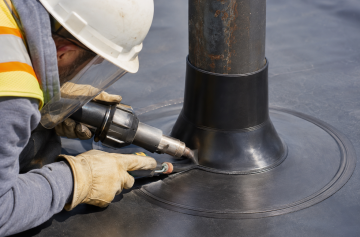
- Follow the specified joints. Overlap width, sewing or other joining methods depend on function, slope and construction demands. Geomembrane welding settings are not general geotextile joining instructions.
- Place cover under controlled conditions. Follow the approved lift thickness, equipment restrictions and placement sequence; inspect displaced, torn or contaminated areas before burial.
- Record acceptance. Map repairs and retain photographs, delivery records and inspection sign-offs.
Quantity and cost: compare the complete section
Mass can help estimate logistics once the performance requirements are established. For example, 10,000 m² × 600 g/m² = 6,000 kg of nominal fabric mass, excluding overlaps, cut waste, cores and packaging. This does not mean 600 g/m² is adequate for that project.
Where an approved redesign reduces a layer by 6 inches over one acre, the geometric volume difference is 43,560 ft² × 0.5 ft ÷ 27 = approximately 807 yd³. That is a volume calculation, not evidence that geotextile can replace that layer. Include testing, installation, seams, repairs, drainage performance and disposal or transport costs when comparing alternatives.
What to send when requesting a landfill geotextile quotation
Send the section drawing, fabric function, project location, liner specification, aggregate grading, design loads, exposed duration, chemical conditions, required test methods and acceptance values. Include quantities and roll-width constraints. State whether values are typical results, minimum acceptance values or minimum average roll values (MARV); these are not interchangeable.
Explore Jinseed’s nonwoven geotextile range and send the project requirements to info@jinseed-geo.com. Request the relevant product data and available test documentation for the proposed grade before approving a substitution.
Frequently asked questions
What fabric weight is suitable for a landfill?
No single weight covers all landfills. Start with the function, contact materials and loading, then confirm material and assembly performance. Two fabrics with the same nominal weight can perform differently.
Can geotextile replace HDPE geomembrane?
No. Geotextile normally passes liquid; the geomembrane provides the barrier function. Their roles are complementary where both are included in the approved design.
Does thicker fabric guarantee a 50-year liner life?
No. Protection, chemical exposure, temperature, installation quality and the entire liner design affect durability. A fabric weight or index test cannot establish a fixed service life.