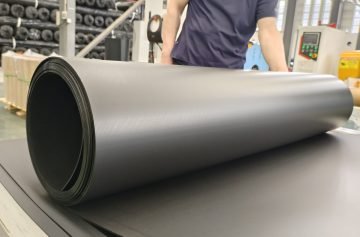
A heap leach liner costs the purchased membrane quantity multiplied by its quoted unit price, plus the protection, installation, testing, freight, and site works included in the contract. For smooth 1.5 mm sheet at an assumed density of 0.940 g/cm³, the sheet-only cost per purchased square meter is 1.41 × the quoted price per kilogram. This guide explains the calculation, not a current market price range; an installed pad budget needs a project-specific quotation.
Have qualified personnel select the lining design, material suitability, installation procedures, and acceptance requirements under local rules and the project specification.
What the liner cost includes
| Price basis | Items to identify in writing | Area basis to confirm |
|---|---|---|
| Sheet only | Polymer, thickness, surface, roll dimensions, specification edition, conformance documents, and quantity | Purchased sheet area, including the stated allowances |
| Delivered material | Sheet plus agreed freight, unloading, duties, and taxes, with exclusions listed | Ordered quantity and delivery terms |
| Installed geosynthetics | Placement, welding, anchorage, penetrations, protection layers, testing, and mobilization; identify inclusions and exclusions | Net installed area or another explicitly agreed measurement rule |
| Complete pad lining works | Geosynthetics plus specified subgrade, drainage overliner, solution ponds, leak detection, assurance work, and earthworks | Individual pay items, not one blended rate |
Check whether the installed rate includes independent construction quality assurance, electrical leak location, dewatering, drainage aggregate, and pond works. Request separate prices for excluded work rather than treating a low membrane rate as the complete pad cost.
Jinseed’s material supply includes HDPE geomembrane, LLDPE geomembrane, single- and double-sided textured HDPE geomembrane, and PET continuous-filament nonwoven geotextile. Soils, aggregates, drainage nets, pipes, and pumps are separate system-scope items, not products claimed as Jinseed’s own supply here.
How much area you pay for
Keep three areas separate: the horizontal pad footprint, the net surface to be lined, and the sheet area purchased. Measure floors, slopes, bunds, ramps, and sumps from the drawings. Add anchor-trench take-up, overlaps, and cutting allowances once, using the panel layout. One hectare is 10,000 m², but a one-hectare footprint does not necessarily require only 10,000 m² of membrane.
For a planar slope with a horizontal-to-vertical ratio H:V, multiply its horizontal projected area by √(H² + V²) / H. A 3:1 slope, for example, has a factor of approximately 1.054: 1,000 m² of horizontal projection becomes about 1,054 m² of sloping surface. Do not apply that factor to the flat floor. Complex geometry needs a drawing-based takeoff, not a blanket slope or waste percentage.
Cost per footprint hectare is the total of the included pay items divided by footprint hectares. On a multi-hectare pad, fixed and mobilization charges go in once, before dividing by hectares. The figure needs currency, date, validity, delivery, and tax beside it.
Thickness and specification
Price the approved thickness and polymer before considering alternatives. Nevada’s environmental regulator describes HDPE and LLDPE heap leach liners commonly at 60–80 mil, double-lined pregnant and barren solution ponds with leak detection, and Nevada approval of a licensed engineer’s construction record before operation. These are jurisdiction-specific descriptions and requirements, not a universal design specification. Confirm the applicable permit, including pad and pond leak-detection obligations, before budgeting. [1]
The exact conversions are 60 mil = 1.524 mm and 80 mil = 2.032 mm. A nominal 1.5 mm product does not automatically satisfy a 60-mil minimum. Have the designer confirm the specified units, thickness tolerances, test method, and standard edition. Price the pad and its process ponds separately within the mining containment package; do not assume that each zone uses the same layer schedule.
To cost HDPE geomembrane on equal terms, note that GRI-GM13 covers smooth and textured sheet at a formulated density of at least 0.940 g/cm³. Carbon black runs 2.0 to 3.0 percent by ASTM D4218, with accepted correlated alternatives, and ASTM D5596 handles dispersion. Content and dispersion sound alike, but they are two different checks. [2]
Use the correct surface-specific table. In GRI-GM13 Revision 16, Table 1(b) for smooth HDPE, the 1.5 mm minimum average values are 22 kN/m tensile yield, 40 kN/m tensile break, 187 N tear, and 480 N puncture. At 2.0 mm they are 29 kN/m, 53 kN/m, 249 N, and 640 N respectively. The methods are ASTM D6693 Type IV, D1004, and D4833; tensile averages use five specimens in each of the machine and cross-machine directions. The textured-sheet table differs: its 1.5 mm and 2.0 mm puncture values are 400 N and 534 N. Do not transfer smooth-sheet values to a textured quotation. [2]
GM13 also addresses stress-crack resistance, oxidative induction time (OIT), oven aging, and UV resistance. Ask for the applicable methods, conditioning, acceptance limits, and conformance reports against the contracted edition. A laboratory result is not a prediction of field life or proof of compatibility with a particular leach solution. [2]
Thickness, weight, and square-meter cost
The sheet-cost math is straightforward. For smooth sheet, kg/m² is density in g/cm³ times thickness in mm. The table below uses 0.940 g/cm³ as a stated planning assumption. That density comes from GM13, not from a measured Jinseed batch. [2]
| Nominal thickness | Calculated mass | Mass per 10,000 m² |
|---|---|---|
| 1.0 mm | 0.94 kg/m² | 9,400 kg |
| 1.5 mm | 1.41 kg/m² | 14,100 kg |
| 2.0 mm | 1.88 kg/m² | 18,800 kg |
| 2.5 mm | 2.35 kg/m² | 23,500 kg |
These are calculated masses, not thickness recommendations or measured batch weights. The sheet-only rate per purchased square meter is the quoted price per kilogram multiplied by the applicable mass per square meter. Use the supplier’s agreed mass or billing basis for the actual order.
A worked purchasing scenario
Consider a hypothetical 10,000 m² net lined surface, already measured along the slopes. Assume smooth 1.5 mm HDPE at 0.940 g/cm³ and, solely to demonstrate the calculation, an additional 10% sheet allowance for overlaps and cutting. Anchor-trench material is measured separately and excluded from this example. The 10% is not a recommended design allowance.
- Purchased sheet area: 10,000 × 1.10 = 11,000 m².
- Calculated sheet mass: 11,000 × 1.41 = 15,510 kg.
- If the supplier’s sheet price is P currency units per kilogram, sheet cost is 15,510 × P.
- Spread over the 10,000 m² net lined surface, that is 1.551 × P per net square meter, not 1.41 × P.
The difference is the purchasing allowance, not a change in the supplier’s unit price. Add separately measured anchorage, freight, protection, welding, testing, and site work without charging an included item twice. This is a reproducible budgeting example, not a completed project, a supplier quotation, or a field-performance claim.
Freight needs real roll data: roll dimensions, packaged weights, and container limits. Weight alone will not tell you the roll count or whether the container fills up. Diameter, packaging, payload limits, and site access all play a part. Textured-sheet mass belongs to the quoted product data, not to this smooth-sheet estimate. Doubling thickness doubles the calculated sheet mass at fixed density, though the installed cost does not follow the same straight line.
Pad details that move the cost
The EPA’s historical heap-leaching report describes synthetic liners over compacted soil, with graded ore or gravel above for drainage and protection, and different liner arrangements according to site conditions. These layers explain why a membrane-only quotation is not a complete pad budget; the report is design background, not evidence of current prices or current permit requirements. [3]
Barrier, protection, filtration, and drainage are distinct geosynthetic functions in the IGS educational guidance. Price the functions specified in the layer schedule rather than treating one material as a substitute for the whole system. [4] Specify smooth or textured geomembrane by zone, and select the protection geotextile for the actual loads and adjacent materials. Texture alone does not establish slope stability; qualified personnel must assess the actual interfaces under project and local requirements.
List overliner drainage, leak detection and collection, pregnant and barren solution ponds, sumps, penetrations, and anchorage as defined pay items. Do not apply HDPE GM13 requirements to LLDPE or substitute polymers without the designer’s approval. Compatibility review needs the reagent, concentration or pH range, operating temperature, and supporting information for the proposed grade. Price seam testing against the project acceptance plan, including destructive and non-destructive testing, repairs, and retesting.
Earthworks, dewatering, weather protection, independent assurance, and leak-location work each need a clear home: included or expressly excluded, never buried in an undefined installation allowance. The comparison uses the datasheet for the ordered grade, MQC and conformance reports, seam test records, and roll-traceability and packing records.
How to compare two liner costs
Compare thickness, surface finish, polymer, standard edition, roll dimensions, quantity, currency, validity date, and delivery terms. Then recalculate both offers on the same scope and area basis. A sheet-only offer can legitimately exclude installation; it becomes misleading only if compared directly with an installed total without adding the missing work.
For each offer, calculate the total of all included and separately quoted pay items, then divide by the same net lined area. Keep a second figure per footprint hectare if that is how the project budget is reported. Record which contractor supplies the subgrade, drainage aggregate, pond works, and independent assurance, and who pays for repairs and retesting.
What to send to cost your pad
Send these eight items with the specification:
- Pad footprint, floor dimensions, slope ratios, bund and ramp geometry, and the net surface takeoff.
- Approved layer schedule, polymer, thickness, surface finish, and protection requirements.
- Process solution type and operating temperature range for compatibility review, without assuming a membrane grade is suitable.
- Panel-layout basis, purchasing allowances, anchor details, penetrations, sumps, and the measurement rule for each rate.
- Solution pond, channel, and leak detection scope included with or excluded from the membrane package.
- Delivery location, unloading arrangements, site access, and construction schedule.
- Required conformance reports, seam testing, independent assurance, and responsibility for repairs and acceptance.
- Separately priced site work, fixed and mobilization charges, taxes, currency, and quotation validity.
Use the approved takeoff and layer schedule to request dated prices for each pay item. The resulting total is a budget for that scope and location, not a universal heap leach liner rate. Qualified personnel must verify design, installation, and acceptance requirements under local rules.
Need a comparable heap leach liner quotation?
Send your pad takeoff with the specification. You get a quotation with the data sheet and a roll plan.
References
- Nevada Division of Environmental Protection, FAQ: Information on Heap Leach Pads. HDPE or LLDPE membranes at 60 to 80 mil, double-lined process ponds with leak collection and recovery system, and licensed-engineer as-built review before operation. Source. Accessed November 6, 2026; confirm current requirements and the applicable permit before design or procurement.
- Geosynthetic Institute, GRI-GM13 Standard Specification for HDPE Smooth and Textured Geomembranes. Formulated sheet density at least 0.940 g/cm³, carbon black 2.0 to 3.0 percent by ASTM D4218 with correlated alternatives, dispersion by ASTM D5596, tensile/tear/puncture/stress-crack/OIT and durability provisions including 1.5 mm and 2.0 mm minimum average values cited in this guide. Source. Accessed November 6, 2026.
- U.S. Environmental Protection Agency, Gold/Silver Heap Leaching and Management Practices That Minimize the Potential for Cyanide Releases, Final Report, pad construction discussion. Native clay, modified clay, asphalt, or synthetic pads; synthetic over compacted soil; graded ore or gravel drainage and protection blanket; single, double, and triple liner arrangements; reported pad sizes from under one acre to 50 acres including a reported 80-mil lined example. Source. Accessed November 6, 2026.
- International Geosynthetics Society, Geosynthetic Functions (educational leaflet). Geosynthetic functions defined by ISO 10318-1, including Barrier, Protection, Filtration, Drainage, Separation, and Reinforcement; few geosynthetics perform only one function. Source. Accessed November 6, 2026.